AI is reshaping how we build products, learn new skills, and lead teams. I’ve seen great organizations stall when training lags behind technology. That’s why we rebuilt our approach to product training from first principles—so every team can operate confidently with AI at the core of their product management practice.
Our north star is simple: operationalize AI Strategy for every product manager and cross-functional partner. We designed a learning system that shortens time-to-adoption, amplifies ROI, and links capability-building to clear, measurable outcomes.
Product School transforms product teams into AI-native organizations with training that accelerates adoption, maximizes ROI, and drives measurable growth.
That ambition informs how we design curriculum and delivery. We combine gen AI foundations, LLMs for product managers, applied product discovery, product roadmapping and sprint planning, and product management leadership. The learning experience blends case-based instruction with simulations and real product data so teams practice exactly how they’ll perform.
To ensure knowledge becomes behavior, we embed training directly into product workflows: in-app guides, product tours, onboarding sequences, and user activation loops tied to outcomes vs output OKRs. This closes the gap between knowing and doing, and it makes capability visible in the metrics that matter.
We focus on empowering product teams—clarifying decision rights, elevating accountability, and creating feedback loops that enable faster iteration. When teams own their roadmap and understand the AI building blocks, they move from experimentation to repeatable, scalable value creation.
Measurement is built in from day one. We instrument for adoption, time-to-first-value, feature activation, and ROI attribution, enabling continuous improvement and transparent stakeholder communication. The result is a system that compounds learning into performance.
This is how we’re building AI-native organizations: practical, data-informed, and outcomes-driven. It’s not just training—it’s an operating model that helps teams learn faster, ship smarter, and grow with confidence.
Corporate innovation isn’t a side project anymore—it’s the operating system for how we build, scale, and win. In my product leadership work, I’ve watched the pace of change accelerate across every function, from engineering and data to go-to-market and customer success. The companies pulling ahead are the ones translating trends into execution with clarity, speed, and measurable outcomes.
We researched corporate innovation to reveal top trends, types, and examples that can spark growth and keep your business ahead.
Here’s how I’m seeing that play out right now—and the nine trends I’m actively using to guide roadmaps, prioritize bets, and ship value faster.
Trend 1: Generative AI is moving from pilots to products. Teams are evolving beyond demos into durable capabilities powered by gen ai, LLMs for product managers, and agentic AI patterns that automate workflows end-to-end. The winners pair bold AI Strategy with AI risk management, privacy-by-design, and clear value propositions so customers trust what we ship and can see its impact on outcomes, not just outputs.
Trend 2: Product-led growth is becoming the default go-to-market motion. I’m doubling down on onboarding, in-app guides, product tours, and activation loops that reduce time-to-value. We back this with disciplined A/B testing, well-chosen minimum detectable effect (MDE), and retention analysis to prove what actually moves the needle. PLG isn’t a tactic—it’s a cultural shift toward continuous learning and self-serve experience design.
Trend 3: Unified analytics and experimentation are the new backbone. A unified analytics platform, instrumented with tools like Amplitude analytics, Pendo, and CRM integration via HubSpot or Intercom, gives us a single source of truth from acquisition through expansion. I push teams to connect user journeys to revenue and to operationalize insights into roadmapping and sprint planning—not monthly reports that sit on a shelf.
Trend 4: Outcome-driven operating models are replacing feature factories. We align on outcomes vs output OKRs, empower product teams, and structure product trios to balance customer insight, technical feasibility, and commercial impact. First principles decision making helps us cut through noise, set sharper points of parity, and focus on differentiation that customers will pay for.
Trend 5: Velocity and reliability matter more than ever in engineering. Continuous delivery via CI/CD, healthy deployment frequency, and DORA metrics are my leading indicators for a team’s ability to learn fast. I’ve seen forward deployed engineers and thoughtful developer evangelism tighten the feedback loop with customers and speed up iteration without compromising quality.
Trend 6: Data governance and security are strategic differentiators. Trust is a product feature. I prioritize data governance, cybersecurity, and threat detection and response alongside usability. Privacy-by-design isn’t a compliance checkbox; it’s table stakes for enterprise adoption and a durable moat when paired with transparent controls and auditability.
Trend 7: Pricing and packaging innovation is unlocking growth. We’re testing SaaS pricing models, including consumption SaaS pricing, to align value delivered with value captured. Clear articulation of the value proposition and thoughtful packaging reduce friction in sales and support product-led expansion. Pricing experiments belong in the product backlog—not just in finance spreadsheets.
Trend 8: Customer-in-the-loop discovery is the fastest path to relevance. I treat product discovery as a continuous practice, weaving QBR-style business reviews into roadmaps and using stakeholder management to align incentives across sales, success, and product. Customer support ai strategy helps surface high-signal insights from tickets and conversations, turning support into a discovery engine.
Trend 9: Open platforms and ecosystems amplify innovation. From API-first thinking and ChatGPT connector patterns to integrations that meet customers where they work, ecosystems drive stickiness and reduce time-to-value. The strongest roadmaps combine a focused core with extensibility that partners and customers can build on.
How to act now: I recommend a simple try do consider framework. Try one high-conviction AI use case with clear guardrails. Do instrumented experiments across onboarding and activation to fuel product-led growth. Consider pricing and packaging tests tied to measurable outcomes. With disciplined learning cycles and empowered teams, these trends stop being headlines—and start becoming compounding advantages.
Innovation favors teams that ship, learn, and adapt. If these trends are on your roadmap, align them to outcomes, measure obsessively, and keep customers in the loop. That’s how we turn momentum into durable growth.
Scaling product operations across markets and teams is equal parts craft and discipline. Over the years, I’ve distilled what works into a pragmatic operating system that balances speed with rigor, enables experimentation at scale, and keeps the entire organization aligned on customer value.
Learn how top product leaders at leading companies scale product operations, drive experimentation, and deliver customer value.
The backbone is a clear outcomes-first operating model. I anchor strategy in outcomes vs output OKRs, empower product trios to own problem discovery and solution delivery end to end, and insist on empowered product teams that can make decisions without waiting for permission. This structure raises the signal-to-noise ratio, reduces handoffs, and accelerates learning.
Operational excellence then turns intent into predictable flow. CI/CD pipelines, high deployment frequency, and DORA metrics give me a real-time view of delivery health while creating the safety to ship smaller, reversible changes. When teams can deploy confidently and measure impact continuously, execution quality and morale both improve.
Experimentation is a first-class citizen, not an afterthought. We normalize A/B testing by defining a minimum detectable effect (MDE) up front, instrumenting guardrails for customer experience, and pre-registering success criteria. This keeps experiments honest, speeds up decision-making, and makes it clear when to iterate, when to scale, and when to stop.
Data turns experiments into insight. I lean on a unified analytics platform, with tools like Amplitude analytics for product discovery, activation, and retention analysis. Standardized taxonomies and event quality reviews ensure we can trust the numbers, compare tests, and build cumulative knowledge rather than running one-off trials.
To translate insight into adoption, I invest in product-led growth mechanics. In-app guides, product tours, and thoughtful tooltip design help users discover value fast, while lifecycle nudges align with milestones in the journey. This reduces the burden on sales and success while compounding engagement and retention over time.
Governance should enable, not constrain. Lightweight data governance and privacy-by-design practices mean experiments respect user trust and regulatory requirements without slowing teams down. Clear review paths and pre-approved templates make it easier to do the right thing quickly.
Alignment is continuous, not quarterly theater. I connect strategy and execution with crisp product roadmapping and sprint planning, and I reconcile learning cycles with planning cycles so insights flow into the next iteration. QBRs evolve from status updates into decision forums where we reallocate capacity based on evidence, not opinion.
Here’s the playbook I rely on: clarify the few outcomes that matter; form durable product trios around customer problems; instrument ruthlessly so every change is measurable; operationalize experimentation with A/B testing, MDE, and guardrails; and maintain fast flow with CI/CD and DORA metrics. When this system hums, teams move faster, risk goes down, and customers feel the improvement in every interaction.
At scale, excellence looks deceptively simple: clear outcomes, empowered teams, fast and safe delivery, and relentless learning. Get those right and product operations become a force multiplier—one that compounds customer value with every release.
Stop chasing the wrong numbers! Learn which customer acquisition metrics actually point the way to growth and which to leave behind.
In my role leading product and growth, I’ve learned that sustainable acquisition comes from a disciplined focus on a few decisive signals. I run a tight scorecard that blends product-led growth inputs with sales-assisted outputs, stitched together in a unified analytics platform and grounded in our CRM integration. Tools like Amplitude analytics, HubSpot, Pendo, and Intercom help me see the entire journey—from first touch to user activation and revenue—without getting lost in dashboard noise.
ICP-qualified lead rate (MQL-to-SQL conversion) is my first gate. If qualified interest isn’t turning into sales conversations, I know our targeting, messaging, or handoff is off. This metric forces alignment between marketing and sales on the actual Ideal Customer Profile and disqualifies the “traffic for traffic’s sake” mindset.
Lead Velocity Rate (LVR) tells me whether next quarter’s growth is compounding. I track the month-over-month growth of qualified leads and opportunities, not raw leads. When LVR dips, I revisit go-to-market strategy and pipeline sources before the lagging revenue number shows trouble.
Activation rate is the heartbeat of product-led growth. I define a clear “first value” action and measure what percentage of new signups reach it within a set time window. Strong activation signals that our onboarding and value proposition are resonating; weak activation pushes me to refine in-app guides, product tours, and tooltip design.
Time-to-Value (TTV) measures how quickly new users experience the core benefit. Shorter TTV correlates with higher conversion, better retention, and lower support costs. I routinely A/B test onboarding steps, copy, and default settings to shave minutes off TTV without sacrificing comprehension.
Customer Acquisition Cost (CAC) by channel keeps us honest. I break out CAC for paid, organic, partner, and sales-led motions, then double-click into cohort performance. Channel-level CAC, tied back to revenue quality, helps me reallocate budget and resist the allure of cheap but low-intent clicks.
CAC payback period is my sanity check on efficiency. I want to know how many months of gross margin it takes to recover CAC—across each motion. When payback creeps up, we revisit pricing, packaging, onboarding friction, and top-of-funnel quality simultaneously.
LTV:CAC ratio shows whether we’re buying durable revenue. I pair it with retention analysis to avoid overestimating Lifetime Value. A healthy ratio without healthy retention is an illusion; I’d rather fix the product and activation leaks than pour more dollars into acquisition.
Win rate is the truth serum for positioning. If we’re losing qualified deals, I look for gaps in our points of parity, competitive differentiation, and proof points. Improving win rate often requires sharper product positioning and fewer—but stronger—value propositions.
Sales cycle length closes the loop between interest and impact. I segment cycle time by ICP, channel, and deal size to expose bottlenecks. Tightening cycle time compounds growth by accelerating cash and freeing capacity for more pipeline.
Organic acquisition share protects us from paid dependency. I aim for a rising share of signups from organic search, referrals, and product-led loops. Healthy organic signals resonance—a clear message-market fit that compounds over time.
To operate this system, I keep experiments rigorous. We set a minimum detectable effect (MDE) up front for key A/B tests so we don’t declare fake wins. Weekly cross-functional reviews keep us focused on outcomes vs output, and we only scale what demonstrably moves these ten metrics.
If you align your team around these signals and instrument the full journey end-to-end, you’ll make better bets faster. More importantly, you’ll stop celebrating vanity spikes and start compounding real, defensible growth.
I’ve learned the hard way that growth isn’t about dashboards crowded with vanity metrics. When I evaluate whether a product is poised to scale, I start with one question: are new users truly activating? If not, everything else is noise.
"Forget vanity metrics. User activation is the compass that shows if your product or organization is lost or scaling."
When I say user activation, I mean the precise, observable milestone where a new user experiences core product value—often within their first session or first week. That might be launching a first campaign, connecting a CRM integration, or completing the key workflow that makes the product indispensable. Activation rate then becomes my primary KPI, far more meaningful than signups or pageviews because it ties directly to retention, expansion, and long-term revenue.
Why does activation predict scale? Because it’s a leading indicator of sustained product-market fit. High activation correlates with stronger retention curves, higher feature adoption, and healthier unit economics. If activation improves, cohorts decay more slowly and customer value compounds. If activation stalls, no amount of top-of-funnel spend or go-to-market strategy will save you from churn.
Here’s how I operationalize activation. First, I define the activation event from first principles, grounded in our value proposition and product positioning. I pressure-test that definition with real users through product discovery, then codify it as a measurable event so it’s unambiguous and auditable across teams.
Second, I instrument the end-to-end journey. Using a unified analytics platform with tools like Amplitude analytics and Pendo, I track time-to-value, drop-off points, and the exact steps users take before and after the activation milestone. I design experiments with a clear minimum detectable effect (MDE) so A/B testing yields decisions, not debates.
Third, I build onboarding that accelerates value realization. In-app guides, contextual product tours, and thoughtful tooltip design reduce friction while keeping users focused on the critical path to activation. Every element in onboarding earns its place by improving activation rate or shortening time-to-value—otherwise, it goes.
Finally, I align the organization around outcomes, not outputs. I set outcomes vs output OKRs tied to activation, run weekly reviews with empowered product teams and product trios, and ensure our product-led growth motion reinforces the activation moment. This creates a shared language from product to sales to customer success.
When activation rises, the path forward gets clear: retention strengthens, expansion opportunities emerge, and scaling becomes a matter of capacity rather than guesswork. When activation falters, it’s a signal to pause, refine the value narrative, and fix the experience. Either way, activation tells the truth. If you want to build a product that truly scales, make user activation your north star.
When I think about what separates resilient products from forgettable ones, it always comes back to product value. In my role leading product at HighLevel, I’ve learned that value isn’t a slogan—it’s the measurable, compounding outcomes customers experience that make your product indispensable and your growth durable.
Discover what product value means, how to measure it with key metrics, and proven ways to increase product value for long-term growth.
Here’s how I define it in practice: product value is the net benefit a clearly defined ideal customer profile realizes over time, relative to their next best alternative and the total cost to achieve that benefit. That framing forces me and my team to zoom in on two questions: who exactly are we building for, and what outcomes do they consistently achieve with us that they can’t achieve as easily or as affordably elsewhere?
Value shows up twice in a customer’s journey—first as perceived value (do they believe it will help?) and then as realized value (did it actually help?). Great product management closes the gap between the two by aligning product positioning, onboarding, user activation, and ongoing engagement with the outcomes customers care about most.
To manage product value rigorously, I look through three lenses: perception, behavior, and economics. Together, they give me an end-to-end picture that is actionable for product discovery, go-to-market strategy, and product-led growth.
Perception tells me how customers feel about their trajectory with our product. I track signals like NPS, CSAT, and CES, and I rely on structured interviews to capture Jobs-to-be-Done narratives. These qualitative insights often reveal points of parity we must meet just to be considered, and the points of differentiation we must elevate in our value proposition to win.
Behavior tells me what customers actually do. Time-to-value, onboarding completion, activation rate, retention curves, feature adoption depth, and weekly active teams are my go-tos. Instrumentation matters: with Amplitude analytics, Pendo, and Intercom, I map funnels and cohorts so I can see where users stall and where they surge. When I spot friction in the first session or first week, I treat it as an opportunity to tighten product tours, improve tooltip design, and personalize in-app guides.
Economics tells me what value means to the business over time. I watch LTV, Net Revenue Retention, expansion revenue, gross margin, and CAC payback. Cohort-based retention analysis is especially revealing—if expansion offsets logo churn, I know we’re delivering value strong enough to merit deeper adoption, not just initial curiosity.
Anchoring this with a North Star Metric helps my teams aim at outcomes, not output. I choose a metric directly tied to customer value creation—something like “activated accounts achieving the aha moment weekly”—and wire it through outcomes vs output OKRs. That way, product roadmapping and sprint planning reflect what customers pay for, not what’s easiest to ship.
Growing product value starts with sharpening the ICP and clarifying the value proposition. I map pains and desired outcomes, articulate points of parity we must satisfy, and highlight the differentiators that change the decision. From there, I revisit SaaS pricing and packaging to ensure customers pay in proportion to realized value, not feature count.
Next, I systematically compress time-to-value. Fast, context-aware onboarding and user activation are non-negotiable. I combine in-app guides, product tours, and progressive tooltips with CRM integration through platforms like HubSpot to trigger the right message at the right step. A/B testing then helps me identify which experiences reduce setup friction and accelerate that first meaningful outcome.
Sustained engagement compounds value. I design habit loops around core jobs, reduce cognitive load in key workflows, and surface proofs of progress at moments when users are most likely to disengage. For advanced users, I introduce higher-order use cases and templates that inspire expansion without overwhelming new users who are still finding their footing.
None of this works without empowered product teams. I rely on product trios to align discovery and delivery, and I keep feedback loops tight so real customer signals inform every release. This is how we move from shipping features to earning outcomes, from intuition-only to evidence-backed decision making.
If you need a starting plan, try this: define your North Star Metric and its leading indicators, instrument your critical paths, identify the three biggest drop-offs between sign-up and activation, and run focused experiments to improve them. Tie these to clear OKRs and review the impact weekly. You’ll see perception, behavior, and economics begin to reinforce each other—and that’s when product value truly scales.
Every product leader I know wrestles with the same question: how fast is fast enough when it comes to shipping? Over the years, I’ve learned that deployment frequency isn’t just a DevOps vanity metric—it’s a direct lever on customer value, risk, and competitive advantage.
When I talk about deployment frequency, I mean how often a team puts code into production, per service or product, in a given time period. It sits alongside lead time for changes, change failure rate, and mean time to recovery (MTTR) as part of the DORA metrics—together, they tell a coherent story about delivery performance and reliability.
If you’re looking for a compass, here’s how I calibrate expectations. Elite teams deploy on demand—often multiple times per day—because they’ve engineered safety into their CI/CD pipeline and decoupled deploy from release. High-performing teams comfortably ship daily to weekly. Medium performers land in the weekly-to-monthly range. These bands aren’t moral judgments; they’re context-aware guideposts. The goal isn’t to copy someone else’s speed, but to reach the fastest sustainable cadence your business, architecture, and risk profile can support.
So what does “fast enough” look like in practice? It depends on your product’s blast radius, regulatory constraints, and architecture. Microservice-heavy platforms with strong automated testing, feature flags, and progressive delivery generally sustain higher cadences with lower risk. Monoliths and highly coupled systems can still move quickly, but they need disciplined trunk-based development, robust test pyramids, and strong release controls to avoid brittle deployments.
At HighLevel, we’ve moved products from a cautious weekly train to safe daily (and eventually on-demand) deploys without increasing incident volume. The breakthrough wasn’t a single tool—it was a system: smaller batch sizes, automated tests that actually fail when they should, immutable artifacts, canary releases, and feature flags that decouple deployment from exposure. The result was faster learning loops, fewer late surprises, and more predictable delivery.
If you’re not measuring deployment frequency yet, start simple. Instrument your CI/CD pipeline or GitOps tooling to count production deployments by service each day. Normalize for rollbacks and re-deploys to avoid inflating the metric. Visualize by team and product area so you can spot bottlenecks and trend improvements over time. Pair it with change failure rate and MTTR to ensure you’re not trading speed for stability.
Once you’ve got a baseline, focus on the levers that actually move the needle. Reduce batch size by merging smaller, well-scoped changes. Embrace trunk-based development to minimize long-lived branches. Accelerate feedback with fast, reliable unit and integration tests, contract testing for services, and ephemeral environments for preview. Use feature flags to control exposure, and progressive delivery (canary, blue-green) to verify in production safely. Automate change approvals where policy allows, and replace heavyweight gates with observable, auditable pipelines.
Watch out for common anti-patterns. Batching several unrelated features into a single deploy increases risk and slows learning. Heroic “release nights” mask systemic issues. Friday deploy bans are a smell; if you can’t safely deploy on Friday, you can’t safely deploy any day—invest in recovery speed and blast-radius controls instead. And never treat deployment frequency as a target in isolation; it’s only healthy when reliability improves or holds steady.
For strategy alignment, I tie deployment goals to outcomes, not outputs. If your objective is time-to-value or activation improvement, a higher cadence of small, measurable changes aligns perfectly. If your objective is stability for a major seasonal event, slow the cadence temporarily and increase release controls. The point is to let business outcomes set the tempo while engineering creates the conditions for safe speed.
Here’s a pragmatic 30-day plan I’ve used with teams: Week 1, baseline deployment frequency and map your current release process end-to-end. Week 2, choose two services and cut batch size in half while enabling feature flags for new code paths. Week 3, refactor the pipeline for faster test feedback and add canary or blue-green for one critical service. Week 4, publish a dashboard that shows deployment frequency alongside change failure rate and MTTR, and run a retrospective to decide the next bottleneck to remove.
Culturally, celebrate small, frequent, reversible changes. Reward teams for boring deploys, rapid recovery, and high-quality instrumentation. Build psychological safety around rollback and kill switches—confidence breeds cadence.
Track deployment frequency, optimize it, and watch delivery speed turn into a competitive edge. Explore how in this article!
Fast enough isn’t a number you copy; it’s a capability you build. When deployment frequency rises in tandem with reliability, you unlock faster learning, happier customers, and a durable advantage in your market.
Products without borders are exhilarating—and unforgiving. In my role leading product strategy, I’ve learned that “global” isn’t a launch plan; it’s a system. It’s the discipline of creating one product vision that flexes to many markets without breaking the core experience, the roadmap, or the business.
Here’s what a Global Product Manager does, key skills, tools, challenges, and how to grow into this high-impact role.
At its heart, the Global Product Manager role orchestrates product-market fit in multiple regions simultaneously. I translate a unified value proposition into localized realities—aligning product positioning, go-to-market strategy, pricing and packaging, and compliance—while keeping the platform cohesive. That means partnering closely with product trios, regional leaders, sales, customer success, and marketing to drive outcomes vs output OKRs that actually move the business.
Operationally, I start with deep product discovery across segments and geographies: what pains are universal, and where do we need regional nuance? From there, I map points of parity we must maintain globally and the differentiators we’ll localize—copy, workflows, payments, support models, and integrations. The art is delivering a consistent core with flexible edges so we can scale without fragmenting the codebase or the customer experience.
Trust is the non-negotiable. I build privacy-by-design into the product and roadmap, and I collaborate early with legal and security on data governance, data residency, and evolving regulations like GDPR. The right guardrails reduce rework later and enable faster regional launches—because compliance is a feature customers feel, even when they don’t see it.
On the commercial side, I partner on consumption SaaS pricing, product-led growth motions, and country-level market entry. Some markets need lighter onboarding and in-app guides; others demand concierge support or partner-led distribution. I use retention analysis to identify fit and inform sequencing, then adjust messaging and activation flows to shorten time-to-value and improve user activation by region.
My analytics and enablement stack is intentionally boring—and ruthlessly consistent. A unified analytics platform with Amplitude analytics gives us comparable funnels across countries. For experimentation, I run A/B testing with a clear minimum detectable effect (MDE) and disciplined rollout plans. Pendo powers product tours and in-app guides tailored by locale, while Intercom and CRM integration with HubSpot help me close the loop with GTM and support teams. The outcome is a learning system, not just a dashboard.
The hardest part isn’t translation—it’s alignment. Time zones, competing priorities, and matrixed ownership test even strong cultures. I rely on stakeholder management, crisp decision records, and product roadmapping and sprint planning rituals that respect regional input without derailing the global plan. When tension rises, I return to first principles decision making and the try do consider framework to make trade-offs transparent and repeatable.
If you’re growing into this role, start by owning a multi-region initiative end to end: lead localization for a critical workflow, run market-specific A/B testing with clear MDE, and publish a country launch plan that ties discovery insights to OKRs and resourcing. Build your credibility by shipping outcomes, not artifacts—then scale your impact by mentoring peers and creating shared templates for pricing, positioning, and experimentation. That’s how you shift from capable PM to trusted global operator.
Ultimately, a Global Product Manager is a force multiplier. We reduce complexity for the organization while increasing resonance for customers. If “products without borders” is your mandate, build the systems—analytics, governance, enablement, and decision-making—that make borderless execution reliable, repeatable, and fast.
I’ve seen what happens when talented teams drift into silos: priorities splinter, timelines slip, and what looks like progress turns out to be motion without momentum. My job is to turn those walls into bridges—aligning product, engineering, design, and go-to-market around outcomes that matter to customers and the business.
For siloed teams, walls go up, and unnecessary work gets done. Learn the signs, the damage, and the way to break free from the illusion of work.
The signs show up early if you know where to look: duplicated efforts across squads, decision-making that bounces between functions, roadmap debates grounded in opinions rather than data, and “busy” sprints that ship outputs without measurable outcomes. These are classic stakeholder management breakdowns, often masked by perfect decks and full calendars.
The damage is real. Customers feel friction and inconsistency, product-market fit signals get missed, and we over-invest in features that don’t drive user activation or retention. Morale takes a hit as teams lose the thread of purpose. That’s the “illusion of work” in action—activity that crowds out impact.
Here’s how I build bridges. First, I organize around empowered product teams and product trios (product, design, engineering) who own customer outcomes, not just velocity. We practice first principles decision making, write decisions down, and align early with adjacent functions so there are no surprises when we move from product discovery to delivery.
Second, I anchor planning in outcomes vs output OKRs. We commit to a small set of measurable outcomes, then use QBRs vs OKRs cadences to inspect progress, cut scope that doesn’t move the needle, and recalibrate with clarity. This shifts the conversation from “What did we ship?” to “What changed for customers and the business?”
Third, I make impact measurable and visible. We instrument the funnel end to end, define a minimum detectable effect (MDE) for experiments, and use A/B testing to de-risk bets before we scale them. A unified analytics platform—with Amplitude analytics, Pendo, Intercom, and HubSpot tied back to our CRM integration—keeps everyone looking at the same truth so we can diagnose what’s working and what’s noise.
Fourth, I bring collaboration into the core rituals: transparent product roadmapping and sprint planning, weekly cross-functional reviews, and fast, lightweight artifacts that clarify hypotheses, success metrics, and trade-offs. By the time we launch, stakeholders already understand the why, the how, and the expected impact.
If parts of your organization feel stuck, start small: pick one shared outcome, form a cross-functional trio, define your leading indicators, and run one experiment with clear MDE and a two-week readout. The momentum you create will turn walls into bridges—and busywork into business results.
Will AI replace product managers, or simply transform their role? Discover what AI can and cannot do, plus insights from PMs on the future of work.
I’m asked this question in nearly every leadership meeting now, and my answer is consistent: AI won’t replace great product managers by 2035—but it will radically reshape how we operate. The PMs who thrive will pair sharp product judgment with an intentional AI Strategy and a practical AI product toolbox, unlocking speed, clarity, and scale without sacrificing vision.
Here’s what AI already does well for us today. With LLMs for product managers, I can synthesize customer feedback at scale, draft PRDs and acceptance criteria, transform notes into user stories, and even auto-generate experiment plans with a minimum detectable effect (MDE) calculation. When I connect these models to Amplitude analytics, Pendo, Intercom, and HubSpot through a unified analytics platform and CRM integration, I accelerate discovery, prioritize confidently, and tighten the loop between signal and action. CustomGPT workflows now handle routine backlog grooming, competitive landscaping, and early concept testing, freeing my team to focus on higher-order decisions.
By 2035, I expect agentic AI to operate as an execution co-pilot: autonomously scheduling A/B testing, launching targeted in-app guides and product tours, monitoring user activation and onboarding funnels, and raising anomalies via Agent Analytics long before a dashboard review. These systems will propose playbooks, draft UX writing and tooltip design, and recommend next-best actions—then wait for human approval when stakes are high. Think of it as the ultimate forward deployed engineer for operational work, working within clear guardrails.
What AI cannot do—and is unlikely to master soon—is the essence of product leadership. It won’t craft a resonant value proposition for a new segment, define points of parity vs. competitive differentiation, or set outcomes vs output OKRs that align messy stakeholder incentives. It won’t navigate board management, reconcile conflicting narratives from sales and engineering, or make ethically grounded trade-offs under uncertainty. That’s where privacy-by-design, data governance, and AI risk management converge with human judgment, context, and accountability.
As the tooling matures, the PM role will tilt from artifact production to decision quality. We’ll spend less time writing and more time deciding: which bets to place, which risks to accept, and where to concentrate our empowered product teams. Product discovery deepens, product positioning sharpens, and product roadmapping and sprint planning become faster and more adaptable—because the busywork is handled, not because the thinking is outsourced.
Practically, I’m evolving team design and rituals now. We operate as product trios, pair PMs with forward deployed engineers, and embed gen ai into daily workflows. We standardize prompts, set review thresholds, and instrument everything for observability. Our stakeholder management improves because we bring clearer narrative artifacts—and because we can test assumptions earlier and share evidence in real time.
If you’re building your own AI Strategy, start with three tracks. First, foundations: instrument data pipelines, establish data governance, and codify privacy-by-design. Second, acceleration: deploy CustomGPT workflows for research synthesis, PRD drafting, retention analysis, and experiment design, while keeping humans in the loop for decisions. Third, automation with guardrails: let agentic AI run low-risk playbooks (in-app guides, content suggestions, ops checks) and require human approval for anything customer-facing and irreversible.
Future-proofing your career is about skill stacking. Double down on first principles decision making, storytelling, and cross-functional influence, and pair that with hands-on fluency in gen ai, prompt engineering, model evaluation, and risk controls. Learn how to frame trade-offs, architect outcomes vs output OKRs, and translate strategy into experiments that AI can help execute. The combination—human judgment plus machine speed—is the new competitive advantage.
So, will AI replace product managers by 2035? No. It will transform average PMs into good ones and great PMs into force multipliers. The ones who lead will embrace AI as leverage, cultivate empowered product teams, and stay relentlessly focused on customer outcomes. The future belongs to product creators who can wield intelligent tools without surrendering accountability for the product’s direction and impact.
I’ve watched Retrieval-Augmented Generation (RAG) shift from a buzzword to a practical advantage that changes how my team discovers insights, makes roadmap bets, and competes. When I ground large language models in our own product, customer, and market data, I make faster decisions with more confidence—and I spend far less time debating opinions and more time shipping outcomes.
Think RAG for product managers is just AI hype? Wait until you see the use cases and ways it’s reshaping your work and product strategy.
RAG connects the power of LLMs with the credibility of your internal knowledge: user research, support tickets, win/loss notes, specs, QBRs, and analytics. Instead of generic answers, I get contextual, citeable responses that reflect our reality. That means cleaner product discovery, sharper product positioning, and a clearer value proposition grounded in customer truth.
Day to day, I use RAG to accelerate product discovery by synthesizing interviews and feedback across channels; to de-risk roadmapping by surfacing evidence behind feature requests; and to power go-to-market strategy with crisp messaging that maps to points of parity and true competitive differentiation. It’s equally effective for onboarding new PMs, increasing stakeholder alignment, and unblocking empowered product teams when signals are noisy or fragmented.
Execution still matters. I treat RAG like any critical system: prioritize data governance, privacy-by-design, and AI risk management. I integrate with our CRM and support stack so the model learns from live customer context, and I instrument everything with product analytics to track impact. When the outputs are measurable, RAG moves from novelty to operating system.
To start, I focus on a narrow, high-signal slice of the workflow—like summarizing support patterns or synthesizing discovery for a single segment—then iterate. I pair PMs with design and engineering in tight product trios, define quality criteria up front, and review answers with subject-matter experts. As quality rises, I scale to roadmapping and product-led growth experiments, always validating with users before I automate.
The payoff is real: faster decisions, clearer narratives, and fewer surprises. RAG won’t replace the craft of product management, but it will amplify it—giving us an edge in both speed and accuracy. If you’re serious about LLMs for product managers and want results you can defend, RAG is a strategic bet worth making now.
It’s Monday morning, and my Slack and email are already overflowing with content requests: “Can you review this flow?”; “Can you rewrite this screen?”; “Can you name this feature?” I’m not freshly back from holiday—this is just a regular work week kicking off. If you’ve ever been a solo content designer supporting multiple teams, you’ll recognize the pressure. The pipeline for content in product design is always full, and the demand for expertise never stops.
Fixing this isn’t just a matter of better time management or incremental process tweaks. To truly scale, I needed to extend my reach by bringing AI into the design process—without sacrificing judgment, standards, or quality. That Monday morning, I realized I had to scale my skills, my judgment, and our systems, not just my calendar.
Building AI is fundamentally about building systems. I wanted to use AI to scale myself without devaluing critical thinking or flooding the product with generic, verbose content. I also knew a useful AI tool must do more than spit out microcopy—it has to plug into a system we can continually shape. As a content designer, the system is always the starting point. Strong design systems create strong content standards; then AI agents can produce content that meets those standards at speed, freeing me from the bulk of standardized work. That’s not a threat—it’s an advantage. To instruct AI well, our systems must be well constructed.
I often think about this work like a bakery. You need a recipe before you can make a loaf of bread. Most interface content churns out the same loaf, day in and day out. It’s better for the master bakers to focus on the unique, custom bakes—and how the recipe needs to change. With that mindset, I set out to build an AI content design agent.
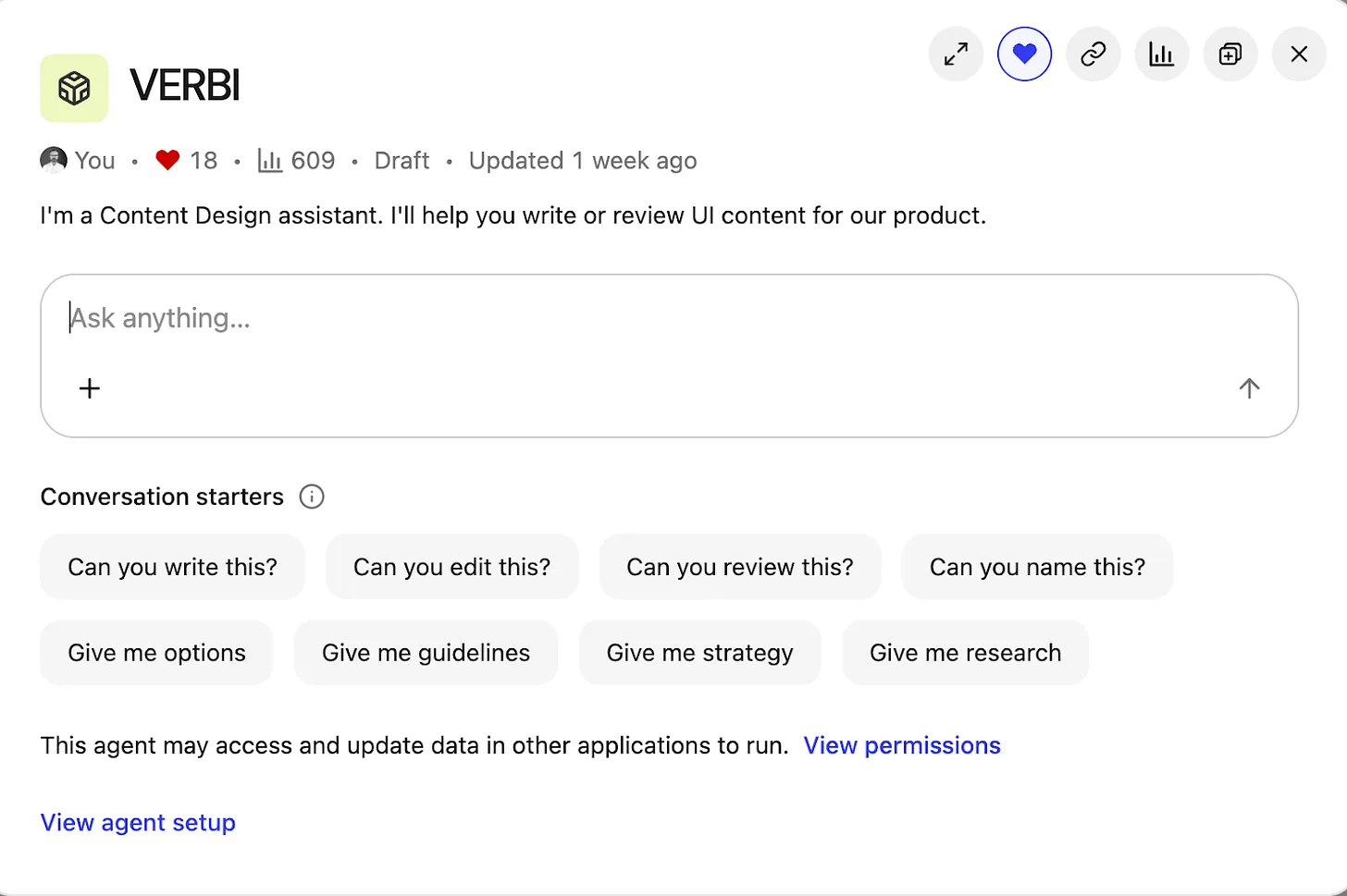
Inside the Content Design Agent workspace, a clean chat UI titled VERBI pairs a central prompt box with chips for writing, editing, and reviews, plus clear controls to view permissions and open the agent setup for product teams.
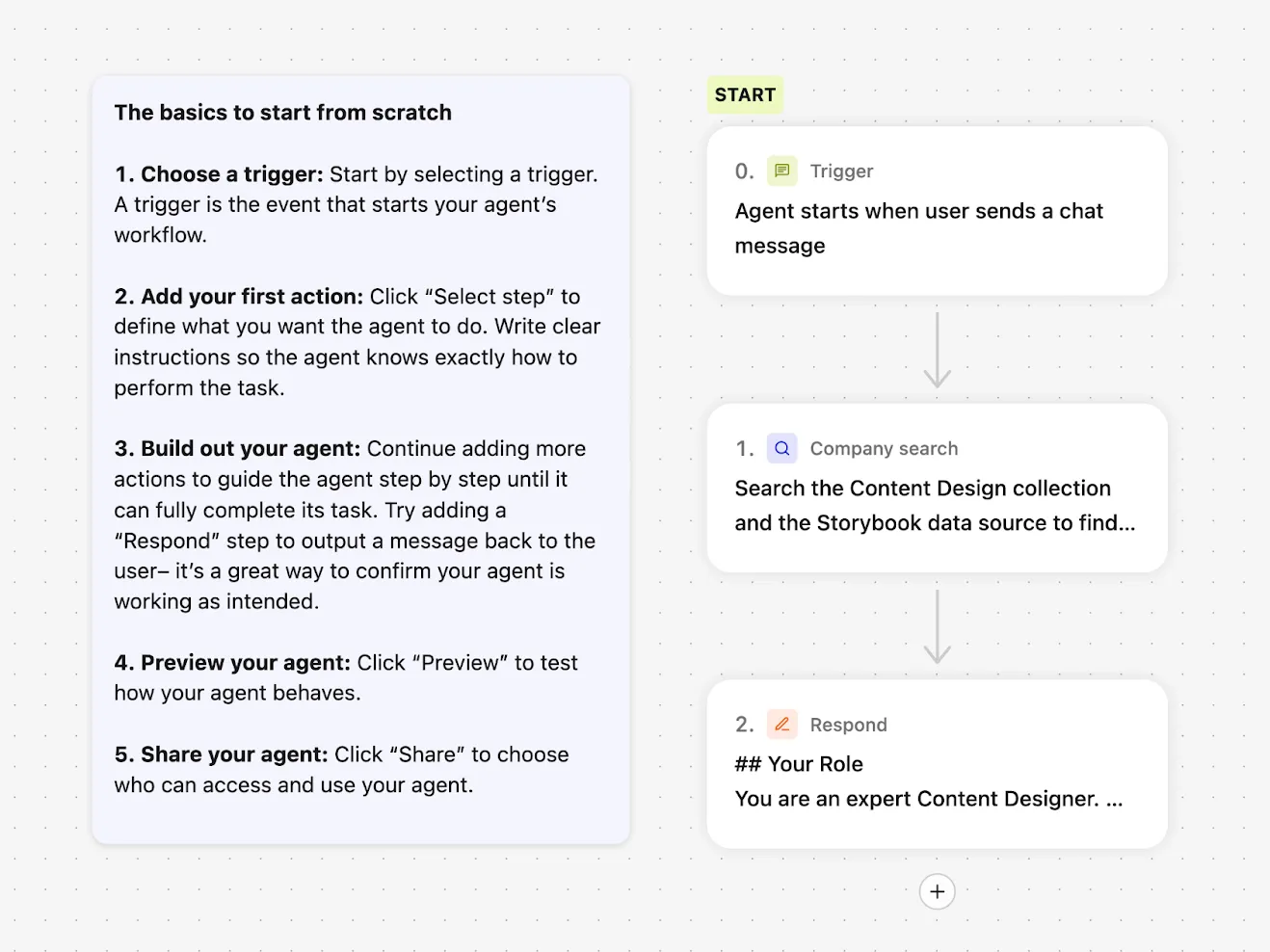
When I started this project back in May 2025, many LLMs still had frustrating limitations. Google Gemini let me build a custom Gem agent, but I couldn’t share it with other users. ChatGPT could be customized, but only with static files: I couldn’t point it to live, updatable URL sources. I settled on Glean for three simple reasons: everyone at the company had access; Glean could access all internal documentation and treat URLs as sources of truth; and its then-new Agents feature made AI search customizable. Configuring an agent in Glean is straightforward—you choose a trigger, a set of prompts, and a set of actions—but first I needed to get the inputs right.
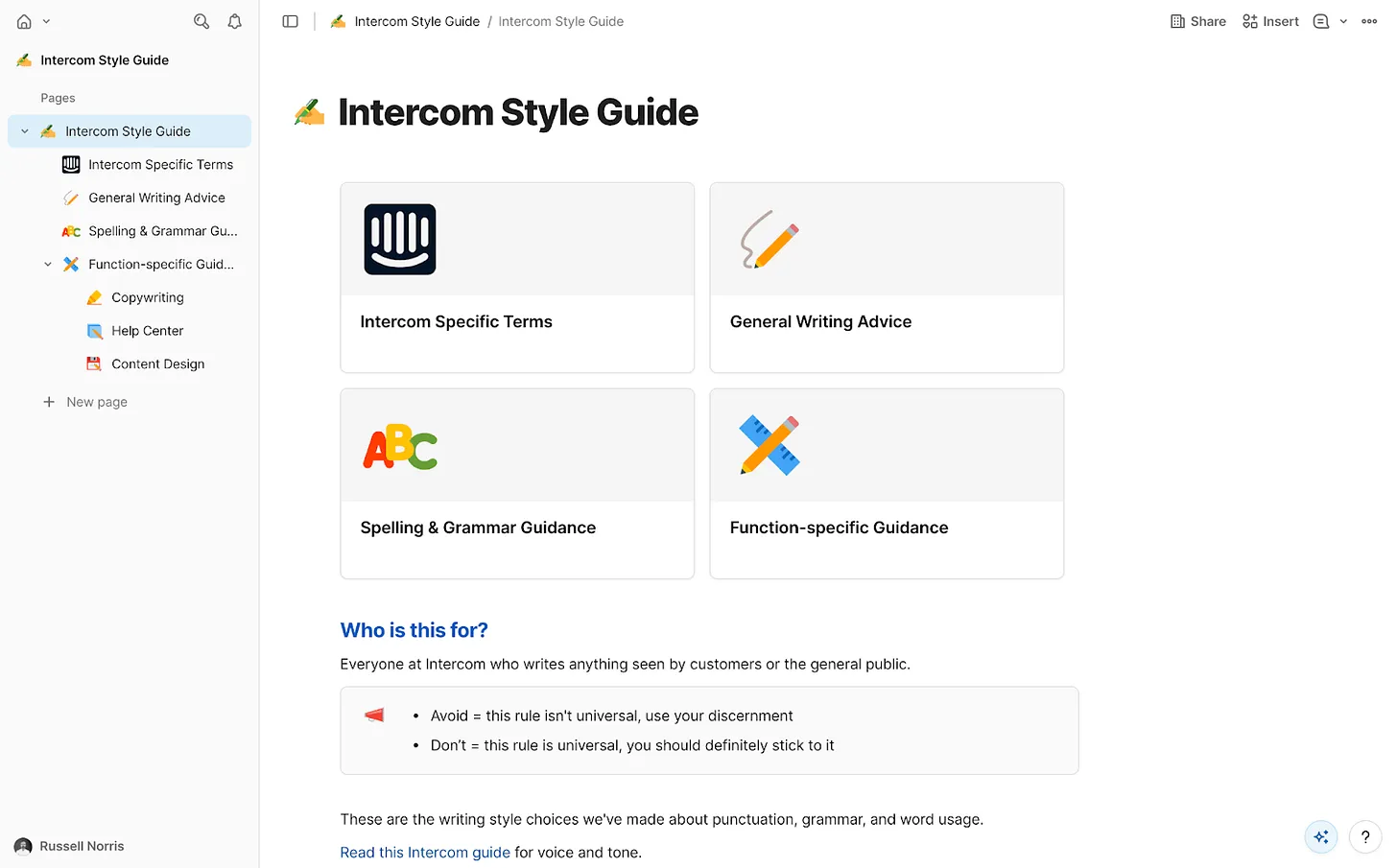
AI agents need focus. We had a wealth of internal information at Intercom, but not all of it was current or reliable. I curated exactly what the agent could access and assembled a tightly governed knowledge collection in Glean. Only essential information made the cut: the Intercom style guide—our definitive house style, including regularly-broken rules like “always write in US English” and “use sentence case everywhere”; tone of voice guidance for how we show up across mediums; a product glossary with hundreds of feature names and writing conventions; a monetization glossary for prices, plans, and add-ons; product marketing messaging guides with positioning for every feature and launch; core research insights across the product; and fin.ai and intercom.com/suite as the official, most up-to-date messaging sources.
This is classic RAG (retrieval-augmented generation) in action, ensuring every answer is grounded in approved sources of truth. With the collection in place, I instructed the agent to prioritize these resources above anything else.
Step into a clean, no-code builder that shows how to assemble a Content Design Agent: kick off with a chat-trigger, run a company search, then respond with expert guidance, all guided by a simple starter checklist.
Then came the fun part—building and branding the agent. “Content Design Assistant” felt bland, so I named it VERBI, a nod to its “verbal” design job. When people interact with VERBI, they usually begin with a question, but the intent varies widely. I defined a set of task prompts to guide expectations and outputs: “Can you write this?”; “Can you edit this?”; “Can you review this?”; “Can you name this?”; “Give me options”; “Give me guidance”; “Give me strategy”; “Give me research.” This mirrors the real breadth of content design, from creation to critique to discovery.
To manage responses, VERBI needed three things: start with a specific task prompt; understand how to draw on the right resources each time; and connect with other systems. With task prompts defined, I wrote a detailed system prompt covering the essentials. Role: you are a content designer, supporting product designers. Employer: Intercom (consisting of Fin AI Agent and our next-gen Helpdesk). Resources: content design collection, research collection, Storybook design system. Tone of voice: follow a specific tone for our UI, adjust the tone for everything else. Components: for UI, use the specific guidelines in our design system only. Use cases: writing, editing, critiquing, naming, researching, and more.
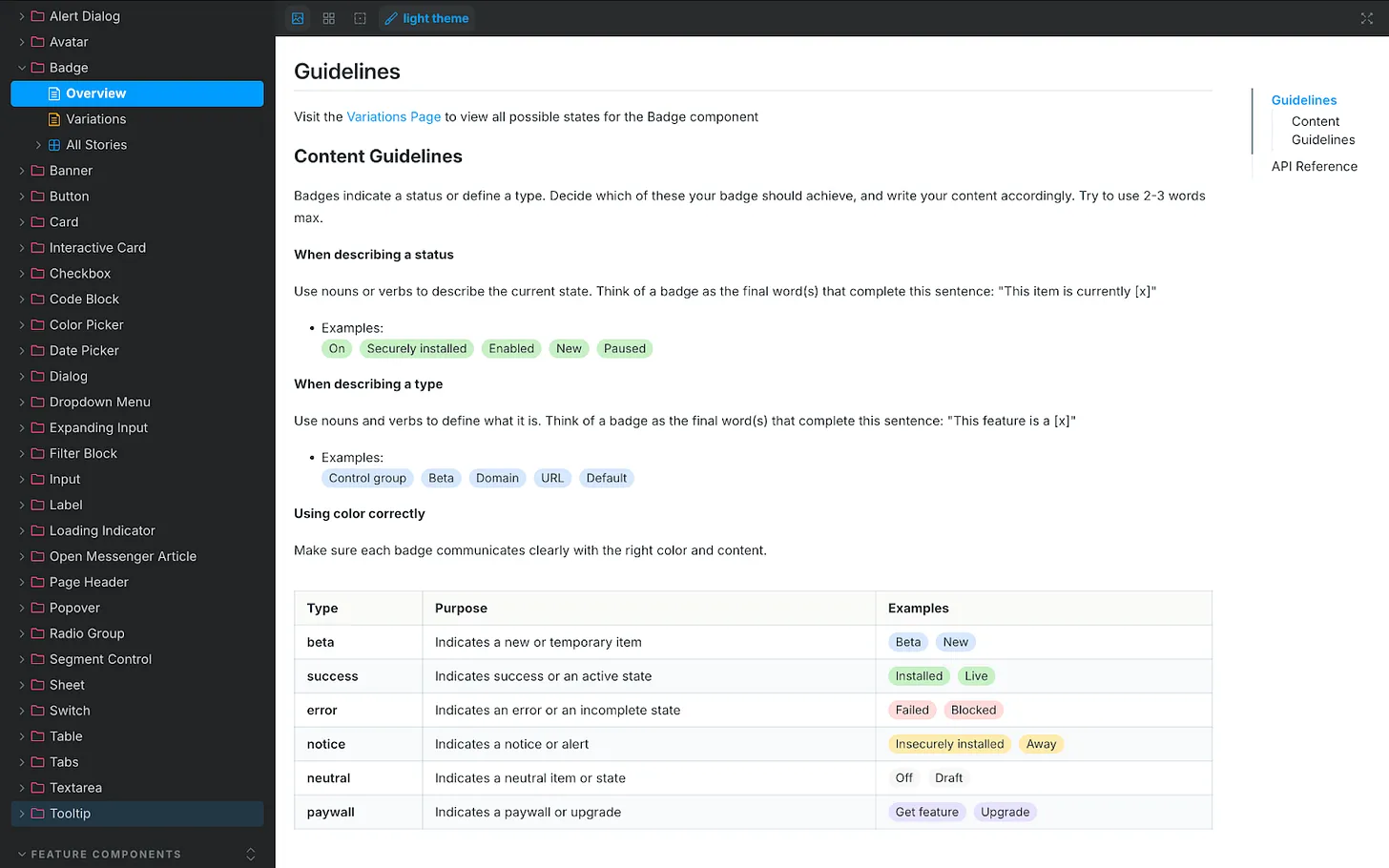
One connection mattered most: our design system, recently rebranded as “Surge.” Surge contains detailed content guidelines for every component in our product UI, from accordions and banners to tabs and tooltips. That granularity took months of human effort to codify, and it paid off. Designers no longer guess how to write for a toggle, a button, or a tooltip—and now VERBI understands and enforces those rules, too. A great content design assistant isn’t just a clever system prompt; it needs deep, component-level guidance to retrieve.
UI documentation showcases the Badge component’s content rules, teaching how to name statuses, define types, and apply color so labels read clearly. A handy visual for building a content design agent and ensuring consistent product messaging.
Accessing the design system wasn’t simple at first. It lives in Storybook, which Glean couldn’t access directly. I started by scraping guidance from Storybook into an HTML file with Cursor and uploading it to VERBI—a functional but clunky workaround that required re-scraping every few days. Then our IT team stepped in. They used the Glean Indexing API to turn Storybook into a live data source. Now VERBI connects to Storybook directly. Ask it something ultra-specific, like the correct date format for Japan, and it returns the right answer. That integration elevated the agent from helpful to indispensable—human-level precision, 24/7, at scale.
With prompts and resources in place, I launched VERBI and pressure-tested it. It was accurate and well-informed most of the time, but like any AI agent, it had quirks. I needed it to act as a gatekeeper, not a brainstorming partner that might bend rules or invent new ones. So I added a few explicit guardrails to the system prompt. Stopping sycophancy: “Inform, challenge, and assist. Never placate. Don’t agree by default. If something’s wrong, say so. Challenge assumptions.” Halting hallucinations: “If you don’t find the information required in our resources, say you don’t know the answer. Don’t guess and don’t give answers based on general knowledge.” Avoiding verbosity: “Keep answers short and to the point. Cut the fluff. Skip all niceties and social padding. Only give longer answers if the user asks you to.” These constraints keep responses crisp, correct, and consistent. Like any living system, the prompt needs occasional tune-ups, but the maintenance is minor compared to the upside.
Where we are now: VERBI has been triggered 700+ times since launch. The benefits are tangible. For me, quality scales without constant policing; repetitive questions about naming, style, or punctuation have dropped significantly. I reclaim time because the agent drafts and checks V1 content across teams, enabling me to focus on higher-impact work. For the design team, iteration is faster, confidence is higher, and strategic clarity improves because shared language and grounded guidelines make decisions easier and more consistent.
I used to spend too much time mopping up basic content mistakes and untangling spaghetti-like UI copy prone to human error. VERBI removes those errors at the source. The real advantage is speed: we get from blank slate to a high-quality first draft quickly, which means we can spend our energy deciding whether the content is right, not just “good enough.” Design is the whole interface—words, visuals, interactions—so reviews now happen with real content, never “copy TBD.” Our principle to sweat the details applies equally whether work is human-made or AI-assisted.
Knee-jerk critiques of AI-driven content design often assume teams generate content from nothing and ship it. In reality, great AI is the outcome of great human decisions and strong systems. Its value is pulling us together faster—getting us to a complete, standards-compliant design we can review as a team before sharing it with the world. That’s how AI helps us win: by turning chaos into consistency, and consistency into velocity.