I’m constantly asked by SMB owners: What if your small business could have a full marketing team—automated content calendars, customer segmentation, and channel-specific posts—without the headcount? That question is no longer hypothetical; it’s precisely the promise behind Mowie, and the way they got there is a masterclass in practical AI product development.
I recently listened to Chris O'Connor (CEO) and Jessica Valenzuela (Co-Founder) of Mowie, an AI marketing platform built for small and medium-sized businesses in restaurants, retail, and e-commerce. Their story starts with a concierge marketing service—doing the work by hand for overwhelmed owners—and evolves into a fully automated AI product.
They walk through their "document hierarchy" approach: how Mowie crawls the web to build a "dossier" about each business, infers customer segments and marketing pillars, and generates quarterly content calendars with channel-specific posts. As a product leader, this is the kind of retrieval-first pipeline that consistently outperforms naive prompt chaining because it builds durable context before generation.
They also unpack the technical challenges of structuring unstructured data and the evolution from rigid schemas to loosely structured markdown. In my experience with LLMs for product managers, markdown becomes a flexible intermediate representation that’s easy to diff, trace, and feed back into models without brittle parsing.
Equally important, they use customer feedback—from calendar approvals to regeneration requests—as their primary evaluation signal. That’s eval-driven development in practice: close the loop with lightweight evals that reflect genuine user intent, not proxy metrics.
The planning model is elegant: the three mini-calendars—public events, business-specific events, and recommended campaigns—roll up into a coherent plan that eliminates the blank-page problem and enables steady, predictable execution.
Crucially, they’re building traceability so customers can see which context documents influenced their content. This kind of transparency increases trust, accelerates edits, and supports governance in regulated categories where auditability matters.
Onboarding and data collection stay pragmatic: let the system crawl first, ask humans only for deltas, and progressively profile over time. It’s a pattern I advocate in continuous discovery and AI workflows—keep humans in the loop without overwhelming them, and make the right action the easy action.
Early on, they used Simon Sinek's Golden Circle framework to validate demand and sharpen messaging. Framing the "why" before the "what" helps teams maintain a crisp value proposition and tighten their go-to-market strategy.
Performance measurement goes beyond vanity metrics by connecting marketing performance back to point-of-sale data for attribution. The ability to tie campaigns to revenue events is the bridge from clever content to accountable outcomes.
What’s next is equally compelling: deeper attribution, omnichannel expansion, and digital out-of-home displays. For SMBs, that points to a unified analytics platform spanning email, social, and in-store touchpoints—exactly where modern marketing is headed.
My takeaways for builders: invest in a retrieval-first pipeline with a resilient document hierarchy; prefer loosely structured markdown over rigid JSON when dealing with messy inputs; design human-in-the-loop controls that double as evals; and always connect activity to business outcomes. That’s how you turn an idea into a repeatable system that scales.
If you want to explore further, start here: Mowie AI — AI marketing platform for SMBs. For early validation and storytelling, revisit Simon Sinek's Golden Circle.
I’ve spent countless cycles guiding teams through the maze of dashboards, SQL pulls, and ad‑hoc analyses—only to watch truly meaningful patterns emerge far too late. Automated insights are the next frontier in product analytics: a shift from manual exploration to AI that proactively surfaces what matters most. When we let the system do the heavy lifting, we accelerate discovery, reduce bias, and give product trios the clarity to act.
Finding causal connections in product data involves exhaustive searches and tests. We trained our AI to find “aha” moments in minutes instead of weeks.
Here’s what that means in practice for product management: the platform continuously scans events, cohorts, and segments; prioritizes signals linked to activation, conversion, and retention; and highlights likely causes behind meaningful movements in your core KPIs. Instead of sifting through endless funnels and cohorts, I get ranked hypotheses I can validate with targeted A/B testing and minimum detectable effect (MDE) guardrails.
This approach turns analytics into action. Automated insights reduce time-to-learning, tighten our discovery loops, and make continuous discovery tangible—especially when we’re aligning roadmaps, designing experiments, and refining onboarding. Whether you’re using tools like Amplitude analytics or instrumenting a unified analytics platform, the value is the same: faster, clearer paths to customer impact.
I’ve seen teams unlock retention analysis breakthroughs by spotting counterintuitive patterns—like a specific feature combination or an overlooked step in onboarding—well before they would have surfaced through manual analysis. With AI workflows scanning the noise and elevating the signal, we can focus on decisions: ship or iterate, scale or sunset, double down or pivot. That’s empowered product teams in action.
If you’re building for product-led growth, this is the leverage you’ve been waiting for. Automated insights transform how we prioritize, test, and communicate strategy—bringing us from gut feel and lagging indicators to explainable, causal narratives we can stand behind. The outcome is simple: more confident bets, less waste, and a faster path to durable product-market fit.
Inspired by this post on Amplitude – Best Practices.
I’ve been working to remove the friction between product questions and product answers. The most impactful step so far: connecting Amplitude analytics directly into ChatGPT via OpenAI’s MCP. This turns everyday conversations into decision-grade insights—no dashboards to hunt, no SQL to write, and no analytics queue to wait on.
Connect Amplitude data directly to the tools your team uses every day. OpenAI’s MCP connector eliminates traditional barriers to product data.
In practice, this means I can ask ChatGPT natural-language questions like, “Where are users dropping in our activation funnel this week?” or “Which cohorts are driving retention lift post-onboarding?” and get grounded answers from Amplitude—fast. It’s a step-change for product-led growth because the insights live where we already think and plan.
Here’s how I apply it day to day: I’ll prompt ChatGPT to compare week-over-week activation for new SMB signups across regions, diagnose drop-offs by step, and summarize A/B testing outcomes with guardrails like minimum detectable effect considerations. When we’re shaping strategy, I’ll pull a retention analysis and cohort breakdown to inform bet sizing and roadmap tradeoffs—all without pulling the team into a BI bottleneck.
Governance remains non-negotiable. I scope the MCP tools to a least-privilege data slice, apply privacy-by-design rules to exclude PII, and log every query for auditability. Clear data governance and AI risk management policies ensure we maintain trust while accelerating discovery. Tight context window management keeps prompts focused and reduces noise.
Operationally, the setup is straightforward: define the MCP tool spec for Amplitude, map canonical events and metrics (activation, retention, conversion, and product-qualified lead stages), and test with a retrieval-first pipeline so responses reliably cite the right source of truth. We standardize metric definitions across product, growth, and customer success to avoid semantic drift.
The impact on empowered product teams is immediate. Continuous discovery becomes a daily habit rather than a quarterly ritual; questions move from “I’ll get back to you” to “Let’s check right now.” For product managers working with LLMs, this is the connective tissue that makes ChatGPT a true ChatGPT connector for analytics—an on-demand, unified analytics platform that supports faster iteration and sharper decision-making.
If you’ve been waiting to make analytics truly ambient, this is the moment. Start small with a single funnel or cohort, validate governance, and expand to your core lifecycle metrics. The payoff is a shared understanding of what’s working, what’s not, and where to focus next—delivered in the flow of work.
Inspired by this post on Amplitude – Best Practices.
Your AI pilot works in the demo. Then it reaches a live workflow and slows down: the data is incomplete, nobody owns the exceptions, reviewers apply different standards, and the team cannot prove whether the result improved revenue, cost, speed, or retention.
The gap is not model quality alone. Scalable growth requires an operating system around the model: a constrained business outcome, a mapped workflow, approved data, explicit decision rights, measurable quality, controlled releases, and a path for handling failure. Build those pieces around one valuable use case, and AI can become a repeatable business capability instead of a collection of pilots.
Choose the growth constraint before the AI use case
Do not begin with a broad instruction to “find an AI use case.” That framing encourages teams to start with a model capability and search for somewhere to place it. Start with a constrained business problem instead.
The unit of investment should be a decision or task inside a customer or employee journey. “Build a churn copilot” is too broad. “Before a renewal review, summarize approved usage and CRM signals, identify the evidence of risk, and propose an action for the customer success manager to review” is narrow enough to test.
Most growth-oriented opportunities fit into four useful lanes:
Revenue: improve qualification, conversion, expansion, cross-sell, or win-back decisions. Measure the commercial event, not the number of AI recommendations generated.
Efficiency: reduce the cost, handling time, rework, or backlog associated with a repetitive process. Good candidates have high task volume and outputs that can be checked without recreating the work.
Speed: shorten a discovery, delivery, or release cycle. If the workflow serves software delivery, deployment frequency can be relevant, but it is not evidence of customer or commercial value by itself.
Activation and retention: make onboarding, guidance, or support more contextual. Measure whether customers reach the intended product behavior and continue receiving value, not whether they clicked an AI-generated tooltip.
What business metric should move, and what is its current baseline?
Which person, decision, and moment in the workflow create that movement?
Does the task occur often enough to justify a reusable solution?
Are the required inputs available, current, and approved for this purpose?
Can a reviewer distinguish an acceptable result from an unacceptable one?
What happens when the system is wrong, and can the action be reversed?
Who owns the outcome after the launch team moves on?
My test is blunt: if you cannot name the workflow event, the owner, the baseline, and the failure consequence, you do not yet have an implementation candidate. You have a discovery question. Fund the learning needed to answer it before funding scale.
Convert the use case into a controlled workflow
An AI feature becomes operational when its behavior is defined inside the surrounding work. That means understanding what happens before the model is called, what the model may do, how its output is checked, and what happens next.
Name the trigger. Specify the event that starts the workflow, such as a support request, renewal review, onboarding milestone, invoice submission, or product release.
Identify the inputs. Record each system, document, field, permission, and freshness requirement. Separate required evidence from optional context.
Expose the decisions. Write down the classifications, judgments, calculations, and approvals a person currently makes. Hidden judgment is where apparently simple automations tend to break.
Specify the output. Define its schema, audience, channel, timing, and acceptable evidence. “Produce a helpful answer” is not a specification.
Map exceptions. Include missing records, contradictory inputs, unsupported requests, low-confidence cases, policy conflicts, and unavailable downstream systems.
Assign each step to code, retrieval, an LLM, or a person. The workflow should use the simplest reliable mechanism for each job.
Define the handoff. State who reviews the result, what they can change, when the workflow must stop, and where failures are recorded.
Use each form of automation for the work it can control
Use deterministic code for exact calculations, validation rules, permissions, routing, and other behavior that should produce the same answer from the same inputs. Use an LLM where language is ambiguous, inputs are unstructured, or the task requires drafting, summarizing, extracting, or classifying meaning.
Keep a person in the path when the consequence is material, the action is difficult to reverse, or the definition of a correct result remains contested. Human review is not a permanent excuse for weak quality, however. The reviewer needs defined criteria, enough context to make a decision, and an easy way to correct and categorize the failure.
Write an execution contract, not just a prompt
A production instruction set should define more than tone and role. Treat it as an execution contract containing:
the objective and the business context;
the permitted inputs and authoritative evidence;
the decision criteria the system must apply;
the required output structure;
the actions it may and may not take;
the conditions that require refusal or escalation;
the way uncertainty should be represented;
examples of acceptable, unacceptable, and edge-case behavior.
For an agentic workflow, increase authority in deliberate stages: observe, draft, recommend, act after approval, and only then act within defined limits. Do not jump from a convincing chat demonstration to autonomous execution. Agentic AI needs explicit guardrails and verifiable quality before it can safely take work out of a human queue.
Measure business value, workflow performance, and AI quality separately
A dashboard that reports requests, tokens, or generated answers tells you that the feature was used. It does not tell you whether the business improved. You need separate measures because an AI system can look healthy at one layer while failing at another.
Measurement layer
What to track
What it reveals
Business outcome
Conversion, expansion, cost per completed outcome, cycle time, activation, or retention
Whether the investment affects the growth constraint it was chosen to address
Workflow performance
Completion, rework, exception, escalation, abandonment, and end-to-end latency
Whether the surrounding process can absorb and use the AI output
AI quality
Correctness, evidence support, instruction adherence, output validity, and appropriate refusal
Whether the system behaves acceptably across expected and difficult cases
Risk and operations
Unauthorized data exposure, prohibited actions, overrides, incidents, rollback events, and unresolved failures
Whether growth is being purchased with unacceptable operational or trust costs
Build the measurement path before the rollout:
Capture the baseline. Measure the existing workflow using the same outcome definition you will use after launch. Otherwise, a faster AI step can hide slower review, higher rework, or shifted labor elsewhere.
Create a representative evaluation set. Use permitted examples from normal, difficult, and failure-prone cases. Define the expected result and the critical errors for each case.
Weight failures by consequence. Formatting errors, unsupported factual claims, privacy failures, and unauthorized actions should not disappear into one average score.
Run offline evaluations before exposure. Test the complete combination of instructions, model, retrieval, tools, and output validation. A model score alone does not represent the production system.
Release behind a feature flag. Start with a controlled cohort, preserve the ability to roll back, and compare outcomes. Use A/B testing when assignment and outcome measurement are credible; use a phased rollout when they are not.
Record versions. Log the model, instructions, retrieval configuration, tools, and policy version associated with each result so a regression can be traced.
Turn failures into future tests. Categorize meaningful production failures and add them to the evaluation set before the next release.
Do not scale because the demo is impressive or employees like the interface. Require four decisions:
The business outcome is moving in the intended direction, or there is credible evidence that the workflow is producing the leading behavior tied to it.
Quality remains acceptable across normal cases, edge cases, and high-consequence failures.
Total cost per successful outcome is viable after model usage, retrieval, storage, human review, escalation, rework, and operations are included.
The operating owner can detect, contain, and learn from failures without depending on the original project team.
If a pilot fails one of these gates, the decision is not automatically to cancel it. Narrow the scope, change the workflow, improve the evidence, or stop. What matters is that expansion is earned by measured behavior rather than assumed from adoption.
Scale through guardrails, reusable components, and clear ownership
Governance should make routine decisions faster. When every team has to rediscover which data is permitted, which evaluation is sufficient, and who can approve a release, governance becomes a sequence of meetings. When those expectations are encoded in a standard launch record, teams know the path before they build.
Create a minimum launch record for every workflow
the business outcome, baseline, and accountable owner;
the workflow boundary, users, and authorized actions;
the approved data sources, access controls, retention rules, and prohibited data;
the evaluation set, acceptance criteria, and critical failure classes;
the human review and escalation conditions;
the logging, monitoring, feature flag, and rollback plan;
the model, retrieval, tool, and vendor dependencies;
the incident owner and the method for notifying affected internal teams or customers when appropriate.
If a workflow touches personal data, confidential customer content, employment decisions, payments, security actions, or contractual commitments, involve the appropriate privacy, security, legal, financial, or people owner before live use. The downside is not limited to a poor answer. The workflow can expose restricted data or take an action the business cannot easily reverse.
Assign ownership beyond launch
Four responsibilities must be explicit, even when one person holds more than one:
Business outcome ownership: decides whether the workflow is worth continuing based on the target metric and economics.
Workflow ownership: manages exceptions, reviewer behavior, process changes, and user feedback.
Technical ownership: controls releases, versions, integrations, reliability, monitoring, and rollback.
Risk ownership: defines the policy boundary and approves material changes to data, authority, or exposure.
This prevents a common operating failure: the product team treats launch as completion, while the operations team inherits a changing probabilistic system without the tools or authority to manage it.
Standardize the recurring parts, not every local process
Once working use cases expose recurring needs, turn those needs into shared capabilities. Useful candidates include identity and permissions, governed retrieval connectors, evaluation tooling, instruction and model versioning, observability, feature flags, rollback controls, and cost attribution.
Keep the final workflow close to the business team that understands the customer, exceptions, and outcome. Centralize the controls and infrastructure that should be consistent. This creates leverage without forcing every function into the same process.
Usually, no. Start with the minimum secure infrastructure required for a valuable workflow. Standardize a component when several use cases need the same capability or when inconsistency creates material risk. Data access, identity, logging, and release controls may need early consistency; a broad internal platform without proven workflows can become an expensive set of assumptions.
How do you know a pilot is ready to scale?
A pilot is ready when it improves the intended business or workflow outcome, stays within quality and risk boundaries, has viable cost per successful outcome, and can be operated without daily intervention from its builders. Usage and positive comments are supporting signals, not a scale decision.
Where should a human remain in the loop?
Keep human approval where consequences are high, actions are difficult to reverse, evidence is incomplete, or acceptable judgment cannot yet be specified. Remove or reduce review only when evaluations and production monitoring show that the remaining risk is understood and controlled. A reviewer who merely clicks approve without adding judgment is not a guardrail; it is latency disguised as governance.
For your next AI proposal, require a one-page charter containing the outcome, workflow boundary, owner, baseline, approved data, evaluation set, failure policy, release plan, and full cost model. If a line is blank, fund discovery to resolve it. If the charter is complete, release the smallest useful workflow behind a control, learn from real failures, and widen its authority only when the evidence earns it.
Your AI support agent handled the easy questions, produced an encouraging early lift, and then stopped getting better. The same topics still reach human agents. Content fixes happen when someone remembers. The aggregate resolution rate moves, but nobody can explain why.
If that describes your operating review, a newer model is unlikely to be the first thing you need. You need a closed operating loop: every weak conversation becomes evidence, every useful insight gets an owner, and every change is tested against the next conversation it is meant to improve.
Measure the improvement loop, not just resolution rate
A self-improving support operation is not an agent that quietly rewrites or retrains itself. It is a managed system in which live conversations expose failure modes, people convert those failures into controlled changes, and later conversations show whether the changes worked.
Resolution rate is an outcome of that system, not a diagnosis. An aggregate rate cannot tell you which intent deteriorated, why the agent handed a customer to a human, or whether a change repaired one topic while damaging another. It can also be misleading when eligibility changes. Expanding automation into harder intents may lower the rate while increasing the number of conversations resolved. Excluding difficult intents can produce the opposite effect.
Start by documenting exactly what your denominator includes and what counts as a resolution. Keep that definition stable enough to compare periods, and report resolved volume alongside the rate. Then add the views that turn a dashboard into a work queue:
Coverage: Which inbound conversations are eligible for AI handling, and which are excluded?
Outcome by intent: Where does the agent resolve, hand off, or fail to answer?
Failure reason: Was the problem missing knowledge, weak retrieval, incorrect behavior, poor routing, or an issue the product itself must solve?
Quality: Did an audit, repeated contact, reopened conversation, or another trusted signal indicate that the apparent resolution was weak?
Change throughput: How many identified failures are waiting for diagnosis, testing, approval, or release?
The intent-level view matters because it gives the owner somewhere to act. A falling aggregate rate is merely a warning. A cluster of unresolved questions about one feature, tied to one failure reason, is a tractable product and operations problem.
Classify the failure before choosing the fix
Teams waste cycles when every poor answer is treated as a documentation problem. Use a small failure taxonomy to route each issue to the layer that can actually repair it.
Failure class
What you observe
Likely action
Knowledge gap
No current, approved answer exists
Create or repair the canonical content
Retrieval gap
The answer exists, but the agent does not receive or select it
Improve structure, segmentation, metadata, or retrieval configuration
Behavior gap
The right information is available, but the response is incomplete or misapplied
Adjust instructions, examples, or agent configuration
Routing gap
The agent should escalate but does not, or the handoff loses essential context
Change escalation conditions and the handoff payload
Product gap
No support answer can resolve the underlying problem
Send the evidence to product or engineering instead of disguising it as a content task
This distinction prevents two common errors: endlessly rewriting accurate content when retrieval is broken, and asking the support agent to explain around a product defect that requires an actual fix.
Give one owner the authority and the improvement queue
Shared participation is useful. Shared accountability is not. One person should own the performance of the AI support operation, even though support, product, content, engineering, and security may contribute to individual changes.
The title can be AI operations lead, support operations specialist, or something else. The mandate is what matters: identify underperforming intents, maintain the improvement backlog, coordinate changes across functions, enforce the evaluation process, and report what improved or regressed.
Ownership becomes especially important after the launch surge fades. At Dotdigital, performance held at about 2,800 resolved conversations per month for three consecutive months. The response was to create a dedicated support operations specialist role focused on snippets, content, and the agent’s resolution capability. The lesson is not that every company needs the same job title. It is that a plateau without an empowered owner tends to remain a plateau.
Do not bury improvement work in the general support queue. A customer ticket can close while the underlying failure remains. Create a separate, persistent record for the system-level issue, with fields that make it possible to trace evidence through to an outcome:
Representative conversation links and the affected intent
The observed failure and its customer consequence
The failure class and the evidence supporting that diagnosis
The knowledge, retrieval, behavior, routing, or product artifact to change
The accountable owner and required reviewer
The evaluation cases that must pass
The release status, version, and deployment date
The live signal that will be checked after release
Define done as more than content published or configuration changed. An improvement is complete only when the change is linked to its originating evidence, reviewed at the appropriate risk level, tested, released, and checked in live operation.
For prioritization, assess recurrence, consequence, confidence in the diagnosis, and effort separately. Do not let raw volume make the decision by itself. A rare failure involving access, privacy, or an irreversible customer action can deserve attention before a frequent wording problem. Conversely, a recurring low-risk knowledge gap may be the best candidate for a fast content repair.
Turn live failures into governed, testable changes
Feedback does not improve an agent merely because it was collected. A thumbs-down, a handoff, or an unresolved conversation is a signal, not a root cause. The operating loop has to convert that signal into a specific hypothesis and then close the loop.
Collect: Group common handoffs and unresolved conversations by intent instead of reading them as isolated tickets.
Diagnose: Assign a failure class and confirm that the proposed layer is actually responsible.
Prioritize: Select the issue using recurrence, consequence, confidence, and effort.
Change: Modify the smallest responsible artifact rather than making broad agent changes by default.
Evaluate: Test the originating failures, realistic variations, and already-passing cases that could regress.
Release and observe: Record what shipped, monitor the affected live intent, and feed any new failure back into the queue.
Write the hypothesis before making the change: for this intent, changing this artifact should reduce this failure reason without degrading these existing behaviors. That sentence forces clarity about what success means and which regression cases belong in the evaluation set.
When a live failure reveals a missing case, promote it into the regression set after the fix. Over time, the evaluation suite becomes a practical memory of mistakes the operation should not repeat. That is where compounding comes from: the team is not merely correcting answers; it is preserving each correction as a reusable control.
Match governance to the blast radius
Fast iteration and responsible review are compatible when the rules are explicit. A useful governance model distinguishes changes by consequence:
Low blast radius: A correction to an approved fact, an obsolete product step, or a missing limitation can follow a lightweight peer review and the relevant evaluation cases.
Moderate blast radius: Retrieval, behavior, and routing changes that can affect several intents should receive cross-functional review and a controlled release.
High blast radius: Actions involving permissions, account access, customer data, money, or security need stronger approval, a safe test environment, a rollback path, and an obvious route to a human.
A wrong explanation can create confusion. A wrong action can change an account or expose data. Treating those changes as equivalent either slows harmless content repairs or makes consequential automation unsafe.
Use focused sprints without making improvement episodic
The sprint should strengthen the standing loop, not replace it. Keep the same taxonomy, backlog, review rules, and evaluation artifacts after the concentrated work ends. Otherwise, the operation improves during special events and drifts between them.
Make the improvement work visible in each operating review. Show the failure observed, the artifact changed, the evaluation result, and the live outcome or next check. Name the person who drove the repair. This rewards the behavior that creates durable gains instead of celebrating only a headline rate that few people can explain.
Make AI-ready knowledge part of product launch readiness
Company-specific support knowledge does not appear because the underlying model is capable. The agent needs current, approved information in a form it can retrieve and apply. Missing or contradictory knowledge is an operating failure, not a model mystery.
Treat knowledge as production infrastructure. Every topic needs an owner. Important changes need versions and effective dates. Retired instructions need to be removed or clearly superseded. The agent’s ingestion and retrieval path needs verification, just as the customer-facing help experience does.
A canonical source of truth does not have to be one enormous help article. It means there is one approved origin for the product facts from which help-center content, agent snippets, human macros, and other downstream formats are derived. When those formats are authored independently, contradictions are almost inevitable.
Add an AI support gate to the new product introduction process. Before a feature is considered ready, confirm that:
A named owner is accountable for keeping the feature’s knowledge current.
The canonical material explains what changed, who can use it, how it works, and where its boundaries are.
Known limitations and escalation conditions are explicit rather than left for the agent to infer.
The effective version or release state is clear, so old and new instructions cannot be confused.
The content has been ingested or indexed and retrieval has been tested.
Expected support intents and representative evaluation cases are ready before inbound volume arrives.
Support has a defined path for returning launch-day failures to product, engineering, or the knowledge owner.
This is not only administrative hygiene. In my organization, embedding a canonical source of truth into launch readiness has consistently supported resolution rates above 50% for new features from day one. That result is evidence for the operating model, not a universal benchmark; intent mix, product complexity, and the definition of resolution still matter.
Do not automatically turn every human answer into permanent knowledge. First decide whether the resolution is generalizable. If it is, update the canonical material. If it is a legitimate exception, encode the escalation path. If the underlying issue is a product defect, preserve the conversation as product evidence and route it accordingly. The objective is a cleaner system, not simply more content.
Key takeaways for your next operating review
Define self-improvement as a managed loop from conversation evidence to a verified change, not autonomous model learning.
Assign one accountable owner with authority to coordinate support, content, product, and engineering.
Classify each failure before fixing it so knowledge, retrieval, behavior, routing, and product problems reach the right layer.
Turn repaired failures into regression cases, and apply stronger review as the blast radius increases.
Make canonical, AI-ready knowledge a launch requirement instead of a cleanup task for support.
At your next review, take one recurring unresolved intent and trace it all the way through: evidence, diagnosis, owner, change, evaluation, release, and live result. If any link is missing, that is the first operating gap to repair. Once the path works for one intent, make it the default path for every failure worth learning from.
Your AI customer service agent can pass a polished demo and still fail the first serious compliance question: Why did it give that answer, which data did it use, what did it change, and could the customer reach a person? If reconstructing one interaction requires guesswork across several systems, the deployment is not governed.
For enterprise support, governance has to live inside the product and its operating model. You need explicit limits on autonomy, deterministic routes for regulated workflows, release gates, human handoffs, and evidence that survives an audit. The goal is not to eliminate every possible failure. It is to know which failures matter, prevent the unacceptable ones, detect the rest, and respond without losing control of the customer case.
Give every decision an owner before the agent gets autonomy
An AI agent is not just a model. The governed system includes its instructions, approved knowledge, retrieval settings, identity checks, connected tools, routing rules, human workflow, logs, and vendor dependencies. Reviewing the model while ignoring those components leaves most operational risk untouched.
Start with a deployment register. Create an entry for every production agent, channel, and materially different configuration. Each entry should identify:
The customer jobs the agent may handle and the outcomes it may produce.
The countries, business units, brands, languages, and channels covered by the deployment.
The tasks the agent must refuse, defer, or transfer to a person.
The customer and company data it can read, create, update, or disclose.
The tools and system permissions available to it.
The business owner accountable for the service outcome.
The product owner accountable for behavior, evaluation, and change control.
The security, privacy, legal, and operational owners responsible for their respective controls.
The people authorized to approve a release, accept a known risk, restrict an intent, or stop the agent.
Several roles can belong to the same person in a smaller organization. Accountability still cannot be shared so broadly that nobody can make a decision during an incident.
Then build a control register beside the deployment register. For every material risk, record the control, the test that proves the control works, the evidence retained, and the owner who reviews a failure. A statement such as “the agent should avoid inappropriate refunds” is a policy aspiration. A scoped refund permission, an approval rule, a test set, and a logged decision form a control.
My practical test is simple: if a team cannot name the owner, test, and evidence for a claimed safeguard, that safeguard should not be used to justify greater autonomy.
Translate service obligations into controls the agent can prove
Compliance requirements usually describe customer outcomes, not model architecture. Your control design has to connect those outcomes to specific events in the support journey.
The broader design lesson is durable: the obligation follows the customer journey across automation and human support. It does not disappear because an AI agent handled the first interaction.
Service obligation
Product control
Evidence to retain
Reachability and response time
Measure the full journey from contact initiation through automated handling, queueing, and human connection. Define overflow behavior for outages and demand spikes.
Channel timestamps, queue events, routing outcomes, abandoned contacts, and performance segmented by incident period.
Human access on request
Recognize an explicit request for a person, expose a visible handoff path, and provide a fallback when the primary human channel is unavailable.
Handoff test results, transfer attempts, completion status, queue time, callback records, and failed-transfer alerts.
Complaint deadlines
Create a case immediately, apply the correct policy-based category and due date, assign an owner, and escalate before the deadline.
Case identifier, classification, policy version, creation time, due date, ownership changes, customer communications, and resolution time.
Unified complaint tracking
Carry one system-of-record identifier across chat, voice, email, messaging, and human follow-up instead of creating disconnected cases.
A linked timeline of every automated and human interaction, action, status change, and final disposition.
Language and accessibility support
Maintain a capability matrix by channel and route unsupported needs to an appropriate alternative rather than improvising.
Evaluation results by supported language and accessibility path, routing outcomes, and unresolved coverage gaps.
Separation of service and sales
Restrict promotional content and sales tools in workflows where service calls cannot be used for selling.
Tool permissions, prompt and policy versions, sampled interactions, blocked-action records, and exception approvals.
External auditability
Version releases, preserve control tests, document changes, and connect incidents to corrective action.
A release evidence package containing scope, approvals, risk decisions, evaluation results, configurations, incidents, and remediation.
Do not ask the language model to infer the applicable legal rule from a customer’s free-text message. Resolve jurisdiction, account type, service category, contractual status, and channel through trusted account data and deterministic policy logic. The agent can explain the resulting process, but it should not invent the rule that governs it.
Set autonomy by consequence, not conversational fluency
A natural answer can make a workflow feel safer than it is. Fluency says little about whether the agent authenticated the customer, selected the right policy, disclosed protected information, or performed the intended system action.
Assign autonomy at the intent-and-action level. A workable classification looks like this:
Inform: The agent answers from approved, versioned knowledge without changing customer data. Outage information, published policies, and basic troubleshooting often fit here.
Prepare: The agent gathers details or drafts a request, but a trusted system or person validates it before anything is committed.
Execute with confirmation: The agent performs a permitted, recoverable action only after authentication, validation, and an explicit customer confirmation. The interface should show what will change before execution.
Human approval required: The action has material financial, contractual, privacy, safety, or service-continuity consequences. The agent may collect context and recommend a next step, but it cannot make the final decision.
Prohibited: The task falls outside the approved purpose, requires inaccessible evidence, or carries a consequence the organization is unwilling to automate.
For each intent, evaluate four separate failure paths: a wrong answer, an inappropriate disclosure, an unauthorized action, and a missed escalation. They need different controls. Approved retrieval can reduce unsupported answers, but it does not enforce account authorization. A confirmation screen can prevent accidental execution, but it does not make a prohibited action acceptable.
Use least-privilege tool access as the hard boundary. If an agent only needs to read shipment status, do not give it a general customer-record role. If it can issue a bounded credit, encode the allowed conditions and limit in the transaction service rather than relying only on a prompt. Instructions shape behavior; permissions limit impact.
Vendor assurance belongs in this assessment, but it answers only part of the question. AIUC-1 certification, for example, includes independent third-party audits and quarterly adversarial testing across more than a thousand enterprise risk scenarios, with coverage spanning areas such as security, customer safety, reliability, privacy, and accountability. That can provide useful evidence about a vendor’s control environment. It does not certify your prompts, connected systems, customer policies, permissions, or human escalation design.
Procurement should therefore collect evidence and define the shared-responsibility boundary. Ask which products, models, subprocessors, and hosting arrangements are in scope; how material changes are communicated; what interaction and administrative logs can be exported; how customer data is retained and protected; what happens when a model or safety layer changes; and which incident information the vendor will provide. Keep the answers with the deployment record. A certification logo without scope and current evidence is not an operating control.
Run releases, evidence, and incidents as one control loop
A launch review is necessary, but it cannot carry the full governance load. Agent behavior can change when the model, system instructions, knowledge base, retrieval settings, safety classifiers, tool APIs, routing logic, or customer policies change. Every material change needs an owner, a risk assessment, proportionate regression testing, and a recoverable release.
Use the following release loop:
Freeze the scope. Record supported intents, prohibited tasks, data access, tools, regions, languages, channels, human routes, and known limitations.
Build evaluations from the control register. Include normal cases, ambiguous requests, missing information, authentication failures, conflicting policies, attempts to obtain protected data, adversarial instructions, tool failures, repeated requests for a person, unsupported languages, and downstream-system outages.
Define pass and fail before testing. Mark unacceptable outcomes explicitly. An average quality score can hide a rare but severe privacy disclosure or unauthorized action.
Gate production on evidence. Require the named approvers to review failed cases, accepted residual risks, fallback behavior, monitoring coverage, and rollback readiness.
Release with bounded exposure. Limit the first deployment by intent, permission, channel, customer population, or geography according to the risk. Expand only when production evidence supports it.
Monitor behavior and control health. Track not just answer quality, but handoff completion, prohibited-action attempts, tool errors, unsupported requests, complaint-clock failures, overrides, repeated contacts, and missing audit events.
Feed failures back into the system. Connect every meaningful incident or near miss to a corrected control, a new evaluation case, and a documented release decision.
Periodic adversarial testing matters because the threat and model landscape changes. AIUC-1 itself is described as evolving quarterly alongside new threat patterns and technical progress. Your internal cadence does not have to copy a certification program, but it should be driven by system risk, material changes, observed failures, and emerging attack paths rather than by the anniversary of the original approval.
Make each consequential interaction reconstructable
For a consequential interaction, an authorized reviewer should be able to determine what the customer asked, which identity and policy context applied, which knowledge version was used, what the agent produced, which tools it called, what changed, whether a person became involved, and how the case ended.
A useful event record normally includes the channel and timestamps; authenticated account context; resolved policy or jurisdiction context; intent and risk class; instruction, model, retrieval, and knowledge versions; tool requests and responses; the customer-facing answer; confirmation events; escalation requests and outcomes; case identifiers and due dates; safety or policy decisions; human overrides; and final disposition.
Do not respond by retaining every raw conversation forever. A larger data store is not automatically a better compliance system. Apply purpose limitation, access controls, redaction, approved retention periods, deletion rules, and legal holds to the evidence itself. Security and privacy owners should be able to explain both why an event is captured and when it is removed.
Package the evidence by release, not only by department. The package should connect the approved scope, risk assessment, control register, evaluation results, configuration versions, vendor evidence, exceptions, monitoring, incidents, and corrective changes. That structure lets an auditor trace a requirement to a control and then to proof without assembling the story from scattered screenshots.
Treat an AI failure as an operational incident
Your incident process should cover more than security breaches. A privacy disclosure, unauthorized account change, systematically wrong billing answer, missing human transfer, broken complaint timer, or unsupported-language dead end can all require containment.
Pre-authorize the response team to disable a tool, intent, channel, or release without waiting for a full governance meeting. The playbook should preserve relevant evidence, identify affected interactions, protect unresolved customer cases, route demand to a safe alternative, assess notification or remediation obligations with the appropriate legal and privacy owners, correct the control, add regression tests, and require approval before autonomy is restored.
Do not silently patch the prompt and delete the trail. That may make the next conversation look better while leaving impacted customers, complaint deadlines, and the underlying control failure unresolved.
Key takeaways
Govern the complete support system – model, knowledge, tools, permissions, routing, people, and evidence – rather than reviewing the model in isolation.
Map each applicable service obligation to a product control, a repeatable test, retained evidence, and a named owner.
Assign autonomy by the consequence of each intent and action. Fluency is not evidence that an action is safe.
Use deterministic policy logic and least-privilege permissions for hard boundaries; do not expect prompts to carry legal or transactional controls alone.
Treat vendor certifications as scoped evidence about vendor controls, not as certification of your deployment.
Retest material changes and convert production failures into new controls and regression cases.
Preserve enough evidence to reconstruct consequential interactions while still enforcing privacy, access, and retention rules.
Start with one high-volume intent that already reaches customer data or a business system. Trace it from the first message through authentication, policy selection, answer or action, human handoff, case closure, and retained evidence. Assign an owner, control, test, and evidence record at every consequential step. Where you cannot complete that chain, reduce the agent’s autonomy before you increase its reach.
When I assess whether an AI product is ready for prime time, I start with trust—not model accuracy. Accuracy is table stakes; trust is what earns adoption, drives retention, and unlocks durable product-led growth.
Evaluation metrics in AI products go beyond accuracy. Learn how product teams use trust-driven metrics to build reliable, growth-driving AI systems.
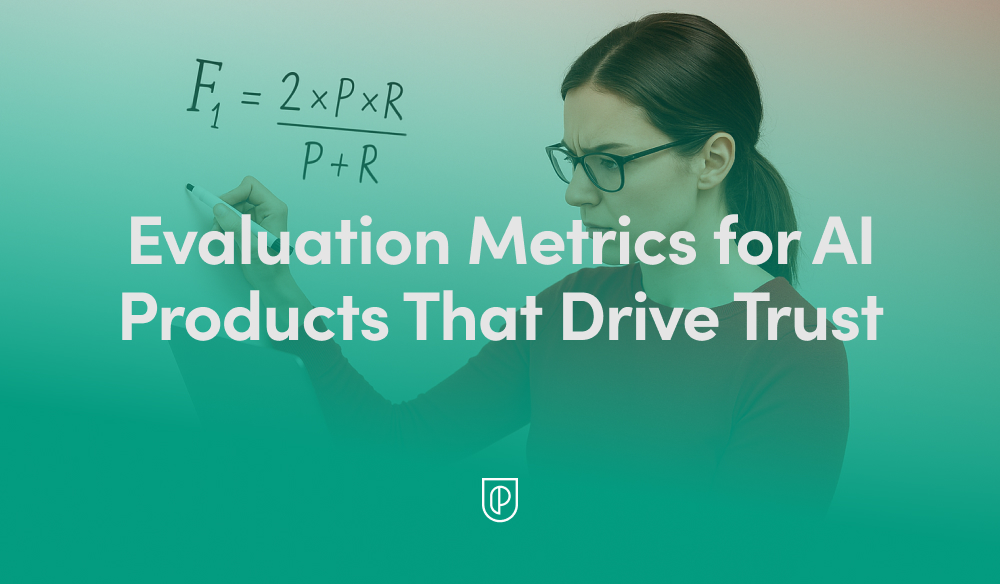
In practice, I organize trust-driven metrics into four layers: model quality and safety, user and business outcomes, operational reliability and cost, and governance and compliance. This layered approach keeps product trios aligned on what matters now, what must be gated in CI/CD, and what signals we’ll use to prove progress against outcomes vs output OKRs.
On model quality and safety, I care about precision, recall, F1, calibration, and abstention behavior, but also the hard-to-fake signals: hallucination rate, grounding and faithfulness, citation coverage, toxicity, bias, and fairness. For generative systems, I instrument refusal correctness (declining unsafe requests) and evidence adequacy (did the answer rely on retrieved, trustworthy sources).
User and business outcomes must be explicit. I track adoption, activation, task success rate, time to first value, win rate uplift in assisted workflows, CSAT and NPS deltas, and retention analysis by cohort exposed to AI features. For customer support scenarios, deflection rate, average handle time change, and first-contact resolution are core; for sales or ops copilots, I monitor cycle-time reduction and error-rate reduction in critical tasks.
Experimentation is non-negotiable. I design A/B testing with a clear minimum detectable effect (MDE), pre-registered guardrails for safety and quality, and sequential tests that stop early if harm outpaces benefit. Online metrics are always paired with offline evals so we can iterate quickly without exposing users to regressions.
Operationally, trust shows up as speed, stability, and cost predictability. I track latency end-to-end, time to first token, throughput, rate of 5xx and timeouts, cost per request, and caching effectiveness. We also trend safety incidents per 10,000 interactions and mean time to mitigation to keep reliability visible alongside performance.
Governance and compliance are part of the product, not an afterthought. Data governance and privacy-by-design metrics include PII exposure rate, data lineage coverage, access-control correctness, audit pass rate against internal policies, and model and prompt change traceability. This is the backbone of our AI risk management posture and accelerates regulatory compliance reviews instead of slowing them down.
The delivery engine for all of this is eval-driven development. We maintain golden datasets and scenario-based test suites that mirror real user intents, gate releases in CI/CD with minimum thresholds, and run canary rollouts to validate offline–online alignment. Every model or prompt update gets a comparable scorecard so product, engineering, and design can trade off quality, speed, and cost with shared facts.
For LLM-heavy features, retrieval-first pipeline metrics are mandatory. I monitor retrieval hit rate, recall at K, mean reciprocal rank, context contamination, and citation correctness. With large prompts, context window management matters: we track context utilization, truncation rate, and the contribution of each context block to final answers to avoid silently losing critical evidence.
Finally, trust must be legible. I package these metrics into an executive scorecard that maps to business outcomes, risk appetite, and OKRs, with clear thresholds for ship, improve, or roll back. When teams can articulate trade-offs—say, a 20% latency reduction at a small cost increase, or a lower hallucination rate at the expense of higher abstention—they build credibility with stakeholders and confidence with customers.
Trust is not a single number; it’s a system of evidence. By instrumenting these layers and operationalizing AI Strategy with rigorous, transparent metrics, we can ship faster, reduce surprises, and earn the right to scale AI features across the product portfolio.
I love real-world AI that ships, scales, and actually solves painful customer problems. This story checks every box. As a product leader who has brought agentic AI to production environments, I was captivated by how a small, focused team at Perk took a no-code voice AI prototype and turned it into a system that reliably makes 10,000+ calls per week to prevent failed hotel payments.
What happens when you combine a real customer problem, a no-code prototype, and a team willing to listen to every single call?
Steven Payne (Product Manager), Gabriel Stock (Senior Engineering Manager), and Philipe Steiff (Senior Software Engineer) from Perk share how they built a voice AI agent that calls hotels to verify virtual credit card payments, preventing travelers from arriving to find their rooms unpaid. This is a textbook example of linking operational pain to a high-leverage AI solution.
What started as a hackathon experiment in Make.com became a production system handling over 10,000 calls per week across multiple languages. Along the way, the team learned hard lessons about prompt engineering for voice (numbers, pronunciation, and a very "Karen-like" first version), how to break a single monolithic prompt into structured conversation stages, and why listening to actual calls beats any amount of theorizing.
From a product management perspective, this approach aligns perfectly with eval-driven development and continuous discovery. Structure the problem, instrument aggressively, ship safely, then listen—deeply—to real interactions. In my own teams, I’ve seen that nothing accelerates iteration on agentic AI like closing the loop between qualitative call reviews and quantitative evals.
They built a working prototype without writing a single line of backend code.
They structured the call into discrete stages (IVR, booking confirmation, payment) to improve reliability.
They created two eval systems: one for call success classification, another for conversational behavior.
They scaled from five calls a day to tens of thousands per week while maintaining quality.
This is a detailed look at building AI for real-time human interaction—where the stakes are high and the feedback is immediate.
Guests: Steven Payne, Product Manager, Perk; Gabriel Stock, Senior Engineering Manager, Perk; Philipe Steiff, Senior Software Engineer, Perk.
What stood out to me was how Perk's team identified an AI use case by connecting prior experimentation with a real operational problem. Why they chose Make.com for prototyping—and shipped to production without touching backend code—underscores how far no-code can take you when paired with crisp problem framing. The evolution from a single prompt to structured conversation stages (IVR handling, booking confirmation, payment request) is exactly how you harden agent behavior for production.
Breaking up the agent's task dramatically improved reliability. They also built two eval systems: classification for success rates and LLM-as-judge for conversational behavior. Even with automation, the team still listens to calls manually—a practice I strongly endorse for uncovering edge cases, trust issues, and UX nuances that dashboards can’t show.
The challenge of prompt engineering for voice—numbers, booking references, and text-to-speech markup—was non-trivial. Expanding to German revealed that prompts in native language improve results. And, as often happens with operations-heavy rollouts, this project uncovered other operational problems they didn't know existed—valuable signal for the roadmap.
Resources & Links: Perk. Make.com — No-code automation platform used for the prototype. Twilio — Voice/telephony provider. Eleven Labs — Text-to-speech provider (used in early experiments).
Chapters: 00:00 Introduction to the Team; 01:54 Understanding PERK's Mission; 02:59 Challenges in Travel Booking; 07:27 AI Solutions for Customer Care; 09:52 Prototyping with AI and Voice; 17:00 Implementing AI in Production; 25:51 Learning Through Trial and Error; 26:40 Prompting Challenges and Solutions; 27:58 Iterating on Prompts and Evaluations; 30:08 Scaling and Production Challenges; 32:43 Advanced Evaluation Techniques; 35:32 Real-World Applications and Success; 49:07 Future Directions and Expansion; 53:53 Conclusion and Team Reflections.
My product takeaways: Start with clear operational pain and measurable outcomes (e.g., payment verification). Use no-code to validate quickly, then progressively harden. Treat voice AI like any production system: break it into deterministic stages, add guardrails, and measure both outcome and behavior. Pair automated evals with hands-on reviews. And when going multilingual, write prompts in the native language—your accuracy will thank you.
If you’re exploring agentic AI for operations, this is the blueprint: tight scoping, Make.com for speed, Twilio for reliability, structured prompts for control, and an eval-driven loop to scale quality with confidence.
A prospect asks ChatGPT or Perplexity for the kind of product you sell. Several competitors appear. Your startup does not. That does not automatically mean your product is weak or your SEO has failed. It often means the system cannot find enough clear, consistent, and corroborated evidence to include you confidently.
Your job is not to force your company into every answer. It is to make your startup easy to identify, accurately categorize, and safely recommend when it genuinely fits the question. That requires coordinated work across positioning, content, technical structure, third-party proof, and measurement.
Key takeaways
Measure visibility across important buyer questions, not as one universal AI-search ranking.
Build a page for each major decision: category, use case, integration, price, comparison, and deployment risk.
Make important claims explicit in visible HTML, then reinforce them with accurate metadata and schema.
Support first-party claims with reviews, partner pages, case studies, documentation, and other independent evidence.
Use a stable prompt set to find specific visibility failures, change the relevant evidence, and retest.
Measure recommendation coverage, not an imaginary rank
Conventional search encourages a positional question: where do I rank? AI search requires a different question: for which buyer decisions can the system understand and support a recommendation of my product?
AI search behaves more like a synthesis engine than a page of ranked blue links. It assembles an answer around the wording and context of a prompt. Change the question from best software for a category to best software for a particular team, workflow, integration, budget, or risk profile, and the eligible recommendations may change.
There is therefore no single visibility score that tells the whole story. A startup can be visible for category discovery but absent from integration questions. It can be named as an alternative yet omitted when the buyer adds a security requirement. It can also be mentioned with an outdated description, which is exposure without useful discovery.
A practical baseline should distinguish four outcomes:
Discovery: Does your company appear when the prompt describes a problem you solve?
Positioning: Is it placed in the right category and associated with the right audience and job?
Fit: Does the answer explain when your product is appropriate, including relevant trade-offs?
Evidence: Are the supporting claims current, specific, and connected to credible pages?
Start with the questions that already matter in your buying journey. Include category exploration, problem framing, use-case fit, integrations, commercial value, alternatives, and deployment risk. Preserve the exact wording of each prompt. If you rewrite the test every time, you will not know whether your evidence improved or the question merely changed.
Record more than whether your name appeared. Save the product description, recommendation context, claims, citations, omissions, and factual errors. A mention is not a win if the answer sends the wrong buyer to your product or attributes a capability you do not offer.
Turn buyer intent into an answerable page system
Many startups try to solve AI visibility by publishing more blog posts. Volume is rarely the first constraint. The more common problem is that the website has no precise page capable of answering the buyer’s actual question.
Your homepage cannot carry the entire decision journey. Give each high-value intent a clear destination:
Buyer decision
Question the page must answer
Best page type
Evidence to include
Category exploration
What is this product, and who is it for?
About or category page
Plain category definition, target customer, core job, and differentiator
Problem framing
How should I understand and solve this problem?
In-depth explainer
Method, terminology, constraints, and links to primary material
Solution fit
Can this product handle my workflow?
Use-case page
User, workflow, inputs, outputs, limitations, and customer evidence
Integration fit
Does it work with the rest of my stack?
Integration page or documentation
Prerequisites, supported connection, setup steps, data flow, and known limits
Commercial fit
What will I pay, and what value should I expect?
Pricing and value page
Pricing structure, inclusions, exclusions, assumptions, and verifiable outcomes
Competitive choice
When should I choose this product instead of an alternative?
Comparison or alternatives page
Points of parity, meaningful differences, trade-offs, and cited claims
Deployment risk
Can my organization use it safely?
Trust center
Security, privacy, compliance, governance, and data-handling information
Each page should lead with a direct answer. Do not make a retrieval system infer your category from a slogan or reconstruct an integration from a press release. A useful positioning sentence follows a simple structure: [Product] is a [category] for [audience] that needs to [job], distinguished by [relevant difference]. Use the same underlying definition wherever the product is introduced.
Use-case pages need more than a collection of benefits. Name the user, triggering problem, workflow, expected output, dependencies, and boundaries. If the product is suitable only under particular conditions, state them. Precise qualification can reduce superficial visibility while improving the quality of the recommendations that remain.
Integration pages deserve the same care. A logo wall proves very little. Explain what connects, in which direction data moves, what setup requires, and which workflows the connection supports. Link to technical documentation and the partner’s corresponding page when one exists.
Comparison pages should help a buyer make a decision, not manufacture a victory. Start with the shared category, acknowledge points of parity, identify the conditions that make each option a better fit, and cite claims that a reader can verify. A fair statement such as one product suits a particular workflow while another suits a different operating model is more useful than an unsupported declaration that yours is best.
Transparent pricing matters for the same reason. If a public amount is not available, you can still explain the pricing unit, packaging logic, included capabilities, major variables, and purchasing path. The aim is to remove avoidable ambiguity from a commercial-fit question.
Make the corpus easy to retrieve and hard to misread
Good information can remain invisible when it is buried in a PDF, hidden behind vague navigation, contradicted by metadata, or scattered across pages with no canonical version. Retrieval-friendly content reduces the work required to locate, segment, and interpret an answer.
Work through the site in this order:
Make the visible narrative consistent. Use the same product name, category, audience, and core capability across the homepage, About page, product pages, documentation, and trust center. Resolve genuine contradictions before adding markup.
Give every important answer a stable URL. Use descriptive headings, short focused sections, sensible internal links, and linkable anchors. Keep documentation in HTML when possible, even if you also offer a PDF.
Add schema that describes the visible page. Organization, Product, FAQPage, HowTo, and Article JSON-LD can clarify entities and content types when they accurately match what a person can read on the page.
Align the surrounding signals. Titles, meta descriptions, canonical URLs, and Open Graph data should reinforce the same identity and purpose rather than introducing alternate names or claims.
Remove retrieval friction. Maintain a clean sitemap, review robots.txt for accidental blocking, keep important pages reachable through navigation, and provide fast mobile-first experiences.
Keep technical material usable. Provide copyable commands, configuration examples, prerequisites, expected results, and failure conditions where they are relevant.
Schema is a translation layer, not evidence. Product markup cannot rescue an unsupported claim, and FAQ markup cannot turn a thin sales page into an authoritative answer. Add structured data after the visible content is accurate and complete.
The trust center is especially important for B2B products. Security, compliance, privacy, governance, and data-handling questions often enter the buying process before a prospect speaks to sales. Give each topic a clear, current answer. Avoid mixing aspirational commitments with controls that are already in place.
Freshness also needs visible ownership. Release notes should reflect material product and integration changes. Outdated feature claims should be corrected or retired instead of left to compete with the current version. Schedule a quarterly review of commercially important pages, documentation, comparison claims, and trust material. The goal is not to alter dates cosmetically; it is to ensure that the underlying answer remains true.
Earn corroboration where your company cannot control the wording
Your website establishes what you claim. Independent surfaces help establish whether anyone else has reason to believe it. That distinction becomes important when a recommendation involves operational risk, meaningful spend, or a crowded category.
Map each commercially important claim to the strongest available proof:
Adoption: detailed customer stories, current review profiles, and customer outcomes with verifiable metrics.
Compatibility: partner directories, joint integration pages, and documentation that confirms the supported connection.
Technical maturity: accessible documentation, maintained repositories where relevant, and README files that accurately explain installation and use.
Category authority: reputable industry mentions, analyst coverage, or citations by practitioners and institutions with relevant expertise.
Deployability: security, compliance, governance, and privacy material that a buyer can inspect rather than a generic statement that the product is secure.
Do not chase mentions indiscriminately. A third-party page is useful when it verifies a claim a buyer cares about. An integration listing that confirms compatibility can be more valuable for an integration prompt than broad publicity that says nothing about the product’s operation.
Case studies should make their evidentiary limits visible. Identify the customer context, starting problem, product use, measured result, and method behind the metric. If the outcome is self-reported or cannot be independently verified, describe it that way. Specificity makes the claim easier to evaluate; inflated certainty makes the entire corpus less trustworthy.
Build a proof inventory before launching another content campaign. For each positioning claim, record the first-party explanation, customer evidence, independent corroboration, current URL, owner, and freshness status. Empty cells reveal whether you have a writing problem, a product-evidence problem, or a distribution problem.
This inventory also prevents a common sequencing mistake. A startup may publish many pages around a claim that no customer, partner, reviewer, or technical artifact supports. More repetition does not create stronger evidence. First establish the truth of the claim, then make that truth easy to discover in the places a recommendation system can retrieve.
Run AI visibility as an eval-driven product loop
AI-search work becomes vague when the team alternates between random prompts and random content changes. Treat the discovery experience as a product surface with defined test cases, observable failures, and controlled iterations.
Define a stable prompt set. Represent the buyer intents you want to serve, using the language a real evaluator would use at each decision stage.
Capture a baseline in ChatGPT and Perplexity. Record the exact prompt, system, test date, answer, recommendation context, cited pages, and factual errors.
Classify the failure. Distinguish absence from miscategorization, weak fit evidence, missing corroboration, stale information, or retrieval of the wrong page.
Change the evidence connected to that failure. Improve the category definition for a positioning error, an integration page for a compatibility gap, or the trust center for an unsupported deployment answer.
Rerun the same test cases. Look for improved coverage and accuracy without assuming that a single response proves a durable change.
Connect visibility to buyer behavior. Track referrals from AI-driven surfaces, landing-page engagement, qualified demand, and pipeline where your analytics can identify them responsibly.
Use a simple evaluation record rather than one blended score. Mark whether the product was present or absent, whether its category was correct or wrong, whether fit was supported or merely asserted, whether citations were current, and whether the linked page offered a useful next step. Separate fields tell you what to fix. A single number hides the cause.
Answer variability is part of the environment, so treat one run as an observation rather than a verdict. The useful signal is whether the same class of important prompts becomes more consistently accurate after you improve the relevant material.
A/B testing can help when a page receives enough appropriate traffic and the change can be measured through user behavior. Test answer placement, headings, proof presentation, or the route to a next step. Do not A/B test incompatible facts about what the product is. Positioning consistency is a prerequisite for the evaluation, not an experiment variant.
Avoid the shortcuts that create activity without evidence: bulk publishing shallow pages, applying every available schema type, writing hostile comparison copy, leaving essential documentation only in PDFs, and reporting raw mentions without checking accuracy or commercial relevance.
In your next working session, choose the buyer question closest to an active product decision. Inspect the answer, identify the missing or unreliable evidence, improve the page that should resolve it, and add one credible corroborating signal. Then preserve the prompt and retest it. Repeating that loop across the decision journey is how AI visibility becomes an operating capability instead of a one-time content project.
You have an activation dip, a cluster of frustrating sessions, and several plausible explanations. One stakeholder wants a copy change. Another sees an engineering defect. Someone else thinks the cohort changed. Everyone has evidence, but the evidence is doing different jobs.
Your task is not to find the chart that wins the argument. It is to build a traceable chain from signal to explanation, intervention, and decision. That chain lets your team move quickly without pretending that correlation is causation or that a statistically inconclusive test proves nothing happened.
Build an evidence chain before you build another dashboard
Product teams often treat analytics, session replay, customer feedback, experiments, and production monitoring as interchangeable forms of proof. They are not. Each answers a different question, and using one beyond its limits is where confident but weak decisions begin.
Evidence stage
Question it should answer
Useful artifact
Common overreach
Signal
What changed, where, and for whom?
Funnel, cohort, retention, adoption, anomaly, or error trend
Assuming the pattern explains its own cause
Context
What did affected users encounter?
Targeted session replays, support cases, and shared cohort views
Treating memorable sessions as representative
Mechanism
What plausible behavior connects the experience to the outcome?
A falsifiable hypothesis with competing explanations
Writing a solution preference as a hypothesis
Intervention
What change could isolate the mechanism?
A pre-registered experiment or controlled rollout
Choosing metrics after seeing results
Decision
What will you do under each credible result?
Decision rules, owner, and recorded outcome
Calling a test successful without making a product decision
Behavioral analytics is strongest at locating a pattern. Replay and customer evidence add context. A well-designed randomized experiment can estimate whether an intervention caused a change within the tested population. Production monitoring tells you whether that result remains healthy after broader exposure. None of these eliminates the need for the others.
Start every meaningful product decision with a small evidence packet. Include the decision being made, the eligible population, the baseline signal, the relevant segment, links to reproducible views, the leading mechanism, credible alternatives, and the method you will use to reduce uncertainty. If a stakeholder cannot reopen the same cohort or understand the denominator, you do not yet have shared evidence.
This distinction also prevents a subtle prioritization error. A defect with a high raw count is not automatically the most important defect. Pair error incidence with conversion, activation, or retention impact, then inspect the affected journeys. Connecting error patterns to behavioral outcomes and reproducible replay filters gives engineering, design, product, and support the same starting point.
Stabilize the measurement, then investigate the behavior
An experiment cannot repair an ambiguous metric. If activation means account creation in one dashboard, first value in another, and repeated use in a leadership report, the team can run a technically clean test and still argue about what it learned.
Create a metric contract for every metric that can approve, reject, or stop a product change. The contract should specify:
Decision purpose: the product decision this metric informs.
Eligible population: who can enter the metric and when eligibility begins.
Qualifying behavior: the exact event and required properties.
Calculation: numerator, denominator, aggregation method, and treatment of repeated behavior.
Measurement window: when the outcome is observed relative to eligibility or exposure.
Exclusions: internal accounts, bots, incomplete instrumentation, or other explicitly invalid traffic.
Ownership: who approves semantic changes and records them.
Version the definition when it changes. Do not silently rewrite history in a dashboard that still carries the old name. If historical recomputation is possible, label the boundary and explain whether earlier decisions remain comparable.
The same rule applies when behavioral data enters an AI workflow. Bringing governed behavioral context into tools used for product work can reduce context switching and preserve consistent definitions. It cannot rescue inconsistent event names, missing properties, or conflicting cohort logic. An AI assistant will often make a fragmented measurement system faster to query without making it more trustworthy.
Once the measurement is stable, use quantitative and qualitative evidence in sequence:
Locate the break with a funnel, cohort, retention view, anomaly, or error trend.
Define the affected segment before opening replay. Useful segments might distinguish first-time users, established users, power users, or high-value accounts when those differences matter to the decision.
Open a saved filter for that exact segment. Prioritize sessions with relevant frustration or error signals instead of browsing random recordings.
Record observation separately from interpretation. What the user did belongs in one field; why you think it happened belongs in another.
Return to aggregate data and test whether the observed behavior appears broadly enough to justify an intervention.
That separation between observation and interpretation matters. A user repeatedly clicking an element is an observation. The claim that the element looked interactive is an interpretation. A redesigned affordance is an intervention. Keeping those statements separate makes the hypothesis testable and leaves room for competing explanations, such as latency, an error state, or unclear copy elsewhere in the flow.
Session replay is excellent hypothesis fuel, but it is not causal proof. Frustration signals, error analytics, and shareable cohort filters help you find consequential moments and let collaborators reproduce what you saw. Use those moments to explain where a test should focus, not to declare the test unnecessary.
Pre-register the experiment as a decision contract
A strong experiment brief is short enough to use and strict enough to prevent retrospective storytelling. Write it before exposure begins. The core sentence should take this form: For this eligible population, changing this part of the experience should move this primary outcome because this observed mechanism is suppressing or encouraging the behavior.
You have put AI inside a real workflow. The demo looks convincing, early users say it feels faster, and the model usually produces something plausible. Yet one question remains unanswered: did the workflow improve, or did AI merely move the effort into reviewing, correcting, and recovering from its output?
You can answer that question without turning every prototype into a platform project. Treat the workflow itself as the product, isolate the assumption you need to test, measure the entire job rather than the generated output, and increase autonomy only when the evidence supports it.
Start with the decision, not the AI feature
An AI workflow is not a prompt attached to a user interface. It is a sequence containing automated steps, AI-augmented steps, and steps that still require a person. The experiment therefore has to cover that full sequence. A model can produce a strong answer while the workflow still fails because the right context was unavailable, verification took too long, or the recommendation arrived after the decision had already been made.
Write the decision you intend to make before building the variant. A useful decision statement has this shape: If the workflow improves the primary outcome by an amount that matters, while staying inside the agreed quality, safety, latency, and cost limits, expand it. If it does not, revise the failed assumption or stop.
Turn that statement into a one-page experiment contract:
User and context: Name the person doing the job and the moment in which the workflow starts. Avoid labels such as all customers or the product team.
Workflow boundary: Define the observable trigger and the completed outcome. Measure the same boundary in the current and AI-assisted versions.
Baseline: Record how the job works now, including input preparation, waiting, review, handoffs, corrections, and recovery from mistakes.
Hypothesis: State the mechanism, not just the desired result. For example, pre-assembling relevant account context will reduce investigation work before a support response is drafted.
Primary outcome: Choose one measure tied to the user’s completed job, not to the amount of AI output produced.
Guardrails: Define what must not deteriorate. Depending on the workflow, that may include critical-error severity, privacy violations, latency, user overrides, or cost per completed job.
Consider AI-assisted support triage. The workflow does not end when the model assigns a category. It ends when the case reaches the right destination with enough usable context for the next person to act. A faster classification that creates more rerouting or forces an agent to reconstruct the context is not a successful experiment. It is a local improvement that made the system worse.
Be equally precise about augmentation and automation. An augmented workflow helps a person make or execute a decision while that person remains accountable. An automated workflow lets the system take an action without case-by-case approval. Those are different experiments because they change permissions, failure consequences, observability, and recovery. My rule is to prove that assistance improves the job before testing whether the same step deserves autonomy.
Build the smallest workflow that can disprove the idea
Scope the experiment around one clear user, one context, and one outcome. A useful forcing function is that the experience should be understandable in a five-minute demonstration and produce measurable behavior within five days. That is not a universal service-level target. It is a way to expose an oversized scope before architecture, integrations, and stakeholder expectations make the idea expensive to change.
Test assumptions in the order that can save the most investment
Most AI workflow proposals hide several independent assumptions. Separate them so one promising result does not conceal a fatal weakness elsewhere:
Context availability: Are the required inputs present, current, permitted, and accessible at the moment of use?
Model capability: Can the system produce an acceptable recommendation across normal cases and important edge cases?
Verifiability: Can the user tell when the answer is wrong without repeating all the work the AI was meant to remove?
Workflow fit: Does the output arrive in the tool, format, and stage where someone can act on it?
User value: Does the assistance improve the completed job rather than a proxy such as words generated or suggestions displayed?
Operational viability: Can latency, reliability, inference cost, support load, and failure recovery remain acceptable at the intended level of use?
Safety: Can the workflow operate within its data, permission, and consequence boundaries even when the input is misleading or the model is wrong?
Start with the assumption most likely to invalidate the investment. If users cannot verify a recommendation, improving model fluency will not solve the problem. If essential context is unavailable at decision time, building an autonomous agent will only automate guessing. If the job is infrequent and low-friction, even excellent output may not create enough value to justify integration and governance work.
Keep the architecture subordinate to the experiment
Use the simplest model and architecture capable of winning the current experiment. Retrieval can help when answers must be grounded in approved knowledge. Tool use becomes relevant when the system must retrieve live state or prepare an action. Agentic behavior should be added one bounded step at a time. Fine-tuning belongs after repeatable value and a stable failure pattern have been established, not before.
A thin test can be assembled in this order:
Provide the required context manually or through a narrow, read-only connection.
Have the model produce a draft, recommendation, classification, or proposed action.
Require a person to review the result and record whether it was accepted, edited, rejected, or escalated.
Capture the final outcome, not just the model response.
Automate an integration or handoff only after the manual version reveals repeatable value and recurring friction.
This approach keeps the product experience honest while leaving the temporary implementation cheap to change. Do not use production secrets, unrestricted tool permissions, or unapproved personal data simply because the prototype is temporary. A disposable architecture still needs an approved data boundary.
Measure the whole job, especially review and repair
Did the system receive enough permitted information to attempt the task?
Required-field availability, stale or missing context, retrieval failures, and manual context added by the user
Assuming a good demonstration prompt represents normal production inputs
AI output
Was the result usable for its intended purpose?
Rubric scores, critical-error categories, unsupported claims, tool-selection errors, and consistency across representative cases
Judging fluency, confidence, or a handful of appealing examples
Human handoff
What work remained after generation?
Acceptance, edit severity, review time, rejection reasons, overrides, escalations, and cases abandoned
Counting an accepted suggestion without checking whether it was later rewritten or reversed
Completed job
Did the user reach the desired outcome?
Completion, time to acceptable outcome, downstream correction, repeat use, activation, or retention where those measures fit the job
Using output volume or time to first draft as the outcome
Economics and reliability
Can the workflow operate at the intended scale?
Cost per completed job, end-to-end latency, retries, timeouts, failure recovery, and support effort
Looking only at token cost or average model latency
Trust and safety
Did the workflow stay inside its operating boundary?
Blocked actions, permission violations, sensitive-data exposure, severe factual errors, incident reports, and rollback events
Treating the absence of a reported incident as proof that the control works
Use evaluation and live experimentation for different questions
An evaluation set asks whether a particular system configuration can perform the task reliably enough to expose to users. A live experiment asks whether that configuration improves behavior and outcomes inside the workflow. Passing an evaluation does not prove value. Winning an A/B test does not explain which failure modes remain hidden in the average.
Build the evaluation set from real task shapes, including ordinary inputs, known edge cases, and failures discovered during use. Give each case an expected outcome or a task-specific scoring rubric. Separate critical failures from cosmetic defects so a polished response cannot offset a dangerous action. Turning feedback and edge cases into structured prompts, examples, and evaluation sets converts production learning into a repeatable release check.
Keep enough version information to reproduce the tested system: model identifier, prompt or instruction version, retrieval configuration, relevant knowledge snapshot, enabled tools, permission scope, and experiment cohort. AI behavior can change when any of these changes. Do not retain raw sensitive inputs merely for convenience; store the minimum evidence your governance and debugging process actually permits.
Choose an experiment unit that contains the spillover
Randomization should match how the workflow changes behavior:
Randomize by task or session when cases are independent, users do not learn a lasting behavior from the variant, and no memory carries between tasks.
Randomize by user when repeated exposure changes habits, expectations, trust, or the way a person prepares inputs.
Randomize by account or team when people collaborate, share generated artifacts, or influence one another’s process. Splitting collaborators across variants can contaminate both experiences.
Use a staged rollout instead of an open A/B test when the primary concern is a low-frequency but serious failure. Begin with shadow operation or explicit approval and expand only after reviewing the cases.
Define the minimum detectable effect and the exposure window before launch. If the available traffic cannot support the decision, change the scope, extend the window, or use stronger qualitative and task-level evidence. Do not lower the bar after seeing a weak result.
Calculate the work AI displaces, not just the work it performs
Measure three views of effort across the same start and finish:
Human effort: input preparation, review, editing, follow-up, escalation, and recovery from a bad result.
Elapsed time: the interval from the workflow trigger to an acceptable completed outcome, including waiting and queue time.
Rework: cases reopened, rerouted, regenerated, reversed, or corrected downstream.
A lower drafting time can coexist with higher total effort when users must inspect every claim or repair the result later. Capture the reason whenever someone rejects, heavily edits, or overrides AI output. A short set of task-specific reasons produces more actionable evidence than a generic thumbs-up button: missing context, incorrect fact, wrong policy, poor tone, unsafe action, duplicate work, or output arriving too late.
Promote autonomy only when the evidence supports the next risk
Autonomy is not a single launch decision. It is a sequence of permission changes. Each stage should answer a new question without exposing the workflow to consequences it has not yet earned the right to create.
Shadow: Run the system without showing or applying its recommendation. Compare its proposed result with the actual decision and outcome.
On-demand assistance: Let the user request a recommendation when useful. Measure invocation, acceptance, edits, and completed outcomes.
Default draft: Generate the proposed result automatically, but let the user decide whether to use it. Watch for automation bias as well as abandonment.
Approve to act: Allow the system to prepare a tool action while requiring explicit confirmation of the target and consequence.
Bounded automation: Permit low-consequence actions inside a narrow policy, with monitoring, exception routing, and a tested rollback path.
Before promotion, confirm that the new stage has a clear owner, representative evaluation coverage, a measurable user benefit, no unresolved guardrail breach, visible failure states, and a recovery mechanism. Stable average quality is not enough if the next autonomy level creates a new kind of irreversible action.
The risk checklist should be concrete:
Prompt injection: Treat retrieved and user-provided content as untrusted. Limit which tools the system can call and which instructions can change its behavior.
Personal or confidential data exposure: Minimize context, map where inputs and outputs travel, apply access controls, and avoid placing sensitive content in logs that do not need it.
Hallucination or unsupported output: Ground the response where appropriate, expose supporting context to the reviewer, require verification for consequential claims, and fail closed when required evidence is missing.
Runaway cost or action loops: Set budgets, timeouts, retry limits, tool-call limits, and an explicit stop condition.
Keep an experiment record that another product trio could inspect without reconstructing the work from chat history:
The decision, hypothesis, workflow boundary, and riskiest assumption
The baseline, primary outcome, guardrails, and minimum detectable effect
The model, prompt, retrieval, tool, permission, and interface versions
The exposure unit, eligible cohort, exclusions, and rollout state
The evaluation result, workflow result, qualitative evidence, and important exceptions
The final decision: expand, hold, revise, stop, or roll back
The edge cases added to the evaluation set and the instrumentation gaps to close
This is where continuous discovery and delivery meet. Feedback is not merely a backlog of feature requests. It becomes a better task definition, a new evaluation case, a refined guardrail, or evidence that the workflow should not be automated. The artifact that compounds is not the prompt. It is the organization’s ability to make increasingly reliable decisions about where AI belongs.
Key takeaways
Define the ship, iterate, stop, and rollback decision before building the AI variant.
Experiment on the complete workflow boundary, from trigger to acceptable outcome, rather than on model output alone.
Start with one user, one context, one outcome, and the assumption most capable of invalidating the investment.
Use offline evaluations to test capability and live experiments to test user and business value.
Measure input preparation, review, editing, waiting, downstream correction, and recovery so displaced work does not masquerade as saved work.
Increase autonomy through shadow, assistance, drafting, approval, and bounded automation stages.
Version the whole AI system and feed production edge cases back into the evaluation set.
Choose one workflow currently being improved with AI and write its trigger, completed outcome, baseline, primary measure, guardrails, and decision rule. If any field is still vague, that is the next product discovery task. Once each field is observable, ship the smallest reversible version that can prove the assumption wrong.
I’ve spent enough time in the trenches of product management to know the hardest part isn’t collecting feedback—it’s separating signal from noise. When every channel is buzzing, the real question becomes: what should we build next, and why? That’s where Amplitude AI Feedback has changed how I work. It gives me a disciplined, data-informed way to turn messy qualitative input into clear, defensible roadmap decisions.
Learn how Amplitude AI Feedback leverages AI to transform massive volumes of customer feedback into actionable product insights.
In practice, this means I can synthesize input from support tickets, NPS responses, user interviews, sales notes, and reviews—then connect those insights to product behavior data from Amplitude analytics. The result isn’t just a list of requests; it’s a ranked problem set grounded in evidence, which makes product discovery and continuous discovery faster, clearer, and less biased.
A recent example: we were hearing recurring complaints about onboarding friction, but it wasn’t obvious which steps truly mattered. By pairing feedback themes with activation and retention signals, I could zero in on the first-session setup tasks that correlated with drop-off. That clarity guided product roadmapping and sprint planning decisions we could stand behind, and it accelerated user activation without bloating the backlog.
My workflow is straightforward: aggregate feedback, cluster themes, validate with behavioral metrics, and translate insight into outcomes. I look for patterns tied to user activation, retention analysis, and moments that drive product-led growth. When the evidence shows a request is both frequent and high-impact, it earns a place on the roadmap; when it’s loud but low-impact, it becomes a targeted experiment rather than a default commitment.
What I appreciate most is the confidence this brings to stakeholder conversations. Instead of debating opinions, we review the evidence: quantified themes, clear user stories, and measurable KPIs. That turns “Finally, Signal That Tells You What to Build” from a slogan into an operating principle, and it helps empowered product teams move faster with fewer reversals.
If you’re building your AI Strategy or exploring LLMs for product managers, this is one of the highest-leverage moves you can make: use a unified analytics platform to connect qualitative feedback with quantitative behavior. It sharpens prioritization, improves time-to-learning, and keeps the team focused on outcomes—not outputs.
Inspired by this post on Amplitude – Best Practices.