You are probably not deciding whether world models are intellectually interesting. You are deciding whether they belong in your agent roadmap, whether they justify another platform investment, and whether they will make an agent meaningfully safer or merely more complicated.
The practical answer is narrower than the hype: most enterprise agents do not need a general-purpose world model. They need a precise representation of the part of the world they can change, a way to predict the consequences of their available actions, and a control loop that notices when reality differs from the prediction.
The missing question is not what the agent knows, but what happens next
A language model helps an agent interpret instructions, reason over context, generate plans, and choose tools. A world model serves a different purpose. It is a working representation of an environment and how that environment may change after an action.
That distinction matters because knowing facts about a system is not the same as predicting its behavior. An agent may know that a customer record has an owner, a status, and an open task. It still needs to determine whether changing the status is valid, which downstream conditions could change, what evidence would confirm success, and what to do if the observed result is different from the expected result.
You can think of a capable agent as running a closed loop:
- Observe the environment and collect the relevant state.
- Update its internal representation of what is currently true.
- Generate one or more possible actions.
- Predict the plausible next state after each action.
- Select an action, subject to permissions and approval rules.
- Execute through a tool or interface.
- Observe the actual result and compare it with the prediction.
- Continue, recover, escalate, or stop.
Many products labeled as agents implement only steps one, three, five, and six. They read context, generate a plan, call a tool, and assume the tool response means the objective was achieved. That can work for short, deterministic tasks. It becomes fragile when actions interact, feedback is delayed, the environment is only partially observable, or a locally valid action creates a bad downstream state.
A world model does not have to be a giant neural simulation. For an enterprise workflow, it may be a state machine, a process simulator, a set of business rules, a learned transition model, or a hybrid of all four. The useful test is not whether the architecture sounds advanced. It is whether the agent can answer, before acting: “Given what I currently believe, what could this action change?”
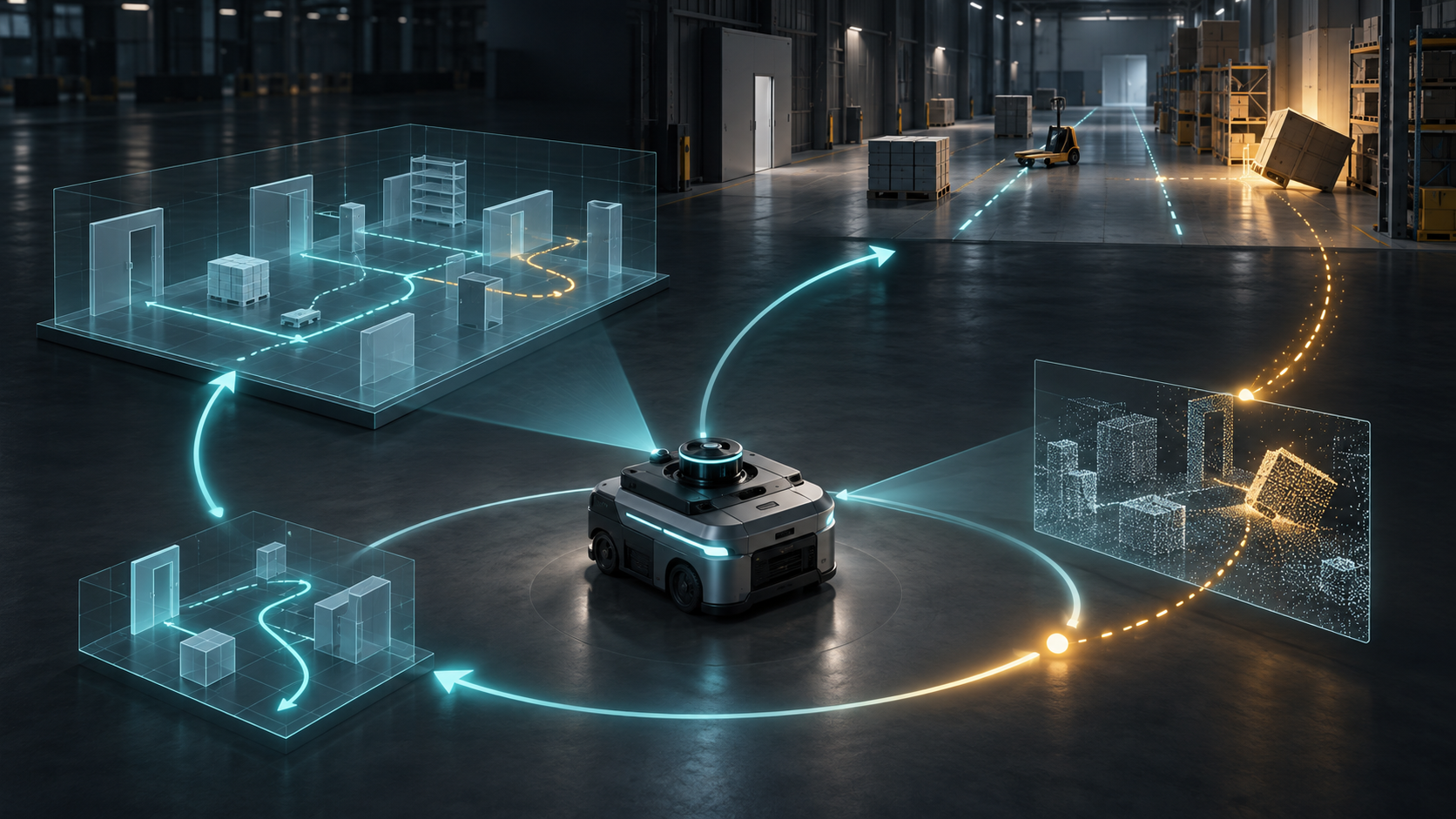
The physical case makes the idea easier to see. A robot cannot treat “move left” as a text completion. It must account for its position, nearby objects, permitted movement, and the possible result of applying force. That is why world-model work includes systems that can simulate factories, predict what may happen when a robot moves, and generate actions for machines. The enterprise equivalent is less visually impressive, but the product question is the same: what state transition will this action cause?
Memory, tools, and world models solve different problems
Product teams often use “memory,” “context,” and “world model” as if they were interchangeable. They are not. Mixing them together makes requirements vague and evaluation almost impossible.
| Component | Question it answers | What it does not establish |
|---|---|---|
| Language model or policy | What action appears appropriate for the goal and context? | That the predicted consequence is reliable in this environment. |
| Retrieval and context | What relevant information can the agent access now? | How the environment will change after an action. |
| Memory | What happened previously, and what should persist across sessions? | What would happen under an action that has not been taken. |
| Tool or executor | How can the agent perform the selected action? | Whether the action advances the user’s real objective. |
| World model | What next states are plausible if the agent acts? | Whether the agent has permission to take the action. |
| Guardrail or evaluator | Is the proposed or completed action acceptable? | A complete representation of the environment’s dynamics. |
A long-running agent may need persistent memory because work can unfold over days or weeks. That memory might preserve the goal, completed steps, unresolved questions, approvals, and prior failures. Persistent memory is valuable, but it is still a record of history. It becomes part of a world model only when the system uses it to update the current state and improve its prediction of future transitions.
Shared context solves another problem. When agent work remains inside one person’s session, the missing information, corrections, and failed attempts remain hidden from colleagues. A shared surface can make requests, corrections, results, previews, and implementation artifacts visible to the people directing and reviewing the work. That improves coordination and oversight. It does not, by itself, teach the agent how the environment behaves.
Consider an agent that closes an operational request. Memory can tell it that a user previously supplied missing information. Retrieval can fetch the current record. A tool can change the request’s status. A narrow world model represents the valid states, required dependencies, permitted transitions, expected confirmation signals, and recovery route if closure fails. A policy then decides whether to close, ask a question, wait, or escalate.
This decomposition also prevents a dangerous design shortcut: using the language model’s confidence as proof that an action is safe. A fluent explanation of what should happen is not evidence that the predicted transition is calibrated. Prediction, permission, execution, and verification should remain distinct responsibilities even if one model participates in several of them.
Decide whether your agent actually needs a world model
I would not start an agent initiative by buying a world-model platform. I would start by identifying where the product must reason about consequences. The following questions expose that boundary:
- Does the agent take multiple actions whose effects interact?
- Can an action look successful at the tool level while leaving the business process in the wrong state?
- Is feedback delayed, incomplete, noisy, or available only through a later observation?
- Must the agent infer important hidden state from indirect signals?
- Could a valid action create a costly, irreversible, or hard-to-recover outcome?
- Does the best next action depend on predicting more than one plausible future?
- Can you build a simulator, sandbox, ruleset, or replay environment in which those predictions can be tested?
If most answers are no, a general world model is likely unnecessary. A well-designed workflow, tool schema, permission layer, and evaluator may be enough. Do not turn a deterministic process into a probabilistic research project.
If several answers are yes, you probably need a consequence model. Its sophistication should match the environment:
- For drafting, summarization, retrieval, and one-shot classification, concentrate on context quality and output evaluation. There may be no meaningful environment transition to model.
- For deterministic record operations, start with explicit states, preconditions, invariants, and allowed transitions. A state machine is often more inspectable than a learned model.
- For multi-step software workflows, add a sandbox or process simulation so the agent can test plans before changing production state.
- For physical systems, model geometry, dynamics, constraints, observations, and uncertainty at the resolution the action requires.
- For changing environments with incomplete rules, use a hybrid: deterministic constraints for what must never happen, learned predictions for uncertain transitions, and human review for consequential ambiguity.
Be equally demanding with vendors and internal proposals. Ask for six concrete artifacts: the represented state, the available action set, the transition prediction, the treatment of uncertainty, the observation used to verify an outcome, and the evaluation that shows the prediction is useful in your domain. If a demonstration produces an eloquent description of the future but cannot expose those elements, you are looking at generated reasoning, not a validated world model.
The distinction is especially important in business applications. A digital twin of the entire company is neither required nor realistically testable for most agent products. A narrow model of the workflow the agent is authorized to change is usually the better product. It gives you a bounded state space, observable outcomes, clearer failure modes, and a realistic evaluation surface.
Build the control loop before expanding autonomy
Start with one consequential decision boundary
Choose one action class where predicting the next state would materially improve the product. Define the user goal, the environment the agent can observe, the tools it may invoke, and the states it is allowed to change. Then write the exclusions.
Exclusions are not an afterthought. If account deletion, movement of money, privilege changes, contract acceptance, or publication to an external audience would create serious exposure, keep those actions behind explicit approval until you have evidence for each action class. A good prediction does not create authorization, and an uncertain prediction should never be converted into silent permission.
Write a state-and-action contract
For every action the agent may take, document:
- The state variables that must be known before acting.
- The preconditions that make the action valid.
- The state variables the action may change.
- The next state or range of states the system predicts.
- The uncertainty or unresolved assumptions in that prediction.
- The observation that would confirm the transition occurred.
- The timeout or signal that indicates the result remains unknown.
- The recovery, rollback, or escalation path.
- The permission level and approval rule.
This contract is useful even if you never train a world model. It reveals missing telemetry, ambiguous ownership, undocumented workflow states, and tools that report technical success without business confirmation. Those are product problems, not model problems.
Use the simplest transition model that survives testing
Start with explicit rules and known process states. Add a simulator where the process has enough interacting parts to make manual reasoning unreliable. Introduce a learned transition model when important behavior cannot be encoded adequately and representative transition data exists. Use a hybrid when hard constraints and uncertain dynamics coexist.
This order is a product discipline, not an argument against machine learning. Deterministic constraints are easier to inspect and enforce. Learned models are valuable where uncertainty is real, but they also create another prediction surface that must be evaluated, monitored, and corrected. Complexity earns its place only when it improves decisions.
Keep prediction, permission, and execution separately observable
Before execution, log the observed state, proposed action, predicted next state, alternatives considered, uncertainty, applicable constraints, and approval result. After execution, log the tool response, observed business outcome, difference from prediction, and recovery action.
That trace should be visible to the people responsible for the workflow. Faster generation can simply move the bottleneck downstream: more output creates more work to inspect, approve, and support. Shared previews and inspectable artifacts help people intervene before an agent completes a large body of work around a misunderstood requirement.
Do not store every token of reasoning as if volume creates accountability. Preserve the compact decision record a reviewer needs: what the agent believed, what it predicted, what it attempted, what actually happened, and why execution was permitted.
Evaluate transitions, not just final answers
A conventional language-model evaluation may tell you whether a response is relevant or well written. It does not tell you whether an agent maintains an accurate state across a sequence of actions. Build an evaluation set around the control loop:
- Replay tests: start from recorded states, ask the agent to predict the next state, and compare that prediction with the known outcome.
- Counterfactual tests: change one meaningful condition and verify that the predicted consequence changes for the right reason.
- Closed-loop tests: let the agent act repeatedly in a simulator or reversible sandbox and measure whether small errors compound across the plan.
- Boundary tests: place the environment near a permission, capacity, dependency, or policy boundary and verify that the agent stops or escalates.
- Observation tests: simulate missing, delayed, contradictory, and stale feedback so the agent cannot mistake absence of evidence for success.
- Recovery tests: inject a failed action or unexpected state and verify that the agent can re-plan, roll back, or hand control to a person.
- Handoff tests: check whether a reviewer can reconstruct the state, prediction, action, and unresolved risk without replaying the entire session.
Track measures that correspond to those tests: next-state prediction error, invalid-action rate, goal completion, error growth over longer plans, human intervention, successful recovery, and the share of outcomes that remain unobserved. Do not collapse them into one agent score. A high completion rate can conceal unsafe actions, while a low intervention rate can mean either strong autonomy or weak oversight.
Expand authority by action class
Roll out through evidence-bearing stages: offline replay, shadow prediction, recommendations for human approval, automatic execution of reversible low-impact actions, and only then broader authority. At each stage, compare predicted and observed transitions. When the environment changes or the prediction degrades, move the affected action class back to a safer stage.
This is more precise than declaring the whole agent autonomous. One agent can have different authority for different tools, states, and consequences. It may automatically retrieve information, propose a record change, require approval to send an external message, and be prohibited from deleting data. The unit of governance is the action in context, not the agent’s brand name.
Key takeaways
- An LLM helps choose or describe an action; a world model predicts how the relevant environment may change after that action.
- Memory preserves history, retrieval supplies facts, tools execute actions, and guardrails control permission. None is a substitute for modeling consequences.
- Most enterprise agents need a narrow workflow model, not a general simulation of the company.
- Start with explicit states and rules. Add simulation or learned dynamics only when simpler models fail on a consequential decision.
- Evaluate predicted transitions, accumulated plan error, recovery, and handoff quality, not only the final response.
- Grant autonomy by action class and consequence. Keep irreversible or high-impact actions behind approval until the evidence supports a change.
At your next roadmap review, pick one agent action and ask the team to show its current state, predicted next state, confirming observation, and recovery path. If those four elements are missing, you do not yet need a grand world-model strategy. You need a better control loop.
References
- Nate Jones’s Substack — Inside NVIDIA: What a world model actually is, and how it connects to the LLM you already use
- Towards AI — TAI #223: Opus 5.5, Cheaper GPT-6 and Agents at Dreamforce