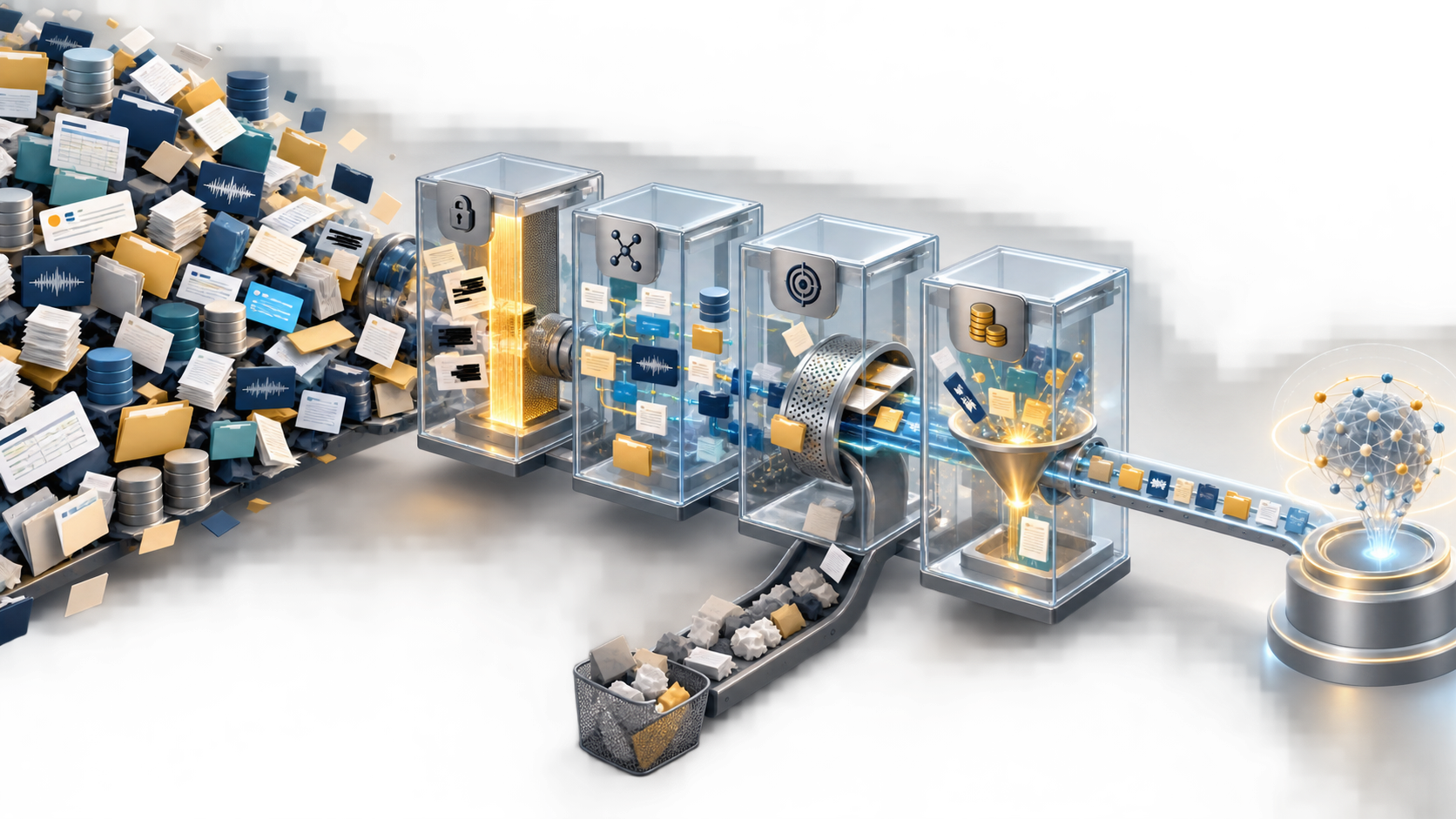
Your tender inbox contains a deadline, a stack of attachments, and a chain of decisions that still lives in people’s heads. The tempting response is to buy a model that can read PDFs. That solves only the most visible part of the problem.
A useful tendering product must determine which documents matter, extract requirements with evidence, match those requirements to a catalog, retrieve approved pricing, draft an offer, identify uncertainty, and route exceptions before anything reaches the customer. If you lead AI or product strategy for a manufacturer or supplier, your first goal should not be an autonomous bidder. It should be the smallest tender category in which every decision can be observed, evaluated, and improved.
Pick a bounded quote, not the entire tendering department
Construction tendering is too broad for a credible first release. Product categories have different terminology, selection rules, catalogs, pricing structures, and exception patterns. A system that works for one bounded category has not automatically learned how to quote every building product.
One effective wedge started with radiator requests for a single design partner before expanding to other building products. That constraint made the catalog, expected outputs, and expert reviewers knowable. It also created a place to learn the real workflow rather than designing from an idealized process diagram.
Choose your wedge using operational criteria, not enthusiasm for the model:
- The request appears often enough for reviewers to recognize recurring patterns.
- The relevant catalog is bounded and maintained by a clear owner.
- A domain expert can explain why a product is suitable, unsuitable, or uncertain.
- The correct price can be traced to an approved system or document.
- Historical tenders and reviewer corrections are available for evaluation.
- An error can be caught during review before it becomes a customer-facing commitment.
A design partner is especially valuable because the work is not fully documented. In one implementation, the product team spent a week observing the process on-site. That kind of observation exposes the browser tabs, informal checks, catalog shortcuts, and exception handling that an interview alone can miss.
Follow one tender from the incoming email to the final offer. At every handoff, record five things: the input, the decision, the evidence used, the person or system responsible, and the condition that triggers an exception. If you cannot state those five things, you do not yet have a well-defined agent task.
Keep three layers of information separate from the beginning:
- Stated requirements: what the tender explicitly asks for, with the originating file, page, section, or table cell.
- Interpretations: conclusions the system or reviewer draws when terminology is ambiguous, incomplete, or inconsistent.
- Commercial decisions: the selected product, approved price, assumptions, exclusions, and offer language.
This separation matters because a polished offer can hide a weak inference. A reviewer needs to see where the tender ends and the system’s judgment begins.
Define the first outcome as a review-ready tender case: organized source documents, structured requirements, proposed product matches, price provenance, unresolved issues, and a draft offer. That is a more useful product boundary than “understands construction PDFs.” It gives the reviewer something concrete to accept, correct, or reject.
Turn the workflow into a decision graph with specialist agents
A chatbot is the wrong mental model. Tendering is a decision graph in which an early classification or extraction error can contaminate every downstream step. Real packages can range from a short request to more than 1,800 pages describing an entire building. The system therefore needs to plan work, retain state, reconcile evidence, and know when coverage is incomplete.
Use agents only where a task requires interpretation, planning, or exception handling. Keep exact operations – file handling, arithmetic, catalog queries, identifiers, template validation, and access control – in deterministic code or approved systems.
| Stage | Preferred control | Required output |
|---|---|---|
| Intake | Rules plus a classifier | A tender case containing the email, attachments, document types, and routing status |
| Requirement extraction | Parser tools plus a specialist agent | Structured requirements with source locations, missing fields, and ambiguities |
| Product matching | Catalog retrieval plus a reasoning agent | Candidate products, requirement coverage, incompatibilities, and rationale |
| Pricing | Approved database, CPQ, or pricing service | Exact product-price records with source and validity information |
| Offer generation | Controlled template plus a drafting agent | A draft that distinguishes confirmed facts, assumptions, and exclusions |
| Quality review | Rules plus a separate review agent | A pass or block decision with issue codes and supporting evidence |
| Human approval | Domain and commercial policy | An approval, correction, rejection, or escalation that becomes evaluation data |
Each agent should have an explicit contract. Specify its permitted inputs, tools, output schema, evidence requirements, completion test, and escalation behavior. “Find the right product” is not a contract. “Return catalog candidates that meet the extracted requirements, identify uncovered requirements, cite the catalog evidence, and abstain when no candidate qualifies” is much closer to one.
For large document sets, require the workflow to maintain a task plan. It should inventory files, identify relevant sections, process bounded units of work, track completed and pending units, reconcile repeated or conflicting requirements, and run a final coverage check. A generated answer is not proof that the package was fully processed.
The review agent deserves its own role. Asking the drafting agent to “check your work” keeps creation and approval inside the same reasoning path. A separate reviewer can inspect the draft against the extracted requirements, catalog evidence, price records, and policy rules. It should return defects and a gate decision rather than silently rewriting the offer. Silent rewriting makes it harder to identify which upstream component failed.
This pattern has practical value because a dedicated review agent can catch errors before human review, much like a separate code review step. Independence comes from the reviewer’s task and evidence contract; adding more agent personas without distinct responsibilities only creates orchestration overhead.
The interface is part of the architecture. During discovery, a dedicated web workbench can be more useful than hiding the workflow behind a legacy integration. Put the source document, extracted requirement, proposed match, price evidence, and review issue within the same review path. That gives the product team control over feedback capture and makes the reason for each correction visible. One tendering product used its own web application to iterate toward greater automation rather than beginning as a backend-only integration.
You can still read from and write to existing systems at defined boundaries. The distinction is between integration and dependence: integrate with systems of record for catalogs, prices, customers, and approved quotes, but do not let an inflexible legacy screen determine how reviewers inspect an emerging AI workflow.
Evaluate every decision before judging the complete quote
An end-to-end result tells you whether a tender case failed. It rarely tells you why. If the final product is wrong, the defect may have come from document routing, requirement extraction, catalog retrieval, product reasoning, pricing, drafting, or review. A single overall accuracy score collapses those failure modes into an unactionable number.
Build an evaluation set for each agent contract and retain a smaller end-to-end set for workflow behavior. Per-agent evaluations make changes and regressions easier to localize. The useful measures differ by decision:
- Intake: correct document classification, attachment coverage, and routing accuracy for each supported tender type.
- Extraction: field-level completeness, exactness for identifiers and numeric values, source-location accuracy, and the rate of unsupported fields.
- Product matching: reviewer agreement, requirement coverage, incompatible recommendations, unsupported matches, and appropriate abstention.
- Pricing: exact agreement with the approved source, correct product-price association, formula validation, and rejection of unavailable or invalid records.
- Offer generation: required-field completeness, consistency with selected products and prices, correct treatment of assumptions, and unsupported statements.
- Review: detection of known defects, false blocks on valid cases, issue classification, and evidence quality.
Slice failures by characteristics that change the work: document length, file type, layout, product category, presence of tables, and conflicting or revised requirements. An aggregate score can improve while performance deteriorates on the long or unusual tenders that consume most reviewer attention.
Use end-to-end measures for the product outcome: review time, correction volume, correction severity, exception rate, percentage of cases that reach the defined completion state, and whether the workflow finishes before its operational deadline. Keep commercial outcomes separate from model correctness. Quote acceptance or win rate can be affected by price, availability, competition, customer relationships, and sales execution; it should not be treated as a clean extraction or matching metric.
Observability must connect those layers. For each tender case, retain the task plan, agent inputs and outputs, tool calls, retrieved catalog or price records, prompt and model versions, gate decisions, latency, failures, and human corrections. Complex agent chains can exceed what generic monitoring exposes, which is why custom tracing and Agent Analytics became necessary in a production tendering workflow.
Capture reviewer feedback as structured data, not only as an edited final document. Store the original output, corrected value, responsible stage, reason code, evidence used, and final disposition. Useful reason codes include missing requirement, incorrect extraction, unsupported product match, pricing issue, unresolved conflict, invalid assumption, and drafting defect.
Do not feed every edit directly back into the system and call it self-learning. A reviewer may change wording for preference, apply customer-specific knowledge, or correct an upstream error in the final draft. Validate the correction, assign it to the right component, and add it to the corresponding evaluation set. That turns human review into controlled learning rather than an untraceable feedback loop.
Release changes through two gates. First, the modified agent must pass its own evaluation set. Second, the complete workflow must pass the end-to-end set because an improvement in one component can change the assumptions of another. The trace should show exactly which version produced every customer-facing artifact.
Earn autonomy one commercial boundary at a time
“Straight-through processing” is incomplete unless you define where the straight-through path ends. Automatically extracting requirements is not the same risk as automatically selecting a product, committing a price, writing to the CPQ, or sending an offer to a customer.
Use an autonomy ladder with an explicit boundary at each stage:
- Shadow: the system processes live-shaped cases, but its outputs do not affect the operational tender.
- Assist: it organizes documents and extracts requirements while a person performs matching, pricing, and drafting.
- Draft: it proposes products and produces an offer, but a human must review and approve every case.
- Gated processing: it completes predefined internal actions for in-scope cases and sends all exceptions to a reviewer.
- External dispatch: it sends an offer without case-by-case approval only when commercial policy explicitly permits that action and every required gate passes.
Eligibility for a higher-autonomy path should be machine-checkable. At minimum, confirm that the product category is in scope, every required document was processed, required fields are present, source evidence is attached, conflicts and revisions are resolved, the product match satisfies its evidence rules, the price comes from an approved valid source, the review agent reports no blocking defect, and the full trace is retained.
A wrong product or price can create margin, delivery, contractual, and customer-trust exposure. If an offer may create a binding commitment, keep human approval until the appropriate commercial and legal owners have defined the policy for automatic dispatch. The safe alternative is to automate preparation while preserving approval at the commitment boundary.
Operational controls matter after launch. Give reviewers a visible exception queue, make the reason for every block legible, preserve manual processing when the AI path is unavailable, and provide a way to suspend autonomous actions without disabling access to already processed cases. Assign owners for catalog quality, pricing validity, tender policy, model behavior, and production reliability; otherwise each exception will bounce between teams.
Expansion should follow evidence and customer pull. A request to replace an existing CPQ system is a meaningful product-market signal, but it is also a change in product scope. CPQ replacement introduces responsibilities for quote versions, approval policy, catalog administration, pricing governance, integrations, and records. Treat that request as a roadmap decision, not as proof that the original agent workflow already covers those capabilities.
Key takeaways
- Start with one product category, one known workflow, and reviewers who can explain the correct decision.
- Optimize first for a review-ready tender case, not an impressive answer from a general chatbot.
- Use deterministic systems for exact operations and specialist agents for interpretation, planning, and exceptions.
- Require structured outputs, source evidence, explicit completion tests, and an abstain-or-escalate path from every agent.
- Evaluate each stage separately, then use end-to-end metrics to measure the operational outcome.
- Increase autonomy only when observable eligibility gates protect the next commercial boundary.
At your next roadmap review, put one representative tender on the screen and draw the decision path from email to offer. Name the owner, evidence, pass condition, and exception path for every node. Wherever those are missing, the next task is workflow discovery, not another agent. Once the graph is explicit, you can automate one bounded decision, measure it, and earn the right to automate the next.