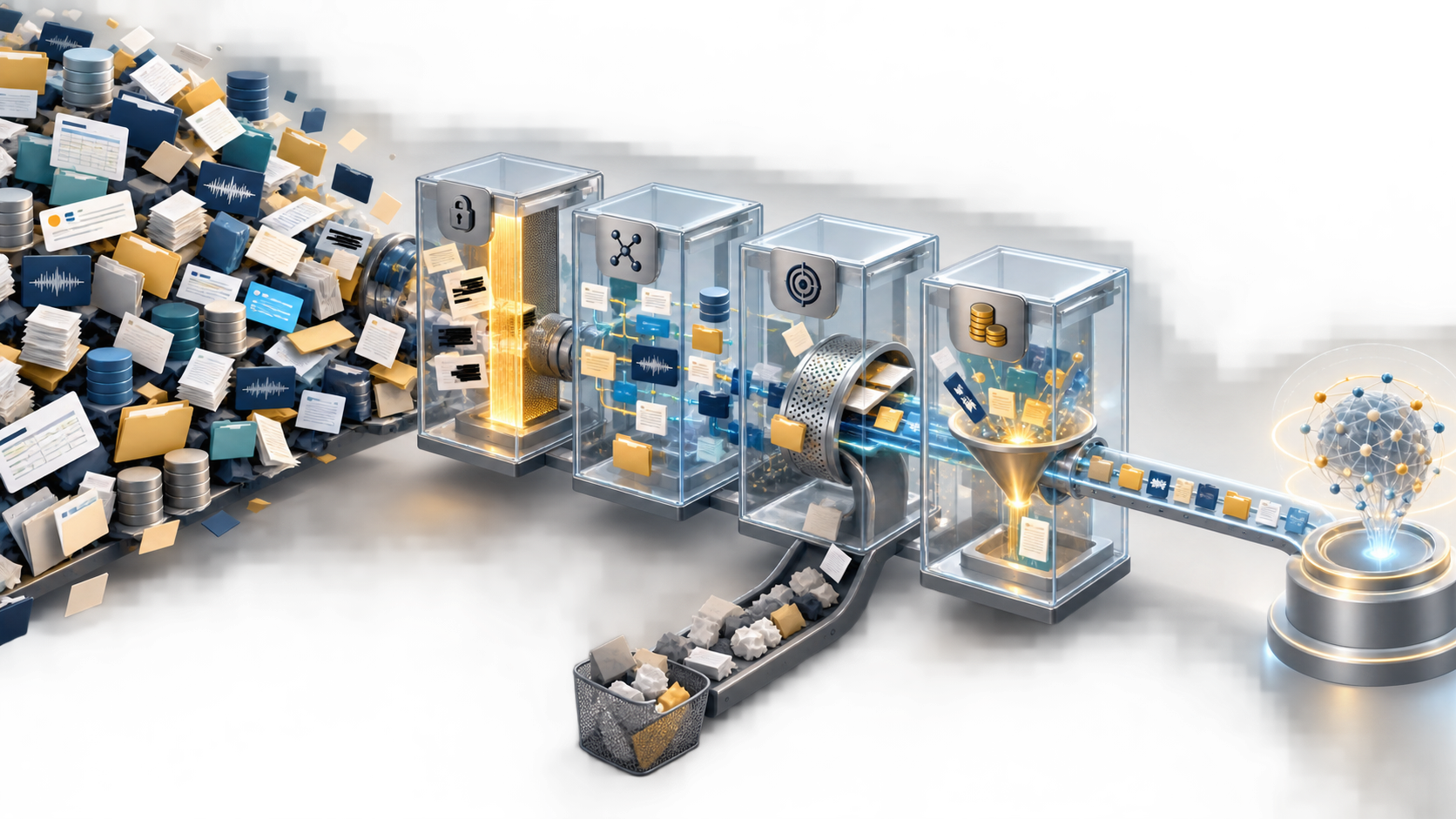
Your team may already use AI to draft emails, summarize calls, research accounts, and answer website questions. Yet the lead still waits in a queue, the seller still reconstructs context, and the customer still repeats the same information after every handoff.
If you are deciding how to make go-to-market genuinely AI-native, do not start with another list of tools. Decide which part of the revenue journey can run as a complete, observable workflow: AI handles defined decisions and actions, humans take over at explicit boundaries, and both work from the same customer state.
Redraw the revenue workflow before automating its tasks
Adding an assistant to every department can make individual tasks faster without making the revenue system faster. Marketing produces more content, sales receives more research, and customer success gets more summaries, but the queues and handoffs between those functions remain intact. More output can even make those bottlenecks worse.
An AI-native workflow has a different unit of design. It owns a bounded outcome over time. It can observe an event, retrieve approved context, choose among permitted actions, update the CRM, evaluate what happened, and either continue or escalate. The distinction matters: generating a follow-up email is a task; noticing that a qualified buyer has gone quiet, selecting the appropriate follow-up, sending it under policy, recording the attempt, and changing course based on the response is a workflow.
Map one live customer journey before discussing models or vendors. For every transition, write down six things:
- Trigger: What observable event starts the work? Examples include a demo request, an unanswered question, a completed trial action, or a missed follow-up.
- State: What must be known before anyone acts? Include the account, buyer, stage, previous interactions, consent, product usage, and open commitments that matter.
- Decision: What choice is being made? Qualification, routing, next-best action, escalation, or disqualification should not be hidden inside a vague prompt.
- Action: What is the agent actually allowed to do? Drafting, sending, booking, calling, demonstrating, updating a field, or creating a human task are different permission levels.
- Evidence: What will prove that the action was appropriate and completed? Preserve retrieved passages, tool results, timestamps, policy checks, and the resulting CRM change.
- Exception owner: Who takes responsibility when confidence is low, the buyer objects, the data conflicts, or the request falls outside policy?
This map exposes where AI can remove elapsed time rather than merely reduce typing. Baseline the current path using measures you already trust: time between stages, abandonment points, manual touches, repeated discovery, and incomplete CRM records. Then choose one customer outcome, such as completing a qualified next step, instead of treating generated messages as success.
My test is simple: if the proposed system cannot identify its current state, show why it acted, and recover from a failed action, it is still a feature. It is not yet part of the revenue operating system.
Start with a bounded inbound motion, then earn more autonomy
I would usually start where the buyer has already expressed intent. An inbound visitor asking a product question or requesting a demonstration gives you a clear trigger, an identifiable job, and a natural human fallback. You can observe whether the interaction advances the buyer without asking an agent to manufacture demand across an ambiguous market.
A strong first workflow has five properties:
- The entry event and desired next state are unambiguous.
- The agent can answer from an approved and maintainable body of knowledge.
- Most actions are reversible, or a human can approve them before execution.
- Failure and frustration can be detected quickly.
- The business outcome appears in a system of record rather than a separate AI dashboard.
Inbound qualification, guided product education, demo support, meeting preparation, and structured follow-up often fit these conditions. A practical early implementation can be deliberately modest: a voice interaction, reusable product demonstrations, and a retrieval-first knowledge layer. Retrieval gives the agent current, company-approved material without forcing every sales fact into a prompt, and it gives evaluators evidence against which to judge an answer.
Treat the interaction surface as part of the workflow, not as decoration. In one documented implementation, adding a realistic avatar changed how prospects behaved: they interrupted, probed, and requested demonstrations in ways associated with a live sales conversation. That is evidence that an interface changes the behavior it invites, not proof that every buyer or sales motion needs an avatar. Test chat, voice, and video against the buyer’s actual job. Do not choose the most human-looking interface by default.
Expand autonomy in gates rather than with one large launch:
- Shadow: The agent recommends an answer, decision, or next action while a human remains responsible for execution. Use disagreements to build the first evaluation set.
- Constrained execution: The agent handles approved questions and actions, writes every result to the CRM, and routes exceptions to a named person.
- Bounded workflow ownership: The agent can continue across interactions and days, but only inside an explicit state machine, policy envelope, and escalation contract.
- Adjacent expansion: Reuse proven capabilities in another stage, such as onboarding or customer success, only after the first workflow is stable and measurable.
Gate movement on evidence, not enthusiasm or a calendar date. The agent should not receive a new action merely because it can generate plausible language. It should receive that action when you can detect a bad decision, contain its consequence, and restore the customer journey.
Give agents distinct jobs and humans a real handoff contract
A single prompt that qualifies, pitches, retrieves facts, controls tools, remembers history, evaluates itself, and decides when to escalate becomes difficult to test. It also mixes goals that can conflict. A persuasive sales response and a conservative policy check should not compete for attention in the same undifferentiated instruction block.
A useful architecture separates five responsibilities:
- Knowledge or creator agent: Turns approved documentation, training material, and transcript patterns into versioned playbooks and retrievable knowledge.
- Conversation agent: Handles the live interaction, asks the next appropriate question, and stays within the current objective.
- Workflow orchestrator: Maintains state across channels and time, selects the next permitted step, invokes tools, and pauses when an exception occurs.
- Evaluator: Scores the interaction for grounding, policy compliance, conversation quality, sentiment, and task completion.
- Human owner: Resolves ambiguity, negotiates unusual terms, restores trust, and changes the playbook when the system exposes a recurring gap.
Specialized conversation roles can also help manage latency, context limits, and model weaknesses. Greeting, discovery, qualification, and pitching do not necessarily need identical instructions or context. The important design move is not the number of agents; it is the ability to isolate a responsibility and test it. Deterministic paths can handle predictable stages while orchestration manages contextual departures.
Do not split a workflow into a swarm merely because multi-agent architecture sounds advanced. Start with the fewest independently testable components. Split one when its context becomes noisy, its latency threatens the experience, its permissions need separate control, or its failures require a different evaluation method.
The orchestrator should persist a compact state record that another worker can understand. At minimum, capture the current objective, stage, known facts, supporting evidence, confidence, unresolved questions, commitments already made, next permitted action, and current owner. Keep the transcript available, but do not force every downstream decision-maker to reconstruct state from raw conversation history.
A human handoff is a product contract, not an emergency notification. Define its triggers before launch. Useful triggers include:
- The agent cannot find approved evidence for a material answer.
- Confidence falls below the level you have defined for that action.
- The buyer repeats a correction, expresses frustration, or explicitly requests a person.
- The request involves commercial, security, legal, or contractual judgment outside the approved playbook.
- A tool fails, CRM state conflicts with the conversation, or the proposed action would duplicate an existing commitment.
The receiving person needs more than a transcript link. Send the buyer’s goal, the current stage, facts already established, the reason for escalation, supporting evidence, actions attempted, promises made, urgency, and the decision the human must make. Pause further automated outreach until ownership is acknowledged. Otherwise, the agent can send a cheerful follow-up while a seller is handling a sensitive objection.
After the human resolves the case, specify whether control returns to the workflow and what state must change first. That return path is where many pilots quietly become permanent manual operations.
The CRM must carry this shared state in both directions. Agents should read the latest account context and write back decisions, actions, outcomes, and evidence. A system that conducts a convincing conversation but leaves the record incomplete creates invisible work for the next person. Tight CRM integration and persistent workflow orchestration are what turn an interface into an operating capability.
Use evaluations and revenue governance as the control plane
A polished demonstration proves that a workflow can succeed once. Revenue leaders need evidence that it succeeds repeatedly, fails visibly, and improves without silently regressing. That requires an evaluation system tied to release decisions.
Build the control loop in this order:
- Define the failure taxonomy. Separate unsupported facts, policy violations, missed discovery, poor routing, broken tools, excessive latency, incorrect CRM updates, weak handoffs, and incomplete outcomes. A single quality score hides the repair you need.
- Create a representative evaluation set. Include common interactions, important segments, known edge cases, adversarial requests, tool failures, and examples that should trigger escalation. Label the expected action and unacceptable actions, not only an ideal sentence.
- Review production conversations aggressively at the start. One practical deployment pattern reviews every interaction during early operation and tapers toward a sample of about 5% as confidence grows. The reduction is earned through observed quality; it is not a default schedule. Customer review, evaluator scoring, and sampling can operate as one quality loop.
- Turn failures into regression tests. When a human corrects an answer, routing decision, or handoff, add a durable test before changing the prompt or playbook. Otherwise, fixing one conversation can break another without detection.
- Release progressively. Use proof-of-concept validation, controlled exposure, A/B rollout where appropriate, CRM logs, and dashboards. Preserve a rollback path for prompts, models, playbooks, tools, and policies.
- Expand authority only after two kinds of evidence agree. Agent quality must remain acceptable, and the intended business outcome must improve without shifting damage into complaints, bad-fit pipeline, downstream rework, or customer churn.
Your dashboard should distinguish system quality from business performance. Both are necessary, and neither can substitute for the other.
| Measurement layer | Question it answers | Useful signals |
|---|---|---|
| Agent quality | Did the system act correctly? | Grounding, policy compliance, playbook adherence, tool completion, latency, and evaluator-human disagreement |
| Buyer experience | Did the interaction preserve clarity and trust? | Repeated questions, corrections, frustration signals, unresolved requests, escalation rate, and handoff continuity |
| Revenue outcome | Did the workflow advance the right customer? | Qualified progression, completed bookings, stage movement, activation, retention, and downstream rejection of poor-fit opportunities |
| Operating health | Can the capability run and improve reliably? | CRM completeness, failed actions, recovery, human review load, overrides, version history, and cost per completed outcome |
Do not reward the agent for conversion alone. A system can raise a local conversion metric by overpromising, qualifying weak opportunities, or making escalation harder. Review performance by segment and release version, and keep quality and downstream outcome guardrails beside the target metric.
Governance also needs named owners. The CRO should own the end-to-end revenue outcome and the interlocks across marketing, sales, solutions engineering, onboarding, and customer success. Product and AI leaders should own agent behavior, experience, evaluation infrastructure, and release gates. Revenue operations should own CRM state, definitions, attribution, and operational dashboards. Functional leaders should own their playbooks and exception policies. Humans in the workflow should own judgment where trust, negotiation, and ambiguity matter.
Centralize the parts that must remain consistent: data definitions, core tooling, pricing guardrails, evaluation standards, and foundational enablement. Let segment plays, partner motions, and contextual field execution stay closer to the teams that understand them. This avoids two common extremes: every function buying its own disconnected agent, or a central AI group becoming the queue for every revenue experiment.
Pair gated releases with a 24-26 month design horizon. The longer view is not a promise that you can forecast models or markets precisely. It forces you to ask what breaks at higher volume, which capabilities must remain centralized, how roles will change, and what data or evaluation debt would block the next level of autonomy. The release in front of you can remain small while the operating architecture anticipates scale.
The first leadership review should produce five concrete artifacts: a workflow map, an agent charter, a human handoff contract, an evaluation set, and a dashboard with a named decision-maker for every release gate. If the meeting ends with only a vendor shortlist, the transformation has not yet been designed.
Key takeaways
- If an agent cannot read and update shared customer state, it is an interface attached to the revenue system, not a worker inside it.
- If the handoff criteria and return path are unclear, the agent’s autonomy is already too broad.
- If production failures do not enlarge the evaluation suite, the organization is collecting incidents rather than compounding learning.
- If a buyer must repeat discovery after escalation, the context architecture has failed even when the AI behaved politely.
- If the roadmap is organized around tools instead of revenue-state transitions, no executive truly owns the transformation.
At your next go-to-market review, choose one live inbound path and walk a real lead through it from trigger to next customer outcome. Assign state, evidence, permissions, and an exception owner at every transition. Automate only the steps whose failure you can detect and recover from. That is how you earn the right to give AI more of the revenue journey.
References
- Shivam.Consulting Blog – Inside ShowMe’s Playbook: Orchestrating Voice, Video & Multi-Agent AI Sales Reps that Close
- Shivam.Consulting Blog – 90% of CROs Will Fall Behind by 2028: Hard-Learned Lessons to Stay Ahead of GTM Change