Tag: CRM integration

  • Speed-to-Lead Is Dead: How AI Agents End the Wait and Rebuild a High-Velocity Sales Org

    Speed-to-Lead Is Dead: How AI Agents End the Wait and Rebuild a High-Velocity Sales Org

    A prospect lands on our site, skims pricing, watches a demo, and clicks “contact sales.” For years, that’s where momentum died. They waited, and we built entire sales motions around managing that delay.

    We optimized for “speed-to-lead,” made it the hallmark of a high-performing sales development org, hired more SDRs, tuned routing rules, added shift coverage, and stared at response-time dashboards. Typical SLA targets were one hour for best-fit leads, four hours for core MQLs, forty-eight hours for everyone else. Those were considered good numbers.

    No one questioned the premise because the lag felt structural—shift scheduling, routing delays, and humans working 9–5. The fastest teams could only shrink the gap; nobody could remove it.

    An AI Agent closes it completely.

    When a prospect arrives today, the conversation can begin immediately. That single change reshapes how I design a sales org—how we staff it, what our team prioritizes, and the metrics we hold ourselves accountable for.

    Step outside our dashboards and look at the buyer experience. We spend heavily to drive traffic, then push visitors into forms and queues that add friction precisely when purchase intent peaks.

    Intent is highest the moment someone seeks out our product. If an SDR follows up two or three hours later, that buyer’s in another meeting, the urgency has faded, and the moment is gone. We still call it a lead; the buyer has already moved on.

    What AI changes

    Agents eliminate the structural constraints that made speed-to-lead a problem—shift scheduling, routing delays, CRM batch processing, the SDR being on another call. None of it applies anymore because every single lead can be engaged immediately, at any hour and in any language.

    The impact goes beyond response time. When an Agent engages at peak intent, qualification, discovery, and even an initial demo moment can unfold in a single, continuous conversation. The gated funnel collapses. There’s no reason to qualify someone today, schedule discovery for Thursday, and demo the following week when the conversation is already happening.

    The constraint the industry built around simply isn’t there anymore. We’re already seeing it with Fin, a Customer Agent. As sales leaders, we need to frame this differently.

    If speed-to-lead is no longer the constraint, the knock-on effects reach every part of the org.

    Minimalist hero graphic with the headline 'Add Fin to your sales team today,' a glossy 3D blue spiral at center, and a black 'Start free trial' button, promoting Fin for Sales as an AI customer agent.
    Introduce Fin for Sales to your team with this clean hero banner: bold headline, signature blue spiral, and a clear 'Start free trial' call to action—inviting readers to explore an AI customer agent built for revenue.

    SDRs focus on moving deals forward. Instead of frontline triage, they double down on phone-based selling and relationship building, complex deal navigation, and multi-threaded engagement across stakeholders—the high-leverage work that used to get crowded out by the inbox.

    Pipeline gets more relevant. The old model rewarded volume: capture as many form fills as possible, respond fast, and sort quality later. When an Agent engages at the moment of intent, it qualifies during the conversation. Low-fit leads get filtered out before they reach the team, and high-fit prospects arrive with context—needs, timeline, stakeholders—instead of just a name and email.

    You measure outcomes, not response time. When first response is instant, different metrics matter. I anchor on three questions:

    1) Is the Agent doing the work? Completion rate, qualification rate, and contact capture rate indicate whether conversations reach clear outcomes and produce usable handoffs to the team.

    2) Is the work producing pipeline? Meetings booked and pipeline created through Agent-handled conversations are the leading indicators of revenue, not how fast someone followed up.

    3) Are buyers having a good experience? Conversation-level satisfaction matters more than ever because the Agent is the first interaction prospects have with your company. The experience it delivers is the first impression you make.

    These three questions reveal whether the motion is working. Time-to-first-response can’t.

    Sales orgs built hiring plans, workflows, and performance metrics around beating intent decay. That made sense when the lag was unavoidable. It isn’t anymore.

    An Agent is always on. It engages the moment a prospect arrives on your site, qualifies them in real time, and routes them to the right outcome without waiting for someone to be free. The lag the industry built itself around doesn’t exist when the conversation starts immediately.

    The companies leaning into this are investing in what happens after the conversation starts: how well the Agent qualifies, where it creates pipeline, and what SDRs should actually spend time on. What matters now is not how fast you respond, but what the conversation produces.

    Speed-to-lead made sense when the delay was structural. It isn’t anymore. If you’re re-architecting go-to-market, instrument Agent Analytics, revisit SDR charters, and tighten CRM integration so every qualified handoff is instant, traceable, and revenue-linked.


    Inspired by this post on The Intercom Blog.


    Book a consult png image
  • Unlocking AI Agents: The Real Barrier Is Readiness—Not Capability—Here’s How to Scale

    There’s a question that runs underneath every AI Agent evaluation: what can it do?

    Two years ago, that was the right question to ask because Agents were limited and capability was a genuine constraint. The gap between what organizations needed and what the technology could deliver was wide. I felt that gap acutely in early pilots—plenty of ambition, not enough dependable execution.

    That gap has since narrowed considerably, and yet most organizations are running their Agents well below what’s technically possible. I see teams lean on answering and routing, but stop short of looking things up, taking actions, or resolving complex, multi-step problems—especially where data, process variance, or risk come into play.

    The standard explanation is that AI isn’t good enough yet—models must improve, or vendors must ship more features. But after studying organizations across industries actively expanding their AI automation, I’ve found that this explanation holds up less often than people assume. The blockers tend to be elsewhere.

    The teams I’ve observed weren’t primarily constrained by what their AI could do; they were constrained by what their organization was structured to let it do. In other words, the ceiling wasn’t the Agent’s capability—it was organizational readiness, governance, and risk tolerance.

    “Readiness” for AI breaks into five distinct types, and most organizations have some but not all of them. Below is how I assess them with product, operations, and engineering leaders.

    Content readiness is whether you can explain your product and policies clearly and consistently. Most companies can. In practice, that means up-to-date knowledge bases, unified policy language, and clear versions that Agents can cite and apply.

    Scope readiness is whether you’ve defined the edges: when should AI engage, and when should it step aside? Edge cases multiply, intent varies by customer segment, sensitive topics surface mid-conversation, but most teams can work through this with effort. Clear guardrails reduce ambiguity and shrink risk.

    Procedural readiness is where things start to get harder. This is about whether you can articulate your processes clearly enough for something other than a human with years of tacit knowledge to follow. The happy path is rarely the problem. It’s the failure paths, decision branches, variations that have never been written down because they’ve always lived in someone’s head.

    Data readiness is the first real cliff. Can you reliably identify the right user, account, or object at the moment a decision needs to be made? Is the data trustworthy in real time? Are the APIs stable, accessible, and actually connected? For most organizations, the honest answer is “partially, but we’re not always sure when it breaks.”

    Execution readiness is the highest bar. Not just technically (can the Agent make the change?) but organizationally. Who owns it when the wrong refund gets processed? Who detects it? Who recovers? Does someone with authority actually accept the risk?

    Most companies have the first two, some have the third, fewer have the fourth and fifth. When I map this with teams, we often discover that their Agent’s ceiling is really a reflection of operational maturity and data plumbing, not model quality.

    We studied companies across six industries – energy, healthcare, ecommerce, gaming, financial services, property management – all trying to expand what their Agents could do. The pattern was consistent: teams set out to automate real actions—looking up account status, processing changes, handling transactions. In most cases, the AI could technically do it, but at a certain point (somewhere between guiding a user through a process and looking something up on their behalf) they hit a wall.

    One team tried to automate application changes but couldn’t reliably identify which application to modify across their internal systems. Another explored billing automation but couldn’t access live account data due to regulatory constraints. A third needed to verify status across third-party vendor systems their Agent couldn’t reliably reach. I’ve seen similar constraints surface around CRM integration, data governance, and vendor SLAs—none of which are model issues.

    In most cases, the team redesigned around what their infrastructure could support. They moved toward guiding—walking users through processes step by step, rather than executing changes on their behalf. It worked, it resolved conversations and delivered real value, just differently than anyone planned. In customer support, this often looks like consultative flows that shorten time-to-resolution even without direct writes.

    Most Agent evaluations are built around capability. Can it handle complex queries? Does it support multiple channels? Can it integrate with our systems? These are reasonable things to evaluate for, but they produce a capability score, and that doesn’t tell you whether your organization can actually use what you’re buying.

    The teams that got to deeper automation, the ones executing actions early, didn’t have “better AI,” they had more standardized operations. Actions that were already well-defined, consistently applied, and exposed through stable systems with clear rules. Automation wasn’t inventing new behavior, it was triggering actions that were already tightly controlled elsewhere.

    Readiness enables capability, not the other way around. Which reframes the evaluation question from “can the AI do this?” to “are we actually ready for it to?”

    Something that gets lost in most conversations about AI readiness is that organizations are often further along than they assume, just not for the kind of work they were planning for. A team that set out to automate refunds but can reliably guide users through complex troubleshooting has genuine capability deployed. They’re operating at the level their readiness supports, which is a starting point, not a deficit.

    The more useful frame isn’t “are we ready?” – it’s “what are we ready for, and what specifically stands between here and the next level?” The gaps tend to be concrete: a missing API, data that lives in three systems that don’t agree, a process that’s never been documented, or an ownership question nobody has answered. These are solvable problems. They just require a different kind of investment than buying a more capable Agent.

    What nobody has worked through seriously yet is how organizations actually build readiness. Does it develop naturally through using AI at shallower levels first? Or is it mostly a function of prior decisions, like system architecture choices made years ago, operational maturity that accumulated over time, engineering investments that have nothing to do with AI? When readiness does increase, what actually changes? Does the support team develop it? Does engineering grant it? Does it require executive sponsorship and investment in infrastructure with no obvious AI label on it?

    In my experience, progress comes from a joint effort: product to define scope and guardrails, operations to codify procedures and edge cases, engineering to harden APIs and observability, and leadership to underwrite risk with clear ownership. When those pieces align, agentic AI moves from guided assistance to safe, auditable execution.

    Until there are clearer answers, the pattern is likely to continue. Companies will buy capable Agents, plan ambitious rollouts, and find that the harder work is building the organizational infrastructure. The Agents can do the work. The question is what it takes to let them.


    Inspired by this post on The Intercom Blog.


    Book a consult png image
  • The Ultimate Knowledge Management Playbook to Supercharge Your AI Sales Agent

    The Ultimate Knowledge Management Playbook to Supercharge Your AI Sales Agent

    Revenue leaders are starting to use AI to generate better leads, capture peak buyer intent, and scale their pipeline without a linear increase in headcount. I see it every day in my own teams: when we get the foundations right, AI doesn’t just answer questions—it accelerates qualification and turns curiosity into pipeline.

    Done well, an AI-first inbound sales experience engages buyers 24/7 in any language, qualifies leads intelligently, and routes high-intent prospects to the right conversion path. But behind that experience, there’s an unsung hero: knowledge management. I’ve learned the hard way that even the smartest Agent underperforms if it’s not fed the right information.

    A Sales Agent is only as good as what you give it to work with. If you’re using an Agent, like Fin, to run inbound sales motions end to end, it needs an extensive pool of knowledge to draw from. You need to feed it accurate answers on pricing, features, and plan fit, and clear rules for how to qualify and route each prospect. Without it, your Agent can’t do its job, and your sales team is back to answering the same questions manually and triaging leads that could have been handled automatically.

    In this guide, I walk through everything you need to know about building and maintaining the knowledge base that powers your Sales Agent—what to include, how to launch, what to measure, and how to iterate so results compound over time.

    What is knowledge management and why is it so important?

    Definition: Knowledge management is the process of creating, organizing, sharing, and maintaining knowledge in your business.

    Black-and-white testimonial graphic for Fin with a close-up portrait on the left and a large quote on the right highlighting how knowledge management boosts sales funnels, conversion, pipeline, and revenue.
    Knowledge is your sales agent's edge. This Fin testimonial shows how organizing and optimizing content removes friction in the funnel, lifting conversion and unlocking millions in pipeline and revenue for growing teams.

    Your public website and product pages are classic examples, but those are just the tip of the knowledge management iceberg. In an inbound sales motion, knowledge management involves a range of activities such as creating resources (FAQs, pricing overviews, competitive battlecards, case studies, internal sales materials), identifying gaps in documentation and qualification criteria, implementing systems that make information easy to access and use, and developing processes to keep everything current. In my experience, these elements are what allow an Agent to move from merely answering questions to recommending the right plan and explaining why it fits.

    Why knowledge management matters even more in the age of AI

    Your knowledge base is no longer just static collateral for buyers to read. It powers your Sales Agent and entire inbound motion. It’s the key to accurately answering complex prospect queries, guiding product discovery, qualifying intent in real time, and accelerating the path to pipeline. Two realities shape my approach:

    1) Your Agent is only as strong as what you “feed” it. Your Agent is only as good as the knowledge and content that it has access to. A lack of information, poorly structured sales materials, or out-of-date pricing documentation all prevent it from providing clear and correct answers to your buyers, leading to poor buying experiences that degrade trust and cost you deals. No large language model (LLM) knows your business like you do. It doesn’t understand your prospects’ specific needs, pain points, pricing tiers, or use cases. That knowledge is unique to you and your organization, which means you need to map it all out and explicitly feed it to your Agent. You need to feed it facts about your product, and also give it the context behind those facts so it can guide buyers to the right solution rather than just answering their questions.

    2) Every investment of knowledge has compounding results. Making the switch to AI isn’t just adopting a new tool. It means adapting to a new ecosystem. Think of it as a flywheel. Every piece of knowledge you add makes your Agent more effective. It generates better conversations and data, which tells you what to add or refine next. The more you invest in it, the faster it compounds.

    Monochrome quote graphic for Fin featuring a grayscale headshot on the left and a large quote on the right about avoiding duplicate content for sales, highlighting efficient knowledge management.
    Smart sales teams don’t copy what already works for service—they connect to it. This Fin quote card reminds readers to reuse trusted knowledge, cut duplication, and keep content manageable for faster, more accurate selling.

    “You have to think about AI like a new sales rep. On day one, it needs coaching, guidance, and feedback. But over time, as you refine the inputs and learn from real conversations, it becomes more autonomous and the level of coaching required decreases significantly.” Pascaline Albin, Director of Sales Development at Fin

    Every upfront investment you make in your sales knowledge has long-term, revenue-generating impact. Whether you hire someone to do this work full time or give your sales reps time away from the inbox each week, the ROI speaks for itself. I’ve routinely seen small content improvements unlock big conversion gains.

    Think of it this way: say it takes 30 minutes to document a new competitive battlecard or update pricing information. That 30-minute investment results in hours saved for your sales team, highly engaged buyers who get instant answers, and actionable data to optimize your inbound motion.

    Calculate: Average time to compose a response × frequency of question = time saved for your team. More importantly, that’s time your SDRs and AEs can reinvest in multi-threading into accounts, running complex evaluations, and closing high-value deals that actually move pipeline.

    Calculate: Number of prospects who ask this query × average time to respond = total time saved for buyers.

    Black-and-white headshot of a smiling professional beside a bold quote about Fin's AI Customer Agent and testing Fin for Sales to ensure complete knowledge, perfect customer experience, and faster revenue.
    Give your sales agents the knowledge they need from Day 0. A friendly portrait sits next to a bold statement on using Fin's AI Customer Agent to optimize content, guide reps, and turn buyer intent into pipeline and revenue.

    “For sales funnels, identifying knowledge gaps or friction can result in a huge improvement in conversion. When you optimize Fin with the right content, the incremental improvements have a big impact on our bottom line and can lead to millions of dollars in pipeline and revenue. That's why knowledge management is an integral part of our training and optimization process.” Tommy Dunton, Senior Manager of Sales Development at Fin

    The best way to start generating that data is simply to start. The sooner you begin, the sooner you can capture insights about what your buyers want and need from your inbound sales experience. I prioritize quick deployment, fast feedback loops, and continuous iteration.

    What to include in your knowledge base

    Wrangling and prioritizing all of your internal and external sales documentation can feel daunting, but with the right technology, it doesn’t have to. The ideal platform provides data-driven insights to show what buyers actually ask and a centralized place to create, manage, and optimize your knowledge content. For example, with Fin for Sales, you get access to a leads report that gives you insight into disengaged prospects. Intercom’s Knowledge Hub enables you to create a single source of truth for your public-facing collateral and internal sales materials. Using Content Targeting, you can segment this information so your Sales Agent only uses the exact content you want.

    1) Pricing and product FAQs. What it is: answers to the most common discovery questions buyers have, from pricing and plan differences to implementation, integration, and security or trust topics. How to source: analyze your sales inbox and early discovery calls. Where to use: public website, Sales Agent, and proactive outbound messages.

    Illustration of a sales agent using an AI-powered knowledge management dashboard on a laptop, with chat bubbles, documents, and analytics icons for faster answers and improved customer messaging.
    Give every seller instant, trusted answers with an AI-powered knowledge base that unifies docs, FAQs, and playbooks into a single source of truth—accelerating ramp, boosting call confidence, and improving every customer conversation.

    2) Competitor comparisons and battlecards. What it is: guidance for handling competitor mentions, addressing friction, and highlighting unique value propositions. How to source: talk to top-performing AEs or your product marketing team. Where to use: internal snippets for your Sales Agent and internal sales materials.

    3) Case studies and social proof. What it is: proof points that help buyers build business cases and gain confidence, speeding deal cycles. How to source: collaborate with customer success and marketing on ROI stories. Where to use: Sales Agent, website, and sales collateral.

    4) Specific use cases and buyer personas. What it is: targeted content for cohorts with similar pain points and jobs-to-be-done (e.g., engineering teams, startups). How to source: combine product marketing’s value propositions with real discovery conversations. Document the exact probing questions your best SDRs and AEs use so your Agent can uncover context in real time. Where to use: website and Sales Agent to enable contextual solution matching.

    Content formats and sources

    When sourcing knowledge, cast a wide net. You likely have more relevant content than you realize, and almost any information is useful once framed correctly. With Fin, you can use public articles (product FAQs, pricing overviews, feature benefits), internal articles (internal sales materials, internal FAQs), snippets (short-form text like promotions or battlecards), website pages (synced from your marketing site), and PDFs (whitepapers, technical specs, detailed sales materials).

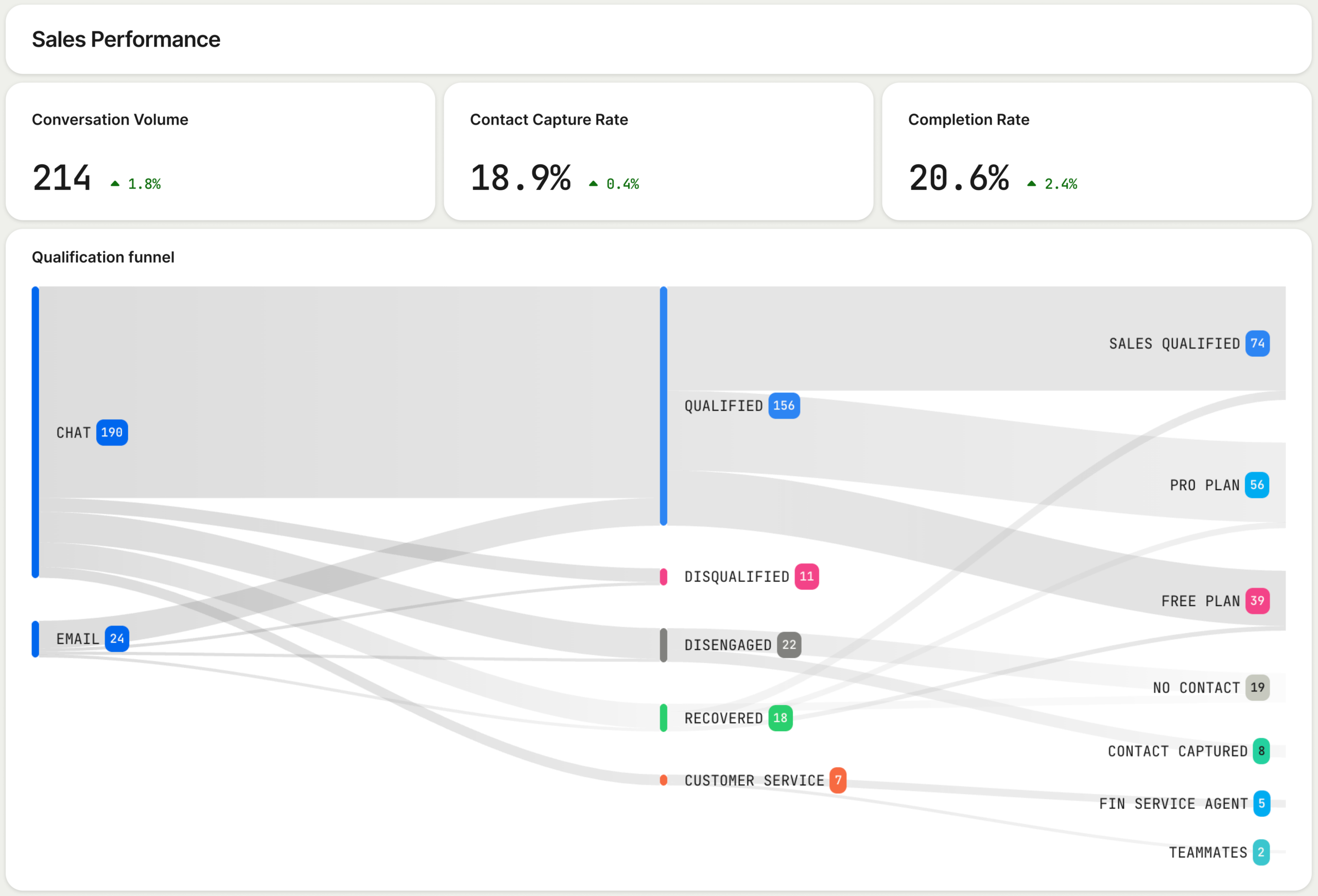
    Sales Performance dashboard with KPIs—Conversation Volume 214, Contact Capture Rate 18.9%, Completion Rate 20.6%—and a Sankey-style funnel from Chat and Email to outcomes like Sales Qualified and Pro Plan.
    Turn conversations into revenue with a clear Sales Performance view. Track rising KPIs and follow leads from Chat and Email through Qualified, Disqualified, and Recovered to outcomes such as Sales Qualified, Pro Plan, or Free Plan.

    Create a knowledge management process that fuels your Agent: 5 steps

    Step 1: Audit what you have. Start by reviewing your current materials to prevent your Agent from learning outdated information and to identify gaps. If you’re already using a Customer Agent, much of that content can pull double duty for sales—no need to start from scratch. Make your existing content available for your Sales Agent and build sales-specific content on top, like pricing comparisons, competitive battlecards, customer case studies, and qualification criteria that wouldn’t apply to service conversations. If you’re starting fresh, audit pricing, product FAQs, feature details, competitor comparisons, case studies, and buyer use cases.

    Put yourself in your buyer’s shoes. Walk through the same steps your prospects take, including their first interaction with your Sales Agent. Before going live, test it yourself. If you’re using Fin, you can do this using the built-in Preview panel to validate answers, routing, and missing topics or objections. Confirm that your Agent asks the right probing questions about goals, fit, and urgency before making a routing decision.

    “We're moving incredibly fast at Fin with our Customer Agent, which means optimising our content, guidance and experience with Fin is a constant focus. Before we launch new products, we're testing Fin for Sales to ensure it's got all of the knowledge it needs to make sure the customer experience is perfect and we can convert that intent into pipeline and revenue from Day 0 of that launch.” Tommy Dunton, Senior Manager of Sales Development at Fin

    Seek input from across your GTM organization. Don’t rely solely on sales. Involve marketing, growth, revenue ops, and sales ops to align content with campaigns and routing logic, and to integrate with systems like your CRM. Your SDRs and AEs bring real-world objections, use cases, and competitor insights that win deals—and those should feed directly into your Agent’s knowledge base. Judging fit is as much art as science, and your best SDRs can teach the Agent to interpret subtle signals.

    Black-and-white headshot beside a bold quote about Fin AI for sales agents, stressing ongoing training and high‑quality knowledge bases to lift performance; clean, minimalist layout.
    Scalable selling starts with better knowledge. This graphic pairs a monochrome portrait with a bold Fin quote showing how training agents and curating a strong knowledge base compound AI performance over time.

    Step 2: Plan and prioritize. Decide where to start by focusing on questions your team still answers manually that, if documented, would help your Agent capture more qualified intent. Identify the content your reps share most (demos, explainers, case studies) and ensure the Agent can access it. Look at leads reporting to find early-stage questions, stuck points, and high-volume disengaged outcomes, then strengthen objection-handling content. Prioritize based on pipeline value—build competitive battlecards and enterprise-tier documentation before free-plan details. Use reporting to find funnel drop-offs and content that hasn’t been updated recently—refresh pricing immediately if it has changed.

    Allocate time and resources. Treat your Sales Agent like a core GTM channel, not a side project. Assemble a cross-functional project team with clear roles. The Agent owner translates sales strategy into prompts, routing logic, integrations, and rollout. The optimization owner reviews performance data, identifies drop-offs, and drives changes to content or Agent behavior. Early alignment ensures your Agent operates as a professional extension of your sales team.

    Step 3: Go live and learn. Deploy broadly across your marketing site and pricing pages to accelerate learning. Within weeks, you’ll see where the Agent guides discovery and qualifies buyers versus where it stalls. Investigate drop-offs—often these point to missing answers or weak probing questions. If your Agent and knowledge base live in the same platform, you’ll get full visibility into your qualification funnel and content performance across touchpoints.

    Track metrics to measure success. Monitor completion rate (conversations reaching a clear routing decision), pipeline created (opportunities generated through Agent-handled conversations), meetings booked (qualified prospects routed to a call), and customer satisfaction (quality of the experience). These metrics show what content is working and where to improve.

    Step 4: Iterate and improve. Expect gaps early on. That’s good—it surfaces what buyers need to convert. When the Agent gives a poor response, the root cause is usually missing, outdated, or shallow content. Close the gaps, then monitor your metrics and conversation reviews to keep compounding improvements.

    Black-and-white headshot on the left, with a large Fin-branded quote on the right stating that content powers a Sales Agent's discovery responses and keeps them current on the latest offerings.
    Your Sales Agent runs on great content. This Fin-themed graphic pairs a professional headshot with a bold statement highlighting how strong knowledge enables discovery answers and timely updates across the GTM motion.

    Build ongoing maintenance into your workflow. Knowledge management is continuous. As your product, personas, and goals evolve, so must your content. Define owners, review cadences, and working time to refresh and create content—don’t wait for launch week chaos. Encourage a “knowledge management” mindset by logging content requests from SDRs and AEs when they hear new objections or discover probing questions that uncover true pain points.

    “Training Agents to get better over time is fundamental to using AI. Fin learns from our website and help center, so the quality of those resources directly impacts its performance. The more we’ve invested in our knowledge base, the more success we’ve seen with Fin and those gains continue to compound.” Beth-Ann Sher, Senior AI Knowledge Manager at Fin

    Step 5: Build knowledge management into future launch plans. Make Agent-ready sales content part of every product or pricing launch checklist. Partner with engineering, product marketing, and revenue operations to update catalogs and your Agent’s knowledge base on day zero. Then review early discovery conversations to add resources, address new objections, and fine-tune contextual solution matching.

    “Content should no longer be an afterthought. It is one of your strongest GTM levers because your Sales Agent relies on it to handle discovery questions and stay up to date on your latest offerings.” Beth-Ann Sher, Senior AI Knowledge Manager at Fin

    Best practices for Agent-friendly knowledge management

    Fin quote graphic with a grayscale portrait next to text about unifying conversation data, lead reporting, and agent configuration to improve sales qualification, content insights, and the buyer experience.
    A pull-quote from Fin explains why one platform matters in sales: centralize conversation data, lead reporting, and agent configuration to spot funnel drop-offs, learn which content works, and elevate the buying journey.

    Use the terms your buyers use. Language varies by industry, persona, and role. Analyze discovery calls and on-site searches to capture how buyers actually speak and train your Agent accordingly. Test internally across SDRs, revenue ops, and marketing to reveal variations and content gaps.

    Simplify language and remove ambiguity. Machine-friendly language is buyer-friendly. Avoid jargon, spell out acronyms, and clearly explain key product terms so value propositions land.

    Keep the experience consistent and on-brand. Ensure product terminology, feature names, and pricing tiers are consistent everywhere. Proof for tone, spelling, grammar, and use standardized templates to build trust.

    Add context to your answers. If your internal FAQ is full of “yes/no” answers, expand on the why. Restate the question, provide business context, and equip the Agent with follow-ups that keep the conversation alive and uncover goals and constraints.

    Add text to images and videos. Show and tell—always include clear explanatory text so your Agent and all users, including those with accessibility needs, can benefit.

    Minimalist hero graphic with the headline 'Add Fin to your sales team today,' a glossy 3D blue spiral at center, and a black 'Start free trial' button, promoting Fin for Sales as an AI customer agent.
    Introduce Fin for Sales to your team with this clean hero banner: bold headline, signature blue spiral, and a clear 'Start free trial' call to action—inviting readers to explore an AI customer agent built for revenue.

    Create a scannable structure. Use clear headers and lists in your source content so both Agents and humans can navigate quickly. Avoid dynamic elements that hide crucial details.

    Collect bite-size information in FAQ articles. Package tactical intel—seasonal promotions, short battlecards, edge cases—into concise snippets so your Agent can retrieve and deliver them instantly.

    A connected Agent turns every conversation into insight. When a Sales Agent is connected to your CRM and enrichment tools, every interaction, qualification signal, and piece of sales content flows into a connected system. “A single platform matters in sales. When your conversation data, lead reporting, and Agent configuration all live in one place, you get much better visibility into your qualification funnel. You can see where buyers are dropping off, what content is working, and can improve the buying experience.” Fred Walton, Senior AI Conversation Designer at Fin

    Every conversation makes your knowledge base sharper, showing you what’s resonating, what’s missing, and where to invest next. That’s the retrieval-first pipeline mindset I push with my teams.

    Make knowledge management a core sales function

    Behind every high-performing Sales Agent is a comprehensive, machine-friendly knowledge management process. Without it, even the most capable Agent will struggle to deliver the pipeline gains AI can deliver. This isn’t a one-time project; it’s a continuous investment. The teams treating knowledge management as a core sales function are building systems that improve with every conversation, turning inbound demand into a compounding growth engine.


    Inspired by this post on The Intercom Blog.


    Book a consult png image
  • Stop Silent Churn: The 8 Best SaaS Prediction Tools for 2026 (Features + Use Cases)

    Stop Silent Churn: The 8 Best SaaS Prediction Tools for 2026 (Features + Use Cases)

    Churn isn’t just a retention problem—it’s a product, go-to-market, and strategy signal that shows up everywhere in the customer journey. Over the past few years, I’ve evaluated and implemented churn prediction tools across high-growth SaaS environments, and the difference between reactive firefighting and proactive, data-driven retention is night and day.

    Compare the top 8 churn prediction tools for SaaS teams. Features, use cases, and how each stacks up, so you can act before customers quietly leave.

    When I assess churn prediction tools for product-led growth, I start with a simple question: will this help my team see risk early enough—and clearly enough—to intervene with precision? The best platforms combine behavioral analytics, retention analysis, and anomaly detection to surface leading indicators before Net Recurring Revenue (NRR) takes a hit.

    First, signal coverage matters. Strong churn models draw from product usage events, CRM integration, support tickets, billing health, and even session replay to capture real-world behavior. I look for native connectors to systems like Intercom, Pendo, and Amplitude analytics, plus flexible ingestion for custom events. Without comprehensive signals, even the smartest models will miss critical moments such as stalled onboarding, shrinking active seats, or feature disengagement.

    Second, I require transparent risk scoring and clear drivers. Black-box scores erode trust with Customer Success and Product teams; explainability builds alignment. Tools that expose driver trees, cohort-based retention analysis, and segment lift help me translate insights into prioritized experiments. When possible, I tie predicted churn segments to A/B testing with a thoughtful minimum detectable effect (MDE) so we can quantify impact quickly and avoid overfitting to noise.

    Third, actionability is non-negotiable. Predictions must trigger targeted AI workflows, in-app guides, and product tours—not just dashboards. My ideal setup routes high-risk cohorts to tailored journeys (e.g., an onboarding rescue path) while notifying the right owner in CRM and Customer Success. Playbooks should be easy to operationalize, measurable, and reversible if the signals change.

    Fourth, I evaluate platform scalability, data governance, and privacy-by-design. Enterprise readiness means clear role-based access, auditability, robust SLAs, and an architecture that can evolve into a unified analytics platform as the product and data footprint grows. I also weigh total cost of ownership, implementation time, and maintenance burden against expected gains in NRR and expansion.

    In my experience, the winning tools are the ones that make it simple to connect predictions to outcomes: reduce onboarding drop-off, increase user activation, prevent seat contraction, and accelerate expansion. They align Product, Customer Success, and Growth around shared metrics, shorten time-to-value, and make proactive retention part of the operating rhythm—not a last-ditch effort at renewal.

    In this 2026 comparison, I’ll outline how each tool handles data breadth, model quality, explainability, and workflow automation. I’ll also share implementation checklists and decision criteria so you can choose the right fit for your stage, stack, and motion—whether you’re primarily product-led growth, sales-led, or hybrid.

    If you’ve ever felt like customers “quietly leave” despite solid top-of-funnel metrics, this guide will help you turn churn signals into concrete actions—and convert at-risk accounts into durable advocates.


    Inspired by this post on Pendo – Perspectives.


    Book a consult png image
  • Outcome-Based Pricing That Delivers: Pay $10 Only for Qualified Leads with Fin for Sales

    Outcome-Based Pricing That Delivers: Pay $10 Only for Qualified Leads with Fin for Sales

    Our outcome-based pricing model hinges on one principle: you pay when Fin delivers value.

    As Fin takes on new roles, that principle doesn’t change, but the definition of value does.

    Fin for Sales qualifies leads, engages prospects, and routes high-intent buyers to your sales team. The value it creates isn’t a resolved query, but a pipeline of qualified opportunities. So we price accordingly: $10 per qualified lead. And you, the customer, define what “qualified” means, not Fin.

    This is the first outcome-based pricing model for an AI Agent for sales. Here’s why I believe it’s the right approach and how I’ve seen it change the way teams think about SaaS pricing and ROI.

    Over the years, I’ve learned that the fastest way to earn trust with sales and finance leaders is to align pricing with outcomes they actually report on. The core finding from our research was unambiguous: zero buyers preferred paying for activity. They wanted to pay for results.

    That insight shaped how we priced Fin for its service role, $0.99 per resolution, where a resolution means the customer’s issue is fully solved without human intervention. More recently, we evolved that model to outcomes, reflecting the broader ways Fin delivers value across complex workflows. We believe pricing should be aligned with value delivery, and the vendor should carry risk when the product doesn’t perform. In sales, the best unit of value is pipeline.

    Most sales teams today are overwhelmed by leads. Early in my career, I watched reps spend hours chasing form fills that looked promising but went nowhere. That experience cemented a lesson I still use: volume is vanity; qualification is sanity.

    Ensuring the right opportunities promptly reach your sales team is what makes a difference. When a prospect visits your site, engages with Fin, answers qualifying questions, and is directed to a sales rep, Fin is identifying whether the opportunity is worth your team’s time and delivering value.

    Charging per conversation would penalize businesses for every curious visitor who asks a question but isn’t a buyer. And charging per token, well, that’s always been a model that protects the vendor, not the customer.

    We needed a metric that captures the actual value Fin creates in a sales context: qualified leads.

    The purest version of outcome-based pricing for Fin’s sales role would be a percentage of closed revenue. Fin qualifies the lead, a rep closes the deal, and we take a cut. On paper, it looks elegant; in practice, I found it breaks down for two reasons that matter to operators.

    First, attribution. Between the moment Fin qualifies a lead and the moment a deal closes, dozens of things can impact the final result. The quality of human-led demos can differ, products can have outages, prospects’ budgets can get cut. Tying Fin’s price to the final outcome holds it accountable for variables entirely outside its control.

    Second, measurement. To track closed revenue, we’d need deep integration into every customer’s CRM, tracking each opportunity from qualification through to close. That’s a significant implementation burden that slows time to value, which is the opposite of what we want.

    So we asked: what’s the most honest proxy for the value Fin delivers, where Fin is clearly the one creating it?

    A qualified lead is that proxy. It represents the moment Fin has done its job. It has engaged the prospect, gathered the relevant information, evaluated them against your criteria, and determined they’re qualified. Everything up to that point is Fin’s work. Everything after it is the rep’s. At $10 per qualified lead, the pricing reflects this boundary.

    There are two key components to how this pricing model works.

    First, the customer defines success. With Fin’s sales role, the customer sets their own qualification criteria based on their business context. A company with high average contract values might set a lower bar because they can’t afford to miss anyone. A company where rep time is scarce and deal sizes are smaller might set a much higher bar, filtering aggressively to only surface the most promising prospects. The criteria flex to match the business.

    Second, the economics are different by design. As a Customer Agent, Fin can switch between roles like sales and service. So if you’ve deployed Fin for Sales, it can still handle support queries like prospects asking a product question. Those queries are charged at $1 per resolution, consistent with our service pricing. Disqualifications, where Fin determines a prospect doesn’t meet the criteria, are also $1. The $10 price point for qualified leads reflects the higher value of pipeline creation compared to issue resolution.

    The ROI speaks for itself. Early customers are reporting significant returns using Fin for Sales. One shared a perspective that mirrors what I hear in executive QBRs:

    “I would say it’s at least 10 times the value. You’re now giving the business exactly what it needs as opposed to just activity. We say this expression in sales leadership all the time – ‘I don’t pay my sales team for activity. I pay them for results.’ I want my AI engine to be the same way.”

    When you compare the cost of a qualified lead from Fin against the fully loaded cost of an SDR—salary, benefits, tooling, ramp time—the economics are compelling. For many businesses, particularly those that never had SDRs in the first place, Fin for Sales isn’t just replacing headcount, but creating an entirely new capability that wasn’t economically viable before.

    This pricing model came from extensive customer research—qualitative interviews and quantitative studies—exploring how buyers want to pay for AI in a sales context. We tested multiple concepts: per-conversation, per-token, per-seat, revenue share, and per-qualified-lead. The research consistently pointed to outcome-aligned pricing as the preferred model, with the qualified lead emerging as the metric that best balances value alignment, measurability, and practical implementation.

    Outcome-based pricing is still rare in AI, but we think that will change. For Sales Agents, we’re the first to do it. Transparency is part of the model. If you understand why we price the way we do, you can evaluate whether it works for your business.


    Inspired by this post on The Intercom Blog.


    Book a consult png image
  • Fin for Ecommerce: The Shopify-native AI Agent transforming product discovery and sales

    Fin for Ecommerce: The Shopify-native AI Agent transforming product discovery and sales

    Today, I’m thrilled to share Fin’s next leap as a Customer Agent: ecommerce. When we launched Fin for Sales, Fin expanded further across the customer journey — and now we’re bringing that same intelligence to product discovery, checkout conversion, and post‑purchase support for Shopify merchants.

    Fin for Ecommerce is a new role purpose-built for Shopify merchants that combines shopping assistance and ecommerce support. Fin is already the best Agent for customer service, resolving over a million queries a week for 8,000+ businesses. Now, it also guides shoppers to the right product, addresses concerns in the moment, and converts browsing into buying — all in one fluid experience.

    Here’s what’s new and why it matters for conversion rate, average order value (AOV), and lifetime value:

    Black-and-white employee portrait beside the Avocado Green Mattress logo and a testimonial explaining that Fin asks about sleep position and firmness preferences to guide shoppers to the right mattress.
    A leading mattress retailer shares how Fin for Ecommerce acts like an expert associate—asking about sleep style and firmness, then recommending the best-fit product to boost confidence and drive conversions.

    Fin helps shoppers find the right product. It asks thoughtful questions, narrows options across large catalogs, and compares products based on what the shopper actually needs — like a great in‑store assistant, at scale.

    Fin helps increase order value. It recommends relevant add‑ons and higher‑value alternatives based on conversation context, keeps carts effortless to update, and guides shoppers smoothly into checkout when they’re ready.

    AI ecommerce UI with a Product Discovery card recommending three ski jackets—blue/green, orange, and yellow/cream—showing item names and prices on a dark green background with lime diagonal bands.
    See Fin for Ecommerce in action: a Product Discovery card curates three high-performance ski jackets with images, names, and prices, revealing how the customer agent guides shoppers and accelerates confident purchases.

    Fin handles support without losing the sale. Returns, refunds, and order changes happen in the same conversation; once resolved, Fin brings shoppers right back to browsing so momentum isn’t lost.

    Fin is integrated with Shopify. Connect your store and Fin syncs your catalog, order data, and APIs in minutes — no manual training or complex setup.

    Monochrome headshot beside a branded quote card for Ninja Transfers, highlighting Fin for Ecommerce performance: 10% of conversations convert to orders and average order value runs 20% above store AOV.
    A customer spotlight from Ninja Transfers shows Fin for Ecommerce boosting sales: 10% of support chats convert, with order values 20% above average—proof that an AI customer agent can drive revenue while improving service.

    In a great retail store, an attentive associate changes everything: they ask what you’re looking for, understand your preferences, answer the questions that matter, and walk you to checkout — and when you return, they remember you. That level of proactive, human‑quality assistance has never truly made it online.

    Most ecommerce still looks like it did a decade ago: filters, FAQs, and self‑serve flows that assume the customer already knows what they want. Ecommerce offers scale and 24/7 convenience, but it’s passive — it can’t understand a shopper’s intent and actively guide them to a product that fits.

    Chat interface titled Fin for Ecommerce helps a shopper change a jacket color, showing three Vertex Hybrid Jacket variants with prices, presented in a clean UI over a green abstract 3D background.
    Fin for Ecommerce acts like a customer agent—checking shipping status, surfacing in‑stock color variants, and updating the order in the same thread—turning a jacket mix‑up into a quick, seamless experience.

    Fin for Ecommerce changes that by bringing high‑quality shopping assistance to Shopify stores.

    "Fin doesn't just recommend products — it asks the right questions about sleep position and firmness preference, understands what the customer actually needs, and guides them to the right decision. It sells the way we sell." Anthony Navarro, Market Sales Manager at Avocado

    Black-and-white headshot next to an Avocado Green Mattress testimonial about Fin for Ecommerce, highlighting smooth support-to-sales handoffs, product and policy guidance, and customer resolutions.
    An Avocado Green Mattress customer experience leader shares how Fin for Ecommerce unifies support and sales—answering policies, selling products, and explaining the mattress break-in period—so shoppers get instant, agent-level help.

    Here’s how it works in practice. When a shopper says "I need a gift for my partner" or asks "what running shoes work for trail and road?," Fin doesn’t dump them on a search results page — it starts a conversation. It asks about preferences, incorporates live browsing context, surfaces the most relevant options, and compares them based on what the shopper cares about.

    This is powered by Fin Apex 1.0, the best-performing model for customer service, combined with a retrieval engine purpose-built for ecommerce. It handles vague, exploratory shopping questions and large product catalogs, helping shoppers find the right fit, faster.

    Modal titled Connect to Shopify with Shopify bag logo, showing a checklist to sync product catalog, understand live inventory, and learn store policies, plus a black Connect to Shopify button.
    Seamlessly connect Fin to your Shopify store. With one click, sync your product catalog, pull live inventory, and import store policies so your customer agent can answer questions and resolve orders faster.

    In practical terms, this is agentic AI meeting ecommerce: Fin plans, retrieves, and reasons through complex product questions and next best actions to move the shopper forward confidently.

    Based on the conversation, Fin recommends complementary or higher-value options, keeps carts easy-to-update, and guides shoppers into checkout when they’re ready.

    Black-and-white headshot beside a Groupsumi testimonial about Fin for Ecommerce, praising fast, high-quality support with minimal, non-technical setup and Shopify-based single source of truth.
    Customer testimonial from Groupsumi spotlights Fin for Ecommerce: rapid, high-quality support with minimal setup, powered by Shopify as the single source of truth, helping teams cut complexity and focus on growth.

    "Fin for Ecommerce is already driving meaningful revenue, with 10% of conversations converting to orders averaging 20% above our store AOV." Matt Satell, Director of Ecommerce, Ninja Transfers

    Fin for Ecommerce is built on the same AI platform that powers Fin for Service. Fin understands whether a conversation requires shopping assistance, support, or both, and moves between them seamlessly without the customer noticing.

    Black hero banner with the headline 'Add Fin to your' centered above a lime‑green 3D Fin logo on a dark background, a minimalist brand visual introducing Fin’s AI customer support agent.
    Meet Fin for Ecommerce, your always‑on customer agent. This bold hero invites you to add Fin to your store so shoppers get instant answers, higher confidence at checkout, and fewer support tickets.

    This means the same Agent that helps shoppers buy also handles the hard and complex post‑purchase work including refunds, exchanges, order changes, tracking, and shipping questions. It can make changes in real time, within the same conversation, using the same context and data.

    "The handoff between support and sales is so smooth I can't tell the difference without checking the filters. Fin talks policy, sells products, and references our mattress break-in period all in one conversation. It handles both the way our best agents would — but without the customer waiting to be passed between people." Kurt Dwiggins, Customer Experience Manager at Avocado

    Fin for Ecommerce is purpose-built for Shopify merchants. Connect your Shopify store and Fin establishes a live connection to your entire catalog – products, variants, content, and order data – ensuring every response reflects your latest inventory and shoppers only see what’s actually available.

    You can add the Messenger to your store and set Fin live in minutes without any manual training or technical expertise. When connected to Shopify’s API, Fin can handle even your most complex customer requests like tracking orders, processing returns, and updating subscriptions via Procedures. Fin automatically drafts Procedures for common ecommerce support queries based on your Shopify account and customized to your company policies.

    You review, adjust, and publish, allowing Fin to start handling real queries in minutes.

    "What surprised us most about Fin for Ecommerce is how quickly it delivers high-quality support with minimal, non-technical setup. Using Shopify as the single source of truth reduces operational complexity and allows us to focus on core business execution." Arnau Jiménez, Chief Technology Officer, GroupSumi

    Fin is now a Customer Agent, with multiple roles that work seamlessly across the customer lifecycle. When a single Agent can guide a shopper from "I need a gift for my partner" to checkout, and handle a return weeks later without losing context, that’s a fundamentally better customer experience. It’s one Agent that deeply understands your products and your customers, and supports them throughout their entire journey with your business.

    Leading ecommerce brands, including Avocado, WHOOP, Shutterstock, Flaviar, Carvana, Nuuly, MPB, Pure Electric, and Goodbuy Gear, already trust Fin to create standout experiences for their shoppers. I’m excited to continue expanding Fin’s roles as a Customer Agent and share more soon.

    Ready to see it in action? Visit fin.ai/ecommerce and add Fin to your Shopify store today.


    Inspired by this post on The Intercom Blog.


    Book a consult png image
  • Break the Headcount Ceiling: How AI Agents Create Net-New Pipeline at Scale

    Break the Headcount Ceiling: How AI Agents Create Net-New Pipeline at Scale

    I’ve been through enough planning cycles to know the impossible math sales leaders juggle. Every year, we’re asked to deliver more pipeline, and the expectation is that the team will somehow hit the target—whether headcount follows or not. In a good year you close some of the gap, but the underlying constraint remains: your pipeline ceiling is tied to your headcount. The ask gets bigger, but the resources rarely keep pace. There’s never been a convincing answer to “how do I grow pipeline by 30% without 30% more people?”

    For the first time in my 20-year sales career, there’s a real answer, and it comes from how we’re using our Customer Agent—internally nicknamed “Fin”—for inbound sales. What changed my perspective wasn’t faster execution on the same tasks; it was recognizing that an Agent can generate its own pipeline, consistently and at scale.

    Most conversations about AI in sales focus on efficiency—do the same work, just faster. That’s helpful but incomplete. In practice, the Agent is producing net-new, attributable pipeline. It’s not simply an efficiency layer inside the SDR team; it’s a distinct source that deserves its own targets, its own owner, and clear visibility in our pipeline analytics.

    Here’s how we run it. Fin has dedicated performance metrics but is held to the same outcomes as any rep: meetings booked, pipeline created, and revenue generated. On live chat, we track qualified, disqualified, and dropped conversations, then follow those cohorts through to opportunity and close. When you fold the Agent’s numbers into the team’s aggregate, you lose the crucial signal of what the Agent is actually doing. Reframing this with explicit attribution changes the boardroom conversation from “efficiency gains” to “a new, incremental source of pipeline.” Last month was our highest pipeline month from Fin to date—stronger than when live chat was handled by humans alone.

    The template for this transformation came from customer service. Before we operationalized AI for sales, I partnered closely with our support organization. They built the organizational architecture we’re applying today: clear ownership of the AI motion, Agents and humans running in parallel, and a continuous optimization loop that treats the Agent as a living system, not a set-and-forget tool. The workflows in support and sales are more similar than people expect—qualify the need, guide to the right solution, and move decisively toward an outcome.

    “The right benchmark is matching a high-performing rep on that channel, consistently and at scale”

    When the Agent reliably meets that benchmark, the gains compound. The team wins back time for work where relationships truly matter—multi-threading across stakeholders, tailoring value narratives, and navigating complex buying processes. That is where human judgment shines.

    The most common question I hear is what this means for SDRs. If the Agent owns the frontline, what are SDRs actually doing? The answer is: higher-leverage work. The Agent handles frontline inbound—engaging instantly, qualifying, routing high-intent prospects to the right team, and keeping lower-intent visitors warm by directing them to self-serve resources or remembering their context until they’re ready for a real conversation. It does this 24/7, across languages, without the capacity constraints that come with a human-only model.

    What changes is where SDRs’ time goes. For us, that’s phone-based qualification, where we still see the strongest conversion. It’s also deeper relationship-building across multiple stakeholders in an account—the kind of multi-threaded engagement that takes time and judgment. Trials are a great example: rather than treating a trial as a conversion mechanism, SDRs can help prospects get real value from it through guided setup and outcome-oriented check-ins.

    Minimalist hero graphic with the headline 'Add Fin to your sales team today,' a glossy 3D blue spiral at center, and a black 'Start free trial' button, promoting Fin for Sales as an AI customer agent.
    Introduce Fin for Sales to your team with this clean hero banner: bold headline, signature blue spiral, and a clear 'Start free trial' call to action—inviting readers to explore an AI customer agent built for revenue.

    “That’s work they rarely have capacity for right now, because too much of their time goes to the frontline. Fin changes that”

    I want to be direct about one thing: replacing your SDR function entirely with AI is a mistake. SDRs are the talent pipeline for closing teams. The reps who become your best AEs are, more often than not, people who came up through an SDR role. That’s where they learn to qualify and build relationships at speed. Eliminating that function to reduce cost creates fragility further up the funnel that can take years to surface.

    Across the market, many sales organizations are still early in this journey. Startups and smaller teams are ahead—they’re building AI-first motions from the ground up and deliberately designing to avoid scaling headcount in the traditional way. Larger, more established sales development functions are mostly still running standard workflows. That makes sense—transforming a mature org is harder than building anew—but complexity isn’t a reason to wait. Momentum is building, and the gap is widening between teams leaning in and those holding back.

    What’s emerging now is dedicated AI ownership within sales. It requires someone with program-level responsibility for how the Agent actually performs, rather than bolting AI tools onto an existing job description. We created that role – it’s called “AI SDR program lead.” This role owns the strategy, implementation, and optimization of Fin within the inbound SDR motion, ensuring it drives pipeline growth and integrates well across our systems and workflows. It’s a new career opportunity that came directly from the AI motion, with one of our existing managers moving into it.

    The long-held assumption that pipeline growth requires proportional headcount growth is no longer a fixed law. AI-generated pipeline is real, measurable, and improvable with the same rigor we apply to any other part of the function. Treating it as its own source—with explicit targets, attribution, and dedicated ownership—is the difference between marginal efficiency gains and truly breaking the link between pipeline growth and headcount.

    The constraint hasn’t disappeared; it has moved. It’s no longer just about how many people you can hire. It’s about how well the Agent understands your product, your customers, and your qualification logic—and how quickly your team can iterate the workflows, knowledge, and guardrails around it. For the first time, the pipeline ceiling can be higher than your headcount allows.

    If you’re standing up this motion now, start with three moves: give the Agent its own KPIs and attribution, put a single owner in charge of performance and iteration, and reorient SDR time toward high-conversion conversations and multi-threaded account development. That’s how you scale pipeline with AI Strategy and sales-led growth—without scaling headcount in lockstep.


    Inspired by this post on The Intercom Blog.


    Book a consult png image
  • Scale Support with Heart: How AI Makes Every Customer Interaction Faster and More Human

    Scale Support with Heart: How AI Makes Every Customer Interaction Faster and More Human

    Every day at HighLevel, I talk with support leaders who are balancing two imperatives that can feel at odds: scaling service efficiently while deepening empathy in every interaction. My product lens is simple—use AI to clear the path for humans to do what only humans can do: listen, understand, and solve nuanced problems with care.

    Discover how AI helps support teams deliver faster, more empathetic experiences. Automate the repetitive, so agents can focus on what matters: the customer.

    That principle anchors our customer support AI strategy. We deploy AI workflows that handle the heavy lift—classification, intent detection, summarization, knowledge retrieval, and next-best-action—so agentic AI can triage, resolve routine issues, and hand off the right context when a human touch is needed. The result is a queue that moves faster, with more signal and less noise, and a team freed to bring empathy and judgment to the moments that matter most.

    On the front line, a voice AI agent or chat interface deflects repetitive requests, while conversation design ensures the experience feels respectful, transparent, and helpful. Inside the console, Agent Analytics surface what leaders care about: which topics spike, where customers get stuck, how sentiment and CSAT shift, and which playbooks actually shorten time to resolution. When an agent steps in, AI-assisted replies, real-time summarization, and suggested macros reduce cognitive load—so attention goes to the customer, not the keyboard.

    Shipping these capabilities responsibly requires rigor. My playbook pairs LLMs for product managers with a retrieval-first pipeline that grounds responses in audited knowledge, backed by privacy-by-design and data governance. We use eval-driven development to measure safety and quality, and A/B testing to quantify impact before broad rollout. This isn’t just about automation; it’s about trust, reliability, and continuous discovery with real customers.

    Context is king, so CRM integration is non-negotiable. By unifying tickets, purchase history, prior conversations, and lifecycle stage, agents walk in with empathy already loaded. Whether the channel is Intercom, HubSpot, or native chat, a unified analytics platform connects signals across journeys, enabling proactive outreach, smarter product tours, and in-app guides that prevent avoidable tickets in the first place.

    The outcome is a support organization that scales without sacrificing humanity. AI handles the repetitive; people handle the relational. Teams spend less time searching and more time solving. Leaders coach with data instead of guesswork. And customers feel heard—because they are. That’s how we make human support more human, at scale.


    Inspired by this post on Amplitude – Perspectives.


    Book a consult png image
  • Unleashing Inbound Sales with AI: My Playbook for Launching and Scaling Sales Agents Fast

    Unleashing Inbound Sales with AI: My Playbook for Launching and Scaling Sales Agents Fast

    Inbound leads shouldn’t wait for a rep’s calendar. When we first launched The Service Agent Blueprint, support leaders finally had a clear AI path. Go-to-market and revenue teams are now facing similar uncertainty, so I’m introducing The Sales Agent Blueprint—a practical map for launching and scaling AI for sales with confidence.

    For most sales teams, inbound motions require a lot of manual work. I’ve watched leads pile up in queues, waiting for availability rather than being prioritized by buyer intent. That delay costs meetings, pipeline, and momentum—and it’s exactly where a modern AI Strategy can transform your go-to-market strategy.

    Agents can run sales conversations end to end – engaging buyers, qualifying leads, and routing high-intent opportunities to the right team to move prospective buyers forward quickly. Humans will still be involved, but will move their focus to the consultative conversations and higher-value work they did not have time to focus on before. In practice, this shift enables cleaner AI workflows, better conversation design, and a healthier balance between sales-led growth and product-led growth.

    The questions many go-to-market and revenue leaders are facing now are where do you start? What should success look like? How do you actually test and deploy these solutions? These are the right questions—and the ones I hear most often when teams weigh build vs buy decisions, evaluation frameworks, and CRM integration nuances.

    The Sales Agent Blueprint answers those questions. It’s designed to be a strategic guide for sales, revenue, and AI transformation leaders who want to deploy AI for inbound sales fast, prove value, and build momentum. If you’re aiming for eval-driven development, this will help you define success up front and operationalize it.

    What’s inside is simple by design yet deep enough to take you from zero to value. The Sales Agent Blueprint is structured around two tracks that reflect how high-performing teams adopt agentic AI: first, launch for quick wins; next, scale for durable growth.

    Minimal blue banner for Introducing the Sales Agent Blueprint with a bold 'Scale it' headline, abstract halftone device graphic, subtle crop marks, and a 'Coming Soon' badge in the upper-right corner.
    Coming soon: Sales Agent Blueprint. A sleek, blueprint-inspired teaser with the call to 'Scale it' signals tools, playbooks, and workflows to grow revenue, streamline operations, and scale teams with confidence.

    Today, I’m releasing the first part of the Blueprint: “Launch it.” It’s a practical guide for getting your Agent live and seeing real results. You’ll learn how to deploy a Sales Agent that runs inbound sales conversations end to end, engaging buyers, qualifying leads, and routing high-intent opportunities to the right outcome in real time—without disrupting your current CRM integration or pipeline processes.

    By the end of the “Launch it” track, you’ll be ready to execute with clarity. Here’s how I frame the essential steps, based on what consistently works in the field.

    Understand what a Sales Agent is: Discover why they’re different from chatbots and how they work. Build a business case: Prove the basic economics of AI, decide whether to buy or build, and get the buy-in and budget you need to move forward.

    Evaluate an Agent: Learn how to define success, choose the right evaluation criteria, and run a focused, high-impact assessment with our five-step framework.

    Deploy with confidence: Build a deployment plan that gets your Agent live quickly to engage buyers at peak intent. Learn what to expect at each stage.

    Vector-style 'Blueprint' title on a light grid with Bézier points, plus a royal-blue panel reading '1 Launch it' next to a satellite icon; footer shows FIN.AI/BLUEPRINT/SALES promoting the Sales Agent Blueprint.
    Introducing the Sales Agent Blueprint. This crisp, grid-based graphic spotlights step 1—Launch it—signaling day-one activation for an AI sales agent. Explore the framework and get started at fin.ai/blueprint/sales.

    Continuously improve performance: After launch, your Agent becomes a system to manage. We’ll show you how to implement a repeatable process to train, test, deploy, and optimize.

    The second track, “Scale it” (coming soon), focuses on the organizational and systems design work that unlocks compounding gains. Launching AI is only the beginning. To unlock its full potential, you need to rewire your inbound sales motion—redesigning the buyer journey, building AI-first systems and ownership models, and rethinking how pipeline is generated and scaled. This is where governance, measurement, and team roles evolve to support sustainable growth.

    I’ll be building this Blueprint in public as I navigate the same challenges—sharing what works, what to avoid, and how to accelerate time-to-value without sacrificing quality or trust. If you’re ready to turn intent into revenue with agentic AI, this is your head start.

    The Sales Agent Blueprint is live now. Explore the full guide at fin.ai/blueprint/sales and start your “Launch it” sprint today.


    Inspired by this post on The Intercom Blog.


    Book a consult png image
  • Fin for Sales: Instantly Engage, Qualify, and Close High‑Intent Leads with an AI Customer Agent

    Fin for Sales: Instantly Engage, Qualify, and Close High‑Intent Leads with an AI Customer Agent

    Today, I’m spotlighting Fin for Sales, a new role for Fin Customer Agent that runs your inbound sales motion end-to-end. From my vantage point leading product management and collaborating closely with revenue teams, this is a meaningful evolution in how we capture, qualify, and convert high-intent demand with precision and speed.

    The promise here is simple and powerful: a single Customer Agent with shared context, memory, and business goals that supports the entire journey from first touch to close. Fin for Sales brings Fin to the start of the customer journey so it can engage prospects, guide them through your funnel, and ensure the best opportunities reach your sales team without delay.

    At a high level, here’s what stands out to me in practice. Fin engages every prospect instantly at the moment intent is highest. It runs discovery like your best rep with clear pricing guidance, product education, and objection handling. It qualifies and routes in real time using your playbook and syncs full context to your CRM. And it closes deals while you sleep by booking meetings, starting trials, and steering buyers to the right next step—boosting MQLs, pipeline, and early close/win rates.

    Fin engages every prospect instantly. It starts the right conversation when interest peaks, re-engages before prospects go cold, and works on every channel, in every language, 24/7. In my experience, that immediacy is the difference between a lead that converts and a lead that disappears.

    Screenshot of a Fin for Sales chat widget on a dark abstract background, where an AI assistant compares Free vs Pro CRM plans, recommends Pro for reporting needs, and offers to book a sales call.
    Introducing Fin for Sales, a conversational assistant that qualifies prospects in real time. The chat compares Free vs Pro, spotlights reporting and Salesforce integrations, and invites users to book a call.

    Fin runs discovery like your best rep. It explains pricing, guides product discovery, handles objections, and personalizes each interaction based on who the prospect is and what they care about. This is where thoughtful conversation design and consistent playbook execution really compound.

    Fin qualifies and routes in real time. Using your playbook, it collects and enriches data about your prospects, sends qualified leads to your sales team or down self-serve paths, while syncing full context to your CRM. Your team never works the wrong lead. That’s operational rigor revenue leaders crave.

    Fin closes deals while you sleep. It can book meetings, start trials, and guide buyers to the right next step. Early customers are already seeing impressive results, increasing MQLs, growing pipeline and seeing close/win rates of nearly 50% in the first month. That’s the kind of lift that reshapes go-to-market strategy and forecasting confidence.

    Graphic showing Fin for Sales connecting a prospect insights panel to Salesforce. A dark UI card lists contact details and signals like purchase intent, opportunity, and timeline over blue shapes.
    Fin for Sales links customer agent insights with Salesforce, turning live conversations into rich profiles and lead scores. View key details, intent and opportunity signals, and guided next steps like booking a meeting.

    Why this matters: most online sales experiences still rely on forms, queues, and follow-ups—exactly when prospects want clarity and momentum. Hiring enough reps to cover every time zone, channel, and hour is unrealistic, and even the best teams burn cycles on leads that were never going to convert. I’ve watched high-intent demand slip through the cracks simply because the response wasn’t fast, consistent, or contextual enough.

    Revenue leaders need a system that meets every inbound interaction immediately, without sacrificing quality, and routes only the right opportunities to sales. Incremental automation doesn’t fix the core issue; an agentic approach does. Fin for Sales closes that gap by pairing instant engagement with disciplined qualification and crisp handoffs.

    How it works in the moment: when a prospect is actively exploring your site, any delay—a form, a queue, a “we’ll get back to you”—erodes intent. Fin engages in real time through the Spotlight Messenger, a new interface built specifically for sales conversations. It can proactively start a conversation based on context like the page someone is on or how they’re browsing, and it offers smart suggestions to kick-start engagement.

    Chat widget for Fin for Sales displaying an in-chat calendar and time-slot picker for March 2026, with Friday, March 9 highlighted and a Confirm booking button on a blue gradient background.
    Fin for Sales schedules meetings directly in chat. A sleek widget shows a March 2026 calendar with selectable time slots and a clear Confirm booking CTA, streamlining lead capture and speeding up sales follow-ups.

    Prospects who might have waited—or never reached out—now get answers immediately. Fin also works across channels including messenger and email, so buyers can engage however they prefer. Whether someone is browsing your pricing page at 2am or comparing features during a lunch break, Fin responds instantly and relevantly so no lead is left behind.

    To move prospects toward a decision, Fin guides personalized discovery conversations that clarify needs and accelerate choices. Four pillars make this consistent and trustworthy. Playbook: you brief Fin in natural language on desired outcomes and scenarios; it follows your rules, handles objections with approved guidance, and stays on track. Knowledge: it draws from your product knowledge base to answer pricing, features, and plan fit, and can reuse what you’ve already trained for customer service—no duplicate setup. Enrichment: once Fin learns a user’s email or name, it enriches that data with outside sources to improve qualification, personalization, and routing. Memory: if Fin recognizes a returning visitor, it remembers context so the buyer never starts over.

    As conversations progress, Fin surfaces the opportunities most likely to close. It qualifies like your best SDR—asking about use case, budget, fit, and timing—and applies your existing playbook to identify the strongest opportunities. Details captured in conversation, plus enrichment, produce a complete picture that’s structured and synced into your CRM for immediate sales action. And when a lead isn’t a fit, Fin gracefully disqualifies or redirects to self-serve resources, ensuring your pipeline stays focused.

    Minimalist hero graphic with the headline 'Add Fin to your sales team today,' a glossy 3D blue spiral at center, and a black 'Start free trial' button, promoting Fin for Sales as an AI customer agent.
    Introduce Fin for Sales to your team with this clean hero banner: bold headline, signature blue spiral, and a clear 'Start free trial' call to action—inviting readers to explore an AI customer agent built for revenue.

    When a lead is ready to act, Fin closes. It books meetings via tools like Chili Piper or Calendly, guides qualified buyers into trials or subscriptions, and routes opportunities to your sales team with full context. Crucially, it passes the full conversation history and an AI-generated summary so reps pick up exactly where the buyer left off—no repeated questions, no lost nuance. For self-serve motions, Fin can guide prospects from discovery to trial signup or even paid conversion, automatically assigning the right path.

    Real results underscore the model’s value. Fin is already delivering measurable results for early customers across different company sizes, sales motions, and go-to-market models. Attio, an AI CRM built for scaling go-to-market intelligently, deployed Fin to replace their traditional form-and-wait inbound flow with real-time conversational engagement. In three months, Fin handled over 1,600 conversations with website visitors, qualified more than 50 leads for sales, and routed over 30 applicants into their startup program. One returning prospect engaged with Fin, had their questions answered in real time, and converted to a paying customer at six times Attio’s average contract value.

    Fellow, an AI-powered meeting assistant and management platform, started by deploying Fin overnight, a window where no human was online and prospects waited up to 18 hours for a reply. In January alone, Fin booked 18 meetings the team would never have reached, converting at around 48%. Importantly, the human team maintained its booking rate while Fin added net-new meetings—proof that automation layered on top of strong human coverage can be additive, not cannibalistic.

    Fin for Sales is built on the same AI platform that powers the highest-performing Agent in customer service, which keeps the end-user experience consistent. If a prospect asks a support question mid-sales conversation, Fin can handle it—no handoffs to other vendors, no lost context. It shares knowledge and memory across its platform, always knows whether it’s talking to a prospect or a customer, and moves between roles as needed. Setup follows the same Fin Flywheel: Train, Test, Deploy, Analyze. Describe your sales playbook, qualification criteria, and routing rules in natural language; test in preview; deploy live; and use Analyze to understand performance and iterate quickly.

    Fin for Sales is available today, and there’s more coming. I share the conviction that the future is a single Customer Agent, vertically integrated down to the model layer, orchestrating customer experience across the entire lifecycle. If you want to see it in action, go to fin.ai/sales and talk to Fin—then imagine that instant, high-quality engagement running across your inbound sales engine, every hour of every day.


    Inspired by this post on The Intercom Blog.


    Book a consult png image
  • Turn Support Wins into a Company-Wide AI Blueprint for Consistent, End-to-End CX

    Turn Support Wins into a Company-Wide AI Blueprint for Consistent, End-to-End CX

    Building a great end-to-end customer experience with AI means going beyond support, and I’ve seen firsthand how transformative that shift can be when we treat every interaction as part of one cohesive journey.

    Every customer touchpoint, from the first sales conversation through to post-sales support and success, is an opportunity to get it right. Other teams are now turning to AI to transform how they show up for customers, and support, which led the way, has already written the blueprint. In my role, I focus on making that blueprint actionable across the entire lifecycle.

    In The 2026 Customer Service Transformation Report, it’s clear most businesses are thinking about what’s next, with more than half planning to scale AI to other departments. Interestingly, they often cite their early success with AI in support as motivation for the move. This makes support teams uniquely positioned to help lead the transition, a strategic role unimaginable just two years ago.

    In this piece, I share how teams are introducing AI to other parts of the business, how to think about this expansion effort, and the new opportunities it creates for support leaders who want to drive a unified customer experience.

    Support was the first proving ground for AI, and our research suggests that businesses are now planning to expand its use to other areas based on the results it’s yielded so far. Fifty-two percent of respondents said that their organizations are actively planning to scale AI to other departments in 2026.

    What will this look like? Leading companies are already finding out.

    Survey chart showing why organizations expand AI beyond support: success with AI in support 57%, unified customer experience 49%, scaling other functions without added headcount 33%, and cross-department requests 31%.
    Wins in support are setting the pace for company-wide AI. Survey results rank the drivers: proven success in support (57%), the push for a unified customer experience (49%), scaling other functions without more headcount (33%), and cross-department demand (31%).

    My favorite example is WHOOP, the fitness wearables company. They offer a premium product which makes their sales conversations more consultative than transactional. Customers want to know “Which membership is right for me?” or “How often do I need to charge my WHOOP?” According to Emily Shirley, Business Manager for Growth Product at WHOOP, if someone chatted with the inside sales team, they were twice as likely to convert, but they didn’t have enough reps to respond to incoming queries fast enough. Customers could wait more than 10 hours for a reply.

    With a big product launch on the line and an anticipated spike in prospective customer conversations, their three-person team needed help. So they deployed Fin to the "Join" page, the final step before purchase.

    With Fin resolving 84% of inbound questions, the sales team was able to focus on high-value leads. Together, they drove a 130% increase in attributable sales. The team is now exploring ways to expand Fin beyond FAQs, focusing on personalised conversation flows, multi-product recommendations, and richer data capture. As Emily says: “There are so many parts of the buyer journey where this applies. We’ve only scratched the surface.”

    It’s clear there’s a desire to push AI to other parts of the customer lifecycle, but there is a risk hidden in this expansion. If sales, customer success, and other departments all launch their own Agent, each operating in isolation, you can end up fragmenting the very thing our research says teams want to create. The second-most cited reason for pushing AI beyond support: desire for a unified customer experience.

    Without shared context, each handoff becomes a source of friction where customers could receive inconsistent answers or be asked to repeat information. I’ve watched even well-intentioned AI rollouts struggle here—great local wins, but an overall journey that feels disjointed.

    Diagram of an AI support blueprint showing roles (SDR, CSM, Sales, Shopping Assistant, Support Rep, Custom) stacked above layers for Goals, Memory & User Context, Business Knowledge, and Interoperability.
    A translucent UI visual maps a support-led AI blueprint that scales across the business—from SDR and sales to custom assistants—anchored by layers for goals, memory and user context, business knowledge, and interoperability.

    The opportunity (and the challenge) is to keep the customer at the center. Instead of department-specific Agents that operate independently, we must strive for cohesion. That means shared memory, consistent governance, and connected AI workflows that respect the customer’s history and intent across channels.

    This is the future I’m building toward: solutions like Fin becoming a “Customer Agent,” capable of handling the entire customer experience. This will mean Fin can function in many roles, supported by a memory that grows with the customer over time and deep knowledge of the business, creating a seamless experience for every interaction. In practice, that’s agentic AI designed to collaborate across teams, systems, and journeys—without losing context.

    Pushing AI into new parts of the business requires someone to own the process. And for many organizations, that’s the support team. Nearly a third of respondents (32%) confirmed their customer service teams are leading their business' AI transformation strategy.

    This presents a real opportunity for support teams to shape the future of customer experience. Instead of each function reinventing the wheel, support can act as a center of excellence, defining shared standards, guardrails, and operating practices that drive performance.

    “You already manage the most complex, high-volume customer interactions; you have rich data on customer needs and behavior; and you know how Agents perform in the real world. Those insights will be invaluable as AI scales across your business.”

    Neon green hero graphic reading 'The 2026 Customer Service Transformation Report', with subhead 'The AI deployment gap is widening' and a black 'Get the report' button over a bar-chart pattern.
    Leaders are racing ahead with real AI in support. Explore the 2026 Customer Service Transformation Report to see where deployment is stalling, benchmark your team, and get practical steps to scale automation that delights.

    In my organization, when we extended AI from support into sales, we deliberately brought our conversation design expertise, Agent Analytics, and governance models along with it. One team owns the orchestration, memory strategy, and CRM integration so a customer can start with a sales question and end up with a support one—without ever feeling a seam. That continuity is where journey mapping meets product strategy and turns into measurable outcomes.

    As Agents like Fin expand their capabilities and move into new areas, I expect many customer service leaders will see their roles expand to include AI implementation across the customer journey. It’s a natural progression for product management leadership in support: owning the experience, the data, and the operating model.

    Achieving perfect customer experience is AI’s biggest promise. But in order to get there, teams need to be smart about the solutions they deploy. A unified Customer Agent capable of handling the entire journey end-to-end will have a significant advantage, delivering consistent, context-aware experiences across every interaction.

    The Customer Agent future is being built right now, and it’s starting with the team pioneering AI transformation from the very beginning: support. For leaders in these organizations, this is a rare opportunity to shape how customer relationships will be built and maintained in the AI era.

    If you’d like to dig deeper into the data and benchmarks guiding these decisions, download The 2026 Customer Service Transformation Report.


    Inspired by this post on The Intercom Blog.


    Book a consult png image
  • Inside ShowMe’s Playbook: Orchestrating Voice, Video & Multi‑Agent AI Sales Reps that Close

    Inside ShowMe’s Playbook: Orchestrating Voice, Video & Multi‑Agent AI Sales Reps that Close

    What happens when you treat an AI agent not as a chatbot, but as a full teammate on your sales team – one that can jump on video calls, demo your product, make phone calls, and follow up over days?

    I recently dug into this question with the team behind ShowMe, an AI-native startup building digital sales reps for inbound teams. Founded in April 2025, ShowMe has engineered a multi‑agent system that combines conversation agents for live voice and video interactions, evaluator agents that score every call for quality and sentiment, and creator agents that ingest customer documentation to build tailored playbooks. A workflow layer orchestrates the entire lead‑to‑close journey across days, not minutes—exactly the kind of agentic AI approach I expect to see become standard in revenue workflows.

    What stood out to me first was the origin story: a glaring conversion gap on a previous website, and the realization that a purpose‑built AI could fill it. The initial MVP was refreshingly pragmatic—start with a voice agent, pair it with product videos, and back it with a simple RAG knowledge base. That retrieval‑first pipeline let the team ship quickly, validate real user behavior, and then scale sophistication where it mattered.

    Then came a pivotal affordance shift: adding a realistic avatar via HeyGen. It wasn’t just eye candy; it changed how prospects engaged. The video-call UX established trust and made the AI’s capabilities legible at a glance. Prospects behaved as if they were with a human rep—interrupting, probing, and asking for demos—because the surface area invited that behavior.

    On the architecture side, the team decomposed a single sales conversation into multiple specialized sub‑agents—greeting, qualifying, pitching—to manage latency, memory constraints, and model limitations. Deterministic workflows handle the happy paths reliably, while a smart orchestrator is emerging to break out of rigid paths when context demands it. Confidence scoring and frustration detection kick in for real‑time human handoff decisions, a must for revenue‑critical moments where a missed nuance can cost pipeline.

    Training the system to sell like your team is where it gets powerful. ShowMe ingests sales transcripts and training materials to teach company‑specific sales skills, then uses creator agents to assemble tailored playbooks. Conversation agents stay focused on live interactions, while evaluator agents continuously score calls for quality and sentiment. The result: repeatable, compliant, and brand‑consistent selling—without flattening personalization.

    Quality isn’t an afterthought—it’s operationalized. Early deployments run with customer-driven evaluation loops where 100% of conversations are reviewed, tapering to about 5% over time as confidence increases. Feedback becomes automated tests to prevent prompt regression, and production quality is proven with POCs, A/B rollouts, dashboards, and CRM logging. This is eval-driven development applied to go‑to‑market: measurable, auditable, and continuously improving.

    I also appreciate how they treat the agent as a coworker, not a widget. Onboarding happens via Slack, weekly reporting aligns with sales leadership rhythms, and tight CRM integration keeps data flowing both ways. That mindset unlocks adoption because it fits how sales teams actually operate—and it creates real Agent Analytics you can manage.

    From a product perspective, several pragmatic details matter. Real‑time voice and avatar demos rely on latency tricks and a library of video clips to keep interactions snappy. The conversation agent evolved from a basic Q&A bot into guided sales discovery, balancing personalization with the ever-present risks of hallucination. Guardrails, human‑in‑the‑loop, and clearly defined handoff rules are non‑negotiables in high‑stakes sales workflows.

    Looking ahead, the roadmap makes sense: move toward self‑serve PLG setup, add smarter orchestration that adapts beyond deterministic flows, and expand into adjacent roles like customer success. For product leaders building in gen ai, the pattern here is instructive: start with inbound value, design AI workflows that align to proven sales motions, and use rigorous evals to earn the right to automate more.

    If you want to go deeper into the build, the live demos, and the full multi‑agent orchestration, listen to this episode on: Spotify | Apple Podcasts. For more on the stack, explore ShowMe and the avatar platform HeyGen.


    Inspired by this post on Product Talk.


    Book a consult png image