Tag: go-to-market strategy

  • From Solutions Engineering to PMM Leadership: Darshil Gandhi’s Playbook for Amplitude’s Edge

    From Solutions Engineering to PMM Leadership: Darshil Gandhi’s Playbook for Amplitude’s Edge

    I look for product marketing leaders who translate market noise into clear decisions that move roadmap, revenue, and relationships. In that context, Darshil Gandhi exemplifies how competitive rigor and technical depth can sharpen product strategy and accelerate go-to-market strategy across empowered product teams.

    Darshil leads competitive intelligence, partner product marketing and technical marketing at Amplitude. He is a former solutions engineering team principal.

    That blend matters: a solutions engineering mindset grounds messaging in real implementation details, while competitive intelligence and partner product marketing align product positioning, points of parity, and competitive differentiation with what buyers actually evaluate. At a company centered on Amplitude analytics, that cross-functional view helps transform behavioral data into a crisp value proposition customers can feel in evaluations and expansions.

    In practice, I prioritize a few patterns when partnering with leaders who span these domains: align on a single competitive narrative using driver trees that connect capabilities to outcomes; use Amplitude analytics to validate claims and win themes; co-create partner playbooks that make integrations repeatable; and ensure technical marketing closes the loop by pressure-testing demos, docs-as-code, and reference architectures with field feedback. This strengthens stakeholder management across sales, solutions engineering, and product trios, reducing ambiguity and speeding decisions.

    The net effect is clarity: sharper differentiation in the field, cleaner handoffs between teams, and faster feedback cycles that de-risk launches. It’s a model I trust when stakes are high—use the truth of implementation to tell a compelling story, then let the market confirm it.


    Inspired by this post on Amplitude – Perspectives.


    Book a consult png image
  • A Game-Changing Leap in Voice AI: Fin Voice 2, Apex Flash, and a Live Demo You Can Trust

    A Game-Changing Leap in Voice AI: Fin Voice 2, Apex Flash, and a Live Demo You Can Trust

    In competitive markets, I see two options: try to win the game competitors set, or choose to play a different game. In the "Customer Agents" category, I’ve watched too many glossy, fabricated demos—especially around voice—mask the real challenges. Voice is just extremely hard. We all know the future of customer experiences will be Agent-driven voice, yet most of us haven’t actually spoken with a modern AI Agent when calling a business because the tech hasn’t been truly ready in the wild. Today, the bar moves.

    What changed? There’s a live, public demo of cutting-edge voice tech you can stress test yourself—no smoke, no mirrors. I recommend taking it for a spin: https://fin.ai/voice. It’s fast, natural, and, yes, very, very good.

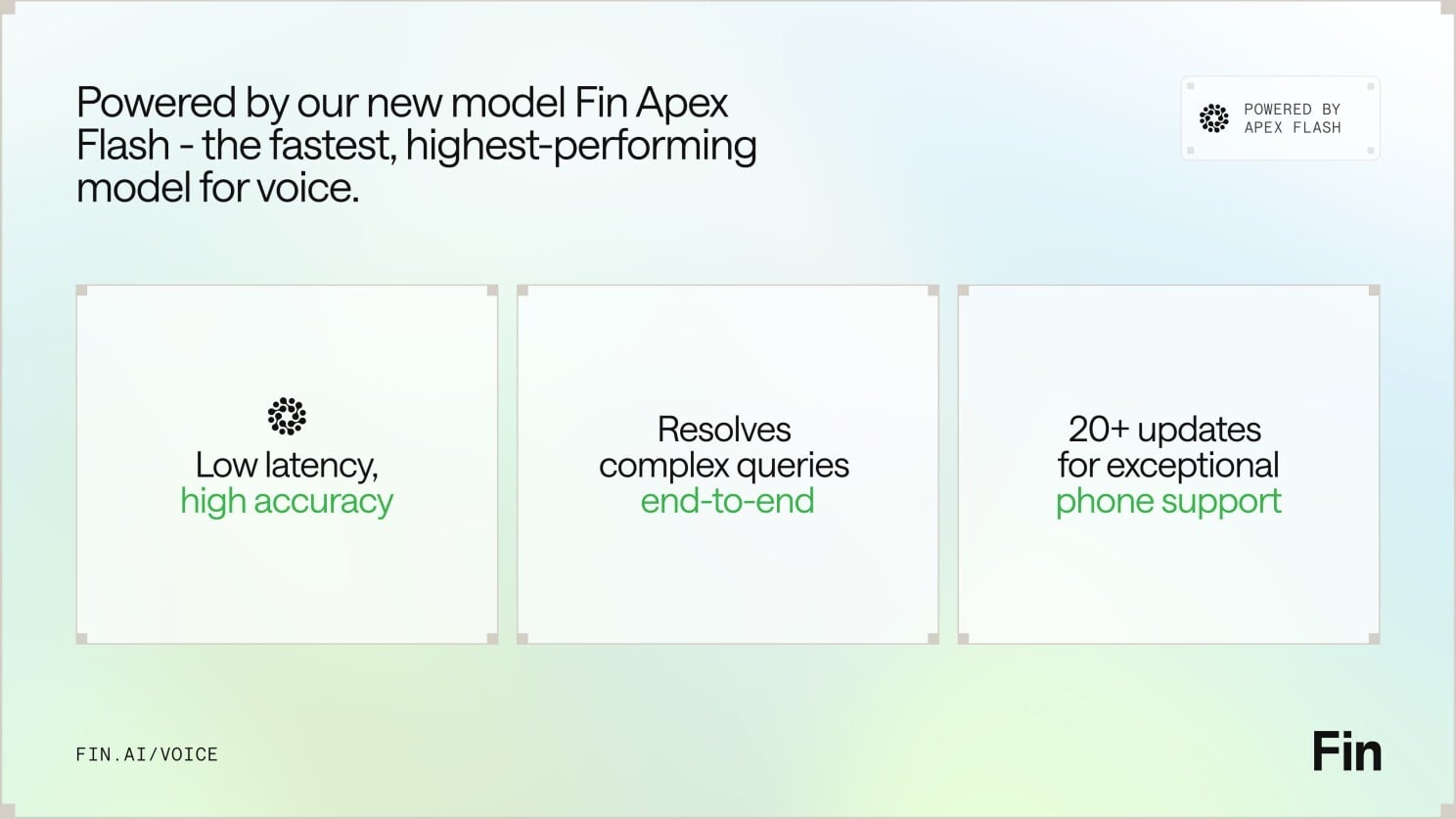
    For context, yesterday brought Apex Flash, their newest and fastest model, built for the unique demands of low latency channels like voice. Today comes Fin Voice 2, a major upgrade to Fin Voice with over 20 new features, and the first product built on Apex Flash.

    Here are the three things that stood out to me—and why they matter for customer support AI strategy and product strategy.

    First — thanks to Apex Flash, Fin Voice 2 is now the fastest, most natural Agent for phone, with higher resolution rates and customer satisfaction scores than ever before. Apex Flash is trained on millions of customer experience interactions, fine tuned for customer service, and can be configured to understand all your knowledge and follow all your policies. The result is higher resolution at significantly lower latency—the best of both worlds for voice AI agent performance.

    Speed and naturalness here aren’t accidental. Most voice AI products are slow because they convert speech to text, send it to a general model, get a text answer, and then convert it back to speech. Fin Voice 2 was designed to work differently, separating the real time layer that handles speech processing, and the layer that generates answers. That architecture is purpose-built for the demands of customer service on voice.

    Slide for Fin Voice 2, powered by Apex Flash, showing it beats Voice 1: +24.5% average resolution, +8.4% guidance following, +1.3% CSAT, -19.2% time to first audio, -37.6% semantic search latency.
    Powered by Apex Flash, Fin Voice 2 raises the bar on quality and speed—boosting resolution rates and guidance following while cutting time to first audio and semantic search latency, with a lift in CSAT too.

    Second — Fin Voice 2 can handle complex queries end to end: taking actions in external systems, verifying callers’ identities, processing refunds, booking appointments, and more. Phone is a high-stakes channel, and Fin adapts to customers across emotional states, clarifies when needed, and confirms key details before taking action. Most of the time, Fin can resolve the query in full, and when it can’t, it seamlessly hands off to the human team, maintaining full customer context and history. You also get multiple improvements to call quality, plus proactive outbound calls to follow up on unresolved issues—all orchestrated by robust AI workflows.

    Third — Fin Voice 2 gives you total control with industry-leading tools to configure and manage how Fin behaves. You get rich, detailed insights into call behavior and quality, the most common topics of calls, and one-click recommendations to improve. As with everything in Fin, you can fully self-serve and then manage it all with ease, without requiring professional services. Many vendors only let you set up their voice agent under supervision; with Fin, you get everything you need to iterate fast.

    If you haven’t tried the demo yet, go check it out: https://fin.ai/voice. If you prefer to wait, don’t be surprised when you end up speaking with it at a favorite brand soon.

    From a product management lens, this is what matters: latency is a feature customers feel; transparency builds trust in enterprise AI; and control is non-negotiable for CX leaders. The combination of a purpose-built, agentic AI architecture, measurable gains in resolution and CSAT, and true self-serve configuration signals that voice is moving from prototype theater to production reality. That’s the different game I want our industry to play.


    Inspired by this post on The Intercom Blog.


    Book a consult png image
  • Crafting Beloved Tech Brands: My Moonshot Marketing Playbook for the Post-LLM Era

    I spend a lot of my time asking a deceptively simple question: what does excellent marketing actually look like in 2026? From the vantage point of product leadership, the answer isn’t a spreadsheet or a channel plan—it’s a feeling. Beloved tech brands earn the benefit of the doubt, create gravity around their roadmap, and make customers proud to belong. That kind of momentum is not an accident; it’s a system.

    Here’s the hard truth I’ve learned building and scaling products: giving teams different goals creates dysfunction. When brand, demand gen, product marketing, and comms run on fragmented OKRs, you manufacture internal headwinds. “Marketing is one engine – not separate pieces.” One strategy, one narrative, one set of outcomes—expressed through different craft disciplines and time horizons.

    That unity of purpose clarifies executive roles, too. The real difference between an SVP and a CMO is scope and narrative ownership. A great CMO architects the whole system—portfolio allocation, brand architecture, integrated go-to-market strategy, and the bar for creative taste—while refusing to get dragged into decisions they should never be making (for example, approving every headline or micromanaging channel tactics). Leaders should decide the outcomes, standards, and constraints; teams should control the craft.

    On portfolio design, I run marketing like a portfolio of moonshots. You need a healthy mix: proven programs that compound, emergent bets that learn fast, and a small set of true moonshots that can change the slope of the curve. The point isn’t bravado; it’s risk-balanced exploration. If everything ships safely, you’re under-investing in differentiation. If everything is a swing for the fences, you’re not building a repeatable growth engine.

    This is where taste becomes a strategic advantage. “Ubiquity is the opposite of cool.” If you want to be beloved, you cannot treat every channel, audience, and moment as equal. Early on, selective distribution, distinctive creative codes, and tight community loops create status and meaning. Later, you scale without sanding off the edges that made the product special.

    Why do a few companies build a flywheel of momentum while others stall? They align story, product, and distribution. The product earns trust, the narrative creates aspiration, and the go-to-market strategy ensures the right customers experience both at the right time. Then perception cycles kick in—the Silicon Valley clock turns—and irrational optimism or skepticism can amplify signals. The antidote is compounding proof: consistent product shipping, community advocacy, and creative that makes people care.

    Scaling taste across an organization is teachable. I codify brand principles, narrative guardrails, and examples of “right” versus “almost right.” I replace abstract feedback with decision rubrics—what we keep, kill, or revise and why. I run recurring creative reviews with a small cross-functional council, so judgment compounds. Taste can’t be fully automated, but it can be operationalized: shared references, a story bible, and a high bar for craft that’s explicit, not mystical.

    In a post-LLM world, the fundamentals haven’t changed—but the frontier has. Generative tools supercharge iteration and research, yet the artistry never really left. You still need a point of view, a tension worth resolving, and a value proposition that’s felt, not just stated. Can taste be encoded in software? Parts of it—pattern libraries, style constraints, data-driven feedback—absolutely. But the spark that makes work unforgettable remains human: judgment, risk tolerance, and the courage to ship something that might not fit the playbook.

    That’s why telling an optimistic, yet realistic story about AI matters. Over-automation drains humanity; under-automation wastes potential. The best work pairs AI Strategy with craft leadership: LLMs for rapid exploration, humans for narrative decisions and ethical judgment. Your message should show how AI expands customer agency, not just efficiency.

    The brand-versus-growth debate is a false choice. The right story accelerates pipeline, and the right demand programs reinforce the brand. Look at Apple’s discipline around product truth and design codes, or Google Chrome’s “The Web Is What You Make of It (Dear Sophie)” for proof that emotion and utility can co-exist. Notion, Pinterest, Square, HubSpot, and Harley-Davidson show how community, identity, and product-led growth interlock when the company knows exactly what it stands for.

    When it comes to launches, I’ve learned that announcement videos full of humans, lack humanity. Overproduced gloss often dilutes the truth customers seek: what problem does this solve, how quickly can I feel the value, and why does it matter now? Real users, real context, and a crisp arc from problem to promise will outperform most theatrics.

    Practically, I architect my week to protect taste and outcomes. Early-week for strategy, portfolio reviews, and cross-functional alignment; mid-week for deep creative and product marketing work; late-week for decision clears and postmortems. I time-box “disruptive energy”—space to chase non-obvious ideas—and I guard it like any critical meeting. Without protected cycles for exploration, the urgent will always suffocate the important.

    If there’s a single takeaway: playbooks are obsolete, but the fundamentals are not. The channels change; the psychology doesn’t. Run one engine. Allocate a true portfolio. Scale taste with rigor. In the AI era, make people care. That’s how beloved tech brands are built—and how they endure.


    Book a consult png image
  • Building AI-Era GTM and Analytics That Make Tough Calls Simple: A Product Leader’s Playbook

    Building AI-Era GTM and Analytics That Make Tough Calls Simple: A Product Leader’s Playbook

    I build "GTM and analytics products for the AI era—tools that make hard calls simple." That guiding principle shapes how I design systems, prioritize roadmaps, and lead teams: we earn speed by engineering clarity. My north star is straightforward—turn noisy signals into trusted insights that move the business, without adding friction for customers or chaos for teams.

    In practice, this starts with behavioral analytics. Whether you're using Amplitude analytics or a homegrown stack, the goal is the same: a unified analytics platform that captures clean events, enforces a clear taxonomy, and maps behaviors to outcomes. I focus on journey mapping, activation and retention analysis, and honest attribution so that every GTM motion ladders to real product usage, not vanity metrics.

    Decisions should be testable and reversible. I operationalize experimentation with A/B testing, feature flags, and guardrailed rollouts. Minimum detectable effect, power analyses, and anomaly detection aren’t academic exercises; they’re the foundation for credible learnings. When a result is unclear, we tighten hypotheses, shrink blast radius, and iterate quickly—biasing for learning while protecting the customer experience.

    AI changes the surface area of product work, but it doesn’t change the discipline. I treat LLMs for product managers as a capability, not a shortcut: eval-driven development, clear success criteria, and human-in-the-loop feedback remain non-negotiable. Privacy-by-design and data governance shape what we build; responsible prompts, retrieval strategies, and safety checks shape how it behaves in the wild. When the model is uncertain, the product should be honest about it—and offer a graceful fallback.

    Great GTM is a system, not a launch day. I connect product strategy to go-to-market strategy through product-led growth loops: in-app guides that meet users where they are, onboarding that accelerates time-to-value, and signals that identify true qualified intent. Driver trees tie adoption to monetization so that marketing, sales, and success work from the same picture—making trade-offs visible and reversible.

    Execution is where clarity compounds. Continuous discovery with product trios keeps problems crisp and solutions grounded in user truth. Product roadmapping and sprint planning follow outcome-first principles: fewer projects, clearer intents, stronger accountability. When teams can trace every backlog item to a metric that matters, they move faster with less oversight—and deliver results that stand up to scrutiny.

    When we do all of this well, decisions feel simple because the work behind them is rigorous. That’s the promise of modern GTM and analytics in the AI era: no theatrics, just dependable systems that turn possibilities into predictable progress.


    Inspired by this post on Amplitude – Best Practices.


    Book a consult png image
  • Speed-to-Lead Is Dead: How AI Agents End the Wait and Rebuild a High-Velocity Sales Org

    Speed-to-Lead Is Dead: How AI Agents End the Wait and Rebuild a High-Velocity Sales Org

    A prospect lands on our site, skims pricing, watches a demo, and clicks “contact sales.” For years, that’s where momentum died. They waited, and we built entire sales motions around managing that delay.

    We optimized for “speed-to-lead,” made it the hallmark of a high-performing sales development org, hired more SDRs, tuned routing rules, added shift coverage, and stared at response-time dashboards. Typical SLA targets were one hour for best-fit leads, four hours for core MQLs, forty-eight hours for everyone else. Those were considered good numbers.

    No one questioned the premise because the lag felt structural—shift scheduling, routing delays, and humans working 9–5. The fastest teams could only shrink the gap; nobody could remove it.

    An AI Agent closes it completely.

    When a prospect arrives today, the conversation can begin immediately. That single change reshapes how I design a sales org—how we staff it, what our team prioritizes, and the metrics we hold ourselves accountable for.

    Step outside our dashboards and look at the buyer experience. We spend heavily to drive traffic, then push visitors into forms and queues that add friction precisely when purchase intent peaks.

    Intent is highest the moment someone seeks out our product. If an SDR follows up two or three hours later, that buyer’s in another meeting, the urgency has faded, and the moment is gone. We still call it a lead; the buyer has already moved on.

    What AI changes

    Agents eliminate the structural constraints that made speed-to-lead a problem—shift scheduling, routing delays, CRM batch processing, the SDR being on another call. None of it applies anymore because every single lead can be engaged immediately, at any hour and in any language.

    The impact goes beyond response time. When an Agent engages at peak intent, qualification, discovery, and even an initial demo moment can unfold in a single, continuous conversation. The gated funnel collapses. There’s no reason to qualify someone today, schedule discovery for Thursday, and demo the following week when the conversation is already happening.

    The constraint the industry built around simply isn’t there anymore. We’re already seeing it with Fin, a Customer Agent. As sales leaders, we need to frame this differently.

    If speed-to-lead is no longer the constraint, the knock-on effects reach every part of the org.

    Minimalist hero graphic with the headline 'Add Fin to your sales team today,' a glossy 3D blue spiral at center, and a black 'Start free trial' button, promoting Fin for Sales as an AI customer agent.
    Introduce Fin for Sales to your team with this clean hero banner: bold headline, signature blue spiral, and a clear 'Start free trial' call to action—inviting readers to explore an AI customer agent built for revenue.

    SDRs focus on moving deals forward. Instead of frontline triage, they double down on phone-based selling and relationship building, complex deal navigation, and multi-threaded engagement across stakeholders—the high-leverage work that used to get crowded out by the inbox.

    Pipeline gets more relevant. The old model rewarded volume: capture as many form fills as possible, respond fast, and sort quality later. When an Agent engages at the moment of intent, it qualifies during the conversation. Low-fit leads get filtered out before they reach the team, and high-fit prospects arrive with context—needs, timeline, stakeholders—instead of just a name and email.

    You measure outcomes, not response time. When first response is instant, different metrics matter. I anchor on three questions:

    1) Is the Agent doing the work? Completion rate, qualification rate, and contact capture rate indicate whether conversations reach clear outcomes and produce usable handoffs to the team.

    2) Is the work producing pipeline? Meetings booked and pipeline created through Agent-handled conversations are the leading indicators of revenue, not how fast someone followed up.

    3) Are buyers having a good experience? Conversation-level satisfaction matters more than ever because the Agent is the first interaction prospects have with your company. The experience it delivers is the first impression you make.

    These three questions reveal whether the motion is working. Time-to-first-response can’t.

    Sales orgs built hiring plans, workflows, and performance metrics around beating intent decay. That made sense when the lag was unavoidable. It isn’t anymore.

    An Agent is always on. It engages the moment a prospect arrives on your site, qualifies them in real time, and routes them to the right outcome without waiting for someone to be free. The lag the industry built itself around doesn’t exist when the conversation starts immediately.

    The companies leaning into this are investing in what happens after the conversation starts: how well the Agent qualifies, where it creates pipeline, and what SDRs should actually spend time on. What matters now is not how fast you respond, but what the conversation produces.

    Speed-to-lead made sense when the delay was structural. It isn’t anymore. If you’re re-architecting go-to-market, instrument Agent Analytics, revisit SDR charters, and tighten CRM integration so every qualified handoff is instant, traceable, and revenue-linked.


    Inspired by this post on The Intercom Blog.


    Book a consult png image
  • Old-School Selling Beats PLG in the AI Era: My GTM Playbook for 8‑Day Enterprise Deals

    Old-school, in-person selling is having a renaissance in the AI era, and I’ve seen why up close. From leading product and go-to-market teams through hypergrowth, I keep returning to one lesson: enterprise buyers still reward the teams who show up, orchestrate change management, and own outcomes end-to-end. The tech has changed; the human dynamics haven’t.

    Has the sales playbook changed in the AI era? The tools are faster and the surface area is bigger, but the core motion remains the same: “showing up” beats letting the marketplace decide. That’s why in-person enterprise rollouts still beat product-led motions, especially when the stakes include security, governance, and cross-functional adoption. You win by reducing organizational risk, not by assuming free trials will do the heavy lifting.

    Great enterprise sellers collapse silos. They sell to engineers and executives in one motion, pairing deeply technical validation with crisp business narratives. In my org, that means every high-velocity pilot has a dual thread: hands-on, eval-driven proof for the builders and a value architecture for the budget owners. When those motions run in parallel, time-to-value plummets and procurement friction fades.

    Selling to AI-native buyers who grew up on ChatGPT changes tempo, not fundamentals. The same seller, different tempo: 8 weeks vs. 8 business days. These buyers evaluate fast, expect clear ROI, and push for automation-first workflows. How AI-native buyers handle build vs. buy decisions comes down to build for differentiation and buy for acceleration. If you make procurement feel like product—frictionless, instrumented, and transparent—you’ll meet their bar.

    Process matters, but humanity wins. Building a robust sales process that still leaves room for unscripted moments is where trust is formed. I’ll never forget the story of the rep who taught a champion’s son guitar over Zoom—an unscripted moment that cemented a partnership. The lesson: raise the floor without capping the ceiling. Equip every rep with repeatable plays, then celebrate the creative instincts that make champions out of customers.

    In early GTM, why the three highest-leverage early sales hires aren’t sellers at all resonates with my experience. I prioritize a solutions engineer who can de-risk integration, a forward-deployed operator who can run the first rollout like a product manager, and a customer success lead who designs adoption paths from day zero. Together, they compress the value journey from proof to production.

    Compensation design shapes your talent market. The case for outsized commission accelerators for star sellers — and the kind of person they attract is real: magnets for competitors who close complex, multi-threaded deals and thrive with ownership. But beware: why too much process narrows the kind of seller you attract. Over-script it and you filter out the very people who can navigate ambiguity with customers.

    Under the hood, instrumenting the funnel from stage zero to close keeps the system honest. I track intent signals before pipeline, conversion by persona and use case, proof milestones, and time-to-value in production. The three pillars of GTM excellence for me are repeatable discovery, referenceable outcomes, and relentless enablement. And inside the leadership team, building peers who are 80% aligned, not 100% preserves healthy tension while keeping execution fast.

    AI is expanding the definition of enablement—whether AI is changing what good enablement looks like isn’t a theoretical question anymore. I see world-class teams arming reps with retrieval-first knowledge bases, sandbox environments, and objection libraries that evolve weekly. Meanwhile, selling against direct and implied competitors at once is the norm: your battlecard must cover “do nothing,” internal tools, adjacent categories, and new AI entrants—while you still remember why in-person enterprise rollouts still beat product-led motions for durable adoption.

    Planning horizons tighten in AI markets. How far out should a GTM leader be planning? I work a dual cadence: a rolling 6-week operating plan that’s ruthlessly tactical and a 2–3 quarter roadmap for coverage, enablement, and category storytelling. What a normal week looks like in hypergrowth blends customer time, pipeline triage, onboarding and enablement, deal engineering, and process tuning—always with one or two high-conviction bets that could bend the curve.

    References: Ahead: https://www.ahead.com; Amazon: https://www.amazon.com; Anthropic: https://www.anthropic.com; Attio: https://www.attio.com; Augment Code: https://www.augmentcode.com/; Cognition: https://cognition.ai; Cursor: https://cursor.com; Dani McCabe: https://www.linkedin.com/in/danielle-mccabe/; Datadog: https://www.datadoghq.com; GitHub Copilot: https://github.com/features/copilot; HubSpot: https://www.hubspot.com; Jeremy Powers: https://www.linkedin.com/in/jeremypowers/; JPMorgan: https://www.jpmorgan.com; Matt McClernan: https://www.linkedin.com/in/mattmcclernan/; MongoDB: https://www.mongodb.com; Nicole Rettinger: https://www.linkedin.com/in/nicole-rettinger-23b20465/; Notion: https://www.notion.com; OpenAI: https://openai.com; Parag Agrawal: https://www.linkedin.com/in/paragagr/; Parallel: https://parallel.ai; Snowflake: https://www.snowflake.com; University of Chicago: https://www.uchicago.edu; Windsurf: https://windsurf.com

    If you’re scaling an AI product today, pair a disciplined sales-led growth engine with the best of product-led growth: fast paths to proof, hands-on validation for builders, executive-level value mapping, and human moments that turn customers into advocates. That’s how you compress an eight-week cycle into five business days—and keep the expansion flywheel spinning.


    Book a consult png image
  • Inside My Pricing Playbook: Building Value-Based Packaging That Balances Growth and Profit

    Inside My Pricing Playbook: Building Value-Based Packaging That Balances Growth and Profit

    Pricing looks deceptively simple from the outside; inside, it’s anything but. Over the years, I’ve learned that every price tag is really a strategic statement about value, priorities, and the future we’re building toward.

    At Fin, pricing and packaging (P&P) is more than a finishing touch. It’s a research problem, a forecasting challenge, a commercial decision, and ultimately, a strategic statement, requiring deep cross-functional work. We must balance the needs and wants of our customers, the value delivered by our product, and the broader vision we are building towards.

    Our approach keeps evolving as our product and market mature. I treat it as a living system—continuously informed by research, GTM learning, and customer behavior, never "set and forget."

    Here’s how I run the process in practice, especially when we launch something new that needs to be monetized, like Fin, our AI Agent. The work moves from qualitative discovery to quantitative validation to commercial modeling, with tight partnership across product, research, data science, finance, GTM, and engineering.

    Step 1: Foundational research

    I start by talking to buyers to understand their mental models of value. How do they define ROI? What pricing models do they expect in this category? What feels intuitive, and what feels off? This early discovery shapes two crucial choices: the pricing model and the pricing metric.

    The pricing model is the overall structure; value-based, usage-based, access-based, fixed fee, and so on. With Fin, we chose a value-based model: you only pay when Fin delivers value. Our research clearly showed that buyers don’t want to pay for usage, they want to pay for results.

    The pricing metric is the unit of value within that model, the unit we anchor pricing to. For Fin, the pricing metric is “outcomes.” An outcome is defined by Fin successfully handling a customer service query.

    Small definitional changes can dramatically alter how customers perceive value, so I obsess over details. Buyers rarely hand us the “right” model; they reveal how they evaluate value, and I translate that into a model and metric that align with their goals and expectations.

    Throughout, I loop in execs, finance, GTM, and engineering to ensure alignment before proceeding. Pricing choices cut across the business; they can’t be made in isolation.

    Step 2: Willingness to pay

    Once we have a model and metric, I quantify what the market will bear. This is where rigorous willingness-to-pay (WTP) research comes in, grounded in the language we validated through the qualitative work.

    Here’s the kind of framing I use in surveys to keep things concrete and consistent with our model and metric:

    You would only pay when Fin delivers an outcome (→ the model). An outcome is counted when the AI Agent resolves a customer query with no further help needed (→ the metric). Would you be willing to pay $X per outcome for Fin?

    The foundational qual is so important as a first step. It helps us decide what we should be asking about before we start asking how much people will pay. Without the qual ground work, you risk building a very convincing answer to the wrong question.

    The goal isn’t to find a perfect price. That doesn’t exist. The goal is to ground our discussions in the reality of the market.

    I use methods like Gabor-Granger and Van Westendorp to understand WTP and to shape a demand curve that informs strategy, not just a single number.

    This chart shows us what percentage of the market is willing to buy the product at various price points. The demand curve shows that 69% of buyers were willing to pay for the product at $0.86 per outcome, whereas only 39% were willing to pay at $1.42.

    The dashed line shows the price point at which revenue for the business would be maximized (by multiplying adoption by the dollar amount).

    This allows us to debate knotty questions like: What’s the right balance between growth and revenue? How sensitive is demand to price changes? At what price do we start losing the market? If we wanted to increase adoption, would lowering our prices by $X make a meaningful difference?

    Those conversations help me weigh customer value and business outcomes side by side. At this stage, decisions feel more tangible, but I don’t finalize a price until I’ve modeled the operational realities.

    Step 3: Modeling

    By now I have a validated model, a clear metric, and a strong WTP signal. Next I translate theory into a commercially workable plan—this is where data science and finance are indispensable.

    I start with a list price aligned to our strategy and commercial goals. Then I adjust for likely discounting to estimate realized price. Next, I analyze beta usage to project outcomes per customer by segment and derive average ARR. I combine usage projections with WTP to model attach rates across conservative-to-optimistic scenarios. Finally, I connect the dots in our long-range plan—logos, ARR, margins—iterating until the numbers and narrative cohere.

    The modeling step is important because willingness-to-pay data is somewhat theoretical. It reflects intent, not behavior. Modeling helps us bridge that gap.

    The goal of this step is to land on a price point recommendation, alongside forecasts for ARR and adoption. It allows us to understand the real business impact of the decisions we’re making.

    Alongside all of this, we need to ensure any decision we make falls in line with our pricing principles and broader business objectives.

    Step 4: Sign-off and execution

    With the analysis complete, I consolidate everything into a clear P&P recommendation for executive approval. Once approved, the real work begins: enabling sales, communicating changes to customers, instrumenting ROI proof points, and monitoring performance so we can learn and iterate.

    Do we run the full process every time?

    Not always. This is the ideal process, and I apply it end-to-end for the most material decisions. In reality, time and resource constraints require judgment; rigor should mirror impact. When uncertainty crops up midstream, I run scrappier, targeted research rather than forcing a linear path.

    The ongoing challenge

    As Fin’s breadth has expanded, our pricing system has had to evolve, too. For a while, modular pricing worked well—each product had its own logic tied to a crisp outcome. As we add more products, more Agent capabilities, and more outcomes, the question shifts from “what is the right P&P for this one product?” to “how does everything fit together into a coherent pricing system?”

    We must recognize that pricing isn’t something you set once and leave alone. As products evolve, especially in a world where AI is rapidly changing how value is created and delivered, it’s important to regularly step back and review the bigger picture, not just the component parts.

    For example, outcome-based pricing has served us well, particularly when our products were tightly tied to clear, measurable outcomes. But as our products become more varied, and as we continue building toward a broader platform, it becomes less straightforward to apply a single model cleanly everywhere.

    The challenge becomes less about replacing one model with another, and more about continually looking up and asking: what pricing philosophy best reflects the value we’re delivering today? And how do we deliver that philosophy in a way that still feels right for customers?

    In short, there is no finish line, pricing is never “done” – and that’s exactly how it should be.

    Why this work matters

    Pricing and packaging is often noticeable only when it goes wrong. A confusing model, a bad metric, or a price that feels disconnected from value. And we hear about those quickly.

    When pricing is done well, it becomes nearly invisible—but it still does a lot of work. It shapes how people perceive value, clarifies what they’re paying for, and makes the product easier to sell, easier to buy, and easier to scale. Most importantly, it forces us to be honest about what the product is really worth. That’s why I take it so seriously—and why I treat pricing as a product in its own right.


    Inspired by this post on The Intercom Blog.


    Book a consult png image
  • Our Operating Model Is the Product—Why We Built Product Partners to Accelerate Outcomes

    Our Operating Model Is the Product—Why We Built Product Partners to Accelerate Outcomes

    I’ve learned that customers don’t just buy features—they buy the way we discover, decide, build, ship, and support. In other words, the operating model is the product. That realization has shaped how my team and I at HighLevel translate product strategy into tangible, repeatable outcomes that show up in quality, reliability, onboarding, and consultative support every single day.

    We created Product Partners to codify that operating model and scale it with discipline. It’s a blueprint and operating rhythm that unifies product strategy with go-to-market strategy, customer success, and solutions engineering—so empowered product teams can move faster without sacrificing clarity, governance, or customer trust.

    First, we anchored on continuous discovery. Product trios work shoulder-to-shoulder with customer-facing teams to run customer interviews, journey mapping, and A/B testing, then validate insights with session replay and behavioral analytics. We use driver trees and opportunity solution trees to connect problems to outcomes, ensuring prioritization is evidence-based and aligned to product-market fit—not just output.

    Second, we elevated delivery excellence. Our practices emphasize CI/CD, feature flags, observability, SRE-informed incident management, and DORA metrics to shorten feedback loops while raising the bar on stability. Privacy-by-design, data governance, and regulatory compliance are built into our workflows, and we make deliberate build vs buy decisions to protect platform scalability and long-term velocity.

    Third, we integrated go-to-market alignment from day one. Solutions engineering and customer success shape requirements early, so launches include in-app guides, product tours, onboarding paths, and consultative support that accelerate user activation. We tie outcomes vs output OKRs to stakeholder management rituals, ensuring sales-led and product-led growth motions reinforce each other instead of competing for focus.

    Finally, we closed the loop with a unified analytics platform. Activation, retention analysis, and Net Recurring Revenue (NRR) sit alongside qualitative signals from customer interviews and support. This single source of truth helps us refine product positioning, sharpen value propositions, and improve roadmapping and sprint planning with clear, testable hypotheses.

    What does this mean for our partners and customers? Faster time-to-value, fewer handoffs, clearer expectations, and a shared lens on the metrics that matter. Product Partners isn’t a side program; it’s how we operationalize trust—through transparency, consistent rituals, and a bias toward learning that compounds.

    If this resonates, you’ll feel it in how we discover, build, and support together. I’ll continue to share our playbooks—covering continuous discovery, onboarding, and outcome-based planning—so we can keep raising the standard for product management leadership and product-led growth, one operating rhythm at a time.


    Inspired by this post on Product School.


    Book a consult png image
  • The Ultimate Knowledge Management Playbook to Supercharge Your AI Sales Agent

    The Ultimate Knowledge Management Playbook to Supercharge Your AI Sales Agent

    Revenue leaders are starting to use AI to generate better leads, capture peak buyer intent, and scale their pipeline without a linear increase in headcount. I see it every day in my own teams: when we get the foundations right, AI doesn’t just answer questions—it accelerates qualification and turns curiosity into pipeline.

    Done well, an AI-first inbound sales experience engages buyers 24/7 in any language, qualifies leads intelligently, and routes high-intent prospects to the right conversion path. But behind that experience, there’s an unsung hero: knowledge management. I’ve learned the hard way that even the smartest Agent underperforms if it’s not fed the right information.

    A Sales Agent is only as good as what you give it to work with. If you’re using an Agent, like Fin, to run inbound sales motions end to end, it needs an extensive pool of knowledge to draw from. You need to feed it accurate answers on pricing, features, and plan fit, and clear rules for how to qualify and route each prospect. Without it, your Agent can’t do its job, and your sales team is back to answering the same questions manually and triaging leads that could have been handled automatically.

    In this guide, I walk through everything you need to know about building and maintaining the knowledge base that powers your Sales Agent—what to include, how to launch, what to measure, and how to iterate so results compound over time.

    What is knowledge management and why is it so important?

    Definition: Knowledge management is the process of creating, organizing, sharing, and maintaining knowledge in your business.

    Black-and-white testimonial graphic for Fin with a close-up portrait on the left and a large quote on the right highlighting how knowledge management boosts sales funnels, conversion, pipeline, and revenue.
    Knowledge is your sales agent's edge. This Fin testimonial shows how organizing and optimizing content removes friction in the funnel, lifting conversion and unlocking millions in pipeline and revenue for growing teams.

    Your public website and product pages are classic examples, but those are just the tip of the knowledge management iceberg. In an inbound sales motion, knowledge management involves a range of activities such as creating resources (FAQs, pricing overviews, competitive battlecards, case studies, internal sales materials), identifying gaps in documentation and qualification criteria, implementing systems that make information easy to access and use, and developing processes to keep everything current. In my experience, these elements are what allow an Agent to move from merely answering questions to recommending the right plan and explaining why it fits.

    Why knowledge management matters even more in the age of AI

    Your knowledge base is no longer just static collateral for buyers to read. It powers your Sales Agent and entire inbound motion. It’s the key to accurately answering complex prospect queries, guiding product discovery, qualifying intent in real time, and accelerating the path to pipeline. Two realities shape my approach:

    1) Your Agent is only as strong as what you “feed” it. Your Agent is only as good as the knowledge and content that it has access to. A lack of information, poorly structured sales materials, or out-of-date pricing documentation all prevent it from providing clear and correct answers to your buyers, leading to poor buying experiences that degrade trust and cost you deals. No large language model (LLM) knows your business like you do. It doesn’t understand your prospects’ specific needs, pain points, pricing tiers, or use cases. That knowledge is unique to you and your organization, which means you need to map it all out and explicitly feed it to your Agent. You need to feed it facts about your product, and also give it the context behind those facts so it can guide buyers to the right solution rather than just answering their questions.

    2) Every investment of knowledge has compounding results. Making the switch to AI isn’t just adopting a new tool. It means adapting to a new ecosystem. Think of it as a flywheel. Every piece of knowledge you add makes your Agent more effective. It generates better conversations and data, which tells you what to add or refine next. The more you invest in it, the faster it compounds.

    Monochrome quote graphic for Fin featuring a grayscale headshot on the left and a large quote on the right about avoiding duplicate content for sales, highlighting efficient knowledge management.
    Smart sales teams don’t copy what already works for service—they connect to it. This Fin quote card reminds readers to reuse trusted knowledge, cut duplication, and keep content manageable for faster, more accurate selling.

    “You have to think about AI like a new sales rep. On day one, it needs coaching, guidance, and feedback. But over time, as you refine the inputs and learn from real conversations, it becomes more autonomous and the level of coaching required decreases significantly.” Pascaline Albin, Director of Sales Development at Fin

    Every upfront investment you make in your sales knowledge has long-term, revenue-generating impact. Whether you hire someone to do this work full time or give your sales reps time away from the inbox each week, the ROI speaks for itself. I’ve routinely seen small content improvements unlock big conversion gains.

    Think of it this way: say it takes 30 minutes to document a new competitive battlecard or update pricing information. That 30-minute investment results in hours saved for your sales team, highly engaged buyers who get instant answers, and actionable data to optimize your inbound motion.

    Calculate: Average time to compose a response × frequency of question = time saved for your team. More importantly, that’s time your SDRs and AEs can reinvest in multi-threading into accounts, running complex evaluations, and closing high-value deals that actually move pipeline.

    Calculate: Number of prospects who ask this query × average time to respond = total time saved for buyers.

    Black-and-white headshot of a smiling professional beside a bold quote about Fin's AI Customer Agent and testing Fin for Sales to ensure complete knowledge, perfect customer experience, and faster revenue.
    Give your sales agents the knowledge they need from Day 0. A friendly portrait sits next to a bold statement on using Fin's AI Customer Agent to optimize content, guide reps, and turn buyer intent into pipeline and revenue.

    “For sales funnels, identifying knowledge gaps or friction can result in a huge improvement in conversion. When you optimize Fin with the right content, the incremental improvements have a big impact on our bottom line and can lead to millions of dollars in pipeline and revenue. That's why knowledge management is an integral part of our training and optimization process.” Tommy Dunton, Senior Manager of Sales Development at Fin

    The best way to start generating that data is simply to start. The sooner you begin, the sooner you can capture insights about what your buyers want and need from your inbound sales experience. I prioritize quick deployment, fast feedback loops, and continuous iteration.

    What to include in your knowledge base

    Wrangling and prioritizing all of your internal and external sales documentation can feel daunting, but with the right technology, it doesn’t have to. The ideal platform provides data-driven insights to show what buyers actually ask and a centralized place to create, manage, and optimize your knowledge content. For example, with Fin for Sales, you get access to a leads report that gives you insight into disengaged prospects. Intercom’s Knowledge Hub enables you to create a single source of truth for your public-facing collateral and internal sales materials. Using Content Targeting, you can segment this information so your Sales Agent only uses the exact content you want.

    1) Pricing and product FAQs. What it is: answers to the most common discovery questions buyers have, from pricing and plan differences to implementation, integration, and security or trust topics. How to source: analyze your sales inbox and early discovery calls. Where to use: public website, Sales Agent, and proactive outbound messages.

    Illustration of a sales agent using an AI-powered knowledge management dashboard on a laptop, with chat bubbles, documents, and analytics icons for faster answers and improved customer messaging.
    Give every seller instant, trusted answers with an AI-powered knowledge base that unifies docs, FAQs, and playbooks into a single source of truth—accelerating ramp, boosting call confidence, and improving every customer conversation.

    2) Competitor comparisons and battlecards. What it is: guidance for handling competitor mentions, addressing friction, and highlighting unique value propositions. How to source: talk to top-performing AEs or your product marketing team. Where to use: internal snippets for your Sales Agent and internal sales materials.

    3) Case studies and social proof. What it is: proof points that help buyers build business cases and gain confidence, speeding deal cycles. How to source: collaborate with customer success and marketing on ROI stories. Where to use: Sales Agent, website, and sales collateral.

    4) Specific use cases and buyer personas. What it is: targeted content for cohorts with similar pain points and jobs-to-be-done (e.g., engineering teams, startups). How to source: combine product marketing’s value propositions with real discovery conversations. Document the exact probing questions your best SDRs and AEs use so your Agent can uncover context in real time. Where to use: website and Sales Agent to enable contextual solution matching.

    Content formats and sources

    When sourcing knowledge, cast a wide net. You likely have more relevant content than you realize, and almost any information is useful once framed correctly. With Fin, you can use public articles (product FAQs, pricing overviews, feature benefits), internal articles (internal sales materials, internal FAQs), snippets (short-form text like promotions or battlecards), website pages (synced from your marketing site), and PDFs (whitepapers, technical specs, detailed sales materials).

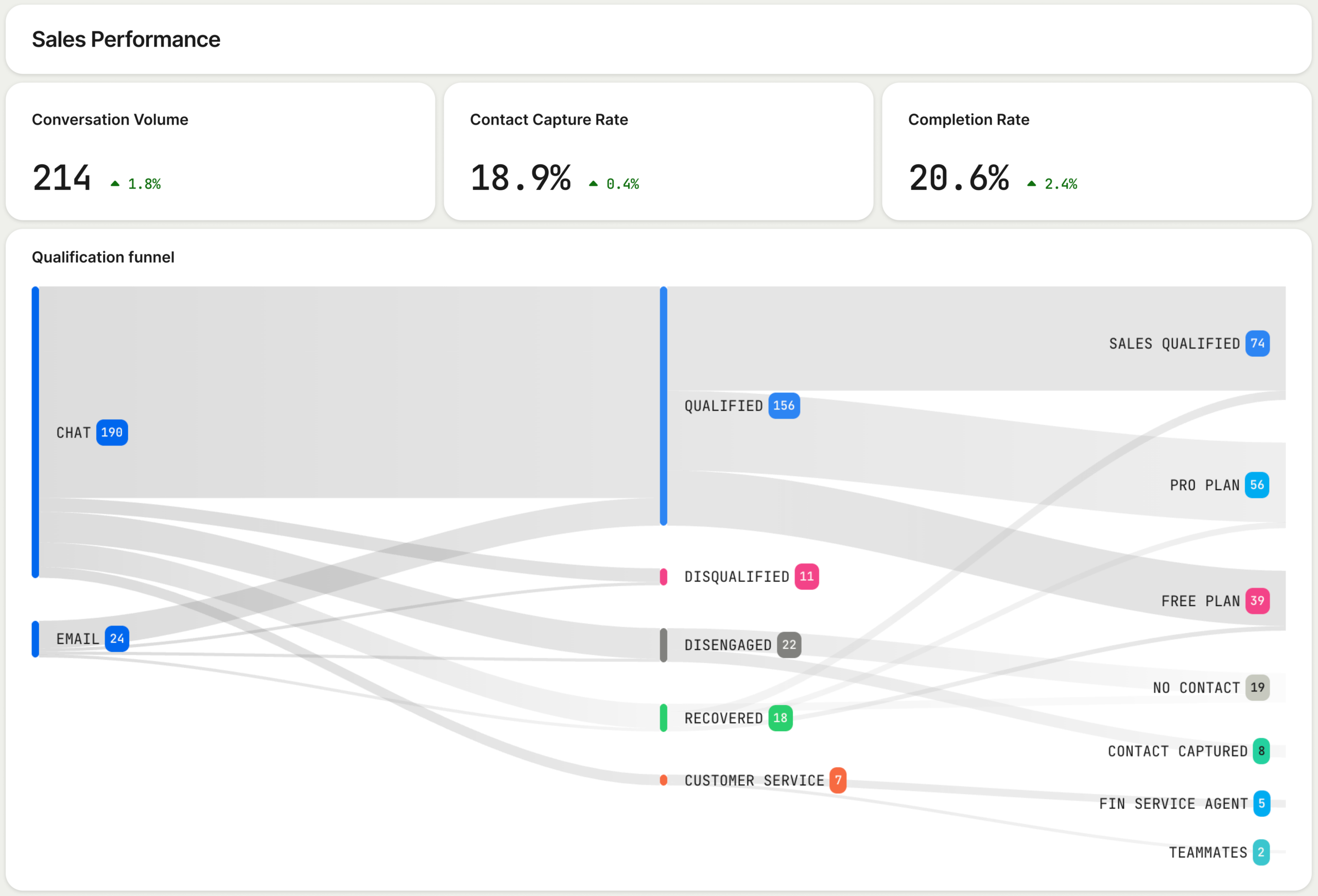
    Sales Performance dashboard with KPIs—Conversation Volume 214, Contact Capture Rate 18.9%, Completion Rate 20.6%—and a Sankey-style funnel from Chat and Email to outcomes like Sales Qualified and Pro Plan.
    Turn conversations into revenue with a clear Sales Performance view. Track rising KPIs and follow leads from Chat and Email through Qualified, Disqualified, and Recovered to outcomes such as Sales Qualified, Pro Plan, or Free Plan.

    Create a knowledge management process that fuels your Agent: 5 steps

    Step 1: Audit what you have. Start by reviewing your current materials to prevent your Agent from learning outdated information and to identify gaps. If you’re already using a Customer Agent, much of that content can pull double duty for sales—no need to start from scratch. Make your existing content available for your Sales Agent and build sales-specific content on top, like pricing comparisons, competitive battlecards, customer case studies, and qualification criteria that wouldn’t apply to service conversations. If you’re starting fresh, audit pricing, product FAQs, feature details, competitor comparisons, case studies, and buyer use cases.

    Put yourself in your buyer’s shoes. Walk through the same steps your prospects take, including their first interaction with your Sales Agent. Before going live, test it yourself. If you’re using Fin, you can do this using the built-in Preview panel to validate answers, routing, and missing topics or objections. Confirm that your Agent asks the right probing questions about goals, fit, and urgency before making a routing decision.

    “We're moving incredibly fast at Fin with our Customer Agent, which means optimising our content, guidance and experience with Fin is a constant focus. Before we launch new products, we're testing Fin for Sales to ensure it's got all of the knowledge it needs to make sure the customer experience is perfect and we can convert that intent into pipeline and revenue from Day 0 of that launch.” Tommy Dunton, Senior Manager of Sales Development at Fin

    Seek input from across your GTM organization. Don’t rely solely on sales. Involve marketing, growth, revenue ops, and sales ops to align content with campaigns and routing logic, and to integrate with systems like your CRM. Your SDRs and AEs bring real-world objections, use cases, and competitor insights that win deals—and those should feed directly into your Agent’s knowledge base. Judging fit is as much art as science, and your best SDRs can teach the Agent to interpret subtle signals.

    Black-and-white headshot beside a bold quote about Fin AI for sales agents, stressing ongoing training and high‑quality knowledge bases to lift performance; clean, minimalist layout.
    Scalable selling starts with better knowledge. This graphic pairs a monochrome portrait with a bold Fin quote showing how training agents and curating a strong knowledge base compound AI performance over time.

    Step 2: Plan and prioritize. Decide where to start by focusing on questions your team still answers manually that, if documented, would help your Agent capture more qualified intent. Identify the content your reps share most (demos, explainers, case studies) and ensure the Agent can access it. Look at leads reporting to find early-stage questions, stuck points, and high-volume disengaged outcomes, then strengthen objection-handling content. Prioritize based on pipeline value—build competitive battlecards and enterprise-tier documentation before free-plan details. Use reporting to find funnel drop-offs and content that hasn’t been updated recently—refresh pricing immediately if it has changed.

    Allocate time and resources. Treat your Sales Agent like a core GTM channel, not a side project. Assemble a cross-functional project team with clear roles. The Agent owner translates sales strategy into prompts, routing logic, integrations, and rollout. The optimization owner reviews performance data, identifies drop-offs, and drives changes to content or Agent behavior. Early alignment ensures your Agent operates as a professional extension of your sales team.

    Step 3: Go live and learn. Deploy broadly across your marketing site and pricing pages to accelerate learning. Within weeks, you’ll see where the Agent guides discovery and qualifies buyers versus where it stalls. Investigate drop-offs—often these point to missing answers or weak probing questions. If your Agent and knowledge base live in the same platform, you’ll get full visibility into your qualification funnel and content performance across touchpoints.

    Track metrics to measure success. Monitor completion rate (conversations reaching a clear routing decision), pipeline created (opportunities generated through Agent-handled conversations), meetings booked (qualified prospects routed to a call), and customer satisfaction (quality of the experience). These metrics show what content is working and where to improve.

    Step 4: Iterate and improve. Expect gaps early on. That’s good—it surfaces what buyers need to convert. When the Agent gives a poor response, the root cause is usually missing, outdated, or shallow content. Close the gaps, then monitor your metrics and conversation reviews to keep compounding improvements.

    Black-and-white headshot on the left, with a large Fin-branded quote on the right stating that content powers a Sales Agent's discovery responses and keeps them current on the latest offerings.
    Your Sales Agent runs on great content. This Fin-themed graphic pairs a professional headshot with a bold statement highlighting how strong knowledge enables discovery answers and timely updates across the GTM motion.

    Build ongoing maintenance into your workflow. Knowledge management is continuous. As your product, personas, and goals evolve, so must your content. Define owners, review cadences, and working time to refresh and create content—don’t wait for launch week chaos. Encourage a “knowledge management” mindset by logging content requests from SDRs and AEs when they hear new objections or discover probing questions that uncover true pain points.

    “Training Agents to get better over time is fundamental to using AI. Fin learns from our website and help center, so the quality of those resources directly impacts its performance. The more we’ve invested in our knowledge base, the more success we’ve seen with Fin and those gains continue to compound.” Beth-Ann Sher, Senior AI Knowledge Manager at Fin

    Step 5: Build knowledge management into future launch plans. Make Agent-ready sales content part of every product or pricing launch checklist. Partner with engineering, product marketing, and revenue operations to update catalogs and your Agent’s knowledge base on day zero. Then review early discovery conversations to add resources, address new objections, and fine-tune contextual solution matching.

    “Content should no longer be an afterthought. It is one of your strongest GTM levers because your Sales Agent relies on it to handle discovery questions and stay up to date on your latest offerings.” Beth-Ann Sher, Senior AI Knowledge Manager at Fin

    Best practices for Agent-friendly knowledge management

    Fin quote graphic with a grayscale portrait next to text about unifying conversation data, lead reporting, and agent configuration to improve sales qualification, content insights, and the buyer experience.
    A pull-quote from Fin explains why one platform matters in sales: centralize conversation data, lead reporting, and agent configuration to spot funnel drop-offs, learn which content works, and elevate the buying journey.

    Use the terms your buyers use. Language varies by industry, persona, and role. Analyze discovery calls and on-site searches to capture how buyers actually speak and train your Agent accordingly. Test internally across SDRs, revenue ops, and marketing to reveal variations and content gaps.

    Simplify language and remove ambiguity. Machine-friendly language is buyer-friendly. Avoid jargon, spell out acronyms, and clearly explain key product terms so value propositions land.

    Keep the experience consistent and on-brand. Ensure product terminology, feature names, and pricing tiers are consistent everywhere. Proof for tone, spelling, grammar, and use standardized templates to build trust.

    Add context to your answers. If your internal FAQ is full of “yes/no” answers, expand on the why. Restate the question, provide business context, and equip the Agent with follow-ups that keep the conversation alive and uncover goals and constraints.

    Add text to images and videos. Show and tell—always include clear explanatory text so your Agent and all users, including those with accessibility needs, can benefit.

    Minimalist hero graphic with the headline 'Add Fin to your sales team today,' a glossy 3D blue spiral at center, and a black 'Start free trial' button, promoting Fin for Sales as an AI customer agent.
    Introduce Fin for Sales to your team with this clean hero banner: bold headline, signature blue spiral, and a clear 'Start free trial' call to action—inviting readers to explore an AI customer agent built for revenue.

    Create a scannable structure. Use clear headers and lists in your source content so both Agents and humans can navigate quickly. Avoid dynamic elements that hide crucial details.

    Collect bite-size information in FAQ articles. Package tactical intel—seasonal promotions, short battlecards, edge cases—into concise snippets so your Agent can retrieve and deliver them instantly.

    A connected Agent turns every conversation into insight. When a Sales Agent is connected to your CRM and enrichment tools, every interaction, qualification signal, and piece of sales content flows into a connected system. “A single platform matters in sales. When your conversation data, lead reporting, and Agent configuration all live in one place, you get much better visibility into your qualification funnel. You can see where buyers are dropping off, what content is working, and can improve the buying experience.” Fred Walton, Senior AI Conversation Designer at Fin

    Every conversation makes your knowledge base sharper, showing you what’s resonating, what’s missing, and where to invest next. That’s the retrieval-first pipeline mindset I push with my teams.

    Make knowledge management a core sales function

    Behind every high-performing Sales Agent is a comprehensive, machine-friendly knowledge management process. Without it, even the most capable Agent will struggle to deliver the pipeline gains AI can deliver. This isn’t a one-time project; it’s a continuous investment. The teams treating knowledge management as a core sales function are building systems that improve with every conversation, turning inbound demand into a compounding growth engine.


    Inspired by this post on The Intercom Blog.


    Book a consult png image
  • Intercom Rebrands to Fin: Why Shedding Brand Baggage Powers the Next AI Era

    Intercom Rebrands to Fin: Why Shedding Brand Baggage Powers the Next AI Era

    Sometimes a corporate rename lands with such obvious inevitability—and such lateness—that it feels like a quiet confession. As a product leader, I’ve wrestled with that timing question: move early and risk confusion, or wait and risk stagnation. In this case, the industry finally received the clarity it has been circling for years.

    The announcement was clear: “we’re changing the name of our company to Fin.” Crucially, the name Intercom will continue as the customer service software platform that many of the best brands rely on as their primary help desk. The team also “just launched a complete rebuild, Intercom 2,” and is doubling down investment in that product. In other words, the company brand now matches its leading customer agent platform—Fin—while Intercom remains the flagship product line.

    From a product strategy and brand architecture perspective, this move aligns the corporate identity with the growth engine. I’ve seen too many winners of a prior era cling to yesterday’s positioning while markets shift under their feet. The phrase that keeps echoing in my mind—because it’s true in practice—is that “the only path to success in the future is through destroying your past.” Culture, pricing models, product lineup, investment priorities—those can evolve. But until the company name evolves, the market’s mental model often does not.

    It’s telling that three years ago, when the team effectively created the service agent category, they led with Fin and kept Intercom in the background. That wasn’t indecision—it was smart category design. Humans don’t frequently remap old concepts; we add new ones. We don’t wake up reinterpreting what a chair is, but we do invest energy to understand a new kind of drone or an intelligent software agent. New categories deserve new names, or they’ll be dragged back into old expectations.

    This is where product positioning meets competitive differentiation. Newcomers without legacy baggage enjoy a clean slate; they never have to convince the market they’ve changed because they never had an old position to defend. Even with provably superior technology, an incumbent can find itself explaining rather than advancing. I’ve led naming and repositioning work where the hardest task wasn’t shipping new capabilities—it was unseating the entrenched narrative in customers’ heads.

    So, “baggage be gone.” Fin is clearly positioned as the future of the customer agent category and is poised to become the largest part of the business. Intercom, as a product brand, very much lives on—and with “Intercom 2” now in the world, the product roadmap and investment thesis are unambiguous. The core takeaway for product management leadership: align corporate naming with your category-creating bet, then let go. That’s how you turn momentum into market leadership.

    For leaders working through similar decisions, here’s the lesson I’m taking to my own teams: rebrands aren’t about logos, they’re about narrative clarity and execution velocity. When the corporate name and the breakout product share the same story, go-to-market motions get sharper, customer understanding improves, and AI strategy integrates more naturally into customer support workflows. Naming follows strategy—not the other way around.


    Inspired by this post on The Intercom Blog.


    Book a consult png image
  • From Tickets to Topline: How We Turned Support into a Consultative, AI-Powered Growth Engine

    From Tickets to Topline: How We Turned Support into a Consultative, AI-Powered Growth Engine

    By the end of 2024, we were already all-in on Fin, and our customer support organization was deep in its own transformation. Resolution rates were strong, efficiency was improving, and for the first time, something new was emerging: capacity.

    That newfound capacity wasn’t just a relief; it was a strategic opening. As we became less reactive day to day, I saw how support’s unique vantage point—rooted in customer needs and aligned with company goals—could evolve into a consultative function that actively drives value for customers and the business.

    This is the story of how we built consultative support. I’ll walk you through how we got started, the results we achieved, and the lessons I’d carry forward if I were doing it again from scratch.

    We didn’t begin from zero. A few years earlier, we partnered closely with research and data science to drive product adoption. In a project we called “next best step,” we tested offering proactive guidance inside already-established conversations. It worked well, and as Fin accelerated how we worked, we realized we were ready to push into broader, more ambitious opportunities.

    Instead of dictating a solution from the top, I opened the floor. We hosted a support town hall and asked the team to share concrete ways support could directly drive company outcomes. The conversation was electric—practical, creative, and grounded in real customer moments.

    Right there, we spun up campaign concepts. One idea was an always-on in-product banner offering a call with a member of our team to help customers set Fin up to the best of its ability. Another was the “Fin upsell campaign,” where, once a customer had a positive interaction with Fin and clicked the “that helped” button, a tailored message would share details about our own success with Fin and invite the customer to book a call to learn more and ask questions.

    The energy from that session made one thing obvious: the team already knew how to help customers extract more value from the product. They just needed focus, permission, and a clear path to act.

    We started small on purpose. I recruited a group of volunteers who dedicated part of their week to exploring new, proactive ways to support customers. We kept the group tight for two reasons: first, even with Fin freeing up significant capacity, we still had to deliver excellent day-to-day support; second, this was an experiment, and we weren’t going to overhaul a 100+ person organization without proof.

    One of our first campaigns focused on proactive engagement with self-serve customers—those without a dedicated sales or success touchpoint. Our goal was to give this group direct access to teammates with first-hand experience in AI transformation and help them see the value they could get from Fin.

    Early use cases included guiding customers through Fin trials, working with mature customers on optimization to get more out of Fin, and proactively identifying high-potential accounts that looked ready for Fin. None of this required a new team or a big budget—just attention and intention.

    To make consultative support stick, we trained for a mindset shift. I encouraged the team to move beyond solving the immediate issue and instead probe deeper to understand each customer’s unique context. We leaned on our sales and success peers to refine our outreach—learning how to time our messages, frame value succinctly, and meet customers at the right moment rather than waiting for them to come to us.

    To validate our approach, we needed data—not vibes. We built a simple but rigorous comparison: accounts we engaged with versus accounts we reached out to but didn’t hear back from. Over a six month period, we tracked feature adoption, Fin usage, and expansion revenue across both groups.

    The result was clear: engaged accounts grew roughly twice as fast in both usage and expansion.

    To further prove the value of proactive support, we also tracked direct Fin resolutions generated after consultative interactions, resolution and automation rate improvements across engaged accounts, and influenced expansion ARR across everything we worked on over the year.

    Seeing those numbers was a turning point. This wasn’t a side project anymore—it was a repeatable motion with measurable business impact.

    As results became visible, partnerships multiplied. Self-serve engineering teams saw the value of well-timed human touchpoints. Customer lifecycle marketing tapped us to handle responses to their campaigns. Product teams began partnering with us to identify high-impact engagement opportunities. We also deepened our collaboration with digital, scale, and high-touch success teams—stepping in where they lacked capacity and offering deep technical guidance to help customers get the best from the platform.

    What began as simple outreach matured into targeted, strategic initiatives tied directly to company goals.

    Within a year, our volunteer crew grew to ~16 teammates across regions—curious, motivated, and eager to try new things. We continued expanding the consultative support function and took on new projects end to end. Most recently, we assumed ownership of the new “sales assist” team to drive self-serve trial conversions and help new customers get the most from their first experience.

    Here are the practices that mattered most in making consultative support real and durable:

    Start with your team, not a strategy doc. The best ideas came from the people closest to customers. That town hall shaped our initial direction more than any top-down plan could have.

    Don’t scale before you’ve proved it. A small, motivated group moved faster, learned quicker, and produced clearer results than a broad rollout. When you need organizational buy-in, a rigorous proof point beats a promising concept.

    Train for a different mindset. Consultative work requires curiosity, commercial awareness, and the ability to hold broader context—not just product knowledge. Invest deliberately in coaching and frameworks that strengthen these muscles.

    Measure against a control group. Without a control, you have a story. With it, you have a business case—and that’s what unlocks resources, headcount, and prioritization.

    Lean into being different. It’s helpful to take cues from sales and success, but you don’t have to operate exactly like them. There’s real power in support’s distinct perspective and tone.

    Building this consultative support function fundamentally changed how we think about our remit. Support is no longer just there to respond; it now drives adoption, influences retention, generates expansion revenue, and, for many self-serve customers, serves as the primary human touchpoint.

    In an AI-first world, where Fin handles all of the transactional work, this kind of work becomes even more important. Because the question for support leaders is no longer “how do we handle more tickets?” but rather, “how do we use support to grow the business?”


    Inspired by this post on The Intercom Blog.


    Book a consult png image
  • Outcome-Based Pricing That Delivers: Pay $10 Only for Qualified Leads with Fin for Sales

    Outcome-Based Pricing That Delivers: Pay $10 Only for Qualified Leads with Fin for Sales

    Our outcome-based pricing model hinges on one principle: you pay when Fin delivers value.

    As Fin takes on new roles, that principle doesn’t change, but the definition of value does.

    Fin for Sales qualifies leads, engages prospects, and routes high-intent buyers to your sales team. The value it creates isn’t a resolved query, but a pipeline of qualified opportunities. So we price accordingly: $10 per qualified lead. And you, the customer, define what “qualified” means, not Fin.

    This is the first outcome-based pricing model for an AI Agent for sales. Here’s why I believe it’s the right approach and how I’ve seen it change the way teams think about SaaS pricing and ROI.

    Over the years, I’ve learned that the fastest way to earn trust with sales and finance leaders is to align pricing with outcomes they actually report on. The core finding from our research was unambiguous: zero buyers preferred paying for activity. They wanted to pay for results.

    That insight shaped how we priced Fin for its service role, $0.99 per resolution, where a resolution means the customer’s issue is fully solved without human intervention. More recently, we evolved that model to outcomes, reflecting the broader ways Fin delivers value across complex workflows. We believe pricing should be aligned with value delivery, and the vendor should carry risk when the product doesn’t perform. In sales, the best unit of value is pipeline.

    Most sales teams today are overwhelmed by leads. Early in my career, I watched reps spend hours chasing form fills that looked promising but went nowhere. That experience cemented a lesson I still use: volume is vanity; qualification is sanity.

    Ensuring the right opportunities promptly reach your sales team is what makes a difference. When a prospect visits your site, engages with Fin, answers qualifying questions, and is directed to a sales rep, Fin is identifying whether the opportunity is worth your team’s time and delivering value.

    Charging per conversation would penalize businesses for every curious visitor who asks a question but isn’t a buyer. And charging per token, well, that’s always been a model that protects the vendor, not the customer.

    We needed a metric that captures the actual value Fin creates in a sales context: qualified leads.

    The purest version of outcome-based pricing for Fin’s sales role would be a percentage of closed revenue. Fin qualifies the lead, a rep closes the deal, and we take a cut. On paper, it looks elegant; in practice, I found it breaks down for two reasons that matter to operators.

    First, attribution. Between the moment Fin qualifies a lead and the moment a deal closes, dozens of things can impact the final result. The quality of human-led demos can differ, products can have outages, prospects’ budgets can get cut. Tying Fin’s price to the final outcome holds it accountable for variables entirely outside its control.

    Second, measurement. To track closed revenue, we’d need deep integration into every customer’s CRM, tracking each opportunity from qualification through to close. That’s a significant implementation burden that slows time to value, which is the opposite of what we want.

    So we asked: what’s the most honest proxy for the value Fin delivers, where Fin is clearly the one creating it?

    A qualified lead is that proxy. It represents the moment Fin has done its job. It has engaged the prospect, gathered the relevant information, evaluated them against your criteria, and determined they’re qualified. Everything up to that point is Fin’s work. Everything after it is the rep’s. At $10 per qualified lead, the pricing reflects this boundary.

    There are two key components to how this pricing model works.

    First, the customer defines success. With Fin’s sales role, the customer sets their own qualification criteria based on their business context. A company with high average contract values might set a lower bar because they can’t afford to miss anyone. A company where rep time is scarce and deal sizes are smaller might set a much higher bar, filtering aggressively to only surface the most promising prospects. The criteria flex to match the business.

    Second, the economics are different by design. As a Customer Agent, Fin can switch between roles like sales and service. So if you’ve deployed Fin for Sales, it can still handle support queries like prospects asking a product question. Those queries are charged at $1 per resolution, consistent with our service pricing. Disqualifications, where Fin determines a prospect doesn’t meet the criteria, are also $1. The $10 price point for qualified leads reflects the higher value of pipeline creation compared to issue resolution.

    The ROI speaks for itself. Early customers are reporting significant returns using Fin for Sales. One shared a perspective that mirrors what I hear in executive QBRs:

    “I would say it’s at least 10 times the value. You’re now giving the business exactly what it needs as opposed to just activity. We say this expression in sales leadership all the time – ‘I don’t pay my sales team for activity. I pay them for results.’ I want my AI engine to be the same way.”

    When you compare the cost of a qualified lead from Fin against the fully loaded cost of an SDR—salary, benefits, tooling, ramp time—the economics are compelling. For many businesses, particularly those that never had SDRs in the first place, Fin for Sales isn’t just replacing headcount, but creating an entirely new capability that wasn’t economically viable before.

    This pricing model came from extensive customer research—qualitative interviews and quantitative studies—exploring how buyers want to pay for AI in a sales context. We tested multiple concepts: per-conversation, per-token, per-seat, revenue share, and per-qualified-lead. The research consistently pointed to outcome-aligned pricing as the preferred model, with the qualified lead emerging as the metric that best balances value alignment, measurability, and practical implementation.

    Outcome-based pricing is still rare in AI, but we think that will change. For Sales Agents, we’re the first to do it. Transparency is part of the model. If you understand why we price the way we do, you can evaluate whether it works for your business.


    Inspired by this post on The Intercom Blog.


    Book a consult png image