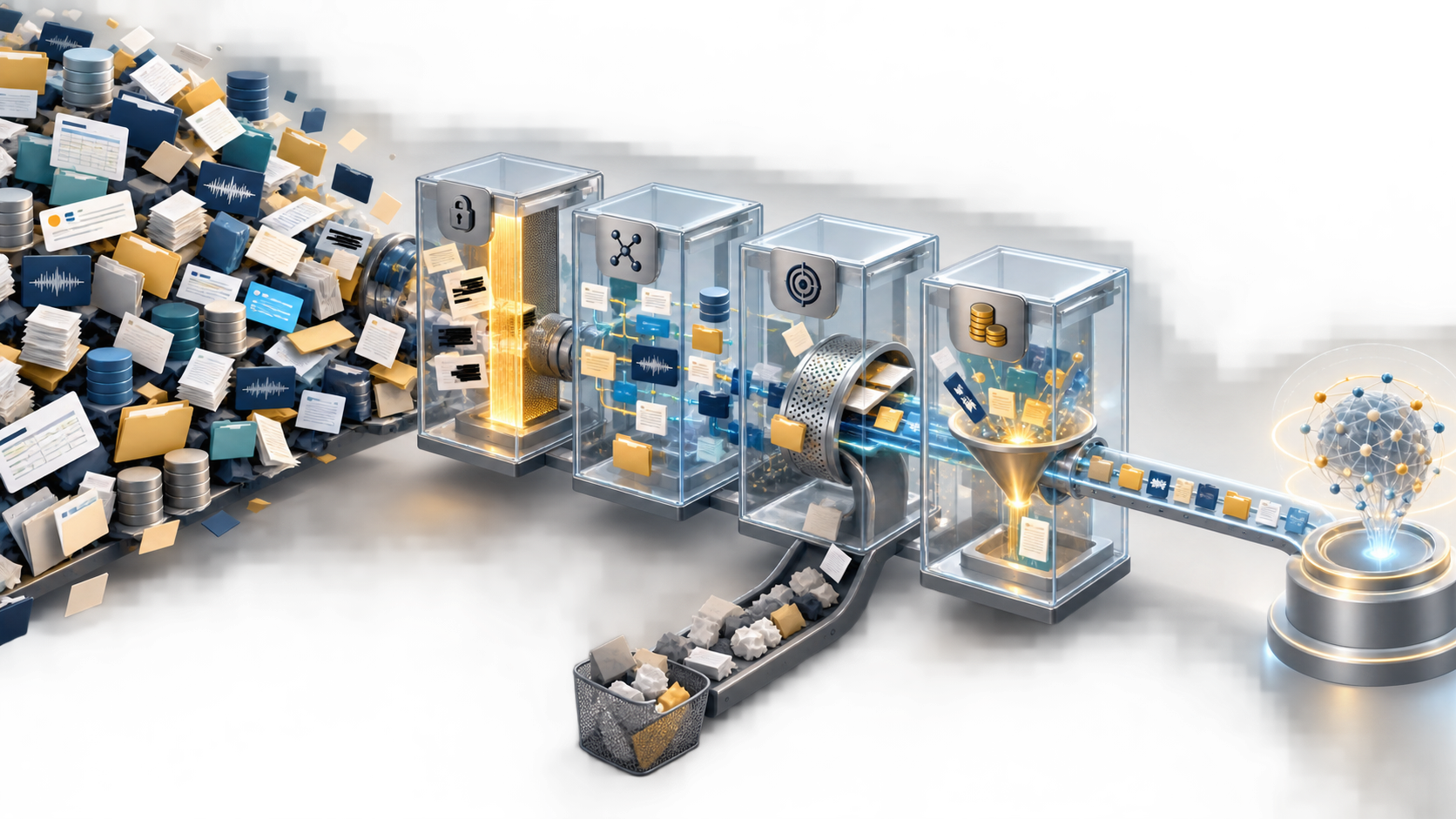
AI-native product delivery has two distinct layers: a product professional who turns uncertainty into testable artifacts, and an agent workflow that divides complex work among specialized AI components. Treating either layer as the whole model misses the more useful opportunity.
Together, the AI Builder role described by Product School and the parallel-agent architecture discussed by Pendo suggest an operating model for moving from customer evidence to evaluated software. The central lesson is not simply to add more AI. It is to assign clear responsibilities, preserve evidence across handoffs, and expand automation only where it improves a measurable constraint.
Key takeaways
- The AI Builder is the human integration layer, connecting discovery, prototyping, evaluation, and delivery inside the product trio.
- Parallel agents are a system design choice, useful when specialized paths can improve latency, answer quality, or resilience.
- Evaluations, analytics, observability, and controlled releases form the shared control system for both layers.
- Fan-out should respond to uncertainty and business importance rather than becoming the default for every task.
One delivery system, with human and machine responsibilities
The Product School article presents the AI Builder as a hybrid product professional rather than a renamed product manager or an isolated prototyper. In its account, this person uses AI across analysis, prototyping, evaluation, and shipping, with the aim of shortening the distance between a customer problem and a runnable experiment.
The Pendo article addresses a different layer. It describes workflows in which research, reasoning, tool use, and formatting can be assigned to specialized agents and then reconciled. Its focus is not ownership of the product problem, but the computational structure used to complete work.
Read together, the articles separate two ideas that are often blurred. An AI-native team still needs a person or group to choose the problem, define acceptable behavior, interpret customer evidence, and decide whether an experiment justifies investment. Agents can perform bounded tasks within that process, but parallel execution does not establish product relevance on its own.
| Layer | Primary responsibility | Typical artifacts | Control question |
|---|---|---|---|
| AI Builder and product trio | Translate customer and business uncertainty into experiments | Prototypes, evaluation criteria, instrumented experiences, delivery recommendations | Is the team learning about an outcome that matters? |
| Agent workflow | Execute and reconcile specialized tasks | Retrieved context, candidate responses, tool results, rankings, formatted outputs | Does orchestration improve the target measure enough to justify its complexity? |
| Delivery platform | Provide access, measurement, release controls, and safeguards | Tool interfaces, traces, feature flags, budgets, analytics, fallbacks | Can the workflow be observed, governed, and changed safely? |
This division of responsibility also clarifies the meaning of vibe coding in the Pendo account. Prompts, examples, and constraints are used to shape an intended experience before the team commits to extensive code or rigid rules. The AI Builder supplies the product judgment and experiment design around that activity; an agent architecture supplies one possible execution mechanism.
Parallelism should target a constraint, not become a default
Pendo reports three proposed benefits of parallel agents. Independent specialists can work concurrently to reduce latency, diverse candidate paths can be compared to improve quality, and risky or failure-prone operations can be isolated behind fallbacks. The article names fan-out/fan-in, race-and-rerank, specialist swarms, consensus, and self-consistency checks as patterns for producing and reconciling candidates.
Those benefits depend on the shape of the task. Parallel research may help when several sources or interpretations must be examined independently. A race-and-rerank pattern may help when multiple plausible outputs can be scored against explicit criteria. Guarded fallbacks may improve resilience when a tool can fail without invalidating the entire experience. By contrast, multiplying agents around a simple, deterministic step adds coordination, cost, and more places to inspect when something goes wrong.
The Product School article provides the missing selection mechanism: the workflow begins with a high-signal use case and explicit evaluation criteria. That makes orchestration a response to observed limitations in an experiment rather than an architectural commitment made in advance. A prototype can begin with the smallest credible workflow, reveal whether the bottleneck is grounding, reasoning, tool reliability, or response time, and introduce specialization at that point.
Pendo proposes a similar progression at the system level: begin with retrieval, add a planner-executor split, and introduce parallel specialists where accuracy or latency problems appear. It also recommends placing budgets on fan-out, caching results, using smaller models when confidence is high, and widening the workflow when uncertainty rises. These are recommendations from the source, not independently reported benchmarks, but they establish a useful product principle: additional computation should be purchased in proportion to uncertainty and consequence.
Evaluation is the bridge from discovery to dependable delivery
The strongest overlap between the two articles is evaluation. Product School describes AI Builders converting interviews and behavioral analytics into instrumented experiments, benchmarking quality before production, and using A/B testing to feed results back into strategy. Pendo similarly calls for offline evaluations before rollout, production experiments afterward, and agent-level analytics to identify regressions across individual workflow steps.
This creates a continuous evidence path rather than a handoff between discovery and engineering. A customer problem informs a prototype; the prototype produces evaluation cases; those cases become release gates; production behavior supplies new evidence for the next iteration. CI/CD can move changes through the delivery system, while evaluations determine whether an AI behavior is ready to move with them.
A staged adoption path
- Select a bounded use case. Product School suggests beginning with a high-signal application such as generative-AI prototyping or an in-app guide, rather than attempting to transform the whole delivery process at once.
- Define the evidence before expanding the build. Specify evaluation criteria, analytics, and the customer or business outcome the experiment is intended to illuminate.
- Establish grounded context. Both articles emphasize retrieval-oriented workflows. Product School also discusses prompts, context windows, and data contracts as product surfaces that require deliberate design.
- Start with minimal orchestration. A single workflow or planner-executor arrangement provides a baseline against which a specialist or parallel design can be judged.
- Add parallel paths selectively. Introduce research, tool-calling, reasoning, or validation specialists only where evaluation results reveal a material limitation.
- Release behind controls. The sources point to feature flags, A/B testing, observability, anomaly detection, fallbacks, and post-launch review as ways to expose failures and limit their impact.
The Model Context Protocol appears in both accounts as a way to standardize access to tools and data. Product School frames MCP integrations as part of an AI Builder’s toolbox, while Pendo argues that standardized access keeps agent roles separate from authentication, quotas, and observability. The combined implication is organizational as well as technical: shared interfaces can let product teams experiment with workflow roles without embedding every platform concern in every prompt.
The operating model changes what a product team owns
Product School places the AI Builder inside the product trio, working with design and engineering from the beginning. Pendo argues that product trios can own complete AI workflows rather than limiting their attention to prompts. These views converge on broader product accountability: the team owns the behavior, evidence, cost, risk, and release mechanism as one product surface.
That ownership requires clearer boundaries, not fewer disciplines. Product judgment determines which outcome deserves attention. Design shapes the customer interaction and failure experience. Engineering and platform work make tool access, observability, quotas, and release controls dependable. The AI Builder connects these concerns through runnable artifacts, while specialized agents remain replaceable components within the evaluated workflow.
The resulting measure of maturity is not the number of agents deployed or the speed of prototype generation. It is whether the team can trace a customer need through an experiment, an evaluation, a controlled release, and a learning decision. As tools become easier to compose, that chain of evidence will be the durable advantage in AI-native product delivery.