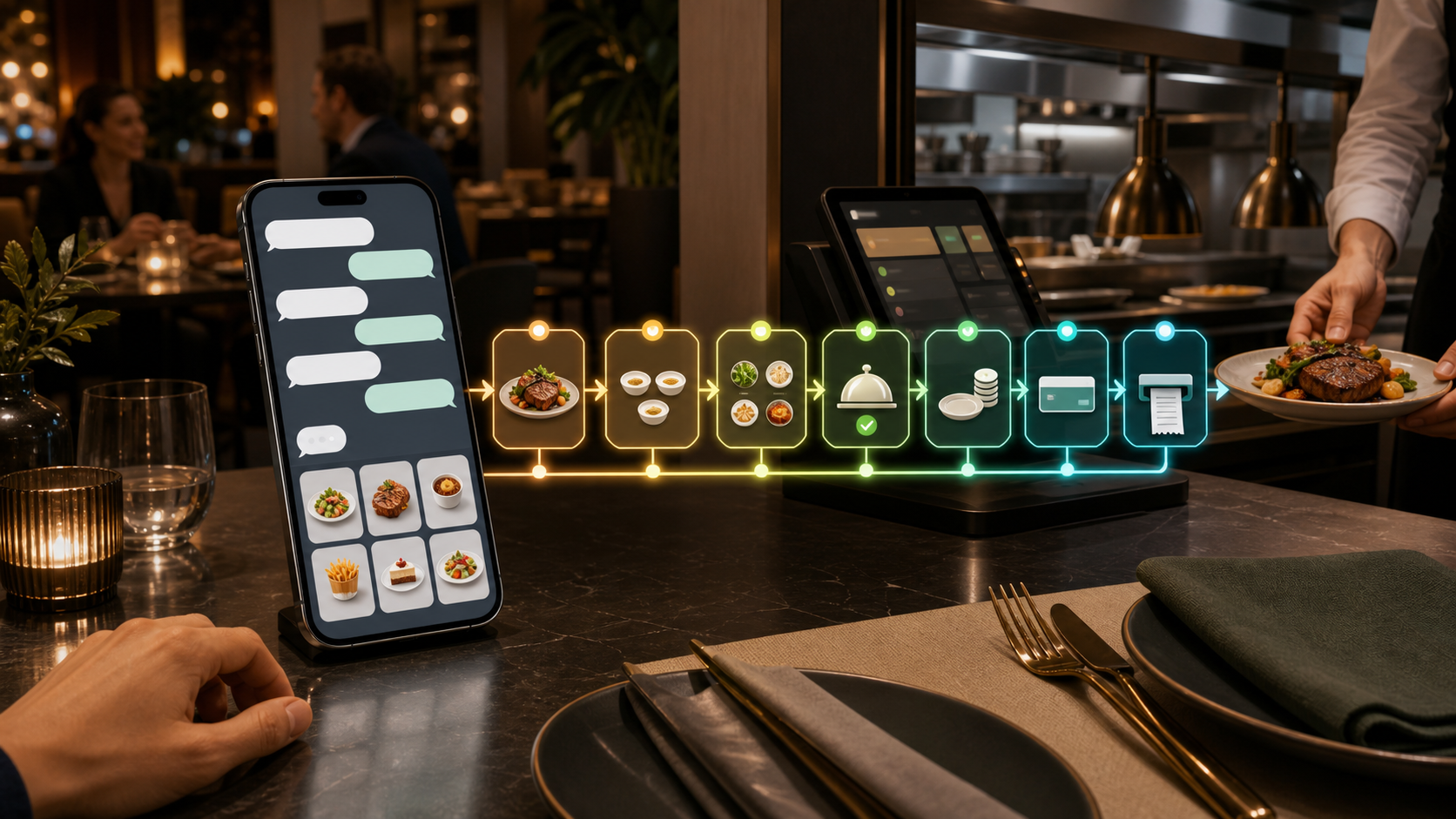
You are not really deciding whether an LLM can chat about a menu. You are deciding whether it can turn a messy WhatsApp exchange into a correct, payable order without making the customer or venue staff repair its work.
That distinction changes the product. The hard parts are structured order state, deterministic commerce operations, response time, failure recovery, and venue-specific evaluation. Get those right and WhatsApp can become a genuine ordering channel. Get them wrong and you have a fluent chatbot sitting in front of an unreliable transaction.
Key takeaways
- Define success as a confirmed, recoverable order in the system of record, not a conversation that sounded helpful.
- Let the model interpret customer language, but keep menu data, prices, modifiers, delivery eligibility, payment state, and order commits behind deterministic tools.
- Store the current order as structured state outside the transcript. A conversation is evidence of intent, not an order ledger.
- Measure useful response time across the complete WhatsApp-to-POS path, then remove tool round trips and parallelize safe read operations.
- Make item identification accuracy the primary trust metric, supported by guardrails for modifiers, payments, duplicate submissions, handoffs, and latency.
- Evaluate every venue against its real menu and rules, then turn recurring configuration, tests, and operating procedures into reusable templates.
Define the product around a completed order
WhatsApp is the interface, not the product boundary. The product boundary should run from the customer’s first request to an order state that the venue can fulfill and the customer can verify.
A useful benchmark is the end-to-end flow implemented by AITropos: recommendations, item modifiers, delivery-zone checks, payment links, and status updates inside WhatsApp. Covering the whole journey matters because every missing step creates a handoff. A bot that recommends a meal but cannot resolve its required modifiers is a discovery feature. A bot that drafts an order but cannot verify submission is an assistant. Neither is yet an autonomous ordering agent.
Write an order contract before choosing models or orchestration frameworks. The contract is the minimum structured state required to fulfill, charge for, recover, and audit an order. It will usually include:
- The venue and the applicable menu version.
- Canonical item identifiers, quantities, and customer-facing item names.
- Required and optional modifier selections, represented by identifiers rather than prose alone.
- Fulfillment method, such as pickup or delivery.
- The validated delivery result when delivery is requested.
- A system-generated quote, including the values the customer must approve before payment or submission.
- Payment-link and payment states, without treating a generated link as proof of payment.
- Customer confirmation state, POS submission state, and the resulting order identifier.
- The current owner of the interaction: agent, venue staff, or a defined recovery process.
The contract gives product, engineering, operations, and venue teams the same definition of done. It also exposes where autonomy is not yet safe. If the integration cannot validate a delivery zone, for example, the agent should collect the address and hand the order to a person. It should not infer eligibility from a conversational guess.
| Order stage | The agent’s job | Condition before proceeding |
|---|---|---|
| Discover | Map natural language to menu candidates and explain relevant options. | One supported item is identified, or the agent asks a specific clarifying question. |
| Configure | Capture quantity, required modifiers, exclusions, and additions. | Every required choice is present and valid for that item. |
| Fulfillment | Resolve pickup or delivery and call the applicable eligibility checks. | The requested fulfillment method is supported for this order. |
| Quote and payment | Retrieve the authoritative quote and create the approved payment flow. | Prices and payment state come from the commerce system, not generated text. |
| Commit | Present the structured summary and submit the confirmed order once. | The customer has confirmed the current version and the POS returns a result. |
| Status and recovery | Report system-backed status or transfer the interaction with its context intact. | The response is tied to an order identifier or an explicit handoff owner. |
Pay particular attention to the acceptance boundary. A friendly message such as “your order is being prepared” is an operational commitment. It must only appear after the system of record has accepted the order. If submission times out or returns an ambiguous result, the safe response is that confirmation is still pending, followed by a status check or human recovery. Guessing success can create duplicate orders, missed orders, and payment disputes.
You can still launch with partial automation, but name it accurately. Menu search, order drafting, and staff-assisted submission can deliver value while the integrations mature. The mistake is allowing the customer to believe the order was accepted when the product has only generated a plausible summary.
Keep the order deterministic even when the conversation is not
Customers do not speak in schemas. They change quantities, refer to items by incomplete names, add a second request before answering the first question, and revise earlier choices. Your architecture has to translate that non-deterministic conversation into structured, POS-compatible data without losing which version the customer actually approved.
My rule is simple: the model may interpret intent and propose an order-state change, but deterministic services must validate and commit it. The transcript should never be the only place where the current order exists.
A reliable turn can follow this sequence:
- Load the current structured order, venue configuration, and relevant menu context.
- Interpret the latest message as a proposed change: add, remove, replace, modify, confirm, cancel, pay, or request status.
- Resolve referenced items and modifiers to canonical identifiers.
- Call read-only tools for availability, configuration, fulfillment rules, or quotes as needed.
- Validate the proposed change against required modifiers and venue rules.
- Write a new order-state version and generate the next response from that validated state.
- Use a separate, idempotent write operation when the customer confirms submission.
This design makes corrections much safer. If the customer says, “Make the second one large and remove the fries,” the agent should apply a state delta to the identified lines, validate the revised configuration, and show the updated summary. It should not regenerate the entire order from memory and hope that unrelated details remain intact.
Tool contracts should be narrow and explicit. Menu search should return canonical candidates and the information needed to distinguish them. Item detail should return valid modifier groups. A quote tool should return authoritative values. A payment tool should return a system-created link or a structured error. An order-submission tool should return an accepted identifier, a definite rejection, or an unresolved state that triggers recovery.
Do not let the model invent a price, payment URL, availability claim, delivery decision, or order status. These are business facts with financial and operational consequences. The response composer can explain them in natural language, but the underlying values must come from an approved system.
Separate reads from writes in the architecture. Independent menu and item lookups can often run in parallel. Writes should be serialized against a known order-state version. Every commit operation should accept an idempotency key so a retry cannot create a second order. If the state changed after the customer saw the summary, require confirmation of the new version rather than silently committing it.
The same discipline applies to human handoff. Transfer the structured cart, unresolved question, relevant tool results, and submission state along with the transcript. A handoff that forces staff to reread the entire conversation and reconstruct the order is not graceful degradation; it is deferred manual work.
Choose the orchestration pattern from the service objective, not from architectural fashion. Under tight response constraints, AITropos chose direct tool calls instead of MCP or a multi-stage pipeline to reduce orchestration overhead. That is not a universal argument against MCP. It is a reason to benchmark the actual path. Compare end-to-end latency, traceability, schema governance, failure isolation, and engineering cost using representative ordering turns. If an abstraction adds useful control, keep it. If it only adds another round trip, remove it.
Manage latency as part of the customer experience
The model’s inference time is only one part of latency. From the customer’s perspective, the clock starts when the message is sent and stops when a useful next action arrives. Context retrieval, menu search, validation, payment calls, POS submission, message delivery, retries, and overloaded queues all sit inside that interval.
Instrument the complete path before optimizing it. Capture timestamps for message receipt, context assembly, model execution, every tool call, state validation, response creation, and outbound delivery. Report median and tail latency by turn type. A single average can hide a checkout path that is consistently slower than menu questions.
At minimum, separate these turn classes:
- Menu discovery and recommendation.
- Item identification and configuration.
- Cart edits and corrections.
- Delivery or fulfillment validation.
- Quote and payment-link creation.
- Order confirmation and POS submission.
- Order-status retrieval.
- Human escalation and recovery.
Set a service objective for each class from observed channel behavior and the operational risk of delay. There is no useful universal number. A status lookup and a multi-item order edit do different work. What matters is that the team can see which component consumes the budget and what happens when that component times out.
Optimize in the order that removes uncertainty as well as delay:
- Remove unnecessary model and tool round trips. Load the active order and venue configuration before asking the model what to do.
- Parallelize independent read operations, such as resolving multiple products mentioned in one message.
- Prefetch likely item context so the agent does not discover basic menu facts one call at a time.
- Inject only the context needed for the current turn. An oversized prompt moves latency rather than eliminating it.
- Keep deterministic validation outside the model when a rule or schema check can answer immediately.
- Give every external dependency a timeout, an observable error state, and a safe recovery path.
- Use concise responses that advance the order. Extra prose increases reading time and can obscure the decision you need from the customer.
A useful implementation pattern is already visible in production: multiple product searches run in parallel, product context is prefetched, and smaller, faster components prepare the relevant context for each turn. The product lesson is not to create a swarm of agents. It is to move predictable preparation out of the critical reasoning loop while preserving one coherent order state.
Watch the failure mode on the other side of aggressive optimization. Cached menu metadata can reduce retrieval work, but stale availability or price data can create a wrong commitment. Define which fields are stable enough to cache, how they are invalidated, and which values must be retrieved at quote or submission time. Speed is valuable only when the answer remains authoritative.
When a slow operation cannot be avoided, use an honest progress message and preserve the pending state. Do not fill the wait with repeated acknowledgements that imply completion. If the customer sends another message while the tool is running, the state machine should know whether to queue the change, cancel the pending operation, or ask the customer to wait for its result.
Evaluate each venue, then template what repeats
Make item accuracy precise enough to govern decisions
Item identification accuracy deserves to be the primary trust metric. If the agent resolves the wrong item, every later component can behave perfectly and still produce the wrong order. AITropos treats order item identification accuracy as its most important KPI, giving model, prompt, retrieval, and fallback decisions a common objective.
Define the metric before building a dashboard. I would count an attempted line item as correct only when the canonical item, quantity, and required modifier interpretation match the customer’s resolved intent. A necessary clarification is not automatically an error; it should count against a separate clarification-burden metric. Otherwise, the team may improve apparent accuracy by asking the customer to confirm every obvious detail.
Do not let the primary KPI hide transaction failures. Pair it with guardrails for:
- Unsupported substitutions or invented items.
- Missing and invalid required modifiers.
- Customer corrections after the agent presents a summary.
- Quote, payment-link, and POS tool failures.
- False confirmations, unresolved submissions, and duplicate commits.
- Order completion and abandonment by journey stage.
- Human handoff rate, reason, and time to recovery.
- End-to-end latency by turn class and venue.
Link corrections back to the original decision. If the customer changes an item because the agent misunderstood it, label the item-resolution turn rather than treating the correction as an unrelated edit. That is how production behavior becomes useful evaluation data instead of a collection of support anecdotes.
Simulate failures before customers encounter them
A venue-specific evaluation suite should use that venue’s menu identifiers, modifiers, availability behavior, delivery rules, payment flow, and POS adapter. A generic restaurant benchmark can test language understanding, but it cannot tell you whether the agent knows that a particular size requires a particular modifier or that two similar menu names map to different SKUs.
Build test families for:
- Incomplete names, colloquial references, and ambiguous matches.
- Several products requested in one message.
- Required modifiers, exclusions, additions, and invalid combinations.
- Quantity changes, replacements, removals, and cancellation.
- Unavailable items and acceptable alternatives.
- Pickup, delivery, and addresses that cannot be validated.
- Quote changes before confirmation.
- Payment failure, delayed payment state, and an abandoned payment flow.
- Tool timeouts, malformed tool results, retries, and uncertain POS submission.
- Interrupted conversations that resume with an existing cart.
- Requests that require staff judgment rather than autonomous execution.
Generate the expected structured order independently from the agent being tested. Otherwise, the same model can reproduce its own misunderstanding in both the answer and the grade. Keep a small, human-reviewed set of critical conversations alongside the larger generated suite, and add every material production failure to the permanent regression set.
Scale matters when menus contain many combinations. Before each new venue goes live, AITropos runs thousands of simulated customer conversations overnight. The number alone is not the release gate. Coverage, a trustworthy expected answer, and clear failure categories are what make simulation useful.
Simulation also cannot reproduce every production condition. Follow it with a staff sandbox and a controlled production phase. Use only redacted, properly authorized customer conversations in evaluation systems, and retain no more personal data than the test requires.
I would treat any path that invents a price or payment state, falsely confirms an order, or can duplicate a commit as release-blocking. Other thresholds should reflect the venue’s menu complexity, existing human baseline, handoff capacity, and the cost of a wrong order. Record those thresholds before the final test run so launch pressure cannot redefine success afterward.
Roll out autonomy in observable stages
Start with a venue that is operationally manageable but representative enough to expose real modifiers, fulfillment rules, and integration behavior. An unusually simple pilot may produce a clean demo while postponing the problems that determine whether the product can scale.
- Configuration: ingest and normalize the menu, map canonical identifiers, mark required modifiers, connect fulfillment and payment rules, and produce a completeness report. No customer-facing ordering is enabled.
- Sandbox: let venue staff run realistic conversations while write tools remain disabled or point to a test environment.
- Approval mode: allow the agent to prepare a structured order, but require a person to approve the commit. Measure how often the person changes it and why.
- Constrained production: enable autonomous submission for the supported venue, fulfillment modes, and order types, with a staffed handoff path and rapid rollback.
- Expansion: widen scope only after production traces confirm the accuracy, latency, recovery, and operational workload expected by the release criteria.
For every stage, decide who can pause the agent, how staff take over an active conversation, how the customer learns that a person has taken over, and how an uncertain submission is reconciled before another order is created. These are product requirements, not post-launch operating notes.
Once one venue works, resist copying its prompt and integrations into a new branch. Make venue differences configuration wherever possible: normalized menu schemas, modifier patterns, fulfillment policies, tool mappings, escalation contacts, evaluation packs, and dashboard dimensions. Keep truly distinct behavior explicit rather than burying it in prompt prose.
The scalability payoff can be substantial. AITropos reduced new-venue onboarding from three months to a few weeks, while domain templates are being used to shorten it further. Track your own onboarding work by category: configuration, data cleanup, integration, prompt or policy changes, evaluation, venue training, and launch support. If every venue still requires bespoke code and a rewritten conversation flow, the product has not yet separated its platform from its implementations.
Your next step should be concrete. Choose one representative venue and create three artifacts: the canonical order contract, a failure-and-recovery matrix for every tool, and a venue-specific evaluation set built from redacted, authorized scenarios. If those artifacts cannot show what happens when item resolution, a modifier, delivery validation, payment, or POS submission fails, the agent is not ready to accept orders. Once those states are explicit, model and architecture choices become testable decisions rather than matters of confidence.