Tag: product strategy

  • Why Product Engineers Are Transforming Software Delivery: Ownership, Speed, and Real Impact

    I’ve watched the rise of product engineering up close, and it’s reshaping how we build software. The old model of rigid handoffs and separate functions is giving way to small, empowered product teams where engineers own the customer problem end to end. That shift isn’t just cultural—it’s a performance advantage that compounds with every release.

    I often summarize it this way: “Product engineers are taking over. They ship code, talk to users, and own outcomes—no handoff required. Here’s what the role is, and why it matters now.”

    When I say “product engineer,” I’m describing a builder who goes beyond writing code. I expect them to partner in product trios with product management and design, participate in continuous discovery, and make decisions grounded in product strategy and real customer insight. They don’t toss features over a wall; they own the problem, the solution, and the measurable outcome.

    Why now? Modern delivery practices like CI/CD and feature flags compress feedback loops, while behavioral analytics and session replay make customer friction visible in real time. As expectations rise for quick iterations and clear value, teams that reduce handoffs and align around outcomes outperform on DORA metrics such as deployment frequency and lead time for changes.

    Day to day, a strong product engineer blends discovery and delivery. They join customer interviews, review support tickets, analyze usage patterns, and run A/B testing to validate hypotheses. Then they ship code in small, safe increments, instrument telemetry, and watch adoption and retention signals to confirm they’re moving the numbers that matter.

    Team shape matters. I favor compact, cross-functional squads anchored by product trios, each with explicit outcomes vs output OKRs. Product engineers often operate like forward deployed engineers, partnering with customer success and solutions engineering to learn at the edge of real-world usage. This proximity to customers turns ambiguity into insight—and insight into product leverage.

    Accountability is concrete. We track DORA metrics for delivery health and pair them with product outcomes such as activation, time-to-value, and Net Recurring Revenue (NRR) drivers. The combination keeps us honest about both how fast we move and whether what we ship truly works for customers.

    The hiring profile is distinct. I look for engineers who are curious about the “why,” comfortable with trade-offs, and energized by customer conversations. They can navigate architectural complexity, but they also translate user feedback into crisp product bets. Many grow into natural facilitators of discovery rituals and developer evangelism across the organization.

    If you’re getting started, pilot a single squad. Establish clear outcomes vs output OKRs, invest in CI/CD and feature flags, and commit to continuous discovery with weekly customer interviews. Give the team ownership of a KPI tied to product strategy, and measure progress with DORA metrics plus usage and retention signals. The early wins—fewer handoffs, faster learning, tighter feedback loops—build momentum quickly.

    In short, product engineers thrive where accountability, autonomy, and user empathy meet. They reduce wasteful coordination, shorten the path from insight to impact, and ensure we ship code that customers actually adopt. That’s why this role is reshaping how software gets built—and why the teams that embrace it will set the pace for everyone else.


    Inspired by this post on Pendo – Perspectives.


    Book a consult png image
  • Salesforce to Acquire Fin for ~$3.6B: Powerful AI Synergy, Product Strategy Takeaways

    Salesforce to Acquire Fin for ~$3.6B: Powerful AI Synergy, Product Strategy Takeaways

    I’m processing a milestone moment for SaaS, AI strategy, and product leadership. One statement captures the news with clarity: “We’re excited to share that we just signed an agreement for Salesforce to acquire Fin for ~$3.6B. The transaction is expected to close in the fourth quarter of Salesforce’s fiscal year 2027.” As a product leader, I see this as a high-conviction bet on agentic AI, Customer Agents, and CRM integration at massive scale.

    The backstory matters, and it’s remarkable: “Fin started as Intercom 15 years ago. We changed our name to cap our transformation just weeks ago. We were a darling of the SaaS era and invented so many of the patterns you see in software today. Nearly four years ago, in need of a reboot, we jumped on weeks-old modern LLMs to create and define the category we know as Customer Agents today.” That arc—from SaaS pioneer to LLM-powered category creator—illustrates how bold pivots, shipped with urgency and clear product strategy, can reset the trajectory of a company and a market.

    From a product management lens, this deal reinforces a few truths: category creation rewards those who move first with conviction; “reboots” succeed when they’re anchored in genuine customer value; and modern LLMs, applied through disciplined roadmapping and eval-driven development, can unlock step-change outcomes in customer support ai strategy and product-led growth. It also signals the rising centrality of agentic AI and operational AI workflows inside the CRM.

    The leadership dimension is just as instructive. As the announcement framed it: “Salesforce invented modern software and SaaS. And Marc Benioff is like the final boss of tech founder CEOs. In seat for 27 years, he’s one of the last of his era. Still pushing, pivoting, placing big bets.” That ethos—placing big, principled bets while adapting the operating model—sets the tone for what sustained product management leadership looks like at scale.

    Customer continuity and acceleration are clearly emphasized: “To our customers: Over the past few years we’ve been shipping intensely. Including recently our groundbreaking model, Apex, and our paradigm-defining internal agent, Operator. With the resources of Salesforce this will only accelerate. And yet little will practically change. I’ll still be CEO, Des will still be running R&D, we’ll both still be committed to continuing to lead this category. Thank you very sincerely and deeply for your belief in us.” For practitioners, the signal is strong: continued focus on shipping, sharper execution readiness, and tighter integration paths inside the Salesforce ecosystem.

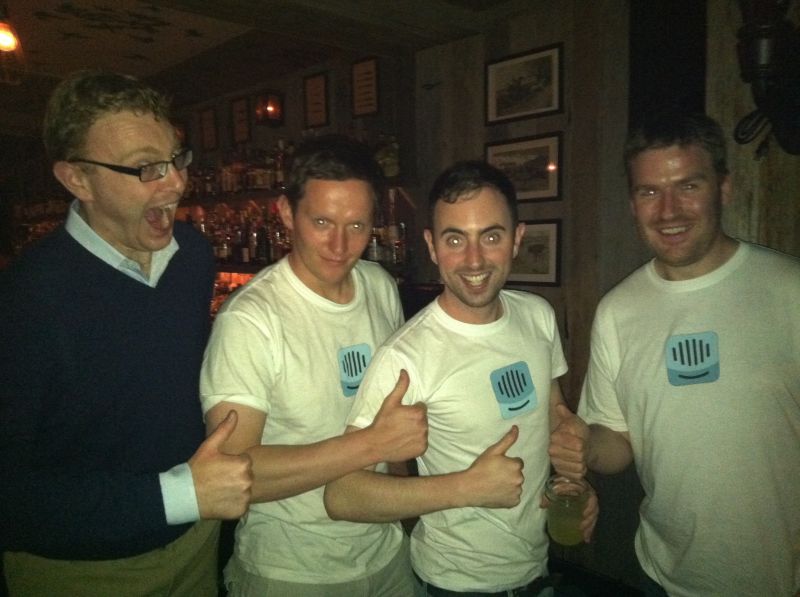
    Group of colleagues seated around a round table in a warm wood-paneled private dining room with pop-art portraits and a starry ceiling, smiling over drinks and dessert as they mark a business milestone.
    Smiles, clinking glasses, and a roundtable toast in a cozy private room capture the energy of a big day—celebrating Salesforce's definitive agreement to acquire Fin and the teams joining forces for what's next.

    There’s a human heartbeat here too: “While this is not the end, it is a major, pivotal, special, and emotional moment for us.” Moments like this remind me that building enduring products is equal parts craft and courage—powered by teams who commit to the long game, navigate uncertainty, and still ship relentlessly.

    Strategically, I expect near-term priorities to center on secure data flow and governance, deep CRM integration, and unifying telemetry for Agent Analytics across channels. On the roadmap, I’d anticipate tighter alignment between LLM safety, retrieval-first pipelines, and enterprise-grade observability—plus thoughtful go-to-market strategy enabling sales-led growth to complement product-led growth. The real unlock comes when Customer Agents are natively orchestrated with Service, Sales, and Marketing workflows—measured with clear outcomes vs output OKRs and reinforced by robust knowledge management.

    For fellow product leaders, the takeaways are actionable: define category boundaries with crisp value propositions; balance speed with governance; invest in eval-driven development and continuous discovery; and keep your product trios aligned around measurable customer outcomes. Above all, build the operating cadence—metrics, rituals, and talent—that lets you compound small wins into durable differentiation.

    And I appreciate the spirit of this closing line: “And now, time to get back to work. See you at our next product launch in a few weeks. (:” That’s the mindset that turns a headline into execution: celebrate briefly, then ship the next proof point.


    Inspired by this post on The Intercom Blog.


    Book a consult png image
  • Beyond Black‑Box Scores: Custom AI That Elevates Trust & Safety Without Burnout

    Beyond Black‑Box Scores: Custom AI That Elevates Trust & Safety Without Burnout

    What do you do when off-the-shelf moderation scores aren't good enough—and the alternative is paying human contractors to spend their days reviewing traumatizing content at scale? I’ve wrestled with that exact trade-off in enterprise environments, and it’s why I was eager to unpack how custom AI can raise the bar on trust and safety without compromising accuracy, latency, or the well-being of our teams.

    In this episode of Just Now Possible, I sit down with Nikki Marinsek (Data Scientist), Brian McCaffrey (Software Engineer), and Dan Means (Machine Learning Engineer) from Musubi, an AI-native trust and safety toolkit for content platforms. Musubi builds custom-trained ML models and LLM-powered moderation tools that adapt to each platform's unique policies—from dating apps to social networks to AI inference endpoints. As a product leader, I’m drawn to their blend of eval-driven development, agentic AI, and pragmatic deployment pipelines that actually meet real-world SLAs.

    We walk through their full journey—starting with a first prototype on tabular data—then discovering the system was sometimes catching issues human moderators missed. That insight became a forcing function to formalize evaluation, calibrate thresholds, and design feedback loops that help humans and models converge. Just as importantly, they built a policy optimizer that uses agentic flows so non-technical trust and safety teams can iterate on LLM moderation policies without needing a data scientist in the room.

    If you’ve ever had to balance latency, accuracy, and cost at scale, you’ll appreciate how Musubi tests trade-offs across traditional ML, embedding-driven classification, and LLMs. Their approach mirrors the patterns I expect in high-throughput stacks: cache and pre-compute where possible, contain worst-case latencies, and push evaluation tooling to customers so policy changes are safe, observable, and fast to deploy.

    What resonated most with me is their core product strategy: put eval tools directly in customers’ hands. When teams can benchmark AI against humans, referee disagreements using “LLM as judge,” and make policy gaps visible, trust increases and operational drift decreases. That’s the foundation for durable product strategy in sensitive domains like content moderation, fraud management, and risk scoring.

    Listen to this episode on: Spotify | Apple Podcasts

    Guests: Nikki Marinsek, Data Scientist, Musubi; Brian McCaffrey, Software Engineer, Musubi; Dan Means, Machine Learning Engineer, Musubi.

    In this episode: Why off-the-shelf moderation scores fail and how custom-trained models fix that; How Musubi combines traditional ML with LLMs for different moderation tasks; The discovery that AI can outperform human moderators—and how to communicate that to clients; Using AI as a judge to referee disagreements between AI and human decisions; How Musubi onboards new customers with "reverse demos"; What custom model training actually means: fine-tuning, feature engineering, and reusable deployment pipelines; The policy optimizer: an agentic flow that helps customers iterate on their LLM moderation policies; Why pushing eval tools directly to customers is a core product strategy; How Musubi is building flexible orchestration workflows for non-technical trust and safety teams.

    From a product management lens, a few highlights stand out. First, the disciplined separation of concerns: use traditional ML for high-precision, low-latency pattern detection and LLMs for nuanced policy interpretation. Second, invest in golden sets and policy loops early so you can quantify improvement and avoid subjective debates. Third, productize customization—create reusable deployment pipelines, parameterized policies, and self-serve evaluation—so each customer’s “custom model” still scales like a platform.

    I also appreciated the onboarding tactic of "reverse demos." Rather than a canned walkthrough, the team invites customers to bring real policies and edge cases, then instruments the workflow live. That move builds credibility, accelerates discovery, and surfaces the fastest paths to value—an approach I recommend whenever you’re selling complex AI workflows to non-technical stakeholders.

    If you’re navigating cost and latency trade-offs, the conversation goes deep on techniques like embedding-driven classification, fine-tuning vs. training, and when to route decisions through LLM adjudication. My takeaway: treat the router, the evaluator, and the policy as first-class products. When those elements are observable and testable, you can raise quality without exploding compute costs or creating operational bottlenecks.

    Resources & Links: Musubi — AI-powered trust and safety toolkit for content platforms. Maven AI Evals Course — AI evals course.

    Chapters: 00:00 Meet the Team; 01:18 Why Everyone Wears Product; 02:32 What Musubi Builds; 04:51 AI for Human Moderation; 09:59 Adversaries and Asymmetry; 11:48 Early Days and Low Latency; 13:35 First Prototype Slice; 15:33 Traditional ML Meets LLMs; 19:52 Benchmarking Against Humans; 23:09 LLM as Judge and Policy Gaps; 29:53 From Prototype to Platform; 31:15 Customer Onboarding Reverse Demos; 36:08 Custom Models Per Customer; 38:05 Fine Tuning vs Training; 39:14 Embedding Driven Classification; 40:04 Cost and Latency Tradeoffs; 43:21 Productizing Customization; 49:16 Scaling Prototypes to Production; 51:58 Golden Sets and Policy Loops; 56:17 Coaching Customers Safely; 01:02:06 Gamified Feedback Signals; 01:06:19 Agentic Toolkit Roadmap; 01:09:05 Workflow Orchestration Future; 01:12:06 Wrap Up and Thanks.

    Ultimately, this is a playbook for modern trust and safety: align your models to your policies, make evals a habit not an event, and empower non-technical teams with agentic workflows and transparent metrics. That’s how we move beyond black-box scores to systems we can measure, manage, and trust.


    Inspired by this post on Product Talk.


    Book a consult png image
  • Learning Together: The Small-Group Product Coaching Strategy That Accelerates Real-World Growth

    Learning Together: The Small-Group Product Coaching Strategy That Accelerates Real-World Growth

    I’m continually evaluating how to invest in my team’s professional development in ways that create lasting capability, not just momentary enthusiasm. Recently, I revisited a compelling conversation featuring Teresa Torres and Petra Wille that zeroes in on how product teams actually learn best—especially when we’re accountable for product management leadership and sustainable practice change across empowered product teams.

    Listen to this episode on: Spotify | Apple Podcasts

    What's the best way to invest in your team's professional development — train everyone at once, let people self-direct, or something in between?

    In my experience, the answer depends on your goals, the maturity of your product discovery habits, and how you create peer accountability. What resonated most with me was their argument that small, intentional groups are a powerful (and underused) learning model—one that aligns with how we build momentum in product discovery, product strategy, and continuous discovery routines.

    Three Models of Team Learning

    Train everyone at once — builds shared language, but not everyone is ready at the same time

    Self-directed learning — works for highly motivated individuals, but lacks accountability

    Small-group learning — the sweet spot: peer accountability, shared momentum, and just-in-time relevance

    Across my teams, I’ve seen organization-wide training create useful common ground, but it rarely changes day-to-day behaviors without a follow-on mechanism for practice. Self-directed learning can inspire, yet it often fails to translate into consistent habits without peer pressure and shared goals. Small-group learning, especially within product trios or adjacent squads, consistently drives the most adoption because it blends relevance, peer accountability, and just-in-time application to real customer interviews, roadmap decisions, and stakeholder management challenges.

    Why Learning Together Works

    Creates natural accountability and deadlines

    Helps people apply concepts to their own real work

    Especially valuable for product leaders, who rarely have built-in peers to learn alongside

    I’ve found small cohorts particularly effective for product leaders who need a safe space to pressure-test decisions, compare notes on org design, and align on product strategy trade-offs—without slipping into status updates. When leaders learn together, they build shared muscle memory that makes it easier to reinforce practices like continuous discovery and communities of practice across the organization.

    Group Coaching vs. One-on-One Coaching

    Individual: sounding board, holding space, powerful questions

    Group/team: real work in the room, peer learning, bridges between leaders who rarely collaborate

    Keep participants as close colleagues — trust and vulnerability go up when people already know each other

    One-on-one coaching is invaluable for personal reflection and targeted growth. But when I need to accelerate collective behavior change—like improving discovery cadence, refining opportunity solution tree reviews, or aligning around outcome-based roadmapping—group coaching wins. Keeping participants as close colleagues increases vulnerability and candor, which in turn speeds up learning and leads to real changes in how teams plan, prioritize, and ship.

    Key Takeaways

    Start a book club — debriefing together beats reading alone

    Train pilot teams before rolling out org-wide

    Encourage duos or trios to take courses together

    Match your learning format to your actual goal

    Keep coaching groups tight for more honest, productive sessions

    Here’s how I operationalize this: I start with a pilot team to validate the learning format and cadence, then expand to adjacent trios to build a network effect. We anchor learning to current initiatives (not abstract theory), ensure weekly touchpoints, and capture playbooks in our internal knowledge base so improvements persist beyond the cohort.

    Resources & Links:

    Follow Teresa Torres: https://ProductTalk.org

    Follow Petra Wille: https://Petra-Wille.com

    Mentioned in this episode:

    Communities of Practice

    Petra Wille's book Strong Product Communities – The Essential Guide to Product

    Become a Better Product Leader: A 52-Week Transformation Journey – Petra's email course with quarterly live Q&A

    Teresa Torres’ book Continuous Discovery Habits

    Continuous Discovery Habits (CDH) Book Club

    Petra’s STRONG Product People Corporate book clubs

    Teresa's Product Discovery Fundamentals course

    Work with Petra

    Learning together at a conference like Product at Heart

    Teresa & Hope Gurion's group leadership coaching program through Product Talk Train Your Team

    Join the Conversation:

    Have thoughts on this episode? Leave a comment below.


    Inspired by this post on Product Talk.


    Book a consult png image
  • A Game-Changing Leap in Voice AI: Fin Voice 2, Apex Flash, and a Live Demo You Can Trust

    A Game-Changing Leap in Voice AI: Fin Voice 2, Apex Flash, and a Live Demo You Can Trust

    In competitive markets, I see two options: try to win the game competitors set, or choose to play a different game. In the "Customer Agents" category, I’ve watched too many glossy, fabricated demos—especially around voice—mask the real challenges. Voice is just extremely hard. We all know the future of customer experiences will be Agent-driven voice, yet most of us haven’t actually spoken with a modern AI Agent when calling a business because the tech hasn’t been truly ready in the wild. Today, the bar moves.

    What changed? There’s a live, public demo of cutting-edge voice tech you can stress test yourself—no smoke, no mirrors. I recommend taking it for a spin: https://fin.ai/voice. It’s fast, natural, and, yes, very, very good.

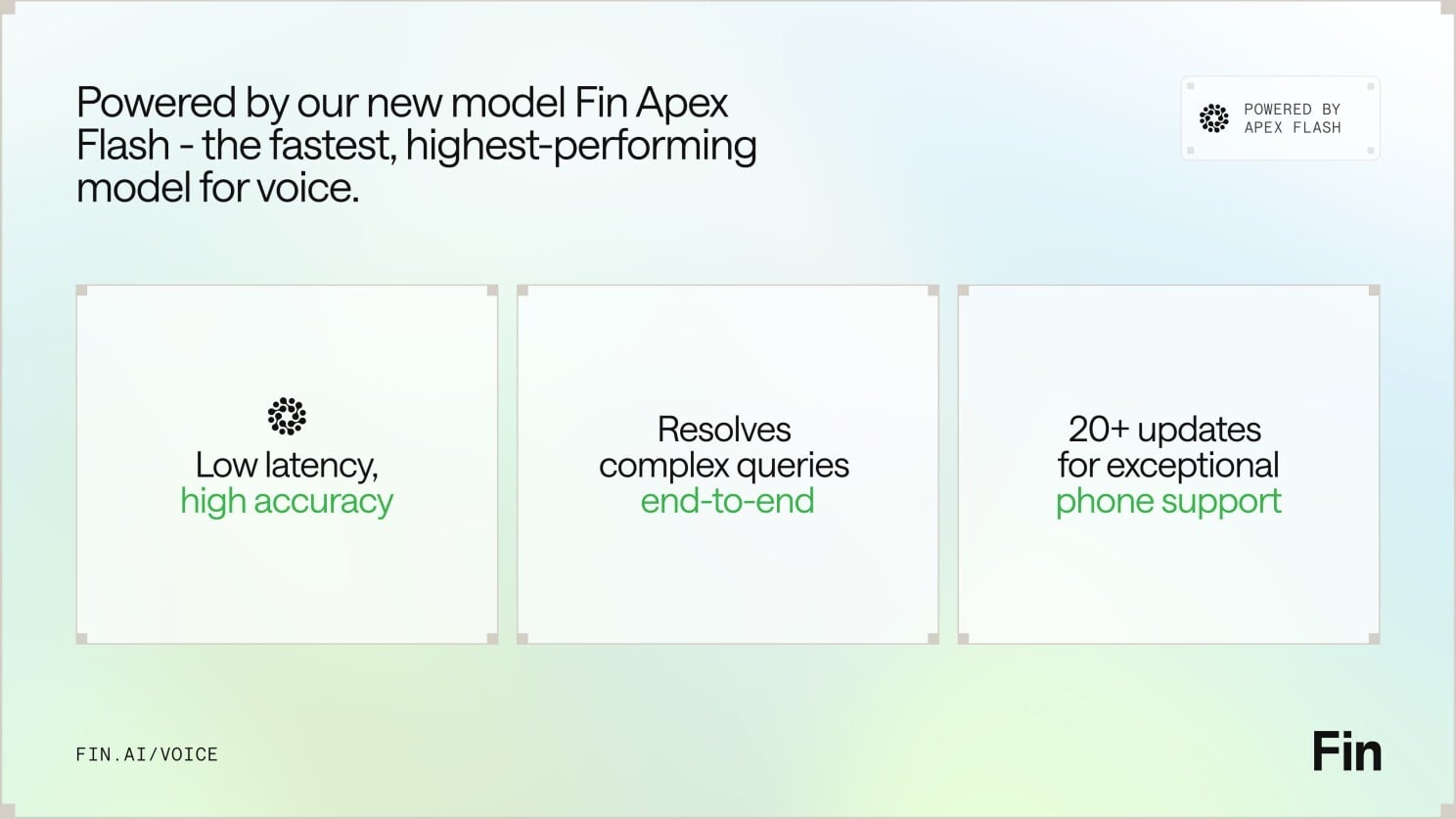
    For context, yesterday brought Apex Flash, their newest and fastest model, built for the unique demands of low latency channels like voice. Today comes Fin Voice 2, a major upgrade to Fin Voice with over 20 new features, and the first product built on Apex Flash.

    Here are the three things that stood out to me—and why they matter for customer support AI strategy and product strategy.

    First — thanks to Apex Flash, Fin Voice 2 is now the fastest, most natural Agent for phone, with higher resolution rates and customer satisfaction scores than ever before. Apex Flash is trained on millions of customer experience interactions, fine tuned for customer service, and can be configured to understand all your knowledge and follow all your policies. The result is higher resolution at significantly lower latency—the best of both worlds for voice AI agent performance.

    Speed and naturalness here aren’t accidental. Most voice AI products are slow because they convert speech to text, send it to a general model, get a text answer, and then convert it back to speech. Fin Voice 2 was designed to work differently, separating the real time layer that handles speech processing, and the layer that generates answers. That architecture is purpose-built for the demands of customer service on voice.

    Slide for Fin Voice 2, powered by Apex Flash, showing it beats Voice 1: +24.5% average resolution, +8.4% guidance following, +1.3% CSAT, -19.2% time to first audio, -37.6% semantic search latency.
    Powered by Apex Flash, Fin Voice 2 raises the bar on quality and speed—boosting resolution rates and guidance following while cutting time to first audio and semantic search latency, with a lift in CSAT too.

    Second — Fin Voice 2 can handle complex queries end to end: taking actions in external systems, verifying callers’ identities, processing refunds, booking appointments, and more. Phone is a high-stakes channel, and Fin adapts to customers across emotional states, clarifies when needed, and confirms key details before taking action. Most of the time, Fin can resolve the query in full, and when it can’t, it seamlessly hands off to the human team, maintaining full customer context and history. You also get multiple improvements to call quality, plus proactive outbound calls to follow up on unresolved issues—all orchestrated by robust AI workflows.

    Third — Fin Voice 2 gives you total control with industry-leading tools to configure and manage how Fin behaves. You get rich, detailed insights into call behavior and quality, the most common topics of calls, and one-click recommendations to improve. As with everything in Fin, you can fully self-serve and then manage it all with ease, without requiring professional services. Many vendors only let you set up their voice agent under supervision; with Fin, you get everything you need to iterate fast.

    If you haven’t tried the demo yet, go check it out: https://fin.ai/voice. If you prefer to wait, don’t be surprised when you end up speaking with it at a favorite brand soon.

    From a product management lens, this is what matters: latency is a feature customers feel; transparency builds trust in enterprise AI; and control is non-negotiable for CX leaders. The combination of a purpose-built, agentic AI architecture, measurable gains in resolution and CSAT, and true self-serve configuration signals that voice is moving from prototype theater to production reality. That’s the different game I want our industry to play.


    Inspired by this post on The Intercom Blog.


    Book a consult png image
  • Supercharge Insights with Amplitude Agent Connectors: Connect Notion, Slack, Linear & More

    Supercharge Insights with Amplitude Agent Connectors: Connect Notion, Slack, Linear & More

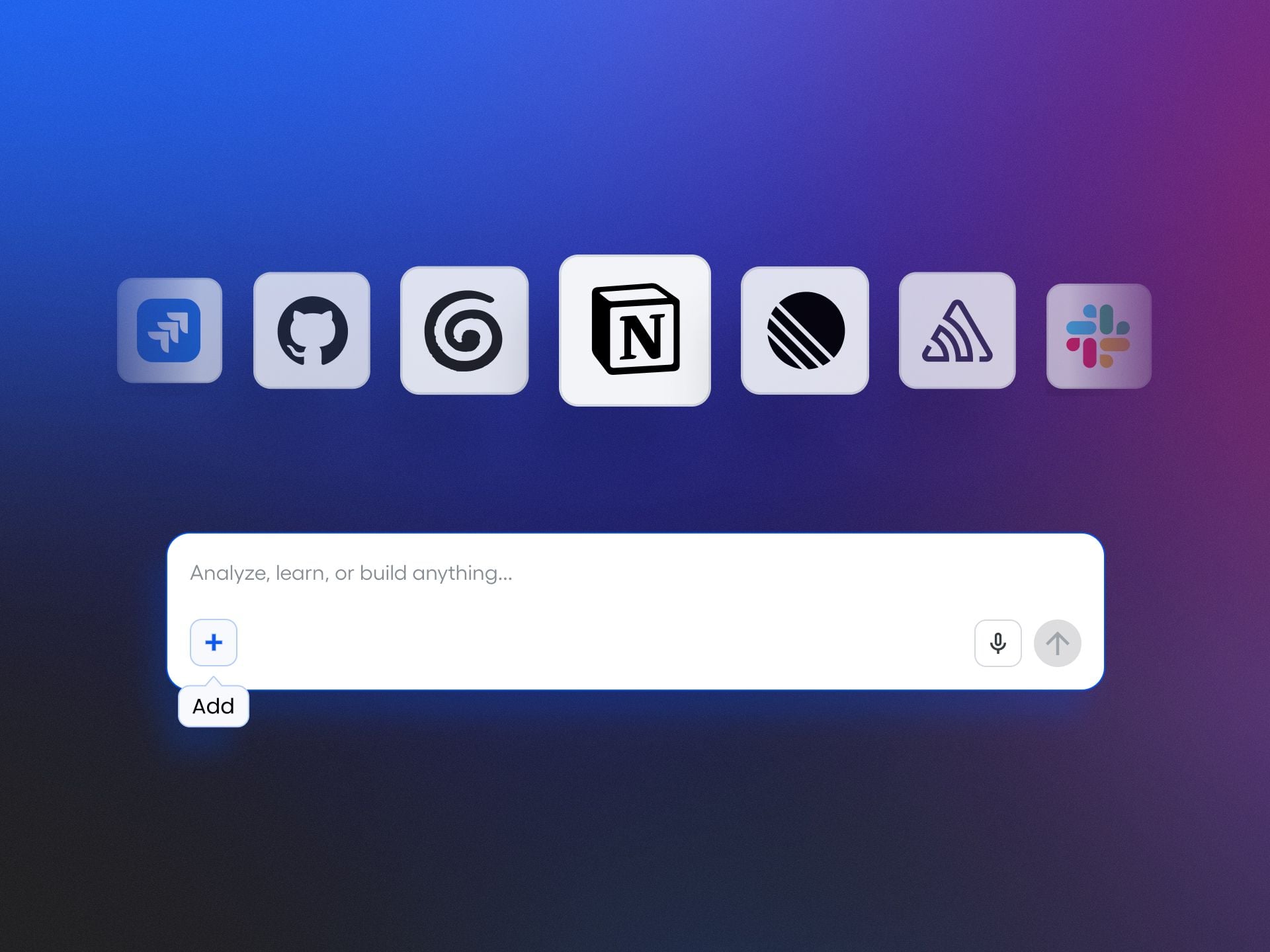
    I’ve led enough multi-tool product organizations to know how quickly momentum erodes when insights and actions live in different places. When my teams bounce between Notion, Atlassian, Slack, Linear, and analytics dashboards, we pay a real tax in context switching. That’s why I’m excited about what Amplitude is enabling with Agent Connectors—bringing our daily work and our data-driven decisions into one fluid, agentic AI workflow.

    Connect Notion, Atlassian, Slack, Linear, and more to Amplitude's Global Agent. Get richer analysis and take action across tools without leaving Amplitude.

    Practically, this means I can treat Amplitude analytics as a unified analytics platform where analysis and execution finally meet. Instead of exporting charts or copying insights into docs, I can drive Agent Analytics directly from the same surface where I manage behavioral analytics, reducing friction and accelerating decisions. For my product strategy, that’s a meaningful shift—from “insight later” to “insight-to-action now.”

    Here’s how I’d use it on a typical day: I ask the agent to synthesize signals from recent feature usage, spotlight anomalies, and then draft a concise summary for our Slack channel. In the same flow, I can prompt it to reference our Notion specs for context and queue next steps in Linear, keeping Atlassian stakeholders looped in without any extra swiveling between tabs. The value isn’t just faster execution; it’s tighter alignment across teams because the analysis and the plan live together.

    From an operating model perspective, this is how I scale AI workflows responsibly. I can define clear prompts, approval paths, and ownership so the agent augments—not replaces—expert judgment. Data governance and permissions remain front and center: the agent sees what your teams are allowed to see, and we maintain auditability on critical workflow steps. The outcome is a trustworthy, repeatable system that compounds learning over time.

    If you’re exploring agentic AI for product teams, start small and instrument your ROI. Pick one or two connectors (Slack and Notion are great first choices), define a measurable workflow—like pushing weekly retention insights and creating prioritized follow-ups in Linear—and iterate using continuous discovery. In my experience, the first wins appear as reduced time-to-insight, fewer meetings to align, and faster cycle time from observation to shipped change.

    The big picture is simple: bring your work to your analytics, and your analytics to your work. With Agent Connectors, Amplitude’s Global Agent helps close the loop from understanding behavior to taking action—without leaving the place where your insights are born.


    Inspired by this post on Amplitude – Best Practices.


    Book a consult png image
  • Broken Procurement Is Costing You Talent: A Product Leader’s Playbook for Speed and Sanity

    Broken Procurement Is Costing You Talent: A Product Leader’s Playbook for Speed and Sanity

    Procurement should accelerate value, not suffocate it. Listening to this episode, I found myself nodding (and wincing) through a painfully familiar story about how well-intended controls morph into barriers that keep great expertise out. As a product leader responsible for speed, outcomes, and brand experience, I see procurement as a direct mirror of culture—and an often overlooked part of the product operating system.

    In the conversation, Teresa is cranky—and honestly, she has every right to be. She’s simultaneously juggling seven speaking engagement contracts, and six of them have become a part-time job in themselves—think 80-page ethics policies, 800-question security forms, and Multi-Factor Authentication (MFA) questions asked 17 different times. Meanwhile, the one company that just put her fee on a credit card? Scheduled, confirmed, and done in two weeks. That contrast is the whole story: friction repels talent; clarity and simplicity attract it.

    Petra adds her own horror story—filling out 12 identical Word document forms—and together they surface a deeper truth I’ve seen across organizations: broken vendor processes don’t just frustrate consultants; they stop companies from getting the expertise they actually need. And despite what many assume, company size isn’t the deciding factor—leadership intent and process ownership are.

    If you’ve ever wondered why a training got canceled, why a speaker backed out, or why your team can’t seem to bring in outside experts, this is likely the culprit: procurement theater. Repetitive forms, unbounded scope creep, and sprawling security reviews create drag that outlasts any short-term legal or compliance gain. The opportunity cost—lost learning, slower progress, and talent that simply says no—is enormous.

    One detail that stood out: with CEO-level buy-in, a legal review timeline collapsed from four months to 10 days. I’ve seen the same thing. Executive sponsorship is the fastest procurement tool there is, and it reveals what the organization truly values. If you can compress the path when a leader cares, you can redesign the path so it’s always faster—without compromising real risk management.

    I also loved the clarity of a simple policy from the episode: Teresa’s new policy is straightforward—her paperwork, credit card payment, no vendor setup—or no speaking engagement. That’s not obstinance; it’s a bright-line test for whether an organization respects expert time and understands total cost. The best experts have options, and friction filters them out first.

    Here’s how I operationalize this in product-led organizations. Tier risk by engagement type (e.g., one-hour talk vs. long-term software vendor) and match the process to the risk. Offer a credit-card fast lane with standard, plain-English terms for low-risk work. Eliminate duplicate data entry and kill redundant questionnaires. Use a single, secure intake that auto-fills known fields. Track cycle time end to end, and publish SLAs for legal, InfoSec, and finance. Most importantly, make vendor experience a first-class metric—because it is a brand experience.

    Security and compliance matter, but they must be right-sized. If you’re buying a keynote, you’re not buying data processing—so why the 800-question security review? Calibrate controls to actual data access and system interaction. The episode even references AWS DynamoDB and GuardDuty, plus Claude Code—helpful reminders that your stack context matters, but not every purchase touches it. Don’t conflate deep technical diligence for a SaaS integration with a simple, no-data engagement.

    There’s a reason the classic film Office Space gets a nod—it’s the perfect metaphor for what happens when well-meaning governance calcifies. Bureaucracy compounds over time, usually after adverse events, until startups—or any team that still moves fast—run circles around you. Procurement that treats experts like adversaries won’t win the race that actually matters: learning faster than the market.

    If you want the full story, listen to the episode here: Spotify (https://open.spotify.com/episode/2JHnTvnZX2WcFczml7ozKY?ref=producttalk.org) | Apple Podcasts (https://podcasts.apple.com/kh/podcast/procurement/id1794203808?i=1000770701690&ref=producttalk.org). It’s cathartic, but more importantly, it’s a blueprint for fixing what’s broken.

    Mentioned in the episode: Hire Teresa to Speak (https://www.producttalk.org/hire-teresa-to-speak/), AWS DynamoDB (https://aws.amazon.com/dynamodb/?ref=producttalk.org), GuardDuty (https://aws.amazon.com/guardduty/?ref=producttalk.org), Claude Code (https://www.claude.com/product/claude-code?ref=producttalk.org), and Office Space (https://en.wikipedia.org/wiki/Office_Space?ref=producttalk.org).

    I’d love to hear your experiences and fixes. Where does your procurement flow break, how do you measure cycle time today, and what would it take to create a vendor experience you’d be proud to put your brand on? Drop your thoughts below and let’s trade playbooks.


    Inspired by this post on Product Talk.


    Book a consult png image
  • Join Me in June: Master Opportunity-First Product Strategy with Continuous Discovery Habits

    Join Me in June: Master Opportunity-First Product Strategy with Continuous Discovery Habits

    I’m celebrating the five-year anniversary of Continuous Discovery Habits by inviting you to read it with me this June. As someone who leads product management and coaches product trios, I’ve seen how a shared discovery practice tightens alignment, speeds up learning, and drives outcomes. This month, we’ll go deep on prioritizing opportunities—not solutions—and I’ll guide you step by step so you can apply the ideas on your own team.

    Each month, I’m releasing an in-depth reading guide that includes:

    We’ll discuss each month’s reading in the comments, and we’ll gather quarterly on a live call to unpack real-world applications, trade wins and missteps, and keep the momentum going.

    Joining late? No problem. I monitor the comments on each reading guide throughout the year. Start with the current month or go back to January—whatever works for you. Ask for help, share what’s working, and connect with other readers at any point.

    If you want to participate, grab a copy of the book (or dust off your old copy), share the “Spread the Love” videos with your team, block time for the exercises, and register for the community sessions. Let’s do this.

    This Month’s Reading

    Chapter:

    Estimated reading time: ~16 minutes

    This month's chapter will introduce you to:

    Need a copy? Grab the book

    Share the Love with Friends and Colleagues

    We learn best in community. Use these short videos to spread the key ideas across your product trios, engineering partners, and stakeholders. Invite them to read along with you so your discovery cadence—and your product strategy—advance together.

    Reflect & Discuss What You Read

    When we reflect and discuss what we read, we absorb more and apply it faster. This chapter challenges a deeply ingrained habit: prioritizing solutions. I’ve been in those meetings—spreadsheets full of features, heated roadmap debates, and a creeping sense that we’re optimizing outputs rather than outcomes. The shift to opportunity-first thinking changed how my teams frame bets, sequence discovery, and communicate product strategy.

    Individual Reflection

    Team Discussion

    Put It Into Practice

    This month is all about shifting from solution-first to opportunity-first thinking. These short, focused exercises will help your product trio practice opportunity prioritization and improve decision speed without sacrificing product discovery rigor.

    Exercise: Map Your Roadmap to Opportunities

    Time: 45 minutesDo this: With your product trio

    Take your current roadmap or backlog and work backwards. For each planned feature or solution:

    This exercise often reveals that you're either:

    Use these insights to inform your next prioritization conversation.

    Exercise: Practice Two-Way Door Thinking

    Time: 30 minutesDo this: With your product trio

    Choose 3-5 recent or upcoming product decisions. For each one, discuss:

    The goal is to calibrate your team's decision-making speed. Two-way door decisions should be made quickly with "just enough" evidence. One-way door decisions deserve more deliberation and data.

    Go Deeper: Additional Reading

    If you prefer an audio summary of this month’s reading, including the book chapters and the following resources, I’ve included an audio version for members at the bottom of this post.

    Related In-Depth Guides

    Supplementary Reading

    Related Courses

    Our Live Discussion Schedule

    Our live discussion sessions are for registered members. Sessions are not recorded. Invitations will go out two weeks before the scheduled event—reserve time now.

    Audio Summary

    Prefer to listen? Stream the audio overview here: June — Prioritizing Opportunities (audio).

    Ready to put continuous discovery into action? Grab the book, share the videos with your team, schedule the exercises, and join the community sessions. Opportunity-first product strategy is a muscle we can build together.

    The chapters we will be readingA preview of the most important concepts we'll be learning aboutShort videos you can share with friends and colleagues to help spread the ideasIndividual and team discussion questions to help you absorb and engage with the readingTeam exercises to help you put the ideas into practiceAdditional reading to help you go deeper on the core ideasChapter 7: Prioritizing Opportunities, Not SolutionsWhy product strategy happens in the opportunity space, not the solution spaceHow to focus on one target opportunity at a time to deliver value iterativelyUsing the tree structure to simplify prioritization decisionsThe four criteria for assessing opportunities: sizing, market factors, company factors, and customer factorsWhy treating prioritization as a messy, subjective decision leads to better outcomes than scoring formulasThe concept of two-way door decisions and how they apply to opportunity prioritizationWork on one small opportunity at a time – Reduce your batch sizeGetting started with compare and contrast decisions – Choose the right target opportunityTurn big intractable problems into smaller, more solvable problems – The power of decompositionThink about your team's current roadmap or backlog. How much of your time is spent prioritizing features versus understanding and prioritizing customer opportunities? What would change if you flipped that ratio?Reflect on the last time you made a product decision. Did you treat it as a one-way door (irreversible) or a two-way door (reversible)? How did that framing affect your decision-making process and timeline?Consider the four assessment criteria (opportunity sizing, market factors, company factors, customer factors). Which of these does your team currently emphasize most? Which do you tend to overlook or underweight?As a team, list the top 5-10 items on your current roadmap or backlog. For each one, try to identify the underlying customer opportunity it addresses. If you can't clearly articulate the opportunity, what does that tell you about how you're making decisions?The chapter argues against scoring formulas (like RICE or ICE) for prioritization, calling them "made-up math." If your team uses a scoring system, discuss: What is it really measuring? Does it help you make better decisions, or does it just make subjective decisions feel more objective?Walk through a recent prioritization decision. Did you assess options in isolation ("should we build this?") or compare and contrast them? How might your decision have been different with a compare-and-contrast approach?Identify the customer opportunity it's meant to addressWrite it as something a customer might say (e.g., "I can't find anything to watch" not "We need better search")Look for patterns: Are multiple solutions addressing the same opportunity? Are some solutions disconnected from any clear customer need?Spreading yourself thin across too many opportunitiesOver-investing in a single opportunity with multiple solutionsBuilding solutions with no clear opportunity attachedIs this a one-way door decision (hard to reverse) or a two-way door decision (easy to reverse)?If it's a two-way door, what's the smallest step we could take to learn whether we're on the right track?What would we need to see to know we made the wrong choice?If we realize we're wrong, how quickly could we course-correct?Opportunity Solution Trees: Visualize Your Discovery to Stay Aligned and Drive OutcomesCustomer Interviews: Uncover Hidden Insights from Every ConversationPrioritize Opportunities, Not Solutions7 Key Benefits of Using Opportunity Solution TreesProduct in Practice: How 2-Way Door Decisions Helped Simply Business Learn FastProduct in Practice: Getting Started with Opportunity Solution Trees at SuperAwesomeProduct Discovery Fundamentals: Learn a structured and sustainable approach to continuous discovery.Tuesday, June 16, 2026: 9am-10am PDTThursday, September 17, 2026: 9am-10am PDTWednesday, December 16, 2026: 9am-10am PST


    Inspired by this post on Product Talk.


    Book a consult png image
  • Value-Based Pricing and Packaging: A Practical Playbook

    Value-Based Pricing and Packaging: A Practical Playbook

    If your pricing discussion keeps bouncing between competitor screenshots, delivery costs, and whatever Sales thinks the market will accept, you are not yet deciding a price. You are mixing four separate decisions: the pricing model, the pricing metric, the package, and the amount charged.

    Separate those decisions and make them in the right order. You will get a pricing system that customers can understand, Finance can model, Sales can explain, and Product can improve as real behavior replaces assumptions.

    Find the value, then choose a metric that tracks it

    Value-based pricing does not mean charging the highest number a customer will tolerate. It means connecting what the customer pays to a result the customer cares about. Your costs still determine whether the offer is sustainable, but they do not explain why the buyer should purchase it.

    Start by keeping four commonly confused decisions separate:

    DecisionQuestion it answersExample output
    Pricing modelWhat overall structure determines how the customer pays?Fixed fee, access-based, usage-based, or outcome-based
    Pricing metricWhat unit causes value and charges to scale?Account, seat, transaction, workflow, or verified outcome
    PackagingWhich capabilities, limits, and service levels belong together?Plans, allowances, add-ons, commitments, and overages
    PriceHow much will you charge for the package or metric?List price, contracted rate, and discount guardrails

    Define value in the buyer’s language

    Your first customer conversations should not begin with a proposed price. Begin with the decision the buyer is trying to make and the change the buyer expects after adopting the product. Ask for recent, concrete examples rather than opinions about a hypothetical offer.

    • What event made this problem important enough to address?
    • What happens if the buyer leaves the problem unsolved?
    • Who experiences the problem, and who controls the budget?
    • What observable change would count as success?
    • How does the buyer prove that change internally?
    • What alternatives compete for the same budget, including manual work and doing nothing?
    • What causes value to grow: more users, more activity, more completed work, better results, or lower risk?

    Turn the answers into one working statement: For [buyer], the product creates value when [observable result] improves [business or operational consequence], compared with [current alternative]. This is not positioning copy. It is a testable value hypothesis that will guide the metric and package.

    If different segments complete that sentence differently, do not average the answers into a vague promise. That is evidence that the segments may need different packages, metrics, or sales motions. A support leader buying fewer escalations and an operations leader buying more throughput may use the same product while evaluating its value in different ways.

    Turn value into a billable unit

    The pricing metric is the bridge between the value hypothesis and the invoice. For an AI support agent, for example, the model can charge only for results, while the unit is an outcome counted when the agent resolves a customer query without further help. The principle is attractive because payment moves with delivered value. The definition is difficult because every ambiguous edge case can become an invoice dispute.

    Write the metric specification before selecting the price. It should define:

    • The event that starts the measurement.
    • The event that qualifies the unit as complete.
    • Any quality threshold required before it is billable.
    • Exclusions, such as tests, spam, duplicates, abandoned work, or activity outside the contracted scope.
    • Attribution when a human, an automation, and an AI system all contribute.
    • How reversals, reopened work, refunds, and corrections affect the count.
    • What the customer can see before the count appears on an invoice.
    • Which record resolves a disagreement between product analytics and billing.

    My rule is simple: if a buyer cannot understand what will be counted and predict the direction of the next bill, the metric is not ready. Evaluate every candidate against six tests:

    • Value alignment: Does an increase in the unit normally mean the customer received more value?
    • Predictability: Can the customer forecast the unit well enough to plan a budget?
    • Auditability: Can both sides inspect the same underlying events?
    • Controllability: Can the customer influence usage or set limits without abandoning the product?
    • Operational feasibility: Can your product, data, billing, and support systems calculate the unit consistently?
    • Economic alignment: Does revenue scale sensibly relative to the cost and risk of delivering the value?

    A value-based design does not always require a literal outcome metric. A proxy can be the better choice when it is closely related to value and much easier to forecast and audit. Raw activity is a poor proxy when it can grow without improving the customer’s result. A seat is a poor proxy when adding users does not increase value. An outcome is a poor metric when success cannot be defined consistently. Choose the least complicated unit that preserves alignment.

    Before charging anyone, run the proposed rules against beta or historical events. Generate shadow invoices, inspect unusually high and low accounts, and reconcile the count from the raw event through the customer-facing bill. This exposes definitional and data problems while they are still product problems rather than financial disputes.

    Make packaging do the segmentation work

    Pricing determines how revenue scales. Packaging determines which customers select which offer. A package is therefore not a decorative feature table. It is a mechanism for matching different value patterns, operating needs, and willingness to pay without creating a custom product for every account.

    1. Segment customers by how they receive value. Company size may matter, but workflow complexity, risk, required integrations, volume, and the cost of failure can be more revealing.
    2. Identify the minimum complete experience. Every package should let its intended customer reach the core outcome; a deliberately crippled entry plan teaches the market that the product does not work.
    3. Place differentiators where their value is concentrated. Advanced governance, analytics, automation, integrations, service levels, and support may matter much more to one segment than another.
    4. Choose the relationship between access and consumption. Decide what is included, what is metered, whether unused commitments expire, how overages work, and whether customers can set caps or alerts.
    5. Test whether buyers can self-select. Show realistic scenarios, ask which package they would choose, and then ask them to explain why. Their explanation is more diagnostic than the selected tier.

    Choose modular, bundled, or hybrid architecture deliberately

    Modular pricing works best when capabilities have distinct buyers, adoption paths, and measurable outcomes. It lets a customer buy one job without funding unrelated functionality. Its weakness appears as the portfolio expands: each additional module adds another decision, metric, contract term, and sales explanation.

    Bundling works better when capabilities reinforce one workflow or when customers experience the combined result rather than the individual components. It reduces buying friction, but it can hide which capability creates value and can force smaller customers to pay for breadth they do not need.

    A hybrid can separate platform access from variable value: a base package covers the shared product, an included allowance makes the initial bill predictable, and overages or commitments let revenue grow with delivered value. Use that structure only when each component answers a different commercial question. Adding a platform fee, several meters, tier thresholds, credits, and add-ons without a clear role for each one creates a billing puzzle, not a pricing strategy.

    Look for these packaging failure signals:

    • Customers repeatedly need capabilities scattered across several tiers.
    • The entry package cannot produce the outcome used to sell it.
    • The highest tier is simply every leftover feature rather than an offer for a distinct need.
    • Two packages attract the same customer for reasons your sales team cannot explain consistently.
    • The economically best package for you is visibly wrong for the customer.
    • Customers need a spreadsheet or a salesperson to estimate a normal bill.
    • Every new capability becomes a new add-on because the portfolio has no shared packaging logic.

    Do not ask customers whether they like the package names or feature list. Give them a buying situation, expected volume, required controls, and a budget constraint. Ask them to choose, identify what feels unnecessary, and state what is missing. You are testing whether the architecture supports a decision, not whether the page looks polished.

    Measure willingness to pay only after the offer is clear

    Quantitative pricing work becomes useful only after buyers understand the model, metric, and package. Otherwise, a survey can produce a precise answer to a question the market would never ask. Use qualitative discovery to establish the buyer’s language and mental model, then carry that exact framing into willingness-to-pay testing.

    Methods such as Gabor-Granger and Van Westendorp answer different questions. Gabor-Granger-style testing helps estimate purchase willingness across proposed price points. Van Westendorp-style questions help expose perceived price boundaries, including where an offer begins to feel implausibly cheap or prohibitively expensive. Neither method discovers the value metric for you, and neither produces a universally correct price.

    A defensible survey sequence looks like this:

    1. Describe the customer problem and product outcome without promotional language.
    2. State exactly how charging works.
    3. Define the billable unit, including the success condition.
    4. Show what the package contains and what it excludes.
    5. Give the respondent a realistic usage or outcome scenario.
    6. Ask about willingness to purchase at a specific price or across a controlled sequence of prices.
    7. Capture the respondent’s role, segment, buying authority, expected volume, and current alternative so the results can be interpreted rather than merely averaged.

    A demand curve is more useful than a single average. In one outcome-priced case, stated purchase willingness moved from 69% at $0.86 per outcome to 39% at $1.42. Those figures are not benchmarks for another product. They demonstrate why the decision is strategic: moving along the curve changes expected adoption as well as revenue captured from each unit.

    A simple price multiplied by the share willing to buy can identify a survey-based revenue peak, but that point is not automatically your final recommendation. It does not, by itself, include realized discounts, differences in unit volume, cost to serve, retention, expansion, sales effort, or the value of establishing market share.

    Decide what the price is meant to accomplish before interpreting the curve:

    • If the priority is adoption, you may accept less revenue per unit to reach more qualified customers.
    • If the priority is near-term revenue, you may choose a higher point while accepting a lower attach rate.
    • If the product requires substantial support or delivery cost, margin may eliminate prices that look attractive in a demand survey.
    • If the category is unfamiliar, simplicity and predictability may be more important than extracting the theoretical maximum.
    • If the product is part of a broader platform, the effect on cross-sell, retention, and portfolio coherence may matter more than stand-alone revenue.

    Treat willingness-to-pay results as stated intent, not observed buying behavior. Segment the curve before using it. A blended result can conceal a high-value segment with strong demand and another segment that should not be targeted at all. It can also overstate confidence when respondents use the product but do not own the budget.

    Convert the demand curve into a commercial model

    The survey narrows the plausible range. The commercial model tells you whether an option can survive contact with actual customers, contracts, usage, discounts, and delivery costs. This is where a promising price becomes an operating plan.

    1. Set a candidate list price. Choose a point that reflects the demand curve and the strategic objective, not just the highest theoretical revenue index.
    2. Estimate realized price. Apply expected discounts, negotiated rates, credits, promotions, and channel effects. A list price that relies on constant exceptions is not the real price.
    3. Project units by segment. Use beta or observed usage to estimate outcomes, transactions, seats, or another billable quantity. Preserve the distribution instead of relying only on the mean.
    4. Model attach rate. Estimate what share of eligible customers will buy in conservative, base, and upside cases. Connect each case to an explicit assumption rather than a general level of optimism.
    5. Calculate customer and portfolio revenue. For a metered product, combine realized unit price with expected annual units. Then roll the result across eligible customers and segments.
    6. Include delivery economics. Subtract variable delivery costs and account for service obligations that grow with usage. For AI products, inspect how model, infrastructure, support, and exception-handling costs behave at both low and high volume.
    7. Connect the recommendation to the operating plan. Show the implications for customer count, adoption, annual recurring revenue, gross margin, expansion, and any dependencies on the rest of the portfolio.

    Stress-test the assumptions that can break the plan

    A single base case hides the shape of the risk. Change one major assumption at a time so decision-makers can see what the recommendation depends on.

    • Discount sensitivity: What happens if realized price is materially below list price?
    • Volume sensitivity: What happens when customers generate far fewer or far more units than the average?
    • Attach sensitivity: How much adoption is required before the product covers its fixed investment?
    • Cost sensitivity: Does high usage improve gross profit, or does the delivery cost scale almost as quickly as revenue?
    • Concentration risk: Does the forecast depend on a small number of unusually large customers?
    • Invoice volatility: Can normal changes in behavior create bills that customers will perceive as unpredictable?
    • Metric leakage: Are valuable events going unbilled, or are low-quality events being counted as successful outcomes?

    Inspect account-level scenarios, not just portfolio totals. A model can produce acceptable average revenue while creating obviously unreasonable bills for a small customer, a seasonal customer, or a high-volume account. Those tails often become the discount exceptions, support escalations, and renewal problems that the average concealed.

    Make the recommendation easy to challenge

    The approval memo should contain the decision and the logic required to dispute it. Include:

    • The buyer, value hypothesis, model, metric, and metric definition.
    • The proposed packages and the segment each package is designed to serve.
    • The willingness-to-pay range and how it changes by segment.
    • The recommended list price, expected realized price, and discount guardrails.
    • Conservative, base, and upside forecasts for adoption, revenue, and margin.
    • The most sensitive assumptions and the evidence supporting them.
    • Alternatives considered, why they were rejected, and what evidence would reopen them.
    • Operational dependencies across Product, Research, Data, Finance, Engineering, Sales, Customer Success, Support, and billing.

    Cross-functional review is not ceremonial. Finance can expose a margin or forecasting problem. Engineering can show that the proposed event cannot be measured reliably. Sales can identify a model buyers cannot procure. Support can anticipate disputes. Product can determine whether the metric rewards the behavior the product is supposed to create. Resolve those conflicts before the price becomes a public promise.

    Launch pricing as a controlled learning system

    Approval is the end of price design and the start of price operations. Customers experience pricing through entitlements, usage counters, contracts, invoices, renewal conversations, and support responses. A sensible strategy can fail if those surfaces disagree.

    Complete the billing path before charging

    • Write a billing specification that maps raw events to billable units and contract terms.
    • Verify entitlements, included allowances, overages, caps, credits, and exception handling.
    • Run parallel or shadow invoices and reconcile them from event log to customer-facing total.
    • Give customers a usage view that uses the same definitions and timing as billing.
    • Enable Sales with qualification rules, scenario-based pricing examples, and clear discount authority.
    • Prepare Customer Success and Support to explain the metric, diagnose discrepancies, and escalate genuine billing errors.
    • Instrument proof of value next to proof of usage so the commercial conversation is not reduced to a meter.
    • Communicate the effective date, affected products, counting rules, package changes, and available customer controls in plain language.

    Do not alter existing charges on the assumption that a product announcement overrides a contract. Review contractual commitments, renewal timing, migration rules, and customer communications before changing what an existing customer pays. An informal migration can create financial disputes and destroy trust even when the new model is better designed.

    Use behavior to diagnose the next problem

    Instrument the system from the first launch cohort. Review both commercial performance and customer experience:

    • Eligibility, attach rate, and package selection by segment.
    • List price, realized price, discount frequency, and exception rates.
    • The full distribution of billable units per customer, not just the average.
    • Revenue and gross margin by segment, package, and usage band.
    • Invoice variance and how accurately customers forecast their charges.
    • Billing questions, disputes, credits, and metric-definition escalations.
    • Activation, continued usage, achieved outcomes, expansion, contraction, renewal, and churn.
    • Sales-cycle friction caused by the model, procurement requirements, or package complexity.

    Use each signal to choose the next investigation. Low attach can point to weak qualification, unclear value, the wrong package, or the wrong price. Strong attach followed by low activity can indicate an onboarding or product-value problem. High activity with poor margin calls for an economics or discount review. Frequent disputes usually justify inspecting the metric definition, event quality, and customer visibility. These patterns are diagnostic prompts, not causal proof; pair the numbers with targeted customer and GTM conversations.

    Review the architecture, not only the number, when the product expands. Modular outcome pricing can work cleanly while each capability has a distinct result. As a platform adds capabilities, buyers may face several meters, overlapping modules, and an invoice they cannot predict. That is a signal to reconsider how access, bundles, allowances, and outcomes fit together, not merely to adjust every component independently.

    Reopen the pricing system when customers cannot forecast bills, new capabilities do not fit an existing package, discount exceptions become routine, sales explanations diverge, gross margin behaves differently from the model, or the value customers receive is no longer represented by the metric. Pricing should be treated as a living system informed by research, customer behavior, and go-to-market learning, not a launch artifact that becomes untouchable.

    Key takeaways

    • Make four decisions separately: pricing model, pricing metric, package, and price.
    • Define value using an observable customer result before asking what anyone will pay.
    • Choose a metric that aligns with value but remains predictable, auditable, operationally feasible, and economically sound.
    • Design packages around distinct value patterns and buying needs, not an arbitrary progression of feature counts.
    • Use willingness-to-pay work to build a demand curve, then combine it with usage, attach, discounts, and margin in a commercial model.
    • Validate the complete billing path before launch and use observed behavior to improve the system afterward.

    If your team is stuck debating the number, stop the meeting and complete six lines first: buyer, customer outcome, billable unit, measurement proof, package boundary, and commercial assumptions. Any line you cannot defend is the next research or modeling task. Put a price on the page only after those six lines tell one coherent story.

    References

  • Level Up: May 26 Claude Code Show & Tell + Final Product Discovery Fundamentals Cohort

    I’m excited to share two opportunities this season to uplevel your craft, connect with peers, and leave with practical, repeatable techniques you can apply immediately to your product work.

    We will be doing another round of Claude Code: Show and Tell on May 26th at 9am PDT. These community-driven sessions are hands-on and fast-paced—we swap proven workflows, compare prompts, and pressure-test approaches together. You’ll see how product teams are operationalizing AI workflows in real contexts and walk away with ideas you can adapt for your own roadmap and experimentation pipeline. Invites will go out to Supporting Members and CDH Members tomorrow. If you'd like to join us, keep an eye on your inbox for the invite.

    I love these Show & Tell sessions because they translate tacit knowledge into clear, reusable playbooks. Whether you’re refining evaluation loops for LLMs, streamlining discovery synthesis, or standardizing prompts for consistency, the shared rigor and camaraderie make it a high-signal hour for any product leader invested in AI workflows.

    I also want to share that I'll be teaching our June 4th – July 9th cohort of Product Discovery Fundamentals. This is the last time I'll be teaching this cohort in its current format. If you've been thinking of enrolling in this program, and want to take it with me, this is your last chance. Register here.

    Across this cohort, we’ll practice continuous discovery habits—framing opportunities, tightening assumptions, running lean experiments, and aligning product trios on evidence-backed decisions. If you want a rigorous, repeatable system for turning customer insight into confident prioritization and compelling product strategy, I’d be thrilled to have you in the room.


    Inspired by this post on Product Talk.


    Book a consult png image
  • Our Operating Model Is the Product—Why We Built Product Partners to Accelerate Outcomes

    Our Operating Model Is the Product—Why We Built Product Partners to Accelerate Outcomes

    I’ve learned that customers don’t just buy features—they buy the way we discover, decide, build, ship, and support. In other words, the operating model is the product. That realization has shaped how my team and I at HighLevel translate product strategy into tangible, repeatable outcomes that show up in quality, reliability, onboarding, and consultative support every single day.

    We created Product Partners to codify that operating model and scale it with discipline. It’s a blueprint and operating rhythm that unifies product strategy with go-to-market strategy, customer success, and solutions engineering—so empowered product teams can move faster without sacrificing clarity, governance, or customer trust.

    First, we anchored on continuous discovery. Product trios work shoulder-to-shoulder with customer-facing teams to run customer interviews, journey mapping, and A/B testing, then validate insights with session replay and behavioral analytics. We use driver trees and opportunity solution trees to connect problems to outcomes, ensuring prioritization is evidence-based and aligned to product-market fit—not just output.

    Second, we elevated delivery excellence. Our practices emphasize CI/CD, feature flags, observability, SRE-informed incident management, and DORA metrics to shorten feedback loops while raising the bar on stability. Privacy-by-design, data governance, and regulatory compliance are built into our workflows, and we make deliberate build vs buy decisions to protect platform scalability and long-term velocity.

    Third, we integrated go-to-market alignment from day one. Solutions engineering and customer success shape requirements early, so launches include in-app guides, product tours, onboarding paths, and consultative support that accelerate user activation. We tie outcomes vs output OKRs to stakeholder management rituals, ensuring sales-led and product-led growth motions reinforce each other instead of competing for focus.

    Finally, we closed the loop with a unified analytics platform. Activation, retention analysis, and Net Recurring Revenue (NRR) sit alongside qualitative signals from customer interviews and support. This single source of truth helps us refine product positioning, sharpen value propositions, and improve roadmapping and sprint planning with clear, testable hypotheses.

    What does this mean for our partners and customers? Faster time-to-value, fewer handoffs, clearer expectations, and a shared lens on the metrics that matter. Product Partners isn’t a side program; it’s how we operationalize trust—through transparency, consistent rituals, and a bias toward learning that compounds.

    If this resonates, you’ll feel it in how we discover, build, and support together. I’ll continue to share our playbooks—covering continuous discovery, onboarding, and outcome-based planning—so we can keep raising the standard for product management leadership and product-led growth, one operating rhythm at a time.


    Inspired by this post on Product School.


    Book a consult png image
  • AI-Enabled Enzymatic Recycling: A Product Leader’s Playbook

    AI-Enabled Enzymatic Recycling: A Product Leader’s Playbook

    You have an AI-enabled materials proposal in front of you, a promising set of enzyme candidates, and a difficult decision: fund another round of discovery or start building toward industrial scale. The candidate sequences may be impressive, but they are not yet the product.

    Your decision should turn on whether the full system can repeatedly transform a defined waste stream into usable monomers at an economically viable cost. That framing connects model performance, laboratory evidence, process engineering, and commercial reality before an exciting demonstration becomes a stranded pilot.

    Define the product around recovered monomers

    Only 10% of the plastic manufactured gets recycled. That ceiling is not merely a sorting or consumer-behavior problem. Traditional recycling commonly shortens polymer chains instead of restoring their original molecular building blocks, so the resulting material can lose quality and move toward downcycling.

    Enzymatic recycling changes the intended output. An engineered enzyme can deconstruct a polymer into its original monomers, which can then become inputs for new, high-quality plastic. The difference is fundamental: the product is not processed waste or a smaller plastic fragment. It is recovered molecular feedstock.

    This distinction gives you a better product boundary. A generated protein sequence is a feature. An enzyme that shows activity in one assay is a technical result. The product is a repeatable monomer-recovery system with a defined input, output, operating envelope, and cost structure.

    Before approving a roadmap, require the team to define five contracts:

    • Input contract: Which polymer, packaging format, mixture, and contamination profile will the process accept? “Mixed plastic” is not a specification. Name the included materials and the variation the system must tolerate.
    • Transformation contract: Which polymer bonds must the enzyme break, and what conversion and selectivity must the reaction demonstrate?
    • Output contract: Which monomers will be recovered, what downstream use must they support, and how will the team determine that the output is suitable for that use?
    • Operating contract: What reaction conditions, throughput, energy consumption, and process controls must hold outside a small laboratory assay?
    • Economic contract: Which cost per ton must the integrated process approach, and which assumptions currently separate measured economics from projected economics?

    Selectivity is especially important. An enzyme can target a particular plastic within a mixed waste stream, potentially reducing the need to treat every input as chemically identical. But selectivity does not make an undefined waste stream manageable. The process still needs to know which target material is present, whether the enzyme can reach it, and how the desired products will be recovered.

    Write the product brief in one sentence: For this defined feedstock, transform this polymer into these monomers, within this operating envelope, output specification, and cost boundary. If a number is unknown, leave a visible blank and assign an experiment to fill it. Do not hide the uncertainty inside a broad ambition such as “make plastic circular.”

    Build the AI as a closed learning system

    AI changes the economics of searching enzyme-design space. Protein language models can generate candidates, multi-step agents can coordinate specialized tasks, and computational evaluations can eliminate weak options before scarce laboratory capacity is used. Advances in protein structure prediction have expanded what can be explored, but prediction does not remove the need for physical validation.

    The useful architecture is therefore not a model that emits sequences. It is a closed loop in which every physical result makes the next design round better. Rhea’s Factory combines protein language models, an agentic pipeline, domain constraints, and proprietary wet-lab feedback. The product lesson is broader than any one implementation: generation, evaluation, experimentation, and learning need to operate as one traceable system.

    1. Encode the objective. Convert the product contract into machine-readable constraints: target polymer, desired products, acceptable operating conditions, and the metrics that will decide whether a candidate advances.
    2. Generate candidates. Explore multiple plausible designs rather than optimizing immediately around the first promising family.
    3. Apply computational gates. Reject candidates that violate explicit constraints, preserve the reasons for rejection, and rank the remaining candidates for laboratory use.
    4. Run controlled wet-lab experiments. Test candidates under recorded conditions and capture successes, failures, and inconclusive results.
    5. Update domain predictions. Use the measured outcomes to improve ranking and candidate selection for the next round.
    6. Feed process evidence back into discovery. When a candidate struggles under reactor or feedstock conditions, turn that failure into a new design constraint instead of treating it as a separate engineering problem.

    Agentic AI is valuable here because the workflow is multi-step, not because an agent should make every decision autonomously. At each handoff, define the required input, expected output, validator, and failure behavior. A generation step should not advance an incomplete candidate. A computational score should not be presented as a laboratory observation. A promising assay should not silently become a scale claim.

    Exploration also needs an explicit lane. Higher model-sampling temperatures can produce more unusual enzyme candidates and reach beyond the safest local variations. Controlled model “hallucination” can be useful during candidate exploration when downstream guardrails prevent novelty from being mistaken for evidence.

    Separate the candidate portfolio into three buckets: improvements near known winners, adjacent designs that test a clear hypothesis, and high-variance exploration. Give each bucket a deliberate laboratory budget. Raise sampling temperature only in the exploratory lane, and never allow generated assay values, reaction outcomes, or scale results into the measured-data record.

    The durable advantage sits in the feedback data. In a narrow, high-signal domain, even hundreds of relevant proprietary laboratory observations can support a useful domain prediction model. That is not a general claim that small datasets are always sufficient. It means contextual quality can matter more than indiscriminate volume when the problem, assay, and outcomes are tightly defined.

    For every experiment, preserve enough context to make the result reusable:

    • The enzyme identity, sequence version, and design lineage.
    • The target polymer, material format, mixture, and relevant contamination profile.
    • The assay and protocol version used for the test.
    • The reaction conditions and duration.
    • The measured conversion, selectivity, yield, and uncertainty available from the experiment.
    • The full result, including failure, no-result, and inconclusive outcomes.
    • The relationship between the candidate, computational evaluations, physical test, and model or data release.

    A spreadsheet of winning sequences is not a data moat. A traceable record of why candidates were proposed, how they were tested, what failed, and how each result changed the next decision can become one.

    Use stage gates that end in physical evidence

    AI product teams often gravitate toward a model leaderboard because it creates a clean sense of progress. Enzymatic recycling does not have one adequate master score. A candidate can look structurally plausible and fail in the lab. It can perform in a controlled assay and miss the required throughput. It can convert the polymer and still lose economically once the rest of the process is counted.

    Use a hierarchy of evidence that moves from design compliance to laboratory performance, operating fit, and scale economics:

    GateDecision questionRequired evidenceRed flag
    Design complianceDoes the candidate satisfy the stated target and pipeline constraints?Deterministic checks, recorded constraint evaluations, and candidate provenanceA candidate advances mainly because it appears novel
    Wet-lab performanceDoes the enzyme convert the target with the required selectivity under defined conditions?Repeatable measured observations, including negative and inconclusive runsOnly the best run is retained or shared
    Operating fitDoes useful performance hold within the intended controlled, low-temperature process and throughput requirements?Process measurements tied to reaction conditions, conversion, yield, throughput, and energy useActivity is reported without the process context needed to interpret it
    Scale economicsCan the integrated system move toward cost parity with inexpensive oil-based plastic?A cost and energy model tied to measured inputs, with assumptions and sensitivities exposedCommercial viability is inferred from enzyme activity alone

    Set pass, hold, and stop conditions before seeing the result. Otherwise, an interesting candidate will repeatedly earn one more experiment while the commercial requirement drifts. Relative improvement is useful for learning, but an enzyme that is twice as good as an unusable baseline may still be unusable. Every relative metric should sit beside the absolute requirement it is meant to approach.

    Keep conversion, selectivity, yield, throughput, and energy per ton separate. Combining them too early into a single score can conceal the actual tradeoff. A team should be able to show why it is advancing a faster candidate with lower selectivity, or a more selective candidate with a different operating burden, without claiming that the candidates are equivalent.

    Three common metric substitutions deserve direct scrutiny:

    • Low reaction temperature is not automatically low total energy. Count the energy demands of the complete process rather than the enzyme reaction in isolation.
    • Polymer conversion is not automatically usable monomer recovery. Measure whether the desired output can be recovered to the specification required downstream.
    • Bench performance is not automatically scaled performance. Treat increasing process scale as a new evidence gate, not a routine deployment step.

    My rule is simple: model output can earn laboratory time; only measured process evidence can earn scale capital.

    Plan the roadmap backward from cost parity

    The commercial benchmark is unforgiving. Enzymatic recycling ultimately has to compete with inexpensive oil-based plastic production. A greener reaction that cannot approach a viable delivered cost will remain dependent on special conditions rather than becoming a broadly adopted circular process.

    Build the economic model while discovery is still underway. At minimum, separate these cost lines:

    • Feedstock acquisition, sorting, and rejected material.
    • Preparation required before the enzyme can act on the target polymer.
    • Enzyme production, delivery, useful lifetime, and replacement.
    • Reactor capacity, reaction time, process control, and energy.
    • Monomer recovery and purification.
    • Waste handling, downtime, and variability in plant utilization.

    Do not wait for perfect values. Use ranges, label each input as measured or assumed, and run sensitivity analysis. The purpose is to identify which uncertain variable can kill the business case. If enzyme lifetime dominates cost, another candidate-generation run may be rational. If purification dominates, generating thousands of additional sequences may be a distraction from the real constraint.

    Pair every scientific milestone with an industrial question:

    • Discovery gate: Is activity and selectivity reproducible enough to justify process work?
    • Process gate: Does the candidate perform inside the intended operating envelope rather than only under a convenient assay condition?
    • Feedstock gate: Does performance survive representative material formats and mixtures, including difficult packaging such as clamshells?
    • Demonstration gate: Can the system sustain the required material flow, output quality, and energy profile at a scale that tests the major engineering assumptions?
    • Commercial gate: Does the cost case remain credible when feedstock composition, utilization, throughput, and other sensitive inputs move away from the preferred case?

    A planned 5,000-ton demonstration plant in California illustrates why demonstration capacity belongs on the product roadmap. A plant is not simply a larger laboratory. It tests whether biology, equipment, controls, feedstock variability, and recovery operations behave as an integrated product.

    Before committing meaningful scale capital, ask six kill questions:

    1. Which assumption has the largest effect on delivered cost per ton?
    2. Which inputs are measured, and which still come from a design estimate?
    3. At what physical scale was each important input measured?
    4. What fails first when the feedstock mix changes?
    5. If enzyme performance improves as planned, which downstream step becomes the bottleneck?
    6. Which observed result will stop, narrow, or materially redesign the program?

    Expansion into additional plastics should follow the same discipline. Enzyme selectivity creates a plausible path toward enzyme blends for mixed streams, and new plastic types and mixed-plastic blends remain important development directions. Treat each added polymer as a new product vertical with its own input contract, assays, process interactions, recovery requirements, and economics. A new enzyme is not automatically a low-cost extension of the first process.

    Key takeaways for your next roadmap review

    • Define success as repeatable recovery of specified monomers, not the generation of novel enzyme sequences.
    • Run discovery as a closed loop connecting product constraints, AI generation, computational gates, wet-lab measurements, and process feedback.
    • Treat proprietary experimental context—including failures—as the data asset; candidate count alone is not a defensible moat.
    • Use separate gates for design compliance, laboratory performance, operating fit, and scale economics.
    • Work backward from cost parity and direct the next experiment toward the assumption that most threatens the integrated business case.

    For your next review, ask the team to bring one page containing the input and output contracts, a diagram of the learning loop, the current stage-gate thresholds, the experimental data schema, and a cost sensitivity model with measured and assumed inputs clearly separated. Every roadmap item should change one of those artifacts or produce evidence for a named decision.

    If the team cannot fill those fields yet, that is the immediate product work. The first defensible milestone is one traceable loop from a defined industrial problem through candidate generation, laboratory measurement, and an updated cost model. Repeat that loop with increasing realism before increasing capital exposure. That is how you determine whether programmable biology is becoming an industrial recycling product rather than remaining an impressive AI demonstration.

    References