You have an AI-enabled materials proposal in front of you, a promising set of enzyme candidates, and a difficult decision: fund another round of discovery or start building toward industrial scale. The candidate sequences may be impressive, but they are not yet the product.
Your decision should turn on whether the full system can repeatedly transform a defined waste stream into usable monomers at an economically viable cost. That framing connects model performance, laboratory evidence, process engineering, and commercial reality before an exciting demonstration becomes a stranded pilot.
Define the product around recovered monomers
Only 10% of the plastic manufactured gets recycled. That ceiling is not merely a sorting or consumer-behavior problem. Traditional recycling commonly shortens polymer chains instead of restoring their original molecular building blocks, so the resulting material can lose quality and move toward downcycling.
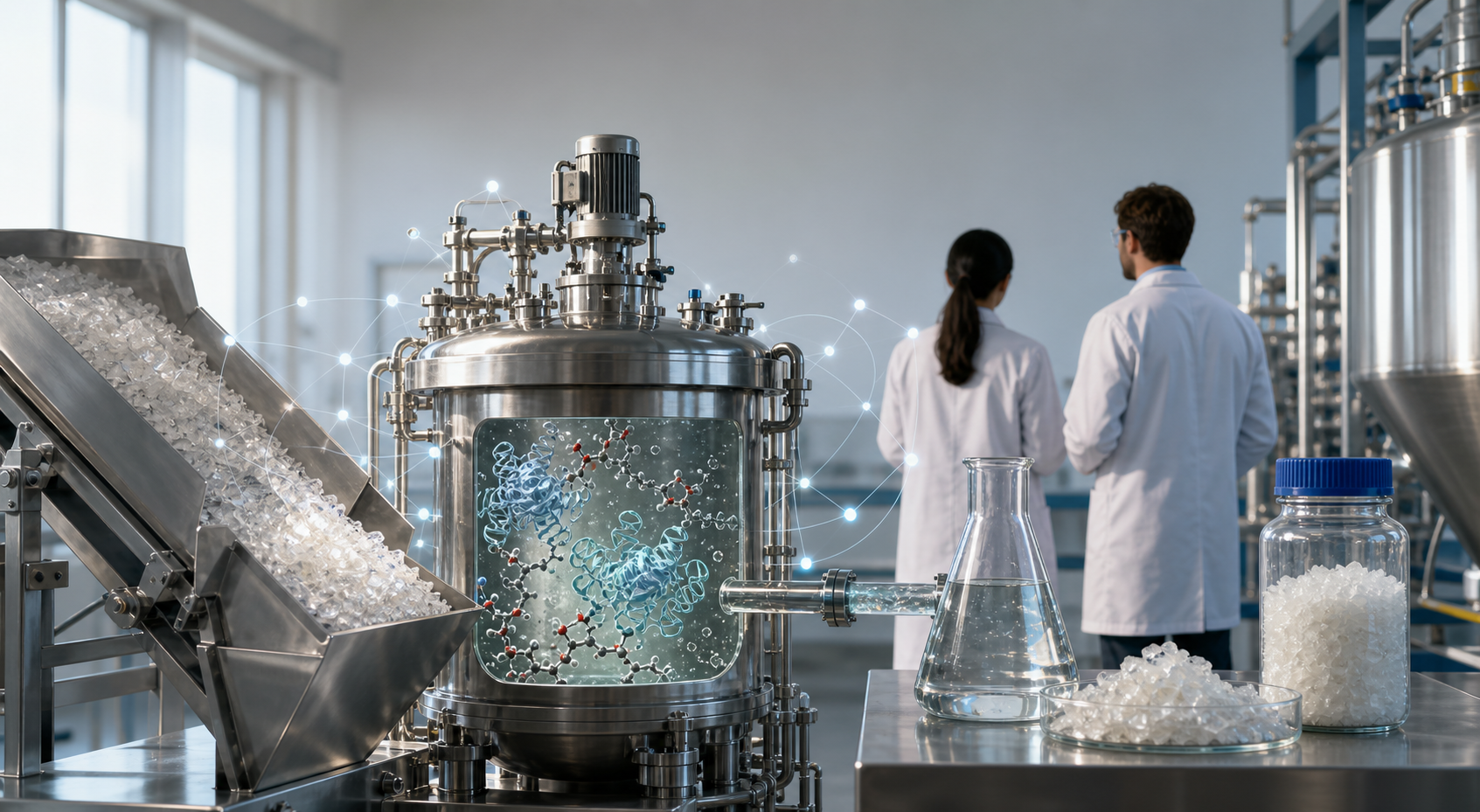
Enzymatic recycling changes the intended output. An engineered enzyme can deconstruct a polymer into its original monomers, which can then become inputs for new, high-quality plastic. The difference is fundamental: the product is not processed waste or a smaller plastic fragment. It is recovered molecular feedstock.
This distinction gives you a better product boundary. A generated protein sequence is a feature. An enzyme that shows activity in one assay is a technical result. The product is a repeatable monomer-recovery system with a defined input, output, operating envelope, and cost structure.
Before approving a roadmap, require the team to define five contracts:
- Input contract: Which polymer, packaging format, mixture, and contamination profile will the process accept? “Mixed plastic” is not a specification. Name the included materials and the variation the system must tolerate.
- Transformation contract: Which polymer bonds must the enzyme break, and what conversion and selectivity must the reaction demonstrate?
- Output contract: Which monomers will be recovered, what downstream use must they support, and how will the team determine that the output is suitable for that use?
- Operating contract: What reaction conditions, throughput, energy consumption, and process controls must hold outside a small laboratory assay?
- Economic contract: Which cost per ton must the integrated process approach, and which assumptions currently separate measured economics from projected economics?
Selectivity is especially important. An enzyme can target a particular plastic within a mixed waste stream, potentially reducing the need to treat every input as chemically identical. But selectivity does not make an undefined waste stream manageable. The process still needs to know which target material is present, whether the enzyme can reach it, and how the desired products will be recovered.
Write the product brief in one sentence: For this defined feedstock, transform this polymer into these monomers, within this operating envelope, output specification, and cost boundary. If a number is unknown, leave a visible blank and assign an experiment to fill it. Do not hide the uncertainty inside a broad ambition such as “make plastic circular.”
Build the AI as a closed learning system
AI changes the economics of searching enzyme-design space. Protein language models can generate candidates, multi-step agents can coordinate specialized tasks, and computational evaluations can eliminate weak options before scarce laboratory capacity is used. Advances in protein structure prediction have expanded what can be explored, but prediction does not remove the need for physical validation.
The useful architecture is therefore not a model that emits sequences. It is a closed loop in which every physical result makes the next design round better. Rhea’s Factory combines protein language models, an agentic pipeline, domain constraints, and proprietary wet-lab feedback. The product lesson is broader than any one implementation: generation, evaluation, experimentation, and learning need to operate as one traceable system.
- Encode the objective. Convert the product contract into machine-readable constraints: target polymer, desired products, acceptable operating conditions, and the metrics that will decide whether a candidate advances.
- Generate candidates. Explore multiple plausible designs rather than optimizing immediately around the first promising family.
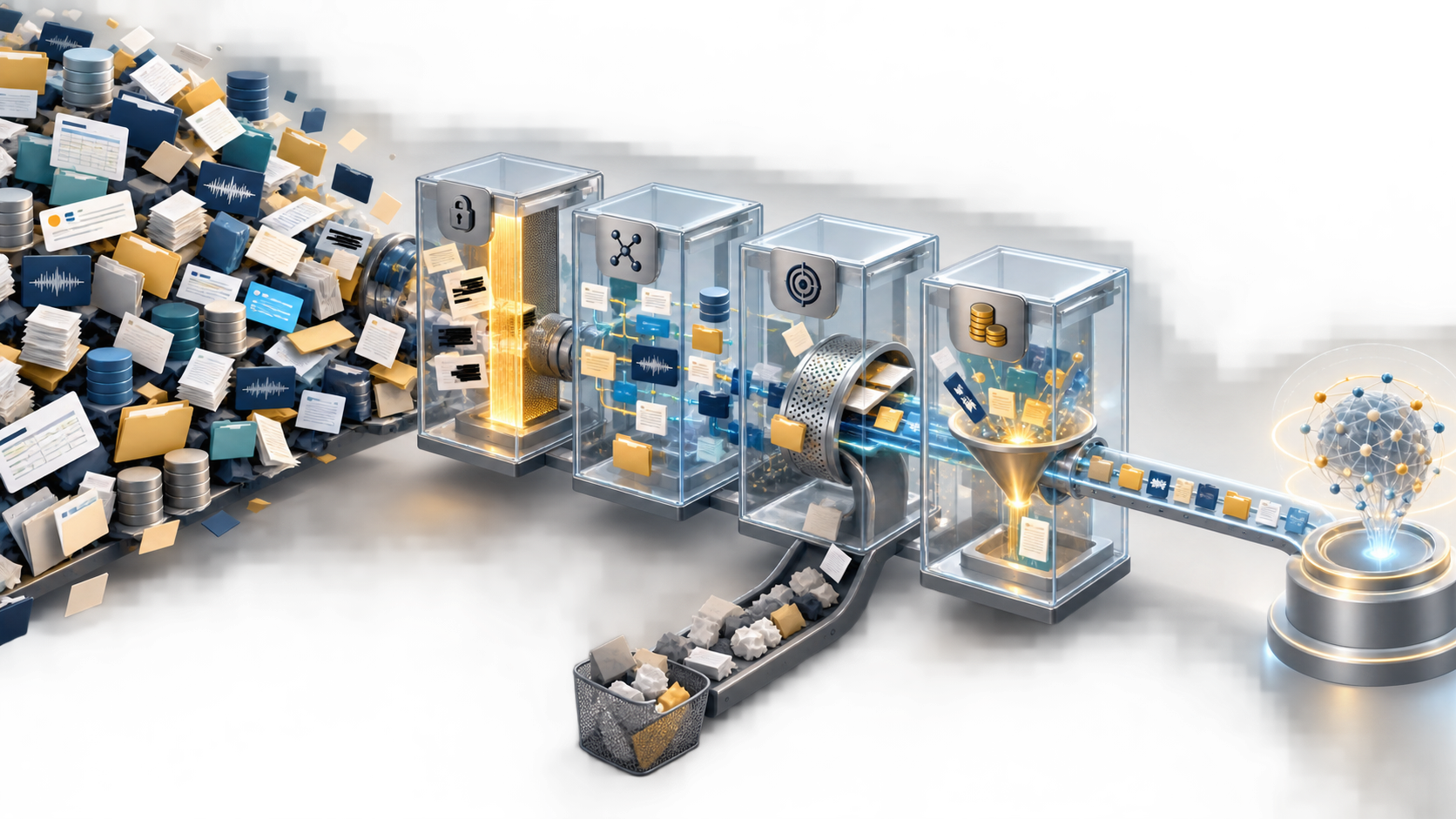
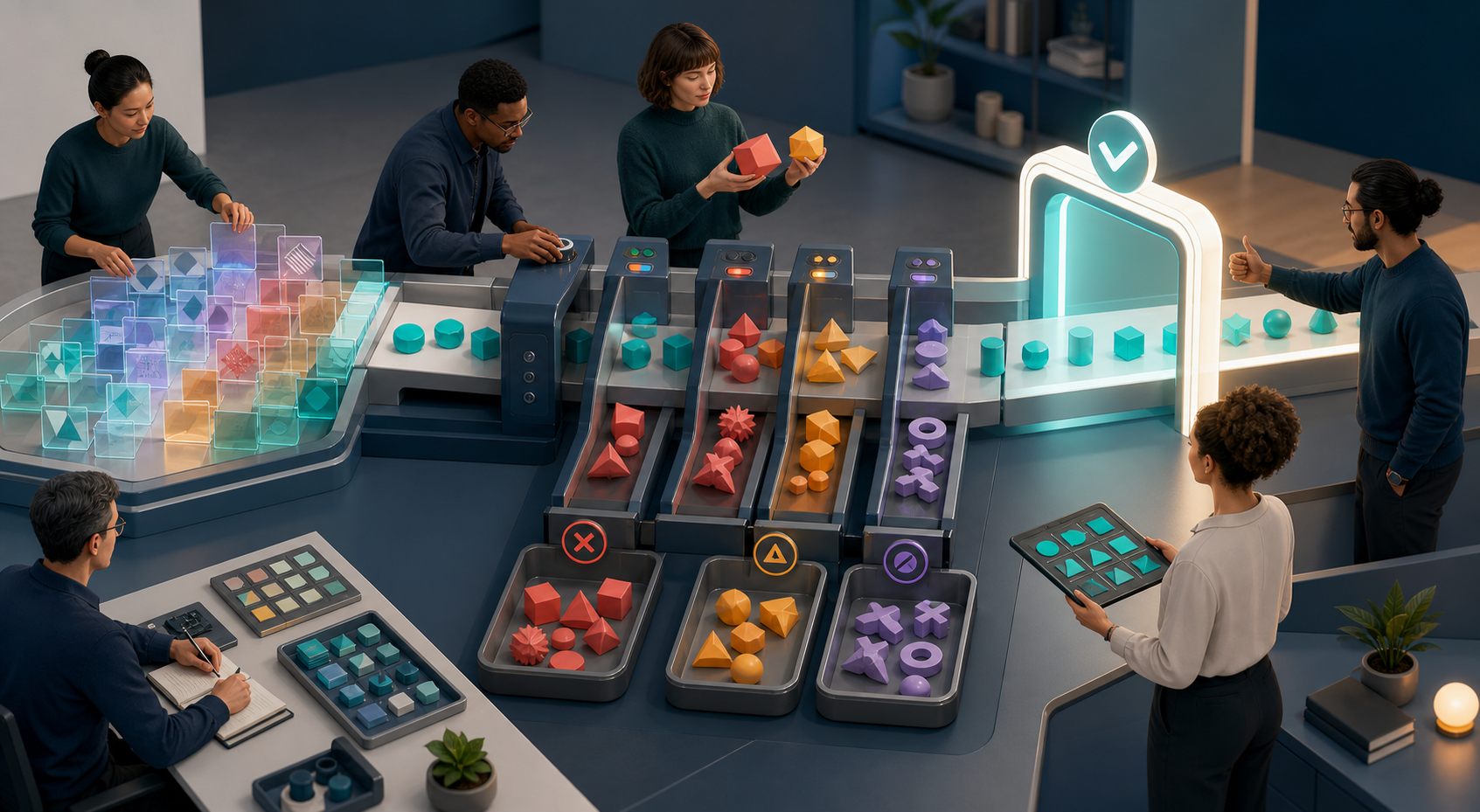
- Apply computational gates. Reject candidates that violate explicit constraints, preserve the reasons for rejection, and rank the remaining candidates for laboratory use.
- Run controlled wet-lab experiments. Test candidates under recorded conditions and capture successes, failures, and inconclusive results.
- Update domain predictions. Use the measured outcomes to improve ranking and candidate selection for the next round.
- Feed process evidence back into discovery. When a candidate struggles under reactor or feedstock conditions, turn that failure into a new design constraint instead of treating it as a separate engineering problem.
Agentic AI is valuable here because the workflow is multi-step, not because an agent should make every decision autonomously. At each handoff, define the required input, expected output, validator, and failure behavior. A generation step should not advance an incomplete candidate. A computational score should not be presented as a laboratory observation. A promising assay should not silently become a scale claim.
Exploration also needs an explicit lane. Higher model-sampling temperatures can produce more unusual enzyme candidates and reach beyond the safest local variations. Controlled model “hallucination” can be useful during candidate exploration when downstream guardrails prevent novelty from being mistaken for evidence.
Separate the candidate portfolio into three buckets: improvements near known winners, adjacent designs that test a clear hypothesis, and high-variance exploration. Give each bucket a deliberate laboratory budget. Raise sampling temperature only in the exploratory lane, and never allow generated assay values, reaction outcomes, or scale results into the measured-data record.
The durable advantage sits in the feedback data. In a narrow, high-signal domain, even hundreds of relevant proprietary laboratory observations can support a useful domain prediction model. That is not a general claim that small datasets are always sufficient. It means contextual quality can matter more than indiscriminate volume when the problem, assay, and outcomes are tightly defined.
For every experiment, preserve enough context to make the result reusable:
- The enzyme identity, sequence version, and design lineage.
- The target polymer, material format, mixture, and relevant contamination profile.
- The assay and protocol version used for the test.
- The reaction conditions and duration.
- The measured conversion, selectivity, yield, and uncertainty available from the experiment.
- The full result, including failure, no-result, and inconclusive outcomes.
- The relationship between the candidate, computational evaluations, physical test, and model or data release.
A spreadsheet of winning sequences is not a data moat. A traceable record of why candidates were proposed, how they were tested, what failed, and how each result changed the next decision can become one.
Use stage gates that end in physical evidence
AI product teams often gravitate toward a model leaderboard because it creates a clean sense of progress. Enzymatic recycling does not have one adequate master score. A candidate can look structurally plausible and fail in the lab. It can perform in a controlled assay and miss the required throughput. It can convert the polymer and still lose economically once the rest of the process is counted.
Use a hierarchy of evidence that moves from design compliance to laboratory performance, operating fit, and scale economics:
| Gate | Decision question | Required evidence | Red flag |
|---|---|---|---|
| Design compliance | Does the candidate satisfy the stated target and pipeline constraints? | Deterministic checks, recorded constraint evaluations, and candidate provenance | A candidate advances mainly because it appears novel |
| Wet-lab performance | Does the enzyme convert the target with the required selectivity under defined conditions? | Repeatable measured observations, including negative and inconclusive runs | Only the best run is retained or shared |
| Operating fit | Does useful performance hold within the intended controlled, low-temperature process and throughput requirements? | Process measurements tied to reaction conditions, conversion, yield, throughput, and energy use | Activity is reported without the process context needed to interpret it |
| Scale economics | Can the integrated system move toward cost parity with inexpensive oil-based plastic? | A cost and energy model tied to measured inputs, with assumptions and sensitivities exposed | Commercial viability is inferred from enzyme activity alone |
Set pass, hold, and stop conditions before seeing the result. Otherwise, an interesting candidate will repeatedly earn one more experiment while the commercial requirement drifts. Relative improvement is useful for learning, but an enzyme that is twice as good as an unusable baseline may still be unusable. Every relative metric should sit beside the absolute requirement it is meant to approach.
Keep conversion, selectivity, yield, throughput, and energy per ton separate. Combining them too early into a single score can conceal the actual tradeoff. A team should be able to show why it is advancing a faster candidate with lower selectivity, or a more selective candidate with a different operating burden, without claiming that the candidates are equivalent.
Three common metric substitutions deserve direct scrutiny:
- Low reaction temperature is not automatically low total energy. Count the energy demands of the complete process rather than the enzyme reaction in isolation.
- Polymer conversion is not automatically usable monomer recovery. Measure whether the desired output can be recovered to the specification required downstream.
- Bench performance is not automatically scaled performance. Treat increasing process scale as a new evidence gate, not a routine deployment step.
My rule is simple: model output can earn laboratory time; only measured process evidence can earn scale capital.
Plan the roadmap backward from cost parity
The commercial benchmark is unforgiving. Enzymatic recycling ultimately has to compete with inexpensive oil-based plastic production. A greener reaction that cannot approach a viable delivered cost will remain dependent on special conditions rather than becoming a broadly adopted circular process.
Build the economic model while discovery is still underway. At minimum, separate these cost lines:
- Feedstock acquisition, sorting, and rejected material.
- Preparation required before the enzyme can act on the target polymer.
- Enzyme production, delivery, useful lifetime, and replacement.
- Reactor capacity, reaction time, process control, and energy.
- Monomer recovery and purification.
- Waste handling, downtime, and variability in plant utilization.
Do not wait for perfect values. Use ranges, label each input as measured or assumed, and run sensitivity analysis. The purpose is to identify which uncertain variable can kill the business case. If enzyme lifetime dominates cost, another candidate-generation run may be rational. If purification dominates, generating thousands of additional sequences may be a distraction from the real constraint.
Pair every scientific milestone with an industrial question:
- Discovery gate: Is activity and selectivity reproducible enough to justify process work?
- Process gate: Does the candidate perform inside the intended operating envelope rather than only under a convenient assay condition?
- Feedstock gate: Does performance survive representative material formats and mixtures, including difficult packaging such as clamshells?
- Demonstration gate: Can the system sustain the required material flow, output quality, and energy profile at a scale that tests the major engineering assumptions?
- Commercial gate: Does the cost case remain credible when feedstock composition, utilization, throughput, and other sensitive inputs move away from the preferred case?
A planned 5,000-ton demonstration plant in California illustrates why demonstration capacity belongs on the product roadmap. A plant is not simply a larger laboratory. It tests whether biology, equipment, controls, feedstock variability, and recovery operations behave as an integrated product.
Before committing meaningful scale capital, ask six kill questions:
- Which assumption has the largest effect on delivered cost per ton?
- Which inputs are measured, and which still come from a design estimate?
- At what physical scale was each important input measured?
- What fails first when the feedstock mix changes?
- If enzyme performance improves as planned, which downstream step becomes the bottleneck?
- Which observed result will stop, narrow, or materially redesign the program?
Expansion into additional plastics should follow the same discipline. Enzyme selectivity creates a plausible path toward enzyme blends for mixed streams, and new plastic types and mixed-plastic blends remain important development directions. Treat each added polymer as a new product vertical with its own input contract, assays, process interactions, recovery requirements, and economics. A new enzyme is not automatically a low-cost extension of the first process.
Key takeaways for your next roadmap review
- Define success as repeatable recovery of specified monomers, not the generation of novel enzyme sequences.
- Run discovery as a closed loop connecting product constraints, AI generation, computational gates, wet-lab measurements, and process feedback.
- Treat proprietary experimental context—including failures—as the data asset; candidate count alone is not a defensible moat.
- Use separate gates for design compliance, laboratory performance, operating fit, and scale economics.
- Work backward from cost parity and direct the next experiment toward the assumption that most threatens the integrated business case.
For your next review, ask the team to bring one page containing the input and output contracts, a diagram of the learning loop, the current stage-gate thresholds, the experimental data schema, and a cost sensitivity model with measured and assumed inputs clearly separated. Every roadmap item should change one of those artifacts or produce evidence for a named decision.
If the team cannot fill those fields yet, that is the immediate product work. The first defensible milestone is one traceable loop from a defined industrial problem through candidate generation, laboratory measurement, and an updated cost model. Repeat that loop with increasing realism before increasing capital exposure. That is how you determine whether programmable biology is becoming an industrial recycling product rather than remaining an impressive AI demonstration.