I obsess over why users do what they do. When I connect the dots between behavior and emotion, product decisions get clearer, roadmaps get sharper, and outcomes improve fast. Customer sentiment analysis is the discipline that helps me bridge that gap between numbers and nuance—turning scattered feedback into a focused narrative that drives product-led growth and retention.
Want to understand the thoughts and feelings that drive user actions? This guide to customer sentiment analysis shows you how to listen and respond.
At its core, customer sentiment analysis blends quantitative signals (usage telemetry, conversion, churn) with qualitative insight (support conversations, reviews, in-app feedback) to reveal why users behave the way they do. I use it to pinpoint friction in onboarding, accelerate user activation, and reinforce the value proposition across the journey. The result is a product experience that not only performs but also resonates.
Here’s how I listen at scale. I aggregate inputs from support tickets and call transcripts, in-app feedback widgets, community posts, and social listening; I supplement them with product analytics from Amplitude analytics, guidance and event data from Pendo, and conversation and engagement patterns from Intercom. With strong CRM integration to HubSpot and a unified analytics platform, I can tie sentiment to accounts, lifecycle stages, and revenue impact—so every signal is actionable, not anecdotal.
On the analysis side, I segment feedback by journey stage (onboarding, activation, adoption, expansion, churn risk) and classify it by theme (usability, reliability, pricing, time-to-value). Gen ai and LLMs for product managers help me summarize large volumes of text, cluster topics, and score sentiment with speed, while I maintain guardrails through data governance, privacy-by-design, and clear AI risk management policies. The aim isn’t just a score—it’s a storyline I can act on.
Closing the loop is where sentiment turns into outcomes. If I see negative sentiment around first-run complexity, I streamline onboarding, add contextual product tours and in-app guides, and refine tooltip design and UX writing. I then validate improvements with A/B testing, watch minimum detectable effect (MDE) thresholds, and track movement on activation, NPS/CSAT, and early retention. This rhythm creates a durable feedback-to-feature pipeline that compounds over time.
Operationally, I run a recurring sentiment review with product trios and cross-functional leaders. We connect insights to outcomes vs output OKRs, pressure-test bets through product discovery, and prioritize work that measurably reduces friction. When sentiment and behavior point to the same problem, it moves to the top of the roadmap. When they diverge, we dig deeper before we build.
If you’re getting started, begin with the highest-value surfaces: onboarding and activation. Instrument the journey, centralize feedback, and label themes consistently. Use small, targeted experiments to address the loudest pain points, then scale what works. Over a few cycles, you’ll see clearer insights, faster decisions, and a product experience that feels intuitively “right” to your users—because it’s grounded in their words and their behavior.
I obsess over retention because it tells me the truth about product-market fit, value delivery, and revenue durability. In my role leading product strategy at HighLevel, I’ve learned that sustainable growth comes less from adding users and more from keeping the right ones engaged, successful, and expanding. The fastest way to get there is through a disciplined view of the right customer retention metrics.
Struggling to keep users? These customer retention metrics reveal what’s working, what’s not, and where to focus to reduce churn.
When I assess a product’s health, I look for a clean story across acquisition, activation, engagement, and expansion—then I validate that story against revenue outcomes. If those lines don’t reconcile, churn is coming. That’s why I track a core set of signals that expose value gaps early, guide product-led growth, and align go-to-market with actual customer outcomes.
Here are the 15 signals I rely on to diagnose retention risk and prioritize roadmaps: logo churn rate, gross revenue retention (GRR), net revenue retention (NRR), cohort retention by signup month, activation rate, time-to-value (TTV), feature adoption rate, DAU/WAU/MAU and stickiness (DAU/MAU), session frequency and duration, expansion revenue rate, contraction/downgrade rate, customer lifetime value (CLV), onboarding completion rate, customer health score, and support tickets per account with time to resolution. Together, these metrics show whether customers realize value quickly, keep finding more value over time, and are willing to grow with the product.
Here’s how I use them in practice. If activation rate or time-to-value slips, I invest in onboarding clarity, in-app guides, and product tours to remove friction and accelerate first success. If GRR weakens, I re-examine renewal messaging, pricing fairness, and critical feature gaps. If NRR stalls, I revisit packaging, discovery-driven upsell paths, and the expansion moments that naturally occur after users unlock initial value.
A unified analytics platform connecting product usage, lifecycle events, and CRM integration is essential. I pair cohort analysis in Amplitude analytics with qualitative insights from Intercom, then use Pendo to instrument in-app nudges and measure feature adoption lift. A/B testing helps me validate which interventions move the metrics that matter, not just vanity engagement.
Cadence matters. I review leading indicators weekly (activation, TTV, feature adoption), lagging indicators monthly (GRR, NRR, CLV), and cohort retention every quarter to ensure improvements compound. This rhythm keeps teams aligned on outcomes vs output and focuses energy where it reduces churn fastest.
If you adopt only one habit, make it this: tie every roadmap bet to a specific movement in these retention metrics, then measure relentlessly. When we do this well, our product doesn’t just acquire users; it earns loyal advocates—and that’s the most efficient growth engine there is.
It’s Monday morning, and my Slack and email are already overflowing with content requests: “Can you review this flow?”; “Can you rewrite this screen?”; “Can you name this feature?” I’m not freshly back from holiday—this is just a regular work week kicking off. If you’ve ever been a solo content designer supporting multiple teams, you’ll recognize the pressure. The pipeline for content in product design is always full, and the demand for expertise never stops.
Fixing this isn’t just a matter of better time management or incremental process tweaks. To truly scale, I needed to extend my reach by bringing AI into the design process—without sacrificing judgment, standards, or quality. That Monday morning, I realized I had to scale my skills, my judgment, and our systems, not just my calendar.
Building AI is fundamentally about building systems. I wanted to use AI to scale myself without devaluing critical thinking or flooding the product with generic, verbose content. I also knew a useful AI tool must do more than spit out microcopy—it has to plug into a system we can continually shape. As a content designer, the system is always the starting point. Strong design systems create strong content standards; then AI agents can produce content that meets those standards at speed, freeing me from the bulk of standardized work. That’s not a threat—it’s an advantage. To instruct AI well, our systems must be well constructed.
I often think about this work like a bakery. You need a recipe before you can make a loaf of bread. Most interface content churns out the same loaf, day in and day out. It’s better for the master bakers to focus on the unique, custom bakes—and how the recipe needs to change. With that mindset, I set out to build an AI content design agent.
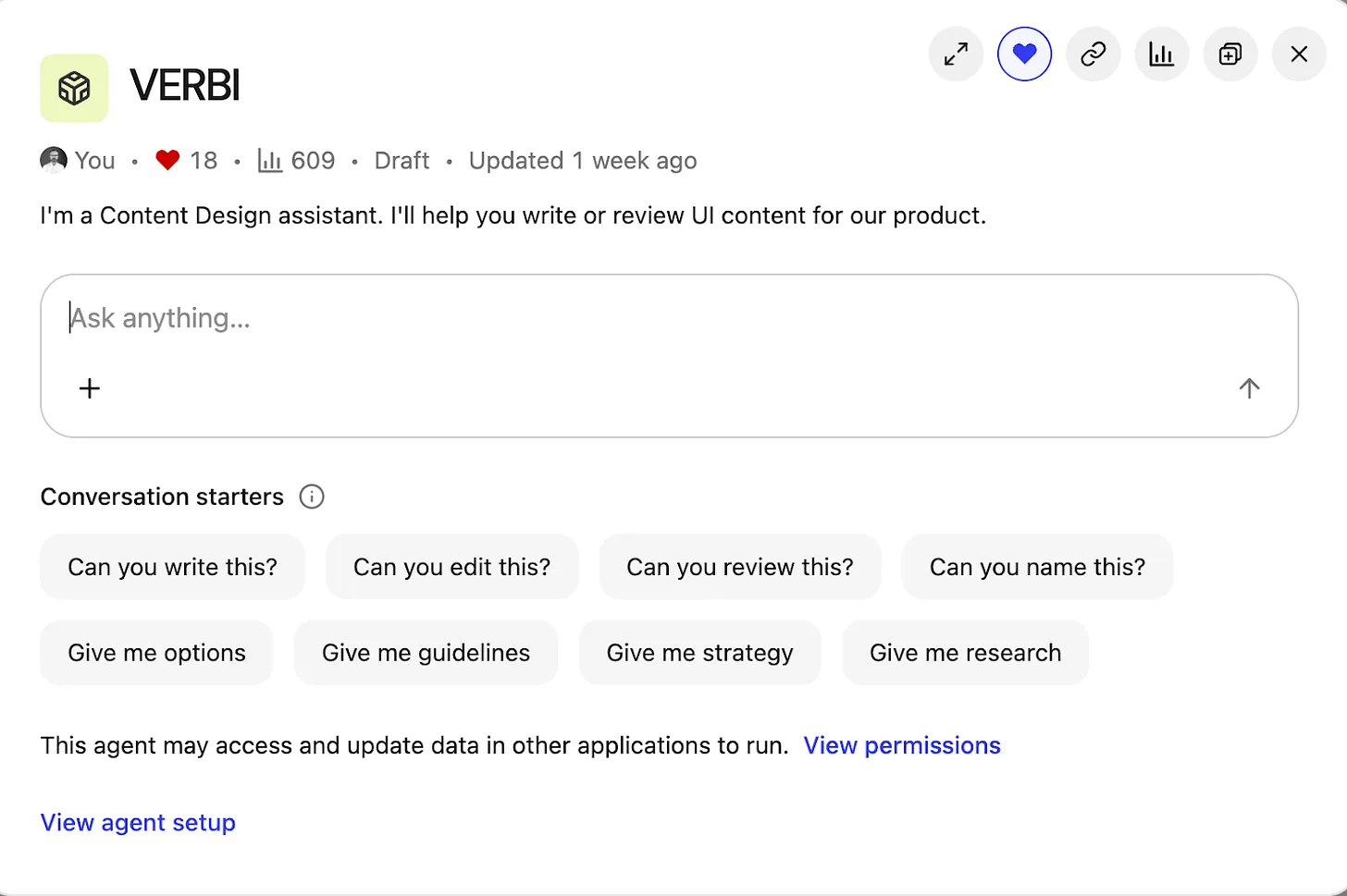
Inside the Content Design Agent workspace, a clean chat UI titled VERBI pairs a central prompt box with chips for writing, editing, and reviews, plus clear controls to view permissions and open the agent setup for product teams.
When I started this project back in May 2025, many LLMs still had frustrating limitations. Google Gemini let me build a custom Gem agent, but I couldn’t share it with other users. ChatGPT could be customized, but only with static files: I couldn’t point it to live, updatable URL sources. I settled on Glean for three simple reasons: everyone at the company had access; Glean could access all internal documentation and treat URLs as sources of truth; and its then-new Agents feature made AI search customizable. Configuring an agent in Glean is straightforward—you choose a trigger, a set of prompts, and a set of actions—but first I needed to get the inputs right.
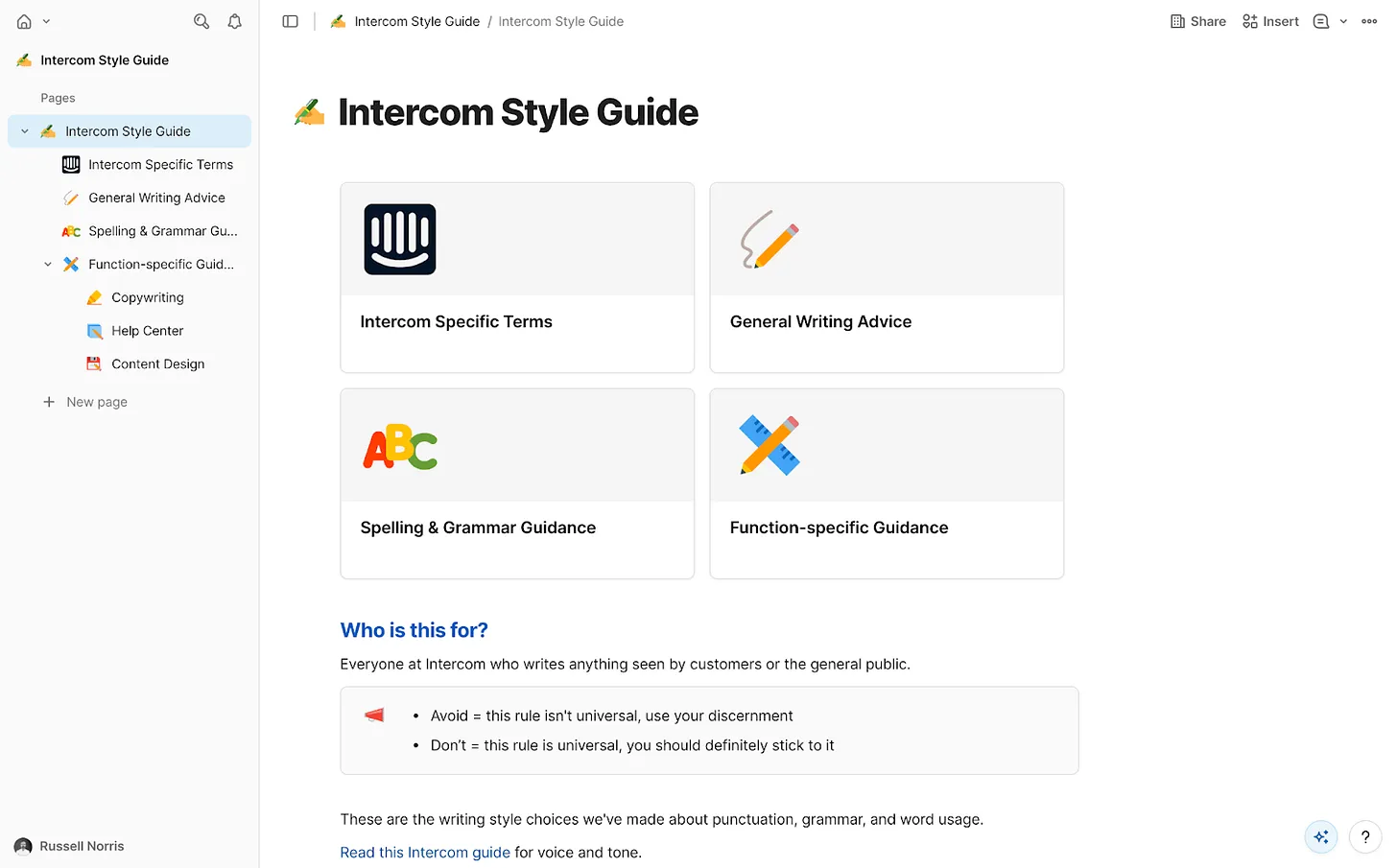
AI agents need focus. We had a wealth of internal information at Intercom, but not all of it was current or reliable. I curated exactly what the agent could access and assembled a tightly governed knowledge collection in Glean. Only essential information made the cut: the Intercom style guide—our definitive house style, including regularly-broken rules like “always write in US English” and “use sentence case everywhere”; tone of voice guidance for how we show up across mediums; a product glossary with hundreds of feature names and writing conventions; a monetization glossary for prices, plans, and add-ons; product marketing messaging guides with positioning for every feature and launch; core research insights across the product; and fin.ai and intercom.com/suite as the official, most up-to-date messaging sources.
This is classic RAG (retrieval-augmented generation) in action, ensuring every answer is grounded in approved sources of truth. With the collection in place, I instructed the agent to prioritize these resources above anything else.
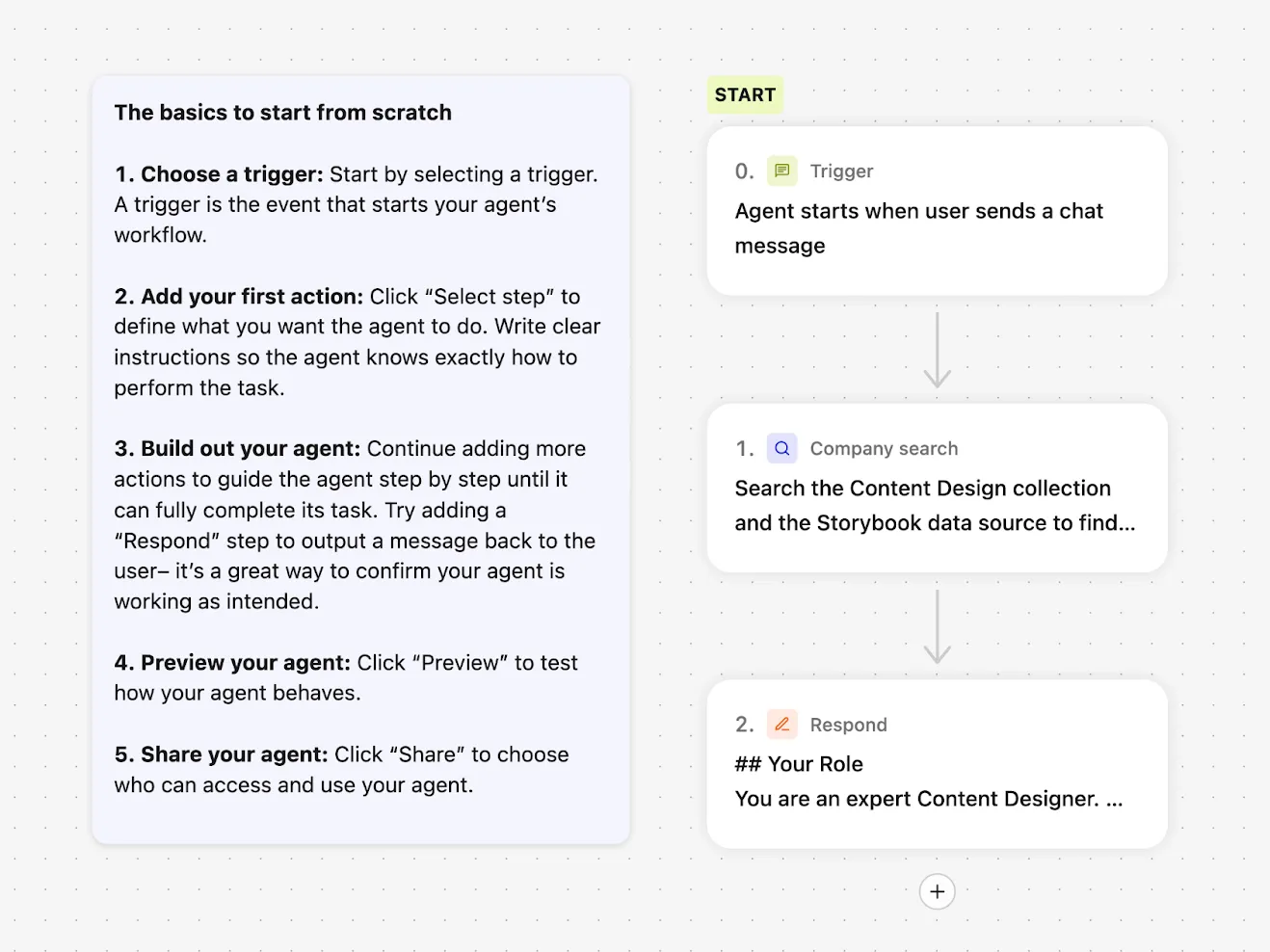
Step into a clean, no-code builder that shows how to assemble a Content Design Agent: kick off with a chat-trigger, run a company search, then respond with expert guidance, all guided by a simple starter checklist.
Then came the fun part—building and branding the agent. “Content Design Assistant” felt bland, so I named it VERBI, a nod to its “verbal” design job. When people interact with VERBI, they usually begin with a question, but the intent varies widely. I defined a set of task prompts to guide expectations and outputs: “Can you write this?”; “Can you edit this?”; “Can you review this?”; “Can you name this?”; “Give me options”; “Give me guidance”; “Give me strategy”; “Give me research.” This mirrors the real breadth of content design, from creation to critique to discovery.
To manage responses, VERBI needed three things: start with a specific task prompt; understand how to draw on the right resources each time; and connect with other systems. With task prompts defined, I wrote a detailed system prompt covering the essentials. Role: you are a content designer, supporting product designers. Employer: Intercom (consisting of Fin AI Agent and our next-gen Helpdesk). Resources: content design collection, research collection, Storybook design system. Tone of voice: follow a specific tone for our UI, adjust the tone for everything else. Components: for UI, use the specific guidelines in our design system only. Use cases: writing, editing, critiquing, naming, researching, and more.
One connection mattered most: our design system, recently rebranded as “Surge.” Surge contains detailed content guidelines for every component in our product UI, from accordions and banners to tabs and tooltips. That granularity took months of human effort to codify, and it paid off. Designers no longer guess how to write for a toggle, a button, or a tooltip—and now VERBI understands and enforces those rules, too. A great content design assistant isn’t just a clever system prompt; it needs deep, component-level guidance to retrieve.
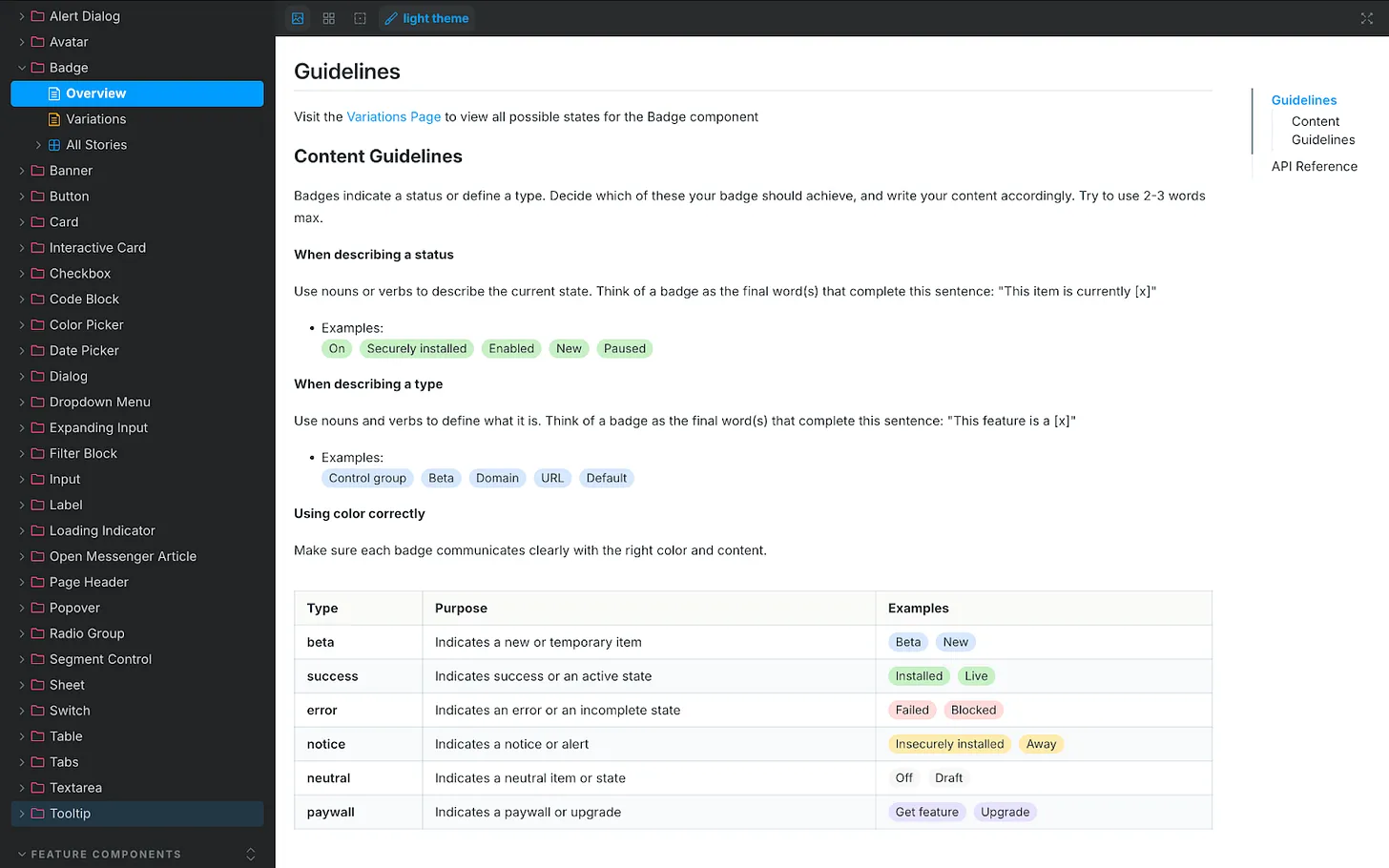
UI documentation showcases the Badge component’s content rules, teaching how to name statuses, define types, and apply color so labels read clearly. A handy visual for building a content design agent and ensuring consistent product messaging.
Accessing the design system wasn’t simple at first. It lives in Storybook, which Glean couldn’t access directly. I started by scraping guidance from Storybook into an HTML file with Cursor and uploading it to VERBI—a functional but clunky workaround that required re-scraping every few days. Then our IT team stepped in. They used the Glean Indexing API to turn Storybook into a live data source. Now VERBI connects to Storybook directly. Ask it something ultra-specific, like the correct date format for Japan, and it returns the right answer. That integration elevated the agent from helpful to indispensable—human-level precision, 24/7, at scale.
With prompts and resources in place, I launched VERBI and pressure-tested it. It was accurate and well-informed most of the time, but like any AI agent, it had quirks. I needed it to act as a gatekeeper, not a brainstorming partner that might bend rules or invent new ones. So I added a few explicit guardrails to the system prompt. Stopping sycophancy: “Inform, challenge, and assist. Never placate. Don’t agree by default. If something’s wrong, say so. Challenge assumptions.” Halting hallucinations: “If you don’t find the information required in our resources, say you don’t know the answer. Don’t guess and don’t give answers based on general knowledge.” Avoiding verbosity: “Keep answers short and to the point. Cut the fluff. Skip all niceties and social padding. Only give longer answers if the user asks you to.” These constraints keep responses crisp, correct, and consistent. Like any living system, the prompt needs occasional tune-ups, but the maintenance is minor compared to the upside.
Where we are now: VERBI has been triggered 700+ times since launch. The benefits are tangible. For me, quality scales without constant policing; repetitive questions about naming, style, or punctuation have dropped significantly. I reclaim time because the agent drafts and checks V1 content across teams, enabling me to focus on higher-impact work. For the design team, iteration is faster, confidence is higher, and strategic clarity improves because shared language and grounded guidelines make decisions easier and more consistent.
I used to spend too much time mopping up basic content mistakes and untangling spaghetti-like UI copy prone to human error. VERBI removes those errors at the source. The real advantage is speed: we get from blank slate to a high-quality first draft quickly, which means we can spend our energy deciding whether the content is right, not just “good enough.” Design is the whole interface—words, visuals, interactions—so reviews now happen with real content, never “copy TBD.” Our principle to sweat the details applies equally whether work is human-made or AI-assisted.
Knee-jerk critiques of AI-driven content design often assume teams generate content from nothing and ship it. In reality, great AI is the outcome of great human decisions and strong systems. Its value is pulling us together faster—getting us to a complete, standards-compliant design we can review as a team before sharing it with the world. That’s how AI helps us win: by turning chaos into consistency, and consistency into velocity.
I’m excited to share that we’re opening our next R&D hub in Berlin to support significant investment in our AI customer service platform, Intercom, and market-leading AI Agent, Fin. We intend to hire 100 people in Berlin over the year ahead across engineering, AI, data science, product, and design. This move reflects our AI Strategy, our commitment to product management leadership, and our focus on building enduring product-led growth.
We believe that in a short number of years, the vast majority of customer service will be done by AI. Fin is already the world’s best Customer Service Agent. At Pioneer, our recent summit for AI customer service leaders in NYC, we talked about how Fin will become a true end-to-end Customer Agent, extending far beyond service. We showcased how companies like WHOOP, Anthropic, and Lightspeed are already pushing Fin in ways that help them grow their business.
This market opportunity is massive and expanding at unprecedented pace. Our ambition is to earn our place as one of the most successful AI businesses during this wave of AI disruption, and we want more brilliant people on our team to pursue this as aggressively as possible. If you’re motivated by Generative AI, LLMs, and building real products that scale, you’ll find both challenge and impact here.
We are already on track to be one of the fastest growing private software companies. Fin is the primary contributor to this, and is months away from passing $100m in ARR. So far, more than 7000 businesses have transformed their customer service with Fin, including German companies like electricity provider Ostrom, smart home technology provider tado°, and grocery delivery company Flink, along with global leaders like Vanta, Clay, Lovable, and Miro.
Why Berlin? We’re drawn to the city’s rare blend of deep technical talent and rich creative culture—within a vibrant, globally connected ecosystem close to our R&D hubs in Dublin and London. It’s a place where top-tier engineers and designers thrive, and where ambitious builders from around the world want to relocate and create category-defining products.
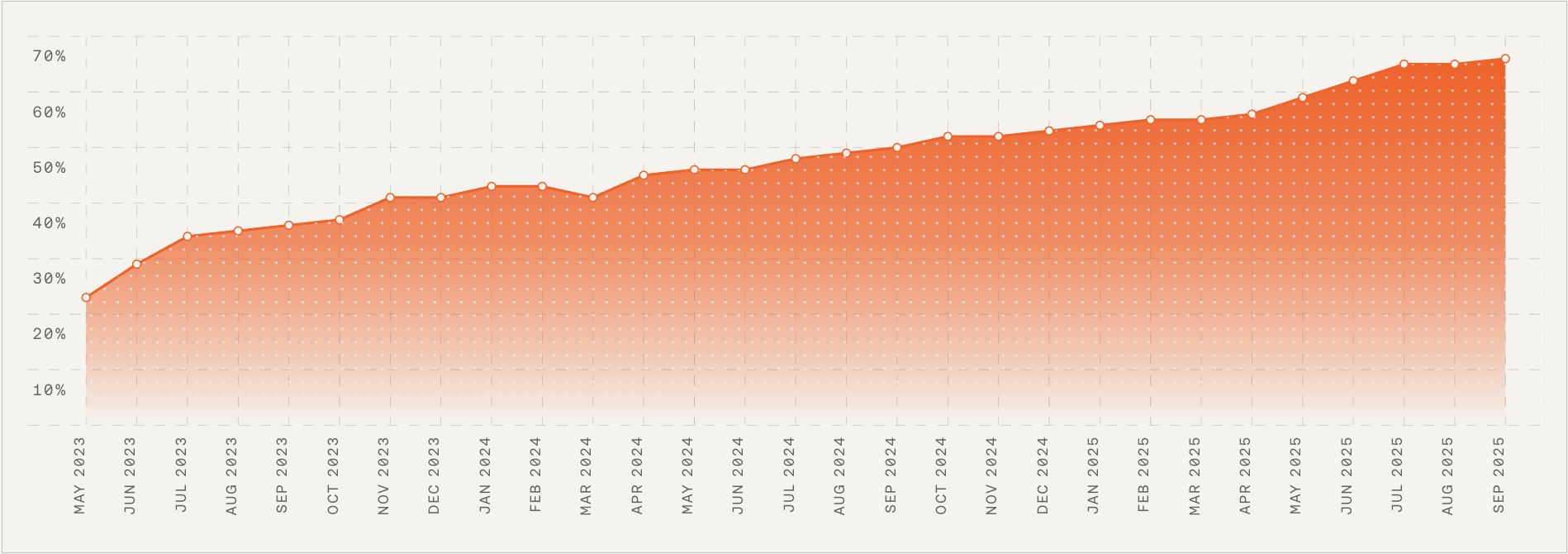
Momentum is building: this month-by-month chart shows a consistent rise from the mid-20s to nearly 70% between May 2023 and Sep 2025—signaling strong progress as we expand engineering, AI, and automation at our new Berlin R&D hub.
We needed a new location that would sustain the high ambition and standards held by our world-class AI teams in Dublin and London. Berlin has emerged as one of Europe’s hottest centers for AI talent, with a high density of AI-focused startups, applied research labs, and practitioners who bring exceptional literacy, optimism, and ambition. It’s the right accelerator for our AI hiring and a place to bring in brilliant minds to shape the future of our product and business.
While Intercom’s reach is global with our headquarters in San Francisco, our R&D leadership remains anchored in Dublin, where half of the executive team sits—making Berlin both geographically and strategically an ideal next location for our growth.
This isn’t our first time expanding our footprint; we previously bet on London and are delighted with how that’s been working. When we shared our Berlin news internally, the energy was palpable, with many teammates volunteering to help spin up the hub successfully—including colleagues who helped make London a big success, like Danny. That level of ownership and momentum is exactly what we aim to cultivate in Berlin.
We’re looking for people who thrive in a high-intensity, high-ambition, high-standards environment and want to help build one of the world’s best AI companies. For builders like that, the opportunity for impact, growth, and career progression is extraordinary. As with London and Dublin before it, the early Berlin cohort will have a disproportionate influence on team norms, culture, and long-term outcomes. We are in the middle of a huge disruptive wave with AI, and Fin is one of the leading examples of commercially successful AI applications. Joining Intercom is an opportunity to be part of this disruptive wave, and help us build out our vision for Fin becoming the world’s best Customer Agent.
On a minimalist stage, four speakers share insights on AI research, automation, and engineering as part of a panel tied to Berlin expansion and the launch of a new European R&D hub.
There are plenty of AI companies to join, but our technology and culture set us apart. Any AI product is only as good as the AI layer powering it. Ours is industry-leading, built by a highly talented, ambitious, and technical team of over 40 machine learning scientists, engineers, and designers in Europe who continuously optimize Fin’s performance through cutting-edge research, experimentation, and innovation. Fin’s average resolution rate increases 1% every month. That kind of steady, compounding improvement is exactly what great customer support AI strategy looks like in practice.
We also build in public and share our progress and learnings with the AI community at large. Recently, our Chief AI Officer Fergal Reid and SVP of Engineering Jordan Neill joined leaders from Cognition, Harvey, and Perplexity in San Francisco to share real lessons, challenges, and breakthroughs from building frontier AI products. Our AI team regularly publishes their insights on the AI research blog; from optimizing inference speed and availability, to building our own proprietary models that outperform general purpose models for CX.
Our AI group and the broader R&D org they operate within work at extraordinary scale and speed. We recognize that moving fast can’t be taken for granted—you must fight for it—and we’re doing just that, embracing the capabilities AI tooling brings us to achieve 2x the throughput. One example of this mindset in practice is us “Betting on the future of frontend at Intercom,” making a technology choice that optimizes for our teams’ ability to build high-quality product, fast.
Our design and product teams are world-class and forward-thinking; they’re embracing AI to evolve how they work, as shared in our 3-point framework for AI-driven design and recently presented by Emmet Connolly, our SVP of Design, at this year’s Hatch conference in Berlin. As a product leader, I’m grateful to work alongside brilliant product and design thinkers—it gives me confidence that we’re solving the right problems, solving them well, and driving real impact.
From live demos to hands-on coding, this snapshot captures the momentum we're bringing to our Berlin R&D hub – AI experiments, hand-tracking prototypes, and simulation tools powering our next wave of engineering.
We plan to open our Berlin office space in December or January. To get the office started, we’re hiring Senior Product Engineers, Machine Learning Scientists, Product Managers, Senior Product Designers, Engineering Managers, and Data Scientists immediately. If your craft sits at the intersection of LLMs for product managers, agentic AI, and empowered product teams, you’ll be right at home.
You can learn more about our open roles, company, culture, and locations on our careers site, or feel free to reach out to me, Jordan, Fergal, or Brian directly on LinkedIn if you have any questions.
Some of our engineering team will also be at LeadDev Berlin on November 3rd—come say hi if you’re attending.
I’m looking forward to continuing to build Intercom as one of our generation’s best AI companies—and I’m excited for our expansion into Berlin to be a major contribution to that success.
I see customer conversations as a goldmine for every team—yet too often, they’re trapped inside the support platform. That silo makes it harder to make confident, customer-first decisions across product, sales, marketing, and leadership. I’ve felt that pain firsthand, which is why this update matters.
From today, the new Intercom connector for ChatGPT changes this. Intercom customers can now allow all teams to securely access conversations, tickets, and user data directly inside ChatGPT. Without having to switch tools, you can now get all the context you need to put the customer first across every area of your business.
Here’s how I approach it in practice: when frontline insights are accessible in the same workspace where I ideate, plan, and write, my team moves faster with more conviction. It’s the difference between guessing at customer needs and grounding decisions in real conversations.
How to connect Intercom to ChatGPT
Connecting Intercom to ChatGPT is easy:
1. In ChatGPT, open Settings → Connectors.
2. Search for “Intercom” and select it.
3. Sign in with your Intercom account to approve the secure connection.
(The connector is read-only and respects your existing Intercom permissions, so people only see what they already have access to. See more about security and setup details here.)
Once you’re in, you can start exploring your customer data using prompts written in natural language, like:
“Help me prepare for a meeting with customer X by updating me on outstanding issues raised in the last four weeks.”
“Find positive Intercom conversations mentioning our new feature Y, and add customer quotes to my campaign brief in Drive.”
“Build a list of the most common feature requests based on customer inquiries.”
What this unlocks
Connecting Intercom to ChatGPT makes customer feedback available across the company in a usable way. In my own workflow, this turns previously buried signals into actionable inputs for roadmaps, messaging, and enablement—without hopping between tools.
Support tickets contain direct information about what’s breaking, what’s confusing, and what people actually need. Normally, that information stays siloed in the support team. When I can query those conversations in plain language, I get immediate clarity on friction points and opportunities, and I can share that context with cross-functional partners in minutes.
When anyone can query it in plain language, it becomes useful for decision-making across the board. Teams stop working at cross-purposes because they’re looking at different parts of the picture. Now, product can see what’s actually frustrating users. Sales can understand common objections. Marketing can use the language customers actually use. Leadership can spot trends as they’re happening.
My recommendation: establish a lightweight ritual around this data. For example, build a weekly highlights digest sourced from Intercom conversations and review it in your product sync or go-to-market standups. It’s a simple way to align stakeholders and keep customer reality front and center.
We’ll be adding more connectors soon so you can access Intercom data in other AI tools your team already uses.