Turning a rambling stream of consciousness into a clean task list while someone is still talking has been a longtime product dream of mine. With Ramble, Todoist brought that dream to life by using live audio AI to capture tasks in real time—no transcription step required. The result is a voice-to-task flow that feels natural, fast, and surprisingly disciplined.
As I listened to the Doist team—Ernesto Garcia (Front-end Product Engineer), Thomas Jost (Backend Software Engineer), and Hugo Fauquenoi (Product Manager)—walk through their approach, I heard a blueprint for building pragmatic GenAI features. What began as a two-to-three month AI exploration became one of their most technically deliberate releases: a “Gemini-powered pipeline that makes tool calls while the user is still speaking, surfacing tasks on screen in real time without any text output from the model.”
The breakthrough started with user research. People weren’t merely dictating tasks; they were doing a “brain dump” first—often into pen and paper or even ChatGPT voice—and only then committing items to Todoist. Meeting users where they already are reframed the problem: don’t force structure upfront; capture fluid thought and translate it into actionable tasks instantly.
That insight led to a bold architectural choice: skip transcription entirely and process raw audio directly with a Gemini live audio model. By removing the brittle middleman of text, the team reduced latency and kept the model focused on one job—turning intent into structured actions. It’s a crisp example of AI workflows designed for reliability over novelty.
The real magic is in the real-time “tool calls.” As the user speaks, the model triggers add task, edit task, and delete task operations immediately. For high-friction contexts like driving, they paired visual task cards with subtle sound effects as confirmation cues. It’s thoughtful conversation design that respects attention and safety without sacrificing speed.
Teaching the model to capture tasks literally—without over-interpreting or trying to complete the work—required careful prompt engineering for voice and temperature tuning. Drawing a bright line between “capture versus do” kept the experience trustworthy. In my own AI Strategy work, I’ve found that establishing explicit agentic guardrails early prevents unintended autonomy later.
Dates were the sleeper challenge. The team had to inject the current date, normalize to days vs. months, and always output dates in English for the natural language parser—while preserving the user’s original language for everything else. If you’ve ever shipped date handling across locales, you’ll appreciate how many edge cases hide in “Taming Dates and Time.”
Quality didn’t hinge on intuition alone. They built an LLM-judge eval system using real employee recordings from 100+ people across 35 countries in 20+ languages to catch prompt regressions. That’s eval-driven development done right: representative data, repeatable scoring, and tight feedback loops as models and prompts evolve.
For project and label matching, they chose direct context injection over RAG. Instead of building a retrieval pipeline, they injected the full project/label list into the system prompt. With smart context window management and a sharply constrained task schema, this was both simpler and more accurate. Sometimes the fastest path to product-market fit is removing moving parts, not adding them.
One product principle stood out: easy correction beats perfect first-time accuracy. Natural language interfaces earn trust when users can fix misfires in a tap or two. That bias toward quick recovery over false precision is how you ship AI that feels useful from day one.
Looking ahead, the roadmap is compelling: multimodal task capture from images and text blobs, Apple Watch support, and automation integrations. As voice AI agent patterns mature, this “tool-only architecture” sets a solid foundation for going from capture to coordinated execution—without losing the simplicity that makes Ramble shine.
If you want to hear the full conversation, you can listen on Spotify or Apple Podcasts. It’s a masterclass in building focused GenAI features that trade cleverness for clarity—and still delight.
Resources & Links: Todoist • Doist • Google Vertex AI (Gemini)
Every so often, a single line captures the essence of platform thinking at scale. "Vinay is a Staff AI Engineer at Amplitude. He builds the foundational AI platforms that empower internal innovation and help define the future of AI analytics." That statement crystallizes the mandate many of us share: create durable AI capabilities that compound value across teams, products, and customers.
When I think about "foundational AI platforms" in the context of Amplitude analytics and behavioral analytics, I see more than infrastructure. I see a product strategy choice: invest in a unified analytics platform that lowers the cost of experimentation, increases the trustworthiness of insights, and speeds time-to-learning for empowered product teams. That’s the engine behind sustainable product-led growth.
For me, the platform blueprint starts with three layers: high-quality data foundations (schema design, governance, lineage), model lifecycle rigor (evaluation, observability, versioning), and safe, self-serve interfaces that meet teams where they work. Without strong data governance and clear accountability, even the smartest gen ai features struggle to gain adoption. With them, platform scalability and reliability become a competitive advantage—not just an operational checkbox.
Empowering internal innovation requires thoughtful constraints. I’ve seen the best teams pair self-serve tooling with guardrails: templates for use cases, bias and risk checks, and well-documented pathways from prototype to production. This balance turns AI Strategy from a slide into a system—one that helps teams decide when to build vs buy, how to measure value, and how to retire what no longer serves the roadmap.
Looking ahead, the future of AI analytics is about making intelligence ambient. That means stitching together event data, product usage, and customer context so insights surface exactly when decisions are made. It also means bringing gen ai responsibly into the workflow—summarizing behavior, explaining anomalies, and suggesting next best actions—while maintaining transparency and auditability.
My practical takeaways: invest early in shared components that everyone can use (feature stores, evaluation harnesses, data contracts); standardize interfaces so teams ship faster with fewer handoffs; and measure platform outcomes with product metrics, not just infrastructure metrics. Done well, this approach compounds: faster cycles, higher confidence, and a steady drumbeat of wins that reinforce a culture of learning.
In short, building the right AI foundations is how we unlock scale, create leverage for every team, and keep our edge in a dynamic market. That one line about building foundational AI platforms isn’t just a role description—it’s a north star for any product leader serious about shaping the next era of analytics.
Inspired by this post on Amplitude – Perspectives.
I spend a meaningful portion of my week helping teams operationalize AI workflows, and one theme comes up over and over: how to share context files and skills seamlessly across devices and with colleagues. Hosting Claude Code office hours has only reinforced it—sharing context and skills is the single biggest blocker to reliable, repeatable outcomes.
I hear from leaders driving AI adoption who have built robust, high-signal context systems and carefully crafted skills. Their challenge isn’t creating value—it’s distributing it. They need a way to make the same trusted workflows available to teammates and to keep everything in sync across laptops, desktops, and phones.
I hit the same wall myself. I work across multiple devices (a Mac Mini for day-to-day, a MacBook Air on the road, and an iPhone) and I collaborate with a full-time admin. I wanted my context and skills to be consistent everywhere, for both of us. In this piece, I’ll share my setup—what I store where, how I share it across devices and with my team, the trade-offs of each option, and how I keep everything current. We’ll cover four different syncing services: git/GitHub, Obsidian Sync, Dropbox and iCloud.
If you’re new to this series, this is the eighth installment. Earlier pieces provide foundational context: Claude Code: What It Is, How It's Different, and Why Non-Technical People Should Use It; Stop Repeating Yourself: Give Claude Code a Memory; How to Use Claude Code Safely: A Non-Technical Guide to Managing Risk; How to Choose Which Tasks to Automate with AI (+50 Real Examples); How to Build AI Workflows with Claude Code (Even If You're Not Technical); How to Use Claude Code: A Guide to Slash Commands, Agents, Skills, and Plug-ins; and Context Rot: Why AI Gets Worse the Longer You Chat (And How to Fix It).
The day it really hit me was right before my interview with Claire Vo on How I AI. I was staying in an AirBnB with only my laptop, and I planned to demo my /today command along with my context file structure. Minutes before the session, I realized the latest version of my /today command wasn’t on that machine. I was able to remote into my Mac Mini and grab it—crisis averted—but it was a wake-up call. I needed a more reliable, shareable approach for syncing context and skills across devices and with my admin.
I started by testing the tools I already used—Dropbox, iCloud, and GitHub—to see what might fit. Each got me partway there, but each also introduced friction that mattered in daily use.
First, absolute file paths don’t travel well. I began with Dropbox but quickly ran into cross-linking headaches. Good context systems rely on rich interlinking—index files point to other context files, and those context files link to each other. When Claude creates a link from one context file to another, it tends to use the full file path: /Users/ttorres/Library/CloudStorage/Dropbox. That worked on my Mac Mini and MacBook (same user name), but not on my phone—and not for my admin. I tried to force relative links (~/Dropbox), but couldn’t get Claude to do it consistently, which led to broken links. This isn’t unique to Dropbox; Claude prefers full paths because they’re reliable on a single machine, but they’re brittle across devices and useless when sharing with colleagues. Claude is trained to use relative file paths when working within a git repository, but I struggled to get it to work reliably in Dropbox.
Second, skills live in a user directory by default. By default, skills live in ~/.claude/skills. Most sync services aren’t designed to share your ~/ folder. iCloud is the exception, but then you’re limited to Apple devices—no Windows or Android. There is a workaround: set up a claude folder in Dropbox and create a symlink from ~/.claude to your synced claude folder, so all skills, commands, and settings live in Dropbox. Then, on each device (yours or a colleague’s), you set up a symlink to that folder so Claude can find the files. This works, but I was running into another limitation that made Dropbox a poor fit.
Third, Obsidian on iOS doesn’t sync cleanly with Dropbox. I rely on Obsidian’s file browser alongside my notes to navigate context quickly. Storing vaults in Dropbox gave me parity across my Mac Mini and MacBook Air, but I couldn’t get the iOS Obsidian app to reliably load my Dropbox vaults. That friction was a dealbreaker for on-the-go work.
At that point, I explored git/GitHub. GitHub is cloud storage for git repositories. A git repository is a folder of shared files used so engineers can collaborate on the same code base. Each person clones a local copy, works locally, then pushes changes back to the hosted repo on GitHub; others pull to update. Git’s merge and conflict tooling is excellent. Git is the powerhouse of file syncing and version control. It easily handles syncing context and skills, Claude behaves better with relative links in a git repo, and I can open the repo in my IDE with a clean file browser. For me, that checked all the boxes—until I factored in my admin. Git has a learning curve, requires manual pull/push hygiene, and often assumes an IDE workflow. That overhead was too heavy for a non-technical collaborator.
The turning point was Obsidian Sync. A colleague suggested it, and it ended up being the sweet spot. Obsidian is a markdown reader; files are stored locally in a normal folder you can open in Finder or File Explorer. There’s no proprietary format—you can read files with any text editor, and Claude can access them via bash commands. Obsidian Sync is simpler than git: open a note and it syncs in the background. I can access the same vaults across my Mac Mini, MacBook Air, and iPhone, and I can share a vault with my admin so we can both create and access notes.
Because we’re in different time zones and rarely edit the same note simultaneously, limited conflict handling hasn’t been an issue. Obsidian’s internal link notation also means one note can link to another and those links just work across devices. Claude can follow these links, so the brittle file path problem disappears.
Here’s where I landed. After a lot of trial and error, I have a setup that works across my devices and for my admin, who uses both a Windows desktop and a Mac laptop. I keep my core context in Obsidian vaults synced with Obsidian Sync, which preserves portability, link integrity, and ease of use. For skills, I avoid scattering files in machine-specific locations and instead centralize what Claude needs to reference in shared, human-readable folders. If you require advanced version control with branching and reviews, git/GitHub is excellent. If your priority is low-friction, cross-device access for non-technical teammates, Obsidian Sync is a practical, reliable choice. And if you must use Dropbox or iCloud, consider symlinks and be vigilant about relative paths—just know that absolute paths won’t travel well.
Lately, I keep hearing a familiar question: with AI making it so easy to generate ideas and build products, do we still need product managers? My answer is unequivocal—yes. Tools accelerate delivery, but they don’t build trust, reconcile competing incentives, or create the shared understanding teams need to ship outcomes. Product work is relationship work.
I recently listened to “Product Work Is Relationship Work – All Things Product with Teresa & Petra,” and it echoed what I see every day in high-performing product organizations. If you prefer to watch, here’s the episode on YouTube: https://www.youtube.com/embed/d-0f8uAfc8w?feature=oembed
Listen to this episode on: Spotify | Apple Podcasts
While AI can help build things faster, it can’t replace the relationship work required to align stakeholders, navigate competing priorities, and create shared understanding across teams. That’s the hard, human part of product management—and it’s not going away.
In my experience, product teams stall when collaboration becomes transactional. We jump to negotiation (“What can you commit by Friday?”) before establishing context (“What problem are we solving and why now?”). When I slow down to get curious—about constraints, incentives, and assumptions—momentum actually increases because we’re rowing in the same direction.
Stakeholder alignment often breaks down when we conflate advocacy with exploration. We argue our viewpoint as if it were the only lens that matters, rather than making space to surface how others see the system. I’ve found the distinction between “dialogue vs. discussion,” rooted in work by Chris Argyris and elaborated in The Fifth Discipline by Peter Senge, to be a powerful reset. Dialogue builds shared understanding; discussion decides. You need both, in the right order.
Language matters in the room. The improv principle “Yes, and” is deceptively simple but transformative. When a designer, engineer, or executive feels heard (“Yes”) and we build on their idea (“and”), we create psychological safety without sacrificing critical thinking. I use “Yes, and” to explore perspectives before we converge on decisions—especially with product trios and senior stakeholders.
Here are the moves I rely on to keep collaboration relational and outcomes-focused. First, we align on outcomes before solutions. I explicitly separate outcomes vs output OKRs so we’re clear on what success looks like, independent of the features we ship. That clarity reduces rework and speeds up decision-making later.
Second, we operationalize curiosity with continuous discovery. I schedule recurring, lightweight touchpoints with customers and internal stakeholders so insights compound. When learning is continuous, debates quiet down—evidence does the heavy lifting.
Third, we invest in relationship rituals. Regular 1:1s with key partners, stakeholder maps that capture motivations, and pre-reads that frame trade-offs all prevent misalignment from surfacing in the last mile. These small habits pay huge dividends in trust and speed.
Fourth, I’m explicit about mode-switching in meetings: are we advocating a position or exploring perspectives? Calling the mode out loud prevents people from mistaking questions for opposition and keeps the conversation productive.
Fifth, we use “Yes, and” to move from possibility to practicality. We explore generously, then converge rigorously—ranking options by impact, effort, and risk so decisions are transparent and fair.
If stakeholder alignment, team dynamics, or product “politics” slow your team down, this conversation offers a practical reframe. You’ll move faster when you build the relational tissue first—because alignment is an accelerant, not a tax.
Resources & Links:
Follow Teresa Torres: https://ProductTalk.org
Follow Petra Wille: https://Petra-Wille.com
Mentioned in this episode:
Petra’s Coaching Packages
Work by Chris Argyris on organizational learning and dialogue vs. discussion
The Fifth Discipline: The Art and Practice of the Learning Organization by Peter Senge
Improv principle “Yes, and”: Saying “Yes, and” — A principle for improv, business & life and Yes, and …
Have thoughts on this episode or examples from your team? Leave a comment below—I’d love to learn what’s working (and what’s not) in your stakeholder landscape.
The best signal often comes from the least scalable work.
I’ve learned this the hard way—and the rewarding way. When I’m closest to customers, rolling up my sleeves with the team, I uncover nuanced, high-signal insights that no dashboard or aggregate report can reveal. Those insights, when treated with rigor and discipline, become the backbone of a durable product strategy and true product management leadership.
At Intercom, that is at the heart of how we operate on “swarms.” Swarms are cross-functional teams of Fin experts focused on ensuring customers succeed when trialing Fin. Each team consists of engineers, data scientists, and a product manager, all focused on optimizing Fin for our customers.
Working in these teams gives us deep insights into the needs of individual customers, but they can also form the foundation of new Fin features. Let me explain.
I frame the journey from insight to impact in three levels: “Level 1: Swarms – where the signal comes from,” “Level 2: Cockpit – where the signal starts to scale,” and “Level 3: Product – where the signal reaches maximum leverage.” This model blends continuous discovery with pragmatic solutions engineering and creates a clear path from hands-on learning to product-led growth.
Level 1: Swarms – where the signal comes from. The goal is simple: help Fin resolve more conversations and help customers understand and use the product. Swarms partner with customers to define their goals and how Fin fits into their workflows. We map out an automation roadmap by analyzing their conversations, determining the APIs and Procedures they need, and the level of automation they can achieve. We then support them in implementing it and reaching that outcome. This involves ongoing analysis to identify optimizations to their configuration and the next best actions for increasing automation levels, such as improving knowledge base content or deploying new APIs.
During a swarm, the feedback loop is fast. We test something, ship something, and quickly see whether the metric moves. That speed and depth is what makes swarms so valuable. It’s also what makes them hard to scale. I’ve felt the thrill of watching a key metric bend within hours—and the constraint of knowing that kind of attention doesn’t scale to every account.
For example, we developed an automation taxonomy to predict the level of automation a customer can achieve. Initially, this analysis was manual and took more than half a day to run, with time required to prep and visualize the data. But the effort was worthwhile. For one customer, we predicted an automation rate of 70% and they achieved exactly that.
By working closely with customers, we learn what drives success, but this work is inherently hands-on and doesn’t scale on its own. So the real challenge is figuring out how to turn what we learn in those high-touch engagements into systems, tools, and product changes that benefit far more customers. That’s the inflection point where AI workflows and product strategy meet.
Level 2: Cockpit – where the signal starts to scale. Not every customer should need swarm-level attention. The way we bridge that gap is by making the swarm analyses repeatable and shareable. Once we can run the same analysis across customers, we can start turning bespoke swarm learnings into reusable signals. This is where Cockpit comes in.
Transform customer signals into action: this dashboard tracks support conversation volume, taxonomy percentages by type, and topic demand across account settings, billing, integration, and more to guide scalable feature bets.
We take patterns learned in swarms and encode them into internal tooling inside our insights web app, Cockpit. Instead of analysis being a bespoke project, it becomes a workflow. For example, we scaled the automation taxonomy and this has enabled us to quickly understand automation potential for all customers.
Now, a customer success manager (CSM) can pick a customer, see their automation potential and current performance, understand the biggest issues, and propose next actions. This is how we scale the impact of swarm learnings through CSMs and Sales. It allows far more customers to benefit from the same patterns we see in high-touch work, without requiring direct data science involvement every time.
Cockpit also functions as a valuable proving ground. It gives us a way to test ideas across a much broader set of customers and see what generalizes before we consider taking anything further. In other words, we transform sharp, local signal into broadly useful guidance—an essential step in any AI Strategy that aims to balance precision with scale.
Level 3: Product – where the signal reaches maximum leverage. The real payoff comes when the patterns we have validated internally become part of the product itself. Instead of helping one customer directly, or helping many customers through internal teams, we deliver a feature directly to customers so they can improve Fin’s performance on their own. Today, the automation taxonomy is a part of Insights and accessible to customers who have this feature.
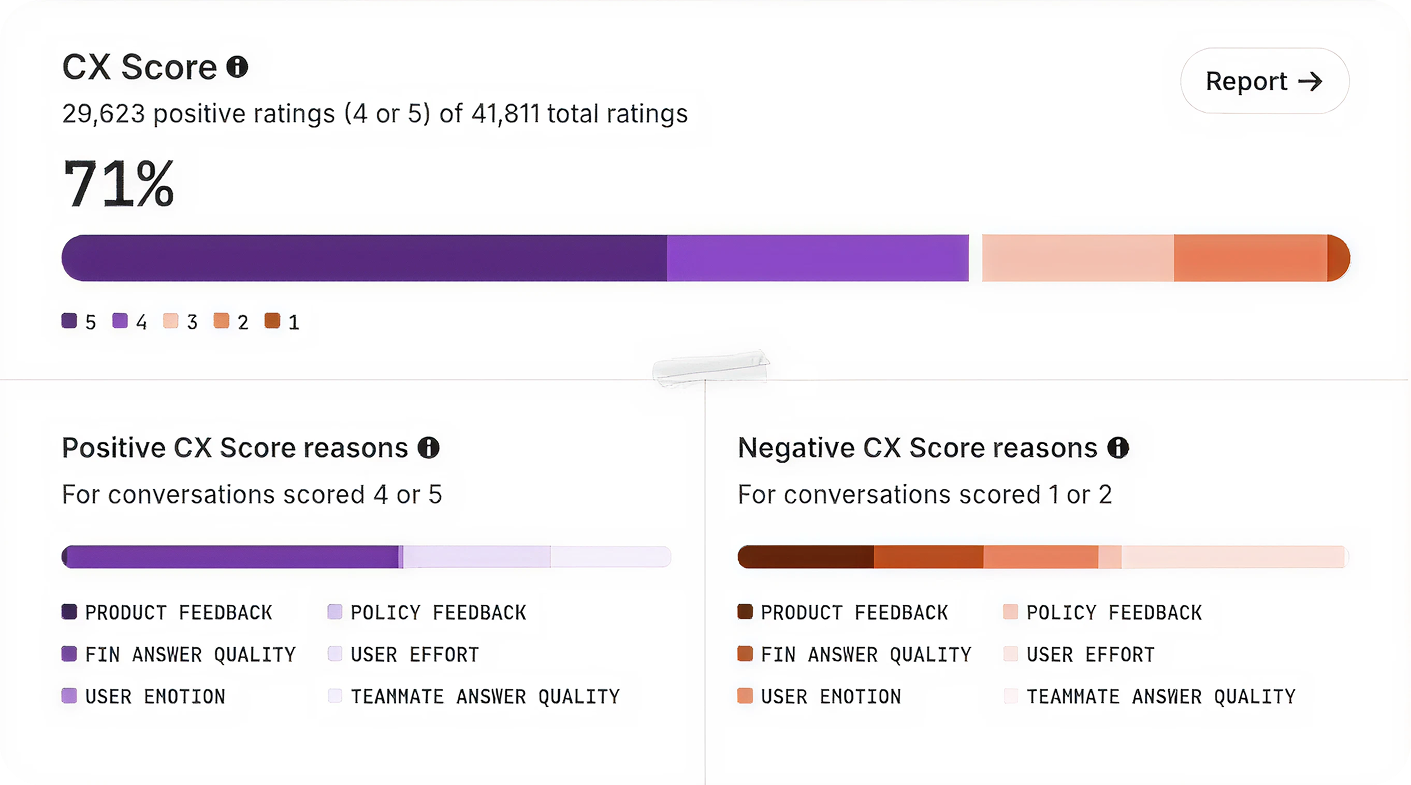
Another example is CX Score. It started with close work alongside Intercom’s Customer Support team to understand performance with Fin, initially through predicted CSAT and resolution. Over time, this work evolved into CX Score: a scalable way to measure conversation quality across all customers.
The product stage is fundamentally different from Cockpit because of the constraints. Cockpit provides a platform for our customer analyses/tools but it doesn’t need to scale as far as product. What moves into product has to work for every customer, without configuration, at scale, so it has to generalize. That bar is what protects long-term quality while unlocking product-led growth.
That’s why the move from Cockpit to product isn’t automatic. We’re not just asking whether something is useful, but whether it’s broadly useful, robust, and scalable enough to run across the entire customer base. As a product leader, I push for this discipline because it’s where customer success, engineering excellence, and business outcomes converge.
The loop. The model is simple. Swarms generate the best signal, grounded in real customer problems. Cockpit operationalizes that signal so CSMs and Sales can use it across many customers. Product takes the patterns that truly generalize and turn them into scalable features that enhance every customer’s experience.
This loop allows a small swarm data science function to have impact beyond a small set of high-touch accounts, resulting in a stream of continuous improvements across all three levels and an ever-increasing level of automation for our customers. Practically, it’s a repeatable playbook for product management leadership: start with high-signal discovery, prove repeatability, and only then scale through product. Done well, it compounds learning, accelerates time-to-value, and aligns the entire organization around measurable outcomes.
Every week I meet marketers who are working harder than ever—more campaigns, more content, more dashboards—yet seeing less movement on metrics that matter. The surge of AI tooling has amplified activity, not necessarily impact. That’s the focus problem: we confuse motion with momentum, and our backlogs look great while our outcomes stall.
Learn how AI agents for marketing can help you prioritize impact so you can do important work, instead of just more work.
In my role leading product and growth teams, I’ve learned that AI only compounds value when it is pointed squarely at outcomes. If we don’t define what “good” looks like, agentic AI will simply scale busywork. The antidote is a disciplined operating model that connects strategy to execution and instruments agents with clear success criteria.
First, anchor your program with outcomes vs output OKRs. Choose one or two measurable business outcomes—such as qualified pipeline, conversion rate, or activation—and make everything else subordinate. This provides the compass agents need to make effective trade-offs when speed and volume tempt you to do “one more thing.”
Second, map a driver tree from the target outcome down to the controllable levers: audience segments, offers, channels, messaging, and experience friction. This traceability shows where agents can move the needle fastest—whether that’s accelerating research, sharpening positioning, or eliminating handoffs that slow experimentation.
Third, design a small, agentic AI workforce aligned to those levers. For example: a Research Agent that synthesizes market insights and past performance; a Copy Agent that generates on-brief, on-brand variants; a Distribution Agent that adapts content to each channel and schedules posts; and an Analytics Agent that runs A/B tests, summarizes results, and flags anomalies. Keep human oversight where judgment matters most—strategy, brand voice, and high-stakes decisions.
Fourth, instrument rigor from day one with Agent Analytics and eval-driven development. Define offline evals for brand consistency, factuality, safety, and response time; pair them with online experiments that quantify lift on your target outcomes. Set a minimum detectable effect (MDE) so you stop shipping changes that cannot plausibly move the metric.
Fifth, operationalize your AI workflows. Standardize prompts, inputs, and handoffs; templatize briefs and acceptance criteria; and keep a change log so improvements compound rather than reset. Use short, frequent feedback loops to prune low-impact work and double down on what demonstrably advances your objectives.
I’ve seen teams reclaim focus and momentum when they treat agents as teammates, not toys. The magic isn’t in producing more assets—it’s in consistently choosing the next best action in service of a clear outcome. When you combine outcome clarity, a driver tree, targeted agents, and tight evals, AI becomes a force multiplier for marketing impact.
If you’re feeling overwhelmed by AI’s possibilities, start small: commit to one outcome, one driver you believe is material, and one agent designed for that job. Prove lift, codify the workflow, then scale. Velocity is only valuable when it’s pointed in the right direction.
Inspired by this post on Amplitude – Best Practices.
I’ve long believed the people function is a strategic engine, not a support lane. That conviction was only reinforced in a recent deep dive with Katie Burke, now COO at Harvey after joining as Chief People Officer. Before Harvey, she spent 11 years in HR leadership at HubSpot, helping build one of tech’s most distinctive cultures. In this piece, I unpack what resonated most for me as a product leader: a marketing-minded approach to HR, deliberate hiring from hospitality, and the non-negotiable case for culture as a core business strategy.
The first principle is simple and often overlooked: HR leaders should think like marketers. Employer brand is a product; your candidate and employee journeys are funnels; and your programs deserve the same rigor we bring to product—segmentation, positioning, channels, and continuous A/B testing. When we treat onboarding, performance, and manager enablement like iterative product launches—complete with activation metrics, retention curves, and NPS—we stop guessing and start compounding results.
One line has become a north star for how I approach executive leadership: “Don’t ask for a seat at the table. Build the table.” In practice, that means codifying the operating system—decision rights, principles, cadences, and accountability—so the organization isn’t improvising strategy in every meeting. Product, People, and Finance should co-own this OS; that’s how you scale clarity faster than headcount.
Transparency is the tax we pay for alignment, and it compounds trust. After an IPO, the impulse can be to close ranks. The better move is radical transparency with context: what changed, why it matters, and how decisions get made now. On my teams, that looks like publishing decision records, sharing tradeoffs explicitly, and using written docs to reduce rumor velocity—core muscles in stakeholder management as complexity grows.
I also loved the counterintuitive hiring bet: prioritize hospitality backgrounds alongside traditional corporate pedigrees. People who’ve thrived in service environments bring customer empathy, operational resilience, and a bias for proactive care—traits that elevate everything from onboarding to incident response. In product terms, they’re culturally accretive hires with high signal on service quality and consistency.
The trickiest part of the Chief People Officer role isn’t process—it’s politics. You are the executive team’s own HR business partner, which requires coaching, candor, and conflict mediation at the highest stakes. The goal is to “Be the Michael Jordan of your exec team”—the teammate who elevates standards, makes others better, and chooses the hard right over the easy familiar.
Layoffs create a culture debt that accrues interest. Expect a “2.5-year cultural hangover after a layoff”—in many companies, an inevitable two-year layoff hangover—unless you actively repay it. That repayment plan includes narrating the why with specificity, rebuilding trust through manager enablement, and re-anchoring on performance and values. Measure leading indicators (manager effectiveness, time-to-decision, psychological safety) alongside lagging ones (regretted attrition) to track the true recovery arc.
People leaders also need to create “graceful exits.” Doing this well preserves dignity for the person, protects the team’s morale, and safeguards the company’s brand. The bar is straightforward: clear rationale, fair process, useful feedback, generous support, and alumni pathways. A graceful exit signals that even when business realities bite, respect is non-negotiable.
Expectation-setting matters. Two truths cut through the noise: “The workplace shouldn’t be Disneyland” and “Our job is not to make you happy every day.” The promise is not perpetual happiness; it’s meaningful work, fair standards, growth opportunities, and leaders who tell the truth. When we set that contract clearly, engagement becomes an outcome of purpose and progress—not perks.
On feedback, I use the protein vs. sugar rule for employee feedback. Sugar feedback is pleasant and perishable; protein feedback is specific, sometimes uncomfortable, and growth-driving. Great cultures build a taste for protein—clear role expectations, crisp examples, and written follow-ups. Mechanically, that looks like structured 1:1s, decision retros, skip-levels, and manager training that demystifies “what good looks like.”
Being a Chief People Officer isn’t for the faint of heart. The role must be demanding by design—on executive hiring quality, performance management courage, and values enforcement. Moments like “Berry-Gate” are reminders that small symbolic issues can balloon when feedback loops are unclear. Close the loop fast, publish the rationale, and ensure there’s a predictable path for concerns to be heard and resolved.
When hiring, beware patterns that predict friction. That’s why “frequent flyers” are a new-hire red flag. Movement can signal adaptability—but weather-vein pivots and blame-shifting often repeat. Probe for ownership, learning moments, and sustained impact; you want people who compound value, not just sample it.
Clarity on scope prevents leadership whiplash. Which company decisions fall to the Chief People Officer? Think leveling frameworks, compensation philosophy and bands, performance calibration, manager standards, ER policies, and org design guardrails—always in lockstep with Finance and the CEO. Escalate when there are values collisions or systemic risks; otherwise, push decisions to the right altitude and owner.
Scaling exposes the same few failure modes on repeat: fuzzy decision rights, a thin manager bench, brittle processes that don’t flex, and inconsistent leveling that erodes trust. The antidote is an operating model that pairs clear principles with lightweight mechanisms—documented roles, regular calibration, and reviews that audit for both outcomes and operating behaviors.
Comparing a scaled SaaS like HubSpot with an AI-native company like Harvey surfaces important differences. The former optimizes for durable systems, predictable cadences, and governance; the latter optimizes for rapid learning loops, emergent org design, and a higher tolerance for ambiguity. The art is porting the right controls at the right time without crushing velocity.
AI is already changing the people function. GenAI can draft job descriptions, summarize performance notes, classify themes from engagement surveys, and power AI workflows that resolve common HR tickets. The human-in-the-loop remains essential for judgment, context, and ethics—especially around data governance and privacy-by-design. A pragmatic AI Strategy here frees HRBPs for higher-order coaching and organizational development work.
One practice I recommend widely: share your own performance reviews. Modeling openness normalizes growth and turns feedback into a shared craft, not a secret ritual. It also builds trust when you later ask the organization to lean into sharper, protein-rich feedback.
Finally, disagreements with the CEO are inevitable—and healthy. Handle them with pre-briefs, crisp written proposals, explicit tradeoffs, and a shared decision record. Argue like scientists, not politicians; once a call is made, disagree and commit. That combination of candor and alignment is what keeps executive teams high-trust and high-velocity.
The people leader’s chair may be the most politically dangerous role in the C-suite—but it’s also one of the most leveraged. Build the table, tell the truth, design for standards and dignity, and treat culture like the product that powers everything else.
Every planning cycle, I feel the drumbeat: “Show me the AI ROI—this quarter.” The pressure is real, especially when boards and CFOs expect immediate payback. Yet when I review stalled initiatives across teams and peers, the pattern is consistent: most companies treat AI like a feature to ship, not a system to manage. That mindset almost guarantees we measure the wrong things, declare victory (or failure) too early, and miss the durable value AI can create.
Here’s the core problem I see: we leap to solution and skip the counterfactual. Without a baseline, a clear control, or a defined “what would have happened otherwise,” we’re guessing. We also fixate on lagging, financial KPIs that move slowly (revenue, cost, risk), then use outputs—not outcomes—as OKRs. If we don’t align on outcomes vs output OKRs upfront, the best team in the world can still optimize for activity over impact.
My AI Strategy starts from a simple truth: value shows up along three vectors—revenue, cost, and risk—on different timelines. In the near term, we must validate leading indicators (adoption, engagement, activation) that ladder to those vectors through a transparent driver tree. Over time, those drivers compound into the lagging KPIs finance cares about. When we make the driver tree explicit, everyone can see how model precision, response time, and workflow integration roll up to conversion lift, case deflection, time-to-resolution, or reduced exposure.
To make this rigorous, I run a five-step playbook. First, define the decision and business outcome in plain terms. Second, instrument the baseline with behavioral analytics on a unified analytics platform—tools like Amplitude analytics or Pendo help expose friction points we’ll later target. Third, create a counterfactual using A/B testing and specify a minimum detectable effect (MDE) so we know how long to run and how much traffic we need. Fourth, quantify costs (training, inference, integration, change management) and include AI risk management, privacy-by-design, and data governance up front. Fifth, lock a measurement plan that connects leading indicators to lagging ROI through the driver tree.
Most AI initiatives don’t fail on model quality—they fail on adoption. If the workflow isn’t smoother, trust isn’t earned, or value isn’t obvious, users revert. That’s why I invest early in onboarding, in-app guides, product tours, and thoughtful tooltip design to reduce the time-to-first-value. Then I watch user activation, retention analysis, and task completion to ensure the assistive experience is not just novel—it’s habit-forming.
For generative use cases, eval-driven development is non-negotiable. I maintain offline evaluations for accuracy and safety, and online evaluations for business impact. Retrieval-first pipeline health, context window management, and prompt engineering affect reliability; so do latency and grounding quality. We ship behind feature flags, measure guardrail effectiveness, and tighten feedback loops from human-in-the-loop reviews into model updates—continuously.
On the business side, I avoid “AI theater” by structuring benefits like a CFO. Revenue: increased conversion or expansion driven by better recommendations, faster sales cycles, or higher trial activation. Cost: case deflection, agent time saved, fewer escalations, and lower rework. Risk: reduced exposure via automated checks, anomaly detection, and consistent policy application. If any claim can’t be tied to measured deltas—via A/B testing or strong quasi-experiments—it doesn’t go in the deck.
Build vs buy deserves the same discipline. I map platform scalability, governance requirements, and total cost of ownership against time-to-impact. Teams often underestimate integration and maintenance drag; a pragmatic mix of bought components with thin custom layers can accelerate outcomes while keeping options open. The goal isn’t to own every layer—it’s to own the learning loop and the differentiated experience.
I also remind teams that tooling should serve the strategy, not replace it. I’ve seen concise, effective messaging that captures the point: “Increase revenue, cut costs, and reduce risk with Pendo’s Software Experience Management platform. Optimize the entire software experience to drive adoption and improve engagement.” The words are compelling because they reflect the three-vector value model and the adoption imperative. The same standard should apply to any AI initiative we propose.
If you’re under pressure to prove ROI, shift the conversation: lead with the driver tree, specify your counterfactual, and anchor on leading indicators you can move in weeks—not quarters. Then connect those to the lagging KPIs finance expects over time. When we manage AI like a product—grounded in evidence, experimentation, and user-centered adoption—we don’t have to force ROI. We compound it.
Lately, it feels like every morning brings a new AI launch, a dazzling demo, or a must-try tool. I love the pace of innovation, but the constant stream can trigger counterproductive FOMO if I’m not intentional. As a product leader, I’ve learned to turn that anxiety into a disciplined learning system—one that keeps me curious without letting novelty hijack my focus.
That’s exactly why this conversation with Petra Wille and Teresa Torres resonated with me. They explore how to stay experimental in the AI era without chasing every shiny object. Their perspective aligns closely with my own operating cadence: start with real problems, go deep on a small set of tools, and create explicit boundaries between work, learning, and play.
Listen to this episode on: Spotify | Apple Podcasts
Here’s the mindset I apply. I don’t start with tools—I start with problems. When I encounter concrete friction in a workflow or see a credible opportunity to improve an outcome, that’s my trigger to explore a new capability. This mirrors the continuous discovery habit of prioritizing opportunities over solutions, and it’s how I avoid performing “innovation theater.”
To keep exploration healthy, I time-box my learning. I block recurring windows specifically for experiments, reading, and hands-on trials so they don’t overrun my core product work. During these blocks, I’ll set a clear question, run a tight test, and capture what I learned. No rabbit holes, no endless tinkering.
I also separate “interesting” from “actionable.” Plenty of inputs are worth awareness, but very few deserve immediate action. I bookmark the rest for later. This simple filter reduces cognitive load and keeps my backlog—from ideas to proofs of concept—well-governed.
Social media can amplify technology hype cycles, so I establish boundaries. I batch consumption, mute low-signal channels, and prioritize practitioner communities over performative threads. The goal isn’t to be first; it’s to be right for my customers, my team, and our strategy.
When choosing what to try next, I use a practical rubric. Does the tool target a real friction I’ve seen in discovery or delivery? Can it plug cleanly into our AI workflows without unsustainable glue work? Do we have a safe, compliant way to test it? Is there a plausible path from trial to compounding value? If the answer isn’t a confident yes to most of these, I wait.
Depth beats breadth. I’d rather take one promising tool into a real use case, instrument it, and measure outcomes than skim ten trending demos. That tighter loop produces sharper intuition, clearer product bets, and better partner decisions. A quick opportunity solution tree helps me connect user pain to outcomes before I let any solution onto the field.
In the episode, Petra Wille and Teresa Torres talk candidly about managing FOMO, deciding which tools to explore, and designing intentional learning systems. They discuss why starting with a problem is more valuable than starting with a tool, how social media amplifies technology FOMO, and why going deeper with fewer tools can lead to better learning. If you’ve ever felt like you’re falling behind because you haven’t tried the latest AI tool yet, this conversation will help you rethink how you approach learning and experimentation.
If you’re curious about what came up, here are some of the tools and communities mentioned: Claude Code, OpenClaw (formerly Clawdbot, Moltbot), NotebookLM, Product Talk, ElevenLabs, Lenny’s Newsletter Community, and even a nod to Bridgerton for a touch of levity.
My takeaway is simple but powerful: curiosity doesn’t require constant experimentation. The best product managers cultivate a balanced system—grounded in product discovery, energized by focused experiments, and protected by clear boundaries—so we can learn faster while staying pointed at outcomes that matter.
Discussion Question: How do you decide which new tools or technologies are worth exploring—and which ones you can safely ignore?
“Continuous Discovery Habits” turns five this year, and I’m celebrating by reading it with our community—together, in practice, not just in theory. Each month, I’m publishing an in-depth reading guide with the chapters we’ll cover, a preview of the most important concepts, short videos you can share with your teams, individual and team discussion questions, practical exercises to apply what you read, and additional resources to go deeper.
We’ll keep the conversation active in the comments each month and meet live once a quarter to compare notes, share what’s working, and troubleshoot what’s not. If you’re joining late, no problem—start with the current month or go back to January. You can also find all of the book club articles here.
If you want to participate, grab a copy of the book (or dust off your old one), share the “Spread the Love” videos with colleagues, block time for the team exercises, and register for the community sessions. Let’s dive in together.
This chapter grounds us in why interviewing on a regular cadence is critical to the success of any product trio; how cognitive biases affect what we learn from direct questions; the difference between research questions and interview questions; how to use story-based interviewing to uncover actual customer behavior (not ideal behavior); the interview snapshot, a one-page tool for synthesizing what you learned from a single interview; how to automate the recruiting process so interviewing becomes easier than not interviewing; and why product trios should interview customers together.
Need a copy? Grab the book.
Share the Love with Friends and Colleagues
We learn best in community. To help your team rally around these practices, share these concise primers and invite them to join the book club discussion with you.
What are customer interviews? – Build a competitive advantage that compounds over time.
What should we ask in customer interviews? – Mitigating cognitive biases.
Research questions vs. interview questions – And why the difference matters.
Getting reliable feedback from customer interviews – Ask the right questions.
Who should conduct customer interviews? – My answer might surprise you.
How do you find customers to interview? – Automate the recruiting process.
The Interview Snapshot – How to synthesize a single customer interview.
Reflect and Discuss What You Read
Reflection cements learning. This month, I’m challenging you—as I challenge my own teams—to build a weekly habit of interviewing customers and to shift from direct questions (which trigger bias) to collecting specific stories about past behavior. For many teams, this is a big mindset change: from infrequent “big research projects” to lightweight, continuous conversations that fuel daily decision-making.
Individual Reflection: Think about your last customer interview or conversation. Did you rely on direct questions, or did you excavate a specific story about what happened? How might the answers have changed if you had used the other approach?
Consider your own behavior—buying jeans, going to the gym, choosing what to watch on Netflix. Where do your ideal intentions differ from what you actually do? How might that same gap show up in your customers’ answers to direct questions?
Scan your calendar from the past month. How many customer interviews did you conduct? If it’s fewer than four, what got in the way? What needs to change to make weekly interviewing sustainable?
Team Discussion: As a team, discuss your current interview cadence. If you’re not interviewing at least weekly, name the biggest obstacle—recruiting, time, or synthesis—and commit to reducing one barrier this month.
Try this together: Ask a teammate, “How does a product idea go from concept to launch at our company?” Have them write it down. Then ask for the last specific feature or improvement that launched and capture the story. Compare the two. What’s different? What does this reveal about the gap between ideal process and actual process?
If you already interview regularly, ask: Who participates? Is it just one person (like the designer or product manager), or does the whole trio join? What value might you be missing by not having all three perspectives in the room?
Put It Into Practice
Understanding the “why” is easy; building the habit is the work. The following exercises are how my teams operationalize continuous interviewing week over week.
Exercise: Conduct a Story-Based Interview (Time: 20–30 minutes. Do this with your product trio.) Schedule a conversation with a current customer. Instead of drafting a long script, identify a handful of research questions (what you need to learn) and translate them into one story-based interview question (what you’ll ask).
For example, research questions might include: What challenges do customers face when onboarding? Where do they get stuck? What are we asking them to do that they don’t understand? How can we make it easier for them to get to the activation moment? The corresponding interview question could be: Tell me about the first time you used our product.
During the interview, excavate the story with temporal prompts like “What happened first?”, “What happened next?”, and “What happened before that?” If the participant drifts into generalities (“I usually…” or “In general…”), gently bring them back to the specific instance.
After the interview, debrief as a trio. What did each of you hear? Which opportunities surfaced? What surprised you? If you want personalized, detailed feedback on your technique, consider the Interview Coach available through the Story-Based Customer Interviews course.
Exercise: Create Your First Interview Snapshot (Time: 30 minutes. Do this with your product trio immediately after the interview.) Using the interview snapshot template, capture a photo of the participant (or a visual that represents their story), quick facts about their context, a memorable quote you’ll still recall months from now, the opportunities (needs, pain points, desires) you heard, notable insights that aren’t yet opportunities, and an experience map that illustrates the story. Over time, aim to complete each snapshot in 15–20 minutes.
Go Deeper: Additional Reading
If you prefer audio, I’ve included an audio summary for paid subscribers that covers this month’s chapter plus the resources below.
Related In-Depth Guides: Customer Interviews: How to Recruit, What to Ask, and How to Synthesize What You Learn.
The Value of Continuous Interviewing: Why Product Trios Should Interview Customers Together – How interviewing together ensures research is timely, actionable, and believable.
How to Find Customers to Talk To: Customer Recruiting: Get Easy Access to Customers Week Over Week – Practical strategies for automating your recruiting process. Ask Teresa: How Do You Select Customers for Customer Interviews? – Who to interview and how to recruit them. Tools of the Trade: Finding People to Interview Before You Have Customers – Recruiting strategies for early-stage products.
What to Ask in Your Interviews: Why You Are Asking the Wrong Customer Interview Questions – Understanding the gap between ideal behavior and actual behavior. Story-Based Customer Interviews Uncover Much-Needed Context – Why collecting specific stories is more reliable than asking direct questions. Ask Teresa: What Are the Best Customer Interview Questions? – Common questions and how to improve them. Ask About the Past Rather than the Future – Why memories about recent instances are more reliable than speculation.
How to Take Notes and Synthesize What You Are Learning: How to Take Notes During Customer Research Interviews – Practical tips for capturing what you hear. The Interview Snapshot: How to Synthesize and Share What You Learned from a Single Customer Interview – A comprehensive guide to creating and using interview snapshots. Customer Interview Analysis: How AI Helps and Hurts – Learn how to use AI effectively.
Videos: All Things Product Podcast: Customer Interview Analysis – Petra and I discuss using AI to analyze customer interviews, the risks and benefits, and why your interviewing skills matter more than any AI tool.
Other Resources from Around the Web: The Top 5 Mistakes Product Teams Make With Customer Interviews by Pragmatic Live. Continuous interviewing with Kristian Collin Berge (CEO & Co-founder at UX Signals) by Afonso Franco. How to Make Time for Customer Interviews & Validation by Rich Mironov. Brave UX: An interview with Teresa Torres by Brendan Jarvis.
Related Courses: Customer Recruiting for Continuous Discovery – Get easy access to customers week over week. Story-Based Customer Interviews – Collect reliable feedback from every customer conversation.
Our Live Discussion Schedule
Our live discussion sessions are for paid subscribers. Sessions are not recorded. Invitations will go out to members two weeks before each event—add these to your calendar now: Tuesday, June 16, 2026: 9am–10am PDT. Thursday, September 17, 2026: 9am–10am PDT. Wednesday, December 16, 2026: 9am–10am PST.
Audio Summary
This summary was produced by NotebookLM. The sources supplied were the book chapters as well as all of the additional reading.
This article is part of the CDH Book Club celebrating the five-year anniversary of Continuous Discovery Habits.
Disruption is the only sustainable strategy in product. When a platform meaningfully changes how we build and operate, I pay attention—not just as a product leader, but as someone accountable for turning AI Strategy into durable competitive differentiation. That’s why the launch of the Fin API platform stands out: it’s a concrete step toward agentic AI at enterprise scale.
Today, I’m diving into what this launch includes, why it matters for product strategy, and how I’d navigate the build vs buy decision in this new landscape. My goal is to translate the announcement into actionable guidance for product teams, CX leaders, and forward-deployed engineers who are building the next generation of customer support and product-led experiences.
Fin is a customer agent platform that at present resolves over 2M customer issues a week, growing at a rapid exponential pace. It’s relied on by the best brands, large and small, in every vertical you can imagine. From Atlassian and Riot Games, to smaller hot upstarts like Mercury and Polymarket. It runs on a family of models trained by its AI group. Last week, they announced Apex, which is the world’s first specialized customer service LLM. In production tests over the last 6 months, it beat every single frontier model, including those from Anthropic and OpenAI, on resolution rate, latency, hallucination rate, and cost.
With this launch, teams can access the platform’s core capabilities and underlying models directly via API, with contracts starting at $250k per year, and usage rates that are by far the cheapest in the industry for each of the model’s subcategories. For leaders evaluating total cost of ownership, this is a meaningful data point: it shifts the economics of scaled automation from experimental to operational.
Why now? Because builders want options. I hear from teams daily that want to design their own agents, tune prompts and policies, and integrate with bespoke CRMs, data lakes, and product surfaces. The Fin announcement meets that demand with three clear build-paths, each mapping to a different operating model and maturity stage.
First, for the vast majority of companies, the Fin Agent Platform is the pragmatic starting point. Fin reports ~8k companies on it today. It addresses 99% of customer needs out of the box—without exhausting consulting engagements—while delivering top-tier resolution rates. If your priority is time-to-value, governance, and platform scalability, this route de-risks implementation and accelerates outcomes.
Second, for teams that need custom surfaces or channels, the Fin Agent API lets you present Fin in unique contexts. You get the Fin platform’s orchestration and controls, but you’re free to bypass the default messenger, email, voice, or any prebuilt channel and embed the agent natively in your product. I see this as the sweet spot for product-led growth motions where conversation design and UX writing are strategic levers.
Third, for companies building hyper-specific agents—think service plus in-product actions—the new API access to Apex and the broader collection of models is the obvious move. Unlike generalized models, these are purpose-trained for customer service scenarios and operational policies. If you have strong in-house solutions engineering, a retrieval-first pipeline, and eval-driven development in place, this path maximizes control without reinventing the model layer.
This also opens the door for vertical specialists. Fin-like businesses focused on deep domains can emerge quickly—Fin for dentists? Why not? Fin for car dealerships? Sure. I expect startups and modern CX providers (including players like Decagon and Sierra) to carve out niches where domain data, workflows, and compliance are the real moats. That’s where differentiated AI beats generic capability.
There’s a defensive reason to pay attention here. The software landscape is shifting fast: the moat is no longer feature parity—it’s the quality of your agents and the data flywheels powering them. Building software is simply less hard now, and I’ve watched engineering teams more than double measurable productivity as they adopt AI-assisted development. The implication is clear: the interface-and-features era is giving way to an agents-and-outcomes era.
Serious software companies must evolve from being a features company to an agents company—and build those agents on differentiated AI. More value will accrue at the model and orchestration layers, where safety, latency, cost, and resolution quality are won. That puts a premium on prompt engineering discipline, policy routing, continuous discovery of edge cases, and rigorous offline/online evals to keep hallucination rates low while maintaining speed.
How would I choose among the three build-paths? If you’re early or resource-constrained, start with the Fin Agent Platform to validate outcomes and align stakeholders. If you need branded experiences and tighter product integration, use the Fin Agent API to control surfaces without owning the heavy lifting. If you have strong ML ops and a mature customer support ai strategy, go model-level with Apex and companions, layering in your own guardrails, context window management, and test harnesses. In each case, balance velocity, control, and risk—your build vs buy decision should be grounded in clear metrics and an explicit product strategy.
Where does this lead? We’ll see more companies expose specialized model families with clearer economics and stronger governance. For now, I’m excited to see what teams build with the Fin API platform—and how they turn agentic AI into measurable improvements in resolution rate, CSAT, cost-to-serve, and ultimately, customer loyalty.
I believe the future of product design isn’t about replacing designers—it’s about giving every team access to one. That’s why Banani grabbed my attention. It’s an AI product designer that doesn’t just generate code—it generates design. For solo founders, stretched design teams, and early-stage startups, that shift matters: it raises the design floor without lowering the creative ceiling.
I spent time with Vlad Solomakha (CEO & Co-founder), Vova Kovalchuk (CTO & Co-founder), and Vlad Ostapovats (Founding Growth) to unpack how they took Banani from a Figma plugin proof-of-concept to a canvas-first AI design tool generating hundreds of thousands of designs per week. Vlad brings a decade of design experience and a precise north star: AI should produce beautiful, tasteful design rather than average, undifferentiated UI.
The architectural choices stood out. They engineered their agent to handle parallel screen edits, manage per-screen context across canvases with hundreds of frames, and make surgical edits without regenerating entire screens. This is the kind of agentic AI work that product leaders have been waiting for: concrete advances in context window management, tool orchestration, and prompt engineering that translate into higher throughput without sacrificing quality.
Equally important is how they addressed the "gulf of specification"—the mismatch between how designers think visually and how agents understand text. Banani’s canvas-first approach acknowledges that design is spatial, hierarchical, and iterative. Rather than forcing a chat-first UX, they center the canvas and let the agent do production work while keeping the designer firmly in control. In practice, this narrows intent ambiguity, speeds up iteration, and preserves taste.
The team made another pivotal bet: Why Banani doesn’t compile running applications — just HTML/CSS mockups — and how that shapes everything. By decoupling the design artifact from runnable code, they optimize for velocity, taste, and exploration. In my experience, this separation is the right product strategy for early discovery and gen ai for product prototyping—move fast on aesthetics and flows, then converge on implementation once you’ve validated the direction.
I also appreciated their pragmatic evaluation approach. Instead of traditional evals, they spin up 10 screens from one prompt to compare models. It’s hands-on, outcome-based, and aligned with eval-driven development in real product environments. They’re relentlessly discerning about when to work around model limitations versus when to wait for the models to improve—an essential discipline when building at the edge of what’s possible.
Under the hood, context engineering and specialized agent tools do the heavy lifting. Per-screen history with shared project context enables precise, reversible changes across large canvases. The result: fewer destructive regenerations, more reliable design intent preservation, and a workflow that feels like collaborating with a strong mid-level designer who’s exceptionally fast and consistent.
If you want a quick tour, I recommend jumping to a few highlights: 20:13 Product Tour Canvas First AI, 33:40 Gulf of Specification, 42:54 Agent Architecture Under Hood, 48:48 State History Context Tricks, and 56:04 Navigating Busy Canvases. Each segment reveals a different layer of the system design and product thinking behind Banani’s canvas-first UX.
For product leaders, this is a compelling blueprint for raising the design floor while protecting the last mile of craft. It aligns with empowered product teams, continuous discovery, and LLMs for product managers who need leverage without losing judgment. If you’re exploring agentic AI in design, this is a thoughtful, execution-focused model worth studying and trialing on your next product tour or redesign.
Resources worth exploring: Banani and TL Draw. To hear the full conversation, you can listen on Spotify or Apple Podcasts. Then, pressure-test the approach inside your own product development lifecycle and see how a canvas-first AI designer reshapes your team’s velocity and quality bar.