You have an activation dip, a cluster of frustrating sessions, and several plausible explanations. One stakeholder wants a copy change. Another sees an engineering defect. Someone else thinks the cohort changed. Everyone has evidence, but the evidence is doing different jobs.
Your task is not to find the chart that wins the argument. It is to build a traceable chain from signal to explanation, intervention, and decision. That chain lets your team move quickly without pretending that correlation is causation or that a statistically inconclusive test proves nothing happened.
Build an evidence chain before you build another dashboard
Product teams often treat analytics, session replay, customer feedback, experiments, and production monitoring as interchangeable forms of proof. They are not. Each answers a different question, and using one beyond its limits is where confident but weak decisions begin.
Evidence stage
Question it should answer
Useful artifact
Common overreach
Signal
What changed, where, and for whom?
Funnel, cohort, retention, adoption, anomaly, or error trend
Assuming the pattern explains its own cause
Context
What did affected users encounter?
Targeted session replays, support cases, and shared cohort views
Treating memorable sessions as representative
Mechanism
What plausible behavior connects the experience to the outcome?
A falsifiable hypothesis with competing explanations
Writing a solution preference as a hypothesis
Intervention
What change could isolate the mechanism?
A pre-registered experiment or controlled rollout
Choosing metrics after seeing results
Decision
What will you do under each credible result?
Decision rules, owner, and recorded outcome
Calling a test successful without making a product decision
Behavioral analytics is strongest at locating a pattern. Replay and customer evidence add context. A well-designed randomized experiment can estimate whether an intervention caused a change within the tested population. Production monitoring tells you whether that result remains healthy after broader exposure. None of these eliminates the need for the others.
Start every meaningful product decision with a small evidence packet. Include the decision being made, the eligible population, the baseline signal, the relevant segment, links to reproducible views, the leading mechanism, credible alternatives, and the method you will use to reduce uncertainty. If a stakeholder cannot reopen the same cohort or understand the denominator, you do not yet have shared evidence.
This distinction also prevents a subtle prioritization error. A defect with a high raw count is not automatically the most important defect. Pair error incidence with conversion, activation, or retention impact, then inspect the affected journeys. Connecting error patterns to behavioral outcomes and reproducible replay filters gives engineering, design, product, and support the same starting point.
Stabilize the measurement, then investigate the behavior
An experiment cannot repair an ambiguous metric. If activation means account creation in one dashboard, first value in another, and repeated use in a leadership report, the team can run a technically clean test and still argue about what it learned.
Create a metric contract for every metric that can approve, reject, or stop a product change. The contract should specify:
Decision purpose: the product decision this metric informs.
Eligible population: who can enter the metric and when eligibility begins.
Qualifying behavior: the exact event and required properties.
Calculation: numerator, denominator, aggregation method, and treatment of repeated behavior.
Measurement window: when the outcome is observed relative to eligibility or exposure.
Exclusions: internal accounts, bots, incomplete instrumentation, or other explicitly invalid traffic.
Ownership: who approves semantic changes and records them.
Version the definition when it changes. Do not silently rewrite history in a dashboard that still carries the old name. If historical recomputation is possible, label the boundary and explain whether earlier decisions remain comparable.
The same rule applies when behavioral data enters an AI workflow. Bringing governed behavioral context into tools used for product work can reduce context switching and preserve consistent definitions. It cannot rescue inconsistent event names, missing properties, or conflicting cohort logic. An AI assistant will often make a fragmented measurement system faster to query without making it more trustworthy.
Once the measurement is stable, use quantitative and qualitative evidence in sequence:
Locate the break with a funnel, cohort, retention view, anomaly, or error trend.
Define the affected segment before opening replay. Useful segments might distinguish first-time users, established users, power users, or high-value accounts when those differences matter to the decision.
Open a saved filter for that exact segment. Prioritize sessions with relevant frustration or error signals instead of browsing random recordings.
Record observation separately from interpretation. What the user did belongs in one field; why you think it happened belongs in another.
Return to aggregate data and test whether the observed behavior appears broadly enough to justify an intervention.
That separation between observation and interpretation matters. A user repeatedly clicking an element is an observation. The claim that the element looked interactive is an interpretation. A redesigned affordance is an intervention. Keeping those statements separate makes the hypothesis testable and leaves room for competing explanations, such as latency, an error state, or unclear copy elsewhere in the flow.
Session replay is excellent hypothesis fuel, but it is not causal proof. Frustration signals, error analytics, and shareable cohort filters help you find consequential moments and let collaborators reproduce what you saw. Use those moments to explain where a test should focus, not to declare the test unnecessary.
Pre-register the experiment as a decision contract
A strong experiment brief is short enough to use and strict enough to prevent retrospective storytelling. Write it before exposure begins. The core sentence should take this form: For this eligible population, changing this part of the experience should move this primary outcome because this observed mechanism is suppressing or encouraging the behavior.
You have put AI inside a real workflow. The demo looks convincing, early users say it feels faster, and the model usually produces something plausible. Yet one question remains unanswered: did the workflow improve, or did AI merely move the effort into reviewing, correcting, and recovering from its output?
You can answer that question without turning every prototype into a platform project. Treat the workflow itself as the product, isolate the assumption you need to test, measure the entire job rather than the generated output, and increase autonomy only when the evidence supports it.
Start with the decision, not the AI feature
An AI workflow is not a prompt attached to a user interface. It is a sequence containing automated steps, AI-augmented steps, and steps that still require a person. The experiment therefore has to cover that full sequence. A model can produce a strong answer while the workflow still fails because the right context was unavailable, verification took too long, or the recommendation arrived after the decision had already been made.
Write the decision you intend to make before building the variant. A useful decision statement has this shape: If the workflow improves the primary outcome by an amount that matters, while staying inside the agreed quality, safety, latency, and cost limits, expand it. If it does not, revise the failed assumption or stop.
Turn that statement into a one-page experiment contract:
User and context: Name the person doing the job and the moment in which the workflow starts. Avoid labels such as all customers or the product team.
Workflow boundary: Define the observable trigger and the completed outcome. Measure the same boundary in the current and AI-assisted versions.
Baseline: Record how the job works now, including input preparation, waiting, review, handoffs, corrections, and recovery from mistakes.
Hypothesis: State the mechanism, not just the desired result. For example, pre-assembling relevant account context will reduce investigation work before a support response is drafted.
Primary outcome: Choose one measure tied to the user’s completed job, not to the amount of AI output produced.
Guardrails: Define what must not deteriorate. Depending on the workflow, that may include critical-error severity, privacy violations, latency, user overrides, or cost per completed job.
Consider AI-assisted support triage. The workflow does not end when the model assigns a category. It ends when the case reaches the right destination with enough usable context for the next person to act. A faster classification that creates more rerouting or forces an agent to reconstruct the context is not a successful experiment. It is a local improvement that made the system worse.
Be equally precise about augmentation and automation. An augmented workflow helps a person make or execute a decision while that person remains accountable. An automated workflow lets the system take an action without case-by-case approval. Those are different experiments because they change permissions, failure consequences, observability, and recovery. My rule is to prove that assistance improves the job before testing whether the same step deserves autonomy.
Build the smallest workflow that can disprove the idea
Scope the experiment around one clear user, one context, and one outcome. A useful forcing function is that the experience should be understandable in a five-minute demonstration and produce measurable behavior within five days. That is not a universal service-level target. It is a way to expose an oversized scope before architecture, integrations, and stakeholder expectations make the idea expensive to change.
Test assumptions in the order that can save the most investment
Most AI workflow proposals hide several independent assumptions. Separate them so one promising result does not conceal a fatal weakness elsewhere:
Context availability: Are the required inputs present, current, permitted, and accessible at the moment of use?
Model capability: Can the system produce an acceptable recommendation across normal cases and important edge cases?
Verifiability: Can the user tell when the answer is wrong without repeating all the work the AI was meant to remove?
Workflow fit: Does the output arrive in the tool, format, and stage where someone can act on it?
User value: Does the assistance improve the completed job rather than a proxy such as words generated or suggestions displayed?
Operational viability: Can latency, reliability, inference cost, support load, and failure recovery remain acceptable at the intended level of use?
Safety: Can the workflow operate within its data, permission, and consequence boundaries even when the input is misleading or the model is wrong?
Start with the assumption most likely to invalidate the investment. If users cannot verify a recommendation, improving model fluency will not solve the problem. If essential context is unavailable at decision time, building an autonomous agent will only automate guessing. If the job is infrequent and low-friction, even excellent output may not create enough value to justify integration and governance work.
Keep the architecture subordinate to the experiment
Use the simplest model and architecture capable of winning the current experiment. Retrieval can help when answers must be grounded in approved knowledge. Tool use becomes relevant when the system must retrieve live state or prepare an action. Agentic behavior should be added one bounded step at a time. Fine-tuning belongs after repeatable value and a stable failure pattern have been established, not before.
A thin test can be assembled in this order:
Provide the required context manually or through a narrow, read-only connection.
Have the model produce a draft, recommendation, classification, or proposed action.
Require a person to review the result and record whether it was accepted, edited, rejected, or escalated.
Capture the final outcome, not just the model response.
Automate an integration or handoff only after the manual version reveals repeatable value and recurring friction.
This approach keeps the product experience honest while leaving the temporary implementation cheap to change. Do not use production secrets, unrestricted tool permissions, or unapproved personal data simply because the prototype is temporary. A disposable architecture still needs an approved data boundary.
Measure the whole job, especially review and repair
Did the system receive enough permitted information to attempt the task?
Required-field availability, stale or missing context, retrieval failures, and manual context added by the user
Assuming a good demonstration prompt represents normal production inputs
AI output
Was the result usable for its intended purpose?
Rubric scores, critical-error categories, unsupported claims, tool-selection errors, and consistency across representative cases
Judging fluency, confidence, or a handful of appealing examples
Human handoff
What work remained after generation?
Acceptance, edit severity, review time, rejection reasons, overrides, escalations, and cases abandoned
Counting an accepted suggestion without checking whether it was later rewritten or reversed
Completed job
Did the user reach the desired outcome?
Completion, time to acceptable outcome, downstream correction, repeat use, activation, or retention where those measures fit the job
Using output volume or time to first draft as the outcome
Economics and reliability
Can the workflow operate at the intended scale?
Cost per completed job, end-to-end latency, retries, timeouts, failure recovery, and support effort
Looking only at token cost or average model latency
Trust and safety
Did the workflow stay inside its operating boundary?
Blocked actions, permission violations, sensitive-data exposure, severe factual errors, incident reports, and rollback events
Treating the absence of a reported incident as proof that the control works
Use evaluation and live experimentation for different questions
An evaluation set asks whether a particular system configuration can perform the task reliably enough to expose to users. A live experiment asks whether that configuration improves behavior and outcomes inside the workflow. Passing an evaluation does not prove value. Winning an A/B test does not explain which failure modes remain hidden in the average.
Build the evaluation set from real task shapes, including ordinary inputs, known edge cases, and failures discovered during use. Give each case an expected outcome or a task-specific scoring rubric. Separate critical failures from cosmetic defects so a polished response cannot offset a dangerous action. Turning feedback and edge cases into structured prompts, examples, and evaluation sets converts production learning into a repeatable release check.
Keep enough version information to reproduce the tested system: model identifier, prompt or instruction version, retrieval configuration, relevant knowledge snapshot, enabled tools, permission scope, and experiment cohort. AI behavior can change when any of these changes. Do not retain raw sensitive inputs merely for convenience; store the minimum evidence your governance and debugging process actually permits.
Choose an experiment unit that contains the spillover
Randomization should match how the workflow changes behavior:
Randomize by task or session when cases are independent, users do not learn a lasting behavior from the variant, and no memory carries between tasks.
Randomize by user when repeated exposure changes habits, expectations, trust, or the way a person prepares inputs.
Randomize by account or team when people collaborate, share generated artifacts, or influence one another’s process. Splitting collaborators across variants can contaminate both experiences.
Use a staged rollout instead of an open A/B test when the primary concern is a low-frequency but serious failure. Begin with shadow operation or explicit approval and expand only after reviewing the cases.
Define the minimum detectable effect and the exposure window before launch. If the available traffic cannot support the decision, change the scope, extend the window, or use stronger qualitative and task-level evidence. Do not lower the bar after seeing a weak result.
Calculate the work AI displaces, not just the work it performs
Measure three views of effort across the same start and finish:
Human effort: input preparation, review, editing, follow-up, escalation, and recovery from a bad result.
Elapsed time: the interval from the workflow trigger to an acceptable completed outcome, including waiting and queue time.
Rework: cases reopened, rerouted, regenerated, reversed, or corrected downstream.
A lower drafting time can coexist with higher total effort when users must inspect every claim or repair the result later. Capture the reason whenever someone rejects, heavily edits, or overrides AI output. A short set of task-specific reasons produces more actionable evidence than a generic thumbs-up button: missing context, incorrect fact, wrong policy, poor tone, unsafe action, duplicate work, or output arriving too late.
Promote autonomy only when the evidence supports the next risk
Autonomy is not a single launch decision. It is a sequence of permission changes. Each stage should answer a new question without exposing the workflow to consequences it has not yet earned the right to create.
Shadow: Run the system without showing or applying its recommendation. Compare its proposed result with the actual decision and outcome.
On-demand assistance: Let the user request a recommendation when useful. Measure invocation, acceptance, edits, and completed outcomes.
Default draft: Generate the proposed result automatically, but let the user decide whether to use it. Watch for automation bias as well as abandonment.
Approve to act: Allow the system to prepare a tool action while requiring explicit confirmation of the target and consequence.
Bounded automation: Permit low-consequence actions inside a narrow policy, with monitoring, exception routing, and a tested rollback path.
Before promotion, confirm that the new stage has a clear owner, representative evaluation coverage, a measurable user benefit, no unresolved guardrail breach, visible failure states, and a recovery mechanism. Stable average quality is not enough if the next autonomy level creates a new kind of irreversible action.
The risk checklist should be concrete:
Prompt injection: Treat retrieved and user-provided content as untrusted. Limit which tools the system can call and which instructions can change its behavior.
Personal or confidential data exposure: Minimize context, map where inputs and outputs travel, apply access controls, and avoid placing sensitive content in logs that do not need it.
Hallucination or unsupported output: Ground the response where appropriate, expose supporting context to the reviewer, require verification for consequential claims, and fail closed when required evidence is missing.
Runaway cost or action loops: Set budgets, timeouts, retry limits, tool-call limits, and an explicit stop condition.
Keep an experiment record that another product trio could inspect without reconstructing the work from chat history:
The decision, hypothesis, workflow boundary, and riskiest assumption
The baseline, primary outcome, guardrails, and minimum detectable effect
The model, prompt, retrieval, tool, permission, and interface versions
The exposure unit, eligible cohort, exclusions, and rollout state
The evaluation result, workflow result, qualitative evidence, and important exceptions
The final decision: expand, hold, revise, stop, or roll back
The edge cases added to the evaluation set and the instrumentation gaps to close
This is where continuous discovery and delivery meet. Feedback is not merely a backlog of feature requests. It becomes a better task definition, a new evaluation case, a refined guardrail, or evidence that the workflow should not be automated. The artifact that compounds is not the prompt. It is the organization’s ability to make increasingly reliable decisions about where AI belongs.
Key takeaways
Define the ship, iterate, stop, and rollback decision before building the AI variant.
Experiment on the complete workflow boundary, from trigger to acceptable outcome, rather than on model output alone.
Start with one user, one context, one outcome, and the assumption most capable of invalidating the investment.
Use offline evaluations to test capability and live experiments to test user and business value.
Measure input preparation, review, editing, waiting, downstream correction, and recovery so displaced work does not masquerade as saved work.
Increase autonomy through shadow, assistance, drafting, approval, and bounded automation stages.
Version the whole AI system and feed production edge cases back into the evaluation set.
Choose one workflow currently being improved with AI and write its trigger, completed outcome, baseline, primary measure, guardrails, and decision rule. If any field is still vague, that is the next product discovery task. Once each field is observable, ship the smallest reversible version that can prove the assumption wrong.
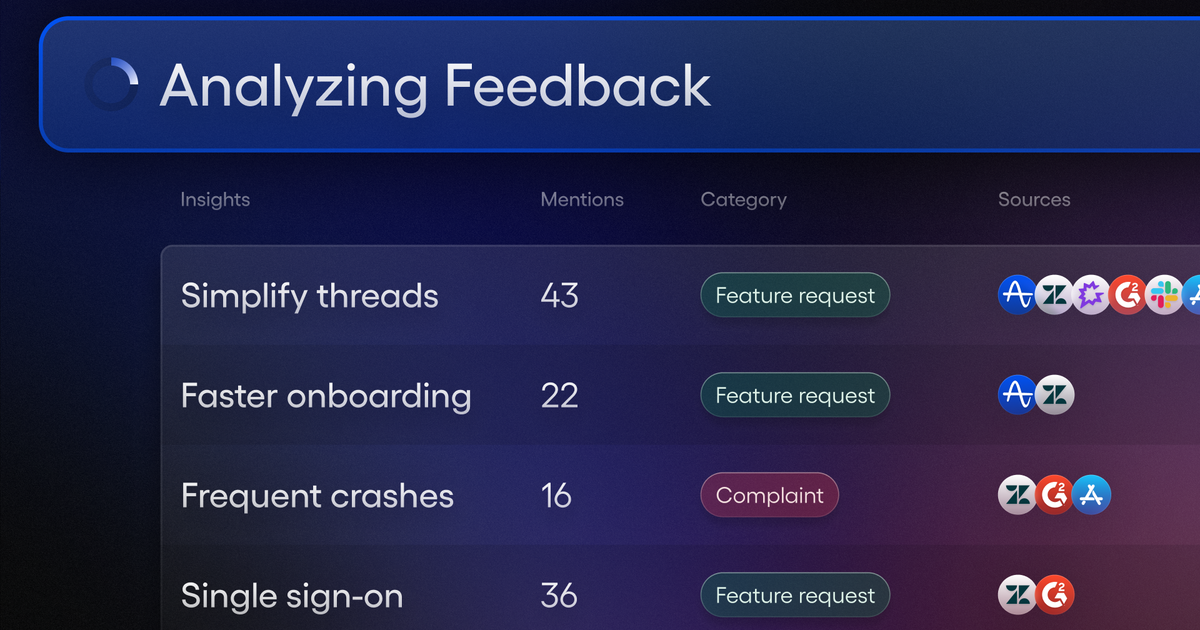
I’ve spent enough time in the trenches of product management to know the hardest part isn’t collecting feedback—it’s separating signal from noise. When every channel is buzzing, the real question becomes: what should we build next, and why? That’s where Amplitude AI Feedback has changed how I work. It gives me a disciplined, data-informed way to turn messy qualitative input into clear, defensible roadmap decisions.
Learn how Amplitude AI Feedback leverages AI to transform massive volumes of customer feedback into actionable product insights.
In practice, this means I can synthesize input from support tickets, NPS responses, user interviews, sales notes, and reviews—then connect those insights to product behavior data from Amplitude analytics. The result isn’t just a list of requests; it’s a ranked problem set grounded in evidence, which makes product discovery and continuous discovery faster, clearer, and less biased.
A recent example: we were hearing recurring complaints about onboarding friction, but it wasn’t obvious which steps truly mattered. By pairing feedback themes with activation and retention signals, I could zero in on the first-session setup tasks that correlated with drop-off. That clarity guided product roadmapping and sprint planning decisions we could stand behind, and it accelerated user activation without bloating the backlog.
My workflow is straightforward: aggregate feedback, cluster themes, validate with behavioral metrics, and translate insight into outcomes. I look for patterns tied to user activation, retention analysis, and moments that drive product-led growth. When the evidence shows a request is both frequent and high-impact, it earns a place on the roadmap; when it’s loud but low-impact, it becomes a targeted experiment rather than a default commitment.
What I appreciate most is the confidence this brings to stakeholder conversations. Instead of debating opinions, we review the evidence: quantified themes, clear user stories, and measurable KPIs. That turns “Finally, Signal That Tells You What to Build” from a slogan into an operating principle, and it helps empowered product teams move faster with fewer reversals.
If you’re building your AI Strategy or exploring LLMs for product managers, this is one of the highest-leverage moves you can make: use a unified analytics platform to connect qualitative feedback with quantitative behavior. It sharpens prioritization, improves time-to-learning, and keeps the team focused on outcomes—not outputs.
Inspired by this post on Amplitude – Best Practices.
Your acquisition dashboard can look healthy while retained usage stays stubbornly flat. If onboarding completions rise but customers do not return, the team may have optimized a checkpoint rather than a value-producing behavior.
The fix is not simply to run more tests. You need a connected operating system: define activation as a testable hypothesis, verify that it predicts retention, instrument the journey, and use controlled experiments to remove the friction that matters. That turns three separate growth activities into one learning loop.
Treat activation as a retention hypothesis
Activation is not the moment a customer finishes your onboarding flow. It is the specific, observable behavior that you believe signals meaningful product value and predicts longer-term use.
That distinction matters because product teams can make almost any shallow milestone improve. A progress bar can increase profile completion. A product tour can increase feature exposure. A shorter form can increase setup completion. None of those changes proves that customers reached a reason to return.
A usable activation definition needs six parts:
Unit: Decide whether you are measuring a person, workspace, account, or organization. In a collaborative B2B product, one person completing setup may not mean the account is active.
Behavior: Name the customer action that represents value, such as connecting a live data source, inviting a teammate, sending a first campaign, or completing an initial automation.
Threshold: State whether one occurrence is sufficient or whether the behavior must reach a minimum frequency, depth, or breadth.
Window: Set the period in which the behavior must happen. For example, an activation definition might require the event to occur within seven days of signup.
Downstream test: Name the later retained behavior that activation is expected to predict. Without this, activation is just another funnel conversion.
Eligibility: Document who belongs in the denominator and which test accounts, internal users, unsupported plans, or incomplete signups are excluded.
Write the definition as one sentence that another analyst could implement without asking what you meant. An illustrative version is: An eligible new account activates when it connects a live data source and completes its first automation within seven days of signup.
Then challenge every word. Why is the account the unit? Does a connected source contain live data or merely credentials? Does an automation have to run successfully? Why is seven days the relevant window? What recurring behavior should appear later if this event genuinely represents value?
Do not force one global definition across unrelated jobs. A marketer building a campaign and an administrator configuring a workspace may follow different paths to value. Use persona- or use-case-specific definitions when the underlying value differs, then make any aggregate reporting transparent about how those segments are combined.
My rule is simple: activation earns attention as a growth outcome only after it shows a credible relationship with retained use. Until then, it remains a hypothesis.
Prove that activation separates retained customers
You need three measurements to understand activation properly. A single conversion percentage hides whether customers are moving faster and whether the milestone has any relationship with future behavior.
Metric
How to define it
Decision it supports
Activation rate
Eligible new units that meet the full activation definition divided by all eligible new units in the cohort
How many customers reach the proposed value threshold?
Time to activation
Elapsed time from the agreed starting event to completion of the activation threshold
Where can the team shorten the path to value?
Early retention
Share of a signup cohort that repeats a meaningful value behavior at the selected retention horizon
Does activation predict a reason to return?
Activation rate tells you reach. Time to activation tells you speed. Cohort-based retention analysis tells you whether the proposed activation event deserves to matter.
Start with customers from the same signup period and split them into activated and non-activated groups. Compare their subsequent retention using the same retained action and horizon. Then repeat the comparison for the properties most likely to change the journey: role, plan, acquisition channel, use case, and onboarding path.
Read the result as a diagnostic, not as automatic proof:
If activated customers remain more likely to perform the retained behavior, you may have a useful leading indicator.
If the groups separate briefly and then converge, the event may represent early momentum without durable value.
If the groups barely separate, revisit the activation behavior, threshold, window, retention horizon, and instrumentation.
If only one persona shows a meaningful separation, a global activation definition may be concealing distinct value paths.
If activation predicts generic logins but not repetition of the core value behavior, your retention metric is probably too shallow.
Choose the retention horizon from the product’s natural cadence. A retained action should represent value expected at that stage of the customer lifecycle, not whichever interval happens to be the dashboard default. Returning to a daily workflow, completing a recurring business process, and renewing a periodic task are different behaviors and should not be flattened into an unqualified return visit.
Keep one important limitation visible: customers with high intent may be more likely both to activate and to remain. That makes the relationship correlational. To build a stronger causal case, run a randomized intervention that helps eligible customers reach activation, then inspect downstream retention as well as the immediate funnel result. The broader measurement discipline is to use experiments, holdouts, and incrementality when a decision requires more than correlation.
Version the activation definition rather than editing it silently. A change to the behavior, threshold, window, unit, or eligibility rules breaks comparability with earlier cohorts. Record the effective date and preserve the old definition long enough to understand the discontinuity.
Instrument the journey before optimizing it
An activation debate often turns out to be an instrumentation debate. One dashboard counts people, another counts accounts, a third includes internal traffic, and lifecycle messaging uses a separate rule again. No experiment can settle a question when the underlying outcome changes between systems.
Map the journey into the smallest useful sequence of discrete events:
Eligibility begins, such as account creation or entry into a supported plan.
The customer starts the setup or value journey.
Required prerequisites are completed.
The first meaningful value action succeeds.
The full activation threshold is met.
The customer repeats the retained value behavior at the chosen horizon.
Do not add events merely because a screen exists. Each event should answer a decision question: where customers stop, how long a step takes, which path they choose, or whether the promised outcome occurred.
Attach properties that explain meaningful variation. Role, plan, channel, and use case are useful when they change eligibility, intent, product access, or the path to value. Onboarding path and experiment assignment are essential when you need to connect an intervention to its outcome.
Before trusting a funnel, validate the tracking end to end with a known test account. Check the following:
Does the event fire only after the action succeeds, or does a click count even when the operation fails?
Can retries, refreshes, or background jobs produce duplicates?
Are anonymous sessions joined to the correct identified user and account?
Does the event timestamp represent the customer action or delayed processing?
Are mutable properties, such as plan or role, interpreted at event time or at query time?
Are employees, automated tests, demonstrations, and deleted accounts handled consistently?
Does the analytics count reconcile with the product’s operational record for the same eligibility rules and period?
If your analytics platform supports computed cohorts or derived metrics, calculate activation from its component events instead of firing a separate activation event with independent logic. That keeps the definition inspectable. If a separate event is necessary for downstream messaging, test it against the computed definition and alert on divergence.
Create a short metric contract containing the metric owner, unit, eligibility rules, event sequence, threshold, window, identity logic, exclusions, retained action, and current definition version. Product, engineering, data, marketing, and customer success should use that same contract.
Apply privacy-by-design to the properties you collect. Every attribute should have a defined purpose, access boundary, and retention policy. Collecting more segmentation data than you can govern creates risk without making the experiment more valid.
Run experiments as decisions, not releases
Once the baseline is trustworthy, diagnose the bottleneck before choosing a treatment. A low activation rate is an outcome, not a diagnosis.
If eligible customers never start, inspect wayfinding, permissions, value proposition clarity, and whether the next action is visible.
If they start but do not complete setup, inspect unnecessary fields, unclear requirements, external dependencies, errors, and handoffs.
If they complete setup but do not perform the value action, setup may be disconnected from the job they came to do.
If they activate but do not retain, reducing onboarding friction alone is unlikely to solve the underlying value or product-quality problem.
If one segment succeeds while another stalls, target the treatment instead of averaging away the difference.
Turn that diagnosis into an experiment card before implementation. Include:
Observation: The precise funnel step, segment, and behavior that indicate a problem.
Hypothesis: The mechanism you believe prevents customers from progressing.
Audience and unit: Who is eligible and whether randomization occurs by user, account, or another unit.
Treatment: The smallest meaningful product or lifecycle change that tests the mechanism.
Primary outcome: Activation rate or time to activation, defined by the metric contract.
Retention validation: The later behavior and horizon that determine whether the gain is durable.
Guardrails: Product-specific measures for errors, quality, unwanted actions, support burden, or other important tradeoffs.
Set the minimum detectable effect to match your traffic reality. If the available population cannot distinguish the effect that would change your decision, do not hide that limitation behind a busy experiment calendar. Test a more consequential change, collect observations for longer under a valid plan, or use discovery methods to improve the hypothesis before spending engineering time.
Pre-register the outcome and decision rules. Under a fixed-horizon design, honor the planned analysis point. If the team needs continuous monitoring, use an appropriate sequential method rather than repeatedly checking an ordinary test and stopping when the result looks favorable. Mature experimentation standardizes minimum detectable effect, pre-registration, guardrails, and valid sequential testing instead of improvising them for each launch.
Good activation treatments usually test one of four mechanisms:
Remove work: Eliminate unnecessary fields or steps, detect configuration automatically, pre-populate safe defaults, or defer nonessential setup.
Clarify the next action: Use progressive disclosure, a checklist tied to the activation behavior, or contextual guidance at the point of uncertainty.
Make success observable: Confirm that the value action worked and show the customer what changed as a result.
Reinforce the same path: Align lifecycle email, in-product messaging, and customer-success outreach around the next value-producing action rather than sending competing prompts.
Do not call an experiment successful just because activation rises. Interpret the immediate and downstream outcomes together:
Activation improves and retention improves: The treatment is a candidate to ship, subject to uncertainty and guardrails.
Activation improves but retention is not mature: Treat the result as provisional until the planned retention window closes.
Activation improves but retention declines: Do not ship on the leading metric alone. The treatment may be pushing low-quality completion or weakening customer understanding.
Activation is unchanged but time to activation falls: Decide whether the speed improvement creates enough customer or operating value to justify the change.
Neither metric moves: Check exposure, instrumentation, statistical sensitivity, and the assumed mechanism before declaring the entire opportunity unimportant.
AI can help analysts and product managers identify anomalies, generate segment cuts, draft hypotheses, and prepare stakeholder updates. It should not silently redefine a cohort, choose a winner, or alter a stopping rule. Require every AI-assisted conclusion to expose its underlying query, cohort definition, experiment version, assumptions, and data lineage. That keeps faster analysis from becoming faster confusion.
Build an operating cadence around durable value
Activation work weakens when it belongs only to the onboarding team. Product and design shape the path. Engineering and data establish trustworthy signals. Marketing sets expectations before signup. Lifecycle messaging and customer success influence what happens after it. All of them can improve a local metric while pulling the customer in different directions.
Use one scorecard and a recurring review with a stable agenda:
Trust: Review tracking changes, identity problems, definition versions, and unusual movements before discussing performance.
Behavior: Examine activation rate, time to activation, and retention by signup cohort and priority segment.
Experiments: Review exposure, planned decision points, guardrails, and whether retention evidence has matured.
Discovery: Add customer feedback, support patterns, and observed journey friction that could explain the quantitative result.
Decisions: Record what will ship, stop, continue, or be investigated, along with the evidence and owner.
Keep the backlog organized by journey bottleneck and mechanism, not by a loose collection of interface ideas. A proposed tooltip, automated default, email, and setup redesign may all test the same uncertainty. Seeing that relationship helps you choose the least expensive intervention that can produce a decisive learning.
Frame the objective around customer behavior: help more eligible new accounts reach recurring value sooner. Activation rate and time to activation are leading outcomes; retained use is the validation. This is more useful than output commitments such as launching a tour, shipping a checklist, or running a fixed number of tests. The discipline is to align product work with outcomes rather than output.
Once the event stream and eligibility logic are reliable, you can close the loop in near real time. A stalled prerequisite can trigger contextual help. A successfully completed value action can prompt the next relevant behavior. A customer who already activated should exit introductory messaging. Measure each intervention as part of the same system, and preserve consent, frequency controls, and clear ownership before automating it.
Key takeaways
Define activation with an explicit unit, behavior, threshold, time window, eligibility rule, and downstream retention test.
Compare activated and non-activated customers from the same signup cohorts before treating activation as a reliable leading indicator.
Measure activation rate, time to activation, and early retention together; each answers a different product question.
Validate the full event journey and publish a versioned metric contract before using the data for experiments or automated messaging.
Set the minimum detectable effect, stopping rule, retention horizon, and guardrails before an A/B test begins.
Do not ship a short-term activation lift that weakens retained behavior, product quality, or another material guardrail.
Start this week with one persona and one signup cohort. Write the activation definition in a single implementable sentence, validate its component events with a known account, and compare later retained behavior for customers who did and did not activate. If the definition survives that test, queue one experiment against the largest observed bottleneck. That is enough to replace disconnected growth activity with a system that learns.
If product managers still open analyst tickets for routine funnel, activation, and retention questions, your analytics transformation has not reached self-service. Buying licenses and publishing dashboards may increase access, but access is not the same as decision autonomy.
You are not trying to turn every product manager into an analyst. You are creating a governed path from question to evidence to decision, while preserving analyst time for problems that require deeper investigation. That takes a shared measurement layer, curated entry points, clear ownership, and operating rituals that make data part of product work.
Start with the bottleneck, not the analytics platform
A self-service analytics transformation should begin with the service your teams experience today. Pick a common product question, such as which users complete activation, where a critical journey loses customers, or which cohorts retain. Ask a product manager to answer it from a standing start, then observe every dependency between the question and a decision.
Look for five distinct sources of friction:
Discovery friction: the product manager cannot find the relevant event, metric, or approved dashboard.
Definition friction: two reports use the same metric name but calculate it differently.
Construction friction: the data exists, but answering the question requires an analyst to build or join the view.
Trust friction: the product manager can create a chart but still needs someone to confirm that it is correct.
Decision friction: the chart answers what happened but does not connect the behavior to a product choice.
This diagnostic separates a tooling problem from a measurement or operating-model problem. Consolidating scattered tools into a unified analytics platform can reduce search and construction friction. It will not resolve inconsistent definitions, unclear ownership, or a culture in which every decision still needs analyst approval.
Establish a baseline before changing the stack. Track the elapsed time from a clearly stated question to decision-ready evidence, the mix of routine and investigative analyst requests, the frequency of conflicting metric definitions, and the product decisions that cite behavioral evidence. Avoid choosing a universal benchmark that your context cannot support. Measure your current state, separate question types, and set improvement targets from that baseline.
The intended end state is narrow enough to test. A product manager should be able to examine activation, funnel drop-off, and cohort retention without joining a reporting queue. An engineer should be able to see the behavioral signal after a release. An analyst should spend less time reproducing standard views and more time on questions whose ambiguity or complexity merits specialist work. When evidence is visible to the people making the decision, discovery and delivery can share the same facts.
Build a governed measurement layer before expanding access
Giving more people permission to query inconsistent data produces faster inconsistency. Self-service becomes trustworthy only when teams share a stable vocabulary for customer behavior and business outcomes.
Treat that vocabulary as a product. Events describe observable behavior; metrics encode an interpretation of that behavior. The distinction matters. A signup event may have a precise trigger, but an activation metric still needs a qualifying action, an eligible population, a time window, and explicit exclusions. If those choices live only inside one dashboard, the dashboard is carrying business logic that other teams cannot reliably reuse.
Use a standard instrumentation workflow for every new event or property:
Start with the decision. Record the question the team needs to answer and the action that could change because of the result.
Define the behavior. Specify the event trigger, required properties, allowed values, exclusions, and the naming convention it follows.
Assign accountability. Name the owner, identify the affected product flow, and record privacy and access requirements.
Implement consistently. Use the same instrumentation pattern and carry the change through the normal CI/CD path instead of relying on an undocumented one-off.
Validate before release. Compare the emitted payload with the tracking contract and check that required properties arrive with expected values.
Publish for reuse. Add the definition to the catalog and expose it through the appropriate curated report, rather than leaving users to discover raw events by trial and error.
This is the practical value of treating data requests like product requests: a team can ask for an event or property with a defined purpose, owner, and privacy classification, while a repeatable path takes it from instrumentation through CI/CD, documentation, and curated analytics.
Your catalog entry should answer the questions a future user will otherwise send to an analyst:
What behavior does this event represent, and what does it not represent?
Exactly when does it fire?
Which properties are required, and what do their values mean?
Which users, accounts, environments, or internal activities are excluded?
Who owns the definition and approves a semantic change?
What privacy classification and role-based access rules apply?
Which approved metrics and dashboards depend on it?
Is it active, deprecated, or scheduled for replacement?
Choose a naming convention that reveals intent, such as an object plus a past-tense action, and apply it consistently. The exact grammar matters less than eliminating synonymous events and ambiguous labels. Do not silently rename or repurpose an event after teams have built reports on it. Deprecate it explicitly, identify the replacement, and update dependent views so a semantic change does not masquerade as a change in customer behavior.
Governance should make the safe path easier, not turn every question into an approval request. Standard definitions, privacy-by-design, role-based access, named owners, and clearly labeled dashboards are the guardrails. Product teams should remain free to explore within them. That balance preserves both speed and trust.
Give non-technical teams a curated front door
A blank analytics canvas is not a self-service experience. It transfers the construction work to users without giving them the context needed to interpret the result. Start with a small set of approved views that answer recurring product questions, then let experienced users branch into deeper exploration.
For one critical product flow, publish three discoverable dashboards:
An activation dashboard that shows the eligible population, qualifying behavior, and relevant segments.
A journey dashboard that exposes conversion between meaningful steps and makes drop-off visible.
A retention dashboard that uses a documented cohort definition and return behavior.
Three well-governed dashboards are more useful than a large library nobody can navigate. Each one should state the question it answers, intended audience, metric definitions, default filters, exclusions, owner, and review status. If a chart is exploratory rather than authoritative, label it accordingly. Users should not have to infer whether they are looking at a decision-grade view or a working draft.
Build enablement around real decisions. Generic feature training teaches people where buttons live; it does not teach them which metric to trust. Use a current product question to show how to select a cohort, inspect a funnel, compare segments, and move from an observed pattern to the next investigation. Targeted onboarding, in-app guidance, and product tours can reinforce that path when users return to the platform.
Then hold a weekly readout for the teams using the flow. Ask what they learned, which decision changed, where a definition was unclear, and which missing property blocked the analysis. Starting with one end-to-end flow, three core dashboards, and weekly decision readouts gives you a controlled environment in which to repair the system before scaling it.
Watch the first few self-service attempts closely. If users repeatedly choose the wrong event, improve the label and catalog entry. If they can build a chart but cannot explain the denominator, curate the metric rather than adding more training. If sensitive properties are broadly visible, fix access design before inviting more users. Friction observed during onboarding is product feedback about the analytics experience.
Change ownership, decision rituals, and success measures
Self-service changes the division of work; it does not eliminate analysts or central governance. Product trios should define measurement needs while they shape a solution, not after engineering has finished it. The data function should own reusable semantics and quality mechanisms. Leaders should make evidence part of routine decisions instead of treating analytics as a separate reporting activity.
A workable ownership split looks like this:
Role
Primary ownership
Boundary
Product trio
Decision question, hypothesis, measurement plan, interpretation, and product action
Does not redefine shared metrics inside a local dashboard
Data and analytics
Event taxonomy, reusable metric definitions, validation patterns, and deeper investigation
Does not become the required builder for every routine chart
Engineering
Accurate instrumentation, implementation consistency, and release validation
Does not decide business meaning without product and data input
Platform and governance owners
Access, privacy controls, catalog standards, dashboard hygiene, and lifecycle management
Does not approve every permitted exploration
Product leaders
Decision rituals, outcome accountability, and protection of specialist capacity
Does not reward unsupported numbers simply because they arrive quickly
Carry measurement through the entire product lifecycle. During discovery, write the expected behavior and the evidence that would change the team’s view. During delivery, make instrumentation part of acceptance criteria. After release, inspect the same agreed signals instead of inventing success measures retrospectively. Before an A/B test, state the hypothesis and justify the minimum detectable effect so the team understands what result the experiment is designed to detect.
The weekly decision ritual can remain simple:
What product question did you answer?
Which governed event, metric, cohort, or dashboard supported the answer?
What decision changed, or what new uncertainty must be resolved?
What defect in instrumentation, definition, access, or documentation slowed you down?
This keeps dashboards connected to action and creates a visible backlog for the analytics product itself. It also prevents login counts from becoming the transformation’s main success measure. A person can log in frequently without reaching a trustworthy conclusion.
Measure the operating change instead:
Time from question to decision-ready evidence, segmented by question type.
Routine questions resolved by the product team without an analyst handoff.
Analyst capacity spent on recurring report construction versus deeper investigation.
Critical events and metrics with complete definitions, owners, and privacy classifications.
Duplicate dashboards, conflicting definitions, validation failures, and data-quality incidents.
Discovery, experiment, and post-release decisions that reference governed behavioral evidence.
Read these signals together. If platform usage rises but routine tickets remain unchanged, access improved while autonomy did not. If self-service rises while definition disputes and quality incidents increase, governance is lagging adoption. If tickets fall but teams cannot name decisions informed by data, people may have stopped asking rather than become self-sufficient.
Do not remove analyst support merely to make the ticket count look better. The intended shift is from repetitive construction to higher-leverage work: investigating ambiguous patterns, improving measurement quality, supporting sound experiment design, and helping teams interpret questions that exceed the safe limits of a standard dashboard.
Key takeaways
Define self-service as the ability to reach trustworthy, decision-ready evidence without a routine analyst handoff, not as access to an analytics tool.
Standardize event definitions, properties, ownership, privacy requirements, validation, and documentation before expanding access.
Begin with one critical flow and three curated views: activation, journey conversion, and retention.
Teach analytics through live product questions and reinforce it with weekly decision readouts.
Measure time-to-insight, ticket mix, governed coverage, quality failures, and decisions changed; logins alone cannot show autonomy.
Scale only after teams can move faster without creating conflicting metrics, unsafe access, or hidden analyst dependencies.
Choose one critical flow in your next planning cycle. Baseline its current question-to-decision path, define the tracking contract, publish the three governed views, and schedule the first weekly readout. Let that flow prove the operating model before you broaden the rollout. Self-service scales when each new team inherits a trusted path, not another blank workspace.
I recently revisited a topic I once pushed back on: using AI to analyze (and maybe even synthesize) customer interviews. After six months of real-world experiments and countless conversations with seasoned product leaders, I’ve evolved my perspective. There is meaningful value here—but only when we’re clear about where AI helps and where it quietly erodes the hard-won customer understanding that powers great product decisions.
If you want to experience the conversation that sparked this reflection, you can listen to the episode on Spotify or Apple Podcast, and watch the discussion here: YouTube. It’s a candid, practical exploration of AI’s role in continuous discovery, and it mirrors what I’m seeing on the ground with product trios and empowered product teams.
Here’s the crux: AI raises the floor for beginners but accelerates experts even more. That matches my experience—early-career PMs get structure, momentum, and a confidence boost, while experienced interviewers can move faster without sacrificing nuance. But there’s a catch. If your interviewing skills aren’t solid yet, AI can create a veneer of insight that masks shallow understanding. In other words, it can help you go wrong more efficiently.
The conversation makes an important distinction between analysis and synthesis. Analysis is about extracting signals from the interview. Synthesis is about building meaning—connecting patterns, weighing contradictions, and deciding what to do next. AI can speed up the former with summaries and highlights. The latter—true synthesis—still demands expert judgment, context, and empathy.
One line from the episode stuck with me: your unpolished interview skills matter more than any shiny new AI workflow. I’ve felt that firsthand. When interview quality is uneven, dropping transcripts into an LLM won’t save you. You still need to synthesize every interview individually so the signals remain traceable and credible. That discipline keeps teams aligned, prevents overfitting to noise, and builds the organizational memory that fuels better bets.
We also explored the operational reality most teams face: interviews pile up. Backlogs grow. Leaders want speed. This is where “expert + AI” shines. With the right prompts, templates, and context, tools like ChatGPT and Claude can help transform raw transcripts into structured artifacts you can trust—provided a strong interviewer sets the frame and makes the calls. That balance preserves both velocity and quality.
What changed my mind most was the evidence from experiments—running sets of interviews through different LLMs and comparing outcomes. The patterns were consistent: beginner + AI is usually better than nothing, but the real performance gains come from expert + AI. When experts guide the process, AI becomes an accelerant rather than a crutch.
A favorite story in the episode takes a detour into building a gaming PC—an unexpected but perfect metaphor for AI’s limits. You can get great step-by-step guidance from a model, but when context shifts or edge cases appear, expertise is what keeps you from making expensive mistakes. Customer interviews are like that. Empathy comes from human interaction; AI can’t replace the experience of talking directly to your customers.
My practical guidance for teams integrating AI into continuous discovery: start with interviewing fundamentals, separate analysis from synthesis, and standardize how you capture single-interview learnings. If you need a tight template for this, refer to “The Interview Snapshot: How to Synthesize and Share What You Learned from a Single Customer Interview.” Use AI for summaries, clustering, and draft artifacts—but have an expert finalize the narratives, evaluate trade-offs, and document assumptions.
If you’re scaling this across an organization, invest in training first, then in workflows. Build a lightweight operating system for discovery: consistent interview guides, “story-based” techniques, and a shared library of prompts. Consider resources like “The Interview Coach,” as well as practical write-ups such as “Customer Interview Analysis: Where AI Helps and Hurts.” These help teams avoid common pitfalls and make better use of AI in high-judgment moments.
My bottom line: AI isn’t magic. It can help, but only if your interviews are strong and you provide the right context. Customer understanding is a competitive moat; outsourcing it entirely will cost you in the long run. Use AI to accelerate—not replace—the human judgment that makes product discovery work.
Resources and links worth exploring: ChatGPT, Claude, The Interview Snapshot: How to Synthesize and Share What You Learned from a Single Customer Interview, The Interview Coach, and Customer Interview Analysis: Where AI Helps and Hurts.
I’d love to hear how your team is using AI in discovery. What’s working, what’s risky, and where do you draw the line between automation and judgment? Share your experiences in the comments—our community learns faster when we compare notes.
When I push our organization to adopt the product operating model, I’m emphasizing a foundational shift—from “shipping roadmaps of features (output)” to solving real customer and business problems, measured by “business results (outcomes)”. That’s the difference between activity and impact, and it’s the only way to build durable value at scale.
This change inevitably reaches beyond the product organization. It reshapes how company stakeholders in Sales, Marketing, Customer Success, Finance, Legal, Security, and Operations engage with product teams, and it reframes what they expect from us. Instead of asking, “When will feature X ship?” they learn to ask, “How will we move the outcome that matters?”
In practice, the product operating model is a contract: product teams commit to outcomes, and stakeholders commit to partnership. That partnership means we co-own the problem, align on evidence, and share accountability for results. The reward is clarity—everyone sees how their work ladders to strategy and why the sequence of work makes sense.
Here’s how I align stakeholders around this model. First, I ground everything in outcomes vs output OKRs. We replace feature roadmaps with a clear strategy, prioritized problems, and measurable objectives. Our product roadmapping and sprint planning then serve the objectives—not the other way around—so capacity is allocated to the highest-leverage bets.
Second, I build empowered product teams around product trios (product, design, engineering). We practice continuous discovery with stakeholders: we share opportunity trees, test riskiest assumptions early, and bring partners into research when it informs go-to-market strategy, pricing, or enablement. This keeps us honest and avoids late-stage surprises.
Third, I establish operating rhythms that make outcomes visible. Monthly stakeholder reviews focus on progress toward objectives and what we’re learning—not status theater. Quarterly, we connect OKRs to business performance so leaders can see the throughline from discovery and delivery to pipeline, retention, or margin. If priorities shift, we renegotiate objectives explicitly.
Fourth, I define metrics that stakeholders trust. We use a balanced set of leading indicators (activation, engagement, cycle time) and lagging indicators (revenue, retention, unit economics). We socialize definitions early so no one debates the scoreboard mid-game. The result: faster decisions and less “data whiplash.”
Fifth, I invest in change management. Moving from outputs to outcomes can feel threatening if your success has historically been measured by launch volume or roadmap commitments. I address this head-on with training, transparent comms, and clear decision rights. The message is simple: outcomes create more autonomy for empowered product teams and more predictability for stakeholders.
At HighLevel, this approach has been especially powerful when cross-functional dependencies are high. For example, when we set an objective to improve user activation for a new CRM integration, we didn’t promise a bundle of features. We committed to a measurable lift in activation and a shorter time-to-value, co-owned with Customer Success and Marketing. That alignment unlocked smarter experiments, tighter enablement, and a more credible launch narrative.
The anti-patterns are predictable: treating OKRs as a renaming of the roadmap, equating discovery with indecision, or isolating product decisions from go-to-market strategy. The cure is equally consistent: bring stakeholders into discovery, attach every bet to an objective, and show progress with evidence—not just demos.
Ultimately, the product operating model is a leadership choice. It asks us to trade certainty theater for learning velocity, and feature checklists for business impact. When stakeholders see that shift pay off—in faster cycles, clearer priorities, and results that matter—support for the model moves from compliance to conviction.
In my role leading product teams, the AI product roadmap isn’t just a plan—it’s the operating system for how we discover value, prioritize with rigor, and ship with confidence. The pace has changed, the stakes are higher, and the best product managers are now orchestrating AI capabilities, data, and customer insight in near-real time.
Master the evolving art of the AI product roadmap. Prioritize smarter, turn data into direction and insight into action, only much faster.
When I say “AI product roadmap,” I’m talking about a living system that blends strategy, discovery, and delivery. It’s less about dates and more about outcomes, risk reduction, and sequencing learning. In practice, that means combining AI Strategy with product roadmapping and sprint planning, then validating each bet with real customer signals.
For prioritization, I anchor on outcomes vs output OKRs and connect them to measurable signals across the funnel. Continuous discovery keeps insights flowing, while a unified approach to analytics and retention analysis tells me where the lift is. This lets me rank initiatives not just by impact and effort, but by how quickly we can learn, iterate, and compound value.
On discovery, product trios are non-negotiable. We prototype early with gen ai and LLMs for product managers to accelerate concept validation and reduce ambiguity. When customers can co-create through in-app guides or lightweight product tours, we turn vague needs into crisp problem statements and testable hypotheses far faster.
On delivery, I pair tight feedback loops with experimentation. A deliberate cadence of A/B testing and strong instrumentation ensures we’re learning every sprint, not just launching. The goal is to de-risk decisions quickly, keep momentum high, and translate signals into roadmap movement without thrash.
Under the hood, the AI stack matters. I rely on a retrieval-first pipeline to ground models in trusted data, and I’m intentional about privacy-by-design and data governance from day one. As agentic AI patterns emerge, I put evaluation workflows in place so we can ship confidently—and safely—without slowing down innovation.
Finally, alignment is the multiplier. Clear narrative roadmaps tied to customer outcomes help stakeholders see trade-offs, while crisp interfaces with go-to-market and CRM integration close the loop from roadmap to revenue. When everyone can trace a line from AI strategy to shipped value, prioritization becomes easier and trust grows.
If you’re feeling the acceleration, you’re not alone. With the right AI product toolbox—rooted in discovery, grounded in data, and delivered through tight feedback loops—you can move faster, learn smarter, and build products your customers can’t live without.
By 2026, the AI Product Owner will be the keystone role that turns AI strategy into measurable business outcomes. In my teams, this seat bridges market insight, model capability, data governance, and shipping velocity—so product decisions are not just clever, but compliant, reliable, and fast.
I often describe the remit simply: "Here is your clear guide to the AI product owner role (skills, responsibilities, how it differs from PM) and ways AI tools supercharge delivery." In practice, the AI Product Owner translates business goals into model-backed experiences, aligns cross-functional execution, and ensures the product’s AI behavior remains safe, lawful, and on-brand under real-world constraints.
How does this differ from a traditional PM? While Product Management sets portfolio strategy, positioning, and market narratives, the AI Product Owner owns the AI experience end-to-end—data readiness, evaluation harnesses, safety guardrails, and the iterative model improvements that drive outcomes vs output OKRs. I anchor the role inside empowered product teams and product trios (PM/Design/ML Eng) to keep discovery continuous and delivery disciplined.
On responsibilities, I expect four pillars. First, discovery: continuous discovery with customers and internal experts to uncover use cases where generative AI or LLMs beat the status quo. Second, experience: define the right interaction patterns for AI UX, including retrieval-first pipeline choices, context window management, and feedback loops for human-in-the-loop correction. Third, governance: privacy-by-design, AI risk management, data governance, and regulatory compliance baked into the roadmap. Fourth, delivery: CI/CD for models and prompts, observable evaluation with A/B testing and minimum detectable effect (MDE), and SRE-grade incident management when AI behavior drifts.
Skills-wise, I look for product sense plus technical fluency. That includes LLMs for product managers (prompting, grounding, RAG), analytics mastery (Amplitude analytics, retention analysis, activation metrics), and comfort with DORA metrics and deployment frequency to keep iteration high but safe. Strong stakeholder management and clear writing are non-negotiable—AI capabilities evolve fast, and leaders must see risk, cost, and ROI with no ambiguity.
AI tools truly supercharge delivery when they eliminate bottlenecks. My practical stack: an AI product toolbox with Claude Code and a ChatGPT connector for rapid prototyping; CustomGPT workflows for support triage and internal knowledge; Pendo product tours and in-app guides to validate behavior changes; Intercom for customer support ai strategy; and tight CRM integration via HubSpot to measure revenue impact. The outcome is faster idea-to-learning cycles, sharper telemetry, and far cleaner handoffs.
For roadmapping, I prioritize thin slices that prove value early—shipping narrowly scoped assistants or copilots, then expanding with product roadmapping and sprint planning that ties capability unlocks to outcomes. A unified analytics platform helps compare human-only baselines to augmented workflows, while agentic AI patterns automate routine steps under strict guardrails.
Risk is a product surface, not a side task. I require explicit policy gates (PII handling, red-teaming, bias audits), clear escalation paths, and incident playbooks. When we treat policy and reliability as features, customers reward us with deeper adoption and higher trust.
If you’re pursuing the AI Product Owner path, build a portfolio around shipped learnings: the experiment you killed with data, the safety constraint you designed, the postmortem you led, and the business metric you moved. That story—evidence of disciplined discovery, responsible delivery, and real-world results—is exactly what teams (and boards) want to see in 2026.
Your dashboard says the ticket was resolved. The customer remembers repeating the problem, moving between an AI agent and a teammate, and discovering that company policy still blocked the outcome they wanted. Product, Support, and Operations can all look at the same conversation and reach different conclusions.
If you are considering conversation-based customer experience scoring, the hard part is not asking an AI model for a rating. It is designing a measurement system that distinguishes the experience from its causes, shows people why the score exists, and sends each cause to someone who can change it.
A useful score separates experience from ownership
A customer experience score should answer a narrow question: how well did this interaction work for the customer? It should not silently answer a different question, such as whether the support agent performed well or whether the product team made the right policy decision.
Those questions overlap, but they are not interchangeable. A teammate can give a clear and accurate explanation of an unpopular refund policy. The teammate’s answer quality may be strong while the overall experience remains poor. An AI agent can use a warm tone while giving an incorrect answer. The sentiment may look positive even though the handling failed. A product limitation can make resolution impossible despite excellent support work.
This is why a credible score needs several layers:
Outcome: Was the customer’s request resolved, partially resolved, redirected to a workable next step, or left unresolved?
Answer quality: Were the responses clear, accurate, relevant, and internally consistent? Evaluate AI and human responses separately when both participated.
Customer effort: Did the customer repeat information, survive avoidable handoffs, chase a promised follow-up, or clarify something the company should already have understood?
Emotional context: Did the customer express strong frustration, anger, relief, gratitude, or delight? Treat emotion as context rather than a verdict by itself.
Product or service feedback: Was the customer reacting to a bug, missing capability, reliability problem, delivery failure, confusing design, or service issue?
Policy feedback: Was the real source of dissatisfaction a refund rule, eligibility condition, account limit, return policy, or another business decision?
Score the experience first. Attribute the drivers second. Assign ownership third. Reversing that order creates predictable dysfunction: teams defend their own performance, difficult conversations get excluded, and the metric becomes a political argument instead of a customer signal.
Design the score as a diagnosis, not a black box
Leadership may want one number for a dashboard, but the useful product is the diagnostic record underneath it. If a support leader cannot open a low-scoring conversation and see why it received that result, the number is not ready for coaching, prioritization, or executive reporting.
The minimum record behind each score
For every eligible conversation, preserve these fields:
Overall experience band: A small set of anchored labels is easier to calibrate than a decimal-heavy score that implies unsupported precision.
Eligibility status: Record whether the interaction was scored, excluded under a defined rule, or genuinely lacked enough information.
Outcome status: Resolved, partially resolved, unresolved, or unclear.
Answer-quality results: Separate evaluations for AI and teammate contributions where applicable.
Driver codes: Effort, strong emotion, product or service feedback, policy feedback, and any operational reason codes you have explicitly defined.
Evidence: The specific message or interaction event that supports each driver. A generated explanation without transcript evidence is an assertion, not an explanation.
Plain-language summary: What the customer needed, what happened, and why the experience earned its band.
System metadata: The scoring model, rubric, and schema versions used to produce the record.
I would begin with anchored experience bands rather than pretending the system can distinguish tiny numerical differences. A practical rubric might distinguish a strong experience, an acceptable experience with minor friction, a weak experience with material friction or incomplete resolution, and a poor experience with an unresolved outcome, serious inaccuracy, contradiction, or excessive burden.
The labels matter less than the anchors. Reviewers need observable criteria for each band. Phrases such as good conversation or unhappy customer leave too much room for interpretation. Criteria such as customer repeated the account history after a handoff or answer contradicted an earlier commitment can be checked against the transcript.
Do not let emotion dominate the rubric. A customer may arrive angry because of a product outage and receive excellent assistance. Another may remain polite after receiving a materially wrong answer. Emotion can increase urgency and explain the experience, but it cannot substitute for outcome, accuracy, and effort.
Do not average away disagreement between dimensions either. An acceptable overall score can conceal an inaccurate AI answer that a teammate later repaired. Preserve that AI-quality failure as a driver so the AI product team can add it to an evaluation set even when the customer ultimately gets a resolution.
Make the metric reliable enough for decisions
A score can look stable while measuring a changing subset of conversations. If short threads, low-context requests, escalations, or mixed AI-human interactions are harder to score, improvements in the average may simply reflect which conversations entered the denominator.
Define eligibility before calibration. Spam, automated notifications, internal-only threads, and interactions with no customer request may reasonably sit outside the metric. A short conversation should not be excluded merely because it is short, and a difficult conversation should not be excluded merely because the model is uncertain. Track uncertainty explicitly rather than removing inconvenient cases from view.
Your recurring dashboard should show:
The share of eligible conversations that received a score.
The distribution across experience bands, not just an average.
The mix of positive and negative drivers.
Results split by AI-only, teammate-only, and mixed handling.
Relevant slices such as channel, language, issue type, conversation length, product area, and escalation path.
The active model, rubric, and schema versions.
Calibration should happen against human judgment before the score becomes a target. Use a representative set containing routine resolutions, short exchanges, long investigations, escalations, emotionally charged threads, AI-only conversations, human-only conversations, and AI-to-human handoffs. Have independent reviewers apply the same rubric, examine disagreements, and rewrite any criterion that depends on intuition rather than observable evidence.
Then test the slices separately. Aggregate agreement can hide systematic failure in one language, channel, issue class, or interaction type. The acceptable level of disagreement depends on the decision. A model used to discover recurring workflow friction can tolerate more uncertainty than one used in individual performance management.
Keep the adjudicated examples as a regression set. Re-run them whenever you change the prompt, model, rubric, knowledge architecture, conversation parser, or driver definitions. Review newly common failure patterns as well; a frozen evaluation set eventually stops representing the work.
Model changes require visible reporting boundaries. A more contextual scoring system may produce a one-time shift without a corresponding decline in support quality. Backfill historical conversations with the new version when that is practical. Otherwise, annotate the change on every trend view and establish a new baseline. Never splice two scoring regimes into one continuous line and ask leaders to interpret the movement as operational performance.
Turn low scores into routed work, not dashboard theatre
A low score is only a symptom. The driver determines who should investigate it and what kind of intervention is plausible. Sending every poor experience to the support manager guarantees that product defects, policy choices, and broken workflows will be misclassified as coaching problems.
Primary driver
What to inspect
Primary owner
Default next action
AI answer quality
Inaccuracy, contradiction, irrelevant guidance, or repeated clarification
AI product and knowledge owners
Correct the underlying knowledge or response path, then add the failure to the AI evaluation set
Teammate answer quality
Unclear explanation, incorrect guidance, missed question, or inconsistent commitment
Support lead or enablement owner
Review the conversation against the rubric, then improve coaching, documentation, or access to information
Map the failing transition and remove the avoidable step, ownership gap, or workflow rule
Product or service feedback
Bug, missing capability, confusing design, reliability issue, delivery failure, or service breakdown
Relevant Product, Engineering, or service owner
Cluster related conversations, connect them to the product area, and decide whether the response is a fix, discovery work, or an explicit trade-off
Policy feedback
Refund, return, eligibility, account, usage, or limit rule
Business or operations owner responsible for the policy
Separate unclear communication from disagreement with the policy, then revise the explanation, the policy, or neither – deliberately
Strong negative emotion
The event that triggered the emotion and whether the issue remains unresolved
Triage owner, followed by the owner of the actual cause
Prioritize review where appropriate, but do not treat emotion alone as proof of agent failure
Automation should route the evidence package, not just the score. Include the conversation link, customer request, outcome, overall band, driver codes, supporting messages, scoring version, and proposed owner. That context lets the receiving team judge the issue without rereading an entire thread or trusting an opaque summary.
Use separate operating lanes for individual cases and recurring patterns. A materially incorrect answer may need immediate review. Repeated handoff friction usually needs aggregation so Operations can see the broken transition. Product and policy feedback becomes useful when related conversations are clustered around a shared problem, while still retaining representative examples.
Count affected conversations consistently rather than allowing a verbose customer to create many separate votes within one thread. Preserve the denominator for every filter. A driver that appears frequently in one product area may look dominant in a filtered dashboard while remaining uncommon across the full support mix.
For recurring themes, maintain a problem record with the driver, affected journey, frequency, severity, controllable owner, proposed intervention, status, and comparable post-change cohort. This converts conversation scoring into a product and operations feedback loop. Without that record, the same issue can be rediscovered in every review without anyone becoming accountable for changing it.
After an intervention, compare like with like: the same scoring version, eligibility rules, issue type, and relevant handling path. If the score improves but coverage falls, or the issue mix changes, you do not yet know whether the intervention worked.
Earn the right to replace CSAT
Conversation scoring addresses a real blind spot: survey metrics describe the customers who choose to respond, while a conversation-based system can evaluate a much broader share of eligible support volume. That makes it attractive as a replacement for CSAT, but broader coverage does not automatically make the new metric valid.
Start in shadow mode. Continue the existing reporting while you calibrate the new score, inspect disagreements, and learn which drivers are actionable. Do not demand that the two measures match. They observe different things: one evaluates evidence in the interaction, while the other records a respondent’s self-reported reaction.
Move the conversation score into operational reviews once teams can inspect its reasoning and route its drivers. Move it into executive reporting only after coverage, version changes, and slice-level performance are visible. Consider reducing or retiring a survey only when all of the following are true:
Eligibility and coverage are stable enough that changes in the denominator cannot masquerade as experience improvements.
The rubric has been calibrated against human review, including difficult and ambiguous conversations.
Explanations consistently point to transcript evidence rather than merely producing plausible prose.
Important channels, languages, issue classes, and AI-human handling paths have been checked separately.
Model and rubric changes are versioned, regression-tested, and visibly marked in reporting.
Driver routing produces owned work, and teams can show what they changed because of the signal.
Material disagreements between the conversation score and survey feedback are investigated rather than averaged away.
Keep a higher standard for individual performance decisions. A conversation score can flag work for human QA, but it should not become an automatic employee rating merely because it covers more conversations. Product limitations, customer history, policy constraints, and model error can all affect the result. Use the driver record and human review to establish what the teammate actually controlled.
Key takeaways
Measure the customer’s experience separately from the performance of the AI agent, teammate, product, policy, or workflow that shaped it.
Keep an overall band for scanning, but preserve outcome, answer quality, effort, emotion, feedback drivers, evidence, and version metadata underneath it.
Report coverage and score distribution together; an unexplained denominator change can invalidate the trend.
Calibrate with representative human-reviewed conversations and retest meaningful slices after every scoring change.
Route each driver to the owner who can change it, then measure a comparable cohort after the intervention.
Replace CSAT only after the conversation score has earned trust as both a measurement system and an operating loop.
At your next customer experience review, bring one low-scoring conversation, its evidence-backed driver record, and the owner capable of changing that driver. If the meeting ends with only a debate about whether the number is fair, calibration is unfinished. If it ends with a named intervention and a valid way to examine comparable future conversations, the score is doing useful work.
If your community of practice needs constant reminders, fills its agenda with updates, and produces little that teams use afterward, the problem probably is not motivation. The community was given a meeting cadence before it was given a job.
Your job as a product leader is to create a repeatable path from a live problem to a better decision, a stronger practice, and knowledge another team can reuse. That is how you design continuous learning as a system instead of hoping it emerges from another recurring call.
Give the community a practice to improve, not a topic to discuss
A broad subject can attract interest without changing anyone’s work. Product strategy, discovery, AI, leadership, and experimentation are all reasonable areas of interest, but each is too large to serve as an operating purpose.
Start with a practice that members perform and can inspect. Opportunity framing is a practice. Writing an AI evaluation plan is a practice. Preparing an experiment decision is a practice. Stakeholder management is still too broad until you identify the behavior you want to improve, such as exposing trade-offs before a roadmap commitment is made.
A useful purpose statement has four parts:
Members: Who needs to learn together?
Practice: What recurring part of their work should get better?
Learning activity: What will they examine, attempt, or critique together?
Work consequence: What should change in a decision, artifact, or team behavior?
For example: This community helps product trios improve opportunity framing by critiquing active discovery artifacts, so teams can separate evidence from assumptions before choosing a solution.
That statement is narrow enough to guide an agenda. It tells members what to bring, tells a facilitator what kind of discussion belongs, and gives a sponsor something more meaningful to inspect than attendance.
Choose a quarterly learning theme with these filters:
Members are encountering the problem in current work, not merely expressing general interest in it.
The practice is shared enough that one person’s case can teach something useful to others.
A real artifact can make the practice visible. That might be an opportunity map, discovery plan, evaluation set, experiment brief, decision record, or stakeholder narrative.
Improvement can be noticed in later work. You should be able to point to a changed question, assumption, method, trade-off, or decision.
The theme is narrow enough to defer adjacent subjects. A community without boundaries becomes an internal conference with no coherent learning loop.
Write those choices into a short charter. Include the theme, target practice, current definition of good, artifact members will examine, evidence of progress, and what is out of scope. Treat the definition of good as a starting hypothesis. Learning can reveal a stronger standard after the work begins; the charter should be stable enough to focus the community but not so rigid that it prevents that discovery.
Combine learning from people with learning with people
A community needs external input and collaborative practice. Input without practice becomes content consumption. Collaboration without input can recycle the same local assumptions. Design both modes deliberately.
Learning mode
Use it when you need
Useful inputs
Expected output
Learning from people
Depth, a reference point, or a clearer definition of good
A tightly curated personal learning network, talks, books, courses, examples, and practitioners whose decisions you can examine
A heuristic, annotated example, sharper question, or alternative approach to test
Learning with people
Feedback, accountability, new patterns, or pressure-testing
Peer circles, artifact critiques, hackathons, meetups, and cross-functional working sessions
A revised artifact, changed decision, new experiment, or reusable lesson
The bridge between the two modes matters more than the volume of material consumed. Begin with a live question from the work. Curate external input that can sharpen that question. Bring the work artifact to peers. Critique its assumptions and trade-offs. Record what changed. Store the lesson where the next person facing the problem can retrieve it.
For an AI product community, the live question might concern an evaluation plan for a support agent. External examples can help the group notice missing failure cases, but reading alone does not improve the plan. Members need to inspect the proposed evaluation set, challenge what it represents, identify gaps, and document the resulting change. The work becomes the learning surface.
Track the network as working infrastructure. For each person or resource, note the practice you are learning, the artifact or decision that demonstrates it, the question it helps answer, and the action you intend to try. Prune the list when the theme changes or an input repeatedly fails to affect your thinking. The goal is not to follow everyone worth knowing. It is to make the right expertise retrievable when a decision needs it.
Build a cadence that ends in changed work and reusable artifacts
A community meeting is only one step in the learning loop. If the loop begins with an agenda and ends when the call finishes, members may enjoy the conversation while the organization loses most of its value.
A lightweight operating model can fit alongside product delivery:
Set a quarterly theme. Tie it to a practice teams currently need to improve.
Curate a small learning network. Gather examples and perspectives that challenge the community’s current standard.
Run monthly critiques. Use current work from product, design, and engineering rather than hypothetical exercises.
Publish one teaching artifact. Turn the strongest learning into a talk, guide, workshop, template, annotated example, or decision pattern.
Close the loop. Write down what changed in a decision, discovery cadence, product bet, or working method.
Do not ask a member to present everything they know about the theme. Ask them to bring something unfinished that matters to a real decision. The critique should answer a small set of questions:
Decision: What decision is the owner preparing to make?
Artifact: What document, model, prototype, dataset, or plan exposes the current thinking?
Evidence: What is known, what is assumed, and where is confidence weak?
Trade-off: Which constraint or competing objective makes the decision difficult?
Critique request: What does the owner want peers to challenge?
Change: What will the owner revise, test, reject, or investigate after the session?
The final question prevents critique from dissolving into commentary. Advice is not yet learning. Learning becomes visible when the owner changes an artifact, runs a test, revises a decision, or explains why the critique did not alter the course.
Keep the feedback about the work, not the person’s competence. Sensitive examples can be anonymized, but stripping out every constraint makes the exercise artificial. Preserve the decision context, evidence, and trade-offs that peers need in order to give useful criticism.
Separate community roles so the founder is not the system
A community becomes fragile when one enthusiastic leader selects every topic, provides every answer, facilitates every discussion, and writes every note. Distribute the work:
Steward: Maintains the charter, boundaries, and relationship to organizational priorities.
Curator: Finds relevant people, examples, and learning inputs for the current theme.
Facilitator: Keeps sessions focused on the stated decision and critique request.
Artifact owner: Brings live work and decides what to do with the feedback.
Synthesizer: Captures the reusable lesson, change made, and retrieval metadata.
A small community can combine roles, but the responsibilities should still be explicit. Rotating artifact ownership also prevents the group from becoming an expert’s help desk. Members learn to expose their reasoning, offer precise critique, and teach what they have understood.
Use the same structure for every durable artifact: context, decision, evidence, critique, change, result still to be observed, and reusable principle. Tag it by practice and decision type rather than only by meeting date. A folder full of chronological notes is an archive. A collection organized around future retrieval is a knowledge system.
Diagnose failure modes and show evidence of impact
Community leaders often respond to weak participation by adding speakers, reminders, or more topics. Those actions can increase activity while preserving the design flaw. Read the symptom as evidence about the operating model.
What you notice
Likely design problem
What to change
Sessions become status updates
Live work is being reported rather than examined
Remove the progress round. Require a decision, artifact, and explicit critique request.
Conversations are energetic but nothing changes afterward
The learning loop ends at discussion
Close every critique with a named change, test, investigation, or reason for retaining the current approach.
The same experts do most of the talking
The community has become a help desk or lecture series
Rotate artifact ownership and ask members to expose their judgment, not just request answers.
Every session covers a different subject
The theme is too broad or absent
Return to one quarterly practice and place adjacent requests in a backlog.
Notes accumulate but are rarely reused
Capture is organized around meetings rather than retrieval
Use a common artifact template and tag lessons by practice, decision, and problem.
People attend but stop bringing unfinished work
Critique may feel unsafe, performative, or disconnected from current decisions
Review the invitation, keep feedback about the artifact, and let owners state the feedback they need.
The community depends on its founder
Operational knowledge and authority have not been distributed
Make roles explicit, rotate them, and document the cadence.
Do not make attendance your primary success measure. Attendance can show reach, but it cannot tell you whether anyone learned, changed a practice, or made a better-informed decision. It is possible to fill every session and still run a content club with no operational effect.
Use an evidence chain that a product or executive sponsor can inspect:
Participation: Members bring relevant work and a real decision question.
Artifact change: A plan, model, evaluation, narrative, or discovery artifact is revised after critique.
Practice change: A team adopts, tests, or deliberately rejects a method with its reasoning recorded.
Knowledge reuse: Another person can find the artifact and apply it to a later decision.
Decision trace: The close-loop note identifies what changed in the team’s cadence, choices, or bets.
This chain is more defensible than claiming the community directly produced a business outcome. Product teams still own delivery and results. The community improves the quality and availability of the practices those teams use. Connect it to business impact when the trace is real, but do not skip the intermediate evidence.
At the end of the quarterly theme, review the artifacts and ask: Which critiques changed work? Which lessons were reused? Which assumptions survived testing? Which part of the definition of good became clearer? Which unresolved practice deserves the next theme? If you cannot answer those questions, adjust the design before adding another meeting.
Key takeaways
Define the community around a recurring practice and a visible change in work, not a broad topic or an attendance goal.
Combine curated learning from people with artifact-based learning alongside peers.
Use a quarterly theme, monthly critique, teaching artifact, and change record to complete the learning loop.
Make unfinished work the center of each session and end with a revision, test, investigation, or explicit decision.
Organize knowledge for retrieval by practice and decision type, not merely by meeting date.
Show impact through artifact changes, practice changes, reuse, and decision traces before connecting the community to business results.
Before scheduling the next session, write the purpose sentence and name the artifact members will examine. Invite them to bring a live decision, then publish a short record of what changed after the critique. If you cannot name the practice or the expected output yet, keep designing the community before you create its calendar.
You have a large dormant cohort, a growth target, and a familiar temptation: send everyone a discount and count the clicks. That may create activity, but it rarely tells you whether the product has regained a place in the user’s workflow.
A useful win-back strategy starts somewhere else. Identify the value that disappeared, remove the friction blocking its return, and measure whether users resume behavior associated with healthy customers. That turns win-back from a messaging campaign into a product and retention system.
Define the behavior you are trying to restore
Dormant users already carry some product familiarity, prior setup, and evidence of intent. Recovering that investment can produce a lower effective acquisition cost and a shorter path to value than starting with a new prospect, but the advantage is conditional: the user must still have a relevant need, and the product must offer a credible way to meet it. A win-back email cannot compensate for a broken workflow or a product that no longer fits.
The first decision is therefore not what to send. It is what behavior will count as a successful return. A login is a response to outreach. It is not proof of reactivation. Define success around a qualifying action that resembles how healthy customers obtain value, such as completing a core workflow, publishing an asset, processing a transaction, or returning to a recurring collaboration habit.
Write a reactivation contract before anyone builds a segment or creative:
Qualifying behavior: Name the core event or sequence that represents delivered value. Avoid proxy events such as opening an email, visiting a pricing page, or signing in.
Observation window: Set the period in which the behavior must occur after assignment to the campaign. Base it on the product’s normal usage cadence rather than an arbitrary reporting deadline.
Eligibility: State which users or accounts can reasonably return. Include account status, permissions, consent, product access, and any commercial constraints.
Persistence check: Define what continued healthy behavior looks like after the first qualifying action. The exact test should reflect the usage pattern of retained customers.
Economic outcome: Decide whether you are trying to recover active usage, retained revenue, expanded seat utilization, or post-cancellation revenue. Those outcomes need different denominators and interventions.
This contract prevents a common measurement error: allowing the campaign channel to define success. Email teams will naturally see opens and clicks. Product teams will see sessions. Sales teams may see replies. None of those measures answers the core question: did the user return to value?
Segment users by the value that stopped, not time alone
Recency is useful, but it is not a diagnosis. Two users can have the same last-active date for completely different reasons. One may have completed a seasonal job and no longer need the product. Another may be stuck one step before a valuable outcome. A third may have moved the workflow to another tool. Treating them as one audience produces generic messages and misleading campaign averages.
Start with behavioral evidence. Look for declining weekly activity, decay in use of a key feature, shallower sessions, incomplete outcomes, billing pauses, reduced seat utilization, and changes in support engagement. Combine those signals with recency, frequency, and monetary context. The purpose is not to assemble every available attribute. It is to form a plausible explanation for why value stopped.
Recent decline in a core behavior, feature usage, session depth, or seat utilization
Preserve a habit before it disappears
Contextual help at the point of friction, completion prompts, or customer-success intervention
Sending a generic win-back message while the user is still active
Dormant
No critical event during the product’s dormancy window; 30–60 days is one workable definition when it matches the product cadence
Restore the original outcome
A direct route back to saved state, relevant improvements, and a guided return-to-value flow
Deep-linking to a blank home screen or listing unrelated features
Churned-eligible
Cancellation has occurred, but the account, need, and commercial path make a return feasible
Re-establish fit and recover viable revenue
Specific product progress, an appropriate plan path, retained setup where possible, and human help for complex accounts
Using a discount before identifying whether price caused the exit
The 30–60 day range is not a universal law. It is useful only when it represents meaningful absence for your product. Thirty days may be several missed cycles in a daily workflow and no lapse at all in a quarterly workflow. Inspect the natural interval between core events among healthy users, then place the dormancy boundary where absence becomes behaviorally meaningful.
Add exclusions before ranking opportunities. Suppress users who cannot access the product, have opted out of the channel, are blocked by a known product defect, have an unresolved serious support issue, or no longer have the role required to complete the job. Outreach to those users creates frustration because the promised next step is not actually available.
Then prioritize recoverable value, not churn propensity alone. A high predicted probability of churn is not automatically a good win-back opportunity. Priority should reflect three things: the likelihood that the need still exists, the value of restoring the relationship, and the feasibility of removing the blocking friction. A simple behavioral score can support that decision before you invest in a sophisticated predictive model. Use AI-based risk scoring when it improves treatment selection or timing, not merely because a churn score is possible.
Build the return-to-value path before writing the message
The message is only the invitation. The experience after the click determines whether the user returns.
Start with the outcome the user originally hired the product to deliver. Prior feature use, industry, account configuration, and plan tier can help you infer which outcome matters. Use that context to select a destination and treatment. Do not turn it into a paragraph showing how much behavioral data you have collected.
A credible return-to-value path should do the following:
Resume state: Preserve previous work, configuration, history, and progress wherever possible. Do not make a returning user repeat onboarding designed for a new account.
Land at the next useful action: Deep-link to the relevant workflow or unfinished outcome, not the general dashboard.
Explain one relevant improvement: Show what changed only when it removes a known obstacle or makes the original job easier. A release-note inventory creates more cognitive load than motivation.
Reduce decisions: Give the user one primary call to action tied to an outcome. Secondary navigation can remain available without competing with that path.
Supply contextual help: Use a short checklist, progressive tooltip, lightweight tour, or human handoff when the workflow requires it.
Confirm value: Once the user completes the qualifying action, acknowledge the result and make the next healthy action obvious.
This is where product work and lifecycle marketing become inseparable. If a user clicks a relevant email and arrives at an empty dashboard, another campaign will not solve the problem. The team needs to repair state restoration, navigation, permissions, setup, or guidance.
Use incentives only against diagnosed friction
A discount is appropriate only when a commercial obstacle is credible and the recovered economics still make sense. It cannot restore a missing use case, fix a reliability problem, or recreate urgency. Starting with price also teaches users to wait for an offer and makes it impossible to learn whether a better return path would have worked.
Match the intervention to the obstacle. Confusion calls for guided completion. A changed workflow calls for a concise explanation and a direct link. Lost setup calls for state recovery. A complex account may need customer-success help. A genuine price or plan mismatch may justify a commercial option. The incentive is a treatment, not the strategy.
Write the message around one outcome
A useful win-back message contains five elements: recognizable context, the outcome available to the user, a relevant reason to return now, one low-friction action, and clear control over future communication.
For example: You previously used the product to complete a particular workflow. The step that slowed that workflow has changed. Your existing setup is still available. Continue from the relevant screen, or choose not to receive further reminders.
That structure is specific without pretending to know the user’s motivation. It also avoids the empty familiarity of messages such as ‘We miss you,’ which explains the sender’s goal but gives the recipient no reason to act.
Coordinate channels without turning persistence into pressure
Channel orchestration should continue one user journey, not repeat the same creative everywhere. Email and SMS can create awareness, a deep link can restore context, and an in-product guide can help the user finish the job. CRM integration keeps those actions connected so the user does not receive a reminder after already reactivating.
Build the sequence around state changes:
Qualify the trigger. Confirm that the user entered the intended cohort and remains eligible when the treatment is assigned.
Choose the least intrusive viable channel. Use a permitted channel that fits the relationship and importance of the outcome. Reserve human outreach for cases where account context or value justifies it.
Connect the message to the product. Carry the user’s segment and intended outcome into the landing experience so the product can resume the correct workflow.
Respond to behavior. Stop reminder messages after reactivation. If the user clicks but fails to complete the core action, address in-product friction instead of repeating the original invitation.
Change the hypothesis before changing the volume. No response may mean weak relevance, poor timing, an unavailable channel, or a vanished need. More sends do not distinguish among those causes.
Apply suppression rules continuously. Respect opt-outs, access changes, support escalations, account closure, and other signals that make further contact inappropriate.
Tools such as Intercom and Pendo can support contextual nudges, product tours, checklists, and progressive guidance. A CRM can coordinate email or consented SMS with those product interactions. Tool choice matters less than shared state: every channel needs to know the cohort, treatment, latest user action, and stop condition.
Trust belongs in the campaign design, not in a compliance review at the end. Tell the user why the message is relevant, avoid personalization that feels disproportionate to the value offered, honor communication preferences, and provide an obvious opt-out. Privacy-by-design and a clear value exchange make the intervention more useful while reducing the risk that a win-back sequence becomes harassment.
Make win-back a measured operating system
Dormant users sometimes return without intervention. Product seasonality, an internal deadline, a new teammate, or a recurring job can bring them back naturally. If every eligible user receives the campaign, you cannot separate that baseline behavior from incremental lift.
Keep a randomized holdout wherever the cohort is large enough to support one. Assign users before delivery and analyze them in their assigned groups, including people who did not open or click. Comparing only recipients who engaged with non-engagers selects for intent and makes the treatment look stronger than it is.
Use a compact measurement hierarchy:
Primary metric: The share of eligible assigned users who complete the qualifying value event within the observation window.
Incremental lift: The treatment group’s reactivation rate minus the holdout group’s rate. This is the portion the intervention can plausibly claim.
Time to reactivation: How quickly qualifying behavior returns after assignment.
Economic outcome: Reactivated revenue, recovered seat utilization, payback, or estimated lifetime-value uplift, depending on the campaign’s stated objective.
Persistence: Whether reactivated users continue to resemble healthy cohorts after the initial event.
Guardrails: Opt-outs, complaints, support burden, discount cost, and rapid re-dormancy. A treatment that raises short-term activity while damaging trust is not a clean win.
Choose the minimum detectable effect before reading the results. That forces an honest decision about whether the cohort can reveal a commercially meaningful change. If the sample is too small, extend the observation period when the product cadence permits it, combine only behaviorally similar cohorts, or treat the result as directional. Do not turn an inconclusive test into a winner because one percentage is numerically larger.
Test the largest uncertainty first. That may be the return path, the reason to come back, the offer, or the channel. Subject-line optimization has limited value when the underlying experience does not produce a qualifying action. Once the treatment is sound, A/B tests on creative and in-product prompts can improve execution. Cohort analysis should then show whether the behavior persists rather than producing a temporary spike.
Clear ownership keeps the system from collapsing into a one-off campaign. Product owns the return-to-value experience and the friction it exposes. Growth or lifecycle marketing owns orchestration and treatment design. Customer success contributes account context and handles situations that need human judgment. Analytics defines eligibility, randomization, event quality, and decision rules. Each group should share one reactivation definition.
Key takeaways
Define reactivation as restored value behavior, not a login, click, or reply.
Separate at-risk, dormant, and churned-eligible users because each state requires a different objective and treatment.
Use behavioral decay and unresolved outcomes to explain dormancy; elapsed time alone is not a diagnosis.
Build the return-to-value path before scaling outreach. The click destination is part of the intervention.
Match incentives to known friction instead of using discounts as the default.
Measure incremental, persistent lift against a holdout and track trust-related guardrails.
Start with one dormant cohort and one lost outcome. Define the qualifying behavior, repair the path back, hold out a valid control group, and run one treatment with clear stop conditions. If users return and remain healthy, scale the proven mechanism. If they do not, you will have learned which assumption to change instead of merely sending another reminder.