“You don’t have to trust the algorithm; you can see exactly why a conversation earned the score it did.”
We recently shared how we redesigned CX Score to deliver deeper, more actionable insights across every conversation. The most common follow-up from support leaders was simpler and incredibly important: “Can I trust it?” It’s the right question—and it’s the one I use as my own bar for whether a metric is ready for the C‑suite.
CS teams are the subject matter experts on customer experience. They understand the nuance of what customers feel, the context behind every interaction, and the difference between a technically resolved issue and a genuinely satisfied customer. I’ve learned, conversation by conversation, that any metric we ship has to capture that nuance at scale—or it doesn’t deserve to be used.
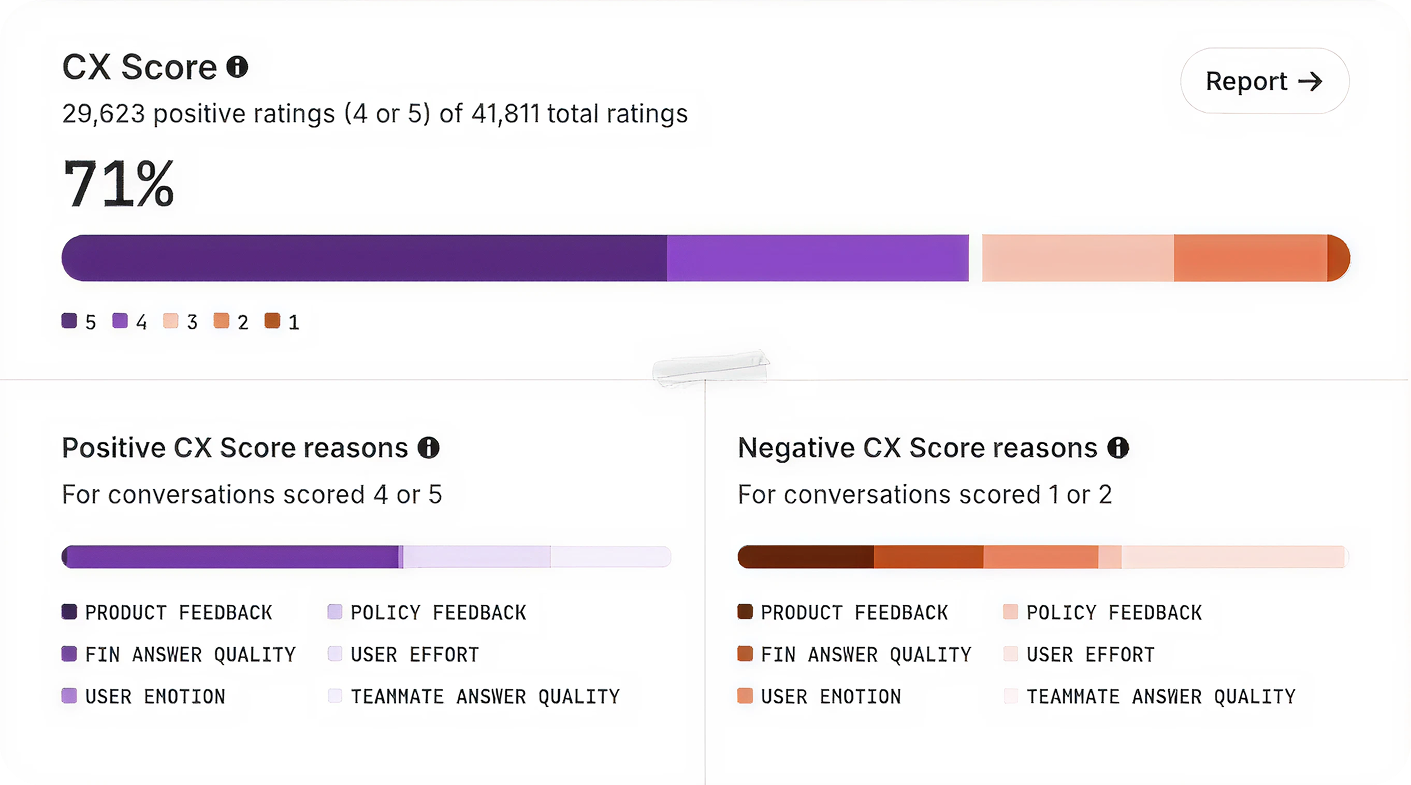
We built CX Score to give support teams a complete view of how their customers feel across every conversation. It surfaces what’s working, what’s not, and why—so leaders can communicate impact clearly and drive change across support, product, and the wider business.
A CX Score in action: repeated CSV export failures trigger a low score and customer frustration, while the AI agent clarifies next steps and gathers details—turning raw signals into actionable support insights.
Here’s exactly how I approached building a trustworthy metric that support leaders can inspect, explain, and defend.
1) It’s grounded in how support teams define quality. I started with how experienced support professionals actually evaluate conversations—collecting real examples of strong, mixed, and poor interactions across industries, identifying the specific factors that shape overall experience, and writing plain-English rules for each. The result: CX Score applies the same criteria a trained support professional would use, not generic LLM assumptions.
2) It’s aligned with human judgment. We created a dataset of thousands of real customer conversations spanning multiple industries, languages, channels, and agent types. Each was manually reviewed by experienced support professionals—with two reviewers per conversation where possible and disagreement resolution to create stable consensus labels. The result: CX Score is trained and tested to behave like an expert reviewer, not a language model making broad guesses.
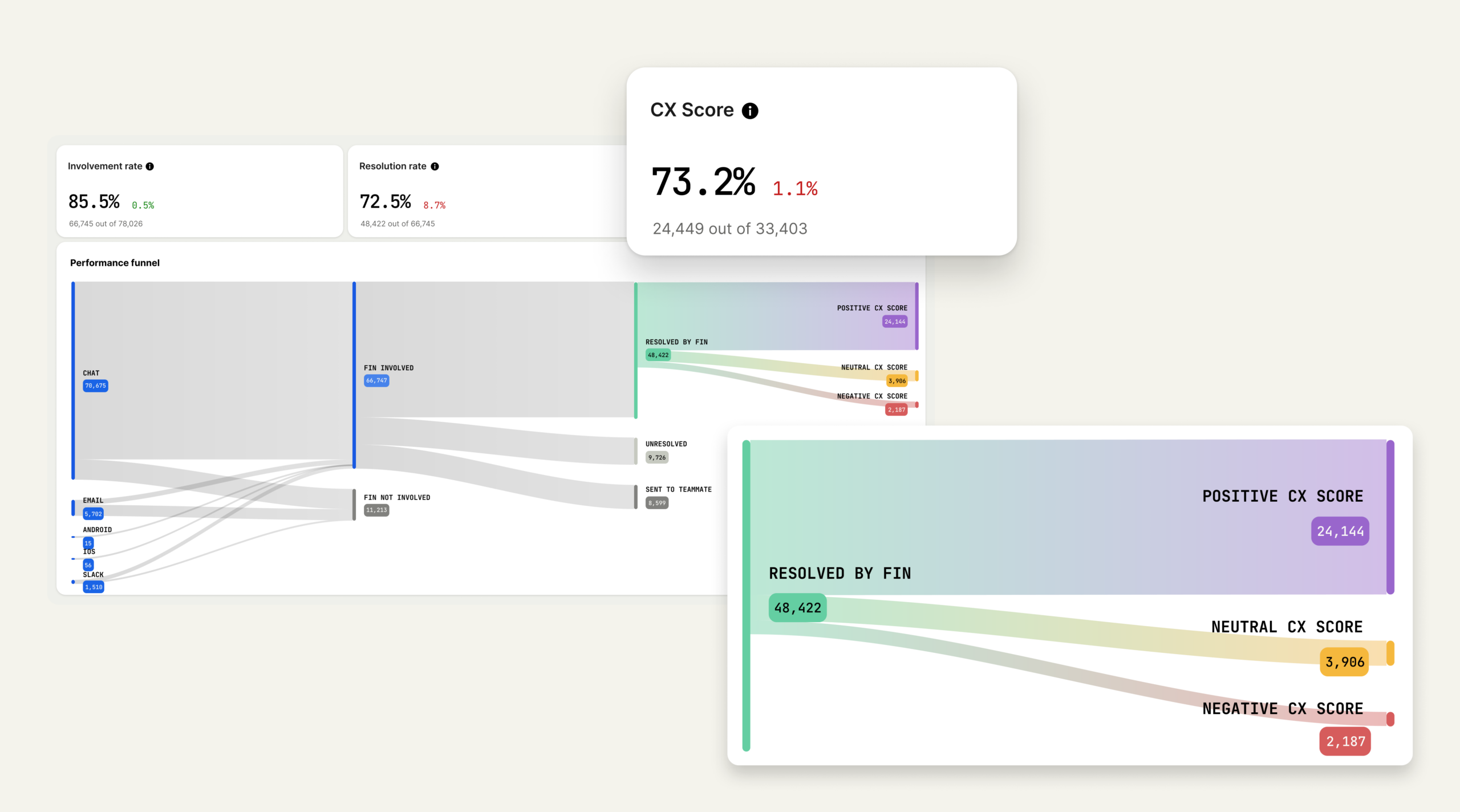
A modern CX analytics view shows how conversations flow from chat, email, and mobile into AI assistance, then to resolutions and sentiment outcomes—turning messy support data into a single, defensible CX Score.
3) It’s engineered by AI specialists. CX Score isn’t a prompt attached to an LLM. It’s a production system built by Intercom’s AI Group: 37 ML scientists and 350 engineers whose full-time focus is AI for customer service. The system includes specialized handling for long transcripts, model configuration tailored for support language and subtle sentiment, prompt engineering designed to default to neutral when evidence is weak, and a multi-stage evaluation pipeline that checks for precision, consistency, and reliability. The result: A metric built by a team that understands LLM behavior in production support environments, where accuracy and consistency matter most.
4) It’s validated statistically, not qualitatively. Trust requires measurement, not vibes. We tested CX Score across standard ML metrics: Precision (when the model flags a negative experience, how often do humans agree?), recall (how many human-identified issues does it catch?), and F1 score (the balance between both). We set an explicit bar: F1 above 0.8, representing high agreement with human judgment. We reran these evaluations through every revision, checking for regressions or biases, and I focused especially on negative experiences, because a false negative hides a real problem. The result: CX Score meets a measurable standard before it ships—not a gut check, a statistical requirement.
5) It was battle-tested with real customers. Lab accuracy isn’t enough. Customer environments are messy: Varied ticket types, mixed languages, unpredictable edge cases. Before release, we ran a multi-phase field test—shadow-scoring conversations with both old and new models, validating sensible behavior across agent type and conversation length, then rolling out to a controlled customer group who confirmed the scores felt right, reasons were clear, and insights were actionable. The result: CX Score shipped because real teams told us it made sense in practice, not because it passed internal tests.
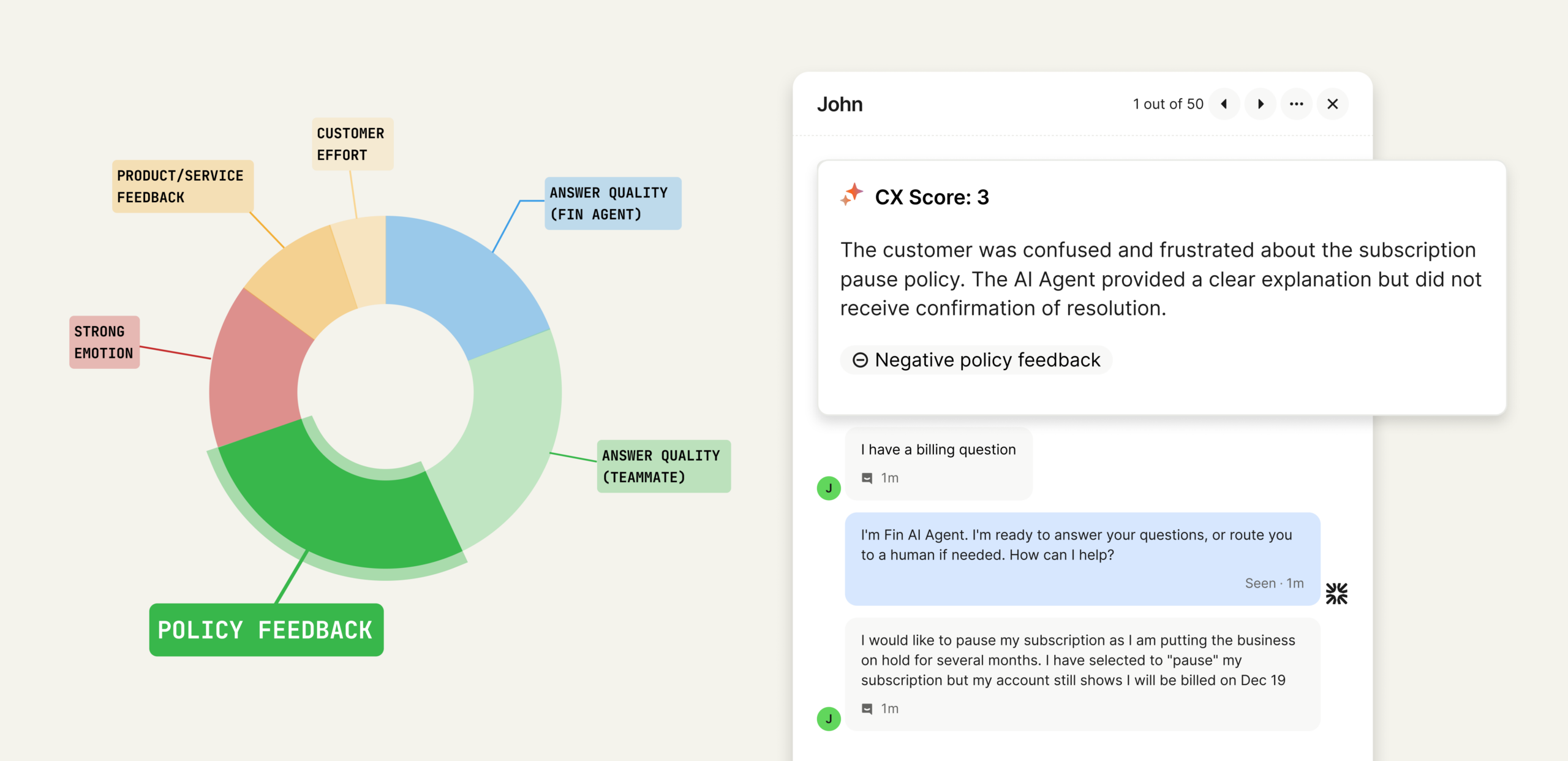
From conversation to clarity: this visual maps the drivers behind a CX Score. Explore how policy feedback, answer quality, and effort combine to produce defendable insights support leaders can act on.
The importance of explainability. One of the most critical choices I made was ensuring CX Score isn’t a black box. Every score comes with clear reasons, concrete excerpts, and a short explanation of what influenced the rating. This turns the metric into something you can inspect, audit, and explain to executives. You don’t have to trust the algorithm. You can see exactly why a conversation earned the score it did.
A metric that evolves with your business. Customer expectations shift. Products change. AI improves. A trustworthy metric can’t be static. CX Score evolves with the same commitments that shaped its redesign: Evaluate the real signals that shape customer experience, keep the logic simple and interpretable, and ensure leaders can make clear decisions from it. It’s built to be a durable source of truth across every conversation.
The takeaway. In a world where products look the same and AI can generate any interaction, customer experience is one of the few differentiators that actually matters. Support leaders have built that expertise conversation by conversation. What they’ve lacked is a measurement system that could validate it at scale—one that’s reliable enough to report to the C-suite, explainable enough to defend in strategy meetings, and rigorous enough to drive real decisions. That’s what CX Score is designed to be: A metric that reflects the reality support leaders see every day, backed by the technical rigor to make it credible everywhere else.
Want to see CX Score in your workspace? Ask your admin to enable it for your team, and start using explainable AI insights to improve customer experience and coach with confidence.
Your customer-service AI agent is live. It answers common questions, the launch dashboard looks healthy, and the next budget conversation is already about scale. Then a harder question arrives: which customer problems can the system actually own from start to finish?
That answer separates a production pilot from a mature deployment. Maturity is not the number of channels using AI or the quality of the demo. It is your ability to give the system meaningful responsibility, measure the result, recover safely when it fails, and improve it as part of normal operations. The framework below will help you diagnose where your deployment is shallow and decide what to build next.
Maturity begins where the pilot stops
Investment no longer distinguishes an AI leader. Among 2,470 global support professionals surveyed by Intercom, 82% of senior leaders said their teams had invested in AI during the previous year, 87% planned to invest in 2026, and 77% said AI was meeting or exceeding expectations. Yet only 10% classified their deployment as mature.
Those are self-reported responses collected by an AI-support vendor, so treat them as a directional benchmark rather than causal proof. The useful signal is the gap: buying and launching AI has become common, while redesigning customer service around it remains rare.
A pilot proves that an AI agent can participate. A mature operation proves that it can take responsibility. Participation might mean generating an answer before handing the conversation to a person. Responsibility means resolving the customer’s need, completing any permitted action, recording what happened, and escalating with context when human judgment is required.
Dimension
Pilot-shaped deployment
Mature operating behavior
Scope
A few answerable intents on one surface
Selected journeys owned from initial request through verified outcome
Work performed
Retrieves information or drafts a reply
Explains, gathers context, uses approved tools, and completes permitted tasks
Ownership
A launch team watches aggregate results
A named operator owns performance, failures, and the improvement backlog
Knowledge
Content is cleaned up before launch
Knowledge coverage, accuracy, and maintenance are governed as production dependencies
Testing
The happy path works in a demo
Realistic scenarios, boundary cases, and regressions are evaluated before changes ship
Handoffs
Escalation is an undifferentiated escape route
Every handoff has a reason, preserves context, and feeds the next improvement decision
Success
Containment or deflection rises
Verified resolution, task completion, quality, safety, and customer impact improve together
Use this as a constraint map, not an average score. A deployment with excellent content but unreliable account permissions is not ready to complete account changes. A deployment with strong automation but no failure taxonomy cannot improve systematically. Your least-developed operating dependency usually limits the next safe increase in responsibility.
Expand responsibility one customer intent at a time
The safest unit of expansion is not a channel, market, or percentage target. It is a customer intent with a defined outcome. Shipping an AI agent to every messaging surface can increase reach without increasing capability. Giving it end-to-end ownership of one additional support journey creates measurable depth.
For each intent, move up this responsibility ladder only when the previous level is dependable:
Answer: Retrieve and explain approved information.
Clarify: Ask the minimum questions needed to identify the customer’s situation.
Contextualize: Use authenticated account, product, region, or history data to provide the applicable answer.
Act: Complete a permitted task through a reliable tool or workflow, then confirm the result.
Intervene proactively: Detect a relevant condition and offer or perform an appropriate next step under explicit rules.
This ladder explains why an answer bot and an operational AI agent can look similar in a dashboard but create very different value. The first reduces reading and typing. The second can remove an entire unit of work for the customer and the support team.
The reported difference between early and deep deployments appears in the type of work performed. Mature teams were more likely than teams in initial deployment to report automation of manual work, proactive engagement, and task completion: 63% versus 52%, 51% versus 41%, and 45% versus 28%, respectively. Mature teams also reported higher quality and consistency more often. The figures do not establish that deployment depth alone caused the gains, but they show what deeper responsibility looks like in practice.
Before promoting an intent to the next rung, answer these questions:
Outcome: Can you state exactly what successful resolution means for the customer?
Knowledge: Is there an approved, current answer for the common case and its important exceptions?
Identity: Does the workflow know who the customer is when personalization or action requires authentication?
Authorization: Can the system verify that this customer and this AI workflow are allowed to perform the action?
Inputs: Can required values be validated before an action is submitted?
Confirmation: Can the system verify that the downstream task succeeded instead of assuming that a tool call worked?
Recovery: Is there a safe retry, rollback, approval, or human-handoff path?
Evidence: Can an operator reconstruct which knowledge, data, rules, and tool results produced the outcome?
Evaluation: Do your test scenarios cover ambiguity, missing information, exceptions, and known failure modes?
If an answer is no, you have found the next capability to build. Do not compensate with a more confident prompt. Missing permissions need a permission model. Unreliable data needs an integration fix. Conflicting policy pages need knowledge governance.
Use additional care for refunds, cancellations, account changes, identity-sensitive requests, and other consequential actions. Start with reversible or approval-gated operations. Validate the customer, the requested change, the permitted amount or scope, and the downstream result. A fast autonomous action is not a success if it creates financial loss, locks the wrong account, or leaves no reliable audit trail.
Build the operating system behind the agent
An AI agent does not mature on its own after launch. Performance plateaus when ownership, content, testing, integrations, and analysis remain side projects. These capabilities need to operate as one system.
Give performance to a named operator
Executive sponsorship and operational ownership solve different problems. The sponsor aligns customer experience, economics, organizational design, and cross-functional priorities. The operator turns failures into changes and makes sure those changes reach production safely. One person can fill both roles in a smaller organization, but the accountabilities should still be explicit.
The operator should own a working backlog organized by customer intent. Each entry needs enough context to support a decision:
The customer intent and desired outcome.
Where the current journey begins and ends.
Conversation volume and customer impact drawn from your own data.
The primary failure mode, supported by examples.
The proposed content, behavior, integration, or policy change.
The person responsible for the dependency.
The scenarios that will validate the change.
The deployment status, observed result, and rollback decision.
This prevents the backlog from becoming a collection of prompt tweaks. It also exposes systemic problems. If several intents fail because account status arrives late, the priority is the shared data dependency, not separate wording changes in every conversation.
Treat knowledge as a runtime dependency
Content quality is not a launch task. The AI agent depends on current knowledge every time it answers, just as a transactional workflow depends on a functioning service. A policy change can therefore create production failures even when no AI configuration changes.
Create a content contract for every intent you expect the agent to own:
Canonical location: Identify the approved source rather than allowing several conflicting pages to compete.
Coverage: Include the common case, eligibility conditions, exceptions, prerequisites, and the point where human judgment begins.
Scope: Separate product, plan, market, language, and policy variants when the answer differs.
Owner: Assign the person or function authorized to approve changes.
Freshness trigger: Tie review to the product, pricing, policy, or workflow event that can make the content stale.
Retirement: Remove or clearly supersede obsolete information so retrieval does not surface an old rule.
Validation: Attach representative scenarios that should pass whenever the knowledge changes.
A retrieval-first pipeline makes content maintainable because the approved explanation lives in governed knowledge instead of being buried inside prompts. Prompt behavior should decide how to use policy, not become a second unofficial policy store.
Run every change through an evaluation loop
A useful production loop is Train, Test, Deploy, Analyze. Its value is not the labels. It is the discipline of connecting an observed failure to a controlled change and then checking whether the change improved real outcomes.
Train: Change the relevant knowledge, behavior, data access, or tool. Record the failure you expect the change to fix.
Test: Run representative customer scenarios, including the happy path, ambiguous wording, missing data, policy exceptions, tool failure, and required escalation. Govern or redact conversation data under your privacy controls.
Deploy: Release to the intended intent, channel, customer segment, language, or market with a known fallback and rollback path.
Analyze: Check the customer outcome and guardrails, inspect new failure patterns, and decide whether to keep, revise, expand, or revert the change.
Your evaluation set should evolve with production. Add scenarios when a customer finds a new ambiguity, a product release changes the journey, or an integration fails in a way the original tests did not anticipate. Keep regression cases after the immediate defect is fixed. Otherwise, one improvement can quietly reintroduce an old failure elsewhere.
Make actions observable and recoverable
Answer quality alone is insufficient once the AI agent can perform tasks. Your operation must distinguish a bad explanation from a failed action, a denied permission, stale account data, a duplicate request, and a downstream timeout. Those failures require different owners and different fixes.
For each consequential workflow, preserve the facts needed to reconstruct the outcome: the detected intent, the applicable knowledge or policy version, required customer inputs, authorization result, tool invoked, request status, returned result, confirmation shown to the customer, and handoff reason. The goal is not indiscriminate data collection. Retain only what your privacy and security rules permit, but retain enough operational evidence to diagnose a failure.
Design the human path at the same time as the autonomous path. A handoff should carry the customer’s request, relevant facts already collected, actions attempted, results received, and the unresolved decision. Making the customer repeat the conversation transfers the AI agent’s failure cost directly to them.
Turn handoffs into the improvement backlog
A handoff is not automatically a failure. Some requests require empathy, judgment, negotiation, policy discretion, or authority that should remain with a person. The operational failure is an unexplained handoff. When every escalation looks the same in analytics, you cannot tell whether to improve knowledge, retrieval, workflow reliability, or the boundary itself.
Handoff or failure type
What to inspect
Likely improvement
Knowledge gap
No approved answer, missing exception, or obsolete policy
Create or update canonical content and add regression scenarios
Retrieval mismatch
Relevant content exists but the wrong variant is selected
Improve structure, metadata, scoping, or content separation
Interpretation or behavior error
The right information is available but applied incorrectly
Refine behavior instructions and add boundary-case evaluations
Missing customer context
The answer depends on account, plan, region, or history data that is unavailable
Connect the required data or ask a precise clarifying question
Authorization boundary
The requested action is not permitted for this customer or workflow
Preserve the guardrail; improve explanation or approval routing
Tool or data failure
A permitted action fails, times out, or returns an uncertain result
Improve integration reliability, confirmation, retry, and fallback behavior
Deliberate human boundary
The request requires judgment, discretion, or specialized handling
Keep the handoff and improve context transfer
Apply one primary reason to each reviewed failure, even when several contributing factors exist. Route the item to the owner who can change that dependency. Over time, the distribution of reasons tells you whether the deployment is becoming more capable or merely handing off in different places.
Measure the operation as a stack rather than relying on one headline rate:
Reach: Where was the AI agent involved, broken down by intent, channel, language, market, and product area?
Outcome: Was the customer’s issue actually resolved, and did any requested task complete successfully?
Quality: Was the answer correct, consistent, clear, and appropriate for the applicable policy and context?
Customer impact: What happened to satisfaction, repeat contact, abandonment, and escalation experience?
Guardrails: Were there unauthorized actions, incorrect confirmations, failed tools, or missed mandatory handoffs?
Diagnostics: Which knowledge gaps, retrieval mismatches, behavior errors, and integration failures drove the result?
Do not confuse involvement with success. It measures how often the system participated. Do not treat a conversation that ended without a human as verified resolution either; the customer may have abandoned the interaction or returned through another channel. Tie autonomous resolution to evidence that the intended outcome occurred, especially when a tool or account change was involved.
Aggregate containment is also easy to misread. It can rise because the mix shifted toward simpler questions while a high-impact journey deteriorated. Review results by intent and relevant customer segment before crediting a model or configuration change. If containment improves while repeat contacts, task failures, or customer satisfaction worsen, the operation has not become more mature.
Key takeaways
AI deployment maturity is the ability to give an AI agent measurable, recoverable responsibility for customer outcomes, not simply expose it to more conversations.
Expand one customer intent at a time through answering, clarification, contextualization, action, and carefully governed proactive work.
Do not automate consequential actions until identity, authorization, validation, confirmation, observability, and recovery are in place.
Assign a named operator to own intent-level performance, failure analysis, dependencies, evaluations, and the improvement backlog.
Manage knowledge as production infrastructure with canonical content, explicit scope, accountable owners, freshness triggers, and regression scenarios.
Classify handoffs by root cause and measure verified resolution, quality, customer impact, and guardrails alongside containment.
At your next operating review, choose one important intent that the AI agent currently answers but does not own. Map it onto the responsibility ladder, run the readiness questions, name its operator, classify its current handoffs, and put the next change through the evaluation loop. The scope is deliberately narrow. The maturity gain is real: one more customer problem resolved safely from beginning to end.
Your calendar is full of approvals, but the problem probably isn’t that your team lacks initiative. The organization has learned that an important decision becomes safe only after you touch it.
You don’t fix that by telling people to be more empowered. You fix it by making authority, context, constraints, evidence, and escalation explicit. The goal is not to remove yourself from every decision. It is to ensure that your involvement is triggered by risk or abnormal variance, not by habit.
Delegation fails when you transfer work but retain judgment
A leader says, "You own this," but still expects to approve the plan, resolve every cross-functional conflict, and make the final tradeoff. The team receives responsibility without authority. It can prepare options, but it cannot truly decide.
The opposite failure is just as common. A leader transfers a decision with so little context that the owner must reconstruct the strategy, risk tolerance, and success criteria from scattered conversations. What looks like autonomy is actually abandonment.
Effective delegation sits between those extremes. You retain accountability for the quality of the operating system while another leader gains authority over a defined class of decisions. That person should know what outcome matters, which constraints are real, what evidence to use, and when the decision must return to you.
This is the transition many managers struggle with when they begin managing managers. Your value can no longer come primarily from supplying the best answer. It comes from installing mechanisms through which other leaders can repeatedly reach good answers.
Key takeaways
Delegate a decision domain, not merely the tasks required to prepare a decision.
Give each recurring decision one clearly named owner with enough authority to act.
Define constraints and escalation triggers before the owner encounters pressure.
Teach the reasoning behind past decisions so people can handle cases you did not anticipate.
Review outcomes and assumptions without reopening every decision you would have made differently.
Increase authority when judgment is consistently sound; intervene when risk, ownership, or evidence breaks down.
A useful test is to step away mentally and ask three questions: Would the priority remain intact? Would the relevant metrics continue to be watched? Would the team make approximately the same tradeoff without waiting for me? A no to any of them points to a missing mechanism, not automatically a weak employee.
Build a minimum decision contract
Before delegating a consequential decision, write a short decision contract. This is not a policy manual. It is the minimum context another capable leader needs in order to act without repeatedly requesting permission.
The contract should answer the following questions:
What decision is being delegated? Name the decision class precisely. "Own onboarding" is vague. "Choose and sequence onboarding experiments within the agreed quarterly outcome" is actionable.
Who decides? Assign one decision owner. Other people may contribute expertise, execute the work, or challenge assumptions, but shared input should not create ambiguous ownership.
What outcome governs the tradeoff? Connect the decision to an outcome and its driver tree. Without that connection, the owner will optimize for the loudest stakeholder or the most visible output.
What is inside the owner’s authority? State the product area, customer segment, time horizon, resources, and dependencies covered by the delegation.
Which constraints are real? Separate non-negotiable boundaries from preferences. If every preference is presented as a constraint, authority remains fictional.
What evidence is expected? Identify the metrics, customer evidence, technical inputs, or operating assumptions that should inform the choice.
What requires escalation? Define the conditions that change the decision from local to executive. Use observable triggers where possible.
When will the result be reviewed? Set the review around the availability of meaningful evidence, not the leader’s desire for reassurance.
Decision rights also need a verb. "Involved" is not a decision right. Use language such as recommend, decide, approve, execute, or advise. If two people both believe they approve, the real decision will drift upward when disagreement appears.
For a recurring product decision, the contract might say that a product leader decides which discovery opportunities to pursue, design and engineering advise on feasibility, and the executive is informed through the normal review cadence. Escalation occurs only if the choice changes the agreed strategy, creates an existential risk, lacks a credible metric owner, or exposes a material contradiction between the operating narrative and the numbers.
That final distinction matters. Notification is not permission. If a leader must wait for your reaction after every update, the supposed decision owner will learn to delay action until you respond.
Use a one-page decision brief for consequential choices
A decision brief makes judgment inspectable without forcing you into every working session. Keep it short enough to use under normal operating pressure:
Decision to make and why it must be made now
Owner and affected teams
Desired outcome and relevant driver-tree nodes
Options considered
Recommendation and rejected alternatives
Critical assumptions and evidence
Constraints and downstream consequences
Escalation triggers
Date or signal for reviewing the result
The brief should expose reasoning, not reward document production. If the owner cannot state the governing outcome, the most fragile assumption, and the reason for rejecting the strongest alternative, more pages will not solve the problem.
Teach judgment through driver trees and decision records
Rules cover familiar situations. Judgment covers the cases no rule anticipated. If you want delegated decisions to survive ambiguity, you have to make your mental models visible.
Start with the outcome. Decompose it into the controllable levers that could plausibly move it, instrument those levers, and assign each one a single-threaded owner. Document the assumptions that connect one level of the tree to the next. This forces a team to distinguish a desired result from the mechanism expected to produce it.
Suppose the desired outcome is stronger customer expansion. A team might initially examine the eligible expansion base, adoption of additional capabilities, realized usage, retention, and the acceptance of relevant offers. That is a hypothesis about causality, not a permanent truth. The team should test whether those nodes actually explain movement in the outcome and revise the tree when the evidence disagrees.
This changes the delegation conversation. Instead of asking, "Do I like this roadmap?" you can ask:
Which driver is the decision intended to move?
What evidence connects the proposed work to that driver?
Which assumption would invalidate the recommendation?
How quickly would the team detect that the assumption was wrong?
Who owns the metric after the decision is made?
What other driver might deteriorate as a result of this choice?
Those questions teach a reusable method. Simply giving the answer teaches the team that your presence is the method.
Record why the decision made sense at the time
A lightweight decision record should preserve the recommendation, assumptions, evidence, expected effect, owner, and review trigger. Its purpose is not to create an audit trail for blame. It is to make organizational learning possible.
Without the original assumptions, a later review is distorted by hindsight. A good outcome can hide poor reasoning, while a bad outcome can follow a sound decision made with incomplete information. Evaluate the process and the result separately.
Decision records also reveal patterns that coaching conversations miss. You may discover that a leader consistently underweights second-order effects, treats weak signals as conclusive, escalates too late, or avoids choices that create short-term metric pressure. That is actionable feedback because it concerns a repeatable reasoning pattern rather than one disputed answer.
Shared metric definitions matter here. If product, sales, marketing, and customer success use different meanings for activation, retention, or expansion, their decisions can appear aligned while optimizing different realities. Define the metric, its data source, its owner, and the assumptions beneath it. Shared language reduces the amount of executive translation required at every cross-functional seam.
Review variance without taking the decision back
A review cadence can scale judgment, or it can quietly recreate centralized approval. The difference lies in what the meeting is designed to do.
Monthly business reviews and quarterly business reviews should connect narrative to numbers. They should reveal whether assumptions still hold, where performance has deviated, who owns the response, and whether the deviation crosses an agreed threshold. They should not become ceremonies in which every team waits for an executive to rewrite its plan.
I use variance as the cue for changing altitude. A stable system with credible owners deserves space. An existential risk, an unowned metric, or a conflict between the explanation and the data warrants a deeper dive.
Signal
Leadership response
What to avoid
Metrics remain within agreed control limits and the owner explains the drivers credibly
Stay at the outcome level and let the owner act
Re-litigating tactics because you have a different preference
A leading indicator departs from its expected range
Ask for a focused diagnostic, owner, and next decision point
Changing the entire strategy before identifying the affected driver
The narrative and the numbers conflict
Inspect definitions, data sources, assumptions, and causal reasoning
Accepting a persuasive story without resolving the contradiction
A material metric has no credible owner
Clarify ownership before debating solutions
Becoming the permanent owner by default
The downside could threaten the business
Enter the decision directly and make the risk explicit
Preserving the appearance of delegation at the expense of accountability
The same class of mistake keeps recurring
Repair the decision mechanism and coach the reasoning pattern
Correcting each incident as though it were isolated
When you dive deep, tell the team why. Otherwise, a risk-based intervention can be interpreted as a permanent withdrawal of authority. Say which trigger fired, what part of the decision you are entering, and what authority the owner still retains.
When you step back, do that explicitly too. Silence is ambiguous. The owner needs to know whether you trust the decision, missed the update, or expect another approval request.
Run post-decisions, not blame sessions
After meaningful evidence arrives, compare the result with the original decision record. Ask what happened, which assumptions held, which failed, what signal appeared first, and how the decision mechanism should change.
Do not use the review to prove that your preferred option would have worked. That teaches leaders to protect themselves through escalation and excessive consensus. The useful output is a better assumption, threshold, driver tree, or decision right that improves the next choice.
Grow authority as leaders demonstrate judgment
Delegation should expand with evidence. A leader may begin by developing options and making a recommendation. As the leader demonstrates sound framing, timely escalation, and consistent tradeoffs, the role can move toward deciding within guardrails and then owning the domain with routine visibility rather than prior approval.
The progression should depend on decision quality, not confidence, tenure, or presentation skill. Look for observable behavior:
The leader frames the decision around an outcome rather than a preferred deliverable.
The strongest alternatives are represented fairly before being rejected.
Assumptions are made explicit and matched to evidence.
Short-term gains are weighed against longer-term consequences.
Cross-functional effects are surfaced before they become escalation points.
Bad news moves upward early enough to preserve options.
Results and learnings are documented without defensiveness.
The leader improves the mechanism after a miss instead of merely promising more effort.
This is where demanding and supportive leadership must coexist. Set an unambiguous bar for reasoning and ownership. Then provide fast feedback, coaching, access to context, and the resources required to meet that bar. High expectations without mechanisms create anxiety. Support without a clear bar creates dependence.
Ask leaders to bring a proposed path with the problem, but do not turn that expectation into a penalty for early escalation. The useful behavior is: "Here is what changed, here is my current diagnosis, here are the options, and here is where I need help." Requiring a polished solution before escalation delays the moment when executive context is most valuable.
Repeated escalations are diagnostic data. If capable people keep returning the same decision to you, inspect the system before questioning their courage. The constraint may be a disputed metric, incompatible incentives, an absent owner, an unclear strategic boundary, or a consequence they lack the authority to absorb.
You should also inspect your own behavior. If you routinely reverse reasonable decisions without explaining the mental model, demand visibility that functions as approval, or punish a well-reasoned miss, the organization will rationally centralize around you.
Know when the system is working
A delegated decision system is becoming durable when priorities survive your absence, tradeoffs remain legible across functions, and teams escalate exceptions instead of routine choices. Leaders can explain not only what they decided but why the decision fits the strategy, metrics, time horizon, and risk boundaries.
Your calendar should change as a consequence. Less time goes to status translation and habitual approvals. More time goes to strategy, architecture, resourcing, talent, and the small number of deviations that genuinely need executive attention.
Start with one recurring decision that currently waits for you. Name its owner, write the minimum decision contract, define the escalation triggers, and schedule a review around evidence. Then resist the urge to improve the decision by taking it back. Improve the system that produced it.
References
Shivam.Consulting Blog — Mastering 30,000-Foot Vision and Ground-Level Execution: Systems That Decide Without You
Your AI feature can be online, fast, and still be failing. A report renders but omits important records. A workflow returns valid JSON with the wrong meaning. A retry creates a duplicate. A permissions change quietly removes the data needed for a trustworthy answer.
If you own an AI product, an uptime dashboard cannot tell you whether users are receiving the outcome you promised. You need a reliability system that covers data, models, runtime dependencies, output quality, delivery, and recovery. The practical goal is not to eliminate every failure. It is to detect meaningful failures early, contain their impact, and recover without making the situation worse.
Define reliability at the user-outcome boundary
Traditional service reliability often starts with a relatively clean question: did the request succeed? AI products make that question insufficient. A request can return a success status while the user receives an incomplete, structurally invalid, stale, unauthorized, or semantically poor result.
Start by writing a reliability contract for one important user journey. State what must be true when that journey succeeds. A useful contract usually covers these dimensions:
Reliability dimension
Question to answer
Evidence to capture
Completion
Did the workflow reach a terminal outcome?
Completed, rejected, timed out, cancelled, or still pending
Structural validity
Does the output satisfy the interface expected downstream?
Schema-validation result, schema version, and rejection reason
Data integrity
Was the required data accessible, current, and complete enough for the task?
Data-source status, permission result, retrieval result, and freshness signal
Semantic quality
Is the answer useful and acceptable for this use case?
Evaluation result by task, customer segment, language, or workflow
Latency
Did the outcome arrive while it was still useful?
End-to-end latency and latency for each pipeline stage
Delivery integrity
Was the result applied once, without duplication or corruption?
Idempotency key, write status, attempt count, and final state
Privacy and risk
Did processing respect the product’s data-handling rules?
Policy checks, PII-scanning result, access decision, and exception path
This contract prevents an easy but damaging mistake: counting technically completed requests as successful user outcomes. If a report is truncated yet parseable, the transport succeeded and the product failed. If a model response is excellent but based on data the user can no longer access, the answer should not be delivered as a success.
Turn the contract into service-level indicators that the system can measure. Then set service-level objectives around the indicators that matter to the user. The difference between the objective and actual performance becomes the error budget available for change and experimentation.
Do not hide behind a global average. Break reliability down by model, prompt version, schema version, dataset, workflow, customer segment, and dependency. AI failures are often concentrated. A healthy aggregate can conceal a severe regression for one language, one integration, or one high-value workflow.
Your error budget should also drive decisions. When budget consumption accelerates, narrow the rollout, pause the risky change, or redirect capacity toward the failure path. When the budget is healthy, you have evidence that the product can absorb controlled experimentation. That is more useful than declaring reliability important while allowing roadmap pressure to settle every tradeoff.
Instrument the full path from request to delivered outcome
A useful AI trace does not stop at the model call. It follows the user request through authentication, permission checks, data retrieval, context assembly, model execution, output validation, business rules, persistence, and delivery. Give the journey one correlation identifier so an engineer can move from a failed user outcome to the responsible stage without reconstructing the request from unrelated logs.
Build visibility at three levels:
Structured events: Record the request identifier, workflow, customer segment, model, prompt version, schema version, dependency, attempt number, latency, result class, and failure code. Use controlled fields rather than free-form error messages for the dimensions you expect to aggregate.
Distributed traces: Create a span for each meaningful stage. A trace should show whether time was spent waiting in a queue, retrieving data, calling a provider, validating output, or committing a side effect.
Keep raw customer data, prompts, and model responses out of routine telemetry unless there is a defined and approved need to retain them. Structured metadata is usually enough for operational diagnosis. When content must be inspected, apply access controls, retention rules, redaction, and PII scanning as part of the observability design. Logging sensitive data first and deciding how to govern it later creates a second reliability problem: the monitoring system becomes a source of risk.
Design failure codes around actions, not organizational boundaries. Invalid model output, missing source permission, provider throttling, exhausted token budget, duplicate delivery, and policy rejection tell the responder what kind of path failed. A generic model error or integration error forces the on-call person to rediscover information the system already had.
Alerts should represent conditions that require intervention. Error-budget burn, broad validation failures, growing queue age, or a dependency circuit remaining open may justify an immediate response. A slow-moving change in evaluation performance may belong in a product review instead. If every anomaly pages someone, the monitoring system trains the organization to ignore it.
The same dashboard should work for product and engineering. An SRE needs the failing dependency and trace. A product leader needs the affected workflow, segment, volume, and user consequence. Connecting both views prevents a team from fixing the loudest technical symptom while a quieter failure causes more product damage.
Harden each boundary instead of trusting the happy path
Most AI workflows combine components with different failure behavior: internal services, databases, queues, retrieval systems, model providers, and third-party data sources. Reliability comes from controlling the boundary around each component. The following sequence gives you a practical hardening checklist.
Bound every external call. Set explicit timeouts using observed latency distributions, including p95 behavior, as an input. A missing timeout allows one slow dependency to consume workers and delay unrelated requests. Treat timeout as a classified outcome rather than an unhandled exception.
Retry only failures likely to be temporary. Provider throttling and transient network failures may recover. Invalid input, permission denial, and schema rejection usually will not. Use delayed retries with exponential backoff and jitter so concurrent failures do not return as another synchronized burst. Cap attempts and record the final reason.
Put a circuit breaker around unstable dependencies. When failure crosses the condition you have defined, stop sending traffic long enough to prevent resource exhaustion and cascading latency. Make the open, probing, and closed states visible. The product should communicate a controlled unavailable or delayed state rather than pretending work completed.
Make side effects idempotent. Derive the idempotency key from the logical operation, destination, and relevant payload version. Persist the result of the operation so retries can return or reconcile the prior outcome. Do not depend on local wall-clock time alone to distinguish writes; clock skew can turn retry protection into duplicate or missing work.
Apply backpressure before the queue becomes the outage. Bound concurrency for each constrained dependency. When demand exceeds safe processing capacity, queue, defer, or reject according to the user promise. Preserve enough state to resume safely. Unbounded retries feeding an unbounded queue convert a temporary provider problem into a long recovery.
Validate contracts before committing effects. Validate generated JSON against the expected schema, including required fields, types, allowed values, and relevant bounds. Keep parsing separate from business validation: syntactically valid output can still violate a product rule. Reject or quarantine invalid results before they reach reporting, billing, messaging, or another irreversible operation.
Detect incomplete generation explicitly. Budget context and expected output together. When the provider exposes completion metadata, use it to distinguish a completed response from one stopped by a limit. Do not pass partial structured output downstream merely because a parser can repair it. Reduce unnecessary context, split an oversized task, or return a controlled failure.
Treat permissions as changing runtime state. Check access near the point of retrieval, classify authorization failures separately, and monitor permission-related drops by integration. Do not repeatedly retry a denial. If upstream access changes silently, the product should expose which data is unavailable rather than producing an apparently complete result from a partial dataset.
Put risky behavior behind feature flags. Separate deployment from release. A flag should let you disable a model, prompt, retrieval path, or downstream action without waiting for another deployment. Test the rollback or disable path before relying on it during an incident.
These controls need an explicit order of operations. Validate permissions before retrieving sensitive data. Validate generated output before executing a side effect. Persist idempotency state before acknowledging completion. Apply retry policy after classifying the failure. Ordering is what prevents individually sensible mechanisms from undermining one another.
Be careful with graceful degradation. It is useful when the degraded state remains honest and valuable, such as delaying a non-urgent report or identifying an unavailable data source. It is dangerous when the system silently substitutes stale, incomplete, or lower-quality information and presents it as equivalent. The user must be able to distinguish degraded output from normal output.
Make model and prompt releases earn production traffic
A prompt edit can change output structure. A model change can improve one task while weakening another. A retrieval change can alter both answer quality and latency. Treat these modifications as production changes even when no application code changed.
An eval-driven release path should work like this:
Version the complete behavior. Record the model, prompt, schema, retrieval configuration, tool definitions, policy rules, and relevant application release. Without this bundle, a failed response cannot be reproduced with confidence.
Build evaluations around the product contract. Cover representative tasks, important customer segments, difficult inputs, and failure cases discovered in production. Include structural checks alongside semantic checks. A quality score cannot compensate for output that breaks its interface.
Establish a baseline. Compare the candidate with the current production behavior on the same evaluation set. Review the distribution by meaningful slice rather than relying only on one average score.
Gate promotion in CI/CD. Require the agreed evaluation baselines to hold or improve before the candidate can progress. Make exceptions explicit, owned, and reversible. A hidden manual bypass is not a release policy.
Release through a canary. Send a limited, observable portion of eligible traffic to the candidate. Keep the current version available. Watch evaluation signals, validation failures, p95 latency, dependency behavior, and error-budget consumption by version.
Expand in stages or roll back. Increase exposure only while the user-facing indicators remain within the agreed conditions. If a signal degrades, use the feature flag or version control to stop exposure quickly while preserving diagnostic evidence.
The release gate needs product judgment. Not every evaluation failure carries the same consequence. A formatting defect in an internal draft is different from an unsupported claim in a customer-facing recommendation or an unauthorized action by an agent. Define which failures block release, which require human review, and which can be monitored after release.
Do not force a choice between delivery speed and reliability without evidence. Track deployment frequency alongside change failure rate. Frequent, small, reversible releases can improve both learning speed and recovery. Large bundled changes make it harder to identify the cause of regression and increase the amount of behavior a rollback must undo.
Before approving an AI release, a product leader should be able to answer five questions:
Which user promise can this change affect?
Which evaluation and production indicators represent that promise?
Which segments could regress even if the aggregate improves?
What condition stops or reverses the rollout?
Who has the authority and the mechanism to act when that condition appears?
If those answers are missing, the release is relying on optimism rather than a control system.
Run reliability as a product operating system
Technical safeguards decay unless ownership and operating routines keep them current. Models change, integrations evolve, permissions move, and traffic develops new burst patterns. Reliability therefore belongs in roadmap and incident decisions, not in a one-time infrastructure project.
Prepare a lightweight runbook for each critical journey. It should identify the owner, user-visible failure states, primary indicators, relevant dashboards, recent release controls, dependency status, safe disable path, and rules for replaying work. A responder should not have to infer whether replay can duplicate a message, report, charge, or external action.
During an incident, establish the user impact before chasing every technical symptom. Identify the affected workflow and segment, stop further harm, preserve evidence, and use the safest available rollback or containment control. Communicate whether results are delayed, incomplete, unavailable, or at risk of duplication. Those states require different user actions.
Afterward, use a blameless review to find the conditions that allowed the failure to reach users. The strongest follow-up actions are testable and automatable: a new schema check, an evaluation case, a permission metric, a retry limit, a canary gate, a better idempotency key, or a rehearsed rollback. An instruction to be more careful is not a control.
Prioritize the reliability backlog by user consequence and error-budget impact. A noisy internal exception with no lost outcome may matter less than a silent data omission affecting a small but important workflow. This keeps observability from becoming a competition to reduce whichever counter is easiest to move.
Privacy-by-design and AI risk management belong in the same operating system. Add PII scanning, access validation, and policy checks to the pipeline and release gates. Assign owners for exceptions. Revisit the controls as the product gains new data sources or actions. Risk is a continuing product constraint, not a review performed after the architecture is settled.
Key takeaways
Define success at the delivered user outcome, not at the HTTP response or completed model call.
Measure completion, structural validity, data integrity, semantic quality, latency, delivery integrity, and privacy where each applies.
Trace the whole pipeline and segment reliability by model, prompt, schema, workflow, dataset, and customer group.
Use timeouts, selective retries, circuit breakers, idempotency, backpressure, validation, and feature flags as coordinated controls.
Gate model and prompt changes with evaluations, then use canaries and staged releases to limit exposure.
Let SLOs, error-budget consumption, and user consequence determine when reliability work outranks feature work.
Choose your highest-consequence AI journey and write its reliability contract. Trace it end to end, attach an SLO to the user outcome, and replay the known failure modes against the controls you already have. If the system cannot tell you whether its output was valid, complete, permitted, and delivered once, that is the first reliability gap to close.
Your AI agent may look convincing in a demonstration and still disappear from daily work. If people try it once but return to spreadsheets, dashboards, tickets, and manual handoffs, you do not have an awareness problem. You have a workflow design problem.
Real adoption begins when a specific user can delegate a meaningful part of a recurring job, understand the agent’s limits, and see that the resulting decision or action is better. Product leaders create those conditions by narrowing the workflow, defining the agent’s authority, measuring the complete decision loop, and expanding autonomy only after the evidence supports it.
Choose a workflow, not a place to add AI
Starting with “Where can I deploy an agent?” pushes the team toward a feature. Start with “Which recurring decision or action is unnecessarily difficult?” That question keeps the work tied to customer or business value.
A good first workflow is frequent enough to generate feedback, narrow enough to evaluate, and bounded enough that a mistake can be caught before it causes material harm. It also has an identifiable beginning and end. “Help people be more productive” is not a workflow. “Use approved customer evidence to prepare the next-best-action options for a campaign review” is much closer.
Evaluate candidate workflows against six practical criteria:
Trigger: The user can recognize the moment when the agent should enter the workflow.
Frequency: The job repeats often enough for the user to form a habit and for the team to learn from actual use.
Grounding: The agent can retrieve the approved data, policies, history, or customer evidence required to do the job.
Completion: The team can observe whether the task reached a useful end state, rather than merely whether the model returned text.
Decision boundary: Everyone can state what the agent may decide, what requires approval, and what it must never do.
Recoverability: An incorrect recommendation or action can be rejected, corrected, or reversed without disproportionate damage.
Mark each candidate high, medium, or low on those criteria. Do not hide a weak decision boundary behind an attractive use case. A repetitive workflow with clear evidence and a review point is usually a better adoption bet than an ambitious end-to-end process with unclear ownership.
This is also why natural-language access alone is not an agent strategy. It can lower the barrier between a user’s question and an analytical answer, which may improve activation. Adoption becomes more valuable when the answer connects to a defined next action and the eventual impact of that action can be observed.
Write the selected workflow in one sentence before approving a roadmap:
When [user] encounters [trigger], the agent uses [approved context] to [recommend, prepare, or execute an action]; [person or policy] controls [decision boundary], and success is measured by [workflow or customer outcome].
Agent workflow template
If the team cannot complete that sentence without vague language, discovery is not finished.
Write an adoption contract before writing the roadmap
An agent changes who performs work, which information informs it, and where accountability sits. That is an operating-model decision disguised as a product feature. A one-page adoption contract makes the change explicit before implementation creates momentum around the wrong behavior.
The contract should answer seven questions:
Who is the intended user? Name the role and the situation, not a broad department.
What job is being delegated? Separate information retrieval, analysis, recommendation, preparation, and execution. They carry different risks.
What outcome should improve? Connect the workflow to an existing customer or business outcome, not to the amount of AI content produced.
Which information is authorized? Identify the systems of record, retrieval scope, freshness requirements, and data that must remain unavailable.
Where does human judgment remain mandatory? Put approval at the consequential decision, not at an arbitrary screen in the interface.
How should uncertainty and failure appear? Define when the agent should cite evidence, ask for missing context, abstain, escalate, or report that a tool failed.
What earns expansion? Specify the quality, adoption, outcome, and risk signals required before the agent receives more users, tools, or autonomy.
This contract prevents a common measurement error: treating interaction volume as value. Conversations, generated documents, and tool calls are outputs. They can help diagnose behavior, but they do not show that the workflow improved. Activation, successful completion, repeat use at the next relevant trigger, and retention are stronger adoption signals. They still need to connect to a journey outcome such as a better decision, a completed customer task, or a validated change.
Use outcomes versus output OKRs to keep the distinction visible. An output key result might promise to launch an agent or add integrations. An outcome key result should describe the behavior or customer result that the workflow is intended to change. The delivery milestone belongs in the plan; it should not masquerade as proof of adoption.
The contract also makes prioritization easier. A request for another model, data connector, or agent tool must improve a named part of the workflow. If it cannot be tied to grounding quality, task completion, user control, or the target outcome, it is probably infrastructure enthusiasm rather than a product requirement.
Earn autonomy through observable stages
Do not jump from a chat interface to autonomous execution because the happy-path demo worked. Autonomy should advance in stages, with a different role for the user and a different standard of evidence at each stage.
Capability stage
What the agent does
Human responsibility
Evidence needed to advance
Explain
Retrieves and synthesizes approved information
Checks the evidence and interprets it
Grounding, completeness, and answer-quality evals
Recommend
Produces alternatives or ranks possible next actions
Makes the decision and records important overrides
Relevance, reasoning, boundary, and decision-support evals
Prepare
Creates a draft action, configuration, or artifact without committing it
Edits and approves before execution
Task-specific correctness, policy, format, and exception evals
Act
Executes a bounded action through approved tools
Supervises exceptions and reviews consequential cases
Reliable task completion, tool behavior, auditability, and recovery controls
The stages are not a maturity contest. Some workflows should remain in recommendation or preparation mode because the consequences of an incorrect action outweigh the benefit of removing approval. Human-in-the-loop design is useful when the person has evidence, authority, and enough context to intervene. A mandatory click from someone who cannot evaluate the result adds friction without adding control.
Before releasing each stage, create an evaluation set that represents the actual workflow. Include normal cases, ambiguous requests, missing or stale context, policy boundaries, conflicting evidence, and tool failures. For every case, record the expected behavior, unacceptable behavior, scoring rubric, and evidence the evaluator should inspect.
Do not collapse evaluation into a single pass rate. An answer can be fluent and wrong, properly grounded but irrelevant, or correct while attempting an unauthorized action. Score the dimensions that matter independently: retrieval and grounding, task correctness, tool selection, instruction adherence, policy compliance, escalation behavior, and completion quality.
Treat prompts and evaluation datasets as versioned product assets. When the model, prompt, retrieval logic, tool definition, or policy changes, rerun the relevant evaluation set and preserve the result with the release. Otherwise, a team can improve one visible behavior while silently degrading another.
A retrieval-first design is especially important when the workflow depends on institutional knowledge. The agent should use authorized context before relying on general model knowledge, expose enough evidence for the user to inspect, and ask for clarification or abstain when required context is unavailable. That behavior may look less magical in a demonstration, but it is much easier to trust in repeated work.
Measure the entire agent loop, not the chat surface
A traditional feature funnel can tell you who opened an agent and who returned. It cannot explain whether the agent retrieved the right context, selected the right tool, required extensive correction, or produced an action that affected the intended outcome. Agent Analytics must reconstruct the path from intent to result.
Instrument the workflow as a connected event chain:
Intent and eligibility: Which workflow was triggered, and was the user and situation within scope?
Context: Which approved knowledge or data was retrieved, and was essential context unavailable?
Reasoning path: Which plan or action sequence did the system select?
Tool behavior: Which tools were called, which arguments were passed, and where did errors or retries occur?
Human intervention: Did the user accept, edit, reject, override, or abandon the result?
Completion: Did the workflow reach its defined end state?
Outcome: Did the customer or business indicator named in the adoption contract move in the intended direction?
Apply privacy-by-design to that event model. Logging every raw prompt, retrieved record, or tool payload by default can create unnecessary exposure. Decide which fields are required for product learning, who may access them, how sensitive data is handled, and how long the information is retained. Data governance belongs in the instrumentation design, not in a review after launch.
Review four layers together:
Quality: Evaluation results by task and failure dimension.
Behavior: Activation, successful completion, repeat use, abandonment, edits, and overrides.
Outcome: The customer or business result attached to the workflow.
Risk and reliability: Boundary violations, unsupported claims, tool failures, escalations, and consequential incidents.
Each layer corrects a possible misreading. High usage with weak quality can mean users are compensating for the system. Strong offline quality with little repeat use can mean the workflow is not important or the interaction arrives at the wrong moment. Completion without an outcome can mean the agent is accelerating work that should not have been done. Outcome movement without traceability makes it difficult to know whether the agent deserves credit or whether the result will persist.
Use qualitative evidence to explain those patterns. Review corrections and overrides, collect feedback at the point of use, and connect support signals to roadmap decisions. A generic satisfaction question is less useful than asking what evidence was missing, which step the user repeated manually, or why the recommendation could not be acted on.
When comparing user-facing variants, define the primary outcome and minimum detectable effect before running an A/B test. This prevents the team from declaring success based on an incidental movement in a convenient metric. A/B testing is appropriate only where traffic, exposure, and risk make controlled experimentation meaningful; rare or consequential actions need direct evaluation, review, and guardrails instead.
Make agent adoption an operating change
A launch campaign can create trials. It cannot resolve unclear ownership, weak evaluation, missing context, or a workflow that asks users to supervise the agent without giving them useful control. Sustainable adoption requires a product operating model around the capability.
Give a product trio responsibility for the complete workflow and pair it with the people who can close the distance between a prototype and production use:
Product management owns the user problem, target outcome, decision boundary, adoption contract, and expansion decision.
Design owns how intent, evidence, uncertainty, approval, correction, and escalation appear in the experience.
Engineering owns retrieval, tool permissions, system behavior, observability, release controls, and recovery paths.
A forward deployed engineer or equivalent customer-facing technical partner helps expose the real context, integrations, and exceptions hidden by a clean prototype.
Data and risk owners define acceptable model behavior, privacy constraints, access rules, and the evidence required for governance.
The leadership cadence should follow the learning loop. Discovery identifies a high-value workflow and pressure-tests it with user evidence. Pre-release review examines evaluations and failure modes. A narrow rollout tests the workflow with explicit human checkpoints. Operating reviews examine quality, behavior, outcomes, and incidents together. Expansion adds a capability, population, tool, or level of autonomy only when the prior boundary is performing as intended.
This model should influence AI hiring as well. A strong AI product candidate should be able to turn a broad ambition into a bounded workflow, define an evaluation rubric, separate model quality from product outcomes, place human judgment at the right decision, and explain what evidence would justify more autonomy. Prompt fluency without those skills is not product leadership.
Key takeaways
Start with one recurring, bounded workflow whose completion and outcome can be observed.
Write an adoption contract covering the user, trigger, delegated job, approved context, decision boundary, failure behavior, and expansion criteria.
Progress from explanation to recommendation, preparation, and bounded action only as evaluation and production evidence improve.
Version prompts, retrieval logic, tool definitions, and evaluation datasets with releases.
Instrument intent, context, tool calls, human intervention, completion, and downstream outcomes as one decision loop.
Scale when quality, repeat use, workflow outcomes, and risk controls agree – not when a demonstration attracts attention.
Your next move does not need to be a company-wide agent mandate. Put three candidate workflows through the six selection criteria. Choose the one with the clearest trigger, evidence, completion point, and decision boundary. Then write its adoption contract and evaluation set before funding a broad build. If the narrow workflow earns repeat use and improves its named outcome, you will have evidence for the next capability – and a repeatable method for every agent that follows.
This is the year to build your personal operating system. For me, that line isn’t a slogan; it’s a commitment to eliminate context switching, compress decision cycles, and turn fragmented information into a reliable source of truth. As a product leader, I needed a system that blends judgment, data, and automation—so I built mine around Claude Code.
When I say “personal operating system,” I mean an integrated set of AI workflows, rituals, and tools that capture knowledge, structure decisions, and automate execution. It’s where product discovery meets delivery: a place to synthesize signals, prioritize with clarity, and move from insight to action without friction. The outcome is fewer ad hoc decisions, more deliberate strategy, and a calmer, more focused day.
Claude Code sits at the center because it helps me translate intent into working software and repeatable processes. I use it to scaffold small utilities, write adapters for APIs, and evolve prompts into robust patterns. It accelerates everything from research synthesis and PRD drafting to backlog grooming and stakeholder updates—while keeping me in the loop for final judgment.
Under the hood, I run a retrieval-first pipeline that connects notes, docs, tickets, research transcripts, and roadmaps into a searchable, living memory. With careful context window management, I feed only the most relevant snippets into Claude Code, preserving accuracy and speed. The result: richer answers, fewer hallucinations, and an assistant that “remembers” what matters without drowning in noise.
My daily loop is simple: capture, synthesize, decide, and act. I capture customer signals and meeting notes into a personal knowledge management vault; synthesize patterns with prompt engineering that emphasizes evidence; decide using outcomes vs output OKRs; and act by generating drafts, creating tasks, and updating artifacts. Claude Code helps me wire this end-to-end, so the system works even on my busiest days.
If you’re implementing this from scratch, start small. Pick one high-friction workflow—say, product feedback triage—and build a narrow agentic AI flow to classify, summarize, and route items. Use eval-driven development to test prompts against known edge cases. Add guardrails and privacy-by-design practices from day one, then expand to neighboring workflows once the first loop is reliable.
Governance matters. I treat AI risk management, data governance, and security as first-class citizens: limited data scopes, clear audit trails, human-in-the-loop approvals, and rollback plans. Feature flags control changes; observability tracks drift and quality; and a simple playbook documents how we deploy, monitor, and improve the system.
Measure what this personal operating system earns you. Track decision latency, cycle time from signal to action, meeting-to-output ratios, and the signal-to-noise ratio of inputs. When the system is working, you’ll feel it: fewer meetings, more momentum, and sharper product strategy supported by trustworthy AI workflows.
The goal isn’t to automate judgment—it’s to protect it. By letting Claude Code handle the glue work and information wrangling, I preserve energy for high-leverage thinking: positioning, sequencing, and trade-offs. Build your personal operating system now, and make this the year your product practice runs with clarity and composure.
Is hiring broken—or just badly designed? I’ve been sitting with that question after a recent conversation that crystallized what I see across product organizations: AI-fueled application overload, sprawling interview loops, and fuzzy criteria that invite groupthink at exactly the wrong moments. If you’ve ever watched a promising candidate stall out late in the process, you’re not alone. Listen to this episode on: Spotify | Apple Podcasts.
Here’s the reality I’m observing in the market: Layoffs and hiring freezes have flooded the funnel, while AI tools make it trivial to submit hundreds of applications. Companies are overwhelmed, so they respond by adding more interviews and more stakeholders, hoping more touchpoints equal better signal. In practice, that complexity often dilutes accountability and increases noise—especially for product management leadership roles where clarity, not consensus theater, determines success.
I’ve seen too many offers derailed by “one last step.” A candidate clears every structured interview, then a casual lunch or unframed panel suddenly becomes the deciding factor. The team isn’t briefed on what to evaluate, one lukewarm comment lands, and group dynamics cascade into a no-hire. That’s not rigor—it’s randomness masked as prudence.
Groupthink ≠ good hiring decisions. When everyone has veto power, risk-averse no-decisions become the default. Focus-group-style interviews create bias, not signal, and “culture fit” often becomes a proxy for stereotyping or personal preference. As product leaders, we’d never ship a feature based on vibes; we shouldn’t make high-stakes hiring calls that way either.
There’s a better way—and it mirrors how we run great product discovery. Define who you’re hiring before writing the job description. Set clear success metrics for the role. Assign each interviewer specific criteria to evaluate. Treat hiring like product discovery: intentional, structured, and evidence-based. In my teams, that looks like tight scorecards, interviewer calibration, and a decision owner who synthesizes evidence—not a popularity contest where the loudest voice wins.
Chemistry checks still matter, but only when we define what collaboration actually means for the role. Introversion, debate style, or lunch-table small talk are not performance indicators. I look for behaviors we value in empowered product teams—clarity of thinking, healthy dissent, co-creation under constraints—often via a real working session with the future product trio. Diverse teams outperform homogenous ones, even if not everyone “vibes,” so I optimize for complementary strengths over sameness.
If you’re a candidate, remember: When a process feels broken, it’s often not about you. Ask how you’re being evaluated to gauge process maturity; a thoughtful team will happily walk you through their rubric and what great looks like. For structure and support, I’ve seen “Who: The A Method for Hiring” help leaders clarify requirements; “Never Search Alone” and joining a Job Search Council (JSC) can give you peer accountability and sharper narratives. For current openings, I regularly point PMs to Scott Baldwin’s PM job postings on LinkedIn.
My challenge to fellow product leaders: Audit your hiring process the way you’d audit your roadmap. Where are decisions getting stuck? Where are you over-indexing on consensus and under-indexing on evidence? Tighten the criteria, streamline stakeholders, and instrument the funnel so you can learn and improve. The payoff is faster, fairer, more confident decisions—and teams that reflect the rigor we expect in product strategy and stakeholder management.
What’s one change you can make this week—reworking the scorecard, calibrating interviewers, or replacing an unstructured lunch with a real collaboration exercise? Small improvements compound. Let’s build hiring systems that are worthy of the talent we’re trying to attract.
“Continuous Discovery Habits” turns five this year, and I’m celebrating by reading the book together with you. Each month, I’m releasing an in-depth reading guide designed for empowered product teams and product trios—complete with the chapters we’ll read, a preview of the key concepts, short shareable videos, individual and team discussion prompts, team exercises you can run immediately, and additional reading to go deeper.
We’ll discuss each month’s reading in the comments, and we’ll gather quarterly for live calls. If you’re joining late, no problem—I’ll be monitoring comments throughout the year. Start with the current month or go back to January (https://www.producttalk.org/lets-read-continuous-discovery-habits-together-january-2026/). Jump in where it serves you best, ask for help, share what’s working, and connect with other readers any time.
If you want to participate, grab a copy of the book (https://amzn.to/3hGkNYT?ref=producttalk.org)—or dust off your old one—share the “Spread the Love” videos with your colleagues, set aside time to run the team exercises, and register for the community sessions. Let’s do this.
This Month’s Reading
Chapters: Chapter 3: Focusing on Outcomes Over Outputs
Estimated reading time: ~22 minutes
This chapter zeroes in on the critical difference between business outcomes and product outcomes—and why it matters which one your team is assigned; how to translate lagging business metrics into actionable product outcomes you can actually influence; why setting outcomes should be a two-way negotiation between leaders and product trios; when to start with a learning goal versus a performance goal; and five common anti-patterns that derail outcome-focused teams. Need a copy? Grab the book (https://amzn.to/3hGkNYT?ref=producttalk.org).
Share the Love with Friends and Colleagues
We learn best in community. I like to seed conversations across my org with short, high-signal content—especially when I’m shifting a culture from outputs to outcomes and sharpening OKRs. Use these short videos to bring peers into the conversation and invite them to read along:
“What’s an outcome?” (https://videos.producttalk.org/videos/ea9fdab71d1ee3c263/whats-an-outcome?ref=producttalk.org) — The real value of starting with an outcome. “Business outcomes vs. product outcomes” (https://videos.producttalk.org/videos/069fd5b5101ee2c78f/business-outcomes-vs-product-outcomes?ref=producttalk.org) — Why product teams need product outcomes, not business outcomes. “What’s the difference between OKRs and outcomes?” (https://videos.producttalk.org/videos/069fdab61919e4c38f/whats-the-difference-between-okrs-and-outcomes?ref=producttalk.org) — Any outcome can be represented as an OKR. “Understanding revenue model formulas” (https://videos.producttalk.org/videos/799fd5b5101ee2c4f0/understanding-revenue-model-formulas?ref=producttalk.org) — How to identify the business outcomes your company cares about. “Revisit your outcome every quarter” (https://videos.producttalk.org/videos/449fd5b4111ee0cfcd/revisit-your-outcome-every-quarter?ref=producttalk.org) — Don’t abandon your outcome, but do revisit how you measure it.
Reflect and Discuss What You Read
Reflection is the conversion rate optimizer for learning. When we pause to discuss what we’re reading, we retain more and apply it faster—especially in product discovery and product strategy work. This chapter challenges us to update our definition of success: away from features shipped and toward outcomes achieved. This month, I’m examining my own relationship with outcomes—where I’ve been rigorous, where I’ve drifted, and how I can help my teams strengthen day-to-day behaviors.
Individual Reflection
If your team isn’t working toward an outcome, look at the features or projects on your roadmap and ask: What impact are they supposed to have? If they succeed, what customer behavior or business result would change? If your team does have an outcome, consider whether it’s a business outcome, a product outcome, or a traction metric—and how that choice shapes your daily decisions and discovery cadence. Finally, think about the last time your team’s outcome changed: Was it a deliberate strategic shift, or did it feel like ping-ponging from one priority to the next?
Team Discussion
As a team, classify your current outcome: Is it a business outcome, a product outcome, or a traction metric? If it’s a business outcome, identify the leading customer behaviors that would signal momentum; if it’s a traction metric, broaden it to a product outcome that gives you more room to explore. Then, name which of the five anti-patterns (pursuing too many outcomes, ping-ponging, individual outcomes, outputs as outcomes, or tunnel vision) shows up for you and pick one concrete change. Finally, assess how outcomes are set: Are they handed down, or does your product trio co-create them? What would it take to make this a true two-way negotiation?
Put It Into Practice
Understanding the difference between business outcomes and product outcomes is table stakes. Translating one into the other is where product management leadership shows up. These exercises will help you connect company goals to customer behavior, avoid outcomes vs output OKRs traps, and increase your span of control over meaningful change.
Exercise: Map Your Revenue Model
Time: 30 minutes. Do this: Solo first, then share with your team. Start with this question: How does your company make money? Write out the formula for your revenue model. For example, a subscription business might be: Revenue = Number of Customers × Average Monthly Spend × Retention. Once you have the formula, identify each variable as a potential business outcome. Then, for each business outcome, brainstorm two to three product outcomes (customer behaviors or sentiments) that might be leading indicators. Which of these product outcomes is your team best positioned to influence?
Exercise: Audit Your Current Outcome
Time: 45 minutes. Do this: With your product trio. Take your team’s current outcome and run it through a quick diagnostic: Is it a business outcome, product outcome, or traction metric? If it’s a business outcome, what product outcomes might drive it? If it’s a traction metric, how might you broaden it to a product outcome? Is it a leading indicator or a lagging indicator? Can you measure progress weekly, or do you have to wait months? Is it within your team’s span of control? Based on your answers, draft a revised outcome that offers more actionable feedback while still connecting to business value, and prepare to discuss this with your product leader.
Go Deeper: Additional Reading
If you prefer an audio summary of this month’s reading, including the book chapter and the resources below, I’ve included an audio version at the end of this post for paid subscribers.
Related In-Depth Guide: Shifting from Outputs to Outcomes: Why It Matters and How to Get Started (https://www.producttalk.org/shifting-from-outputs-to-outcomes/).
Supplementary Reading: Empower Product Teams with Product Outcomes, Not Business Outcomes (https://www.producttalk.org/2020/05/product-outcomes/). Defining Product Outcomes: The 8 Most Common Mistakes You Should Avoid (https://www.producttalk.org/2022/12/defining-product-outcomes/). Understanding How Product Outcomes Connect to Revenue and Costs (https://www.producttalk.org/2023/04/connecting-product-outcomes-to-revenue-and-costs/). Product in Practice: Iterating to an Actionable Outcome at tails.com (https://www.producttalk.org/2020/08/actionable-outcomes/). Product in Practice: Iterating on Outcomes with Limited Data (https://www.producttalk.org/2023/12/iterating-on-outcomes-with-limited-data/). Measurable Outcomes – All Things Product with Teresa Torres and Petra Wille (https://www.producttalk.org/measurable-outcomes-all-things-product-podcast-with-teresa-torres-petra-wille/).
Other Voices: The Business Equation by Brett Bivens (https://venturedesktop.substack.com/p/the-business-equation?ref=producttalk.org). KPI Trees: How to Bridge the Gap Between Customer Behavior, Product Metrics, and Company Goals by Petra Wille and Shaun Russell (https://www.petra-wille.com/blog/kpi-trees-how-to-bridge-the-gap-between-customer-behavior-product-metrics-and-company-goals?ref=producttalk.org). Persistent Models vs. Point-In-Time Goals by John Cutler (https://cutlefish.substack.com/p/tbm-2553-persistent-models-vs-point?ref=producttalk.org). Is It Time to Ditch the Old SaaS Metrics? by Kyle Poyar (https://openviewpartners.com/blog/saas-metrics-plg/?ref=producttalk.org). How Engagement Metrics Can Be Misleading by Oleg Yakubenkov (https://gopractice.io/blog/how-engagement-metrics-can-be-misleading/?ref=producttalk.org). Subscription Churn Metrics and Benchmarks for Operators by Elena Verna (https://www.elenaverna.com/p/subscription-churn-benchmarks-and?ref=producttalk.org).
Related Courses: Business Fundamentals: Navigate Your Business Context with Confidence (https://learn.producttalk.org/course/business-fundamentals?utm_source=Product+Talk&utm_medium=cdh-book-club-february-2026).
Our Live Discussion Schedule
Our live discussion sessions are for paid subscribers and will not be recorded. Invitations will go out to Supporting Members and CDH Members (http://members.producttalk.org/?ref=producttalk.org) two weeks before each event—reserve time on your calendar now so you can participate fully and bring real examples from your team.
Wednesday, March 18, 2026: 9am–10am PDT and 4pm–5pm PDT. Tuesday, June 16, 2026: 9am–10am PDT and 4pm–5pm PDT. Thursday, September 17, 2026: 9am–10am PDT and 4pm–5pm PDT. Wednesday, December 16, 2026: 9am–10am PST and 4pm–5pm PST.
Audio Summary
Prefer to listen? I’ve included an audio summary—Stop Measuring Code Start Measuring Behavior—at the end of this post so you can review the main ideas on your commute or between meetings.
I’m excited to dive into outcomes with you this month. As a product leader, I’ve seen teams transform their product discovery, product roadmapping and sprint planning, and OKR quality when they anchor on clear product outcomes tied to business value. Let’s build that muscle together and make this a quarter where we stop measuring output and start driving outcomes.
You have AI pilots that demo well, enthusiastic teams asking for broader rollout, and executives expecting the investment to show up in operating results. Yet the closer you get to production, the longer the list of unresolved questions becomes: Who owns the workflow? How will quality be measured? What happens when the model is wrong? Can the economics survive real usage?
The next move is not to launch more pilots. It is to install a system that can repeatedly turn a validated use case into a governed, measurable, and improving production workflow. That system is what separates AI experimentation from mature deployment.
A successful pilot is not evidence of production readiness
AI adoption is already common enough that adoption itself tells you very little. Among more than 2,400 global customer service professionals, 82% of senior leaders invested in AI in 2025, 87% planned to invest in 2026, and only 10% described their deployment as mature. The sample is specific to customer service, so those figures are better used as a directional benchmark than as a universal maturity rate. The underlying execution problem applies much more broadly: buying or piloting AI is easier than making it dependable inside a core workflow.
A pilot is designed to answer a narrow learning question. Can the model classify this request, draft this response, summarize this record, or choose the next action under controlled conditions? Production has to answer a harder question: can the entire workflow create enough value, across ordinary and difficult cases, while remaining safe, observable, supportable, and economically sensible?
I use a simple test. If the team can describe the model but cannot describe the operating workflow around it, the work is still a prototype. A production case should make each of these elements explicit:
Outcome: The customer or business result that should improve, plus the current baseline.
Workflow boundary: Where AI enters, which decisions it may make, which systems it may use, and where its authority ends.
Quality standard: The evaluation cases, acceptance criteria, and failure categories that determine whether a release is good enough.
Safe failure path: What the system does when information is missing, a tool fails, a policy is triggered, or the requested action exceeds its authority.
Accountability: A named product owner for the outcome and a named operational owner for production performance.
Economics: The value created and the full cost of inference, retrieval, tools, review, support, and incident handling.
Learning mechanism: How production failures and user corrections return to the evaluation set and release process.
These are not finishing tasks to schedule after the model works. They are part of the product. Deferring them creates a predictable trap: the pilot looks increasingly impressive while the distance to a responsible launch quietly grows.
Do not confuse automation coverage with maturity, either. A system can handle many requests and still be immature if nobody can explain why it made a decision, detect a quality regression, contain a failure, or calculate the result. Conversely, a narrowly scoped workflow can be mature when its boundaries, controls, outcomes, and ownership are clear.
Promote each workflow through explicit maturity gates
Maturity should be earned workflow by workflow. An organization does not become mature because it has a central AI team, an approved model vendor, or a large portfolio. It becomes mature when important workflows can move through a repeatable sequence of decisions without relying on heroics.
Stage
Decision to make
Evidence required to advance
Reason to hold
Discover
Is this a valuable and appropriate problem for AI?
A defined user problem, current baseline, workflow map, risk classification, and initial build-versus-buy view
The use case is driven by model novelty, has no meaningful outcome, or depends on inaccessible data
Prove
Can the proposed workflow improve on the current process?
Representative evaluation cases, a working prototype, documented failure modes, and a controlled comparison with the baseline
Success appears only in curated demos, or the team cannot reproduce the result across realistic cases
Operate
Can the workflow run safely and reliably in production?
Monitoring, escalation, access controls, auditability, incident procedures, release controls, rollback, and an accountable operator
Failures cannot be detected or contained, or production responsibility is still ambiguous
Scale
Should usage, autonomy, channels, or organizational reach expand?
Sustained outcome improvement, acceptable quality and risk, validated economics, user adoption, and reusable operating components
Volume is growing faster than quality, cost, support capacity, or governance can be understood
The purpose of a gate is not to create a committee. It is to prevent enthusiasm, executive attention, or sunk cost from substituting for evidence. The domain team should be able to prepare the evidence as part of normal product development. Specialist review should become more demanding only as the possible consequence of failure increases.
Give every workflow a short deployment contract. Keep it in the same system where the team manages releases and evaluations, not in a presentation that disappears after approval. The contract should include:
The intended user, job to be done, business outcome, and current baseline.
The inputs the workflow accepts and the outputs or actions it may produce.
The actions that are prohibited, require confirmation, or must be routed to a person.
The data sources, retrieval rules, system permissions, retention rules, and privacy constraints.
The evaluation set, quality dimensions, acceptance criteria, and known limitations.
The failure taxonomy, escalation path, incident owner, and customer recovery procedure.
The prompt, model, retrieval, tool, and policy versions included in the release.
The production metrics, cost measures, rollout control, and rollback conditions.
The product owner, operational owner, and risk approvers.
The acceptance criteria will differ by workflow. A drafting assistant, an internal search experience, and an agent authorized to modify a customer account should not face the same bar. Base the bar on consequence, reversibility, detectability, and recovery. If an error can create an irreversible change, expose sensitive data, make a material commitment, or deny someone an important service, require an appropriate human authorization step rather than relying on average model performance.
The deployment contract also makes scope changes visible. Adding a new tool, data source, channel, language, model, or autonomous action is not merely more traffic. It changes the system’s failure surface. Update the contract, extend the evaluation set, and pass the relevant gate again.
Build three feedback loops before increasing autonomy
A mature deployment learns at three levels: whether the workflow creates value, whether its decisions meet the required standard, and whether the production system remains reliable. If any loop is missing, the team can collect impressive activity metrics while the actual product deteriorates.
Connect model behavior to a business outcome
Start with the baseline process, not an AI metric. If the workflow is intended to resolve a support request, qualify an opportunity, complete an onboarding step, or assist an employee, measure how that outcome happens without the new system. Otherwise, you will know that the AI generated output but not whether it improved anything.
Use a metric stack that separates outcomes from diagnostics:
Business outcome: The customer, revenue, cost, risk, or productivity result the investment is meant to change.
Workflow outcome: Completion, resolution, successful handoff, correction, rework, abandonment, or another measure of whether the task reached its intended end.
Quality and safety: Correctness, grounding, policy compliance, appropriate escalation, harmful failure, and user correction.
Economics: Cost per successful outcome, including model usage, infrastructure, external tools, human review, support, and remediation.
The layers diagnose different problems. A prompt change may improve an offline score without changing task completion. More automation may reduce handling work while increasing corrections. A cheaper model may lower inference cost but create enough rework to raise the cost per successful outcome. Do not compress those effects into one AI score.
When traffic and product conditions support an experiment, compare the AI workflow with the current experience. Define the decision metric and minimum detectable effect before running an A/B test. For lower-volume or higher-risk workflows, use controlled rollout evidence, expert review, and structured case analysis rather than pretending a small sample provides statistical certainty.
Turn evaluations into release criteria
An evaluation set is not a collection of attractive examples. It should represent ordinary work, difficult edge cases, policy boundaries, known failures, and the situations in which the system should refuse or escalate. Build it before optimizing the prompt so the team cannot unconsciously redefine success around whatever the prototype already does well.
For each case, record the expected behavior and why it is expected. Some outputs can be checked against a deterministic answer. Others need a rubric that distinguishes task completion, factual support, instruction following, tone, policy compliance, and escalation quality. Where reviewers can reasonably disagree, capture that disagreement instead of forcing false precision into a single label.
Use offline and online evaluation for different jobs. Offline evaluation protects releases by testing candidate changes against a stable set. Online evaluation reveals distribution shifts, new user behavior, integration failures, and outcomes that cannot be recreated fully before launch. Neither is sufficient on its own.
Version the entire behavior-producing system: model, prompt, retrieval configuration, knowledge snapshot, tools, policies, and routing logic. A model comparison is not meaningful if the surrounding system changed silently. For every proposed release, make the decision policy explicit: ship, hold, narrow the scope, expand gradually, or roll back. This is the practical core of eval-driven development with target metrics and a decision policy defined before launch.
Operate the workflow as a production service
AI introduces variable outputs, but it still depends on familiar production systems: identity, permissions, data pipelines, APIs, queues, search, external tools, and user interfaces. A model can appear to be wrong when retrieval returned stale information or a downstream tool rejected an action. Monitoring only the final text hides the failure that engineers need to fix.
Trace the workflow end to end. Subject to your privacy and retention rules, capture the release version, retrieval and tool events, policy decisions, response, escalation, user correction, and eventual workflow outcome. Monitor distributions and failure categories, not just averages. An acceptable overall score can conceal a serious regression for a particular intent, customer segment, channel, or action.
When the workflow depends on changing or private knowledge, connect it to governed retrieval instead of expecting the base model to contain the right answer. Use safe integration points for tools, least-privilege access, and explicit authorization for consequential actions. CI/CD, feature flags, canary releases, observability, audit trails, privacy controls, red teaming, and human review form a practical control plane for releasing changes without exposing the entire population at once.
Every material production failure should produce more than an incident ticket. Classify the failure, add or update the corresponding evaluation case, correct the prompt, retrieval, policy, tool, or interface responsible, and retest the workflow before restoring scope. That turns operational pain into a permanent improvement in the release system.
Use 30-60-90 days to build the scaling system
A useful 30-60-90-day sequence starts with two lighthouse use cases. The goal is not to force every use case into production within a quarter. It is to prove that your organization can move valuable workflows through the same gates, shared controls, and learning loops.
Days 0-30: narrow the portfolio and establish accountability
Inventory active pilots and classify each as discovery, proof, operation, or scale. Do not let a polished demo assign its own stage.
Select two lighthouse workflows using customer impact, feasibility, strategic relevance, and risk. Choose workflows meaningful enough to matter but bounded enough to operate responsibly.
Record the current process and baseline before the AI changes user or employee behavior.
Name the product owner, operational owner, and required risk decision-makers for each workflow.
Complete the first version of each deployment contract, including the autonomy boundary and safe failure path.
Make the build-versus-buy decision at the workflow level. Include data access, integration, auditability, evaluation portability, operating cost, and switching constraints.
Pause pilots that have no accountable owner, no measurable outcome, or no plausible route through the operating gate.
This first phase is where leadership earns focus. A broad AI mandate often creates a queue of unrelated prototypes, each with its own vendor, data assumptions, and definition of success. Choosing lighthouse workflows gives the platform and governance work a real customer instead of turning them into abstract architecture programs.
Days 31-60: install evaluation, controls, and workflow operations
Build the offline evaluation set from representative work, edge cases, policy boundaries, and failures already found during discovery.
Define acceptance criteria and the release decision policy before further prompt or model optimization.
Integrate the necessary retrieval and tools through governed access points. Keep permissions narrower than the user’s full access where the workflow does not need it.
Add observability across retrieval, reasoning inputs, tool execution, output, escalation, and business outcome.
Prepare feature flags, a controlled rollout, rollback, incident procedures, and a customer recovery path.
Run the workflow with appropriate human oversight. Record corrections and escalations as structured evidence, not informal feedback in chat.
Train the people who will supervise, support, and improve the workflow. Update operating procedures before transferring real responsibility to AI.
Training cannot be limited to prompt tips. Operators need to know what the system may do, how its failure modes appear, when to intervene, how to report a new failure, and who can change production behavior. Product and engineering teams need the same vocabulary for evaluation, incidents, and risk.
Days 61-90: expand evidence, not enthusiasm
Increase scope only for workflows that meet their operating gate. Expansion may mean more traffic, another intent, a new channel, or greater autonomy; evaluate each change explicitly.
Compare the production outcome and cost with the original baseline. Include corrections, review, support, and remediation in the economics.
Turn repeated needs into shared components such as model access, retrieval, identity, evaluation infrastructure, observability, policy enforcement, and audit logging.
Move validated production failures into the evaluation suite and confirm that the release process catches them.
Review job responsibilities, incentives, staffing assumptions, and training needs created by the redesigned workflow.
Hold a portfolio decision for every remaining pilot: advance, narrow, combine, pause, buy, or stop.
Organizational change is part of this phase. As AI altered customer service work, 45% of teams updated job descriptions and 40% increased AI training. That is a useful warning against treating adoption as an in-app onboarding problem. If AI takes responsibility for part of a workflow, someone must take responsibility for supervising it, handling exceptions, and improving the system.
Assign decision rights clearly. The domain product team should own the user problem, outcome, workflow design, evaluation cases, and adoption. A platform function should own shared access, retrieval, observability, release infrastructure, and policy enforcement. Risk specialists should define control requirements and review higher-consequence uses. The operational owner should manage quality, escalations, and incidents after launch. Executive leadership should decide portfolio priority, capacity, and which bets no longer deserve investment.
This structure avoids two common extremes. A fully centralized AI team becomes a delivery bottleneck and loses domain context. Fully independent teams duplicate infrastructure and apply inconsistent controls. Centralize reusable capabilities and non-negotiable policies; keep workflow outcomes and day-to-day learning with empowered domain teams.
Expect pressure to spread successful patterns. In customer service organizations, 52% planned to scale AI into areas such as customer success, marketing, and sales. Reuse the platform, governance, evaluation methods, and operating vocabulary. Do not copy a support workflow into another function and assume its value, risks, permissions, or quality bar remain valid.
FAQ: decisions that determine whether AI scales
Should AI be owned centrally or by product teams?
Use a federated model. Centralize capabilities that become safer, cheaper, or more consistent when shared: approved model access, identity, data controls, retrieval services, evaluation tooling, observability, auditability, incident standards, and risk policies. Embed workflow ownership in the domain team that understands the user, process, and business outcome. A central group can set the paved road, but it should not become the permanent product team for every AI use case.
When is an AI workflow ready for more autonomy?
Increase autonomy when the workflow has demonstrated acceptable behavior for the exact action and population being added, failures are detectable, consequences are containable, rollback works, and an operational owner can handle exceptions. Do not remove human review merely because the average quality score improved. Judge autonomy by the worst credible consequence, the reversibility of the action, and the system’s ability to recognize when it should stop.
Autonomy is not binary. The system can retrieve information, recommend an action, draft the result, ask for confirmation, execute within a limited permission, or execute and trigger retrospective review. Choose the narrowest level that captures the value. Expand only when evidence supports the next level.
When should a pilot be stopped rather than scaled?
Stop or reframe a pilot when it has no accountable workflow owner, cannot beat a meaningful baseline, works only on curated inputs, requires unacceptable access, has no safe failure path, or creates more review and remediation than the outcome justifies. Also stop when the supposed AI problem is actually a broken policy, missing data, or poorly designed process that should be fixed directly.
A failed autonomy concept can still reveal a useful assistive product. If execution is too risky, narrow the workflow to retrieval, recommendation, drafting, or exception detection. That is a product decision, not a face-saving exercise. The right scope is the one that creates measurable value under an operating model you can defend.
At your next AI portfolio review, ask each owner to bring a baseline, deployment contract, evaluation evidence, and a clear gate decision. Fund shared infrastructure where the lighthouse workflows expose a recurring need. Expand only after the operating evidence catches up with the demo. That is how you turn a collection of pilots into an AI capability that can carry real responsibility.
I stopped treating churn as a postmortem and started treating it as a forecasting problem. When we instrument our product, connect the dots across journeys, and embed those signals into our daily operations, churn becomes predictable—and preventable. This shift has been one of the most impactful product strategy moves my teams have made for product-led growth and retention analysis.
"Discover why and how CS teams can use digital analytics to take a proactive, predictive approach to churn, stopping it before it happens." That is exactly the mindset I bring to customer success and product collaboration: anticipate risk, intervene with precision, and demonstrate measurable impact.
The practical work starts with leading indicators. I look at user activation milestones, time-to-first-value, feature adoption depth, frequency and recency of key events, account-level coverage (are multiple users active or just one champion?), usage volatility, and friction signals like repeated errors or stalled onboarding. These behavioral inputs are stronger predictors of churn than survey sentiment alone.
From there, I create a churn risk score. Early on, a transparent rules-based model is usually enough to separate healthy from at-risk accounts. Over time, we can layer in supervised learning if the data supports it. I rely on Amplitude analytics, Pendo, or a unified analytics platform to tag events, build cohorts, and compute risk in near real time. This is where we consistently see the patterns that matter—especially around user activation and sustained adoption.
Signals without action won’t save a customer, so I connect the model to our systems of engagement. Through CRM integration, at-risk accounts trigger clear playbooks for CSMs and lifecycle marketers. Inside the product, in-app guides address gaps exactly where they occur—guiding users to the next best action, unblocking onboarding, or showcasing the value hidden behind underused features.
Because not every nudge works for every segment, we treat intervention design as a product problem and run A/B testing on copy, timing, channel, and offer. We test whether a contextual tooltip outperforms an email sequence, whether a short product tour beats a knowledge base link, and which incentives accelerate onboarding without cannibalizing expansion.
Operationally, this is a team sport. Product, CS, and marketing meet in product trios to review risk cohorts, prioritize root-cause fixes, and tune playbooks. We run a weekly risk review to turn insights into decisions, and we use monthly business reviews to connect leading indicators to lagging outcomes like retention, expansion, and NRR.
Measurement is non-negotiable. We pair retention analysis with qualitative feedback to understand whether our interventions truly change behavior. The goal is to close the loop: when a risk cluster improves, we codify the playbook; when a tactic underperforms, we learn, adjust, and try again. Over time, the organization builds a muscle for proactive, data-informed customer health management.
If you’re getting started, begin by instrumenting events tied to value moments, define a simple health score, and stand up a basic alerting workflow. Pilot one or two interventions, measure lift, and iterate. Within a single quarter, you’ll have enough signal to prioritize product improvements and scale the practices that reliably reduce risk.
Churn rarely surprises teams that listen to their data and respond in real time. With disciplined analytics, thoughtful in-product guidance, and tight alignment across CS and product, we can move from reacting to predicting—and keep more customers succeeding with far less effort.
Inspired by this post on Amplitude – Perspectives.
Build vs. buy is a decision that never truly goes away, and with AI reshaping the economics of software, I’m revisiting this question more frequently—and with more nuance—than ever. The temptation to “just build it” is real when prototypes are cheaper, shipping feels faster, and small tools can rival big platforms. But the real decision has never been about code; it’s about value, data, and long-term responsibility.
Across product orgs at every stage, I see the same pattern: AI makes building feel easier—but it doesn’t eliminate the tradeoffs. The hard part is separating what differentiates your product from what simply supports it. That’s why I start by asking whether the capability is truly core to my value stream, and then I force myself to reason about ownership and maintenance, not just velocity.
My rule of thumb remains simple: If something isn’t core to your value stream, don’t build it. And even when it is core, vendors may still be better positioned—especially for payments, invoicing, and infrastructure. Those domains carry deep operational complexity, continuous compliance, and reliability requirements that are easy to underestimate and painful to own.
Here’s how this plays out for me. I would never build my own blogging platform. I moved from WordPress to Ghost, because publishing isn’t where I differentiate, and the long tail of upgrades, security, and performance is a drag on focus. The platform does the job, my audience gets a better experience, and my team avoids owning commodity maintenance work.
On the other hand, I did build my own task management system—despite the abundance of excellent tools like Trello, Evernote, and OmniFocus. For me, tasks, notes, and workflows are deeply personal and idiosyncratic. I wanted my system to reflect how I think, plan, and communicate, with tight integration to my daily product rituals. In this case, the underlying data became the real product—and owning and controlling that data changed the equation.
That’s the heart of the decision: When the underlying data becomes the real product, ownership matters. Task management, notes, and workflows evolve into a personalized operating system. The moment your data model represents your unique value—and your future differentiation—build vs. buy is no longer a tooling choice; it’s a strategy choice.
AI is pushing this even further. Cheaper prototyping and “vibe coding” lower the cost of building. Tools like Claude Code and platforms from OpenAI make it viable to ship smaller, targeted tools that would have been uneconomical a few years ago. That expands the frontier of what teams can build without committing to a monolithic platform—and it puts pressure on vendors to improve data portability.
Which brings me to vendor lock-in. Exports aren’t always enough. When I evaluate CRMs or course platforms, I look for more than CSV dumps. I want robust, well-documented APIs, webhook coverage, import/export parity, schema transparency, and a clear migration path. I’ve seen teams drown in brittle integrations with Salesforce or HubSpot, struggle to unwind course data from Teachable, or get stuck in signature workflows around DocuSign without a clean escape hatch. Portability is table stakes now.
I treat build vs. buy as a discovery problem. Options are assumptions to test. On the build side, I run feasibility spikes: proof-of-concept integrations, latency checks, cost-to-serve models, and a sober read on maintenance. On the buy side, I trial vendors, not their marketing. I replicate a real workflow, test the edges, validate data portability, and simulate failure modes like vendor downtime or schema changes.
A word of caution on complexity: “we can build anything” is not the same as “we should build this.” Long-lived products accumulate hidden complexity over time—security, privacy, performance, observability, SRE runbooks, QA automation, documentation, and compliance. Be honest about engineering capabilities and maintenance costs, especially when uptime and regulatory exposure are in play.
My practical checklist looks like this: Is this core to our differentiation? Do we need to own the data model? How strong is data portability (APIs, webhooks, mapping, re-import)? What’s the true total cost of ownership over three years (people, ops, security, compliance)? Are there regulatory or reliability constraints better handled by a vendor? What’s the opportunity cost of not building something more strategic? And if we buy, what’s our exit plan?
Ultimately, build vs. buy isn’t just about speed or cost—it’s about core value, data ownership, and long-term responsibility. AI lowers the barrier to building, but it doesn’t erase complexity. Treat build vs. buy decisions like any other discovery effort: test assumptions, prototype, and validate before committing. Ask not just can we build it, but should we own it?
If you’re wrestling with vendor lock-in, fielding pressure to “just build it,” or rethinking your stack in an AI-first world, this lens will help you ask better questions before you commit. And if you’re exploring targeted builds alongside platforms like Stripe, Dropbox, Obsidian, or Ghost, I’d love to hear what’s working for you and where portability remains a hurdle.
“Speed is not the enemy of safety; it is the prerequisite for it.” I live by this principle. In our organization, the average time from merging code to it being used by customers in production is just 12 minutes, and that short window is fundamental to how we build, ship, and learn.
In January 2026, we are averaging 180 ships per workday – roughly 20 deployments every hour. Conventional wisdom suggests that to increase stability, you must slow down. I believe the opposite. Speed is not the enemy of safety; it is the prerequisite for it. Accumulating code creates risk; shipping small batches minimizes it. Shipping is our company’s heartbeat.
Maintaining this frequency while targeting 99.8+% availability has required over a decade of focused investment in systems, principles, and processes. We protect the integrity of our systems through three layers of defense: an automated pipeline that is simple, reliable, and removes the need for manual intervention, a shipping workflow that promotes ownership and uses guardrails as accelerants, and a recovery model that optimizes for mitigating inevitable failures. Here’s how we’ve built each layer so that velocity is our greatest source of stability.
While our platform consists of various services and frontend applications, I’ll focus here on our Ruby on Rails monolith. It is our core application and the one we deploy most frequently; we also deploy it to three different data‑hosting regions with independent pipelines. Our other services follow similar pipeline principles and safeguards, but the Rails monolith is the clearest example of how we ship at scale.
The automated pipeline is designed to move code from merge to production as fast as possible while enforcing strict safety checks. It is fully automated, and the vast majority of releases require no human intervention—critical for CI/CD at high deployment frequency.
Once an engineer merges code to GitHub, two things happen immediately. First, the build: we compile the Rails application and its dependencies into a deployable asset (a slug) in about four minutes. Second, parallel CI: our test suite runs alongside the build; through extensive optimization, parallelization, and test selection, the vast majority of CI builds finish in under five minutes.
As soon as the slug is built, it’s deployed to a pre‑production environment. CI does not block the progression of the slug to pre‑production. Deploying to pre‑production takes around two minutes. This environment serves no customer traffic, but it is connected to our production datastores, mirrors our production infrastructure variants (e.g., web serving, asynchronous worker), and is configured so that requests exercise the pre‑release code and workers.
Immediately after deployment, we run and await several automated approval gates. We verify that the application boots cleanly on hosts (boot test), confirm the parallel test suite passed (CI check), and execute functional synthetics using Datadog Synthetics on critical flows—such as loading or editing a Fin workflow. If any gate fails, the release is halted and does not go to production.
Once approved, we promote the code to thousands of large virtual machines. A deployment orchestrator triggers these deployments simultaneously, while a decentralized, staggered rollout avoids changing the state of the entire fleet at the same millisecond. Within each machine, a rolling restart mechanism removes a process with old code from the serving path, lets it drain gracefully, and replaces it with a fresh process running the new code. From the moment a deployment starts, first requests are served by new code within roughly two minutes, and the vast majority of the global fleet updates transparently within six minutes. When restarts trigger on every machine, production unblocks so the next deployment can begin.
We treat a stalled pipeline as a high‑priority incident. If the automated system rejects three consecutive release attempts, it pages an on‑call engineer. These are pre‑production blocks, but if the shipping lane stops moving, changes pile up—and our stability relies on building and shipping in small steps. The on‑call’s job is to restore flow so that tiny, safe, frequent updates continue to keep risk low.
Our shipping workflow is built on extreme ownership: tools assist, but the engineer is accountable for quality and the decision to merge. I insist that you are present when you ship. The practical benefit of a 12‑minute deployment cycle is that engineers remain in the zone, focused on the problem they just solved, and ready to validate behavior as it goes live.
A rocket lifts into a luminous sky, a metaphor for shipping code fast without breaking things, where precision, automation, and guardrails power 180 safe deployments a day.
To support this, our deployment system sends Slack notifications the moment code is submitted and as it advances through stages, embeds direct observability links to relevant dashboards and logs in every PR and message, and prompts verification so engineers actively watch the dials and test features in production. It is not acceptable to rely on green builds. You’re expected to watch your change go live and if you’re not prepared to rollback, you’re not prepared to ship. We maintain a no‑blame culture: quick rollbacks and immediate reverts are signs of vigilance and ownership, not failure.
We make extensive use of feature flags to turn deployment into a non‑event. By decoupling deployment (moving code to servers) from release (turning features on), we shrink the blast radius of change. Flags can be enabled for all customers, a specific subset, or disabled for everyone in under 60 seconds through our backend UI. Engineers can group flags into beta features and run phased rollouts; we also ensure flags work consistently across non‑monolith applications. In the past three months, we created over 560 flags—and we actively manage them to avoid permanent complexity.
For complex refactors—especially when behavior should not change—we leverage GitHub Scientist, an open‑source experimentation library. It runs candidate logic (new code) in parallel with existing logic (old code) in production, instruments both paths for result and timing comparisons, and keeps existing behavior user‑visible. That means we can iterate on and validate new code under real load without risking the experience, then switch seamlessly when confident.
When engineers need to go deeper before merging, they can generate a slug and deploy it to a virtual machine, detaching a running production host from the serving path and connecting for manual testing. They can also put a pre‑release slug on a serving machine that handles a small percentage of jobs or web requests. Single‑host validation lets us slice observability to those hosts, compare against the main release, and make low‑level changes safer. Staging is a simulation; production is reality. Testing on a single production host validates assumptions with real‑world data without risking the fleet.
Our recovery model starts from a simple principle: stop monitoring systems; start monitoring outcomes. Traditional monitoring tells you if a server is healthy; we care whether customers are healthy. We rely on heartbeat metrics—vital signs that represent the core value our product provides—such as the rate at which messages and comments are created.
Unlike standard uptime checks, heartbeat metrics are binary in spirit. If message send rates dip below baseline, it does not matter if infrastructure dashboards are green. Down is down, and if customers can’t do their job, uptime percentages are irrelevant. By tracking real‑world success rates as a high‑level signal, we catch subtle degradations that traditional alerting either misses or over‑alerts on.
Because we ship in small, incremental steps and maintain previous releases on our virtual machines, our Time to Recover (TTR) is generally very fast. If a heartbeat metric drops or a critical anomaly is detected right after a ship, the system can trigger an automatic rollback, reverting to the release that was running 20 minutes ago—often restoring service before an engineer responds. For complex issues, engineers can initiate a manual rollback through our deployment UI; doing so also locks the production pipeline to prevent further releases while we investigate and remove problematic code.
Resumption of service is not the end. Every incident prompts an incident review, and we don’t just fix the bug. We ask, “How did the machine allow this to happen?” Then we harden the system so it cannot happen again. This loop—fast shipping, fast recovery, rigorous learning—compounds resilience over time.
This operating model aligns to DORA metrics: high deployment frequency, short lead time for changes, low change failure rate, and rapid time to restore service. It’s a CI/CD and SRE‑informed approach that converts speed into a defensive advantage rather than a liability.
Shipping 180 times a day isn’t a vanity metric; it’s a deliberate choice to protect the customer experience. With a 12‑minute window from code to customer, the feedback loop is tight and engineers retain context—and accountability—for the immediate impact of their work. Maintaining this pace requires more than fast CI; it requires judgment, extreme ownership, disciplined use of feature flags, and a recovery model that monitors outcomes. We rely on human expertise, augmented by these layers of defense, to catch issues before they turn into customer pain. We don’t ship fast despite our need for stability; we ship fast to stay in control of change.