To truly transform with AI, I’ve learned it’s never just about the technology—it’s about redesigning how we work. The teams that win don’t bolt AI on; they re-architect around it. That means rethinking roles, workflows, and governance to build a system that sustains and improves AI performance over time.
In The 2026 Customer Service Transformation Report, teams at every stage of maturity describe human agents taking on more proactive work—training AI systems, handling the hardest queries, and owning tasks that demand judgment. Job descriptions are shifting, too, with many organizations explicitly adding AI-related responsibilities.
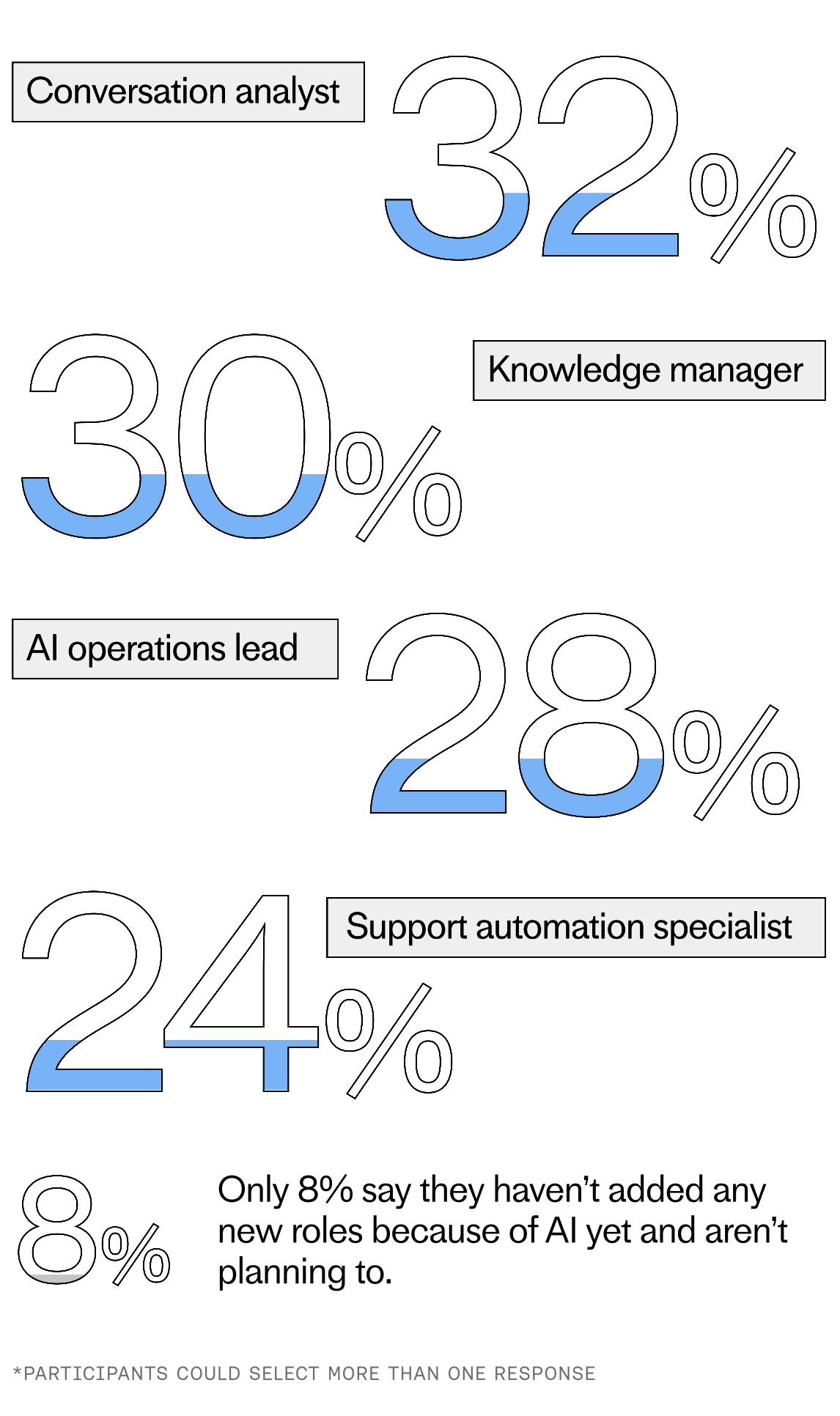
I’m also seeing a clear rise in dedicated AI specialists. Conversation analysts, knowledge managers, and AI operations leads are fast becoming standard. For support professionals, this opens new, higher-leverage career paths—and creates a talent pipeline that blends service excellence, data fluency, and product thinking.
Support once centered on queue-level activity—ticket triage, routing, translations, and answering FAQs. Now, as AI handles more frontline interactions, our human roles are moving up the stack toward optimization, oversight, and continuous improvement.
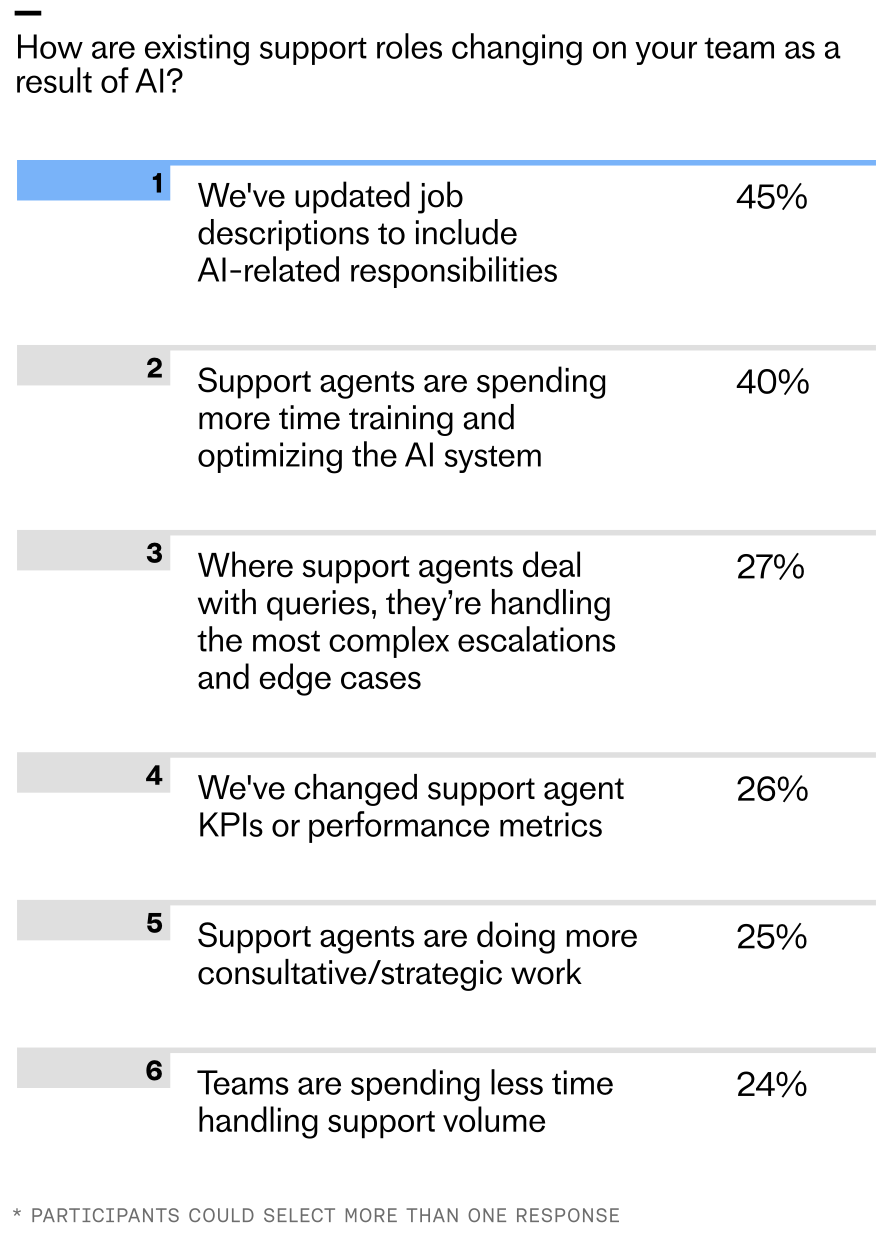
According to the latest research, 45% of teams report updating job descriptions to include AI-related responsibilities, with 40% saying their human agents are now more focused on training AI systems. Another 27% report that human agents primarily handle the most complex escalations and edge cases, while a quarter say agents are doing more consultative and strategic work.
Even at the initial deployment stage, 16% of teams report spending less time handling support volume since implementing AI – and among teams who’ve reached maturity, that figure rises to 28%.
When Intercom’s Research, Analytics & Data Science (RAD) team interviewed 166 of our customers, similar themes emerged. Nearly all participants (≈95%) reported meaningful workflow changes, with manual processes being handled by AI, and humans focusing more on monitoring or fine-tuning AI outputs. Eighty-three percent of participants also reported seeing their team’s roles and responsibilities change to become more strategic and supervisory in nature.
AI is reshaping support teams: organizations are adding conversation analysts (32%), knowledge managers (30%), AI operations leads (28%), and support automation specialists (24%). Just 8% report no new AI roles.
It’s not just the work that’s evolving; organizational structures are, too. Some teams are reallocating existing talent into AI-focused roles; others are hiring entirely new skill sets. Many of the most common job titles in this space didn’t exist two years ago.
Consider a Senior AI Knowledge Manager, Beth-Ann Sher, who transitioned from a help center manager role. Like many careers transformed by AI, her work evolved from administrative to strategic. Instead of focusing solely on customer-facing, self-serve content, her mandate expanded to designing and optimizing knowledge inputs that directly improve AI Agent Fin’s performance—work that materially lifts resolution rates.
Or look at a Senior Conversation Designer, Fred Walton, hired specifically for an AI-first function. He focuses on frictionless customer journeys with Fin, smoothing handoffs between automation and human support while keeping customer satisfaction front and center—hallmarks of mature AI workflows and conversation design.
In high-performing organizations, roles like these typically sit within a dedicated AI support team under senior CS leadership. Clear ownership and accountability for AI performance is critical; without it, optimization stalls and trust erodes.
These shifts aren’t isolated. Take Robb Clarke from RB2B. He went from Head of Technical Operations to Head of AI. With Fin, his focus moved from repetitive support questions to managing knowledge and improving the system behind it—freeing him to be proactive about product improvements and fix issues before they hit customers.
Or consider Eric Broulette from Bloomerang, a support leader who leaned into AI and became the VP of Support and Education. By deploying Fin, his team found breathing room to invest in what’s next. Agents stepped into new roles, contributed to meaningful projects, and built skills that had previously felt out of reach. As Eric puts it: “Do not wait to embrace AI. It will unlock more career growth for your teams than you can imagine.”
Leaders are racing ahead with real AI in support. Explore the 2026 Customer Service Transformation Report to see where deployment is stalling, benchmark your team, and get practical steps to scale automation that delights.
Bringing AI into support will eventually change every agent’s day-to-day work. For leaders at the start of the journey, that can feel daunting. My perspective: the most successful teams treat this as an operating model shift, not a tooling rollout—anchored in AI Strategy, governance, and continuous improvement.
Be transparent about what’s changing, why it matters, and how success will be measured. Define how AI performance will be evaluated (resolution rate, containment, CSAT impact), empower agents to train and improve the system, and communicate how responsibilities will evolve. When teams help build the AI, they’re invested in making it great.
Here’s the playbook I rely on with support leaders: First, reset expectations about time allocation—less time in the queue, more time improving the AI system that serves the queue. Second, elevate knowledge management as a core capability. Prioritize content quality and coverage for your AI Agent, and carve out dedicated “out of the inbox” time so every agent contributes. Third, keep outcome metrics—especially resolution rate—front and center. It gives the team a north star for experimentation and iteration.
Scaling AI is as much a people challenge as it is a technology challenge. As automation takes on more work, support roles become more proactive, strategic, and cross-functional—even early in the journey. Responsibilities expand, new roles emerge, and team structures adapt to concentrate on and amplify AI performance. In the process, support careers are transformed.
If you’re leading this shift, now’s the moment to reimagine your operating model: clarify ownership, invest in knowledge and conversation design, adopt eval-driven development, and build the muscle for continuous improvement. That’s how you move from tickets to strategy—and unlock compounding value for your customers, your business, and your teams.
I’ve led product organizations through multiple growth chapters, and the pattern is always the same: the tighter the alignment between product, sales, and marketing, the faster you scale. Reflecting on the journey of Chris Degnan — the first sales hire at Snowflake who spent 11 years helping scale the company from zero to $3.5 billion in revenue as its CRO while partnering with four different CEOs — I’m struck by how consistently the fundamentals win. The playbook isn’t mysterious; it’s disciplined execution, ruthless clarity, and a go-to-market strategy that matures with each revenue stage.
At $10M ARR, the CRO role is hands-on and founder-adjacent. You’re close to the product, running point on key deals, pressure-testing messaging, and building credibility with early customers. By $1B+, the job is organization design: segmentation, international expansion, forecast accuracy, enablement, recruiting, and cross-functional orchestration. The shift is from deal quarterback to system architect — standing up repeatable, auditable processes that produce reliable outcomes across regions, segments, and industries.
Sales leaders who can’t sell the product themselves don’t last. Whether you sit in product management leadership or run the field, you need to master discovery, speak the customer’s language, and translate use cases into value. That also means getting fluent in solutions engineering — understanding integrations, data paths, security, and the operational realities buyers live with. I’ve found this hands-on competence to be the fastest way to earn trust internally and externally, and to keep product strategy grounded in market truth.
The MEDDIC methodology is the foundation for every durable sales org — and, frankly, a founder’s best insurance policy. MEDDIC forces alignment on qualification criteria, from Metrics to Economic Buyer to Decision Process and Identifying Pain. When product and sales both operate to this standard, roadmap bets improve, marketing targets sharpen, and win rates climb. It’s not paperwork; it’s pattern recognition at scale.
High-output CROs obsess over the right numbers. Pipeline coverage by segment and stage; conversion rates through each gate; sales cycle length by use case; average selling price and discount discipline; consumption predictability when you have consumption SaaS pricing; and post-sale expansion velocity. The art is deciding which two or three metrics are the organization’s true north at a given stage — then designing enablement, compensation, and operating cadence around them.
On operating cadence, the week in the life at scale is predictable for a reason. Forecast reviews that surface risk early. Deal reviews that coach to MEDDIC depth, not activity theater. Enablement blocks to uplevel managers and ICs. Recruiting time — always. Customer roadshows to refine value proposition and product positioning. And standing meetings with product, marketing, and finance to keep the GTM motion, roadmap, and unit economics in sync.
Compensation is a force multiplier or a silent saboteur. Keep it simple, consistent, and aligned to the current motion. Early on, weight new logo acquisition and land quality; as you mature, balance new business with expansion, multi-product adoption, and healthy consumption. Guardrails matter — cap over-discounting, reward multi-threading, and avoid plans that create end-of-quarter cliff behavior. The best plans reinforce the behaviors you want your culture to scale.
Technical CEOs often underestimate how much narrative, segmentation, and process discipline great GTM requires. The handoff from founder-led GTM to sales-led growth is where many teams stall. My rule: prove one repeatable motion in one segment before you add complexity. Codify the buyer’s journey, instrument the funnel, and make sure product strategy and enablement move in lockstep.
Culture sets the ceiling. You have to find the fakers, manage-uppers, and passengers quickly — people who look busy but don’t move pipeline, who talk big but avoid accountability, or who ride the momentum of others. The mantra that has saved me endless time: “When there’s doubt, there’s no doubt”. Move fast, but with humanity; be clear on expectations, coach hard, and when it’s not a fit, make the change before the team does it for you.
Feedback is the operating system of a high-performing org. Leaders at every level need to be coachable — on message discipline, on forecast rigor, on how they develop people. I’ve benefited from straight talkers who hold a high bar, and I try to pay that forward. The fastest way to raise organizational IQ is to institutionalize feedback loops across sales, product, and marketing — from post-mortems to win-loss analysis to field-sourced roadmap reviews.
What separates exceptional ICs from the rest? Hunger, intellectual honesty, and a builder’s mindset. They qualify hard, align to customer metrics early, multi-thread to power and value, and partner tightly with solutions engineering. They don’t hide from gaps; they surface them, and they know exactly what they need from product, marketing, and leadership to win.
Executive teams that scale share a few traits: crisp segmentation decisions, single-threaded ownership for outcomes, and healthy conflict that resolves into commitment. Dysfunction, by contrast, looks like metrics roulette, opaque decision-making, and a tolerance for exceptions that become precedent. Make the rules explicit and the exceptions rare.
Leaders like Frank Slootman have popularized intensity, speed, and focus — and there’s real power there when paired with clarity and data. The lesson I carry forward: move fast on people decisions, keep the message simple, and measure what matters. Equally important is knowing where that approach can backfire — when speed outruns learning, or when pressure erodes cross-functional trust. The best operators balance urgency with systems thinking.
Most AI companies will face a go-to-market reckoning. Model quality won’t save a weak motion. The winners will articulate a hard-nosed ROI, solve specific workflow pain, address data governance and security head-on, and show measurable lift — not demo dazzle. In other words, the same fundamentals apply; the stakes and scrutiny are just higher.
If you’re building or rebuilding your revenue engine, start here: define your ideal customer profile and segmentation with ruthless clarity; adopt MEDDIC and teach it across product and sales; align compensation to today’s motion; instrument the funnel and inspect it weekly; and cultivate a culture where feedback is fuel. Do that, and the path from $0 to $3.5B stops feeling like mythology — and starts looking like math.
Where is the true boundary between product and engineering—and what happens when it gets blurry? I’ve led and coached teams through this question many times, and I’ve learned that clarity here isn’t just a nice-to-have; it’s foundational to quality, velocity, and team health.
I’ve seen well-intentioned product managers step in to “help” by taking ownership of bug triage, tech debt prioritization, or even system architecture. At first, it feels productive. Over time, it creates role confusion, slows decision-making, and burns out PMs—while paradoxically lowering engineering quality. The “CEO of the product” myth and legacy IT, project-based mindsets are usually at the root. Treating engineers as “order takers” breaks down in evergreen product environments.
The healthiest collaboration model is simple and disciplined: The product trio owns the “what”; engineering owns the “how”. Product managers are not people managers for engineers—and shouldn’t be accountable for engineering quality. Our job is to frame the problem, align on outcomes, and continuously discover value with customers—not to supervise technical execution.
If quality is a problem, the solution is escalating and fixing the system, not managing individual bugs. In practice, that means surfacing patterns and elevating them to engineering leadership, who can address root causes—staffing, skills, code health, CI/CD gaps, observability, or process design—rather than asking PMs to paper over issues with status updates. This keeps accountability where it belongs and reinforces outcomes vs output OKRs.
One high-leverage move is to remove unnecessary intermediaries. Removing the PM as a middleman creates better flow and clearer ownership. Create direct paths for stakeholders to get bug status without routing everything through product. Use dashboards, shared tools, or Slack channels instead of one-off updates. In my teams, shared Jira views, Slack incident channels, and status pages eliminated handoffs, improved stakeholder management, and gave engineers the space to solve problems end-to-end.
Strong engineering leadership is non-negotiable. What strong engineering leadership should own (and why that matters) is the technical system, quality guardrails, sustainable pace, and the practices that uphold them—incident management, code review rigor, test coverage, and SLOs with SRE. Skilled engineering teams naturally push back when boundaries are crossed—and that’s a good thing. It signals ownership, craft pride, and a pathway to durable execution.
When do I step in as product? Primarily to clarify desired outcomes, sequencing, and trade-offs—bringing customer and business context to the table. I structure product roadmapping and sprint planning around value slices and risks, not task lists. I align on decision rights early: architecture and tech debt strategies live with engineering; product strategy, positioning, and success metrics live with product; discovery and prioritization live with the product trio.
Here are the system-level moves I’ve found most effective: Escalate systemic quality issues to engineering leadership, not individual contributors. Advocate for real engineering leadership if your org expects product teams—not IT teams. Then reinforce a culture of continuous discovery so product, design, and engineering make better upstream decisions together. This is how empowered product teams ship higher-quality outcomes—without burning anyone out.
If you’ve ever found yourself acting as the middleman for bug status or being asked to “own” engineering decisions outside your expertise, you’re not alone. Reset the boundaries, make work visible, and double down on shared outcomes. In my experience, the moment we clarify roles and remove status theater, quality rises, cycle time improves, and everyone does the job they were hired to do—better.
Human-in-the-loop oversight is the fastest and most reliable way I know to elevate AI quality, build user trust, and reduce risk. At HighLevel, my teams treat oversight as a product feature—not an afterthought—because dependable AI experiences come from deliberate design choices across data, models, and people.
When I say “human-in-the-loop,” I mean a system that blends automation with targeted human judgment at key moments: during data curation, prompt engineering, evaluation, deployment, and post-launch learning. This approach turns “AI workflows” into measurable, repeatable processes and keeps me honest about what’s working, what’s drifting, and where a human safety net must step in.
Architecturally, I start with a retrieval-first pipeline to ground outputs in trusted knowledge, then wrap it in guardrails. Deterministic preprocessing, careful prompt engineering, and post-processing validators catch obvious failure modes. Confidence thresholds and policy checks route ambiguous or sensitive cases to a human reviewer, while clear, auditable traces show why the system chose automation versus escalation. This balance supports reliability at scale while preserving agility for “agentic AI” patterns when they add value.
Quality is only real if I can measure it, so I build with eval-driven development from day one. I maintain golden datasets, rubric-based scoring guidelines, and an automated evaluation harness that runs on every change to prompts, models, or data. Pre-production gates protect against regressions, while production telemetry surfaces drift by segment and use case. When it’s time to run experiments, I use A/B tests sized with a minimum detectable effect (MDE) to avoid overfitting to noise.
Operationally, I optimize for outcomes, not output. I track task success rate, time-to-resolution, safety violation rate, hallucination rate, and cost-to-serve, then connect these to outcomes vs output OKRs. The signal I want is simple: are we reliably solving the user’s job-to-be-done with lower effort and higher confidence? If not, I tighten prompts, refine retrieval, or expand human review where it pays off most.
Risk governance is non-negotiable. I design with privacy-by-design and data governance from the start—role-based access, audit trails, PII redaction, and red-team tests for safety. Clear reviewer playbooks and calibration sessions reduce bias and ensure consistent decisions. These practices aren’t bureaucracy; they’re how I operationalize AI risk management while maintaining velocity.
Teams make or break this model. I empower product trios to own the full lifecycle—discovery, build, and learning—so feedback loops close quickly. In-product feedback widgets, reviewer queues, and incident management playbooks help us respond in hours, not weeks. Over time, human review becomes a targeted scalpel rather than a blanket requirement as the system learns and improves.
Economics guide the level of oversight. I treat each workflow like a portfolio: where the value of accuracy is high and ambiguity is common, I route more to humans; where tasks are simple, frequent, and well-bounded, I automate aggressively. The goal isn’t zero humans—it’s optimal humans, deployed precisely where their judgment compounds ROI.
If you’re getting started, begin with one high-impact workflow, establish your golden set and evaluation rubric, and wire in a simple review queue. Prove the lift, then scale. In the short video above, I walk through the patterns I use to design these loops, measure quality with rigor, and ship AI that teams—and customers—can trust.
I’ve learned that the most effective partner product marketing is less about decks and more about decisions. When I collaborate with partner product marketing managers, we translate complex capabilities from a unified analytics platform into crisp, outcome-led narratives that customers can act on. This is where product positioning and go-to-market strategy intersect to create momentum for product-led growth.
In my experience, the strongest partner product marketing managers operate like solution orchestrators. They align value propositions across partners, clarify the problem-solution fit, and articulate competitive differentiation without drowning teams in feature lists. By anchoring messaging in clear customer pains and measurable gains, they help everyone—from solutions engineering to sales—tell the same story with confidence.
My playbook starts with outcomes. We define the “why” in terms customers care about, then quantify it with retention analysis, user activation, and time-to-value. That evidence shapes positioning, enables tighter points of parity and differentiation, and ensures our value proposition resonates in market. The result is faster alignment and fewer cycles spent debating messaging without data.
Cross-functional execution makes or breaks the strategy. I partner closely with solutions engineering to validate solution patterns, and with sales to balance sales-led motions alongside product-led growth. Strong stakeholder management keeps discovery loops tight: we capture objections early, refine narratives quickly, and reduce friction across the funnel.
On the tactics side, I rely on A/B testing to de-risk bold messaging changes and to optimize in-app guides and product tours. We set a minimum detectable effect upfront, instrument journeys with Amplitude analytics, and iterate quickly. This gives the team statistical confidence while keeping speed high—especially when refining narratives for complex partner solutions.
Ultimately, great partner product marketing illuminates the shortest path from capability to customer value. When we pair disciplined positioning with data-driven learning, we strengthen our go-to-market strategy and build durable competitive advantage. That’s how we turn strong solutions into market-leading stories that win—and keep—customers.
Inspired by this post on Amplitude – Best Practices.
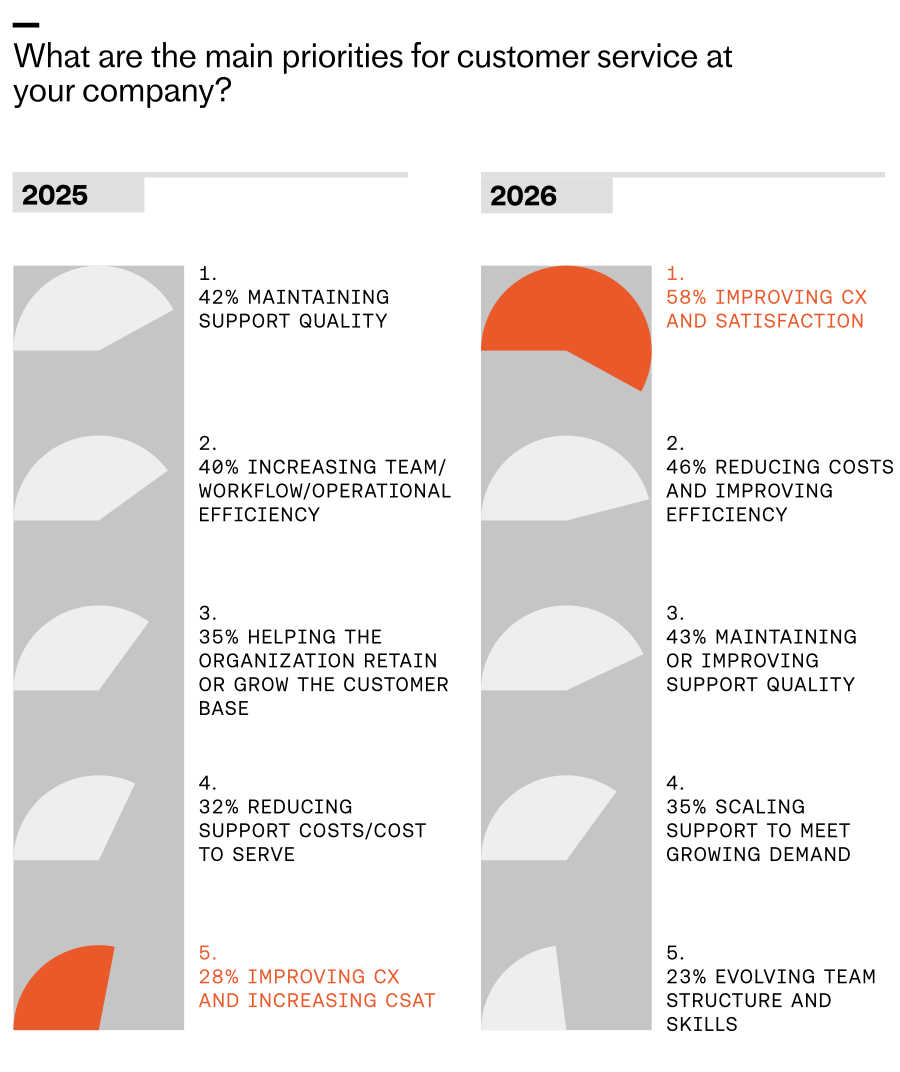
For years, I chased the elusive goal of delivering a perfect customer experience. Today, with AI embedded in our support operations, that standard is finally within reach—and it’s reshaping how we prioritize, design, and scale service.
In “The 2026 Customer Service Transformation Report,” teams report early, tangible wins from AI: faster responses, higher efficiency, and consistent coverage across languages and time zones. Those gains create the capacity we’ve always needed. The more we push the technology, the more quality improvements we unlock.
This marks a fundamental shift. As AI takes on more, our focus can finally move from firefighting to crafting the customer experience. When the AI is working, the measure of success becomes how well it’s working—across accuracy, tone, resolution, and end-to-end journey quality.
I’ve seen this transformation firsthand. Mature AI deployment gives my team “breathing room,” so we can design for consistently excellent outcomes rather than obsess over deflection. That means widening access to support, removing friction on the path to resolution, and anticipating customer needs before they escalate.
In our own support organization, we opened support to trial customers, accelerated first response times, and added consultative sessions during onboarding. We absorbed a 300% increase in total demand without adding headcount—made possible by deep integration of an AI Agent and a disciplined AI strategy.
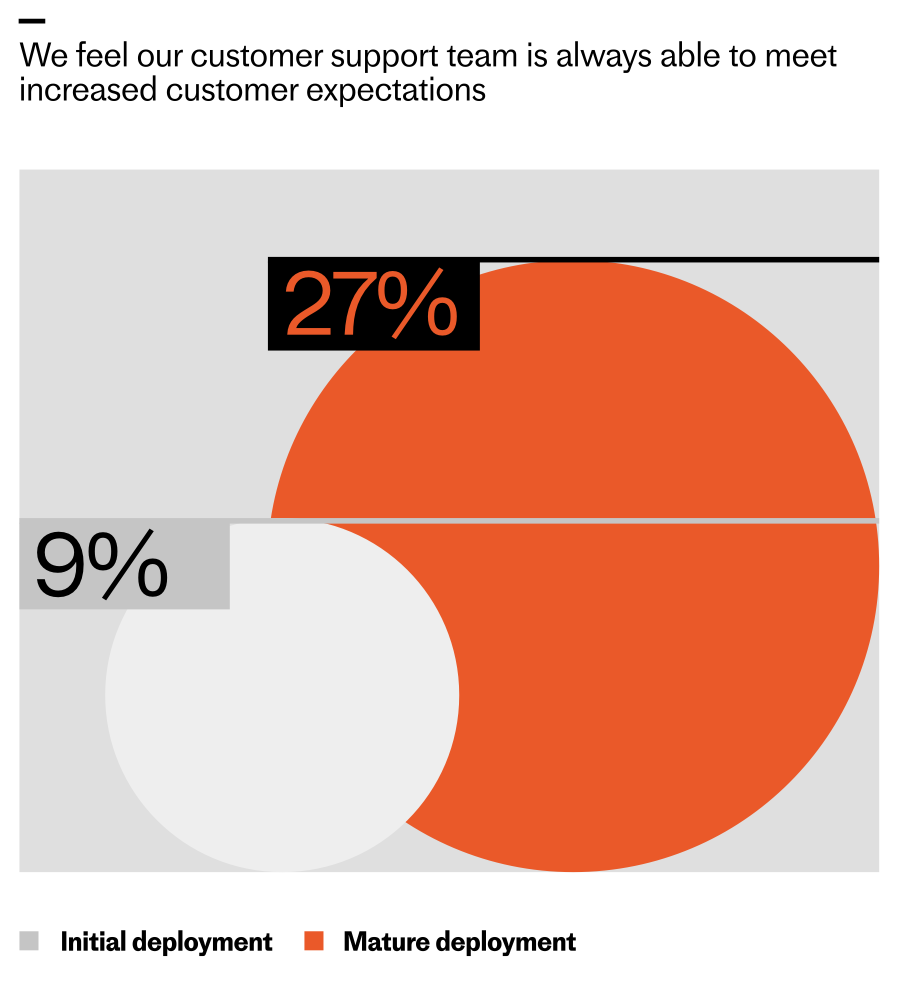
Teams with mature customer service deployments are nearly three times likelier to say they always meet increasing expectations—27% vs 9% at initial rollout—highlighted by bold orange and gray comparison bubbles.
Across the industry, the pattern is similar. When teams initially deploy AI, only 9% say they can always meet customer expectations. That number triples as teams reach a mature level of deployment. Even as expectations rise, the organizations that deeply integrate AI—complete with clear ownership, robust instrumentation, and continuous improvement loops—are the ones most likely to meet (and exceed) the bar.
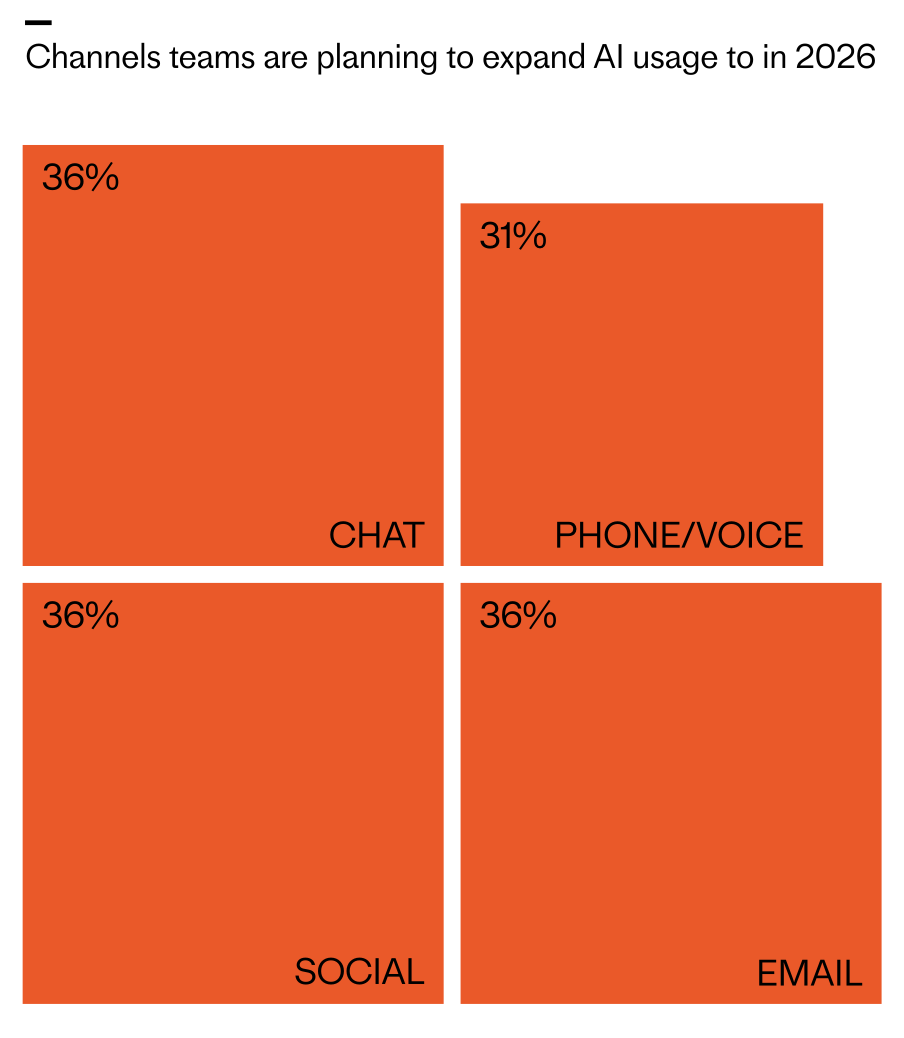
Looking ahead to 2026, I expect omnichannel consistency to become a key differentiator. The data shows planned investment is distributed nearly equally across chat, email, and social messaging (36% each), closely followed by phone/voice (31%). The question is no longer “Which channel should we optimize?” but “How do we deliver a consistent, AI-powered experience everywhere our customers are?”
Teams that solve for omnichannel consistency will bridge the long-standing gap between what customers expect and what support can deliver. Every touchpoint becomes an opportunity to exceed expectations and build durable trust.
Consider Clay, a team that scaled support without sacrificing quality. Support is one of their main growth drivers, and as their customer base expanded, ticket volume surged. Early on, they concentrated much of their effort in Slack, cultivating close, transparent community relationships. But relying on a single channel created friction as they grew; customers wanted the flexibility of email and in-app chat, and Clay needed to deliver the same high standard everywhere.
Where AI investment is headed for customer service in 2026: chat, social, and email lead at 36%, with phone/voice close behind at 31%. A bold visual snapshot of shifting channel priorities in CX.
By unifying their support experience with an AI Agent, Clay brought consistency across channels. Today, AI is involved in 90% of all queries and handles half of Clay’s total volume, upwards of 7,000 queries a month. First response rates improved significantly, freeing the team to focus on proactive, high-impact work.
That work includes identifying content gaps for education and content marketing, reaching customers before they need to ask for help, and surfacing feature requests and recurring challenges to product teams. Clay proves that when support is truly great, it becomes a competitive edge.
So how do you build a superior customer experience with an AI Agent? Here are five principles I use when scaling toward mature deployment.
1) Treat customer experience like a product. Treating support as a product means designing, building, and managing the support experience with the same rigor as your core product. You define goals (faster onboarding, higher CSAT or CX Score, lower churn). You map flows (AI starts the conversation, human handovers, proactive nudges). You instrument the journey (track handoffs, drop-offs, success states). You run tests and ship improvements (tone tweaks, fallback paths, training updates). You own the outcomes (gather feedback, measure performance, use insights to continuously improve the system).
Leaders are racing ahead with real AI in support. Explore the 2026 Customer Service Transformation Report to see where deployment is stalling, benchmark your team, and get practical steps to scale automation that delights.
2) Lead with AI, back with humans. AI isn’t replacing the human touch. It’s redefining when, where, and how it’s most valuable. In a scaled model, AI is the first responder and the end point for most conversations. Humans step in where they add the most value—particularly during high-stakes issues—and those handoffs should feel seamless. Meanwhile, your team focuses on improving AI performance and optimizing the end-to-end journey.
3) Be proactive. Use AI to anticipate needs, guide customers before problems arise, and nudge them toward successful outcomes. This is where customer support AI strategy shines—moving from reactive triage to journey orchestration that protects momentum and builds trust.
4) Build for trust. Many customers still carry the legacy of clunky chatbots that delivered vague answers and dead ends. You earn trust by showing that your system works. Don’t hide your AI Agent behind layers of “choose an option.” Get customers to the AI quickly, demonstrate real problem-solving, and ensure that when a human is needed, they join with full context to resolve complex issues efficiently.
5) Make it feel personal. Your AI Agent represents your brand. The way it speaks, follows policies, and responds matters. Use tone control, fallback logic, and language preferences to align the experience to your standards. Consistency builds trust; personality builds connection and loyalty.
Perfect really is possible. With deep AI implementation, you can scale comprehensive, fast, and personal support across channels—so customers feel supported not just when they reach out, but throughout their journey. That’s the promise of modern AI workflows in support, and it’s what will separate leaders from laggards in the years ahead.
Your team may already use AI to draft emails, summarize calls, research accounts, and answer website questions. Yet the lead still waits in a queue, the seller still reconstructs context, and the customer still repeats the same information after every handoff.
If you are deciding how to make go-to-market genuinely AI-native, do not start with another list of tools. Decide which part of the revenue journey can run as a complete, observable workflow: AI handles defined decisions and actions, humans take over at explicit boundaries, and both work from the same customer state.
Redraw the revenue workflow before automating its tasks
Adding an assistant to every department can make individual tasks faster without making the revenue system faster. Marketing produces more content, sales receives more research, and customer success gets more summaries, but the queues and handoffs between those functions remain intact. More output can even make those bottlenecks worse.
An AI-native workflow has a different unit of design. It owns a bounded outcome over time. It can observe an event, retrieve approved context, choose among permitted actions, update the CRM, evaluate what happened, and either continue or escalate. The distinction matters: generating a follow-up email is a task; noticing that a qualified buyer has gone quiet, selecting the appropriate follow-up, sending it under policy, recording the attempt, and changing course based on the response is a workflow.
Map one live customer journey before discussing models or vendors. For every transition, write down six things:
Trigger: What observable event starts the work? Examples include a demo request, an unanswered question, a completed trial action, or a missed follow-up.
State: What must be known before anyone acts? Include the account, buyer, stage, previous interactions, consent, product usage, and open commitments that matter.
Decision: What choice is being made? Qualification, routing, next-best action, escalation, or disqualification should not be hidden inside a vague prompt.
Action: What is the agent actually allowed to do? Drafting, sending, booking, calling, demonstrating, updating a field, or creating a human task are different permission levels.
Evidence: What will prove that the action was appropriate and completed? Preserve retrieved passages, tool results, timestamps, policy checks, and the resulting CRM change.
Exception owner: Who takes responsibility when confidence is low, the buyer objects, the data conflicts, or the request falls outside policy?
This map exposes where AI can remove elapsed time rather than merely reduce typing. Baseline the current path using measures you already trust: time between stages, abandonment points, manual touches, repeated discovery, and incomplete CRM records. Then choose one customer outcome, such as completing a qualified next step, instead of treating generated messages as success.
My test is simple: if the proposed system cannot identify its current state, show why it acted, and recover from a failed action, it is still a feature. It is not yet part of the revenue operating system.
Start with a bounded inbound motion, then earn more autonomy
I would usually start where the buyer has already expressed intent. An inbound visitor asking a product question or requesting a demonstration gives you a clear trigger, an identifiable job, and a natural human fallback. You can observe whether the interaction advances the buyer without asking an agent to manufacture demand across an ambiguous market.
A strong first workflow has five properties:
The entry event and desired next state are unambiguous.
The agent can answer from an approved and maintainable body of knowledge.
Most actions are reversible, or a human can approve them before execution.
Failure and frustration can be detected quickly.
The business outcome appears in a system of record rather than a separate AI dashboard.
Inbound qualification, guided product education, demo support, meeting preparation, and structured follow-up often fit these conditions. A practical early implementation can be deliberately modest: a voice interaction, reusable product demonstrations, and a retrieval-first knowledge layer. Retrieval gives the agent current, company-approved material without forcing every sales fact into a prompt, and it gives evaluators evidence against which to judge an answer.
Treat the interaction surface as part of the workflow, not as decoration. In one documented implementation, adding a realistic avatar changed how prospects behaved: they interrupted, probed, and requested demonstrations in ways associated with a live sales conversation. That is evidence that an interface changes the behavior it invites, not proof that every buyer or sales motion needs an avatar. Test chat, voice, and video against the buyer’s actual job. Do not choose the most human-looking interface by default.
Expand autonomy in gates rather than with one large launch:
Shadow: The agent recommends an answer, decision, or next action while a human remains responsible for execution. Use disagreements to build the first evaluation set.
Constrained execution: The agent handles approved questions and actions, writes every result to the CRM, and routes exceptions to a named person.
Bounded workflow ownership: The agent can continue across interactions and days, but only inside an explicit state machine, policy envelope, and escalation contract.
Adjacent expansion: Reuse proven capabilities in another stage, such as onboarding or customer success, only after the first workflow is stable and measurable.
Gate movement on evidence, not enthusiasm or a calendar date. The agent should not receive a new action merely because it can generate plausible language. It should receive that action when you can detect a bad decision, contain its consequence, and restore the customer journey.
Give agents distinct jobs and humans a real handoff contract
A single prompt that qualifies, pitches, retrieves facts, controls tools, remembers history, evaluates itself, and decides when to escalate becomes difficult to test. It also mixes goals that can conflict. A persuasive sales response and a conservative policy check should not compete for attention in the same undifferentiated instruction block.
A useful architecture separates five responsibilities:
Knowledge or creator agent: Turns approved documentation, training material, and transcript patterns into versioned playbooks and retrievable knowledge.
Conversation agent: Handles the live interaction, asks the next appropriate question, and stays within the current objective.
Workflow orchestrator: Maintains state across channels and time, selects the next permitted step, invokes tools, and pauses when an exception occurs.
Evaluator: Scores the interaction for grounding, policy compliance, conversation quality, sentiment, and task completion.
Human owner: Resolves ambiguity, negotiates unusual terms, restores trust, and changes the playbook when the system exposes a recurring gap.
Specialized conversation roles can also help manage latency, context limits, and model weaknesses. Greeting, discovery, qualification, and pitching do not necessarily need identical instructions or context. The important design move is not the number of agents; it is the ability to isolate a responsibility and test it. Deterministic paths can handle predictable stages while orchestration manages contextual departures.
Do not split a workflow into a swarm merely because multi-agent architecture sounds advanced. Start with the fewest independently testable components. Split one when its context becomes noisy, its latency threatens the experience, its permissions need separate control, or its failures require a different evaluation method.
The orchestrator should persist a compact state record that another worker can understand. At minimum, capture the current objective, stage, known facts, supporting evidence, confidence, unresolved questions, commitments already made, next permitted action, and current owner. Keep the transcript available, but do not force every downstream decision-maker to reconstruct state from raw conversation history.
A human handoff is a product contract, not an emergency notification. Define its triggers before launch. Useful triggers include:
The agent cannot find approved evidence for a material answer.
Confidence falls below the level you have defined for that action.
The buyer repeats a correction, expresses frustration, or explicitly requests a person.
The request involves commercial, security, legal, or contractual judgment outside the approved playbook.
A tool fails, CRM state conflicts with the conversation, or the proposed action would duplicate an existing commitment.
The receiving person needs more than a transcript link. Send the buyer’s goal, the current stage, facts already established, the reason for escalation, supporting evidence, actions attempted, promises made, urgency, and the decision the human must make. Pause further automated outreach until ownership is acknowledged. Otherwise, the agent can send a cheerful follow-up while a seller is handling a sensitive objection.
After the human resolves the case, specify whether control returns to the workflow and what state must change first. That return path is where many pilots quietly become permanent manual operations.
The CRM must carry this shared state in both directions. Agents should read the latest account context and write back decisions, actions, outcomes, and evidence. A system that conducts a convincing conversation but leaves the record incomplete creates invisible work for the next person. Tight CRM integration and persistent workflow orchestration are what turn an interface into an operating capability.
Use evaluations and revenue governance as the control plane
A polished demonstration proves that a workflow can succeed once. Revenue leaders need evidence that it succeeds repeatedly, fails visibly, and improves without silently regressing. That requires an evaluation system tied to release decisions.
Build the control loop in this order:
Define the failure taxonomy. Separate unsupported facts, policy violations, missed discovery, poor routing, broken tools, excessive latency, incorrect CRM updates, weak handoffs, and incomplete outcomes. A single quality score hides the repair you need.
Create a representative evaluation set. Include common interactions, important segments, known edge cases, adversarial requests, tool failures, and examples that should trigger escalation. Label the expected action and unacceptable actions, not only an ideal sentence.
Review production conversations aggressively at the start. One practical deployment pattern reviews every interaction during early operation and tapers toward a sample of about 5% as confidence grows. The reduction is earned through observed quality; it is not a default schedule. Customer review, evaluator scoring, and sampling can operate as one quality loop.
Turn failures into regression tests. When a human corrects an answer, routing decision, or handoff, add a durable test before changing the prompt or playbook. Otherwise, fixing one conversation can break another without detection.
Release progressively. Use proof-of-concept validation, controlled exposure, A/B rollout where appropriate, CRM logs, and dashboards. Preserve a rollback path for prompts, models, playbooks, tools, and policies.
Expand authority only after two kinds of evidence agree. Agent quality must remain acceptable, and the intended business outcome must improve without shifting damage into complaints, bad-fit pipeline, downstream rework, or customer churn.
Your dashboard should distinguish system quality from business performance. Both are necessary, and neither can substitute for the other.
Qualified progression, completed bookings, stage movement, activation, retention, and downstream rejection of poor-fit opportunities
Operating health
Can the capability run and improve reliably?
CRM completeness, failed actions, recovery, human review load, overrides, version history, and cost per completed outcome
Do not reward the agent for conversion alone. A system can raise a local conversion metric by overpromising, qualifying weak opportunities, or making escalation harder. Review performance by segment and release version, and keep quality and downstream outcome guardrails beside the target metric.
Governance also needs named owners. The CRO should own the end-to-end revenue outcome and the interlocks across marketing, sales, solutions engineering, onboarding, and customer success. Product and AI leaders should own agent behavior, experience, evaluation infrastructure, and release gates. Revenue operations should own CRM state, definitions, attribution, and operational dashboards. Functional leaders should own their playbooks and exception policies. Humans in the workflow should own judgment where trust, negotiation, and ambiguity matter.
Centralize the parts that must remain consistent: data definitions, core tooling, pricing guardrails, evaluation standards, and foundational enablement. Let segment plays, partner motions, and contextual field execution stay closer to the teams that understand them. This avoids two common extremes: every function buying its own disconnected agent, or a central AI group becoming the queue for every revenue experiment.
Pair gated releases with a 24-26 month design horizon. The longer view is not a promise that you can forecast models or markets precisely. It forces you to ask what breaks at higher volume, which capabilities must remain centralized, how roles will change, and what data or evaluation debt would block the next level of autonomy. The release in front of you can remain small while the operating architecture anticipates scale.
The first leadership review should produce five concrete artifacts: a workflow map, an agent charter, a human handoff contract, an evaluation set, and a dashboard with a named decision-maker for every release gate. If the meeting ends with only a vendor shortlist, the transformation has not yet been designed.
Key takeaways
If an agent cannot read and update shared customer state, it is an interface attached to the revenue system, not a worker inside it.
If the handoff criteria and return path are unclear, the agent’s autonomy is already too broad.
If production failures do not enlarge the evaluation suite, the organization is collecting incidents rather than compounding learning.
If a buyer must repeat discovery after escalation, the context architecture has failed even when the AI behaved politely.
If the roadmap is organized around tools instead of revenue-state transitions, no executive truly owns the transformation.
At your next go-to-market review, choose one live inbound path and walk a real lead through it from trigger to next customer outcome. Assign state, evidence, permissions, and an exception owner at every transition. Automate only the steps whose failure you can detect and recover from. That is how you earn the right to give AI more of the revenue journey.
Over the past few years, I’ve led cross-functional teams to deploy agentic AI in production, and I’ve learned that success rarely hinges on the model alone. It comes from methodically designing the right workflows, instrumenting every step, and building a feedback loop that compounds. Learn how companies like Replit are consolidating workflows, creating one-person departments, and building systems for scale with Amplitude.
When I talk about AI agents, I’m describing software that behaves like a focused teammate—owning a clear job to be done end-to-end. In practice, that means consolidating fragmented tasks into a single accountable “one-person department,” then giving it the context, tools, and analytics to perform reliably. This is how agentic AI moves beyond demos into durable business impact.
I start with outcomes, not algorithms. I map a driver tree from business goals (e.g., lower response time, higher activation, better retention) to the specific moments an agent can influence. This outcome-first alignment keeps scope tight, informs guardrails, and grounds the value proposition in measurable change instead of vanity metrics.
Next, I define the workflow the agent will fully own. I look for high-volume, rules-adjacent processes—think lead qualification, support triage, or billing inquiries—where clear decision criteria already exist but human time is the bottleneck. I document triggers, inputs, decision points, and handoffs, then design the ideal-state flow the agent will run autonomously, with transparent escalation paths to humans.
On architecture, I favor a retrieval-first pipeline to keep responses accurate and current. I scope the knowledge base, implement context window management, and standardize tools the agent can call (search, CRM actions, ticket updates). For teams new to this, I coach “LLMs for product managers” fundamentals so we make sensible trade-offs between speed and reliability rather than chasing model-of-the-week headlines.
Instrumentation is where the system becomes self-improving. I use Amplitude analytics and an Agent Analytics schema to track intent detection, tool usage, resolution rate, time-to-resolution, deflection, and escalation causes. A unified analytics platform lets me connect agent outcomes to core product metrics—activation, retention, and conversion—so we can see the real revenue and experience impact, not just local efficiency gains.
To validate impact, I run A/B testing when traffic allows, setting a minimum detectable effect (MDE) upfront to avoid inconclusive reads. In lower-volume scenarios, I lean on eval-driven development: curated test sets for edge cases, scenario-based regression suites, and error taxonomies that accelerate iteration. Feature flags let us stage capabilities safely (shadow mode, assistive, autonomous) while we monitor deltas before full rollout.
Reliability and trust are designed in from the start. I apply AI risk management practices—privacy-by-design, data governance, and policy-aligned prompt templates—paired with observability to trace decisions. Clear escalation policies, incident management runbooks, and human-in-the-loop checkpoints ensure the agent fails safe, not silently.
Shipping cadence matters. I use CI/CD to increase deployment frequency, keep prompts and tools versioned, and gate risky changes with targeted rollouts. As patterns stabilize, we scale horizontally to new use cases, sharing core capabilities (retrieval, analytics, guardrails) as a platform. This is how “one-person departments” multiply without multiplying overhead.
Change management closes the loop. I partner with product trios and frontline teams to co-design prompts, set acceptance criteria, and define what “good” looks like in plain language. In-app guides and product tours introduce the agent’s role and limits, and structured feedback channels feed directly into our discovery and iteration rhythm.
The throughline of this playbook is simple: treat agents like real teammates with a job description, operating procedures, and performance reviews. With disciplined workflow design, a retrieval-first pipeline, and outcome-level instrumentation in Amplitude, agentic AI stops being a science project and starts compounding into durable product-led growth.
Inspired by this post on Amplitude – Perspectives.
Your analytics agent can turn a question into a chart. Then a product leader asks which activation definition it used, an analyst gets a different cohort result, or security discovers that the agent queried data the user could not normally access. That is where a promising pilot becomes an enterprise risk.
The way through is not a better chat interface. You need a controlled path from question to decision: approved definitions, bounded tools, task-level evaluations, visible evidence, and permissions that expand only after the agent proves it can handle a specific workflow reliably.
Before you give an agent a task, define its contract. The contract should answer five questions:
What decision is being supported? A request to explain a funnel is different from a request to change the funnel definition or publish a recommendation.
Which definitions are authoritative? Identify the canonical metric, its version, the population, the unit of analysis, the time window, and any approved exclusions.
What may the agent access and do? Specify datasets, fields, tools, credentials, and whether the task is read-only, produces a draft, or can trigger an action.
What evidence must accompany the answer? Require the metric identifier, query or tool calls, filters, lineage, assumptions, and enough result detail for an analyst to reproduce the work.
When must the agent stop? Define the ambiguities, policy conflicts, statistical gaps, and high-consequence actions that require clarification or approval.
Consider a seemingly simple question: Did activation decline for new accounts? The answer depends on the approved activation event or event sequence, cohort entry rule, identity resolution, time zone, date range, and exclusions. If the agent silently supplies one of those details, it has made a product decision while pretending to perform analysis.
The safe behavior is straightforward. The agent should retrieve the approved definition, display the material assumptions, and ask for clarification when the remaining ambiguity could change the result. It should not create a new activation definition in the course of answering the question. Changes to definitions belong in a governed workflow with an owner, review, version history, and rollback path.
This distinction also gives you a better definition of accuracy. An answer fails if it uses the wrong metric, violates an access rule, omits a material assumption, or cannot be reproduced, even when the final number happens to be correct. Trust is a property of the whole execution path, not only the sentence shown to the user.
Move through four levels of autonomy one task at a time
Teams often treat agent maturity as a platform-wide label. That hides risk. The same system may be mature enough to draft a funnel but not mature enough to interpret an under-specified experiment. Assign maturity to each task, dataset, and action instead.
Level
Agent role
Evidence required before moving forward
L0: Conversational interface
Summarizes charts or reports that already exist.
The agent accurately identifies the selected artifact, preserves its filters and caveats, and does not imply that it performed new analysis.
L1: Grounded retrieval
Retrieves definitions and context from the analytics catalog, taxonomy, or metric store before answering.
Canonical definitions are consistently selected, citations and assumptions are visible, and retrieval respects the requesting user’s permissions.
L2: Governed tool use
Reads schemas, generates safe SQL, calls approved tools, and reconciles results against canonical definitions.
Representative tasks pass golden-data and regression evaluations; queries, tool calls, lineage, errors, latency, and cost are observable.
L3: Bounded autonomous workflow
Completes an end-to-end workflow with approval gates, audit logs, feature flags, and rollback controls.
The exact workflow has a stable evaluation history, clear ownership, tested failure handling, and a reversible execution path.
L0 can still be useful. It reduces navigation work and helps a user understand an existing dashboard. The mistake is presenting that convenience as autonomous analytics. L1 improves trust by grounding language in the organization’s own definitions, but retrieval alone does not prove that a newly calculated result is correct.
L2 is the consequential transition. The agent is no longer explaining an approved artifact; it is producing analytical work. Schema awareness, safe SQL, result reconciliation, and complete traces become release requirements rather than optional diagnostics.
L3 should describe a narrow, governed workflow, not a general promise that the agent can handle anything. For example, an agent might autonomously refresh an approved weekly retention analysis while still requiring an analyst to approve a new cohort definition. Broaden the task boundary only after the additional behavior has its own tests and controls.
Build evaluations around the work people actually do
A generic chatbot benchmark will not tell you whether an agent can support your product decisions. Your evaluation unit should be a complete analytics task performed under your definitions, schemas, policies, and edge cases.
I hear the same refrain from product leadership peers everywhere: we’re overwhelmed. Shrinking headcount, constant AI disruption, economic uncertainty, and relentless context switching make it feel like we’re carrying two jobs—setting strategy while shielding our teams. I recently listened to an episode of All Things Product that zeroes in on what a real support system for product leaders looks like, and it resonated deeply with my day-to-day.
Want to listen to the conversation yourself? Find it on Spotify or Apple Podcasts.
Here’s the core tension I see (and felt early in my own leadership journey): product leaders tend to underinvest in themselves. We hold onto work because it feels faster, safer, or “just easier if I do it.” But that pattern quietly taxes strategy, slows learning, and caps team throughput. The hidden cost of “doing it all yourself” is real.
Early in my tenure leading product, I tried to keep every plate spinning—roadmap reviews, stakeholder prep, user research, executive updates—while protecting my team’s focus. I was busy and useful, but not maximally valuable. The turning point came when I started building a lightweight support stack: a few hours of executive assistant help each week, targeted research support for bet sizing, and a personal cadence with a leadership coach. The result wasn’t just more time; it was better time.
One provocative point that landed hard: product leaders rarely have executive assistants—and that’s a problem. If your calendar is your operating system, an EA is an extension of your leverage. Mine now handles scheduling, meeting hygiene, prep packets, and post-meeting artifacts. That shift moved me from “calendar triage” to “strategic curation.” It also reinforced a core principle: delegation is a leadership skill, not a weakness. When I delegate outcomes (not just tasks), my team learns, ownership grows, and we ship decisions faster.
Support for strategy work shouldn’t stop at the calendar. Research and data enable better bets. Lightweight research ops, access to product analytics, and brief synthesis sprints keep me anchored in evidence without drowning in artifacts. Paired with a strong community of practice, I get a steady stream of comparative patterns—how other leaders delegate, scope advisory boards, or run decision reviews—which short-circuits trial-and-error.
Coaches were framed as shortcuts for clarity, accountability, and skill-building—and I agree. A good coach compresses cycles, sharpens decision quality, and holds the mirror up when you drift into doer mode. Two quotes captured the mindset perfectly: “You are a pro athlete. It makes sense to think about how you scale your impact without adding more to your calendar.” — Petra Wille. “As you get busier, it becomes more important to focus on the value only you can bring.” — Teresa Torres.
There’s also a helpful nudge to let go of perfectionism: “80% done by someone else is 100% awesome.” — Dan Martell (quoted). In practice, that means I accept great drafts from others, then add the 10–20% only I can contribute—context, narrative, and the sharp edges of the decision.
What about AI? The conversation hits a practical middle ground I share: use AI where it compounds leverage—meeting summaries, research synthesis starters, doc outlines, and backlog triage. But keep humans where judgment, alignment, and context truly matter—strategy framing, stakeholder management, and the final decision-making loops. In other words, apply an AI Strategy that respects product leadership’s uniquely human work.
Key themes I took away: why product leaders struggle to scale themselves; the true cost of “doing it all yourself”; why not having executive assistants limits impact; delegation as a core leadership capability; how to identify and protect the work only you can uniquely do; using research and data to inform strategy; coaches as accelerators for clarity and accountability; communities of practice as a force multiplier; adopting a “professional athlete” mindset; when AI helps—and when humans still matter; and the liberating mantra that “80% done by someone else is 100% awesome.”
If you’re wondering where to begin, start small and practical. Audit your time: what work truly requires you? Experiment with small amounts of support (even a few hours a week). Delegate outcomes, not just tasks. Keep the hands-on work you love—but be intentional. Use peers, coaches, and communities to learn how others delegate. Don’t wait until burnout to build your support system.
Resources mentioned if you want to go deeper: Follow Teresa Torres: https://ProductTalk.org. Follow Petra Wille: https://Petra-Wille.com. Petra’s Coaching for Product Leaders: https://www.petra-wille.com/coaching-packages. Dan Martell’s book Buy Back Your Time: https://www.buybackyourtime.com.
I’m curious: what’s one outcome you’ll delegate this week, and what support would make it stick? Share your thoughts in the comments—your playbook might be exactly what another product leader needs right now.
Over the last year, I’ve had the same conversation with a lot of support leaders.
They’ve deployed AI and are seeing initial efficiency gains, but want to push beyond these early results and achieve meaningful transformation.
When AI is first introduced, the gains show up quickly. Teams resolve higher volumes of queries, free up capacity, and deliver faster responses. But the real opportunity for impact extends well beyond those initial wins. As AI becomes more deeply integrated into support operations, taking on harder, more complex work, those results compound, new ways to create and measure value open up, and the economics of support change entirely. That shift is where I spend most of my time with leaders—turning early efficiency into durable business value.
This sits at the heart of “The 2026 Customer Service Transformation Report.” In this reflection, I explore how deeper integration compounds impact and why that makes business value easier to articulate across the organization—especially to finance and product peers who need to see outcomes, not just output.
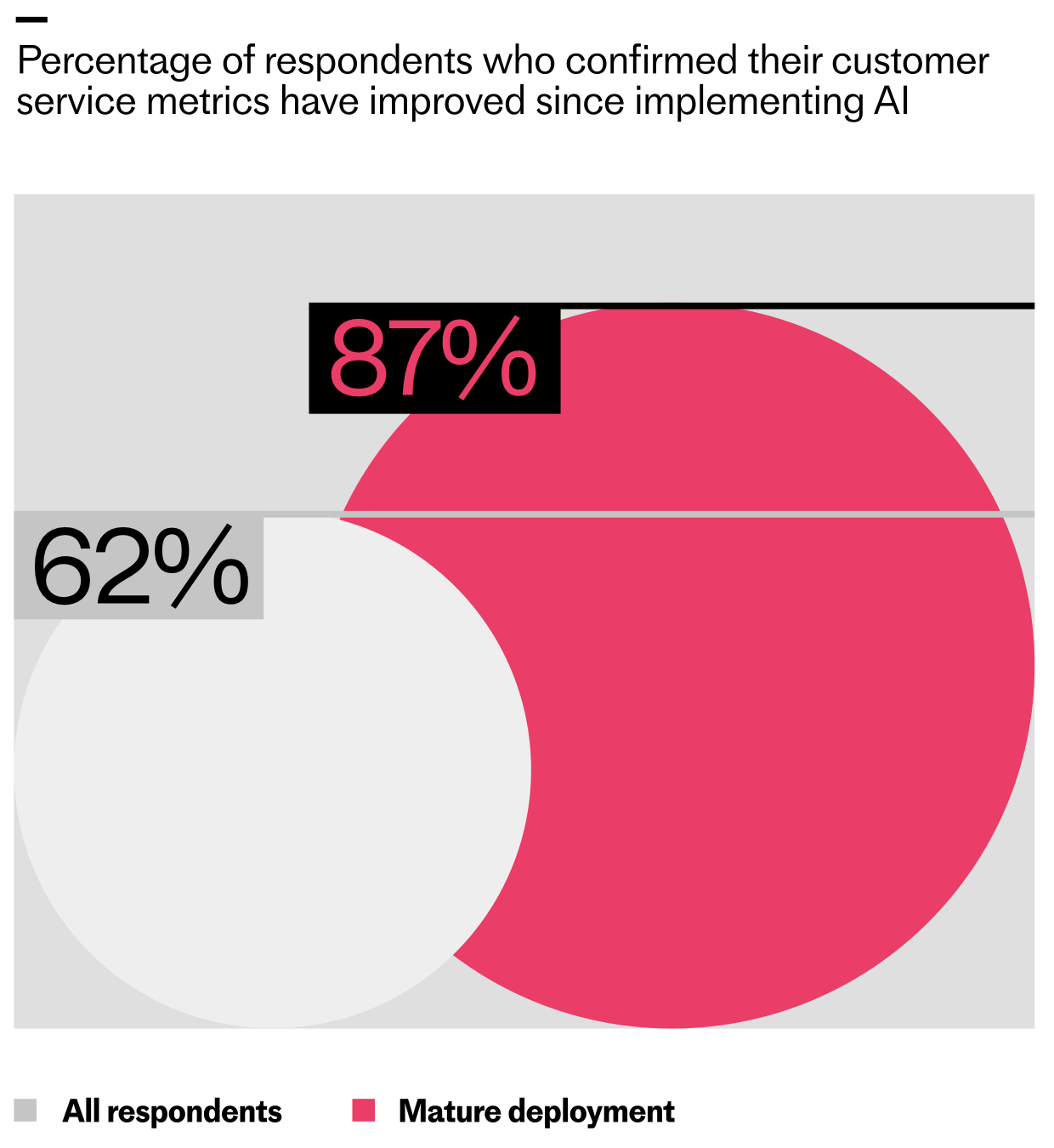
The teams going deeper are seeing higher returns. The research shows that 62% of support teams have seen their customer service metrics improve since implementing AI, with early wins showing up most clearly in speed and efficiency. But for teams that have reached mature deployment (where AI is fully integrated into operations) that number jumps to 87%.
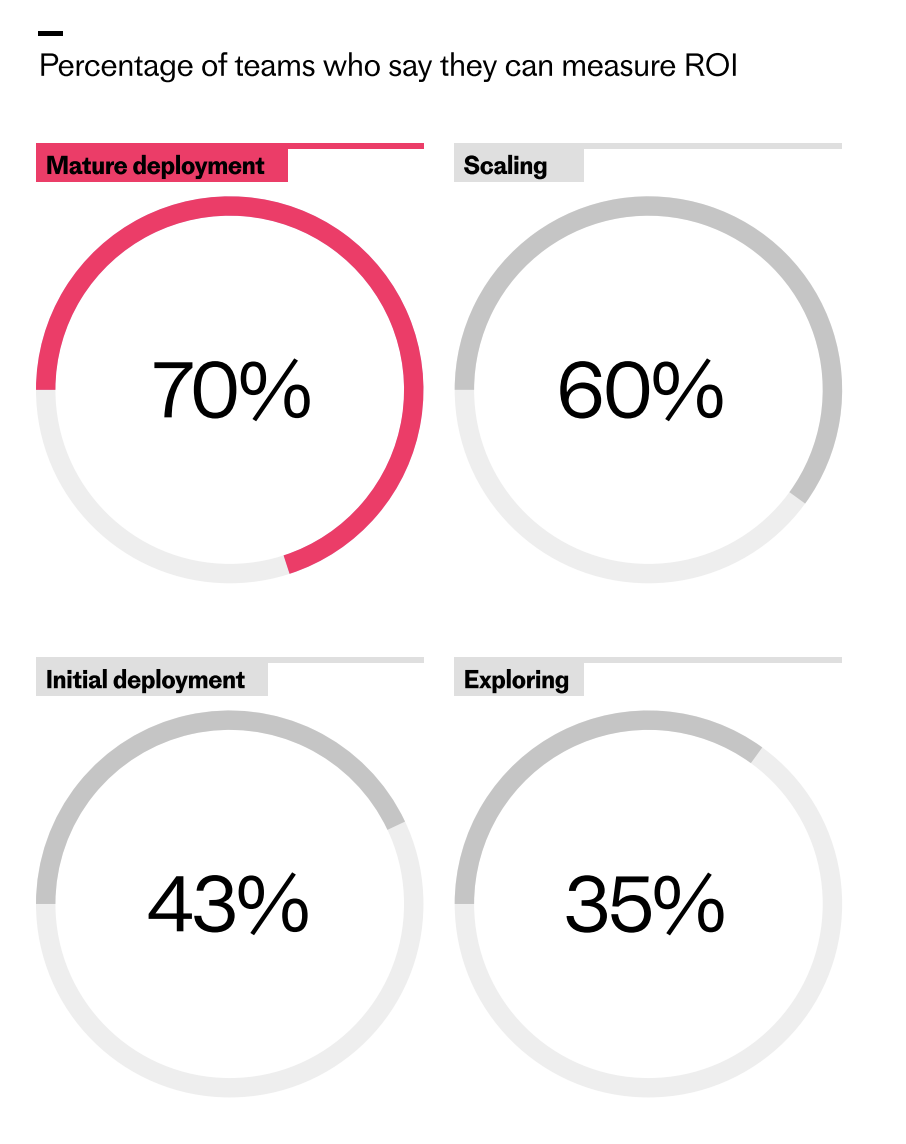
As AI programs advance, measurement confidence surges. This chart shows how ROI tracking rises from 35% in exploring to 70% in mature deployments—evidence of a widening execution gap in customer service.
The same pattern holds for the ability to measure ROI. Among teams in early exploration, just 35% say they can measure their return on AI investment, but for teams at the mature deployment stage, that rises to 70%. In my experience, this is the moment the conversation shifts from “is AI working?” to “how much leverage are we creating?”
As AI becomes more embedded in support workflows, what teams choose to measure starts to change. In the early stages of deployment, ROI is typically understood through improved customer response times, lower cost to serve, and freeing up capacity. Teams focus on how much time AI creates and whether it’s relieving pressure on the support organization. These signals help validate that the system is working, but they say little about how that capacity is ultimately used.
As deployments mature, measurement starts to reflect a different intent. Instead of stopping at time saved, teams look at where that capacity is reinvested—into higher value customer work and revenue-generating activities. ROI becomes less about relief and more about leverage. I encourage teams to set targets for capacity redeployment and tie them directly to activation, retention, and expansion outcomes.
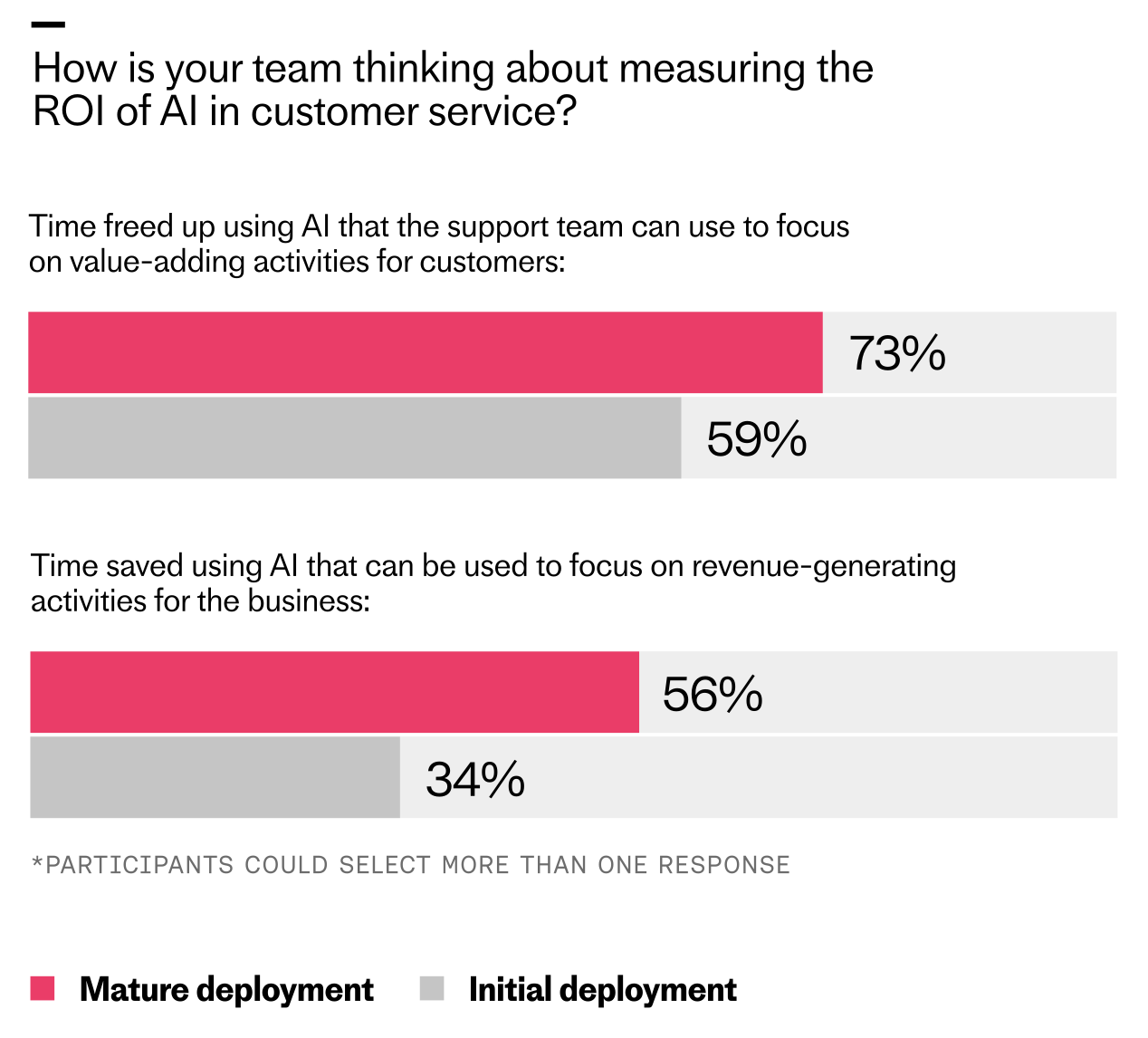
The report data shows this clearly. Across all maturity stages, the most commonly cited measure of ROI is "time freed up that the support team can use to focus on value-adding activities for customers." But at mature deployment, that signal intensifies, with 73% of teams citing it, compared to 56% at early exploration.
Mature AI deployments reveal clearer ROI: teams report more time freed for value-adding customer work (73% vs 59%) and more hours redirected to revenue-generating tasks (56% vs 34%) than initial rollouts.
What’s also interesting is that 56% of mature teams say freed capacity is being directed toward revenue-generating activities, up from 34% at initial deployment. That’s a powerful indicator that AI is shifting from a cost narrative to a growth narrative.
The result is a shift in economic intent: from measuring what AI saves to demonstrating how the capacity it creates is reinvested to drive growth. As a product leader, I anchor this conversation in outcome-based metrics and clear counterfactuals: what would it have cost to deliver the same experience without AI?
As AI takes on more work, the question moves from “does it save money?” to “how does it change the economics of support?” Legacy support economics were built for linear growth: more customer tickets meant more headcount, more outsourcing, and more software costs. Success was measured through containment—the number of queries that didn’t reach human agents. These models worked when volume and effort were tightly linked, but AI doesn’t scale linearly, and it needs to be evaluated differently.
To sustain AI investment and expand its impact, teams need to move beyond cost-cutting narratives and build a clearer case for business value. When done right, AI goes far beyond improving support efficiency. It rewires the financial model, breaking the link between support costs and revenue growth, and turning support into a contributor to customer activation, retention, and lifetime value. This means treating your AI Agent as a new workforce capability that changes how your support function creates and captures value. Here’s what value looks like in an AI-first model:
Deeper AI integration decouples growth from headcount. This split chart shows support volume surging while team size plateaus, revealing how automation unlocks scale, reduces costs, and makes ROI easier to prove.
Human productivity: Your team focuses on more strategic areas, not the queue.
System improvement: Every resolved query makes the system smarter.
Revenue influence: Support becomes a lever for activation, retention, and growth.
Organizational agility: You scale service without scaling headcount.
Leaders are racing ahead with real AI in support. Explore the 2026 Customer Service Transformation Report to see where deployment is stalling, benchmark your team, and get practical steps to scale automation that delights.
How does this look in practice? Intercom offers a compelling example with Fin. What started as a focused effort to improve their customer support experience has become one of the clearest illustrations of what happens when AI is fully embraced across an organization.
Since 2022, Fin has helped Intercom absorb more than a 300% increase in customer demand while improving the consistency of delivery—including supporting new routes into support for trial customers and website visitors. Today, Fin is involved in 97% of their customers' conversations. Of those, it resolves 83.5% end-to-end, putting their overall automation rate at 81%.
That depth of deployment allowed Intercom to scale service without scaling headcount. Without Fin, they would have needed at least 100 additional support teammates to meet rising demand and service standards.
As Fin took on the majority of day-to-day volume, the human support team shifted toward consultative work—helping customers adopt Fin more deeply, succeed faster, and unlock more value from the platform. Intercom now tracks metrics like “direct revenue generated” and “expansion revenue influenced” to understand the impact of these consultative support activities. This repositioned support from a cost center to an active contributor to long-term growth.
The throughline from The 2026 Customer Service Transformation Report is that deployment depth makes a significant difference. Teams that are investing in deeply integrating AI are reshaping how support scales and contributes to growth. Value becomes clearer as AI takes on more work, and support leaders can articulate that value to the rest of the business.
The gap between these teams and those still in the early stages is widening. A select group of pioneers are setting a new bar for what AI-powered customer service can deliver, and understanding what they’re doing differently is the first step toward closing that gap. If you want to dive deeper into the data and frameworks, you can download the report here: https://www.intercom.com/customer-transformation-report?utm_source=blog&utm_medium=internal&utm_campaign=20260128-report-owned-2026cstransformationreport&utm_content=chapterseries_2
I keep a simple mantra front and center: Figma is not the source of truth. The customer is. In practice, that means the only thing that truly counts is what we ship, how it performs, and whether users come back for more. Mockups are hypotheses; production usage is evidence. When my teams adopt this lens, velocity improves, judgment sharpens, and quality rises where it matters most.
So what does design actually do in a software company? At its best, design builds leverage for the whole system—engineering, product, and marketing—by clarifying problems, raising the quality bar, and making complex decisions legible. The standard I hold is ancient and still essential: products must be useful, usable, and desirable — and above all, used. When we calibrate around “used,” debates about pixels give way to outcomes, and cross-functional partners feel the difference.
I often trace the roots of our craft back well beyond the digital era. The lineage from industrial design to software is real; constraints, ergonomics, affordances, and systems thinking didn’t start with screens. If you’ve ever mapped delight, performance, and reliability in a Kano Model, you’ve touched this lineage. The translation to software is simple: design the full journey, not just the interface—prioritize what improves time-to-value, reduces cognitive load, and earns habitual use.
One lesson I’ve learned the hard way: why design leaders who stop designing stop leading. I still sketch flows, write UX copy, and prototype when it unblocks the team or sets a decisive quality bar. The altitude changes constantly—one hour I’m in a strategic roadmap review, the next I’m in a critique or poking at a prototype. Great design leaders jump up and down in altitude to connect vision to details without becoming a bottleneck.
Over time, I’ve come to rely on four pillars every design manager must master: craft (raising taste and execution), product strategy (clarifying choices and trade-offs), people leadership (coaching, feedback, and hiring), and systems (processes, rituals, and design ops that scale). Neglect any one of these and either quality, speed, or team health will eventually falter.
Perfectionism is a double-edged sword. Over-indexing on quality can paralyze decision-making, but lowering the bar indiscriminately is worse. I’ve seen moments where relaxing standards to “go faster” actually cost the business—rework piled up, trust eroded, and customer value stalled. The answer is principled delegation: I define what “must be true” at each milestone, delegate ownership with clear guardrails, and reserve my veto power for moments where product integrity is genuinely at risk.
Measuring success as a design leader starts with outcomes vs output OKRs. I care about activation, retention, time-to-first-value, NPS verbatims tied to key journeys, and the operational metrics that earn the right to build the next thing. Design output is visible; design outcomes are durable. When trade-offs are needed, I optimize for the smallest shippable surface that still proves the core value proposition, then expand with data.
Scaling judgment is the multiplier. I build it through pattern matching—studying enduring product systems from companies like Airbnb, Amazon, Apple, Asana, Notion, Stripe, Nest, and others—to distinguish where polish compels usage versus where it’s ornamental. Strong opinions matter, but so does being easy to convince with new evidence. I encourage designers to articulate the pattern they’re invoking, why it fits the job-to-be-done, and how we’ll know it worked.
Operating cadence matters. My week is anchored around recruiting, crits, and staff meetings that actually make decisions. In critiques, I use the Do/Try/Consider framework to give actionable direction without micromanaging. On one-on-ones, the question isn’t “Should one-on-ones exist?” but “What are they for right now?”—coaching, performance, or clearing execution blockers. If a meeting doesn’t increase clarity or commitment, it gets redesigned or removed.
Execution-wise, I’ve taken inspiration from Rippling’s operating system—especially its emphasis on speed, precise ownership, and hard commitments. The lesson is timeless: go fast on the right things, make clear promises, and instrument your work so you can see reality quickly. When speed is paired with crisp decision rights and observable outcomes, momentum compounds rather than frays trust.
Hiring your first design leader? Look for someone who can set standards, scale judgment, and ship. They should be able to zoom from company narrative to interaction copy in a single afternoon, coach product trios, and build rituals that make taste and trade-offs explicit. Above all, they should have a point of view on where quality moves the business and where speed is the quality.
Here’s how my team’s approach differs from many: Figma is not the source of truth. We design in Figma, but we learn from production. We pair designers with engineering early, prototype in code when it reduces risk, and wire telemetry into every critical path. Product trios use discovery to validate “useful, usable, desirable — and used,” then commit to outcomes with clear, testable definitions of success. The result is faster iteration, fewer surprises, and experiences customers actually adopt.
The throughline is simple and demanding: design for reality, not for the board. Keep your standards where they create business value, scale judgment with explicit patterns, and instrument everything so learning never stops. When teams embrace that, the work gets better, customers feel it, and the roadmap starts to pull you forward.