In fast-moving product cycles, weak signals slow teams down and let avoidable issues linger. I’ve been leaning on Session Replay to strengthen those signals and align stakeholders faster, especially when we’re balancing roadmap bets with day-to-day reliability fixes.
Discover how frustration analytics, error analytics, and shareable filters in Session Replay help you spot problems faster and collaborate more effectively.
Frustration analytics has become my shortcut to the moments that truly matter. Instead of sifting through countless replays, I start where friction peaks and focus on the sessions that best represent real user pain. In one onboarding flow, these insights pointed us to a confusing step that was suppressing user activation; a simple adjustment to the layout and copy led to higher completions and fewer support tickets.
Error analytics turns anecdotes into evidence. By pairing error trends with conversion and retention analysis in Amplitude analytics, we isolate the defects with the highest customer and revenue impact. That clarity helps my team sequence fixes in sprint planning with confidence—and it gives leadership a clean narrative for why certain issues deserve priority now.
Shareable filters have been a quiet superpower for cross-functional collaboration. I create saved views for specific cohorts—first-time users, power users, or high‑value accounts—so engineering, design, and support can reproduce exactly what I’m seeing in Session Replay. No more screen recordings in Slack or back-and-forth on “what filters did you use?” Everyone starts from the same context and moves to decisions faster.
This workflow fits naturally into how our product trios practice continuous discovery. We pick one question each week, open a shared filter, and review a handful of targeted sessions together. Within the same unified analytics platform, we connect what we observe to metrics that matter, then translate insights directly into product roadmapping and sprint planning without losing momentum.
If your goal is sharper detection of issues and stronger collaboration across stakeholders, these capabilities deserve a place in your toolkit. They compress time-to-insight, improve stakeholder management, and fuel product-led growth by focusing attention where it delivers the most customer value.
Inspired by this post on Amplitude – Best Practices.
I’ve spent enough cycles in product and growth to know the biggest drag on experimentation velocity isn’t creativity—it’s waiting. Waiting for engineering to wire events, for analysts to pull cohorts, for approvals to trickle in. When marketers can move autonomously with the right guardrails, learning accelerates and impact compounds.
“Amplitude’s new web experiment capabilities enable teams to scale experimentation 3X faster without waiting for help.” That promise hits directly at the bottlenecks I see most often across product and marketing organizations.
My takeaway: the real unlock isn’t only speed; it’s confidence. Faster learning loops power continuous discovery and product-led growth, but only if teams trust the data, align on success metrics, and can iterate without creating downstream tech debt. Self-service done right transforms scattered tests into a durable growth engine.
From a VP of Product lens (and what we practice at HighLevel), self-service experimentation means more than a new UI. I look for governance-by-design, role-based permissions, clear metric definitions, pre-built test templates, and operational best practices like minimum detectable effect (MDE) sizing and traffic allocation standards. That mix keeps A/B testing fast, statistically sound, and repeatable—without piling work onto engineering.
Here’s the playbook I recommend to teams leaning into this shift: instrument a unified analytics platform and lock a shared taxonomy; define canonical success metrics and guardrails; require lightweight pre-registration for hypotheses and MDE; stand up weekly experiment reviews; and close the loop by sharing learnings in-product and across go-to-market. When marketers, PMs, and designers operate as an empowered product trio, the flywheel spins.
To maximize value from any web experimentation stack—Amplitude analytics included—connect the dots from insight to activation. Tie experiments to CRM integration for downstream campaigns, ensure user activation metrics are first-class citizens, and keep your experimentation backlog aligned to outcomes, not outputs. The goal is fewer opinions and more evidence, shipped continuously.
Self-service also requires culture. Set expectations around statistical rigor, data governance, and post-test decisions, then celebrate the teams that sunset ideas just as quickly as they scale winners. That’s how you reduce waste, build confidence, and keep momentum high without creating hidden operational costs.
If your marketers are still waiting in ticket queues, it’s time to raise the bar. With the right foundations and process, you can go from idea to live test in hours, not weeks—learning more, shipping smarter, and unlocking 3X faster cycles where it matters most: customer value.
Inspired by this post on Amplitude – Best Practices.
I build products at scale, and I write about how we make them successful. When I need a clear, evidence-based perspective on what actually drives outcomes, I turn to the Amplitude Blog. It’s a dependable source for sharpening my thinking on "digital analytics, product strategy, and product-led growth"—and it consistently helps me translate analytics into business impact.
What keeps me coming back is the way practical, well-structured guidance meets real-world constraints. Whether I’m refining our event taxonomy in Amplitude analytics, evaluating a unified analytics platform approach, or aligning stakeholders on the right success metrics, I find concrete patterns I can apply immediately. The content connects data literacy with product management leadership, the exact combination required to navigate complex roadmaps and high-stakes decisions.
Here’s how I apply these insights day to day. I anchor our experiments in A/B testing best practices and set a minimum detectable effect that matches our traffic realities. I guide teams to prioritize user activation and retention analysis over vanity metrics, and I frame plans with outcomes vs output OKRs so we stay focused on customer and business value. In parallel, I reinforce continuous discovery and product discovery habits—feeding learning back into product roadmapping and sprint planning without losing speed.
The payoff shows up in the details: better funnel instrumentation, cleaner cohorts, and faster hypothesis cycles that reduce rework. When we operationalize these ideas—tying activation to onboarding flows, clarifying value moments, and aligning cross-functional owners—we see measurable lifts without bloating scope. That’s the discipline I expect from a modern, product-led growth motion: rigorous analytics paired with empowered execution.
If you’re scaling a team or modernizing your analytics practice, make the Amplitude Blog part of your weekly ritual. Use it to pressure-test your strategy, level up experimentation, and build a shared language for data-informed decisions. The right "tips and examples" can save months of trial and error—and, more importantly, help you ship products that customers return to again and again.
Inspired by this post on Amplitude – Best Practices.
I’ve felt the drag of data bottlenecks firsthand—PMs waiting on a reporting queue, engineers guessing at success metrics, and stakeholders making decisions with partial context. The “Add Data to Cart” mindset changed the game for me: make high-quality data as easy to request, enrich, and consume as dropping an item into a shopping cart.
Learn how Ankorstore’s teams make autonomous decisions, leveraging enriched data from Amplitude to accelerate feature delivery and drive topline growth.
Here’s what resonates with me and how I apply it in practice. When teams get self-serve access to a unified analytics platform like Amplitude analytics, decision autonomy becomes the default. Product trios operate with clarity, discovery cycles tighten, and we ship with confidence because the evidence is visible to everyone, not buried in a backlog.
The foundation is a clean, shared event taxonomy. I prioritize naming conventions, consistent properties, and governance so we can enrich events once and reuse them across A/B testing, retention analysis, and user activation dashboards. This lets product managers answer critical questions—Who’s activating? Which cohorts retain? Which journeys convert?—without waiting on an analyst, while still preserving data quality.
In my teams, “Add Data to Cart” means we treat data like a product. If a feature team needs a new event or property, they can request it with clear definitions, privacy requirements, and owners. We standardize the instrumentation pattern, ship it through CI/CD, document the event, and surface it in curated Amplitude reports. The result is faster feature delivery and fewer ad-hoc asks.
The payoff shows up in everyday decisions. Product managers run A/B tests with a minimum detectable effect (MDE) they can justify, analysts focus on deeper insights instead of ad-hoc tickets, and engineers get immediate feedback loops post-release. It’s a blueprint for product-led growth: know what moves activation, double down on the paths that retain, and sunset the work that doesn’t move outcomes.
Governance matters as much as speed. I pair data governance with privacy-by-design so teams can move quickly without risking compliance or eroding trust. That means documented event definitions, role-based access, and well-labeled dashboards that steer people to the right sources of truth.
If you’re starting from scratch, begin small: instrument a single critical flow end to end, publish three core dashboards everyone can find, and hold weekly readouts where teams share what changed because of the data. Within a few sprints, the habit forms—questions get sharper, hypotheses improve, and the roadmap shifts from output to outcomes.
“Add Data to Cart” isn’t just a catchy phrase; it’s a practical way to empower product teams. With enriched data in Amplitude, autonomous decisions become the norm, discovery accelerates, and growth compounds because every iteration is informed by what customers actually do.
Inspired by this post on Amplitude – Best Practices.
Engagement starts with a single, repeatable moment: activation. Over the years, I’ve learned that when we obsess over activation, everything downstream—retention, expansion, and product-led growth—gets easier and more predictable. As I often remind my teams, "Discover how winning teams drive engagement by obsessing over activation. Learn to define, measure, and improve the moments that keep users coming back."
When I say activation, I mean the specific behavior that reliably predicts long-term value for a new user or account. In different products, the activation moment could be connecting a data source, inviting a teammate, sending the first campaign, or completing an initial automation. My first move is to define that moment precisely, set an activation threshold (for example, “within 7 days of signup”), and align the team around it as a primary outcome.
From there, I track three core metrics: activation rate (the percentage of new accounts that hit the activation threshold), time-to-activation (how quickly they get there), and early retention curves by cohort. Cohort-based retention analysis gives me the most honest read on whether our activation definition truly predicts stickiness or if we’re celebrating vanity milestones. Tools like Amplitude analytics and Pendo make it straightforward to instrument these events, segment users, and visualize the funnel from first touch to activation and beyond.
Instrumentation quality is non-negotiable. I map the activation journey into discrete events, add clear event properties (role, plan, channel, use case), and validate tracking end-to-end before I trust any dashboard. A strong unified analytics platform lets me slice activation by persona, acquisition source, and onboarding path, so we can see where friction lives and where momentum builds.
Improving activation is where design and data meet. I lean heavily on in-app guides, product tours, and contextual tooltips to reduce cognitive load at the exact moment a user needs help. We run A/B testing with a minimum detectable effect in mind, prioritize experiments that remove steps or shrink time-to-value, and iterate quickly based on user feedback gathered through continuous discovery. The goal is simple: shorten the distance from curiosity to value.
Onboarding is the frontline of activation. I favor progressive disclosure, crisp checklists tied to the activation moment, and “just-in-time” education rather than dumping documentation up front. Clear wayfinding—what to do next, why it matters, and how success is measured—pushes users toward that first “aha” moment with confidence.
Cross-functionally, I align activation to outcomes vs output OKRs so everyone—from product and design to marketing and customer success—pulls in the same direction. For example, lifecycle emails and in-app messaging should reinforce the same activation path that product guides inside the app. This harmony lowers friction, speeds time-to-activation, and compounds engagement.
As we scale, I keep a living experiment backlog focused on activation levers: simplifying setup, removing form fields, auto-detecting configurations, and pre-populating defaults. Each change gets measured against activation rate and time-to-activation, with guardrail metrics to protect quality and retention. Over multiple releases, these small wins stack into durable growth.
I’ve seen teams unlock double-digit improvements by treating activation as a product, not a project. When we define the right moment, instrument it well, and iteratively remove friction with data-informed design, engagement rises naturally—and sustainably. That’s the power of an activation-obsessed culture.
Inspired by this post on Amplitude – Best Practices.
When I push our organization to adopt the product operating model, I’m emphasizing a foundational shift—from “shipping roadmaps of features (output)” to solving real customer and business problems, measured by “business results (outcomes)”. That’s the difference between activity and impact, and it’s the only way to build durable value at scale.
This change inevitably reaches beyond the product organization. It reshapes how company stakeholders in Sales, Marketing, Customer Success, Finance, Legal, Security, and Operations engage with product teams, and it reframes what they expect from us. Instead of asking, “When will feature X ship?” they learn to ask, “How will we move the outcome that matters?”
In practice, the product operating model is a contract: product teams commit to outcomes, and stakeholders commit to partnership. That partnership means we co-own the problem, align on evidence, and share accountability for results. The reward is clarity—everyone sees how their work ladders to strategy and why the sequence of work makes sense.
Here’s how I align stakeholders around this model. First, I ground everything in outcomes vs output OKRs. We replace feature roadmaps with a clear strategy, prioritized problems, and measurable objectives. Our product roadmapping and sprint planning then serve the objectives—not the other way around—so capacity is allocated to the highest-leverage bets.
Second, I build empowered product teams around product trios (product, design, engineering). We practice continuous discovery with stakeholders: we share opportunity trees, test riskiest assumptions early, and bring partners into research when it informs go-to-market strategy, pricing, or enablement. This keeps us honest and avoids late-stage surprises.
Third, I establish operating rhythms that make outcomes visible. Monthly stakeholder reviews focus on progress toward objectives and what we’re learning—not status theater. Quarterly, we connect OKRs to business performance so leaders can see the throughline from discovery and delivery to pipeline, retention, or margin. If priorities shift, we renegotiate objectives explicitly.
Fourth, I define metrics that stakeholders trust. We use a balanced set of leading indicators (activation, engagement, cycle time) and lagging indicators (revenue, retention, unit economics). We socialize definitions early so no one debates the scoreboard mid-game. The result: faster decisions and less “data whiplash.”
Fifth, I invest in change management. Moving from outputs to outcomes can feel threatening if your success has historically been measured by launch volume or roadmap commitments. I address this head-on with training, transparent comms, and clear decision rights. The message is simple: outcomes create more autonomy for empowered product teams and more predictability for stakeholders.
At HighLevel, this approach has been especially powerful when cross-functional dependencies are high. For example, when we set an objective to improve user activation for a new CRM integration, we didn’t promise a bundle of features. We committed to a measurable lift in activation and a shorter time-to-value, co-owned with Customer Success and Marketing. That alignment unlocked smarter experiments, tighter enablement, and a more credible launch narrative.
The anti-patterns are predictable: treating OKRs as a renaming of the roadmap, equating discovery with indecision, or isolating product decisions from go-to-market strategy. The cure is equally consistent: bring stakeholders into discovery, attach every bet to an objective, and show progress with evidence—not just demos.
Ultimately, the product operating model is a leadership choice. It asks us to trade certainty theater for learning velocity, and feature checklists for business impact. When stakeholders see that shift pay off—in faster cycles, clearer priorities, and results that matter—support for the model moves from compliance to conviction.
When I think about how I stay sharp as a product leader, one principle anchors my approach: design your learning system—don’t leave it to chance. Communities of practice are that system. They turn curiosity into a habit, accelerate product discovery, and strengthen product management leadership across empowered product teams.
I recently dug into a powerful conversation on the All Things Product podcast that explores how product people can intentionally design their own communities of practice—and why that matters for long-term learning and growth. The insights apply whether you operate as an independent coach or you’re scaling continuous discovery inside a product org.
I appreciated the contrast in learning styles. Teresa shares an introvert-friendly approach to continuous learning: curating a personal learning network (PLN) filled with people she wants to learn from. Petra contrasts that with a more collaborative style—learning with others through small peer groups, hackathons, and local meetups. Together, they unpack how each approach supports curiosity-driven development, how to find your “definition of good” when starting something new, and the habits that make learning a deliberate practice.
In my own practice leading product trios and shaping outcomes over output, I rotate between these modes. When I need speed or depth on topics like product discovery or stakeholder management, I learn from people: I curate a tight set of voices, reverse-engineer their decisions, and study how they frame trade-offs. When I need new patterns or accountability, I learn with people: I form small peer circles to review experiments, pressure-test roadmaps, and critique discovery plans. Both paths create momentum—one by focus, the other by feedback.
Key takeaways I’m acting on right now:
– What a “community of practice” really means in modern product work: the infrastructure that makes continuous discovery sustainable—and keeps empowered product teams aligned on craft.
– The difference between learning from people vs learning with people—and when to use each depending on whether you need depth, breadth, or accountability.
– How to find like-minded peers for collaborative learning: start with one person you respect, ask who they regularly spar with, attend one local meetup with a clear learning goal, and follow up with a structured exchange.
– Building your Personal Learning Network (PLN): set a theme (e.g., pricing, product roadmapping and sprint planning), prune it quarterly, and track “who I’m learning from” with the same rigor you track stakeholders.
– Personal knowledge management as a product skill: treat notes, highlights, and artifacts as a system, not a junk drawer—so insights compound and are easy to retrieve when you need them.
– Why curiosity-driven learning builds stronger product intuition: schedule time for curiosity and socialize it with peers so it scales beyond individual motivation.
– How committing to talks, books, or courses drives deeper learning: public commitments create productive pressure and force you to clarify your thinking.
Here’s the simple playbook I use with my team: define a quarterly learning theme; curate a small PLN aligned to that theme; assemble a peer circle (PM, Design, Eng) for monthly critiques; commit to shipping one artifact publicly (a talk, guide, or internal workshop); and close the loop with a short write-up on what changed in our decisions, discovery cadence, or bets. It’s lightweight, measurable, and fits neatly alongside product-led growth priorities.
Two quotes from the discussion capture the spirit perfectly:
“Nobody on that list knows they’re in my personal community of practice.” — Teresa Torres
“Sometimes you don’t know your new definition of good until you start learning.” — Petra Wille
If you’d like to go deeper, you can listen to the episode on your favorite platform:
Listen to this episode on: Spotify | Apple Podcasts
Curation – All Things Product with Teresa & Petra episode
Hamel’s Blog
AI Evals for Engineers and PMs course by Hamel Husain (get 35% off through Teresa’s link) on Maven
Harold Jarche’s Personal Knowledge Management workshop
Petra’s book, Strong Product Communities – The Essential Guide to Product Communities of Practice
I’d love to hear how you’re designing your own community of practice. What’s your learning theme this quarter? Which peers are you building with, and what commitments are helping you go deeper? Drop your thoughts—I’ll share my own PLN stack and peer-circle cadence in a future post.
I’ve learned the hard way that the fastest, lowest-risk growth lever is hiding in plain sight: reactivating the users we already earned. When our team prioritized win-back programs over new acquisition, we unlocked higher net revenue retention, shorter payback periods, and stronger product-market signal—with a fraction of the spend.
"Discover why reactivating dormant users delivers better ROI than new acquisition. Learn how to identify and bring back at-risk users via targeted campaigns." That insight matches what I see daily: win-back campaigns compound value because they capitalize on existing familiarity, prior data, and stored intent.
Here’s the ROI logic I use. New acquisition burns budget on education and trust-building before value is realized. Reactivation, by contrast, taps into latent demand and prior setup, which means lower effective CAC, faster time-to-value, and higher LTV recapture. In retention analysis, these programs often outperform prospecting by a wide margin because the user already knows how to get value—they just need a relevant nudge.
To find the right users to re-engage, I start with leading indicators of risk: declines in weekly active use, feature decay (e.g., key workflows not triggered), shrinking session depth, and unresolved outcomes. Amplitude analytics or a unified analytics platform help me segment cohorts by recency, frequency, and monetary signals, then rank accounts by churn propensity. I also track intent proxies like billing pauses, reduced seat utilization, and cooling support contact.
I group users into three practical tiers: “at-risk” (recent value decay), “dormant” (no critical events in the past 30–60 days), and “churned-eligible” (post-cancel window with a viable path back). Each tier gets a distinct message strategy, incentive structure, and time horizon. The goal is to match the intervention to the activation friction each group faces.
For creative strategy, I anchor on the outcome they originally hired us to deliver. I lead with the value proposition they care about, not the features. A strong win-back narrative reminds users of the job-to-be-done, showcases what’s improved since they last engaged (new capabilities, performance, integrations), and offers an effortless next step—often a guided “return-to-value” flow or a one-click way to pick up where they left off.
Channel orchestration matters. I use Intercom and Pendo to deliver contextual nudges, in-app guides, and lightweight product tours that meet users at the precise moment and screen of friction. With CRM integration, we coordinate email and SMS for timely follow-ups, then reinforce success in-product with progressive tooltips and checklists. The best-performing sequences pair a personalized message, a sharp call-to-outcome, and a low-friction path back to activation.
Experimentation is non-negotiable. I run A/B testing on subject lines, offers, and in-product prompts, and size tests with a minimum detectable effect (MDE) that’s realistic for each segment. We personalize content by prior feature use, industry, and plan tier to avoid generic blasts that underperform. Over time, the library of proven treatments compounds, and the system becomes predictively better at catching risk earlier.
Measurement should be unambiguous. I define “reactivation” as the return to a qualifying level of usage that mirrors healthy customers (e.g., core event completion in a set window), not just a login. I track reactivation rate, time-to-reactivation, reactivated revenue, payback, and LTV uplift versus holdout cohorts. Cohort views in Amplitude analytics reveal whether improvements are persistent, and whether we’re driving true behavior change or short-term spikes.
Trust is part of the strategy. We build privacy-by-design into all outreach and respect user preferences. Clear value exchange (why this message, why now, how to opt out) consistently improves response rates and strengthens long-term relationships—win-backs should feel helpful, not harassing.
Operationally, I pair product-led growth with lifecycle marketing: product teams ship the “return-to-value” experiences; growth teams run the orchestration; customer success brings context from the field; and analytics sets guardrails and success criteria. When executed as a system, win-backs turn from occasional campaigns into a durable, compounding growth engine.
If you’re chasing growth in a tight market, start here. Your next quarter’s ARR may be sitting in dormant cohorts that are one relevant nudge—one fast path to value—away from coming back.
Inspired by this post on Amplitude – Best Practices.
I’ve spent years helping talented engineers explore what’s next when pure coding no longer feels like the only—or best—path. From hiring across cross-functional teams to mentoring career pivots, I’ve seen firsthand how engineering strengths translate into high-leverage roles that shape product, strategy, and growth.
Software engineers have alternative career options leveraging their skills in roles like product manager, data scientist, business analyst, and 22 more.
When an engineer moves into product management, they’re not starting from scratch—they’re redirecting problem-solving, systems thinking, and customer empathy toward outcomes. In practice, that means mastering product discovery, strengthening stakeholder management, and getting fluent in product roadmapping and sprint planning, so decisions are guided by impact rather than “outputs vs outcomes” confusion. I’ve watched this transition unlock empowered product teams and clearer prioritization across complex backlogs.
Data-oriented paths are equally compelling. If you enjoy experimentation and evidence-based decisions, roles in analytics or data science reward rigor. Think A/B testing, identifying the minimum detectable effect (MDE), and using tools like Amplitude analytics to translate behavioral signals into product bets. Pair that with retention analysis and you’ll become indispensable to growth conversations.
Business-facing roles such as business analyst or product marketing manager are ideal if you’re energized by customer problems and market narratives. Your engineering fluency sharpens value propositions, product positioning, and go-to-market strategy in a way that resonates with both buyers and builders. In my teams, the best bridges between product and revenue often came from former engineers who could articulate trade-offs with clarity.
If operational excellence is your edge, consider SRE, DevOps, or cybersecurity. The same instincts that push you toward clean CI/CD pipelines and resilient architectures translate well into incident management, threat detection and response, and privacy-by-design practices. These roles reward systems thinking and the ability to balance reliability with delivery speed.
For engineers who love community and storytelling, developer evangelism is a natural fit. You’ll translate complex concepts into actionable guidance, from in-app guides and product tours to UX writing and documentation. The best evangelists I’ve worked with turn feedback loops into product insight, strengthening activation and product-led growth without heavy sales pressure.
Customer-facing technical roles—solutions engineer, forward deployed engineer, or technical consultant—let you stay close to the product while solving real-world problems. You’ll drive onboarding quality, user activation, and adoption while surfacing insights that influence roadmaps. Done well, this work tightens the loop between customer outcomes and product decisions.
AI-centered roles are expanding rapidly. If you’re curious about AI Strategy, retrieval-first pipelines, or the practical use of LLMs for product managers, you can bring an engineer’s discernment to a noisy space. The most valuable contributors here pair pragmatic architecture choices with clear risk management and measurable business value, not hype.
Leadership tracks remain a strong option too. The IC to manager transition isn’t about title; it’s about raising the ceiling for others. You’ll coach empowered product teams, shape organizational development, and align initiatives to defensible metrics—think DORA metrics for flow, leading indicators for value, and OKRs that measure outcomes over output.
If you’re exploring a pivot, start small and intentional. Run “career A/B tests” by taking on cross-functional projects, shadowing adjacent roles, or shipping a lightweight portfolio that demonstrates the new muscle. Join a ProductCon session, practice conference networking, and refine a narrative that links your engineering foundation to the outcomes your target role owns.
Finally, map your personal unfair advantages—domain knowledge, systems thinking, customer empathy, or operational rigor—to the roles that value them most. With focus, you can reposition your engineering experience into a differentiated story that accelerates your next chapter. The breadth of options is real, and with a deliberate plan, you’ll turn curiosity into conviction—and conviction into impact.
I’ve long believed the most resilient software companies master two hard things at once: they move decisively from mid-market to enterprise, and they ship multiple “best-of-breed” products without losing focus. The operating model that makes this possible — running 16 “startups within a startup” — resonates with how I build product organizations. In this piece, I’m unpacking the frameworks I use to make that model work at scale, from “product-market-sales fit” to capacity-driven go-to-market.
Why do companies get stuck in the mid-market? In my experience, it’s rarely just sales execution. It’s usually a product readiness gap hiding inside a distribution story. Enterprise customers expect battle-tested architecture, deep security and compliance, robust RBAC, data governance, audit trails, and predictable SLAs. They also expect a clear value proposition, strong references, and a crisp “who do we beat and why” articulation. If any one of those is fuzzy, your deals elongate or disappear. The fix starts by designing intentionally for enterprise and mid-market from day one: plan for scale, extensibility, change management, and procurement complexity — then validate with lighthouse customers, not just friendly pilots.
Sometimes the hardest enterprise move is saying no. I’ve advised teams to walk away from a marquee logo like Netflix when the requirements force unnatural acts that derail your roadmap. It feels counterintuitive — especially when the logo is irresistible — but your ideal customer profile must govern priorities. Your long-term velocity compounds when you align deeply with the customers who value your native strengths.
I differentiate between “product-market-fit” and “product-market-sales fit.” The former tells me a product delivers undeniable value; the latter tells me my distribution system can reproduce that value at scale. I watch for signals beyond anecdotes: win rates by segment, cycle time, ramp time to first deal, multi-threading depth, net revenue retention, and the percentage of customers who expand within two quarters. When these lag, I diagnose whether I have a product problem (insufficient value or clear “must-have” outcomes) or a distribution problem (positioning, enablement, or segmentation). The diagnosis determines whether I ship features, sharpen messaging, or rewire the motion.
On go-to-market, I build a capacity-driven machine instead of chasing deals. That means matching pipeline health to quota capacity, calibrating territories to intent density, and instrumenting enablement so new reps reach productivity with consistent talk tracks and crisp objection handling. I prefer simple, repeatable plays that compound: a precise ICP, strong proof packages, and a pricing model that meets customers where they are. When those are humming, founder-led GTM transitions smoothly to a scalable sales engine without losing the product’s original edge.
Hiring your first head of sales is a leverage point. I look for four things: pattern recognition in my specific segment, a builder’s mindset (process and playbooks without bureaucracy), rigorous pipeline hygiene, and the ability to partner with product on “where we win and why.” In the interview, I run scenario loops: how they’d disqualify non-ICP deals, how they’d recover a late-stage stall, how they’d deliver the first 90 days plan, and how they’d coach to a consistent message. Early founders absolutely need to learn sales — not to become the forever closer, but to encode customer truth into the product and the motion.
Strategic timing matters, too. There’s a well-known case of selling three days pre-IPO; whether or not you’d make the same call, the lesson stands: market timing, certainty of outcome, and board alignment are strategic variables, not afterthoughts. A healthy board brings independent thinking, timely guidance on capital and risk, and a unified narrative — especially when the market is volatile.
On competition, I pressure-test our narrative around points of parity and a “binary differentiator.” In crowded markets, incremental advantages don’t move the needle. You need one thing customers can’t ignore — faster time-to-value, a step-function in accuracy, or a cost curve that resets the category. I ask every team to prove a binary outcome: if we’re in the eval, there’s a clear, testable reason we win.
Launching multiple products simultaneously demands ruthless clarity. I structure the org as “startups within a startup,” each with its own GM, product roadmap, and GTM targets, but anchored to a shared platform for identity, data, and extensibility. Product managers operate as mini-entrepreneurs — owning P&L-like metrics, customer outcomes, and crisp product positioning — while a central platform team ensures consistency and speed. The rallying cry across these teams is simple: “We need to be best of breed.” If a product can’t credibly win on its merits, we either sharpen it until it does or we stop investing.
Execution lives in the details. I emphasize outcomes vs output OKRs, product trios for tight alignment, and continuous improvement powered by CI/CD so we can learn faster. We track DORA metrics like deployment frequency to ensure our cadence supports enterprise reliability. Weekly operating reviews focus on value delivered: have we solved the customer’s core job, and can our sales and success teams prove it with repeatable stories? When the answer is yes, expansion follows naturally.
Bringing it all together: moving upmarket, building “product-market-sales fit,” and running 16 product lines under one roof is achievable with the right structure and discipline. Design for enterprise from the start, let your ICP guide every trade-off, anchor GTM in capacity and repeatability, hire sales leaders who build with you, enforce a “binary differentiator,” and empower product managers as owners. Do that, and the “startups within a startup” model becomes a force multiplier — not just a slogan.
I’ve spent years leading product organizations where the best outcomes emerged from a tight handshake between design rigor and product strategy. The role that consistently sits at that high-impact intersection is the UX product manager. Done well, it’s the engine of product-led growth: deeply empathetic with users, relentlessly focused on outcomes, and fluent in both discovery and delivery.
Curious about the UX product manager role? Discover how it overlaps with design, PM, and why it might be the next step in your career.
At its core, a UX product manager owns the customer experience end-to-end while steering the business toward measurable outcomes. I translate user insights into prioritized problems, shape the solution space with designers and engineers, and validate decisions with data. Unlike a traditional PM who may skew toward market sizing and business cases, or a designer who may emphasize interaction patterns and visual systems, I integrate both frames to ensure we ship experiences that users adopt, retain, and recommend.
On the design side, I work hand-in-hand with product designers and UX writing to define the problem, craft flows, and stress-test usability. I obsess over clarity, affordances, and friction—especially during onboarding. Strong UX writing often makes or breaks first-run experiences, and I treat microcopy as part of the product, not an afterthought.
On the product management side, I anchor teams on outcomes vs output OKRs, facilitate product discovery, and drive prioritization against clear value propositions. I operate within empowered product teams and build tight product trios with design and engineering so we can validate assumptions fast, reduce waste, and increase the surface area for innovation.
Day-to-day, my craft blends qualitative research and quantitative analysis. I lean on tools like Amplitude analytics, Pendo, and Intercom to instrument funnels, run A/B testing, and perform retention analysis. When I experiment, I’m explicit about the minimum detectable effect (MDE) to avoid inconclusive reads. I measure the impact of changes on activation, time-to-value, and core feature adoption—and I make sure we can trace improvements to specific user segments.
User activation is my early warning system. If activation is lagging, I revisit the first-mile experience: guidance, progressive disclosure, in-app guides, product tours, and contextual tooltip design. I also ensure our onboarding is sequenced around the critical path to value rather than a feature parade. When activation improves, downstream KPIs like retention and expansion usually follow.
If you’re looking to become a UX product manager, start by strengthening three pillars: customer insight, product strategy, and experience design. Build a habit of continuous product discovery—co-creating with users, running lightweight experiments, and synthesizing findings into actionable decisions. Learn to translate insights into a product roadmapping and sprint planning cadence that energizes the team and keeps stakeholders aligned.
Your portfolio should read like a decision journal, not a gallery of screens. For each case study, frame the problem, outline constraints, describe alternatives considered, and show the experiments you ran. Include the metrics that mattered (activation, adoption, retention), the instrumentation you used, and the decisions you made when data was ambiguous. Hiring managers want to see your thinking under uncertainty and how you rallied cross-functional partners.
Communication and stakeholder management are differentiators. I tailor narratives for executives (trade-offs and business impact), for engineers (clarity on constraints and sequencing), and for design (user jobs, heuristics, and the narrative arc of the experience). Clear, frequent updates keep momentum high and reduce thrash, especially when priorities shift.
On the execution side, I make sure delivery never drifts from discovery. Every sprint is tied to a learning goal or outcome. We pair quick prototypes with production experiments, and we celebrate killing ideas that don’t move the needle. That discipline keeps us focused on outcomes and accelerates iteration speed without sacrificing quality.
Finally, a few career accelerators: get comfortable with analytics, learn the language of UX writing, practice story-based demos, and go deep on onboarding patterns. If you can move activation, you can change the trajectory of the business. Pair that with a strong perspective on product-led growth and you’ll be ready to lead product work that compounds.
The UX product manager role is a force multiplier. It’s where rigor meets empathy, and where design and PM converge to create experiences customers love—and businesses rely on. If that intersection energizes you, you’re already on the right path.
Like many support leaders right now, I’m deep in 2026 planning. The more I map scenarios and stress-test assumptions, the clearer one thing becomes: the way work gets done has fundamentally changed, and that change must reshape our customer service organization.
In 2026, you won’t get the full value of AI by keeping your org chart, systems, and operating model the same. You need to think differently about how support is structured, how performance is owned, and how your systems evolve around an AI-first model. That’s the lens I’m using across my team and our cross-functional partners.
To help you do the same, I’m launching a 2026 customer service planning series. Over the next five weeks, I’ll share how I’m approaching roles, skills, organizational design, and an operating model that makes AI the backbone of support—not a bolt-on feature.
We’ll publish each edition here and on LinkedIn. If you’d rather get them by email as soon as they go live, drop your details and I’ll send each edition straight to your inbox.
But before you can make any of those decisions, you need the right mindset and the right internal conditions for change. That’s where I’m starting this week.
Week 1: Start with a mindset shift
If you were building support from scratch today, you’d design around AI from day one. That’s the mindset to carry into 2026—and it’s the mindset I’m using to guide investment and accountability.
Too many teams still treat AI like a feature instead of infrastructure. They tack it onto existing processes, limit scope to tier-one issues, and never evolve the organization or systems around it. I’ve seen that approach stall progress and fragment the customer experience.
Those teams are thinking too small. They chase incremental efficiency, underinvest in the system change required to make AI successful, and get stuck. The result: a reactive team, a choppy customer experience, and value left on the table.
AI Agents are fully capable, end-to-end resolution engines. They fundamentally change the architecture of support.
To plan effectively and get the most value out of the technology, you need to adjust your mental model. Here are the mindset changes I’m prioritizing.
1) Move from ‘AI as a tool’ to ‘AI as infrastructure’
For the past decade, support systems have been the intermediary between customers and human support agents. AI isn’t an intermediary, it’s the first touchpoint (and often the last), the primary resolver, it manages workflows, orchestrates handoffs, and takes real actions.
Planning with the “AI is a tool” mindset leads to small optimizations that don’t move the needle. Planning with the “AI is infrastructure” mindset lets you redesign around the real sources of value creation.
Here’s what I’m designing around in 2026:
• Clear ownership of Agent performance
• A feedback loop that never shuts off
• A shared understanding of when humans step in
• Systems that evolve as AI capabilities expand
This framing sets up every decision that comes later in your planning process.
2) Look at how the work is changing
You need to plan your 2026 support organization around what the distribution of work will be—not what it is today. AI has shifted where volume goes, what humans spend time on, where judgment is needed, how performance is measured, and how the customer experience is designed.
If your planning assumes the current distribution is stable, you’ll design the wrong structure. I’m modeling for the work that’s coming, not just the work on our queue today.
3) Think like a product leader
When customers primarily interact with your AI Agent, support becomes responsible for designing the customer experience—not just managing it.
“Support is becoming a product function, and you are becoming a product leader”
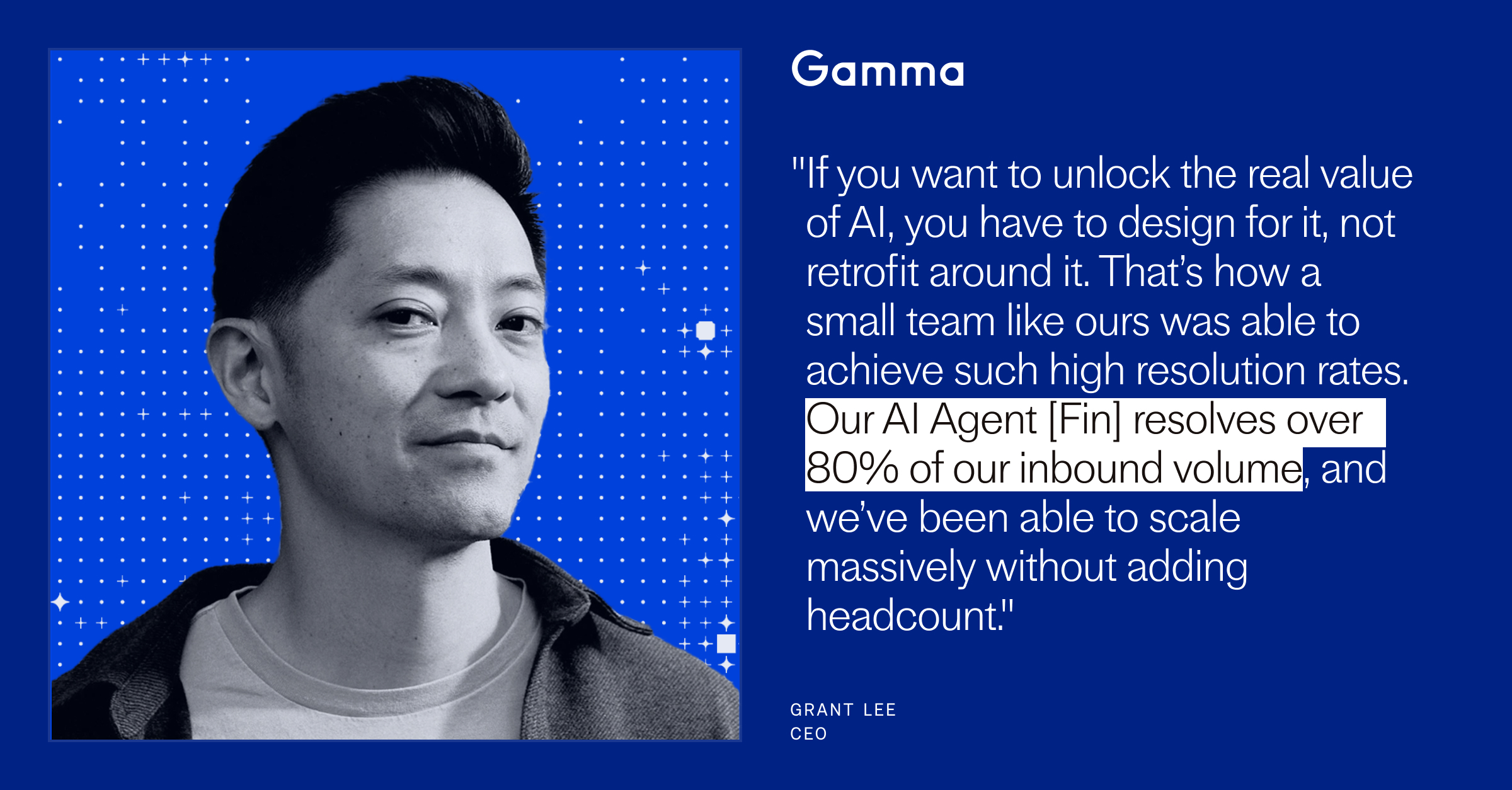
Design your 2026 support org for AI from day one. This Gamma testimonial shows how an AI agent (Fin) resolves 80%+ of inbound requests, letting a small team scale customer service efficiently without increasing headcount.
Support is now a product surface, and support teams act like AI product teams. They:
• Design the customer experience
• Create and curate the knowledge layer that drives AI quality
• Maintain continuous improvement loops and tune system behavior over time
This is a big shift. Your planning—hiring, skills, rituals, and metrics—needs to reflect that evolution.
4) Redefine performance
This is a big mental leap for support leaders. Traditional performance was measured on speed and satisfaction, but AI performance is measured on resolution, impact, and system reliability.
Planning for 2026 means assuming that:
• Humans will handle a smaller % of volume.
• Customer experience will be shaped by AI’s performance, not throughput
When AI handles the bulk of your support volume, you need new metrics for how your team creates value. In practice, that means instrumenting AI and human-in-the-loop workflows with the same rigor you’d apply to a customer-facing product.
5) Understand that your value increases as AI takes on more work
You need to re-orient your team around AI’s performance to get the most value out of it. The more complex work you give it, the higher impact it will have.
Instead of routing complex, messy questions straight to your human team, shift their focus to improving the AI system so it can take on more over time.
Automating low-effort questions reduces noise, but automating complex workflows changes the economics of your entire team. It creates asymmetric returns that compound as AI absorbs the work that once demanded the most time and skill.
6) Plan for adaptability
A big difference between traditional planning and 2026 planning is simple: change will be constant.
“Change is hard, but the teams that adapt will be the ones who get the most out of this opportunity”
AI learns, evolves, and improves continuously. I’m asking, “How do we build an organization designed to adapt fast as the system evolves?” That question is informing everything from team topology to knowledge governance and experimentation cadence.
Food for thought
Heading into 2026, your org chart will look different—and that’s a good thing. Your people will play new, more meaningful roles as designers, curators, and stewards of an AI-first customer experience.
Once you accept that 2026 demands a different way of thinking, working, and planning, you can move to the next stage: designing the support organization that fits this future. I’ll share exactly what that looks like next week, including roles, skills, and ownership models that have worked well in my experience.
Want the full series delivered by email? Drop your details and I’ll send each edition to your inbox as soon as it’s published.