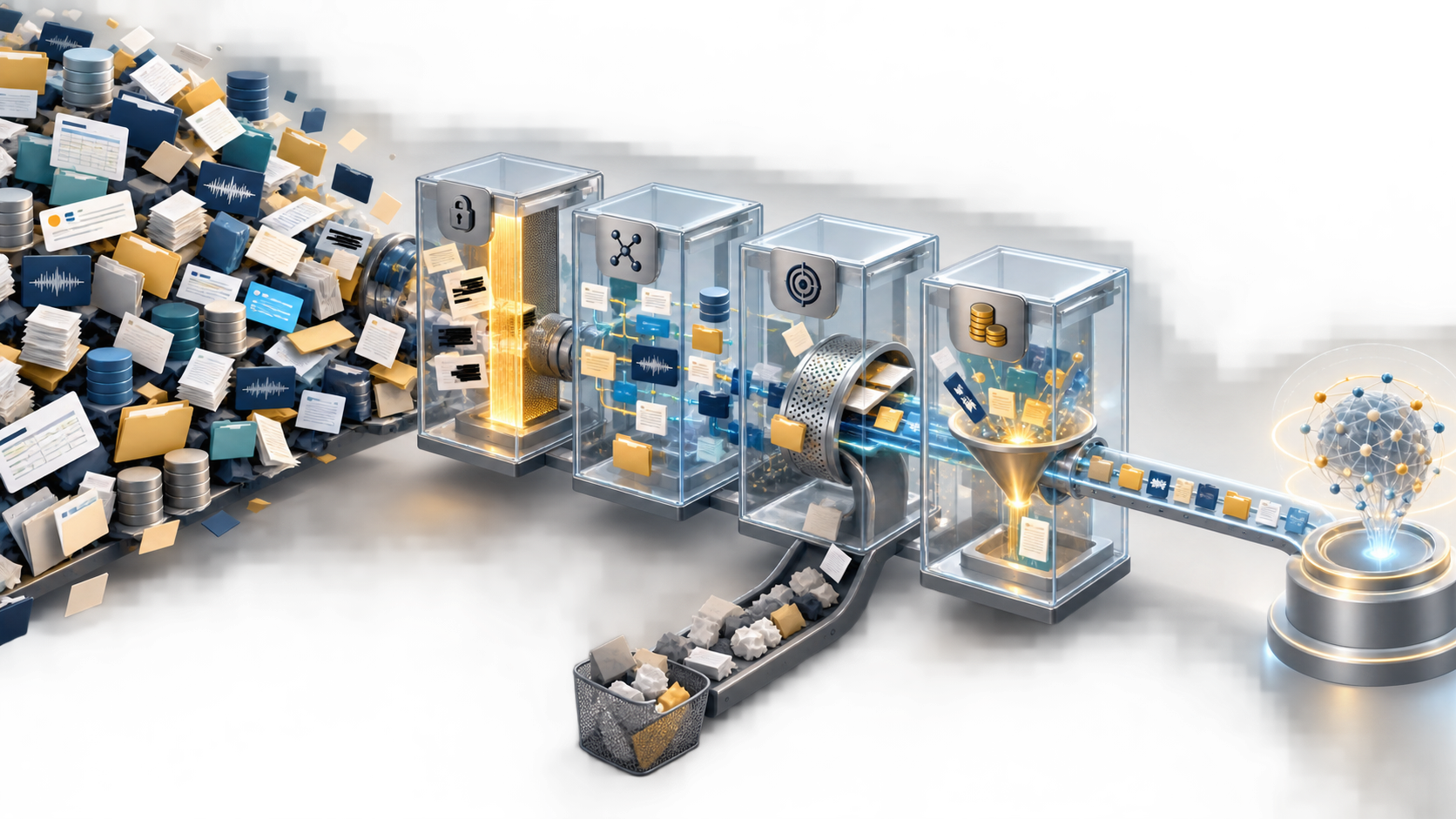
Your team can now get from prompt to prototype quickly. The harder question is whether that speed can survive contact with customer evidence, architecture, security, quality assurance, and a real production rollout.
An effective AI-enabled product engineering workflow is a controlled learning loop. It connects evidence to a product decision, the decision to implementation, implementation to evaluation, and production behavior back to the next decision. Design that loop well and AI removes waiting and repetitive work. Design it poorly and AI simply helps the team create rework faster.
Key takeaways
- Start with an evidence-backed decision brief, not an open-ended request to generate a feature.
- Give AI access to approved context through explicit, least-privilege connections. Keep experimental agents away from unrestricted production writes.
- Let AI retrieve, transform, draft, scaffold, and check. Keep a named person accountable for product intent, consequential trade-offs, and release decisions.
- Write acceptance scenarios and evaluation criteria before generating the implementation. Otherwise, the same model can help create both the defect and the argument that the result is acceptable.
- Measure elapsed flow time, review burden, rework, production quality, and customer outcomes. Generated code volume is not a product metric.
Build a decision loop, not a separate AI coding lane
Bolting a coding assistant onto the engineering stage optimizes only one part of delivery. The implementation may arrive sooner, but it can still wait behind an unclear problem, missing analytics, unresolved design decisions, inaccessible documentation, or a release process that was never prepared for the change.
The useful unit of optimization is not code generation. It is the time and effort required to move from credible evidence to a safe, observable product change. That boundary includes product management, design, engineering, analytics, operations, and any domain owner whose approval affects the release.
The evolving product engineer model fits this environment because it brings problem framing, implementation, and learning closer together. It does not eliminate specialists or make every engineer responsible for every discipline. It gives one person enough product context to carry intent across boundaries without treating the ticket as the complete definition of the work.
A practical workflow can use the following stages. Each stage has an artifact, an accountable human, and an exit condition. The gate can be lightweight, but it should never be invisible.
| Stage | AI contribution | Human accountability | Exit condition |
|---|---|---|---|
| Frame | Organize available evidence, surface contradictions, and draft the decision brief. | Product owner defines the user, problem, desired behavior, constraints, and non-goals. | The team can state what must change for the user and what evidence supports the bet. |
| Retrieve | Gather permitted analytics, feedback, specifications, prior decisions, and relevant code context. | Artifact owners approve access and determine which records are authoritative. | Material claims link to an underlying record; missing information is labeled as a gap. |
| Shape | Generate options, expose assumptions, identify dependencies, and draft acceptance scenarios. | Product, design, and engineering select the approach and reject inappropriate trade-offs. | A chosen hypothesis has clear boundaries, risks, and expected behavior. |
| Build | Draft an implementation plan, scaffold code and tests, propose telemetry, and check consistency. | Engineering owns architecture, correctness, maintainability, and integration decisions. | The change satisfies review requirements and can be evaluated in a controlled environment. |
| Evaluate | Run permitted checks, compare behavior with acceptance scenarios, and organize failures. | Named reviewers decide whether the evidence is sufficient for the intended level of risk. | Known failures, unresolved risks, and release constraints are documented. |
| Release | Prepare rollout instructions, monitoring queries, support notes, and a rollback checklist. | The release owner approves scope, exposure, timing, and rollback authority. | The change can be observed, limited, and reversed if its behavior is unacceptable. |
| Learn | Assemble behavioral, operational, and qualitative signals for review. | The product team decides whether to retain, revise, expand, or remove the change. | The outcome and resulting decision update the context for future work. |
This structure prevents a common failure: AI produces a plausible solution before the team has made the product decision. Once working software appears on a screen, people become reluctant to discard it. Make the problem, constraints, and evaluation criteria visible before the prototype acquires that momentum.
Give AI a context contract it can actually use
A large prompt is not a context strategy. It is a temporary bundle whose assumptions, permissions, and freshness are difficult to inspect. A context contract is better: a small set of maintained artifacts that tells both people and AI what may be used, what must be produced, and where human approval is required.
Your context contract should contain:
- A decision brief: target user, observed problem, desired behavior, supporting evidence, business constraint, non-goals, and unresolved questions.
- An evidence bundle: links to approved analytics, customer feedback, prior experiments, support patterns, and relevant decisions. Each item should have an owner and enough date or version context to reveal whether it may be stale.
- A system map: affected services, interfaces, data objects, dependencies, architectural constraints, and the repositories or documentation considered authoritative.
- A quality contract: acceptance scenarios, test expectations, accessibility requirements, data-handling rules, operational constraints, and any evaluation rubric needed for non-deterministic behavior.
- A release plan: instrumentation, exposure controls, monitoring, support readiness, accountable approver, and rollback path.
Store these artifacts somewhere the team can review and version. A conversation transcript can preserve useful exploration, but it should not become the only record of why a product decision was made. Move accepted decisions into durable artifacts and discard incidental model output that no longer matters.
Connected tools can remove the manual work of copying context between systems. In its own demonstration, Pendo used a Pendo MCP workflow to build "Pendo Wrapped" in under ten minutes. Treat that vendor-created example as evidence that connected context can compress a bounded prototype, not as a neutral benchmark for production delivery. Production readiness still depends on data permissions, correctness, maintainability, evaluation, and release controls that a quick demonstration does not establish.
Model Context Protocol connections are valuable when they let an approved tool retrieve relevant product context or perform a narrowly defined action. The protocol does not decide whether a tool should have access, which data is safe to expose, or whether an action is appropriate. Those remain product, engineering, security, and governance decisions.
Create a permission map for every connected tool. Record the resources it can read, the actions it can perform, the environment in which those actions occur, the data classifications it may encounter, the credential owner, and the approval required before a write.
- Begin with read-only retrieval. Add write actions only when the workflow has a clear owner, validation rule, and recovery path.
- Use sandbox or test environments for generated changes. Promote a reviewed diff rather than allowing an experimental agent to edit production directly.
- Keep secrets, personal data, and sensitive customer content outside the model context unless an approved design explicitly permits their use.
- Require the AI to link important claims to the underlying analytics record, feedback item, specification, or code location. If it cannot, label the statement as an assumption.
- Log tool calls and resulting changes so a reviewer can reconstruct what happened without relying on the model’s own explanation.
- Require explicit human confirmation for destructive, externally visible, financial, permission-changing, or difficult-to-reverse actions.
Do not give an experimental agent broad production write access merely because the connection is technically convenient. An incorrect instruction, stale assumption, or unintended tool call can alter customer data or system behavior. Read-only access, a sandbox, a reviewed change set, and a named approver provide a safer path to the same learning.
Treat evaluation and observability as product requirements
AI-generated implementation can be syntactically valid and still solve the wrong problem. It can also satisfy narrow unit tests while breaking an integration, omitting telemetry, mishandling an edge case, or creating support work elsewhere. Evaluation therefore starts before generation, with an explicit description of acceptable behavior.
There are two different cases to design for. In an AI-assisted workflow, a model helps the team build conventional software. In an AI product, model behavior also appears in the customer experience. The second case needs all the controls of the first, plus evaluation for non-deterministic behavior.
When AI assists the team
Keep the engineering quality bar independent of who or what generated the change. Review the resulting behavior and evidence, not the fluency of the explanation that accompanies it.
- Product intent: Does the change satisfy the acceptance scenarios and preserve the declared non-goals?
- Correctness: Do automated checks cover normal behavior, important boundaries, error handling, and affected integrations?
- Architecture: Does the implementation respect current interfaces, ownership boundaries, and maintainability expectations?
- Data handling: Are collection, storage, access, retention, and deletion consistent with the approved design?
- Customer experience: Are loading, empty, failure, permission, accessibility, and recovery states accounted for?
- Operations: Can the team observe failures, identify the affected path, limit exposure, and roll back the change?
Ask AI to propose tests and inspect gaps, but do not let its proposed suite define completeness by itself. The generator shares the same incomplete context that may have shaped the implementation. A human reviewer should compare both the code and the tests with the quality contract.
When AI is also inside the product
Add an evaluation set that represents the product situations you actually intend to support. Organize it by user goal and failure mode rather than collecting a loose set of impressive prompts. The relevant threshold depends on the consequence of a failure; there is no universal score that makes every AI feature safe to ship.
- Define what a good response or action must contain, what it may contain, and what would make it unacceptable.
- Include routine inputs, ambiguous inputs, missing-context cases, misuse attempts, and situations in which the correct behavior is to ask, refuse, or hand control to a person.
- Separate model quality from retrieval quality, tool execution, policy enforcement, latency, and interface behavior. A single blended score can hide the failing layer.
- Retain enough trace information to diagnose which context, instruction, tool result, and model output shaped an important decision, subject to the product’s data-handling rules.
- Provide an escape path when the AI is uncertain or wrong. The user should be able to correct, undo, retry, or reach a human where the product consequence requires it.
This is eval-driven development: expected behavior is specified alongside the product decision and exercised throughout implementation. Evaluation is not a final demonstration assembled after the feature is already considered complete.
Observability closes the loop. Instrument the behavior named in the decision brief, not merely clicks on the new interface. If the intended outcome is successful task completion, the workflow must capture completion, abandonment, recovery, and relevant downstream effects. A feature flag can limit exposure, but it cannot tell you whether the feature created value. Pair the release control with outcome telemetry and a preassigned person who can pause or reverse the rollout.
Run the first workflow as an operating-model experiment
Do not begin by standardizing an AI workflow across the entire organization. Choose one bounded change that is reversible, observable, and representative of normal product work. Avoid a ceremonial demo with no production path; it will teach you about presentation speed rather than delivery performance.
- Select the work. Pick a real customer or internal-user problem with accessible evidence, a known system owner, and a safe way to limit exposure.
- Capture the current path. Record the artifacts, handoffs, approvals, missing-context searches, review loops, and release controls the work would normally require. This gives you a baseline without inventing an industry benchmark.
- Publish the context contract. Name the records AI may retrieve, the artifacts it may draft, the tools it may call, and the actions that require confirmation.
- Assign decision owners. Put a person’s name beside product intent, architecture, data handling, evaluation acceptance, and release authority. AI can prepare evidence for a decision; it cannot absorb accountability for the consequence.
- Run through the full loop. Include evaluation, instrumentation, deployment, and learning. A workflow that stops when a prototype renders is not a product engineering workflow.
- Record interventions. Note where a person corrected fabricated context, rejected generated code, supplied missing information, narrowed permissions, or repaired an inadequate test. These interventions reveal where the operating model needs stronger structure.
- Update the standard. Convert repeated corrections into templates, checks, permission rules, reusable tests, or better maintained context. Do not rely on everyone remembering a lesson from a chat transcript.
Measure the workflow, not the spectacle
The goal is not to prove that AI was involved. The goal is to determine whether the resulting system moves a sound product decision into production with less avoidable effort and no unacceptable loss of quality or control.
- Flow: elapsed time from accepted problem to releasable change, waiting time for missing context or approval, and time spent on repeated handoffs.
- Review burden: review iterations, substantial corrections, and work returned because the implementation did not match product intent.
- Quality: escaped defects, failed checks, rollbacks, incidents, and support issues connected to the change.
- Outcome: adoption by the intended user, task completion, abandonment, retention behavior, or the specific product result named in the decision brief.
- Governance: unauthorized tool attempts, missing trace information, sensitive-data exposure, and actions that required manual recovery.
- Learning: assumptions confirmed or rejected, reusable artifacts created, and context gaps that now have an owner.
Do not use generated lines, accepted suggestions, prompt counts, or commits as executive success measures. They describe activity inside the workflow, not whether the workflow produced a better decision, a safer release, or a useful customer outcome.
Reject the failure patterns that look like progress
- Prompt-to-production: a plausible output bypasses product framing and independent review. Restore the decision brief, quality contract, and release gate.
- Prototype orphaning: a fast demonstration has no owner for architecture, instrumentation, support, or maintenance. Assign those responsibilities before treating it as a candidate for production.
- Permission creep: an agent accumulates tool access because each new permission removes a small inconvenience. Review access as a permission map and remove capabilities that are not required by the approved workflow.
- Invisible product management: AI-generated requirements quietly become the team’s decision. Require the accountable product owner to approve the target behavior, constraints, and non-goals in a durable artifact.
- Automated ambiguity: the team automates a handoff whose owner or exit condition was never clear. Clarify the decision and artifact first; then automate the stable part.
- Velocity theater: faster code generation is presented as faster product delivery while review, rework, and release queues expand. Measure the complete path from evidence to observed outcome.
At the end of the first run, make an explicit decision: scale the workflow, repair it and repeat, or stop using it for that class of work. A mixed result is still useful if it reveals that retrieval is valuable while write access is premature, or that scaffolding saves effort while generated tests need stronger independent review.
Your next move is concrete: choose one low-risk, instrumented product change and write its decision brief, context contract, permission map, quality contract, and release gate before anyone prompts an agent to build it. That small discipline will tell you far more about AI readiness than another isolated coding demo.
References
- Pendo — The evolution of the product engineer [2026]
- Pendo — How I used Pendo MCP to build "Pendo Wrapped" in under 10 Minutes (and you can too)