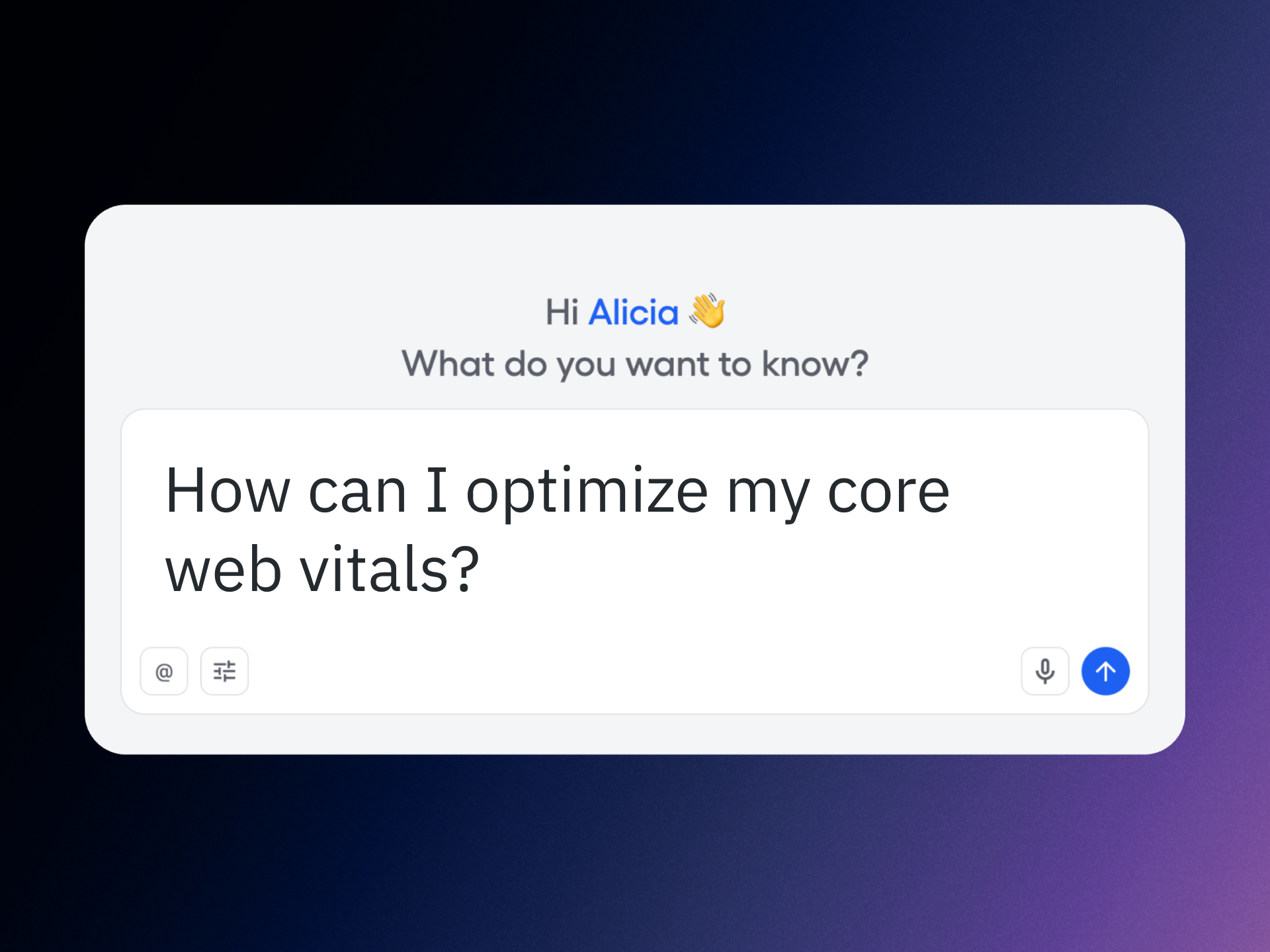
I measure product health by a simple equation: speed plus clarity equals trust. That’s why I prioritize Core Web Vitals and search performance together—because the fastest path to better UX and higher rankings is a closed loop between measurement, diagnosis, and action. Standardizing on Amplitude’s Global Agent with Amplitude AI Agents let my teams compress that loop from weeks to hours, and in many cases, to minutes.
Learn how to track your web vitals and page rankings faster with Amplitude AI Agents and improve your site’s user experience and SEO rankings. That goal sounds ambitious, but with the right instrumentation and analytics workflow, it becomes a repeatable operating rhythm rather than a one-off project.
Here’s what changed for us with Amplitude’s Global Agent: a single, consistent way to capture performance signals across pages and journeys, unified context for every session, and a lightweight footprint that doesn’t get in the way of speed. By centralizing measurement, we eliminated blind spots and gave product, growth, and engineering one shared truth for Core Web Vitals and behavioral analytics.
My practical playbook is straightforward: 1) Establish a performance baseline for Core Web Vitals on key templates and critical user paths. 2) Segment results by device, location, acquisition channel, and content type to surface where users actually feel the friction. 3) Connect those vitals to downstream behaviors—scroll depth, engagement, and conversion—so we prioritize fixes that move business outcomes, not just lab scores. 4) Use feature flags and A/B testing to ship improvements safely and quantify uplift. 5) Close the loop with Agent Analytics to keep learnings visible and actionable.
Operationally, we rely on anomaly detection to flag regressions early, CI/CD guardrails to prevent performance slips at deploy time, and observability plus session replay to accelerate root-cause analysis. This combination reduces mean time to resolution, protects page experience during fast iteration cycles, and helps us avoid trading UX for speed—or vice versa.
The strategic benefit is compounding: better Core Web Vitals improve user perception and increase engagement, which strengthens SEO signals and, ultimately, page rankings. With a unified analytics platform in place, we can spotlight the few improvements that create outsized gains, then scale those patterns across the site with confidence.
If your roadmap includes faster pages, stronger rankings, and happier users, align your teams around this simple loop: measure precisely, diagnose quickly, experiment safely, and learn continuously. Amplitude’s Global Agent and Amplitude AI Agents give you the instrumentation and insight to make that loop your competitive advantage.
Inspired by this post on Amplitude – Best Practices.