Tag: anomaly detection

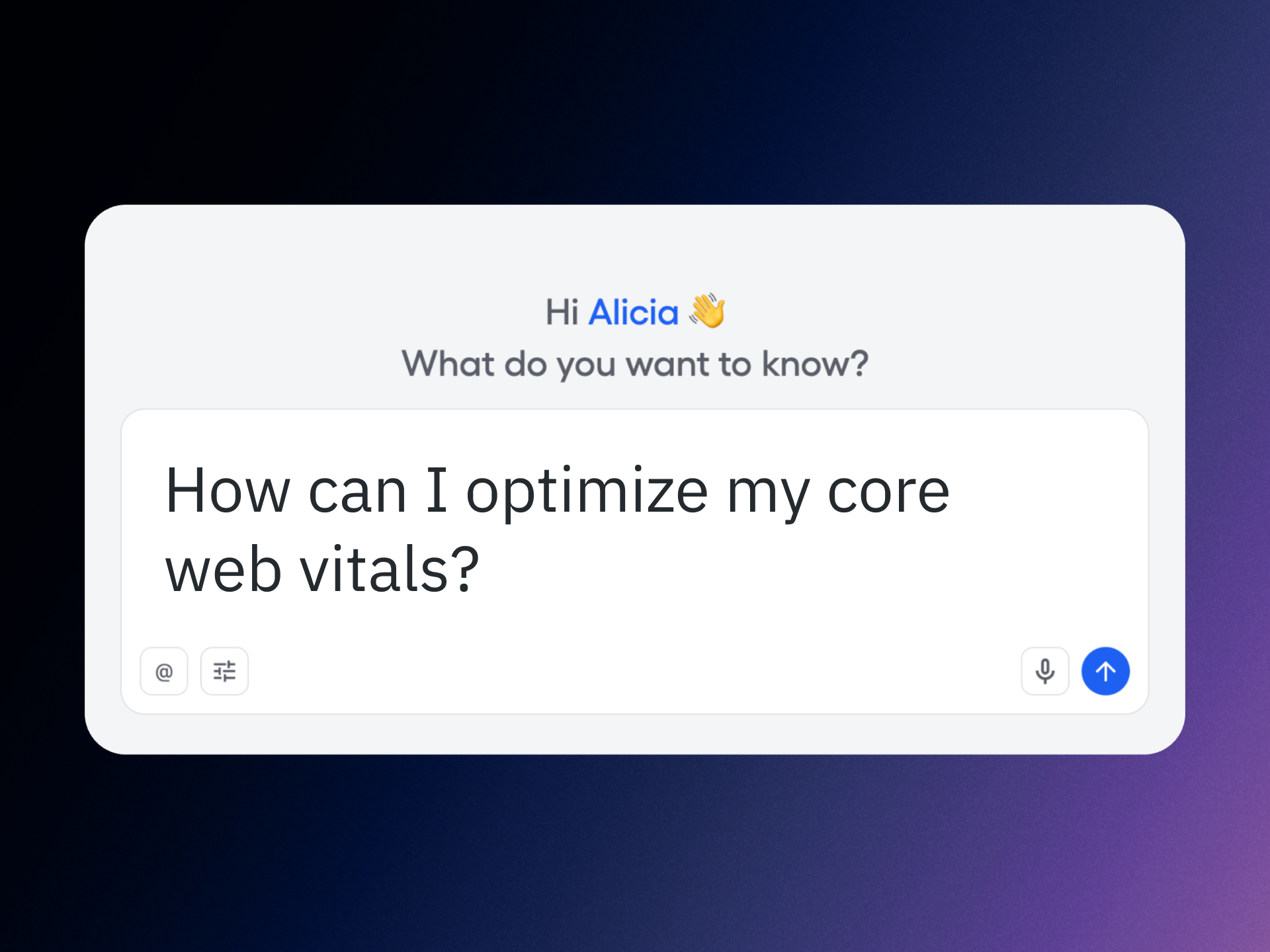
  • Supercharge Core Web Vitals with Amplitude’s Global Agent: Faster Rankings, Happier Users

    Supercharge Core Web Vitals with Amplitude’s Global Agent: Faster Rankings, Happier Users

    I measure product health by a simple equation: speed plus clarity equals trust. That’s why I prioritize Core Web Vitals and search performance together—because the fastest path to better UX and higher rankings is a closed loop between measurement, diagnosis, and action. Standardizing on Amplitude’s Global Agent with Amplitude AI Agents let my teams compress that loop from weeks to hours, and in many cases, to minutes.

    Learn how to track your web vitals and page rankings faster with Amplitude AI Agents and improve your site’s user experience and SEO rankings. That goal sounds ambitious, but with the right instrumentation and analytics workflow, it becomes a repeatable operating rhythm rather than a one-off project.

    Here’s what changed for us with Amplitude’s Global Agent: a single, consistent way to capture performance signals across pages and journeys, unified context for every session, and a lightweight footprint that doesn’t get in the way of speed. By centralizing measurement, we eliminated blind spots and gave product, growth, and engineering one shared truth for Core Web Vitals and behavioral analytics.

    My practical playbook is straightforward: 1) Establish a performance baseline for Core Web Vitals on key templates and critical user paths. 2) Segment results by device, location, acquisition channel, and content type to surface where users actually feel the friction. 3) Connect those vitals to downstream behaviors—scroll depth, engagement, and conversion—so we prioritize fixes that move business outcomes, not just lab scores. 4) Use feature flags and A/B testing to ship improvements safely and quantify uplift. 5) Close the loop with Agent Analytics to keep learnings visible and actionable.

    Operationally, we rely on anomaly detection to flag regressions early, CI/CD guardrails to prevent performance slips at deploy time, and observability plus session replay to accelerate root-cause analysis. This combination reduces mean time to resolution, protects page experience during fast iteration cycles, and helps us avoid trading UX for speed—or vice versa.

    The strategic benefit is compounding: better Core Web Vitals improve user perception and increase engagement, which strengthens SEO signals and, ultimately, page rankings. With a unified analytics platform in place, we can spotlight the few improvements that create outsized gains, then scale those patterns across the site with confidence.

    If your roadmap includes faster pages, stronger rankings, and happier users, align your teams around this simple loop: measure precisely, diagnose quickly, experiment safely, and learn continuously. Amplitude’s Global Agent and Amplitude AI Agents give you the instrumentation and insight to make that loop your competitive advantage.


    Inspired by this post on Amplitude – Best Practices.


    Book a consult png image
  • My Playbook for Safe AI Analytics in Financial Services: Compliance, Trust, and Real Workflows

    My Playbook for Safe AI Analytics in Financial Services: Compliance, Trust, and Real Workflows

    I spend a lot of time helping financial services teams adopt AI analytics without compromising on risk, compliance, or customer trust. The stakes are high: regulations are evolving, data sensitivity is non‑negotiable, and a single misstep can erode confidence. That’s why my approach centers on governed AI, rigorous data governance, and measurable business value—not flashy demos.

    Learn how Amplitude delivers safe, governed AI analytics for financial services—aligned to compliance, built for trust, and ready for real workflows.

    In practice, “safe and governed” means clear lines of accountability and controls that hold up under audit. I look for privacy-by-design principles, role-based access controls, robust audit trails, and granular data permissions that keep sensitive data segregated. Strong AI risk management also requires model oversight—documented policies, human-in-the-loop review where needed, and explainability for high-impact decisions. Above all, the platform must meet regulatory compliance expectations and support the organization’s risk posture without slowing teams down.

    Real workflows are where the value shows up. In financial services, that can mean using behavioral analytics to understand user intent, applying anomaly detection to surface suspicious patterns earlier, and empowering product managers and analysts to iterate safely within a unified analytics platform. When these capabilities are built into the core analytics motion, I see faster detection of issues, clearer attribution of outcomes, and more confident decision-making—all while staying within governance guardrails.

    When I evaluate a solution, my checklist is simple and strict: does it enforce strong data governance by default; does it provide transparent, auditable AI behaviors; can it scale securely to meet enterprise requirements; does it tie insights directly to product and growth outcomes; and will it help risk, compliance, and product teams work together instead of at cross purposes? If the answer is yes across that list, the platform earns a place in the enterprise toolbelt.

    Done right, governed AI analytics give financial services teams the confidence to move faster with less risk. You gain sharper insights from behavioral data, earlier warning from anomalies, and the trust that comes from controls that are aligned to compliance and resilient under scrutiny. That’s the path to durable advantage: responsible AI that accelerates learning, protects customers, and translates directly into better products and performance.


    Inspired by this post on Amplitude – Best Practices.


    Book a consult png image
  • I Pointed a “Ralph Wiggum” AI Loop at My Product for a Week—The Data That Stopped Chaos

    I Pointed a “Ralph Wiggum” AI Loop at My Product for a Week—The Data That Stopped Chaos

    I spent a week pointing a "Ralph Wiggum loop" at my product to see how far an agentic AI could take pragmatic, everyday improvements without human micromanagement. It was equal parts exhilarating and nerve-wracking. The short version: the loop moved fast and broke assumptions, but Amplitude analytics kept it from going off the rails—and turned chaos into controlled acceleration.

    By "Ralph Wiggum loop," I mean a deliberately naive, endlessly curious cycle: try something small, ship it behind a flag, watch the data, then try again. It is the product equivalent of a fearless intern who experiments constantly. That energy is invaluable for discovery, but it absolutely demands strong guardrails and a clear definition of success.

    Before I started, I framed the outcomes I cared about: user activation within the first session, reduction in time-to-value, and early retention indicators. I set baselines and a minimum detectable effect (MDE) for A/B testing so the loop could distinguish noise from signal. I also documented a driver tree of behaviors we wanted to influence and ensured every event was cleanly instrumented in Amplitude analytics to support reliable behavioral analytics.

    The guardrails mattered most. I put every change behind feature flags with instant rollback. I defined "off the rails" conditions upfront, including regression thresholds for activation and retention analysis, and enabled anomaly detection to surface unexpected spikes or drops. Session replay was ready to diagnose confusion fast, and I kept a daily evaluation cadence so the loop never ran unattended for long.

    Day by day, the loop proposed micro-experiments: onboarding copy variants, tooltip timing, in-app guide sequencing, and subtle changes to progressive disclosure. Each iteration shipped behind a flag to a small cohort. I watched leading indicators in real time, then zoomed out to cohort views to guard against short-term gains that might erode longer-term value. When something looked promising, we expanded exposure methodically; when something looked risky, we paused immediately.

    We had a pivotal moment where the loop suggested a bolder call-to-action that spiked activation. On the surface, it looked like a win. Amplitude cohorts told a fuller story: downstream engagement softened, and anomaly detection flagged a pattern that hinted at premature conversion rather than genuine intent. A quick rollback through feature flags saved the week—and reminded me why eval-driven development should be the default for agentic AI workflows.

    The most surprising part was how quickly the loop unlocked small compounding gains once the measurement scaffolding was in place. With a unified analytics platform and crisp guardrails, the system became a safe sandbox where the AI could explore aggressively while we stayed anchored to outcomes. The combination of behavioral analytics, A/B testing discipline, and daily human review turned raw speed into durable learning.

    My takeaways are direct. Agentic AI can accelerate discovery, but only if you define stop conditions and wire strict feedback loops into your stack. Measurement is product strategy here—without it, you get noisy activity instead of progress. Invest in instrumentation first, treat feature flags as non-negotiable, and let anomaly detection and session replay be your early warning system. Most of all, tie every experiment to activation, engagement, or retention, not vanity metrics.

    If you’re considering your own week with a "Ralph Wiggum loop," start painfully small, constrain the blast radius, and insist on decision-quality data. Do that, and you’ll turn a chaotic agent into a compounding engine for product discovery—one that moves fast, learns faster, and stays on track.


    Inspired by this post on Amplitude – Perspectives.


    Book a consult png image
  • Why We Built AI-Powered FinOps In‑House—and Beat Off‑the‑Shelf Tools in Under a Year

    Why We Built AI-Powered FinOps In‑House—and Beat Off‑the‑Shelf Tools in Under a Year

    When our cloud costs started outpacing growth, I knew we had to make a decisive call on “build vs buy.” Buying a FinOps platform would have been faster on paper, but it wouldn’t internalize our operational nuance. Building an agentic AI layer on top of our cost, telemetry, and product usage data promised not just dashboards—but compounding leverage. Less than a year later, our homegrown approach outperformed off‑the‑shelf alternatives on speed, precision, and organizational adoption.

    The aspiration was clear from the outset: See how Amplitude scaled FinOps with AI agents—cutting manual work, accelerating insights, and turning a one-person function into a cost optimization engine. We set that as a bar for both outcomes and operating cadence, then translated it into a roadmap grounded in first principles.

    Our build vs buy analysis hinged on three factors. First, cloud cost optimization is only as good as the context it carries; we needed deep hooks into our pricing, feature flags, and deployment frequency to reason about unit economics in real time. Second, we required agentic AI workflows that could detect anomalies, recommend actions, and close the loop—not just visualize waste. Third, governance mattered: privacy‑by‑design, data governance controls, and transparent decision logs were non‑negotiable under our AI Strategy and product management leadership standards.

    We architected a retrieval‑first pipeline to blend billing exports, usage telemetry, and observability signals with product and GTM metadata. Agent workflows ran on top: one agent built driver trees that explained spend shifts by service, customer cohort, and environment; another specialized in anomaly detection with confidence scoring; a third agent proposed commitment strategy, rightsizing, and schedule adjustments. Each recommendation linked back to source data for auditability.

    From a delivery standpoint, we treated the system like a product, not a tool. A product trio (PM, engineering, and FinOps) ran continuous discovery interviews with stakeholders, instrumented eval‑driven development for agent prompts, and shipped improvements via CI/CD weekly. We optimized prompt engineering for decision clarity over verbosity and codified acceptance criteria: time‑to‑insight, actionability, and measurable savings per recommendation.

    The impact was immediate and then compounding. Manual effort on month‑end analysis shrank as agents pre‑triaged drift and surfaced root causes with suggested remediations. Insights arrived continuously, not as end‑of‑month surprises, which meant engineering could fold changes into regular sprints. What started as a one‑person FinOps function evolved into a cost optimization engine embedded across teams—product, SRE, and finance—all speaking a shared language of drivers, tradeoffs, and outcomes.

    Along the way, we learned where building truly beats buying. If your architecture, pricing model, and growth loops are unique—and they usually are in consumption SaaS—agentic AI amplifies institutional knowledge in a way generic platforms can’t. Conversely, if you lack clean tagging, clear ownership, or basic observability, investing there first will raise ROI on any approach, built or bought.

    My advice if you’re at this crossroads: define success in terms of decisions changed, not reports shipped. Start with a thin slice—anomaly detection plus one high‑leverage remediation path—then iterate. Keep humans in the loop for executive sign‑off until your confidence intervals and post‑action telemetry prove reliability. With the right guardrails and focus, in‑house AI FinOps can move faster than the market and pay for itself well within a year.


    Inspired by this post on Amplitude – Perspectives.


    Book a consult png image
  • Stop Silent Churn: The 8 Best SaaS Prediction Tools for 2026 (Features + Use Cases)

    Stop Silent Churn: The 8 Best SaaS Prediction Tools for 2026 (Features + Use Cases)

    Churn isn’t just a retention problem—it’s a product, go-to-market, and strategy signal that shows up everywhere in the customer journey. Over the past few years, I’ve evaluated and implemented churn prediction tools across high-growth SaaS environments, and the difference between reactive firefighting and proactive, data-driven retention is night and day.

    Compare the top 8 churn prediction tools for SaaS teams. Features, use cases, and how each stacks up, so you can act before customers quietly leave.

    When I assess churn prediction tools for product-led growth, I start with a simple question: will this help my team see risk early enough—and clearly enough—to intervene with precision? The best platforms combine behavioral analytics, retention analysis, and anomaly detection to surface leading indicators before Net Recurring Revenue (NRR) takes a hit.

    First, signal coverage matters. Strong churn models draw from product usage events, CRM integration, support tickets, billing health, and even session replay to capture real-world behavior. I look for native connectors to systems like Intercom, Pendo, and Amplitude analytics, plus flexible ingestion for custom events. Without comprehensive signals, even the smartest models will miss critical moments such as stalled onboarding, shrinking active seats, or feature disengagement.

    Second, I require transparent risk scoring and clear drivers. Black-box scores erode trust with Customer Success and Product teams; explainability builds alignment. Tools that expose driver trees, cohort-based retention analysis, and segment lift help me translate insights into prioritized experiments. When possible, I tie predicted churn segments to A/B testing with a thoughtful minimum detectable effect (MDE) so we can quantify impact quickly and avoid overfitting to noise.

    Third, actionability is non-negotiable. Predictions must trigger targeted AI workflows, in-app guides, and product tours—not just dashboards. My ideal setup routes high-risk cohorts to tailored journeys (e.g., an onboarding rescue path) while notifying the right owner in CRM and Customer Success. Playbooks should be easy to operationalize, measurable, and reversible if the signals change.

    Fourth, I evaluate platform scalability, data governance, and privacy-by-design. Enterprise readiness means clear role-based access, auditability, robust SLAs, and an architecture that can evolve into a unified analytics platform as the product and data footprint grows. I also weigh total cost of ownership, implementation time, and maintenance burden against expected gains in NRR and expansion.

    In my experience, the winning tools are the ones that make it simple to connect predictions to outcomes: reduce onboarding drop-off, increase user activation, prevent seat contraction, and accelerate expansion. They align Product, Customer Success, and Growth around shared metrics, shorten time-to-value, and make proactive retention part of the operating rhythm—not a last-ditch effort at renewal.

    In this 2026 comparison, I’ll outline how each tool handles data breadth, model quality, explainability, and workflow automation. I’ll also share implementation checklists and decision criteria so you can choose the right fit for your stage, stack, and motion—whether you’re primarily product-led growth, sales-led, or hybrid.

    If you’ve ever felt like customers “quietly leave” despite solid top-of-funnel metrics, this guide will help you turn churn signals into concrete actions—and convert at-risk accounts into durable advocates.


    Inspired by this post on Pendo – Perspectives.


    Book a consult png image
  • Build vs. Buy for Churn Prediction: My Proven Playbook for Faster Retention and ROI

    Build vs. Buy for Churn Prediction: My Proven Playbook for Faster Retention and ROI

    Churn is the silent tax on growth, and I treat churn prediction as a core product capability—not a side project. Over the years, I’ve led teams through multiple implementations across different data maturities and go-to-market motions, and the same question keeps returning at kickoff: what’s the smartest path to impact now and defensibility later?

    “Should you build or buy your churn prediction model?” The right answer depends on time-to-value, data readiness, available talent, and whether churn prediction is a true differentiator for your product strategy or simply a must-have capability to power customer success and product-led growth.

    When speed and coverage matter most, I start by evaluating category platforms that pair behavioral analytics with activation. As one example, vendors emphasize immediate business outcomes such as integrations, in-app guides, and workflow triggers that help you act on risk signals fast—without waiting months for model training or data engineering.

    Increase revenue, cut costs, and reduce risk with Pendo’s Software Experience Management platform. Optimize the entire software experience to drive adoption and improve engagement.

    Buying makes sense when you need rapid time-to-value, opinionated best practices, and a unified analytics platform to operationalize insights through product tours, in-app guides, and CRM integration. In these cases, I’m optimizing for coverage, consistent signal quality, and ease of activation for customer success—so the team can focus on interventions, not infrastructure.

    Building is compelling when churn prediction is a source of competitive differentiation or you have proprietary signals others can’t access. If your product generates unique behavioral data, requires custom anomaly detection or explainability constraints, or must blend usage telemetry with domain-specific risk scoring, a tailored model can raise precision and unlock novel retention levers.

    My hybrid approach has become a reliable playbook: buy first to establish a strong baseline and close the activation loop, then selectively build where proprietary data and context yield outsized gains. I use retention analysis to identify high-signal behaviors, then iterate with A/B testing and a clear minimum detectable effect (MDE) to validate uplift before committing engineering capacity.

    Total cost of ownership is non-negotiable. I account for more than license or training costs: ongoing data engineering, feature pipeline maintenance, model monitoring for drift, and AI risk management all add up. Strong data governance, privacy-by-design, and regulatory compliance must be baked in—whether I build, buy, or blend both.

    Activation determines real ROI. Predictions that don’t flow into customer success workflows, lifecycle messaging, or in-product nudges rarely move Net Recurring Revenue (NRR). I prioritize tight integrations that enable targeted experiments—journey mapping, contextual tooltips, and timely outreach—to reduce friction and increase user engagement at the moments that matter.

    My quick decision test: buy if time-to-value and adoption are the immediate goals; build if proprietary signals and explainability are core strategic assets; blend if you want fast wins now with room to differentiate later. Answering the build vs. buy question through this lens consistently improves retention, accelerates product-led growth, and keeps teams focused on the customer experience rather than plumbing.


    Inspired by this post on Pendo – Perspectives.


    Book a consult png image
  • Inside Amplitude’s ML Playbook: Practical Strategies for Smarter A/B Tests and Growth

    Inside Amplitude’s ML Playbook: Practical Strategies for Smarter A/B Tests and Growth

    I’m continually asked how machine learning can make product analytics more actionable. Drawing from Amplitude analytics in real-world settings, I’ve distilled what matters most for product teams that want faster, smarter decisions without sacrificing rigor.

    When I design experiments, I start with minimum detectable effect (MDE) to size samples correctly and avoid costly, inconclusive tests. I pair that with disciplined A/B testing hygiene—clear hypotheses, thoughtful stop rules, and guardrails for key metrics—so results translate into credible product strategy choices instead of noisy dashboards.

    For growth and retention, I map behavioral analytics to activation and long-term value. Driver trees help me connect feature adoption to revenue or retention, and anomaly detection keeps me from overreacting to outliers when seasonality or data quality shift.

    I segment cohorts by user intent and lifecycle stage, measure user activation with crisp event definitions, and monitor leading indicators across a unified analytics platform. This keeps cross-functional conversations grounded, accelerates product-led growth, and reduces the risk of optimizing for vanity metrics.

    Operationally, that means building self-serve views that flag MDE-ready experiments, surface retention analysis by cohort, and trigger anomaly detection alerts only when the signal outpaces noise. The payoff is fewer meetings debating data quality and more time shipping value.

    If you’re leveling up your analytics stack, start by tightening experimentation basics, instrumenting activation and retention with behavioral analytics, and wiring in anomaly detection as a safety net. You won’t just move faster—you’ll learn faster, and with the confidence to bet big when the data earns your trust.


    Inspired by this post on Amplitude – Perspectives.


    Book a consult png image
  • Unlock Confident Decisions with Bayesian Statistics: Smarter A/B Tests from Small Samples

    Unlock Confident Decisions with Bayesian Statistics: Smarter A/B Tests from Small Samples

    Shipping great products is a game of making high‑quality decisions under uncertainty. In my role leading product management, I’ve seen teams stall when classic methods demand huge sample sizes before we can say anything useful. Bayesian statistics has become my go‑to approach for turning sparse data into clear, decision‑ready insights—especially when traffic is limited or experimentation windows are tight.

    Understand Bayesian statistics vs. frequentist methods and learn how Bayesian approaches improve experiment insights with small sample sizes.

    Here’s why I rely on it in A/B testing: frequentist methods focus on p‑values and long‑run error rates, which are tough to translate into action. With a Bayesian lens, I can express outcomes as intuitive probabilities—“Variant B has a 92% chance to outperform A”—and use credible intervals to communicate likely ranges of impact. That clarity reduces decision friction and helps the team move faster with confidence.

    Bayesian methods shine when sample sizes are small and the minimum detectable effect (MDE) of a frequentist test would be impractically large. I incorporate prior knowledge—historical conversion trends, seasonality, and learnings from related experiments—to stabilize noisy early data. Done thoughtfully, priors improve estimate quality without overfitting; I always run sensitivity checks to ensure the posterior is driven by the data we’re observing, not wishful thinking.

    In practice, my workflow is straightforward. I set a prior from historical performance in Amplitude analytics, run the experiment, and update the posterior daily. I track the probability of superiority, expected lift, and a credible interval that the CRO role can rally around. When the probability of a meaningful win crosses a pre‑agreed threshold, we ship. When it doesn’t, we bank the learning and move on—no prolonged debates about p‑values that few stakeholders truly understand.

    This approach also strengthens product discovery. By using behavioral analytics and retention analysis as informative priors, I can evaluate early signals from narrower cohorts—new geographies, niche segments, or enterprise accounts—where traffic is scarce. The result is faster iteration in product‑led growth environments, even when a full‑funnel test would take weeks to reach frequentist significance.

    Operationally, I treat Bayesian experimentation as part of a unified analytics platform strategy. The same posterior machinery that powers A/B testing can support anomaly detection during releases, quantify risk in phased rollouts, and estimate lift from in‑app guides or product tours. Because results are framed in plain language probabilities, cross‑functional teams make better, faster decisions aligned to outcomes rather than outputs.

    A few guardrails keep me honest. I preregister decision rules (stop/go thresholds, guardrail metrics), run prior sensitivity analyses, and document assumptions alongside results. That discipline prevents overconfidence, improves reproducibility, and builds trust with leadership.

    If your experiments are bottlenecked by low traffic or you’re tired of waiting weeks for a binary “significant/not significant,” consider a Bayesian upgrade. You’ll get earlier readouts, clearer stakeholder communication, and a repeatable path to compounding learning—without sacrificing rigor.


    Inspired by this post on Amplitude – Perspectives.


    Book a consult png image
  • Behavioral Analytics That Crush Fraud: Spot Anomalies, Prioritize Risk, Act with Confidence

    Behavioral Analytics That Crush Fraud: Spot Anomalies, Prioritize Risk, Act with Confidence

    Fraud teams are drowning in signals—events, alerts, and edge cases that look suspicious but rarely point to what truly matters now. In my role leading product, I focus on turning that noise into clear, ranked actions the team can trust. Behavioral analytics is how we bridge the gap from “something looks off” to “here’s why it matters and what to do next.”

    See how behavioral analytics helps fraud management teams surface anomalies, prioritize risk factors, and act faster with greater confidence.

    When I build fraud capabilities, I start by defining the outcomes that matter: find anomalies early, prioritize by impact, and respond in minutes—not days. That requires a rigorous approach to data governance, strong observability across the stack, and a mindset tuned to threat detection and response rather than passive reporting.

    For me, behavioral analytics means unifying event streams across web, mobile, payments, and support into a single, trustworthy, unified analytics platform. We then apply anomaly detection on top of baselines for user, device, and entity behavior—capturing velocity spikes, geolocation drift, account takeover signals, and unusual journey paths. The win is not more alerts; it’s clearer context per alert.

    Prioritization is where the value compounds. I combine deterministic signals (e.g., device fingerprint mismatches, impossible travel, repeated declines) with weighted risk scoring that adapts to emerging patterns. This helps fraud analysts triage by potential loss and customer impact, not just alert volume—so the highest-risk cases land at the top of the queue with the right context attached.

    Actionability is the final mile. I map each risk tier to a playbook—step-up authentication, temporary holds, secondary review, or immediate block—so teams can act with confidence. Real-time alerts route to the right channel; feature flags allow fast containment; and AI risk management practices ensure continuous learning while preserving precision and recall. We close the loop by measuring investigation time, false positive rates, and recovery to keep improving.

    A few lessons keep paying off: instrument early and consistently; keep your schema stable; document risk definitions; and test changes with A/B testing to quantify impact before scaling. Treat your fraud stack like a mission-critical cybersecurity system with tight SLAs, clear ownership, and auditable decisions—because it is.

    If you’re evaluating your next move, start with a narrow but high-ROI use case (account takeover or payment fraud), stand up clear dashboards for analysts, and iterate on the risk scoring model weekly. With disciplined data practices and aligned playbooks, behavioral analytics turns scattered signals into decisive, defensible action.


    Inspired by this post on Amplitude – Perspectives.


    Book a consult png image