Tag: product management leadership

  • How to Design Your Product Leadership Legacy: Impact, Craft, and Values That Endure

    How to Design Your Product Leadership Legacy: Impact, Craft, and Values That Endure

    I recently spent time with an episode of All Things Product that hit especially hard as we head into year-end: Petra Wille and Teresa Torres ask, “What do you want to be known for in your work?” As someone leading product management and building high-performing teams, I regularly bring this question into my Q4 conversations. It’s a powerful lens for product management leadership, career transitions, and how we show up for our customers and colleagues.

    Listen to this episode on: Spotify | Apple Podcasts

    In this conversation, I appreciated how clearly they unpack the nuances of impact, craft, personal brand, and values—and how those ideas shape the footprints we leave in teams, organizations, and the broader product community. Their stories and lessons learned are equal parts relatable and practical, which is exactly what we need when we’re balancing execution with reflection.

    Let’s talk about “legacy.” The word can feel loaded—big, vague, and distant. I reframe it with my teams into a question we can act on now: What meaningful change did we enable for customers and our organization this quarter, and what do we want colleagues to remember about how we did it? That framing keeps us grounded in outcomes and behaviors, not just lofty aspirations.

    The distinction between impact and craft is central. Impact is the difference our work makes—what changes because of our decisions. Craft is what we hone for intrinsic reward—our product discovery techniques, decision-making frameworks, and communication muscles. Early in my career, I over-indexed on impact metrics and under-invested in craft. I shipped value, but I wasn’t building the repeatable habits that elevate a product creator for the long haul. Over time, I learned that craft compounds—and it pays dividends in both product-market fit lessons and leadership credibility.

    Personal brand and values also matter more than many of us admit. When the pressure is on, people remember how we decide, how we communicate trade-offs, and how consistently we anchor on customer value. I want to be known for rigorous product discovery, clarity under uncertainty, and the integrity to say “no” when it protects long-term outcomes. Those cues travel fast across an organization and quietly define our leadership legacy.

    Feedback gaps can reveal blind spots—and we all have them. I proactively create multiple feedback loops: structured 1:1s, skip-levels, stakeholder debriefs after key product decisions, and customer touchpoints. I specifically ask for disconfirming evidence—what am I missing, where did my decision-making create friction, and how might I simplify? Weekly customer learning is non-negotiable for me; it keeps the team grounded and accelerates product discovery. If you need a starting point, Teresa’s work on weekly customer interviews is a solid playbook: Customer Interviews: How to Recruit, What to Ask, and How to Synthesize What You Learn.

    Here are the prompts I’m using with my team for Q4 reflection. Why “legacy” can feel loaded—and better ways to frame the question. The difference between impact (what changes because of your work) and craft (what you hone for intrinsic reward). How personal brand and values influence what colleagues remember about you. Why feedback gaps can reveal blind spots—and how to proactively seek better input. Reflection prompts to carry into your Q4 (and beyond). I encourage folks to journal on these, then bring two concrete actions into our next planning cycle.

    If you’re thinking about your own growth, preparing for career transitions, or simply curious how others reflect on their product practice, this episode offers both inspiration and pragmatic takeaways. I’m weaving these themes into our planning and calibrations because reflection is a force multiplier—it sharpens strategy, strengthens culture, and ultimately improves customer outcomes.

    Follow Teresa Torres: https://ProductTalk.org

    Follow Petra Wille: https://Petra-Wille.com

    Mentioned in the episode: Petra’s Thought-Provoking Questions to Prompt Your End-of-Year Reflection

    Mentioned in the episode: Xing

    Mentioned in the episode: Teresa’s work on weekly customer interviews: Customer Interviews: How to Recruit, What to Ask, and How to Synthesize What You Learn

    Mentioned in the episode: Petra’s guide: The Product Leader’s Guide to Giving Feedback

    Join the conversation with me: What do you want to be known for in your product work this coming year? Share your thoughts below and let’s learn from one another.

    Full Transcript

    Full transcripts are only available for paid subscribers.


    Inspired by this post on Product Talk.


    Book a consult png image
  • AI Coworkers That Actually Work: Inside Neople’s Guardrails, Evals, and Customer-Ready Agents

    AI Coworkers That Actually Work: Inside Neople’s Guardrails, Evals, and Customer-Ready Agents

    What if my next teammate wasn’t a human hire but an AI coworker—one that can answer support tickets, process invoices, or draft emails—and my non-technical colleagues could teach it how to do those tasks themselves? That is the practical promise behind Neople’s “digital coworkers,” and it’s a shift I’ve been anticipating across customer support and operations: AI that blends the reliability of automation with the empathy and flexibility of modern agents.

    Listen to this episode on: Spotify | Apple Podcasts

    In exploring how Neople builds and deploys these agents, I appreciated the clarity from Seyna Diop (Chief Product Officer), Job Nijenhuis (CTO & Co-founder), and Christos C. (Lead Design Engineer). They walked through the evolution from simple response suggestions to fully autonomous customer service agents, the architecture powering their conversational workflow builder, and the evaluation loops that include customers as part of the quality process. As a product leader, this resonates deeply with how I approach product discovery, product management leadership, and go-to-market enablement for gen AI in customer support.

    Moved from “LLMs will solve everything” to finding the right balance between code, agents, and guardrails

    Designed evals that run in production to detect hallucinations before an email ever reaches a customer

    Helped non-technical users build automations conversationally — and taught them decomposition along the way

    Turned customers’ feedback loops into eval pipelines that improve product quality over time

    From a customer support AI strategy standpoint, these choices are decisive. I’ve seen teams struggle when they lead with model horsepower rather than a layered system of retrieval, business logic, and guardrails. The Neople approach aligns with what I’ve practiced: set clear task boundaries, ground responses in trustworthy knowledge, and instrument every step so evals reflect real-world behaviors—not just lab benchmarks.

    I also love the emphasis on conversational building for non-technical users. Teaching decomposition implicitly—by guiding users to break down tasks into steps—accelerates adoption and reduces support burden. It’s a practical onramp to gen ai for product prototyping: let users design flows in natural language, then progressively reveal structure, data dependencies, and edge cases as they iterate.

    Scaling these agents “where you work” requires deep integrations and visibility. We discussed how the team makes agents feel native in existing tools, maintains “Visibility and Transparency in Neople Responses,” and keeps humans in the loop for sensitive workflows. That transparency is non-negotiable: if an AI is going to act on behalf of my team, I want traceable reasoning, source citations, and reversible actions.

    Quality, of course, is where most agent initiatives rise or fall. Running evals in production, detecting hallucinations before messages reach customers, and converting feedback loops into continuous improvement pipelines—this is exactly how you earn trust at scale. It mirrors how I deploy forward deployed engineers with customers: ship intentional constraints, watch real usage, and feed structured signals back into the system to compound quality.

    The roadmap beyond support is equally compelling. Once agents demonstrate reliability in high-volume, high-variance environments like customer support, adjacent functions—sales ops, finance ops, and onboarding—become reachable. That’s a credible path to product-market fit lessons: start where the pain is sharp and measurable, prove value with operational KPIs, then expand horizontally with guardrails intact.

    For those who want to go deeper, the conversation spans the origin story and real-world applications, through “Integrations and Scaling: Making Neople Work Everywhere,” into techniques for “Ensuring Quality in Customer Knowledge Bases,” “Customer Feedback and Error Analysis,” and the “Technical Details of Knowledge Retrieval.” It also touches “Embedding Strategies and Document Types,” “Automation and Actions in Customer Support,” and “Expanding Beyond Customer Support.” It’s a comprehensive, pragmatic tour of what it takes to make AI coworkers production-ready.

    Neople.io – Learn more about Neople’s AI coworkers

    The Joy Lab – Neople’s community and podcast about AI and work

    If you’re piloting agents today, my recommendations are straightforward: choose a single, high-impact use case; define guardrails and “safe failure” modes; stand up production evals that mirror customer outcomes; and make transparency a default. With that foundation, AI coworkers can become dependable teammates—ones your non-technical colleagues can actually work with, trust, and improve.


    Inspired by this post on Product Talk.

    Book a consult png image
  • From Closet Cold Calls to Category Leader: Gusto’s Playbook for Urgent Product-Market Fit

    From Closet Cold Calls to Category Leader: Gusto’s Playbook for Urgent Product-Market Fit

    I gravitate to origin stories where product strategy meets real human pain. Tomer London is the co-founder and Chief Product Officer at Gusto, the payroll and people platform used by over 400,000 businesses. He grew up helping run his dad’s clothing store in Israel — an experience that sparked his mission to build better tools for small business owners. After moving to the US for a PhD at Stanford, he met his co-founders and started Gusto. That founding context matters: it rooted the company in empathy for SMBs and created the “burning problem” lens that still defines their roadmap. What stands out most to me is the insistence on “emotional urgency.” In product discovery, polite feedback is noise; urgency is signal. I use a simple heuristic—the tug-of-war test for product-market fit: are customers fighting to pull the product into their workflow today, or gently praising it while doing nothing? Why founders should actively seek rejection is the companion lesson. Rejection exposes the edges of the problem, clarifies the job-to-be-done, and forces focus. When prospects say no with conviction, they’re actually giving you a prioritized backlog. Gusto’s scrappy customer research: cold calling from a walk-in closet is the type of hustle I expect from great product teams. It’s a reminder that qualitative discovery doesn’t require a lab—just proximity to customers. I’ve seen forward-deployed conversations beat large-scale surveys every time, especially in SMB markets where workflows are idiosyncratic and switching costs are emotional as much as economic. Those early calls transformed abstract hypotheses into concrete user journeys, error states, and trust moments. Reinventing payroll without any prior experience can be an advantage when you pair first-principles thinking with domain humility. The discipline is to ship with credibility from day one. “It’s not an MVP, it’s something that wows people” captures this perfectly. For regulated, high-stakes workflows like payroll and taxes, a minimum lovable product must feel complete at the edges that matter—accuracy, compliance, and support—while still being opinionated and simple. Competing with incumbents like ADP, Intuit, and Paychex required that Gusto’s default experience be both safer and easier. Hiring for humility, not just talent is another keystone. In complex categories, humility accelerates learning loops, reduces coordination drag, and keeps teams close to customers. I’ve applied a similar bar in co-founder and executive selection: values alignment over resume prestige. The weekly co-founder ritual that built trust is a practice I recommend—structured, recurring time to surface concerns, decide faster, and avoid silent drift. Teams that maintain this cadence sustain velocity even as they scale. Betting on SMBs – and ignoring investor advice is a familiar crossroads. Serving SMBs vs. startups demands different GTM mechanics, pricing psychology, and onboarding pathways. Gusto’s “start small” GTM playbook—narrow ICP, land with a high-urgency job, then earn the right to expand—de-risks complexity while proving unit economics. The shift from payroll to a multi-product platform only works when the initial wedge earns trust. That’s how switching costs became Gusto’s moat: not through lock-in tactics, but by becoming the source of truth for money-in, money-out, and people ops. I also appreciate the candor around The two lucky breaks that gave Gusto an edge. Timing, regulatory tailwinds, or partner enablement often look like luck from the outside and like relentless preparation on the inside. Programs like Y Combinator can sharpen that preparation, but the compounding advantage still comes from daily execution—shipping, learning, and iterating. Along the way, names like Wells Fargo matter because financial infrastructure choices affect reliability and trust, which in turn affect retention. A throughline here is craftsmanship anchored in real-world retail empathy. What Tomer learned about customers from his dad’s clothing store mirrors what I’ve seen across SMB product-market fit lessons: respect the owner’s time, remove ambiguity, and solve the whole problem, not just the shiny part. Building products customers actually love is the result of pairing opinionated design with verifiable outcomes—on-time payroll, fewer errors, less admin stress, and clearer cash flow. If you’re a product creator tackling a workflow as critical as payroll, take these as your operating principles: measure emotional urgency, welcome rejection, over-index on discovery, hire for humility, and aim for wow, not just MVP. Whether you’re up against ADP, Intuit, Paychex, or building a new wedge entirely, this is a repeatable path from wedge to platform. For inspiration that shaped many builders in our field, revisit Steve Jobs’ “Secrets to Life” clip and Steve Jobs’ Stanford Commencement Speech—both reminders to question defaults and start from first principles. Finally, a note on leadership. Product management leadership isn’t about grand roadmaps; it’s about creating the conditions for truth to surface quickly—through customer conversations, team rituals, and clear success metrics. Do that well, and like Gusto, you’ll earn the right to expand your product surface area without losing the trust that made customers choose you in the first place.
    Book a consult png image
  • How Braintrust Nailed Product-Market Fit: Paranoia, Patience, and High-Bar Quality

    How Braintrust Nailed Product-Market Fit: Paranoia, Patience, and High-Bar Quality

    Product-market fit in the GenAI era is elusive because both the technology surface area and user expectations change weekly. That’s why Braintrust caught my eye: they set a relentless quality bar, delayed go-to-market on purpose, and used real-world evaluation pain to shape an end-to-end platform for building AI apps. In my work leading product management teams, I recognize this pattern as the difference between shipping demos and shipping durable value.

    Context matters. Ankur Goyal’s journey runs through MemSQL (now SingleStore), Impira, and Figma. Working with high-bar users at MemSQL forged a bias toward precision, performance, and reliability—traits that translate directly to AI infrastructure where flaky evals and brittle prompts can quietly erode trust. When you build for exacting users early, the feedback loop is unforgiving—and that’s a gift.

    The throughline is quality. Great software often comes from a place of “paranoia”—the productive kind that compels us to fail proofs, harden edge cases, and verify outcomes under load. In AI product development, that paranoia shows up as rigorous evals, clear data contracts, reproducibility, and measured rollouts. It’s not glamorous, but it’s how you earn compounding trust with builders and operators.

    Recruiting is strategy. The trick to recruiting well is selecting for taste, curiosity, and ownership—people who elevate the craft and sweat the engineering details. In AI-heavy products, I’ve had the most success with forward deployed engineers who live with users long enough to discover the non-obvious constraints that should drive the roadmap. Taste plus proximity beats velocity without context.

    Impulse control creates leverage. Braintrust delayed go-to-market, which is counterintuitive when the market is hot. But in a new category, premature scaling yields fake signals. The better move is to tighten the loop: instrument the “prompt playground,” pressure-test evals, validate the inner loop of building AI apps, and only then broaden access. When the core interaction is right, growth compounds; when it’s off, every feature feels like a workaround.

    Figma-era frustrations with evals became the opportunity. Anyone who has tried to standardize AI evaluations across prompts, models, and datasets knows how quickly the surface area explodes. Converting that frustration into Braintrust’s product thesis—reliable, end-to-end workflows for AI app development—speaks to a classic product discovery principle: go deep on a painful, persistent job-to-be-done before you go broad.

    How to recognize a real market opportunity: look for high-frequency workflows with measurable outcomes, teams who already duct-tape solutions, and buyers who have the budget and urgency to pull the product in. When you see repeatable pull from discerning users—and you can demonstrate quality with transparent evals—you’re approaching true PMF rather than narrative fit.

    Inside the first six months, the right posture is deliberate focus. For a platform like Braintrust, that means obsessing over the developer inner loop: data in, prompt iteration, eval rigor, versioning, approvals, and productionization. The “prompt playground” must evolve from experimentation to governance, so teams can move from clever demos to reliable deployments with confidence.

    AI continues to reshape the platform’s future. As model ecosystems shift (OpenAI and beyond) and the data plane sprawls (Databricks, Snowflake), developers want a unified surface to build, evaluate, and ship. Integrations with familiar tools like Airtable, Coda, Zapier, and Figma lower adoption friction by meeting teams where they already work, while enterprise-grade controls unlock buyers at the scale of Goldman Sachs.

    The cultural choices matter as much as the code. Make big bets with extreme clarity, or don’t make them at all. Stay mission-driven when novelty tempts distraction. Write down the customer promise and keep it tight. Hiring mistakes—especially around quality, curiosity, and ownership—compound quickly in AI product teams, so reset the bar early and protect it.

    What PMF really looks like here: customers self-discover core value, usage deepens without hand-holding, and cross-functional teams (engineering, data science, and operations) align around shared definitions of quality. Support volume becomes more about how-to than break-fix. Roadmap prioritization becomes easier because the next best feature reveals itself in the workflow data.

    My playbook takeaways for product management leadership in GenAI: prioritize eval rigor before growth, use forward deployed engineers for product discovery, specialize the prompt playground into a governed inner loop, and delay go-to-market until high-bar users pull you in. These are the same principles I apply to gen ai for product prototyping and customer support ai strategy—because durable PMF in AI still comes down to quality, focus, and earned trust.

    Referenced:

    • Airtable: https://www.airtable.com/

    • Adam Prout: https://www.linkedin.com/in/adam-prout-0b347630/

    • Braintrust: https://braintrust.dev

    • Brian Helmig: https://www.linkedin.com/in/bryanhelmig/

    • Coda: https://coda.io/

    • Databricks: https://www.databricks.com/

    • David Kossnick: https://www.linkedin.com/in/davidkossnick/

    • Figma: https://www.figma.com/

    • Goldman Sachs: https://www.goldmansachs.com/

    • Kris Rasmussen: https://www.linkedin.com/in/kristopherrasmussen/

    • Manu Goyal: https://www.linkedin.com/in/mngyl/

    • MemSQL: https://www.singlestore.com/ (now SingleStore)

    • Nikita Shamgunov: https://www.linkedin.com/in/nikitashamgunov/

    • OpenAI: https://openai.com/

    • Snowflake: https://www.snowflake.com/

    • Zapier: https://zapier.com/


    Book a consult png image
  • Inside a $15B Autonomy Powerhouse: Founder Grit, Multi-Product Strategy, and GTM Wins

    Inside a $15B Autonomy Powerhouse: Founder Grit, Multi-Product Strategy, and GTM Wins

    I’m fascinated by how world-class founders translate deep domain expertise into durable products and category-defining companies. Qasar Younis is the co-founder and CEO of Applied Intuition, a leading vehicle intelligence platform that helps companies develop and deploy autonomous systems at scale. In June 2025, the company raised $600M at a $15B valuation. Before Applied Intuition, Qasar was the COO and a group partner at Y Combinator, and earlier founded TalkBin, which was acquired by Google. He’s also held engineering roles at General Motors and Bosch.

    From my vantage point leading product teams, the throughline in Qasar’s journey is the disciplined fusion of vertical SaaS focus with an enterprise-grade product-led GTM. It’s a masterclass in choosing a hard problem, building undeniable technical leverage, and then scaling with operational rigor. Below, I unpack the ideas that stood out and how I map them to day-to-day product management leadership and product-market fit lessons.

    Two founder traits Silicon Valley undervalues came up early. I read this as stamina and operational discipline — the unglamorous habits that compound into advantage. In practice, that looks like tight execution cadences, brutally clear roles, and a willingness to slow down to make faster decisions later. In my experience, these traits are the difference between momentum and motion.

    On productivity, the goal is to gain 1–3 extra months of work every year without burning people out. I’ve seen teams unlock this by standardizing operating rhythms (weekly operating reviews, quarterly product strategy resets), protecting deep work time, and eliminating decision latency with crisp escalation paths. If you’re looking for a playbook, “High Output Management” and “Only the Paranoid Survive” remain gold standards for building repeatable management systems.

    Founders should read outside the startup canon. Industrial history like “The History of the Standard Oil Company” teaches power, platform strategy, and regulatory dynamics in ways Twitter threads never will. When you’re building in autonomy, defense, or other regulated arenas, these mental models become execution tools.

    From YC, the big lessons were pattern matching and clean feedback loops. Pattern matching helps you see when a problem is fundamental versus incidental. But it only works if paired with fast, unvarnished feedback from customers and the board. I encourage PMs to institutionalize this with pre-briefs and debriefs for every major customer interaction and launch.

    Qasar’s battle-tested startup formula resonated: start with a hard, valuable problem; recruit top 1% technical talent; instrument the business like an operator; and make the market come to you by shipping undeniable value. The founding insight for Applied was that companies needed robust simulation, tooling, and infrastructure to safely accelerate autonomy development — not just a single application.

    Applied’s playbook — “vertical SaaS, product-led GTM, and leveraging VC networks” — is a blueprint I’d happily hand to any B2B founder. Product wins the first meeting; credibility and references win the second; value-delivery speed wins procurement. How Applied expanded beyond automotive and why Applied went multi-product early show the value of building a platform surface area that compounds learning, data, and revenue resiliency.

    Why co-founder fit is make-or-break is a reminder that alignment on pace, product philosophy, and customer promise matters more than complementary résumés. The moment you become a real founder often coincides with choosing the harder path when an easier, shinier option appears. How great founders master luck is straightforward: maximize surface area with smart bets, tighten the feedback loop, and keep fixed costs low so you can wait for the right wave.

    I appreciated the contrarian takes on startup culture, compensation, and cost control. Why being cheap is a startup superpower isn’t about austerity — it’s about optionality. Every dollar you don’t spend buys time to learn. And on the myth of “competition doesn’t matter,” the truth is it absolutely does; it shapes your positioning, pricing, hiring narrative, and customer urgency. Track it like a core product metric.

    The early scrappiness — the Sunnyvale house setup — is a great reminder that proximity and speed matter in the zero-to-one phase. One tactic I’ve found powerful in enterprise motion is deploying forward deployed engineers to collapse the distance between product, implementation, and value realization. It converts “pilot purgatory” into production faster.

    Why domain knowledge is making a comeback is obvious in autonomy and defense. In complex, safety-critical spaces, credibility, toolchain depth, and integration expertise drive trust as much as UI polish. That’s also why a multi-product strategy, when grounded in a coherent systems view, can accelerate product-market fit across adjacent verticals.

    The mentors who shaped Qasar underscore the value of learning from operators across eras. Names like Paul Graham, Sam Altman, Marc Andreessen, Elad Gil, Kyle Vogt, and builders at companies like Waymo and Zoox reflect a network that pairs ambition with practical judgment — a useful pattern for any founder assembling their own advisory bench.

    Referenced resources worth exploring: Applied Intuition; Ansys; Bosch; General Motors; Waymo; Zoox; “Google’s Acquisition of TalkBin”; “High Output Management”; “Only the Paranoid Survive”; “The History of the Standard Oil Company”; and profiles of Bilal Zuberi, Elad Gil, Marc Andreessen, Paul Graham, Peter Ludwig, and Sam Altman. These links provide context across autonomy, simulation, company building, and the investor-operator network that helps compound advantage.

    Where to find Qasar: LinkedIn: https://www.linkedin.com/in/qasar/


    Book a consult png image
  • How Ignoring Silicon Valley Advice Fueled a $3B Fintech Breakout—Lessons I Apply Daily

    How Ignoring Silicon Valley Advice Fueled a $3B Fintech Breakout—Lessons I Apply Daily

    I’ve learned the hard way that you shouldn’t copy-paste advice. What works in one company, market, or moment often collapses under different constraints. Listening to the story of a digital banking platform becoming the go-to financial infrastructure for startups reinforced this truth—and sharpened how I think about building enduring products in fintech. In my role leading product strategy, I gravitate toward what’s invariant: genuine customer pull, clear value exchange, and an operating cadence that compounds.

    The most durable lesson mirrors what I’ve seen across serial product-building: the gap between a good idea and a great business is defined by behavior. Users don’t just praise a great business; they pull it out of you. They adopt quickly, they expand without being asked, and they complain loudly if anything breaks. That’s what strong product-market fit feels like. It’s trust earned through painful clarity about the job-to-be-done, not a clever feature checklist.

    Culture is where this begins. Personality trumps culture playbooks. Slide decks don’t make decisions—people do. The habits you normalize early (how you debate, ship, and hold the bar) become the “DNA” that scales. Mercury’s unusual culture playbook – and why it works comes down to a small set of lived behaviors: write to think, default to clarity, ship to learn, and protect craft. It’s a system that rewards truth-seeking over politics and outcomes over optics.

    Hiring then becomes the highest-leverage culture act. How to hire with intention: define non-negotiable values, design interviews that surface them, and hold the line when the candidate is strong but misaligned. I favor structured prompts, real working sessions, and backchannel references that probe for ownership, curiosity, and resilience. Cultural fit isn’t about sameness; it’s about shared standards and complementary strengths.

    On the product side, I’m uncompromising about avoiding the trap of weak product-market fit. Weak PMF feels like constant push—heroic sales, marketing duct tape, and feature thrash to chase disparate demands. Don’t fall into the weak product-market fit trap. Instead, isolate a segment with extreme pain, deliver a 10x improvement on the one thing that matters, and measure pull, not noise: self-serve activation, organic expansion, and sustained retention.

    I’m often asked how to evaluate startup ideas that scale. I look for four compounding drivers: frequent usage (habit-forming workflows), margin structure with room for pricing power, embedded distribution (network or platform leverage), and defensibility (data, network effects, or regulated moats). In fintech, the regulatory and integration surface area adds weight to all four—if you get them right, the moat is real.

    Mercury’s unlikely origin story is a reminder that the best wedge often looks too narrow from the outside. Focus on an overlooked user with distinct needs, build an MVP that does the essential thing flawlessly, and layer expansion only when the core is undeniable. Building Mercury’s MVP meant shipping the must-have workflow end-to-end with ruthless prioritization, not an encyclopedic feature set.

    Breaking into the fintech space requires both product taste and institutional fluency. You need great UX and resilient plumbing. That means precise integrations, clear risk posture, and an obsessive approach to reliability. The teams that win treat compliance, security, and operations as product surfaces—not afterthoughts. It’s how you keep promises at scale.

    There’s also a mindset shift that separates enduring companies from short-lived ones: moving from “This is hard” to long-term gains. Most advantages in fintech compound quietly—ledger accuracy, reconciliation speed, dispute handling, partner trust. When you invest in these flywheels early, growth feels smoother later.

    Rapid growth tests every seam. Navigating Mercury’s rapid growth phase wasn’t about clever hacks; it was about raising the quality bar as you scale headcount, maintaining a crisp roadmap narrative, and protecting speed without sacrificing safety. The teams that thrive operationalize strategy: crisp goals, transparent tradeoffs, and one source of truth for priorities.

    I remind founders that Competition isn’t the reason you’re failing. In most cases, the real culprit is fuzzy positioning, an undifferentiated wedge, or a value proposition that doesn’t clear the 10x bar. If your best customers wouldn’t fight to keep you, competitors aren’t your issue—focus is.

    Shipping under intense pressure during the SVB crisis underscored what great product leadership looks like in a storm: compassionate, clear communication with customers; a written decision log to prevent thrash; and small, high-confidence releases that reduce risk fast. Crisis management during the SVB collapse is a masterclass in operational readiness—runbooks, war rooms, and real-time telemetry tied to a single owner for every critical path.

    For additional context and resources mentioned: Airbnb: https://www.airbnb.com/; Andreessen Horowitz: https://a16z.com/; Apple: https://www.apple.com/; Block: https://block.xyz/; Brex: https://www.brex.com/; Chime: https://www.chime.com/; Gusto: https://gusto.com/; Mercury: https://mercury.com/; Paul Graham: https://x.com/paulg; Plaid: https://plaid.com/; Stripe: https://stripe.com/; SVB (Silicon Valley Bank): https://www.svb.com/; True Link Financial: https://www.truelinkfinancial.com/; Varo: https://www.varomoney.com/; Y Combinator: https://www.ycombinator.com/

    If you’re a product creator navigating fintech—or any complex, high-stakes category—anchor on behaviorally proven value, not borrowed wisdom. Build a culture that compounds, hire with intention, and chase unmistakable pull. When the market is truly with you, the work gets harder—and far more rewarding—in all the right ways.


    Book a consult png image
  • Inside the AI‑First Web: Designing Agent‑Friendly APIs, Prioritizing Accuracy, and Scaling Trust

    Inside the AI‑First Web: Designing Agent‑Friendly APIs, Prioritizing Accuracy, and Scaling Trust

    I’ve spent the last few years watching AI reshape product roadmaps, developer workflows, and customer expectations. One idea now feels undeniable: the web must evolve to serve a new primary user—AIs. That shift changes how we think about search, reliability, governance, monetization, and ultimately, how we design products that scale with trust.

    Parag Agrawal is the co-founder and CEO of Parallel, a startup building search infrastructure for the web’s second user: AIs. Before launching Parallel, Parag spent over a decade at Twitter, where he served as CTO and later CEO during a period of intense transformation, as well as public scrutiny.

    I was particularly struck by how crisply this frames the next frontier for product leaders: build systems that machines can consume at massive scale without sacrificing accuracy, provenance, or trust. In particular, I was drawn to the emphasis on “deep research,” where Parallel is tackling “deep research” challenges by prioritizing accuracy over speed, and the design choices that make their APIs uniquely agent-friendly. As someone who has shipped AI features into production, that trade-off resonates—speed gets demos; accuracy earns renewals.

    Here’s how I’m synthesizing the most actionable takeaways for product, engineering, and go-to-market leaders. First, design for AI as the primary customer. That means structuring content and APIs so agents can reliably reason, verify, and self-correct. Agent-friendly interfaces need deterministic schemas, explicit provenance, stable latency envelopes, and predictable failure modes. If an agent can’t trust your contract, it won’t chain your service into complex workflows, and you’ll lose the compounding effects that make AI platforms defensible.

    Second, bring a systems mindset to accuracy. “Accuracy over speed” isn’t a slogan—it’s an architecture choice. In my experience, that shows up as retrieval strategies tuned for recall and precision trade-offs, multi-pass verification, and human-in-the-loop escalation paths for high-risk queries. For deep research use cases, you need to make the cost of being wrong explicit in your design and your SLAs.

    Third, expect your ICP to evolve as AI matures. Early adopters may be research-heavy teams and product creators building agentic workflows. Over time, as reliability improves, your ideal customer shifts toward operational teams that demand measurable outcomes—support deflection, conversion lift, cycle-time reduction. I map these stages explicitly in the roadmap and keep pricing, packaging, and onboarding aligned to each phase.

    Fourth, consider business models that keep the web open for AI while aligning incentives. If AIs are the web’s second user, publishers need fair value exchange for structured access, provenance, and usage. In practice, that could look like tiered access, usage-based pricing, attribution requirements, or revenue-sharing tied to agent-driven outcomes. The key is ensuring that openness and sustainability are not at odds.

    Fifth, build engineering teams that are both pragmatic and research-aware. On my teams, I look for a balance between high-potential builders who move fast with ambiguous specs and experienced hands who can productionize novel systems. Forward deployed engineers can be a force multiplier here—embedding with customers to surface edge cases, close the verification loop, and turn qualitative insights into productized patterns.

    Sixth, recognize how the software engineer’s role is evolving in an AI-assisted world. Engineers are increasingly orchestrators—composing models, retrieval layers, tools, and policies—rather than only writing business logic. That requires better observability for prompts and agents, reproducibility for experiments, and contracts that make emergent behavior inspectable and testable. This is where “uniquely agent-friendly” APIs show their value—clear contracts enable safe autonomy.

    Seventh, treat launch timing as a function of trust, not just velocity. Founders often ask when to ship. My rule: launch when you can document bounds, prove repeatability on critical paths, and explain failure semantics. In AI, your narrative is your control surface—fundraising frameworks and customer conversations both benefit when you can quantify reliability, not just showcase capability.

    Finally, the long-term vision matters. If agents are finally becoming useful in production, the platforms that win will combine: machine-readable content at scale, accuracy-first retrieval and verification, agent-safe API design, and sustainable economics for an open web. That’s the blueprint I’m applying to my own product strategy: build for agents, measure for trust, and align incentives so the ecosystem compounds rather than fragments.

    To product leaders navigating this shift: revisit your ICP, rewrite your API contracts for agents, and make “accuracy over speed” a first-class requirement. To engineering leaders: invest in evaluation harnesses, data quality pipelines, and forward deployed engineers who can turn messy customer workflows into reusable system capabilities. The AI era rewards teams that pair ambition with discipline—and that’s where the next wave of durable advantage will be built.


    Book a consult png image
  • Inside Canva’s $42B Rise: Unconventional Growth Levers, Onboarding Wins, and PM Lessons

    Inside Canva’s $42B Rise: Unconventional Growth Levers, Onboarding Wins, and PM Lessons

    I’m endlessly fascinated by how products break out of niches and become part of daily life for millions. Canva’s story is one of those rare cases where smart product decisions, relentless iteration, and unconventional growth levers combined to unlock mass-market adoption. From a product management standpoint, it’s a case study in lowering barriers, scaling trust, and aligning vision with execution.

    Cameron Adams is the co-founder and Chief Product Officer at Canva, the design platform valued at $42B as of July 2025, used by over 230 million people every month.

    Before starting Canva, Cameron was a designer and engineer at Google and co-founded Fluent, an email startup.

    In this deep dive, Cameron walks through Canva’s earliest days — from the remarkably fast courtship with co-founders Melanie Perkins and Cliff Obrecht, to the counterintuitive product decisions that helped Canva instantly resonate with users who thought they would never design anything.

    From my vantage point leading product teams, I see a set of repeatable patterns here: choose the right first persona, compress time-to-value with intuitive onboarding, and design growth into the experience rather than bolting it on. Canva executed these with uncommon clarity—and the results speak for themselves.

    “In this episode, we cover:”

    “How Canva turned social media managers into early evangelists”

    Choosing social media managers as an initial wedge was a masterclass in product discovery. This persona had an urgent, recurring need for on-brand visuals at speed, and a strong incentive to share output publicly—perfect conditions for organic, product-led growth. When I map early adoption paths, I look for exactly this intersection: high-frequency jobs-to-be-done, immediate value, and built-in distribution.

    “Balancing a huge vision with scrappy execution”

    Vision without sequencing is just aspiration. Canva kept the ambition expansive, but the execution ruthlessly focused: nail core templates, make editing feel magical, and remove friction everywhere. That balance is how you earn the right to pursue the bigger roadmap later—enterprise, collaboration, and advanced workflows—without losing momentum.

    “Hard lessons from their near-silent launch day”

    Quiet launches are not failures; they are feedback. The key is converting that signal into action. I’ve learned to treat launch as the start of systematic learning: instrument onboarding, watch activation cohorts, prioritize the sharpest drop-offs, and keep shipping until the curve bends. Canva’s trajectory highlights the compounding effect of that discipline.

    “The two growth levers that changed everything”

    Every breakout product eventually finds one or two levers that out-pull the rest. The trick is recognizing them early, doubling down with conviction, and being willing to refactor the product, pricing, or go-to-market around them. When we run growth reviews, I ask: which lever moves both acquisition and retention, and how do we amplify it inside the product experience?

    “And much more…”

    “Why onboarding was the unlock for retention”

    Onboarding is where trust is earned and churn is decided. Canva’s approach underscores a timeless principle: shorten time-to-first-value, scaffold early wins, and keep the UI context-aware so users never feel lost. In my teams, we treat onboarding as a living system—measured weekly, tuned to personas, and tightly coupled to activation, engagement, and long-term retention.

    “How word-of-mouth spurred early retention”

    When your product becomes part of how people express themselves publicly, word-of-mouth becomes an engine—not a byproduct. Canva benefited from this virtuous loop: the more people shared their creations, the more others discovered the tool. That’s community-led growth baked into the product, not just the marketing plan.

    “Targeting different user personas”

    Expansion requires thoughtful layering of personas—adjacent use cases, then adjacent buyers. The art is sequencing: keep the core experience simple while introducing just enough depth for power users and teams. This is where product management leadership shows up in the roadmap: deliberate tradeoffs, clear positioning, and crisp UX boundaries.

    “Building a community on social media”

    Community is a force multiplier when it’s authentic. By showcasing templates, celebrating user success, and teaching design basics, Canva turned social channels into an education loop. That creates durable retention because users don’t just use the product—they identify with it.

    “Why Canva should have gone mobile sooner”

    Mobile is not a form factor choice; it’s a job context. When creation moves to the moment and place of need, you capture frequency and defensibility. The takeaway for PMs: if your customers’ work happens on the go, mobile-first isn’t a feature—it’s the product.

    “What underpins Canva’s dominance today”

    Foundationally, it’s relentless focus on accessibility and outcomes: templates that reduce blank-page anxiety, collaboration that feels native, and a platform that scales from the individual to the enterprise. That alignment across product-market fit, brand promise, and go-to-market is what compounds.

    “Rebuilding for enterprise”

    Winning the enterprise means rethinking identity, permissions, governance, brand controls, and performance—often from the ground up. The lesson I emphasize with teams: enterprise-grade is not a layer you sprinkle on top; it’s an architectural commitment.

    “Lessons from Canva’s tough times”

    Every scaling company hits turbulence—hiring, platform debt, or market shifts. The durable ones maintain clarity of purpose, instrument their bets, and keep shipping value. That resilience is a cultural choice as much as a product choice.

    References:

    Adobe: https://www.adobe.com/home

    Atlassian: https://www.atlassian.com/

    Campaign Monitor: https://www.campaignmonitor.com/

    Canva: https://www.canva.com/

    Cliff Obrecht: https://www.linkedin.com/in/cliff-obrecht-79ba9920/

    Dave Greiner: https://www.linkedin.com/in/davegreiner/

    Lars Rasmussen: https://www.linkedin.com/in/larserasmussen/

    Melanie Perkins: https://www.linkedin.com/in/melanieperkins/

    Mike Cannon-Brookes: https://www.linkedin.com/in/mcannonbrookes/

    New York Stock Exchange: https://www.nyse.com/

    Pinterest: https://pinterest.com/

    Scott Farquhar: https://www.linkedin.com/in/scottfarquhar/

    Where to find Cameron:

    LinkedIn: https://www.linkedin.com/in/themaninblue/

    Timestamps:

    (01:24) The birth of Canva

    (04:32) Meeting Canva’s co-founders

    (11:22) Building the first iteration of Canva

    (15:26) The discovery that changed prototyping

    (20:48) Why onboarding was the unlock for retention

    (27:36) The anticlimactic launch day

    (32:43) How word-of-mouth spurred early retention

    (36:33) Targeting different user personas

    (41:02) Building a community on social media

    (43:38) Two impactful growth levers

    (47:14) Why Canva should have gone mobile sooner

    (48:12) What underpins Canva’s dominance today

    (53:37) Rebuilding for enterprise

    (58:38) Lessons from Canva’s tough times


    Book a consult png image
  • Building an Education Giant in a ‘Bad Market’: Product Strategy Lessons from ClassDojo

    Building an Education Giant in a ‘Bad Market’: Product Strategy Lessons from ClassDojo

    Education is often labeled a “bad market”—fragmented buyers, long sales cycles, and entrenched systems that resist change. Yet that framing misses a powerful truth: when you build directly for the people who care most—teachers, students, and families—you can unlock extraordinary adoption and defensibility. That’s the core product lesson I drew from the ClassDojo story and one I return to often as a product leader.

    ClassDojo is a multi-product education platform used in 95% of U.S. schools and over 180 countries globally to connect teachers, students, and families. The scale is impressive, but the path there is what matters: start with the consumer, design for delight, and let community power distribution. In a space where enterprise selling is slow and political, that decision to serve families first wasn’t just contrarian—it was strategically correct.

    Why build for families, not schools? Because enterprise education is broken. District procurement often prioritizes compliance and consensus over usability and joy. By focusing on the “end customer” experience—teachers in classrooms, students eager to learn, parents seeking connection—ClassDojo built pull instead of push. The platform earned trust the hard way: one classroom at a time, one interaction at a time.

    The origin story included false starts. A group-making tool didn’t land, and early skepticism about the education market was warranted. But meeting co-founder Liam Don at a hackathon and getting into Imagine K12 provided momentum and mentorship. This is where the founder mindset showed up clearly: relentless resourcefulness. Instead of forcing a PMF narrative, they iterated until they found a communication platform that teachers loved and families valued.

    One inflection point I found especially instructive was the conversation with Reid Hoffman that changed everything. The takeaway wasn’t about advice for advice’s sake; it was about reframing distribution. If you want to reach more families, you need to build the network and community that carry your product forward. That means designing every surface for shareability, trust, and repeat use—so your users become your go-to-market.

    ClassDojo grew entirely by word-of-mouth. That doesn’t happen by accident. It happens when the product is genuinely delightful, solving a real problem with minimal friction. As a product manager, I think about “designed virality” not as gimmicks, but as a byproduct of exceptional UX: faster onboarding, clear moments of value, and emotional resonance that makes people want to invite others.

    The team waited seven years to launch the first monetization feature. That restraint isn’t common, and it’s not always advisable—but in this case, it compounded trust and created a broader surface area for durable revenue later. The principle is timeless: earn the right to monetize by compounding value. When you do, paid experiences can feel like natural extensions rather than distractions.

    Market selection decisions were equally thoughtful. Start focused; go broad when the network is strong enough to support new products. The explosive expansion into the tutoring industry is a great example of a logical adjacency: serve an existing community with a new solution that aligns to core jobs-to-be-done. That’s not opportunism—it’s strategy built on distribution strength.

    Creating safe online spaces for kids is non-negotiable. Beyond compliance, safety is a product and brand promise. You earn parent and teacher loyalty when you treat trust as a first-class feature—clear controls, default safeguards, and purposeful content environments. In education, this is a core differentiator.

    Harnessing AI in education adds a new dimension. The opportunity isn’t to replace teachers; it’s to augment them and personalize learning at scale while preserving safety and transparency. For teams building in this space, the bar is higher: align AI features to measurable learning outcomes, ensure explainability, and keep humans in the loop. That’s how you turn “gen ai” from a buzzword into durable product value.

    What’s the enduring playbook I take from ClassDojo? Build for consumers in a system that undervalues them. Pursue word-of-mouth with product excellence, not marketing spend. Sequence monetization after trust. Expand into adjacencies when your community is ready. And above all, practice relentless resourcefulness—keep learning, keep iterating, and keep showing up for the people you serve.


    Book a consult png image
  • Saying Yes to Customers: How Samsara Scaled from Basement Hack to IoT Leader

    Saying Yes to Customers: How Samsara Scaled from Basement Hack to IoT Leader

    I’m endlessly fascinated by companies that turn raw customer obsession into enduring advantage. Listening to the story behind Samsara’s rise, I saw a roadmap that every product leader can learn from: start with real problems in physical operations, build unreasonably tight feedback loops, and keep a startup mindset even as you scale. Kiren Sekar, the CPO of Samsara, has lived this playbook. Before Samsara, he was an early leader at Meraki, which was acquired by Cisco for $1.2B—a formative experience that shaped how he thinks about product quality, go-to-market, and culture.

    What struck me most was how the company’s origin story moved from hardware hacking in a basement to a cross-industry IoT platform by rigorously following customer signals. Early on, they said yes to on-the-ground learning, iterated fast, and let mid-market operators guide their priorities. As someone who’s led product teams through rapid growth, I’ve learned that the discipline to be customer-centric—especially when the signal is messy—is what separates hopeful roadmaps from high-velocity execution.

    The decision to start with the mid-market wasn’t accidental; it was a deliberate go-to-market strategy. Mid-market buyers often make decisions faster, adopt products with less friction, and generate clearer product feedback loops. That dynamic accelerates discovery, sharpens positioning, and creates a foundation for a scalable sales motion. I’ve seen the same pattern: when you nail “ease of use,” adoption compounds and sales efficiency climbs.

    Several themes stood out to me as powerful lessons in product management leadership. Lessons from Meraki’s acquisition by Cisco inform how to keep product quality uncompromising while scaling. Hiring for intrinsic motivation ensures teams stay close to the customer, not just the metrics. Building for operations industries means embracing real-world constraints, where reliability and clarity beat novelty and complexity every time.

    The early hardware prototype—and the Cowgirl Creamery insight—illustrate why field research matters. Early customer research even surfaced a failed fridge monitoring idea, a reminder that the right near-miss can be more valuable than a false-positive win. I’ve learned to treat these moments as the price of market truth: when a hypothesis fails, your search space gets sharper.

    Balancing depth and breadth was a recurrent tension. Building broad vs. niche from day one requires a crisp POV about platform versus verticalization. Samsara chose a platform approach while still solving acute, industry-specific use cases. That choice made it easier to transition from founder-selling to a scalable sales motion—because the product could flex to multiple profiles without fracturing the roadmap.

    Organizing product teams around revenue vs. experience is another area where I’ve felt the trade-offs firsthand. Revenue squads drive near-term outcomes; experience squads protect long-term usability. The best model is often hybrid: scorecards that hold teams accountable to both pipeline impact and customer satisfaction while preserving a single, coherent user journey. That’s how “ease of use” becomes a growth secret rather than a slogan.

    Pricing strategies and market positioning evolved in lockstep with customer value. As product-market fit deepened, pricing clarity improved, and packaging aligned with outcomes rather than features. The throughline: when customers trust you to help them navigate change management, they’re more willing to expand into new modules and adopt new workflows.

    It was also energizing to hear how Samsara uses LLMs and AI today. In operations, AI becomes practical when it reduces cognitive load: summarizing events, flagging anomalies, and automating routine decisions. My rule of thumb is simple—AI should be invisible when it’s working well, surfacing the right insight at the right moment, with humans always in control. That’s where LLMs shine in IoT at scale.

    A few timestamped moments I found especially useful: (01:27) Meraki’s growth and acquisition by Cisco; (03:25) The “evaporating” exit strategy from Meraki; (04:42) Identifying the IoT market gaps; (07:38) The early keys to success at Samsara; (09:39) What does quality mean to Kiren?

    More highlights worth revisiting: (10:54) Building a customer-centric roadmap; (17:34) Early customer research and the failed fridge monitoring idea; (20:57) How a cheese producer helped create Samsara’s first prototype; (28:06) Balancing depth and breadth in customer profiles; (33:45) Developing customer trust to build feedback loops; (40:27) How “ease of use” became a growth secret; (44:23) Pricing strategies and market positioning; (51:51) How Meraki influenced Samsara’s GTM strategy; (57:19) Helping customers navigate change management; (1:00:48) How Samsara’s team evolved during rapid growth; (1:04:03) What AI means for an IoT giant.

    If you want to follow the operator behind these insights, here’s where to find Kiren: LinkedIn: https://www.linkedin.com/in/kirensekar/

    References for further exploration: Cisco: https://www.cisco.com/ | Clay: https://www.clay.com/ | Cowgirl Creamery: https://cowgirlcreamery.com/ | IBM: https://www.ibm.com/ | Meraki: https://meraki.cisco.com/ | Microsoft: https://www.microsoft.com/ | Salesforce: https://www.salesforce.com/ | Samsara: https://www.samsara.com/ | Sanjit Biswas: https://www.linkedin.com/in/sanjitbiswas/ | Uber: https://www.uber.com/

    My takeaway as a product leader: saying yes to customer truth—especially when it’s inconvenient—creates momentum you can’t fake. When you combine a customer-centric roadmap, a scalable sales motion, clear pricing, and an unwavering commitment to “ease of use,” you don’t just ship features—you build a durable IoT platform that compounds with every feedback loop.


    Book a consult png image
  • From Yale Dorm Room to Lifesaving AI: How Prepared Disrupted 911 and Won an Axon Acquisition

    From Yale Dorm Room to Lifesaving AI: How Prepared Disrupted 911 and Won an Axon Acquisition

    I’m fascinated by products that earn their right to exist in the toughest markets, and Prepared is one of those rare cases. Michael is the co-founder and CEO of Prepared, the AI assistant for 911 calls that helps dispatchers capture information faster, translate emergency calls in real time, and deliver lifesaving context to first responders. Founded out of Yale in 2019, Prepared grew from a school safety app into a critical platform for emergency communications, disrupting a notoriously tough market. This mission-driven journey just reached a major milestone: Prepared was acquired by Axon, the global public safety technology company. From a product leadership lens, several choices stand out. The catalyst—tragically, school shootings—anchored the team’s conviction and sharpened their definition of value: every second saved and every bit of context delivered could change an outcome. That clarity enabled an unusual go-to-market motion for govtech: give away the first product for years to earn trust, validate workflows, and build a wedge that later expanded into an AI-driven suite. Counterintuitive? Yes. But in a market defined by risk, compliance, and procurement inertia, it was precisely the kind of strategy that compounds. I’ve spent years navigating complex buyers, and Prepared’s approach to government and public safety agencies is a case study in disciplined product discovery. When systems are “so outdated,” pushing a modern layer requires empathy for the incumbent stack, forward deployed engineers who embed with users, and a readiness to translate mission need into procurement-friendly outcomes. It’s also a reminder that in govtech, distribution is a feature: partnerships, integrations, and interoperability often unlock more value than any single UX improvement. One lesson I keep returning to is mission as competitive moat. Mission creates resilience during headwinds—endless rejections, long sales cycles, and the grind of security reviews—and it focuses prioritization when tailwinds arrive. Along the way, the team balanced conviction with customer feedback, asking not just “What did we hear?” but “Which signals matter?” That’s the only way to move from a wedge product to a robust platform without drifting into feature sprawl. A few moments from the story hit me personally. Staying mission-oriented under pressure is more than a slogan; it’s the muscle memory of teams doing the work when no one’s watching. Negotiating an acquisition from a hospital bed underscores how founder endurance and timing often collide in ways you can’t plan for. And the self-aware quip—“I want to be terrible at sales”—captures a product ideal: build something so indispensable that champions sell it for you. It’s not anti-sales; it’s pro-traction. On the AI front, Prepared’s evolution mirrors what I see across high-stakes operations: start with a narrow, high-value job-to-be-done and expand as trust accrues. Real-time translation and structured data capture are obvious force multipliers for dispatchers. Expanding the product surface area with AI requires rigorous guardrails, model performance transparency, and tight human-in-the-loop workflows—especially in public safety. That’s where gen ai earns its keep: augmenting judgment, not replacing it. For founders and product leaders, here are the takeaways I’m carrying forward. Use a wedge that maps to urgent, measurable outcomes; then earn the right to broaden. Consider free or subsidized entry when trust and standardization are prerequisites to adoption. Treat procurement like a product: reduce friction, de-risk the choice, and make integration paths obvious. Balance conviction with a learner’s mindset to keep the signal-to-noise ratio high. And build investor relationships early and often so capital is an accelerant, not a lifeline. If you’re exploring product-market fit in an enterprise or govtech context, ask the hard questions: How much should you listen to customers? Are you building in headwinds or tailwinds—and why? What partnerships both de-risk and differentiate? And when the mission is non-negotiable, how do you sustain it across phases—from first user to acquisition—without losing the soul of the product? Where to find Michael: LinkedIn: https://www.linkedin.com/in/michaelchime/ References: Axon: https://www.axon.com/ Dylan Gleicher: https://www.linkedin.com/in/dylan-gleicher/ March for Our Lives: https://marchforourlives.org/ Neal Soni: https://www.linkedin.com/in/neal-soni/ OpenAI: https://openai.com/ Peter Thiel Fellowship: https://thielfellowship.org/ Prepared: https://www.prepared911.com/ Sam Altman: https://x.com/sama Slack: https://slack.com/ Uber Eats: https://www.ubereats.com/ Yale University: https://www.yale.edu/
    Book a consult png image
  • Stop Monitoring Systems—Start Monitoring Outcomes with Heartbeat Metrics That Protect Trust

    Stop Monitoring Systems—Start Monitoring Outcomes with Heartbeat Metrics That Protect Trust

    When millions of conversations flow through a platform every day, reliability isn’t just a technical metric—it’s the foundation of customer trust. I’ve learned the hard way that green dashboards can still mask red-hot customer pain. That’s why I push teams to focus on outcomes, not just infrastructure signals.

    For me, reliability starts with one essential question: “Can our customers do the job they’ve hired us to do?” That single question cuts through complexity and forces a customer-outcome lens on everything from alerting to SLAs.

    That mindset leads naturally to what I call “heartbeat metrics” — vital signs that instantly tell us if systems are truly serving their purpose. Think of them as a pulse check on real customer outcomes. If the pulse weakens, customers feel it instantly. A heartbeat metric is the clearest signal you can get that a product is alive and doing its job.

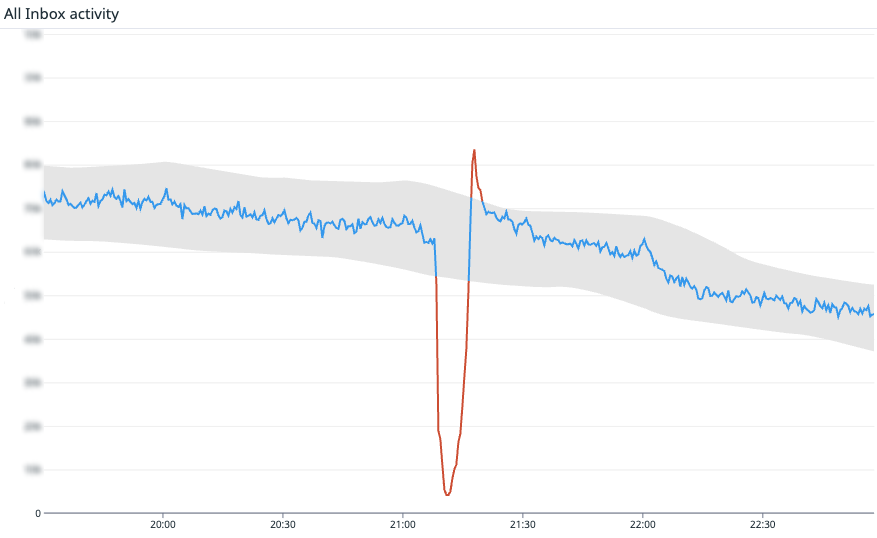
    I’ve seen this put into practice at scale. At Intercom, where the AI Agent Fin resolves millions of customer inquiries autonomously, their fundamental heartbeat metric is the rate of new messages and replies across Intercom. For Fin, it’s successful AI responses. If those dip, it’s hitting the ability to connect. It might be a database failover, a misconfigured fleet, or a bad code change — it doesn’t matter. What matters is that it’s hitting customers’ ability to use Intercom.

    Intercom isn’t alone. Amazon tracks order volume as their heartbeat. Affirm watches checkout attempts. If those numbers fall below expected levels, they don’t wait for a support ticket—they investigate immediately, because they know their customers’ success depends on it.

    Not every metric qualifies as a heartbeat. The best ones share three traits: they’re directly tied to customer value (the main job your product is hired to do), high-volume and predictable (so anomaly detection can spot small drifts quickly), and binary in spirit (a drop is a clear sign something is broken, not just “a bit slower than usual”).

    Time-series chart titled Web Messenger Conversation Part creation, with a blue line of event rate steadily declining from 20:00 to 22:30 inside a gray tolerance band, illustrating outcome-focused SLI monitoring.
    Stop watching servers—start watching customer impact. This chart tracks conversation-part creation over time; the blue line descends within a shaded band, indicating expected behavior and clear SLIs aligned to your SLA.

    When we anchor on heartbeat metrics, three benefits show up fast: we detect issues faster than user reports or support tickets, we keep teams focused on what truly matters to customers, and we create a direct tie to our SLA—a system-level answer to, “Is the promise we made being kept?”

    To be clear, I still monitor the usual suspects—latency, error rates, and infrastructure health. Heartbeat metrics don’t replace those; they complement them. They’re the fastest shortcut to understanding customer impact.

    At scale, one pulse isn’t enough. Complex systems need multiple vital signs that reflect how different user groups succeed. Intercom started simple—are customers creating messages at the expected rate?—and then broke that signal down across core systems. Together, these metrics form a complete picture: Fin replies to your customers. Teammates reply in the Inbox. Teammates interact with the Inbox UI. Users on your website can message with the Web Messenger. Users on your app can message with the Mobile Messenger. If even one of them drops, it’s a major customer-impacting problem.

    Speed matters when the heartbeat alarm fires. After months of reliable signal, automation becomes a force multiplier—paired with human oversight. Here’s what happens when a heartbeat metric drops: If we have just deployed new code to production, we automatically roll it back. Rolling back recent changes is a safe, and fast operation. We automatically create an incident in incident.io and page in engineering and an incident commander. If this alarm fires, it’s likely we will need our full incident response including status page updates. The system automatically suggests initial actions to first responders. For example, we use incident.io’s Investigations feature to get a head start on suggesting root causes.

    This kind of automation pays off. On April 24th, a server issue slowed the Inbox, impacting teammates’ ability to use the Inbox. Heartbeat metrics caught it fast, and the issue was resolved in 10 minutes. End-user messaging was unaffected. This counted as downtime toward the SLA, with a full root cause analysis shared publicly here. That level of transparency keeps trust intact even when incidents happen.

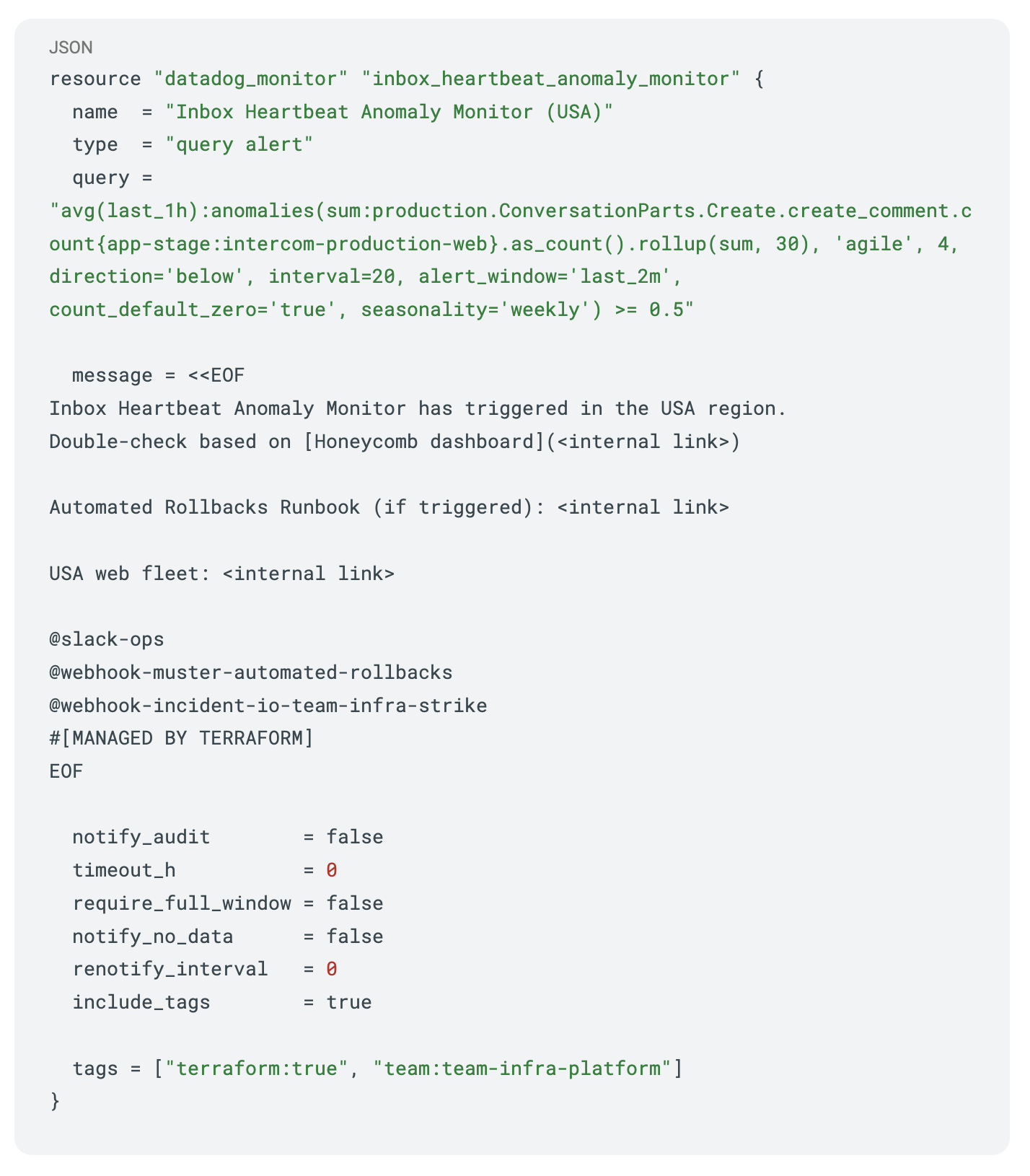
    Terraform configuration for a Datadog query alert titled 'Inbox Heartbeat Anomaly Monitor (USA)', using anomalies() on production events with Slack and webhook notifications plus team tags.
    Outcome-first monitoring in action: a Terraform-managed Datadog heartbeat anomaly alert with Honeycomb double-checks, rollback runbook links, and Slack/webhook routing for SLA-conscious operations.

    Where heartbeat metrics truly shine is in how they define and enforce accountability. They don’t just monitor; they inform SLAs in a way customers understand. Two independent SLAs matter most in this model: Core Platform SLA: If your team can’t reply in the Inbox or customers can’t message via the Messenger, that’s downtime. Fin SLA: If Fin cannot generate text answers, we record downtime.

    Measurement matters. Many status pages stay green as long as an HTTP probe returns 200 OK, even when users are stuck. Heartbeat metrics close that gap by checking real customer outcomes, not just server responses. I also favor anomaly detection—tracking expected patterns over time and flagging when something looks off—and tooling that lets us drop to a per-customer level when we need to understand individual impact.

    If you don’t have a heartbeat metric yet, start simple. Pinpoint your product’s must-do job—the one thing customers must accomplish to succeed. Choose a metric with volume so you can detect drifts quickly, not just total failures. Make it binary in spirit so a drop clearly signals breakage. Hook it to your alerts so it’s loud and reaches the right responders. Use it to align teams on what to do when the heartbeat falters. And stick to it, 24/7—reliability isn’t a 9-to-5 job.

    For monitoring, I like practical guardrails. Here’s a Datadog monitor pattern I recommend for an Inbox-style heartbeat (Terraform syntax, simplified for clarity): keep a tight baseline window, alert on negative deviations beyond statistically expected ranges, auto-page responders, and attach standard operating procedures for immediate rollback and incident initiation. It’s simple, auditable, and fast.

    Modern systems grow more complex every quarter. The question that matters stays refreshingly simple: “Can our customers do what they came here to do?” Build a reliability heartbeat that answers that question in real time, and you’ll keep your teams honest, aligned, and fast. Define yours—it might become your most valuable signal.


    Inspired by this post on The Intercom Blog.


    Book a consult png image