I’ve sat in countless AI measurement debates and noticed a recurring gap. One major voice has been noticeably underrepresented in the AI measurement conversation: the product manager (PM) that’s leading development. From experience, PMs and developers do need different measurement tools—and making those differences explicit is exactly what speeds up decisions and improves outcomes.
Developers optimize the model and system layer. Their toolkit centers on eval-driven development: offline evals, regression suites, red-teaming, latency and throughput monitoring, token cost tracking, and hallucination rate reduction. On the delivery side, engineering teams watch DORA metrics alongside CI/CD performance to keep iteration fast and safe. When building LLM-backed experiences, they also care deeply about retrieval-first pipeline quality and context window management because those mechanics determine grounding, relevance, and consistency.
PMs, by contrast, own outcomes. We instrument user journeys end to end and define a clear north-star tied to value: activation, time-to-value, task success rate, retention analysis, support deflection, and revenue contribution. We rely on A/B testing frameworks and minimum detectable effect (MDE) planning to separate real impact from noise, and we consolidate behavioral signals in a unified analytics platform like Amplitude analytics and Pendo to understand adoption, friction, and cohort differences. This is the heart of product-led growth and continuous discovery: evidence, not anecdotes.
The fact that these toolboxes differ is a strength, not a weakness. Specialized metrics keep responsibilities crisp: developers guarantee model quality and reliability; PMs guarantee that quality translates into customer and business outcomes. What we need is an explicit metrics ladder that connects layers—model-level quality floors and SLOs, feature-level KPIs, and company-level results—so trade-offs are transparent and prioritization is principled.
In practice, I create a shared measurement contract for every AI initiative. It links eval sets to user-facing success criteria, defines acceptance thresholds, and spells out observability across the stack. We include governance from day one—AI risk management, privacy-by-design, and data governance—so we can scale responsibly without slowing teams down.
Here’s the AI product toolbox I give my teams: start with a concise value hypothesis; define a success rubric the customer would recognize; instrument the happy path and the failure path; plan experiments with MDE up front; segment results by persona and job-to-be-done; and close the loop with qualitative feedback inside the product via in-app guides, product tours, and lightweight surveys. For AI features specifically, add Agent Analytics for agentic AI, capture grounding sources for explainability, and log model/context inputs to make debugging and iteration repeatable. That way, LLMs for product managers stop being magic and start being manageable.
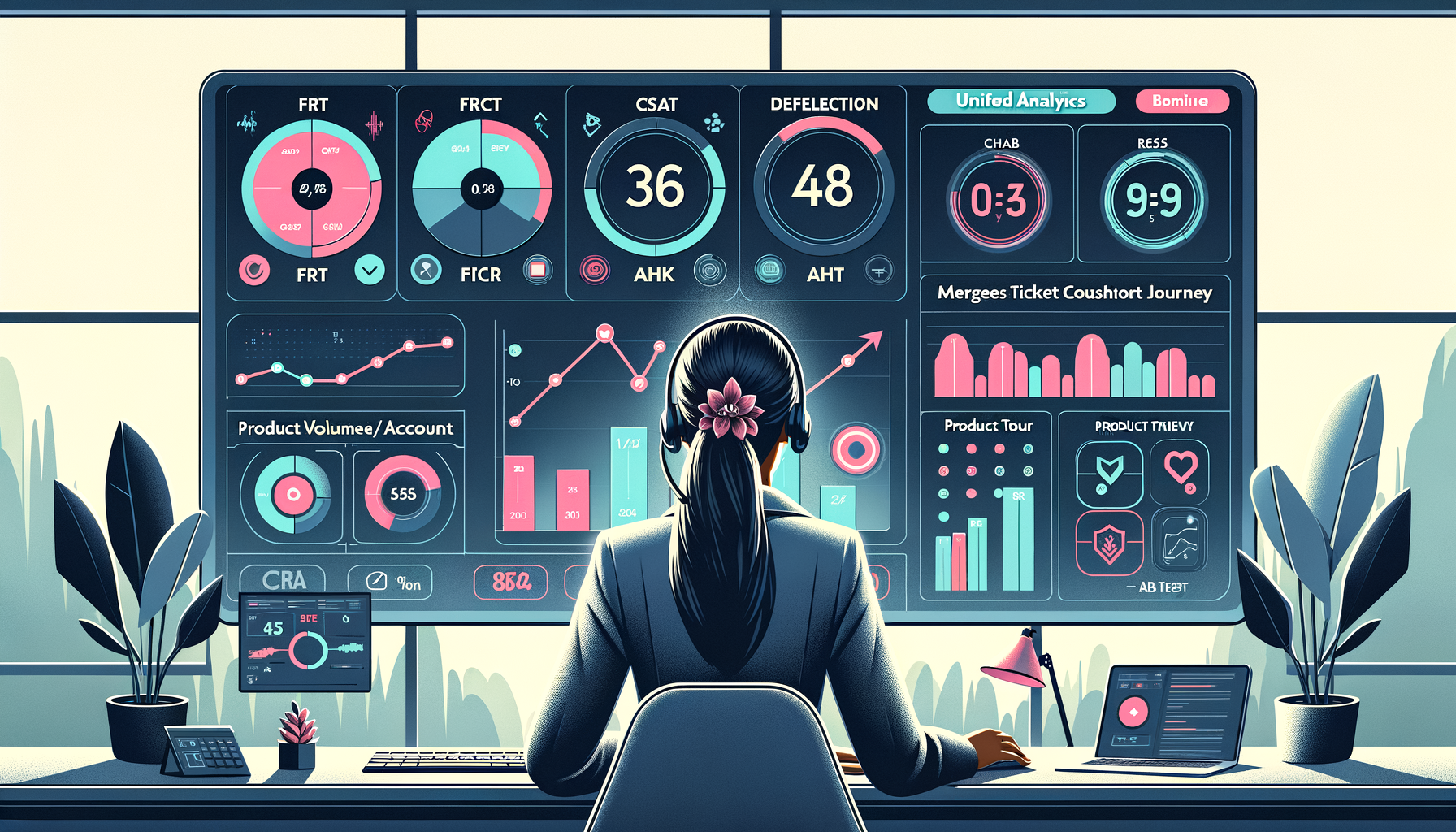
When we roll out a new assistant—whether a retrieval-augmented copilot or a voice AI agent—we set two dashboards: one for developers (eval pass rates, latency, context integrity, error budgets) and one for PMs (activation, task completion, deflection, satisfaction). The dashboards read differently by design, yet they are joined at the hip by shared definitions and experiment IDs. This lets us move quickly with confidence: engineering can tighten quality loops while product steers toward the outcome that matters most.
If you’re feeling the tension between model metrics and product metrics, don’t collapse them—connect them. Start with a thin slice, agree on 3–5 measurable outcomes, and let your evals and A/B tests work together. With a clear metrics ladder and a unified analytics platform, PMs and developers can each excel at their craft and still ship AI that customers love.
Keeping employees informed and engaged isn’t just a communications challenge—it’s a product challenge. When we treat internal tools like products with clear activation moments, measurable outcomes, and continuous discovery, adoption moves from hope to habit. Over the years, I’ve seen small changes in how we onboard, communicate, and measure compound into dramatically higher engagement, better compliance, and faster time-to-value.
“How to improve onboarding, compliance, and internal communications within your employee tools.” That question guides my approach end to end—from the moment someone logs in for the first time to the day they become an expert, championing best practices across their team.
First, I personalize onboarding to accelerate user activation. I map the critical first actions and design a lightweight sequence of product tours and in-app guides that surfaces only what matters right now. Progressive disclosure, clear UX writing, and thoughtful tooltip design reduce cognitive load. I measure time-to-first-value, A/B test checklist microcopy to remove friction, and use Intercom or Pendo to deliver contextual walkthroughs by role, location, and permission level. Amplitude analytics helps me validate that the guided path leads to the intended activation event and sustained usage.
Second, I make compliance effortless and measurable. Instead of long trainings, I embed micro-learnings and policy nudges directly in the flow of work, with just-in-time prompts and short, scenario-based confirmations. I segment by role to avoid alert fatigue and localize where regulations require nuance. Completion rates, quiz accuracy, and time-to-complete are tracked alongside qualitative feedback. When compliance messaging underperforms, I run A/B testing on tone, timing, and format, then iterate until adherence is both higher and faster.
Third, I orchestrate internal communications as lifecycle messaging—not announcements. Employees get targeted release notes, role-specific tips, and in-app reminders aligned to their stage: new, adopting, proficient, or champion. I avoid channel sprawl by making the primary source of truth available in the product, then reinforcing it via email or chat only when necessary. CRM integration and audience rules ensure relevance, while a champions network and office hours create human touchpoints that deepen trust and accelerate adoption.
Fourth, I close the loop with analytics and continuous discovery. I instrument key events and run retention analysis to understand which behaviors predict long-term engagement. I look at cohorts before and after a new guide or product tour, and I compare lift in user activation and feature adoption over 14-, 28-, and 90-day windows. Amplitude analytics provides the behavioral picture; surveys, interviews, and passive feedback widgets explain the why. Together, these inputs power a product-led growth approach for internal tools—observable, repeatable, and improvable.
When teams ask where to start, I pilot one persona, one workflow, and one high-value outcome. I define the activation event, instrument it, launch a single targeted in-app guide through Pendo or Intercom, and A/B test the onboarding microcopy. Two weeks later, I review retention cohorts and completion data, talk to users, and either scale the pattern or iterate. That cadence builds credibility quickly because it ties every communication to a measurable result.
The payoff is tangible: faster onboarding, higher compliance, clearer internal communications, and employees who feel supported rather than overwhelmed. With disciplined messaging, smart instrumentation, and ongoing discovery, we can turn internal tools into catalysts for performance—and transform engagement from a campaign into a culture.
I lead product teams building travel and hospitality experiences, and one lesson keeps repeating: companies that measure what matters move faster. Benchmarks turn gut feel into grounded product strategy, making it clear where activation, conversion, and retention are underperforming—and where we can unlock outsized growth.
Discover exclusive data and strategies from our Product Benchmark Report. Compare the travel and hospitality industry’s performance across key product metrics.
When I evaluate a product line, I start with a simple model: attract, convert, delight, and retain. For travel and hospitality specifically, I focus on search-to-book conversion, onboarding completion, first-booking activation rate, time-to-book, average booking value, cancellation rate, support contact rate, DAU/MAU stickiness, repeat booking rate, and long-term retention. These key product metrics reveal friction in discovery and checkout flows, surface pricing and inventory gaps, and quantify loyalty.
From there, I assemble a test-and-learn plan. Using Amplitude analytics to instrument the funnel and Pendo for in-app guides and product tours, my teams design A/B testing with a clear minimum detectable effect (MDE), prioritize hypotheses, and execute rapid, weekly iterations. This is classic product-led growth: reduce cognitive load in onboarding, streamline search and filter UX, clarify policies before payment, and personalize reactivation nudges to improve user activation and retention analysis.
Benchmarks are only as trustworthy as the underlying data. I insist on strong data governance, privacy-by-design practices, and clear event taxonomies so that insights remain reliable across quarters and across markets. That foundation keeps our decisions defensible with stakeholders and regulators while accelerating delivery.
Finally, we translate insights into action with crisp product roadmapping and sprint planning. Cross-functional product trios align OKRs to the biggest benchmark gaps, and we review progress in weekly performance rituals so every experiment ladders up to strategy. This cadence helps teams stay empowered and keeps leadership focused on outcomes, not output.
If you’re building in travel and hospitality, use these benchmarks as your starting line and your ongoing scorecard. Calibrate targets against peers, double down on what moves the needle, and let the data guide bold, customer-centered bets. When teams rally around meaningful metrics, momentum compounds.
Inspired by this post on Amplitude – Perspectives.
Continuous Discovery Habits turns five this year, and I’m celebrating by inviting you to read it with me. Over 135,000 people have bought the book. I’ve seen these habits transform outcomes, reduce rework, and sharpen product strategy in my teams and across the product community, but I also know it’s not easy to sustain the practice—especially when you feel like the lone champion in your organization.
To make it easier and more social, I’m launching the 2026 Continuous Discovery Habits Book Club. We’ll read the book together—one section per month—with discussion questions, practical exercises, and resources that help you actually do the work, not just read about it. Whether you’re picking up the book for the first time or revisiting it, the goal is to build real muscle memory in discovery.
By December, you won’t just understand continuous discovery—you’ll be practicing it.
Each month, I’ll share a reading guide with reflection prompts, exercises you can run solo or with your product trios, and short videos to help you spread the ideas across your team. I’ll monitor comments throughout the year so you can ask for help, share what’s working, and connect with peers—even if you join late.
I’ll also host quarterly live discussion sessions so we can compare notes, push through sticking points, and swap tactics with other empowered product teams. If you want to participate, grab a copy of the book (or dig up your old copy), share the "Spread the Love" videos to get friends and colleagues on board, reserve time to try the team exercises, and register for the community sessions. Let’s do this.
🎖️ This reading guide is brought to you by New Year, New Habit: The 5-Day Customer Interview Challenge. Become a more confident interviewer in less than a week. You’ll conduct one practice interview a day, get personalized and detailed feedback so you know exactly what to improve, and we’ll be giving out daily prizes to the most improved. Join the challenge today.
This Month’s Reading: Introduction; Chapter 1: The What and Why of Continuous Discovery; Chapter 2: A Common Framework for Continuous Discovery. Estimated reading time: ~40 minutes.
These chapters will introduce you to why discovery and delivery are not phases—they happen continuously. You’ll see a clear benchmark for what "continuous discovery" looks like, learn what product trios are and why they’re the foundation for good discovery, and explore six prerequisite mindsets (outcome-oriented, customer-centric, collaborative, visual, experimental, continuous) you’ll need before these habits can stick. You’ll also get the opportunity solution tree—a visual framework for connecting what you’re building to why you’re building it. Need a copy? Grab the book: https://amzn.to/3hGkNYT?ref=producttalk.org
We learn best in community. Use these short videos to share key concepts with teammates and invite them to read along: What is product discovery? https://videos.producttalk.org/videos/799fdbb41e16ebc4f0/what-is-product-discovery?ref=producttalk.org — a quick intro to the key idea behind discovery work. Defining continuous discovery https://videos.producttalk.org/videos/a79fdbba151ee3c72e/defining-continuous-discovery?ref=producttalk.org — a clear benchmark to aspire to. The rhythm of continuous discovery https://videos.producttalk.org/videos/4d9fd5b4111ee0c2c4/the-rhythm-of-continuous-discovery?ref=producttalk.org — the two small research activities you should do every week. The underlying structure of product discovery https://videos.producttalk.org/videos/449fdbb5191fedc4cd/the-underlying-structure-of-product-discovery?ref=producttalk.org — how outcomes, opportunities, and solutions connect. What’s a product trio? https://videos.producttalk.org/videos/a79fdbb31e1be2c12e/whats-a-product-trio?ref=producttalk.org — why cross-functional collaboration matters.
🎖️ This reading guide is brought to you by Just Now Possible, a podcast about how AI products come to life—straight from the builders. If you are being asked to add AI features to your roadmap, you don’t have to start from scratch. Get a head start by hearing how other teams are navigating similar challenges. Find it on YouTube, Apple Podcasts, and Spotify.
When we reflect and discuss what we read, we absorb more and apply it better. This month is about building awareness of where you are today—no judgment. The first step in any change is getting a baseline. Next month, we’ll take small steps to strengthen the habits.
Here are three prompts for individual reflection. 1) Think about a recent product decision your team made. Did you rely more on opinions, data, or customer input? Get specific. 2) Which of the six prerequisite mindsets (outcome-oriented, customer-centric, collaborative, visual, experimental, continuous) is strongest for you personally? Which would require the biggest shift? 3) What’s your reaction to weekly customer touch points? Does this excite you? Scare you? Something else?
And here are three prompts for team discussion. 1) Who on your team is responsible for discovery and delivery? How interconnected are these activities? 2) How does your team currently collaborate cross-functionally? When product, design, and engineering come together, is it to make decisions—or to hand off work? 3) Think of a recent feature your team built. What opportunity did it address? What else could you have built to address that opportunity?
For this introductory month, focus on seeing your current system clearly. In my experience, visibility alone reveals friction and makes the path to change obvious—and measurable.
Exercise: Draw Your Current Discovery Process. Time: 60 minutes. Do this solo first, then compare with your team. Take a blank sheet and draw how your team actually decides what to build. Show where ideas come from, who makes decisions and how, where (if anywhere) customers enter the picture, and how you know if you built the right thing. Then compare drawings with teammates. Where do perceptions differ? What does that say about your shared understanding?
Exercise: Audit Last Week’s Decisions. Time: 30 minutes. Do this solo or with your team. List every product decision your team made last week—big or small. For each decision, note who made it, what information it was based on, and whether customer input was part of the process (and how). Then look for patterns: how many included direct customer input versus assumptions, opinions, or secondhand information?
If you prefer an audio summary of this month’s reading—including the book chapters and the resources below—listen here: Stop Building The Wrong Things Faster (audio summary by NotebookLM): https://www.producttalk.org/content/media/2025/12/January—Stop_Building_The_Wrong_Things_Faster.m4a
Related in-depth guides to go deeper: Product Discovery Basics: Everything You Need to Know: https://www.producttalk.org/product-discovery/ Product Trios: What They Are, Why They Matter, and How to Get Started: https://www.producttalk.org/product-trios/ Opportunity Solution Trees: Visualize Your Discovery to Stay Aligned and Drive Outcomes: https://www.producttalk.org/opportunity-solution-trees/
Other voices worth reading: Product Discovery: Pitfalls and Anti-Patterns by Chris Jones: https://svpg.com/product-discovery-anti-patterns/?ref=producttalk.org Addressing the Challenges of Product Discovery by Saeed Khan: https://medium.com/swlh/the-challenges-of-product-discovery-6ac6109d13a8?ref=producttalk.org Making Product Discovery Work in Small Teams by Sofia Quintero: https://www.chargebee.com/blog/product-discovery/?ref=producttalk.org Product Waste and the ROI of Discovery by Richard Mironov: https://www.mironov.com/waste?ref=producttalk.org
Related course if you want structured practice: Product Discovery Fundamentals – this course walks you through the complete continuous discovery framework with hands-on exercises: https://learn.producttalk.org/cdh-master-class?ref=producttalk.org
Our live discussion schedule for 2026 (sessions are not recorded): Wednesday, March 18, 2026: 9am–10am PDT and 4pm–5pm PDT. Tuesday, June 16, 2026: 9am–10am PDT and 4pm–5pm PDT. Thursday, September 17, 2026: 9am–10am PDT and 4pm–5pm PDT. Wednesday, December 16, 2026: 9am–10am PST and 4pm–5pm PST. Invitations will go out to Supporting Members and CDH Members two weeks beforehand—reserve the time now.
As you work through this month’s material, connect it to your product strategy, outcomes vs output OKRs, and product roadmapping and sprint planning. In my teams, discovery sticks when product trios own the rhythm, weekly customer touch points are normalized, and the opportunity solution tree keeps everyone aligned on outcomes.
I’m thrilled to learn alongside you this year. Grab the book, invite your trio, and let’s build habits that last.
I’ve lost count of how many times I’ve been asked for a “quick AI agent” that can autonomously fix customer problems, write code, or run sales ops. The promise is intoxicating—and I get why. But in practice, sustainable impact comes from disciplined product thinking, not wishful automation. Drawing on my experience leading product for complex, agentic AI initiatives, I want to debunk four misconceptions I see repeatedly and share what actually works.
Misconception 1: AI agents are plug-and-play. The reality is that effective agentic AI behaves more like a new product line than a feature toggle. It needs clear job stories, domain grounding, tool access, and guardrails. I start by narrowing scope to one painful job to be done, then design AI workflows that reflect real constraints (SLAs, compliance, edge cases). From day one, I instrument with Agent Analytics and set up eval-driven development so we can see failure modes early and iterate with intent.
What consistently moves the needle is treating the agent like a teammate you onboard: define responsibilities, provide the right tools, and measure outcomes. I pair scripted validations with live evals, track containment rates and handoff quality, and balance precision/recall depending on the risk profile. This is slow to fast, not fast to broken.
Misconception 2: Bigger models make better agents. In my experience, architecture outperforms horsepower. A retrieval-first pipeline, tight context window management, and practical prompt engineering often beat an oversized model that hallucinates. Tool use matters more than model size: give the agent reliable APIs, clear schemas, and deterministic fallbacks. For LLMs for product managers, the play is to right-size the foundation model and invest in data quality, prompts, and evaluators that reflect your true acceptance criteria.
When I see erratic behavior, I don’t immediately swap models; I improve retrieval, prune irrelevant context, and clarify the agent’s planning loop. Most performance gains come from better state management and grounding rather than a pricier token budget.
Misconception 3: Agents replace teams. High-performing organizations design human-in-the-loop systems. I implement human review on high-risk actions, explicit escalation paths, and simple override mechanisms. That’s not just safety theater—it’s good product design. AI risk management and data governance are part of the product backlog, not an afterthought. In customer support ai strategy, for example, the agent drafts, a specialist approves, and the system learns from deltas to tighten future responses.
The social system matters as much as the technical one: clear role boundaries, audit trails, and feedback loops turn the agent into a force multiplier. Teams gain leverage without surrendering accountability.
Misconception 4: Shipping the agent equals success. Adoption is earned, not announced. I treat agent launches like any product-led growth motion: define activation events, remove friction with in-app guides and product tours, and A/B test prompts, tool choices, and UI affordances. We track time-to-value, task completion rate, and user trust signals (edits, undo patterns, and escalation requests). When we get those leading indicators right, retention follows.
Increase revenue, cut costs, and reduce risk with Pendo’s Software Experience Management platform. Optimize the entire software experience to drive adoption and improve engagement.
My playbook is simple and repeatable: frame the problem narrowly, ground the agent with the right tools and data, measure with eval-driven development and Agent Analytics, then grow adoption with a disciplined go-to-market inside the product. The agents that win don’t feel like magic—they feel dependable. That’s what customers trust, and that’s what scales.
Every quarter, I revisit the same three questions: Are we accelerating adoption, lowering cost-to-serve, and managing risk without slowing the roadmap? Tools that help me answer all three with clarity earn a place in my stack. That’s why the concept behind Pendo’s Agent Analytics resonates so strongly—it gives product leaders a way to see, in one view, how users engage with AI-powered assistants, in-app guides, and core workflows, and how those behaviors translate into product-led growth.
Increase revenue, cut costs, and reduce risk with Pendo’s Software Experience Management platform. Optimize the entire software experience to drive adoption and improve engagement.
In practice, Agent Analytics functions as a unified analytics platform for the modern product team. I can observe how users interact with agents and nudges inside the product, connect those interactions to user activation and retention analysis, and prioritize improvements that deliver measurable outcomes. The result is fewer blind spots across the journey and a tighter feedback loop between discovery and delivery.
The real value shows up when I pair analytics with targeted interventions. For example, I’ll instrument critical paths, baseline activation, then use in-app guides to remove friction at the exact moment users need help. I incorporate A/B testing and continuous discovery to validate which prompts, pathways, or workflows actually move the needle. With a clean view of adoption, engagement, and time-to-value, my team can double down on what works and retire what doesn’t—faster.
Risk reduction is equally important. With clear behavioral signals, I can spot confusing prompts, unhelpful agent responses, or unexpected drop-offs before they scale into churn or support volume. That visibility informs our product strategy, aligns stakeholders on trade-offs, and keeps our governance tight without stifling innovation—especially critical as AI Strategy becomes part of everyday product decisions.
If you’re weighing whether Agent Analytics deserves a place in your toolkit, consider this: better instrumentation yields better decisions. When you unify guide interactions, agent engagement, and core product usage, you can attribute uplift more precisely, forecast impact with greater confidence, and operationalize product-led growth. That’s how we increase adoption, cut unnecessary cost, and de-risk the roadmap—while building experiences customers actually love.
I’ve never seen great products emerge from a one-sided mindset. Inside-out thinking (strategy-first) and outside-in thinking (customer-first) aren’t rivals—they’re a flywheel. When I weave product vision and defensible differentiation together with real customer signals and behavioral data, adoption climbs, engagement deepens, and the roadmap becomes a catalyst for growth rather than a list of features.
For clarity: inside-out anchors on product strategy, value proposition, and the unique capabilities only we can deliver. Outside-in centers on continuous discovery, user research, and telemetry that reveals what customers actually do—not just what they say. At HighLevel, we pair these perspectives in every planning cycle so we’re bold in direction and grounded in evidence.
Increase revenue, cut costs, and reduce risk with Pendo’s Software Experience Management platform. Optimize the entire software experience to drive adoption and improve engagement.
That promise captures why the blend matters. Product-led growth lives or dies on moments like activation, time-to-first-value, and day-30 retention. Inside-out thinking ensures we’re building toward a compelling vision; outside-in thinking ensures users can discover, adopt, and realize value through clear onboarding, in-app guides, and contextual product tours.
Here’s how I apply it in practice. We start by articulating the smallest, sharpest version of our strategy—who we serve, the jobs we must win, and the non-negotiable outcomes. Then we pressure-test that thesis with continuous discovery: call snippets, funnel analysis, pathing, and retention analysis by cohort. When friction shows up in onboarding or early feature adoption, we deploy targeted in-app guides and tours to accelerate user activation without bloating the product or training costs.
A simple operating rhythm keeps the balance: begin each quarter with outcomes vs output OKRs tied to adoption and retention; instrument flows to expose drop-offs; ship iterative improvements; and reinforce them with just-in-time guidance. We use outside-in signals to sequence what we tackle next, and inside-out conviction to avoid chasing noise. The result is faster learning cycles and fewer expensive reworks.
Measurement closes the loop. I track activation rate, time-to-first-value, engagement with the few behaviors that predict renewal, and the impact of each guide or tour on completion rates. When we see lift, we codify the pattern; when we don’t, we prune and refocus. That evidence-based cadence keeps teams empowered and stakeholders aligned.
Culture makes this sustainable. Empowered product teams own outcomes, not tickets. Stakeholder management becomes easier when decisions are grounded in a clear strategy and transparent evidence from real users. And customers feel the difference when the product teaches itself—meeting them with the right help, in the right moment, without getting in their way.
If you’ve been choosing between inside-out and outside-in, stop. Fuse them. Lead with a crisp product strategy, listen with humility, and operationalize adoption through purposeful onboarding, in-app guides, and product tours. That’s how we compound learning, reduce risk, cut support costs, and accelerate product-led growth.
I walked into PendomoniumX London energized by a simple question: are we finally past the AI hype cycle and into real product impact? From the hallway conversations to the main stage, the momentum was unmistakable—and deeply practical.
PendomoniumX’s sixth stop brought 350+ software leaders together for a day of AI transformation, real-world stories, and product innovation.
That scale and focus say a lot. Across the dialogues I joined, the center of gravity has clearly shifted from experiments to execution: building an AI Strategy that aligns with product roadmaps, turning promising prototypes into production-grade AI workflows, and measuring value in ways that reinforce product-led growth. It’s the inflection point where Generative AI moves from isolated pilots to cross-functional capabilities.
My biggest takeaway for product leaders: treat AI like any other durable capability. Start with sharp problem framing and customer outcomes, run continuous discovery to validate use cases, and sequence delivery through product roadmapping and sprint planning. Pair this with privacy-by-design and sensible governance so your teams can move fast without cutting corners.
Operationally, I’ve found it essential to design experiences that accelerate user activation—think thoughtful onboarding, in-app guides, and product tours that reduce friction while teaching new AI-powered behaviors. For teams adopting LLMs for product managers, keep your evaluation loops tight, instrument the journey end-to-end, and make sure every iteration maps to a clear value proposition customers can feel.
Events like PendomoniumX London remind me why community matters: they compress learning cycles. If you’re steering an AI portfolio, now is the moment to translate vision into repeatable systems—prioritize the right bets, make adoption effortless, and let data tell you when to double down or pivot. That’s how we turn AI transformation into durable product innovation.
Experience quality compounds just like code quality. To align teams and accelerate outcomes, I rely on a clear, five-stage software experience maturity model to assess where we are, why we’re there, and how to advance. It turns fuzzy debates into concrete product strategy and reinforces a product-led growth mindset.
Find out where you stand—and what to fix first—with this maturity framework.
Why a five-stage model? It gives product, design, engineering, and go-to-market a shared language for trade-offs, helps us move from opinions to evidence, and ties day-to-day improvements to outcomes vs output OKRs. Instead of spreading effort thin, we sequence the right bets at the right time and build momentum with measurable wins.
Here’s how I apply it in practice. I start with a brief, honest self-assessment across the customer journey: onboarding clarity, user activation moments, in-app guides and product tours, UX writing, support loops, reliability, and analytics coverage. Then I layer in learnings from continuous discovery and product discovery—interviews, usage patterns, and support transcripts—so we see the experience as customers do, not just as we intended.
When it comes to what to fix first, I prioritize prerequisites over polish. If the value proposition isn’t clear, onboarding is confusing, or activation is inconsistent, we address those before adding new features. I instrument the funnel end-to-end, establish a minimum detectable effect (MDE) for A/B testing, and ensure we can answer basic questions about who activates, who retains, and why.
Measurement is non-negotiable. I pair retention analysis and activation metrics with qualitative signals to avoid local maxima. Amplitude analytics helps reveal behavioral patterns, while Pendo and in-app guides close gaps in comprehension and guidance. Intercom and CRM integration with HubSpot connect product signals to account health, so we can see how experience maturity drives revenue and retention.
Operationally, I anchor the roadmap to a small set of experience outcomes, link them to product strategy, and review progress in cadence with leadership. This approach builds product management leadership muscle: sharper stakeholder management, clearer trade-offs, and faster feedback loops. Most importantly, the team sees how each improvement ladders up to a better, more durable user experience.
If you’re mapping your own path across the five stages, start by sizing the gaps that block activation and retention, commit to a few high-leverage fixes, and measure relentlessly. With a shared maturity model, your team gains focus, your customers feel the difference, and your product compounds value with every release.
When agent performance improves, everything else follows: faster resolutions, happier customers, and stronger product adoption. In my role leading product management at HighLevel, I use Pendo Agent Analytics to build a shared, measurable view of how our support motions shape the entire software experience and influence product-led growth.
Increase revenue, cut costs, and reduce risk with Pendo’s Software Experience Management platform. Optimize the entire software experience to drive adoption and improve engagement.
In practice, I connect Agent Analytics with our product strategy by pairing product signals (user activation, onboarding progress, feature usage depth) with operational signals (first-response time, time-to-resolution, and deflection rates). This lets me see how in-app guides, product tours, and contextual tooltips impact outcomes across segments without guesswork.
To separate signal from noise, my team runs small, controlled experiments and targeted A/B tests. For example, we’ll instrument a guide for a complex workflow, then compare cohorts on activation, retention, and support ticket volume. If engagement improves and cost-to-serve drops, we standardize the pattern and scale it.
The real advantage is alignment. By treating analytics as a unified analytics platform that integrates agent activity with product insights, we tie day-to-day support work to our value proposition and roadmap. That transparency sharpens prioritization, accelerates adoption, and creates a clear line of sight from agent coaching to measurable business impact.
For teams getting started, baseline your agent performance metrics, map the key friction points in your user journey, and instrument those moments with precise, helpful in-app guides and product tours. Review outcomes weekly, double down on what reduces effort and drives engagement, and keep refining the loop until adoption and satisfaction compound.
Protecting customer data is non‑negotiable—and it must coexist with our need for precise product insights. In my role, I frame every analytics initiative, Pendo Agent Analytics included, around measurable outcomes and rigorous governance so we can accelerate growth without compromising trust.
Increase revenue, cut costs, and reduce risk with Pendo’s Software Experience Management platform. Optimize the entire software experience to drive adoption and improve engagement.
To make that promise real, I anchor implementation in privacy-by-design. Practically, that means data minimization, purpose limitation, role-based access control, auditable workflows, and clear retention policies. These are the same standards I expect from any unified analytics platform and the operating guardrails my team applies in partnership with security and legal.
On the product side, I focus Agent Analytics on the behaviors that move the needle: adoption, feature engagement, user activation, and time-to-value. Paired with in-app guides, product tours, and thoughtful tooltip design, insights become timely interventions that drive product-led growth—while staying within our data governance boundaries.
Reducing organizational risk demands discipline. I pair analytics rollout with a documented data map, DPIAs where appropriate, vendor risk assessments, and clear incident management protocols. We align with regulatory compliance requirements and integrate with cybersecurity practices for continuous monitoring and threat detection and response.
I track success through business and trust metrics: higher adoption, stronger retention analysis, fewer support tickets, and cost savings from deprecating low-value features—alongside clean audits and consistent adherence to governance standards. The outcome is a tighter feedback loop, smarter roadmap decisions, and sustained customer confidence.
If you’re evaluating Agent Analytics, start with a controls checklist, define the minimum viable telemetry for your KPIs, validate consent flows, and pilot with a narrow audience before you scale. This approach balances velocity with vigilance, ensuring we harness analytics for impact without sacrificing privacy or compliance.
When I map the customer lifecycle, I look for the precise moments where guidance, context, and timing can transform a casual click into a committed relationship. That’s exactly why I rely on Pendo Orchestrate—to turn intent into a systematic, repeatable product strategy that scales across every stage of the journey.
From first click to lifelong retention, you’ll deliver the right message at the exact right time, every step of the way. With Pendo Orchestrate, you can design those kinds of moments with intention. And in this blog, we’ll show you how.
In practice, I translate that promise into four lifecycle journeys every product team should be running with Pendo Orchestrate: new user onboarding, activation to the aha moment, expansion and upsell, and renewal and retention. These journeys power product-led growth and keep the roadmap aligned to measurable business outcomes.
Onboarding: I use in-app guides and product tours to welcome new users, set expectations, and reduce time-to-value. Contextual tooltips and gentle checklists keep users moving, while clear, concise UX writing removes friction. The goal is simple: accelerate early wins so onboarding naturally flows into user activation.
Activation: To help users reach the aha moment, I pair behavioral insights with targeted in-app guides. When a user approaches a key milestone, Pendo Orchestrate triggers just-in-time prompts that reinforce the value proposition. I keep these nudges focused, specific, and measurable so activation improves without overwhelming the experience.
Expansion: Once users adopt core workflows, I introduce advanced capabilities through tailored tours and contextual education. These cues appear where they’re most relevant—in the flow of work—so cross-sell and upsell moments feel helpful, not salesy. The intent is to deepen adoption by connecting features to outcomes users already care about.
Renewal and retention: I watch for patterns that suggest risk (stalled usage, incomplete workflows) and offer supportive interventions. Lightweight guides, quick tips, and feedback loops help resolve issues before they become churn. Combined with retention analysis, these orchestrations keep customers engaged and set the stage for long-term value.
When these four journeys run in concert, your product becomes the primary engine of growth. Pendo Orchestrate ensures the right in-app guidance shows up at the right moment—so your product strategy, product discovery, and day-to-day execution stay tightly aligned. That’s how you move beyond one-off campaigns and build a durable, product-led growth system.