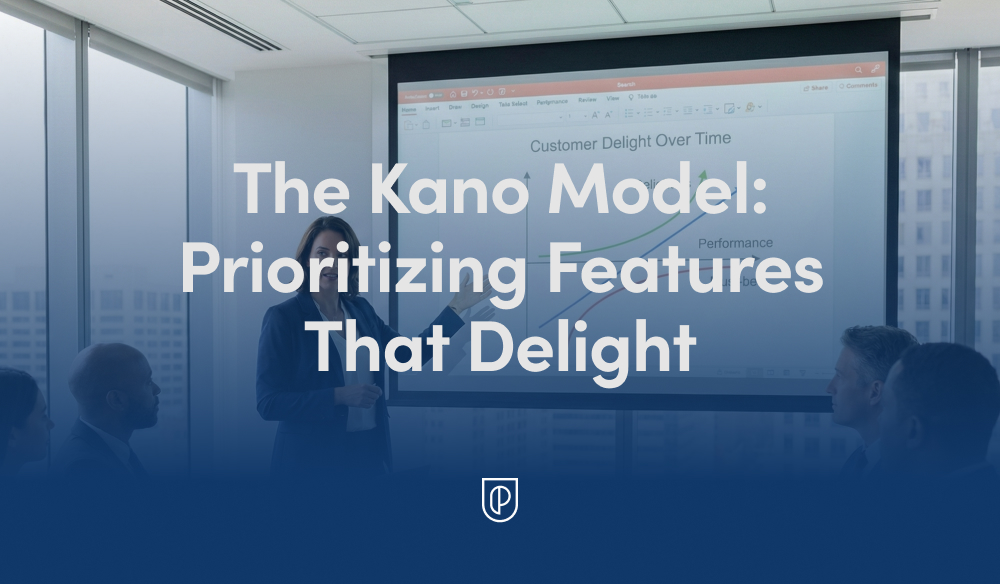
When I sit down with our product trios to shape the next quarter’s roadmap, I rely on The Kano Model to cut through the noise and focus on what actually moves the needle for customers and the business. It gives me a rigorous, human-centered lens for separating baseline expectations from differentiators and sustained value creation.
Learn how the Kano Model prioritizes the product features that matter by categorizing them into must-haves, satisfiers, and delighters.
Here’s how I think about each category in practice. Must-haves are the non-negotiables—if they’re missing or broken, no amount of innovation will save the experience. Satisfiers scale linearly with user happiness; do them better, and customers feel the improvement immediately. Delighters surprise users with unexpected value that elevates the product’s perceived quality and creates memorable moments that fuel advocacy.
In continuous discovery, I mix quantitative Kano surveys with qualitative interviews to validate which capabilities land in each bucket for specific segments. We ask both functional and dysfunctional questions (e.g., “How would you feel if this feature existed?” and “How would you feel if it didn’t?”) to avoid false positives and to distinguish true delighters from nice-to-haves. This approach de-risks assumptions and keeps our product discovery anchored in real customer voice.
Translating insights into action starts with outcomes vs output OKRs. Must-haves protect core outcomes like reliability, trust, and activation. Satisfiers inform product roadmapping and sprint planning by tying investment to measurable improvements such as speed, accuracy, or completion rate. Delighters earn a deliberate share of the roadmap to strengthen competitive differentiation and to refresh our value proposition before market expectations shift.
Kano also sharpens product-led growth motions. By aligning satisfiers with key activation steps and running retention analysis on cohorts exposed to delighters, we can see where excitement features become habit-forming behaviors. When a delighter consistently correlates with improved retention or expansion, it graduates into the backbone of our product positioning.
Stakeholder management gets easier with a shared framework. I present the portfolio as a balanced mix: must-haves that protect reputation, satisfiers that demonstrate continuous improvement, and delighters that signal vision. This narrative connects short-term reliability with long-term strategy and helps leaders understand why some high-effort ideas are best sequenced behind critical must-haves or high-yield satisfiers.
A quick caution: delighters decay. What delights today often becomes tomorrow’s must-have. I schedule periodic re-reads of our Kano results, especially after major releases or market shifts, to recalibrate where features sit. Combined with A/B testing and usage analytics, this habit prevents us from over-investing in fading differentiators and ensures our roadmap stays crisp and customer-centered.
If your roadmap feels crowded or your team debates priorities without resolution, bring The Kano Model to your next planning session. It adds structure to product discovery, clarifies trade-offs, and helps us deliver a roadmap that not only works—but wins.
Product analytics isn’t a specialist’s sport—it’s a team capability. In my role leading product teams, I’ve seen designers, engineers, marketers, and customer success partners uncover insights that shape strategy, accelerate product-led growth, and improve outcomes for customers. When we demystify the basics and bring analytics into everyday decisions, we build truly empowered product teams.
Here’s the core promise of this approach: "Learn the product analytics fundamentals of funnels, retention, and conversion drivers so that anyone can confidently answer key product questions." That line has guided how I teach product managers to think—start with the essentials, tie them to real customer behaviors, and make the work repeatable across the organization.
I start with funnels because they tell a story—the journey from discovery to value. A simple example: track the path from sign-up to user activation to the first value event. This reveals where onboarding succeeds or stalls, what friction blocks adoption, and which moments are ripe for optimization. With tools like Amplitude analytics or Pendo, we can break down conversions by segment, channel, or feature usage to isolate where improvements matter most.
Next comes retention analysis, the clearest signal that we’re building something customers choose to return to. Cohort analysis shows who comes back and when; retention curves show where value compels a second, third, and tenth use. Tie retention to activation milestones and the outcomes customers achieve—not just logins—and you’ll quickly spot whether your product discovery assumptions hold up in the wild. A unified analytics platform makes these insights discoverable and repeatable across teams.
Conversion drivers round out the picture. Once the funnel is clear and retention is stable, I look for the behaviors and experiences that predict success: feature combinations, time-to-value, message timing, or supportive content. Whether in Amplitude analytics or Pendo, correlating these drivers with outcomes lets us prioritize roadmaps with confidence. Pair this with continuous discovery—qualitative interviews, in-product feedback, and rapid experiments—and you’ll move from interesting data to decisive actions.
This is how we build empowered product teams: by making analytics a daily habit rather than a quarterly report. We bring insights into roadmap reviews, design critiques, and sprint planning; we celebrate learning from experiments as much as shipping features; and we hold ourselves accountable to customer outcomes, not just output. When everyone can interpret funnels, discuss retention, and isolate conversion drivers, we make smarter bets faster.
If you’re getting started, keep it simple. Define a clear activation metric, instrument the top of your funnel, and track a small number of cohorts. Share a weekly readout with highlights, surprises, and questions to investigate. Over time, stitch insights into narratives that drive product-led growth—and, most importantly, help customers achieve what they came for.
Product analytics isn’t just for analysts. It’s a shared language for product discovery, onboarding excellence, user activation, and long-term retention. When we practice it together, we build better products and stronger teams.
Inspired by this post on Amplitude – Best Practices.
I love real-world AI that ships, scales, and actually solves painful customer problems. This story checks every box. As a product leader who has brought agentic AI to production environments, I was captivated by how a small, focused team at Perk took a no-code voice AI prototype and turned it into a system that reliably makes 10,000+ calls per week to prevent failed hotel payments.
What happens when you combine a real customer problem, a no-code prototype, and a team willing to listen to every single call?
Steven Payne (Product Manager), Gabriel Stock (Senior Engineering Manager), and Philipe Steiff (Senior Software Engineer) from Perk share how they built a voice AI agent that calls hotels to verify virtual credit card payments, preventing travelers from arriving to find their rooms unpaid. This is a textbook example of linking operational pain to a high-leverage AI solution.
What started as a hackathon experiment in Make.com became a production system handling over 10,000 calls per week across multiple languages. Along the way, the team learned hard lessons about prompt engineering for voice (numbers, pronunciation, and a very "Karen-like" first version), how to break a single monolithic prompt into structured conversation stages, and why listening to actual calls beats any amount of theorizing.
From a product management perspective, this approach aligns perfectly with eval-driven development and continuous discovery. Structure the problem, instrument aggressively, ship safely, then listen—deeply—to real interactions. In my own teams, I’ve seen that nothing accelerates iteration on agentic AI like closing the loop between qualitative call reviews and quantitative evals.
They built a working prototype without writing a single line of backend code.
They structured the call into discrete stages (IVR, booking confirmation, payment) to improve reliability.
They created two eval systems: one for call success classification, another for conversational behavior.
They scaled from five calls a day to tens of thousands per week while maintaining quality.
This is a detailed look at building AI for real-time human interaction—where the stakes are high and the feedback is immediate.
Guests: Steven Payne, Product Manager, Perk; Gabriel Stock, Senior Engineering Manager, Perk; Philipe Steiff, Senior Software Engineer, Perk.
What stood out to me was how Perk's team identified an AI use case by connecting prior experimentation with a real operational problem. Why they chose Make.com for prototyping—and shipped to production without touching backend code—underscores how far no-code can take you when paired with crisp problem framing. The evolution from a single prompt to structured conversation stages (IVR handling, booking confirmation, payment request) is exactly how you harden agent behavior for production.
Breaking up the agent's task dramatically improved reliability. They also built two eval systems: classification for success rates and LLM-as-judge for conversational behavior. Even with automation, the team still listens to calls manually—a practice I strongly endorse for uncovering edge cases, trust issues, and UX nuances that dashboards can’t show.
The challenge of prompt engineering for voice—numbers, booking references, and text-to-speech markup—was non-trivial. Expanding to German revealed that prompts in native language improve results. And, as often happens with operations-heavy rollouts, this project uncovered other operational problems they didn't know existed—valuable signal for the roadmap.
Resources & Links: Perk. Make.com — No-code automation platform used for the prototype. Twilio — Voice/telephony provider. Eleven Labs — Text-to-speech provider (used in early experiments).
Chapters: 00:00 Introduction to the Team; 01:54 Understanding PERK's Mission; 02:59 Challenges in Travel Booking; 07:27 AI Solutions for Customer Care; 09:52 Prototyping with AI and Voice; 17:00 Implementing AI in Production; 25:51 Learning Through Trial and Error; 26:40 Prompting Challenges and Solutions; 27:58 Iterating on Prompts and Evaluations; 30:08 Scaling and Production Challenges; 32:43 Advanced Evaluation Techniques; 35:32 Real-World Applications and Success; 49:07 Future Directions and Expansion; 53:53 Conclusion and Team Reflections.
My product takeaways: Start with clear operational pain and measurable outcomes (e.g., payment verification). Use no-code to validate quickly, then progressively harden. Treat voice AI like any production system: break it into deterministic stages, add guardrails, and measure both outcome and behavior. Pair automated evals with hands-on reviews. And when going multilingual, write prompts in the native language—your accuracy will thank you.
If you’re exploring agentic AI for operations, this is the blueprint: tight scoping, Make.com for speed, Twilio for reliability, structured prompts for control, and an eval-driven loop to scale quality with confidence.
More signups are exhilarating—until the retention curve tells a colder truth. I’ve led launches where top-of-funnel spiked, only to watch active usage slide week over week. That’s the leaky bucket problem in action: acquisition outpaces activation, engagement, and retention, so net growth stalls.
Losing users as fast as you acquire them? Get exclusive insights from our 2025 Product Benchmark Report on how to fix the leaky bucket problem and drive lasting growth.
When I assess a product’s trajectory, I reframe the goal: our job isn’t to add users; it’s to create retained value. In product-led growth, durable growth comes from systematically increasing activation and Day 7/30 retention, not just traffic. That shift aligns teams on outcomes vs output and turns experiments into a compounding engine.
Diagnosis comes first. I run a retention analysis by cohort in Amplitude analytics (and corroborate with Pendo for in-app behavior) to pinpoint where the flow breaks: sign-up, onboarding, first value, habit formation, or paywall. Then I define a crisp activation metric—what specific action within a time window predicts long-term engagement—and measure time-to-value for each segment.
From there, we remove friction. Simplify onboarding, trim non-essential fields, and guide users to the “aha” with in-app guides, product tours, and contextual tooltips. Seed accounts with sample data, pre-built templates, and smart defaults so new users experience the core value in minutes, not days.
We prove impact with disciplined experimentation. A/B testing with a clearly calculated minimum detectable effect (MDE) prevents false positives, while a continuous discovery cadence with product trios keeps us close to real customer problems. Every test is tied to leading indicators—activation rate, Day 1/7/30 retention, and weekly engaged usage—not vanity metrics.
Activation does not live in product alone. Pricing and packaging, lifecycle messaging, and customer support all influence early habit formation. Align GTM and product on one retention-centric scorecard and instrument a unified analytics platform so every team sees the same truth.
Once the core journey holds water, we layer in expansion: prompts that surface adjacent value at the right moment, educated upsells tied to outcomes, and permissions or collaboration features that invite team adoption. That’s how growth becomes efficient and compounding instead of brittle and expensive.
If this resonates, you likely have more of a prioritization problem than a traffic problem. Fix activation, measure retention rigorously, and let acquisition follow. Patch the leaks, and growth stops being a hustle—and starts being a flywheel.
Inspired by this post on Amplitude – Perspectives.
I’ve led product teams through the pain of scattered dashboards and contradictory metrics, and I’ve seen how it slows decision velocity and quietly inflates costs. When insights are fragmented, roadmaps drift into opinions and meetings multiply. A unified analytics platform changes the conversation—from noise to signal, from lagging to leading indicators, and from guesswork to confident execution.
"Escape fragmented tools with a unified analytics platform that accelerates growth, reduces costs, and empowers smarter, real-time decision-making."
Here’s what “unified” means in practice: one source of truth that connects product usage, marketing attribution, sales pipeline, and customer support signals. With CRM integration, consistent event taxonomy, and retention analysis in place, every team works from the same playbook. Cohorts, funnels, and lifecycle metrics become part of daily rituals, and insights flow directly into product discovery and go-to-market decisions.
The impact is tangible. Product-led growth becomes predictable because activation, engagement, and retention are measured the same way across functions. Experimentation accelerates as A/B testing cycles tighten and learning compounds. Outcomes vs output OKRs stay visible and honest, helping us prioritize what moves the needle. Costs come down as redundant tools are rationalized and manual data wrangling disappears. Most importantly, real-time decision-making replaces weekly retrospectives with timely action.
My playbook for getting there is straightforward: start with a tool and data audit; define a clear north-star metric with a handful of leading indicators; standardize event names and properties; connect the data layer to your CRM for closed-loop visibility; instrument product tours and in-app guides to drive user activation; and institutionalize continuous discovery so every insight informs the roadmap and sprint planning.
Governance and trust matter as much as dashboards. Invest in data governance and a clean tracking taxonomy so metrics are trusted across the organization. Document definitions, automate quality checks, and maintain privacy-by-design from the start. The goal isn’t more data—it’s better decisions, faster, with confidence.
I’ve watched teams cut time-to-insight from days to minutes, reallocate budget from underperforming channels to winning ones, and ship with far greater conviction. When the organization rallies around a unified analytics platform, stakeholder debates shrink, velocity increases, and the value proposition to customers sharpens.
If growth, cost savings, and smarter decision-making are on your agenda this quarter, commit to unifying your analytics. Start small, prove the value in one journey (like activation to retention), then scale. The moment you align your teams to a single source of truth is the moment your product strategy becomes unmistakably clear.
Inspired by this post on Amplitude – Perspectives.
I’ve long believed that the Product Strategist & Evangelist role is where analytics meets impact. When I work with teams using Amplitude, my focus is simple: turn product data into decisions that compound, and tell the story in a way that mobilizes people—customers, stakeholders, and empowered product teams alike.
At its core, this role aligns product strategy with business outcomes. I anchor planning to outcomes vs output OKRs, partner closely with product trios, and run continuous discovery to ensure every roadmap item is tied to a measurable customer problem and value proposition. That discipline keeps us honest about what moves the needle.
Analytics is the engine. I start with a clean event taxonomy, dependable instrumentation, and a self-serve insight layer in Amplitude analytics. From activation to retention analysis, I define a few sharp metrics that predict sustainable product-led growth—then I build dashboards the whole organization can trust and use.
Experimentation is where insight becomes action. I operationalize A/B testing with clear hypotheses, guardrails for minimum detectable effect, and crisp success criteria. The goal is speed with rigor: learn fast, ship what works, and retire what doesn’t. Over time, this creates a culture where teams default to evidence rather than opinions.
Evangelism turns analytics into momentum. I practice developer evangelism to meet practitioners where they are, and I translate complex findings into accessible narratives for executives and customer-facing teams. That means live walkthroughs, in-app guides, product tours, and field enablement that shows not just the what, but the why and the how.
Under the hood, a unified analytics platform is essential. I pair it with pragmatic data governance and privacy-by-design so we can scale insights confidently. The result is a flywheel: reliable data, repeatable workflows, and reusable patterns that accelerate every subsequent initiative.
On the go-to-market front, I connect product strategy to positioning, packaging, and enablement. The stories we tell in the market should mirror the value we measure in the product. That alignment makes launches sharper, sales motions clearer, and adoption smoother.
In practice, my playbook is straightforward: clarify the North Star and adjacent metrics, stand up trustworthy pipelines and dashboards, institutionalize experimentation, and continuously translate insights for decision-makers. Done well, analytics stops being a report and becomes a system for growth.
If you’re building or evolving this function, start small and intentional: instrument the few events that matter, ship one meaningful A/B test, and circulate a concise narrative on what you learned. Consistency beats complexity, and momentum compounds quickly when teams see their decisions move the metrics that matter.
Inspired by this post on Amplitude – Perspectives.
I’ve learned that the most powerful AI features rarely emerge from lone-wolf brilliance—they’re born when a community rallies around a shared objective. “Building Amplitude’s AI for insight automation felt a lot like the fable of travelers making stone soup with their community.” That spirit captures how I approach shipping AI for analytics: bring focused ingredients, invite contributions, and let rigorous evaluation transform the result into something extraordinary.
At the core is Eval-Driven Development. Rather than debating preferences, we define explicit evaluation sets, success thresholds, and guardrails, then wire them into CI/CD so every change improves reliability, quality, and relevance. For AI-driven analytics, our evals combine offline judgment tests (precision, recall, hallucination rates), user-centric measures (time-to-insight, actionability), and production health signals (failure modes, latency). When the bar rises, the product improves—continuously and measurably.
We made “stone soup” by inviting contributions from every function. Data science established gold-standard datasets and baselines. Engineering implemented retrieval, orchestration, and safe deployment paths. Product and design framed high-value use cases, in-app guides, and UX writing that clarified intent. Customer success and support piped real-world edge cases into our evals so the system improved where it mattered. Product trios kept us outcome-focused and empowered product teams moved quickly without sacrificing governance.
Why this matters for analytics: AI insight automation reduces the heavy lift of exploring funnels, cohorts, anomalies, and retention patterns—accelerating activation and product-led growth. With a unified analytics platform and strong data governance, we can surface relevant patterns proactively, explain the “why” behind movements, and recommend next best actions without drowning users in noise. The result is faster decisions, cleaner handoffs between teams, and a tighter loop from observation to intervention.
Our practical playbook is simple but strict: define a clear north-star outcome; curate representative eval sets that mirror real user questions; simulate A/B testing offline before live traffic; instrument time-to-insight and adoption; and integrate evals into CI/CD so regressions never ship. We monitor DORA metrics to maintain delivery velocity while holding quality lines, and we use human-in-the-loop review to continuously refine prompts, patterns, and explanations.
We also learned what doesn’t work. General-purpose prompts seldom transfer cleanly to analytics without domain grounding and context window management. A retrieval-first pipeline improves factuality, but only if metadata and event taxonomies are consistent. And while generative UX can delight in demos, it must earn trust in production through transparent reasoning, privacy-by-design, and predictable behavior under load.
In the end, the stone soup metaphor isn’t about cute storytelling—it’s about disciplined collaboration. When a cross-functional community contributes the right ingredients and Eval-Driven Development keeps us honest, AI for insight automation becomes both credible and compounding. That’s how we turn analytics into action—and how we ship AI products that users rely on every day.
Inspired by this post on Amplitude – Best Practices.
In fast-moving product cycles, weak signals slow teams down and let avoidable issues linger. I’ve been leaning on Session Replay to strengthen those signals and align stakeholders faster, especially when we’re balancing roadmap bets with day-to-day reliability fixes.
Discover how frustration analytics, error analytics, and shareable filters in Session Replay help you spot problems faster and collaborate more effectively.
Frustration analytics has become my shortcut to the moments that truly matter. Instead of sifting through countless replays, I start where friction peaks and focus on the sessions that best represent real user pain. In one onboarding flow, these insights pointed us to a confusing step that was suppressing user activation; a simple adjustment to the layout and copy led to higher completions and fewer support tickets.
Error analytics turns anecdotes into evidence. By pairing error trends with conversion and retention analysis in Amplitude analytics, we isolate the defects with the highest customer and revenue impact. That clarity helps my team sequence fixes in sprint planning with confidence—and it gives leadership a clean narrative for why certain issues deserve priority now.
Shareable filters have been a quiet superpower for cross-functional collaboration. I create saved views for specific cohorts—first-time users, power users, or high‑value accounts—so engineering, design, and support can reproduce exactly what I’m seeing in Session Replay. No more screen recordings in Slack or back-and-forth on “what filters did you use?” Everyone starts from the same context and moves to decisions faster.
This workflow fits naturally into how our product trios practice continuous discovery. We pick one question each week, open a shared filter, and review a handful of targeted sessions together. Within the same unified analytics platform, we connect what we observe to metrics that matter, then translate insights directly into product roadmapping and sprint planning without losing momentum.
If your goal is sharper detection of issues and stronger collaboration across stakeholders, these capabilities deserve a place in your toolkit. They compress time-to-insight, improve stakeholder management, and fuel product-led growth by focusing attention where it delivers the most customer value.
Inspired by this post on Amplitude – Best Practices.
I’ve spent enough cycles in product and growth to know the biggest drag on experimentation velocity isn’t creativity—it’s waiting. Waiting for engineering to wire events, for analysts to pull cohorts, for approvals to trickle in. When marketers can move autonomously with the right guardrails, learning accelerates and impact compounds.
“Amplitude’s new web experiment capabilities enable teams to scale experimentation 3X faster without waiting for help.” That promise hits directly at the bottlenecks I see most often across product and marketing organizations.
My takeaway: the real unlock isn’t only speed; it’s confidence. Faster learning loops power continuous discovery and product-led growth, but only if teams trust the data, align on success metrics, and can iterate without creating downstream tech debt. Self-service done right transforms scattered tests into a durable growth engine.
From a VP of Product lens (and what we practice at HighLevel), self-service experimentation means more than a new UI. I look for governance-by-design, role-based permissions, clear metric definitions, pre-built test templates, and operational best practices like minimum detectable effect (MDE) sizing and traffic allocation standards. That mix keeps A/B testing fast, statistically sound, and repeatable—without piling work onto engineering.
Here’s the playbook I recommend to teams leaning into this shift: instrument a unified analytics platform and lock a shared taxonomy; define canonical success metrics and guardrails; require lightweight pre-registration for hypotheses and MDE; stand up weekly experiment reviews; and close the loop by sharing learnings in-product and across go-to-market. When marketers, PMs, and designers operate as an empowered product trio, the flywheel spins.
To maximize value from any web experimentation stack—Amplitude analytics included—connect the dots from insight to activation. Tie experiments to CRM integration for downstream campaigns, ensure user activation metrics are first-class citizens, and keep your experimentation backlog aligned to outcomes, not outputs. The goal is fewer opinions and more evidence, shipped continuously.
Self-service also requires culture. Set expectations around statistical rigor, data governance, and post-test decisions, then celebrate the teams that sunset ideas just as quickly as they scale winners. That’s how you reduce waste, build confidence, and keep momentum high without creating hidden operational costs.
If your marketers are still waiting in ticket queues, it’s time to raise the bar. With the right foundations and process, you can go from idea to live test in hours, not weeks—learning more, shipping smarter, and unlocking 3X faster cycles where it matters most: customer value.
Inspired by this post on Amplitude – Best Practices.
I’m constantly looking for ways to collapse the distance between product questions and trustworthy answers. When behavioral data shows up in the tools I already use, my team moves faster, aligns better, and makes higher-confidence calls. That’s exactly why Amplitude MCP caught my attention—and why it’s quickly becoming essential to my AI Strategy and day-to-day Product Management practice.
Discover how Amplitude MCP brings behavioral context to AI tools like Claude and Cursor, enabling data-driven decisions in your existing workflows.
In practice, this means I can ask Claude, Cursor, or even Claude Code about activation cohorts, retention analysis, funnel drop‑offs, and feature adoption—and get responses grounded in Amplitude analytics without tab-hopping. By bringing our unified analytics platform into the flow of work, I keep momentum high and decision latency low, especially during fast-moving discovery and delivery cycles.
This approach elevates LLMs for product managers from clever assistants to reliable copilots. During continuous discovery, I can interrogate segments, compare behaviors across personas, and pressure-test hypotheses in minutes. In product-led growth environments, that behavioral context turns prioritization into a repeatable, outcomes-first ritual rather than a debate fueled by anecdotes.
Equally important, MCP helps me protect the integrity of our metrics. With consistent definitions flowing into AI tools, I reduce shadow analysis, preserve governance, and support privacy-by-design. Stakeholders—from engineers to design to GTM—see the same truths, which improves trust and accelerates alignment across the organization.
Getting started is straightforward: connect your workspace, ensure your event taxonomy is clean, and align key properties with CRM integration so segments and journeys remain attributable. I also curate an AI product toolbox of prompts for common workflows—say, exploring A/B testing outcomes or checking the minimum detectable effect (MDE) before a new experiment—so the team can move quickly without reinventing the wheel.
The payoff is immediate: fewer context switches, faster iteration loops, and sharper decisions where they matter most—inside the tools we already rely on. If you’re charting your gen ai roadmap, consider how Amplitude MCP can infuse behavioral insight into every conversation and commit. For me, it’s a pragmatic step toward an intelligent, data-informed product practice that scales.
Inspired by this post on Amplitude – Best Practices.
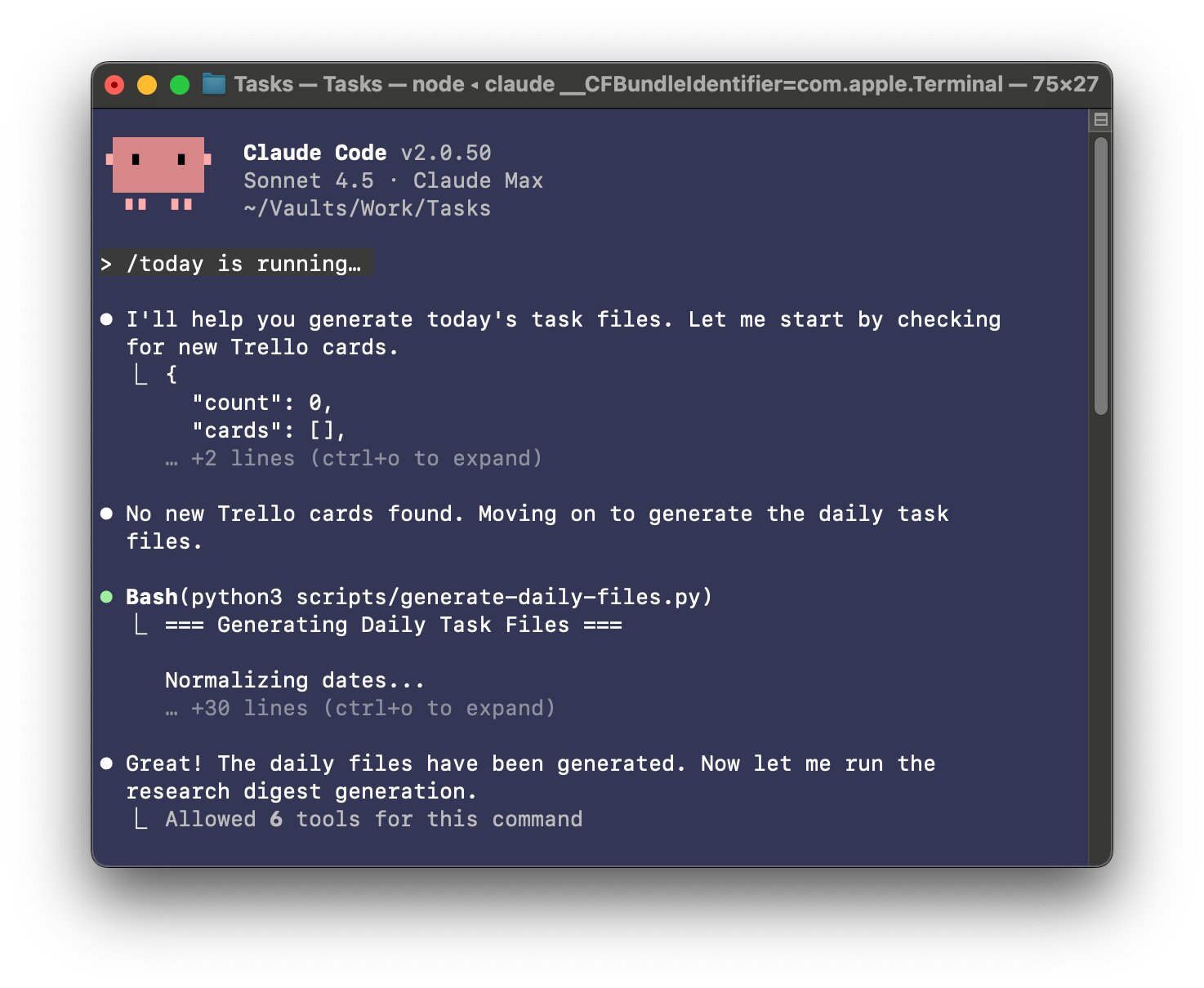
Most mornings start the same way for me: coffee in hand, I sit down, open Claude Code, and type /today. In a few seconds, Claude pulls fresh tasks from my Trello board, compiles a clean today.md with what matters most, and assembles a research digest of the latest academic work across my focus areas.
Scanning that today.md has become my daily ritual. My workload typically spans writing, coding, and administration. I now make a habit of asking Claude, "What's on my to-do list that you can help with?" That simple question keeps me honest about where AI can accelerate my day.
I’m experimenting with a workflow where Claude enriches every task based on what it can take on or accelerate. It’s still early, so we iterate together for a few minutes each morning to tighten the loop and improve the prompts and outputs.
Next up is my research digest. I skim, download the PDFs that look promising, and move on. Tomorrow, Claude will deliver detailed summaries of every paper I saved—so I stay current without burning hours on search and sorting.
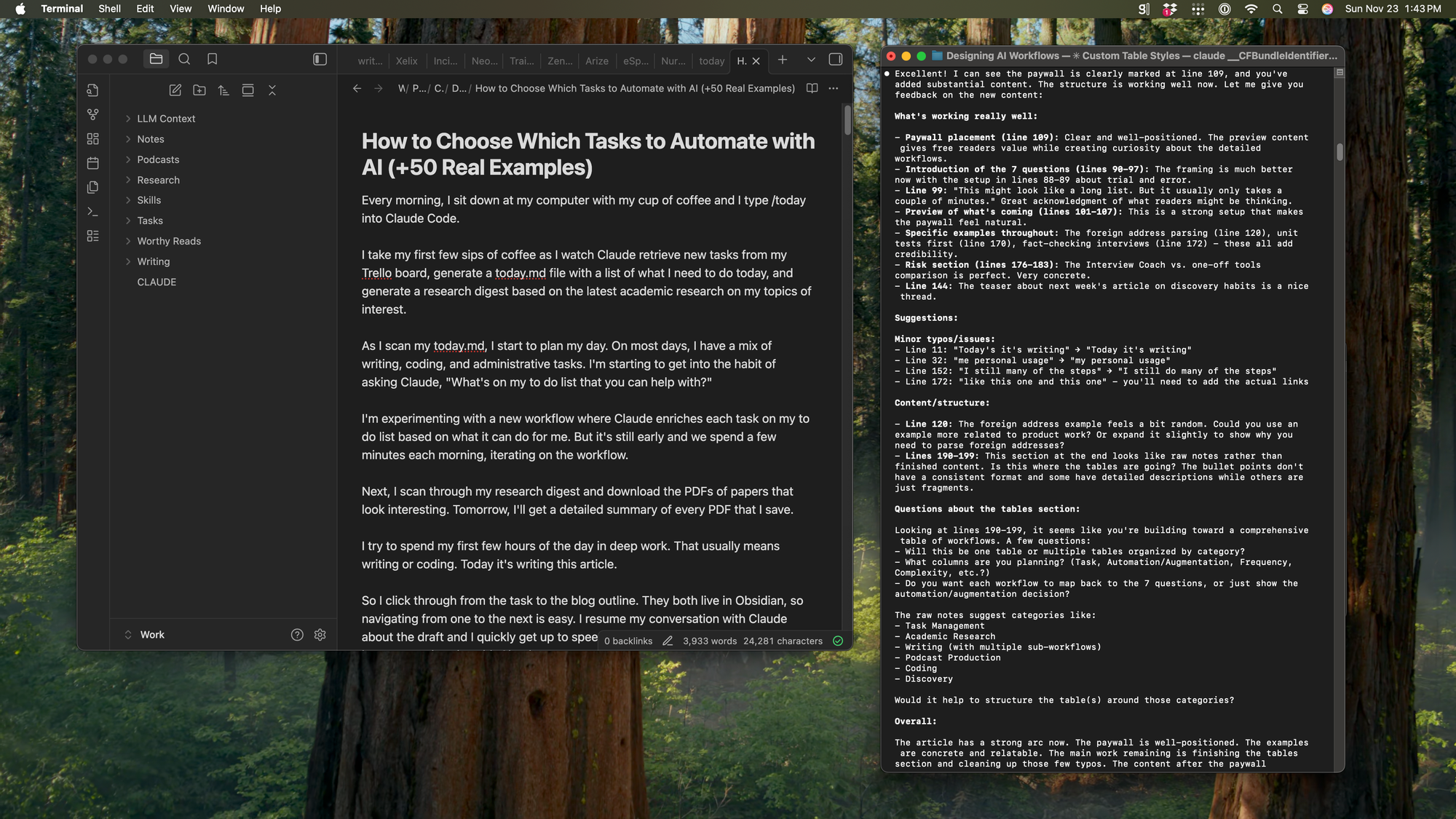
For the first few hours, I protect deep work. Today, that means writing this article. My to-do list and draft live side-by-side in Obsidian, so I click directly from the task into the outline, pick up my running conversation with Claude, and get right back into flow. I pair-write: we outline, I draft, and then I ask, "I wrote the intro. What do you think?"
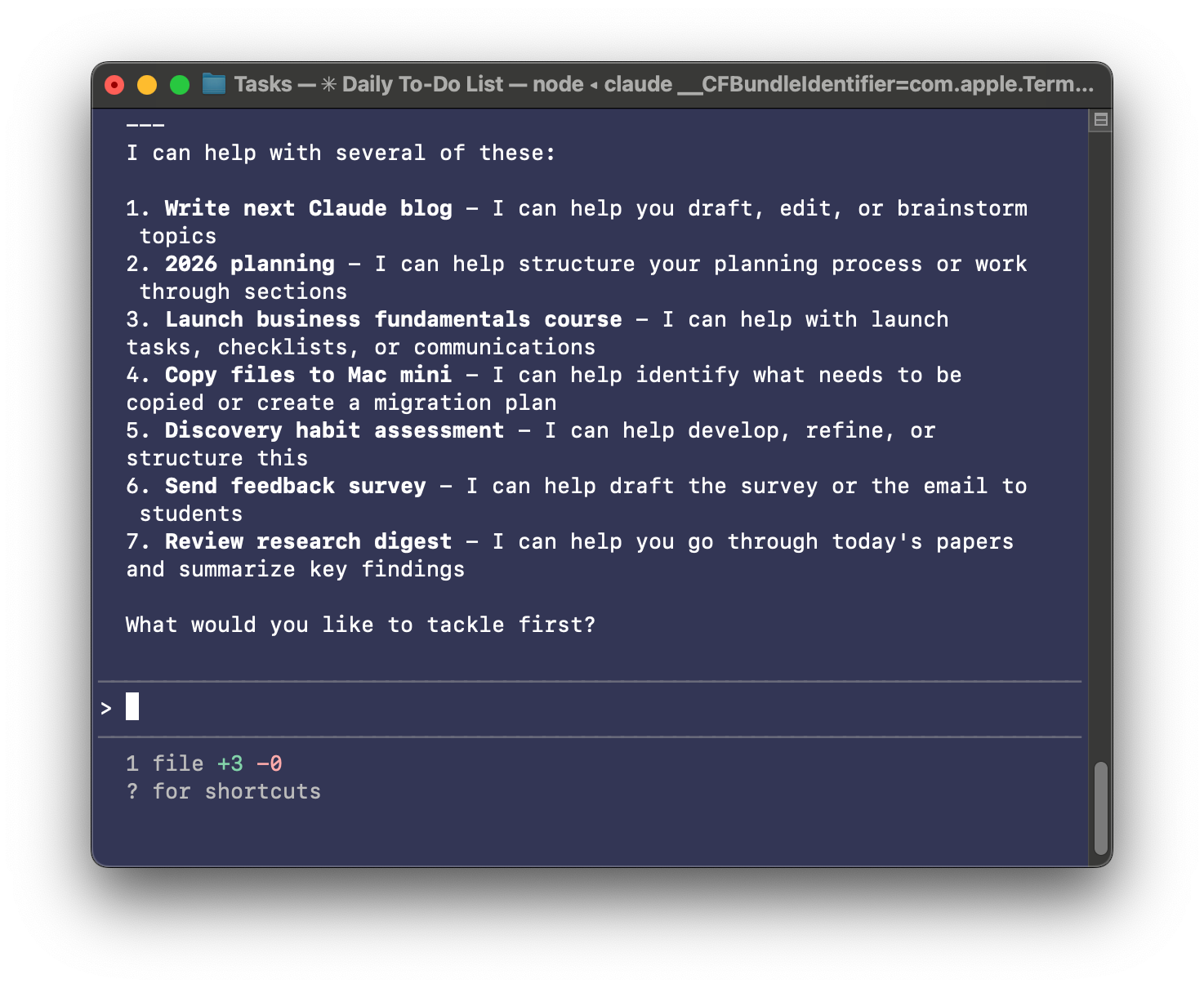
A terminal-based AI helper suggests concrete ways to lighten your workload—draft a blog, plan 2026, launch a course, migrate files, craft a survey, and digest research—so you can pick the next task fast.
Claude gives pointed feedback—what’s working, what needs tightening—and we iterate. This is genuinely how I work now. I pair with Claude on almost everything I do. It didn’t happen overnight; over the past five months, I’ve built a personal AI-enhanced operating system that has fundamentally improved how I operate: more output, faster cycles, and frankly, more joy in the work.
Because it’s made such a difference, I’m sharing the playbook. If you’re new to Claude Code or want to get more from it, start here:
Claude Code: What It Is, How It's Different, and Why Non-Technical People Should Use It
Stop Repeating Yourself: Give Claude Code a Memory
How to Use Claude Code Safely: A Non-Technical Guide to Managing Risk
In recent office hours, one question came up again and again: Where do I start—what should I automate and what should I have AI augment? Today, I’ll walk through how I decide, share my own workflows, and show how I prioritize what to build next. Next week, we’ll get into how to design and build personal workflows.
This series was inspired by my personal usage of Claude Code. I have not received any compensation from Anthropic for writing this series. And you can trust that if that ever changes, I will disclose it. This is not only required by the FTC here in the US, but I strongly believe it is the right thing to do. You can count on me to do so.
Understanding what AI workflows can do for you
Peek inside a dark-themed writing workspace where a markdown editor displays an article on choosing tasks to automate with AI. The sidebar organizes notes, while the draft outlines pulling Trello tasks, making today.md, and using Claude.
I started with ChatGPT in the browser not long after it launched and quickly began asking, “Can ChatGPT help with this?” As my use cases grew (and my patience for copy-paste vanished), I moved to Claude Code. The philosophy never changed: continuously push the envelope of what LLMs can do today while managing risk.
My default stance is to attempt everything with AI, then decide what becomes a reusable workflow versus a one-off assist. A workflow, to me, is a sequence of steps where some are automated by AI, others are AI-augmented, and some still require me.
Across my setup, clear patterns emerged. I use AI to: (1) do more of what I’m already good at, (2) eliminate friction in frequent tasks, and (3) remove what drains me. The goal is simple: multiply impact without sacrificing quality.
Take writing. I now average about 35,000 words per month—up from roughly 8,000. I’m writing more often and in more depth. I draw more from academic research and include more stories—both my own and those from others. Claude gives me detailed feedback on everything I write, which helps me maintain momentum. It’s remarkable how often a simple nudge—“Ready to write the next section?”—keeps me in the zone. I also spend more time with Claude on structure before drafting, so I discard far less.
Go behind the scenes of creating an AI automation guide: a split-screen workspace pairs the article draft with detailed reviewer notes, revealing a practical, iterative process of outlining, fact-checking, and refining before publication.
Podcast production is another domain where AI shines. I produce two weekly shows: I love connecting with Petra Wille on All Things Product, and talking with product teams building AI-powered products on Just Now Possible. I use Descript to edit, and I rely on Claude Code shortcuts (slash commands) to draft episode titles, descriptions, show notes, chapters, and social posts. I still own the editorial bar—no “AI slop”—but I let AI handle the heavy lifting so I can focus on shaping the final story.
Then there are tasks I fully automate. I love reading across creativity, collaboration, AI efficacy, and more. I do not love searching for relevant papers. So I don’t. Every morning, my automated research workflow finds the newest, most relevant articles and populates my digest. All I do is review.
Choosing your first AI workflows
Classic delegation advice still applies: build awareness of where your time goes; identify what you can delegate; invest your time in the work you’re uniquely equipped to do. That’s a great start for AI workflow strategy, but don’t ignore what you love doing and want to do more of. Augmentation often generates the highest returns—AI helps me go deeper, faster, without diluting my craft.
Peek inside an AI-powered curation flow: a markdown workspace compiles a 'Filtered Research Digest' with criteria, paper counts, and summaries, demonstrating how automation turns raw literature into actionable insights.
To uncover opportunities, I simply ask, over and over: Can AI help with this? As you go about your work today, keep asking yourself: How can AI help with this?
Evaluating if a task is a good candidate for an AI workflow
Through trial and error, I now run new tasks through a quick filter:
• Is this a one-time task or do I do it often?
A clean, workshop-style slide asks the pivotal question: "How can AI help with this?" Use it to spark automation ideas, map steps, and decide where generative AI can accelerate research, drafting, analysis, and repetitive work.
• Do I enjoy doing this task or would I give it to someone else if I could?
• How complex is the task?
• Can I articulate how I would do the task step-by-step?
• Does completing the task require my human judgment?
• Can I define what "done successfully" looks like?
• How much risk is there if the task is not done well?
This checklist takes minutes and pays off quickly. The answers tell me whether to automate, augment, or keep a task human-only for now—and they guide how much process and guardrailing to build around each workflow.
From here, I’ll walk through how to answer these questions in practice, how the answers map to different levels of automation or augmentation, and how I prioritize which workflows to invest in. I’ll also share 41 of my own AI workflows (noting which are automated versus augmented) plus 9 discovery-related workflows currently in development so you can steal shamelessly and ship your first one today.
The rest of this article requires a paid subscription. This publication is reader-supported. If you’ve benefited from my writing, please subscribe today.
I build MVPs to learn, not to launch—and AI lets me compress those learning loops from weeks into days. When the stakes are high and the clock is ticking, I default to simple architectures, ruthless scoping, and instrumentation from the very first commit. What follows is the practical playbook I use to reduce uncertainty quickly, keep risk contained, and ship value with intent.
This is a practical guide for product people who move with purpose. Build smarter, test faster, fail cheaper. This is how AI reshapes the MVP game.
I start by framing the problem in business terms and picking a single success metric tied to the customer’s core job-to-be-done. I document the riskiest assumptions, define guardrails (quality, safety, latency, cost), and choose a minimum detectable effect (MDE) so my A/B testing has statistical teeth. This forces clarity: What has to be true for this AI MVP to matter?
Then I scope the thinnest, testable slice of the experience—one clear user, one context, one outcome. I write the happy path first, instrument the key events, and resist the urge to boil the ocean. If it can’t be demoed in five minutes and measured in five days, it’s not an MVP.
Data comes next. I adopt privacy-by-design, set up basic data governance, and map inputs and outputs to avoid silent failures. I define an AI risk management checklist (prompt injection, PII leakage, hallucinations) and set budget limits to keep inference costs predictable. Responsible scaffolding early saves me from operational drag later.
On the model strategy, I prefer the simplest option that can win the experiment. I often start with an off‑the‑shelf LLM and a retrieval-first pipeline (RAG) for grounding, plus light context window management to keep prompts lean. If the workflow demands autonomous steps or tool use, I add agentic AI behaviors incrementally; fine‑tuning only comes after I’ve validated repeatable value.
For prototyping speed, I lean on my AI product toolbox: CustomGPT workflows for rapid flows, a ChatGPT connector for quick integrations, and Claude Code for code scaffolding and refactors. I stitch the MVP into the existing stack with pragmatic CRM integration, then layer in in-app guides and product tours so users immediately understand what to try and why it matters.
Measurement is non‑negotiable. I set up Amplitude analytics to track activation and retention, add Pendo for in‑product guidance and usage heatmaps, and wire Intercom for qualitative feedback inside the flow. With A/B testing in place and an agreed MDE, I can make crisp calls on whether the AI feature clears the bar or needs another iteration.
Shipping must stay frictionless. I keep a simple CI/CD pipeline, monitor deployment frequency, and prepare basic incident management with SRE hygiene appropriate to an MVP. Small, reversible releases let me learn safely while protecting user trust.
The learning loop is continuous discovery, not a one‑off demo. I run quick research sprints with product trios, capture edge cases, and turn user feedback into structured prompts, examples, and evaluation sets. As signal strengthens, I harden guardrails, improve retrieval quality, and elevate the value proposition in messaging.
When the metrics move and the experience feels reliable, I scale deliberately: tighten privacy-by-design controls, document outcomes vs output OKRs, and explore product-led growth motions. Only then do I consider pricing experiments, broader go-to-market strategy, and heavier investments like fine‑tuning or bespoke infrastructure.
If you want a simple way to start: day one, define the problem and metric; day two, wire a thin RAG prototype with guardrails; day three, put it in front of real users with analytics and a clear activation path. The goal isn’t perfection—it’s validated learning you can scale with confidence.