I just tuned into the latest conversation on the upcoming Product at Heart 2026, and it hit on the exact challenges product leaders are navigating right now: curating meaningful content in a world where AI moves faster than our agendas, designing formats that create real connection, and ensuring every minute earns its place. Listening to Petra Wille and Teresa Torres map out the speaker lineup, workshops, and structural shifts, I found myself nodding along—this is the kind of thoughtful curation we need if we want product teams and product leaders to walk away with practical value, not just inspiration.
Listen to this episode on: Spotify | Apple Podcasts
What stood out immediately is the bold move to a single-track conference for 2026. In an era of gen ai hype and endless breakouts, this choice signals clear intent: tighter curation, a shared experience, and less FOMO. The team isn’t carving out a separate AI track—and I love that decision. Their stance is simple and sensible: No AI track—AI will show up everywhere, but not as a siloed topic. The team sees it as part of the everyday toolkit. That mirrors how high-performing, empowered product teams actually work today—AI Strategy and AI workflows are part of the operating system, not a side show.
The keynote lineup is already compelling. Christian Idiodi (SVPG) brings storytelling that turns product principles into habits you can actually use on Monday. Elaine Kasket, cyber-psychologist, exploring digital afterlife and AI replicas, will push us to think more deeply about the human side of our systems. And Teresa Torres will be sharing what she’s learning about AI—exactly the kind of continuous discovery mindset we need as we integrate LLMs into product discovery and delivery.
I’m also thrilled to see roundtables become what they’re calling an “alternative track.” That’s a smart way to deepen learning without fragmenting attention. The best conference ROI I’ve had often comes from targeted small-group conversations—where product trios compare approaches, swap metrics frameworks, or challenge each other’s product strategy assumptions. It’s a design choice that rewards curiosity and builds communities of practice.
We also get a behind-the-scenes look at Teresa’s Maker Studio workshop, where participants will build personal AI workflows. That’s exactly the hands-on, practitioner-first approach teams need right now—less demo theater, more systems that stick. If your roadmap includes integrating LLMs into continuous discovery or augmenting your team’s decision velocity, this kind of guided practice is gold.
The broader workshop slate looks deep and balanced. Expect returning favorites and practical frameworks: Rich Mironov on the realities of product leadership in complex orgs; Büşra’s metrics workshop translating outcomes into action; and an overview of additional workshops from Rich Mironov, Büşra Coşkuner, Marcus Castenfors, and Özlem Yüce. From success metrics to toolkits for product managers, the content spans IC to product management leadership—ideal if you’re stepping into new roles or scaling empowered product teams.
One of the most exciting evolutions is the Product Leadership Event, now a 1.5-day retreat. The format blends talk sessions, mini-workshops, dinners, and small-group excursions (boat rides, improv, etc.), giving leaders time and space to exchange playbooks, stress-test decisions, and build real relationships. It’s capped at 60 attendees (all in product leadership roles) to keep it intimate and useful. As someone who believes in outcomes vs output OKRs and first principles decision making, I appreciate how this structure encourages depth over breadth—and real accountability among peers.
Here are the core takeaways I’m carrying into my own planning: single-track means tighter curation, so every talk has to earn its place. Roundtables are growing into an “alternative track,” offering more ways to engage beyond stage talks. Workshops go deep and meet you where you are—IC, manager, or executive. And the leadership retreat expands to maximize learning from peers, not just from the stage. If you care about product discovery, product strategy, and conference networking that leads to actual business impact, this program looks thoughtfully engineered.
If you’re planning your 2026 calendar—or just curious how conferences evolve alongside the craft—this is a thoughtful walkthrough of what to expect. Come say hi to Teresa and Petra—on stage, at a roundtable, or somewhere in the hallway conversations that make these events memorable.
For more context and resources mentioned, explore: Product at Heart, Arne Kittler, Mind the Product, Christian Idiodi of Silicon Valley Product Group, Elaine Kasket, House of Beautiful Business, The 7 Habits of Highly Effective People by Stephen Covey, Rich Mironov, Marty Cagan, Claude Code, Codex by OpenAI, Marcus Castenfors, Büşra Coşkuner and her Success Metrics: A Playbook for Product Managers, Özlem Yüce’s Essential Toolkit for Product Managers, Petra’s Product Leadership Wheel (PLwheel), and Netlight.
Follow Teresa Torres: https://ProductTalk.org
Follow Petra Wille: https://Petra-Wille.com
Full transcripts are only available for paid subscribers.
I’ve led product teams through countless discovery cycles, and nothing has accelerated our learning loops like AI. By weaving AI into our continuous discovery practice at HighLevel, I cut time-to-insight, reduce risk earlier, and keep our product strategy relentlessly focused on customer outcomes.
AI streamlines product discovery by accelerating research, prototyping, and validation, enabling teams to make faster, smarter, and user-driven decisions.
In the research phase, I use gen ai and LLMs for product managers to synthesize interviews, cluster themes, and surface unmet needs in minutes instead of days. Pairing those qualitative insights with behavioral signals in Amplitude analytics helps me spot high-intent cohorts and friction points at scale, so our problem framing is both human-centered and data-backed.
From there, I translate insights into crisp hypotheses and prioritize with the Kano Model and outcomes vs output OKRs. To keep experiments honest, I define a minimum detectable effect (MDE) up front and design A/B testing plans that reflect realistic traffic and seasonality, ensuring our decisions are statistically grounded rather than anecdotal.
Prototyping is where gen ai for product prototyping really shines. I spin up multiple UX flows, UI copy variants, and edge-case scenarios using prompt engineering, then iterate with rapid feedback from product trios. When needed, I mock in-app guides and product tours to validate onboarding concepts before we commit to code, preserving velocity without sacrificing quality.
For validation, I lean on a mix of lightweight experiments—fake-door tests, concierge pilots, and targeted A/B testing—augmented by in-product surveys via Pendo or Intercom. For AI-powered features, I apply eval-driven development to measure relevance, latency, and safety, so we can ship responsibly while maintaining the pace of learning.
This approach only works when the team is structured to move fast. Empowered product teams and product trios own discovery end-to-end, with clear guardrails around data governance, privacy-by-design, and AI risk management. That alignment lets us shift from opinions to evidence, and from output to outcomes, without friction.
If you’re getting started, pick one discovery loop to transform: automate research synthesis, prototype two to three variants with AI, and validate with a tightly scoped experiment. Instrument your analytics, track time-to-insight and time-to-prototype, and iterate your product roadmapping and sprint planning with what you learn. The payoff is immediate: faster cycles, stronger conviction, and a more user-driven path to product-led growth.
I set out to create a lightweight, high-impact “Pendo Wrapped” experience for our users—and I did it in under 10 minutes with Pendo MCP. As a VP of Product Management, I’m constantly looking for fast, pragmatic ways to turn product insights into moments that drive engagement. This experiment was about transforming raw analytics into a concise, celebratory year‑in‑review that motivates customers to explore more value.
When I say “Pendo Wrapped,” I mean a simple, narrative-style summary of usage highlights: what got adopted, which moments mattered, and where value showed up most clearly. Framed well, that story reinforces product‑led growth by reminding users why they chose us, nudging them toward the next best action, and strengthening activation and retention without heavy development work.
My approach was straightforward: define a clear objective (celebrate milestones and prompt the next step), choose a focused set of metrics (adoption, engagement, and activation), and target relevant segments. Then I layered the narrative on top of existing analytics using in‑app guides and product tours to deliver the experience where it matters most—inside the product.
The reason it took minutes, not hours, is that Pendo MCP let me work with what we already had—segments, saved reports, and proven guide templates—so I could spend time on the story, not the scaffolding. No code, minimal configuration, and a crisp call to action made it feel polished without being heavy.
Increase revenue, cut costs, and reduce risk with Pendo’s Software Experience Management platform. Optimize the entire software experience to drive adoption and improve engagement.
If you want to replicate this quickly, start by selecting one user segment and three metrics that matter to them, write a two‑sentence narrative that connects those metrics to outcomes, and ship a short in‑app guide with a single, purposeful CTA. That’s enough to deliver a personalized year‑in‑review feel and spark immediate exploration—no new infrastructure required.
What surprised me most was how a small, story‑driven touch created outsized alignment across customers and internal teams. It turned analytics into advocacy, reminded our users of the value they’re already getting, and opened the door to deeper adoption. If you’re pursuing product‑led growth, a fast “Pendo Wrapped” is one of the highest‑leverage experiments you can run this week.
Your tender inbox contains a deadline, a stack of attachments, and a chain of decisions that still lives in people’s heads. The tempting response is to buy a model that can read PDFs. That solves only the most visible part of the problem.
A useful tendering product must determine which documents matter, extract requirements with evidence, match those requirements to a catalog, retrieve approved pricing, draft an offer, identify uncertainty, and route exceptions before anything reaches the customer. If you lead AI or product strategy for a manufacturer or supplier, your first goal should not be an autonomous bidder. It should be the smallest tender category in which every decision can be observed, evaluated, and improved.
Pick a bounded quote, not the entire tendering department
Construction tendering is too broad for a credible first release. Product categories have different terminology, selection rules, catalogs, pricing structures, and exception patterns. A system that works for one bounded category has not automatically learned how to quote every building product.
One effective wedge started with radiator requests for a single design partner before expanding to other building products. That constraint made the catalog, expected outputs, and expert reviewers knowable. It also created a place to learn the real workflow rather than designing from an idealized process diagram.
Choose your wedge using operational criteria, not enthusiasm for the model:
The request appears often enough for reviewers to recognize recurring patterns.
The relevant catalog is bounded and maintained by a clear owner.
A domain expert can explain why a product is suitable, unsuitable, or uncertain.
The correct price can be traced to an approved system or document.
Historical tenders and reviewer corrections are available for evaluation.
An error can be caught during review before it becomes a customer-facing commitment.
A design partner is especially valuable because the work is not fully documented. In one implementation, the product team spent a week observing the process on-site. That kind of observation exposes the browser tabs, informal checks, catalog shortcuts, and exception handling that an interview alone can miss.
Follow one tender from the incoming email to the final offer. At every handoff, record five things: the input, the decision, the evidence used, the person or system responsible, and the condition that triggers an exception. If you cannot state those five things, you do not yet have a well-defined agent task.
Keep three layers of information separate from the beginning:
Stated requirements: what the tender explicitly asks for, with the originating file, page, section, or table cell.
Interpretations: conclusions the system or reviewer draws when terminology is ambiguous, incomplete, or inconsistent.
Commercial decisions: the selected product, approved price, assumptions, exclusions, and offer language.
This separation matters because a polished offer can hide a weak inference. A reviewer needs to see where the tender ends and the system’s judgment begins.
Define the first outcome as a review-ready tender case: organized source documents, structured requirements, proposed product matches, price provenance, unresolved issues, and a draft offer. That is a more useful product boundary than “understands construction PDFs.” It gives the reviewer something concrete to accept, correct, or reject.
Turn the workflow into a decision graph with specialist agents
A chatbot is the wrong mental model. Tendering is a decision graph in which an early classification or extraction error can contaminate every downstream step. Real packages can range from a short request to more than 1,800 pages describing an entire building. The system therefore needs to plan work, retain state, reconcile evidence, and know when coverage is incomplete.
Use agents only where a task requires interpretation, planning, or exception handling. Keep exact operations – file handling, arithmetic, catalog queries, identifiers, template validation, and access control – in deterministic code or approved systems.
Stage
Preferred control
Required output
Intake
Rules plus a classifier
A tender case containing the email, attachments, document types, and routing status
Requirement extraction
Parser tools plus a specialist agent
Structured requirements with source locations, missing fields, and ambiguities
Product matching
Catalog retrieval plus a reasoning agent
Candidate products, requirement coverage, incompatibilities, and rationale
Pricing
Approved database, CPQ, or pricing service
Exact product-price records with source and validity information
Offer generation
Controlled template plus a drafting agent
A draft that distinguishes confirmed facts, assumptions, and exclusions
Quality review
Rules plus a separate review agent
A pass or block decision with issue codes and supporting evidence
Human approval
Domain and commercial policy
An approval, correction, rejection, or escalation that becomes evaluation data
Each agent should have an explicit contract. Specify its permitted inputs, tools, output schema, evidence requirements, completion test, and escalation behavior. “Find the right product” is not a contract. “Return catalog candidates that meet the extracted requirements, identify uncovered requirements, cite the catalog evidence, and abstain when no candidate qualifies” is much closer to one.
For large document sets, require the workflow to maintain a task plan. It should inventory files, identify relevant sections, process bounded units of work, track completed and pending units, reconcile repeated or conflicting requirements, and run a final coverage check. A generated answer is not proof that the package was fully processed.
The review agent deserves its own role. Asking the drafting agent to “check your work” keeps creation and approval inside the same reasoning path. A separate reviewer can inspect the draft against the extracted requirements, catalog evidence, price records, and policy rules. It should return defects and a gate decision rather than silently rewriting the offer. Silent rewriting makes it harder to identify which upstream component failed.
This pattern has practical value because a dedicated review agent can catch errors before human review, much like a separate code review step. Independence comes from the reviewer’s task and evidence contract; adding more agent personas without distinct responsibilities only creates orchestration overhead.
The interface is part of the architecture. During discovery, a dedicated web workbench can be more useful than hiding the workflow behind a legacy integration. Put the source document, extracted requirement, proposed match, price evidence, and review issue within the same review path. That gives the product team control over feedback capture and makes the reason for each correction visible. One tendering product used its own web application to iterate toward greater automation rather than beginning as a backend-only integration.
You can still read from and write to existing systems at defined boundaries. The distinction is between integration and dependence: integrate with systems of record for catalogs, prices, customers, and approved quotes, but do not let an inflexible legacy screen determine how reviewers inspect an emerging AI workflow.
Evaluate every decision before judging the complete quote
An end-to-end result tells you whether a tender case failed. It rarely tells you why. If the final product is wrong, the defect may have come from document routing, requirement extraction, catalog retrieval, product reasoning, pricing, drafting, or review. A single overall accuracy score collapses those failure modes into an unactionable number.
Pricing: exact agreement with the approved source, correct product-price association, formula validation, and rejection of unavailable or invalid records.
Offer generation: required-field completeness, consistency with selected products and prices, correct treatment of assumptions, and unsupported statements.
Review: detection of known defects, false blocks on valid cases, issue classification, and evidence quality.
Slice failures by characteristics that change the work: document length, file type, layout, product category, presence of tables, and conflicting or revised requirements. An aggregate score can improve while performance deteriorates on the long or unusual tenders that consume most reviewer attention.
Use end-to-end measures for the product outcome: review time, correction volume, correction severity, exception rate, percentage of cases that reach the defined completion state, and whether the workflow finishes before its operational deadline. Keep commercial outcomes separate from model correctness. Quote acceptance or win rate can be affected by price, availability, competition, customer relationships, and sales execution; it should not be treated as a clean extraction or matching metric.
Observability must connect those layers. For each tender case, retain the task plan, agent inputs and outputs, tool calls, retrieved catalog or price records, prompt and model versions, gate decisions, latency, failures, and human corrections. Complex agent chains can exceed what generic monitoring exposes, which is why custom tracing and Agent Analytics became necessary in a production tendering workflow.
Capture reviewer feedback as structured data, not only as an edited final document. Store the original output, corrected value, responsible stage, reason code, evidence used, and final disposition. Useful reason codes include missing requirement, incorrect extraction, unsupported product match, pricing issue, unresolved conflict, invalid assumption, and drafting defect.
Do not feed every edit directly back into the system and call it self-learning. A reviewer may change wording for preference, apply customer-specific knowledge, or correct an upstream error in the final draft. Validate the correction, assign it to the right component, and add it to the corresponding evaluation set. That turns human review into controlled learning rather than an untraceable feedback loop.
Release changes through two gates. First, the modified agent must pass its own evaluation set. Second, the complete workflow must pass the end-to-end set because an improvement in one component can change the assumptions of another. The trace should show exactly which version produced every customer-facing artifact.
Earn autonomy one commercial boundary at a time
“Straight-through processing” is incomplete unless you define where the straight-through path ends. Automatically extracting requirements is not the same risk as automatically selecting a product, committing a price, writing to the CPQ, or sending an offer to a customer.
Use an autonomy ladder with an explicit boundary at each stage:
Shadow: the system processes live-shaped cases, but its outputs do not affect the operational tender.
Assist: it organizes documents and extracts requirements while a person performs matching, pricing, and drafting.
Draft: it proposes products and produces an offer, but a human must review and approve every case.
Gated processing: it completes predefined internal actions for in-scope cases and sends all exceptions to a reviewer.
External dispatch: it sends an offer without case-by-case approval only when commercial policy explicitly permits that action and every required gate passes.
Eligibility for a higher-autonomy path should be machine-checkable. At minimum, confirm that the product category is in scope, every required document was processed, required fields are present, source evidence is attached, conflicts and revisions are resolved, the product match satisfies its evidence rules, the price comes from an approved valid source, the review agent reports no blocking defect, and the full trace is retained.
A wrong product or price can create margin, delivery, contractual, and customer-trust exposure. If an offer may create a binding commitment, keep human approval until the appropriate commercial and legal owners have defined the policy for automatic dispatch. The safe alternative is to automate preparation while preserving approval at the commitment boundary.
Operational controls matter after launch. Give reviewers a visible exception queue, make the reason for every block legible, preserve manual processing when the AI path is unavailable, and provide a way to suspend autonomous actions without disabling access to already processed cases. Assign owners for catalog quality, pricing validity, tender policy, model behavior, and production reliability; otherwise each exception will bounce between teams.
Expansion should follow evidence and customer pull. A request to replace an existing CPQ system is a meaningful product-market signal, but it is also a change in product scope. CPQ replacement introduces responsibilities for quote versions, approval policy, catalog administration, pricing governance, integrations, and records. Treat that request as a roadmap decision, not as proof that the original agent workflow already covers those capabilities.
Key takeaways
Start with one product category, one known workflow, and reviewers who can explain the correct decision.
Optimize first for a review-ready tender case, not an impressive answer from a general chatbot.
Use deterministic systems for exact operations and specialist agents for interpretation, planning, and exceptions.
Require structured outputs, source evidence, explicit completion tests, and an abstain-or-escalate path from every agent.
Evaluate each stage separately, then use end-to-end metrics to measure the operational outcome.
Increase autonomy only when observable eligibility gates protect the next commercial boundary.
At your next roadmap review, put one representative tender on the screen and draw the decision path from email to offer. Name the owner, evidence, pass condition, and exception path for every node. Wherever those are missing, the next task is workflow discovery, not another agent. Once the graph is explicit, you can automate one bounded decision, measure it, and earn the right to automate the next.
Your AI feature has passed the demo. Customers want it, leadership wants a date, and the team believes the remaining risks can be handled before launch. The problem is that nobody can state what evidence would make the feature safe enough to release – or who can stop it when that evidence is missing.
This is where AI ethics has to become product governance. You need a repeatable way to classify risk, set release conditions, assign decision rights, test safeguards, and respond when production behavior differs from the demo. The goal is not to eliminate uncertainty. It is to make uncertainty visible and govern the consequences.
Start with a release contract, not a list of principles
For each AI capability, write a short release contract before implementation begins. It should answer:
What decision or task is the product helping with? Describe the user outcome, not the model output. Generating a response is an output; helping a support agent resolve a request accurately is an outcome.
What must the system never do? Name unacceptable behavior such as exposing restricted data, presenting unsupported claims as facts, acting without required confirmation, or concealing that AI influenced an outcome.
Who can be affected? Include people represented in the data, people discussed in generated content, employees asked to rely on the output, and anyone subject to a downstream decision.
How consequential is a wrong result? Separate an inconvenient suggestion from an output that can affect access, money, employment, safety, privacy, or another difficult-to-reverse outcome.
What evidence is required to ship? Tie every material risk to an evaluation, control, review, or operational test. Avoid release criteria such as reasonable quality or adequate safeguards; two reviewers can interpret those phrases differently.
What will stop or reverse the feature? Define the conditions for disabling an action, reverting a version, narrowing availability, or returning the workflow to human handling.
Treat these conditions as part of the acceptance criteria. If a trust condition fails, the feature has not passed release readiness even when its primary quality metric looks strong. That keeps ethical constraints from becoming optional work negotiated away at the end of the schedule.
Classify the use case by consequence, autonomy, and reversibility
A model does not have one fixed risk level. The same underlying model can draft a headline, recommend an account action, or execute that action. Governance should therefore follow the use case rather than the model name.
A practical classification starts with three questions:
Consequence: What happens if the output is wrong, biased, misleading, or disclosed to the wrong person?
Autonomy: Does the system inform a person, recommend a decision, or take the action itself?
Reversibility: Can the affected person notice the result, challenge it, and restore the prior state without disproportionate effort?
Use those answers to choose a product path. A reviewable drafting aid may rely on disclosure, editing controls, standard evaluations, and ordinary monitoring. A consequential recommendation needs stronger evidence, an accountable human reviewer, and a clear appeal or correction path. An autonomous, hard-to-reverse action should not launch until the team can justify the autonomy, constrain permissions, require confirmation where appropriate, and demonstrate a reliable override.
Do not confuse a human in the workflow with meaningful human oversight. A person who lacks context, time, authority, or a usable way to reject the output is functioning as a rubber stamp. For higher-risk actions, the reviewer needs the evidence behind the recommendation, a clear indication of uncertainty or limitations, and the authority to choose a non-AI path.
Record the classification in an AI risk register. Each entry should contain the risk scenario, affected parties, possible impact, warning signals, preventive control, detection method, response, owner, required evidence, residual risk, and the person authorized to accept that residual risk. A model defect belongs in the backlog; a plausible future failure belongs in the risk register; a failure already affecting users belongs in incident management. Keeping those states distinct prevents serious risks from disappearing into a generic bug queue.
Likelihood will often be uncertain before production. Do not turn that uncertainty into a convenient low-risk label. Record what is unknown, how the team will test it, and which production signal will cause a review. For a consequential or difficult-to-reverse feature, I would also separate the person implementing the control from the person accepting the remaining risk.
Turn governance into four evidence-based release gates
A governance meeting should inspect evidence, not collect reassuring opinions. Four gates cover the path from data collection to production response. The depth of each gate should match the use-case classification.
Data gate: prove that the inputs are governed
Trust problems often begin before a prompt reaches the model. The data gate should make the full path of customer and organizational data inspectable.
Document what data is collected, where it came from, why it is needed, and which product purpose it serves.
Identify the applicable basis for processing and make consent flows explicit where consent is used. Legal requirements depend on the product, data, and jurisdiction, so product teams should validate this with qualified privacy and legal partners rather than infer an answer from a generic checklist.
Remove fields that are not needed for the stated outcome. Data minimization reduces both privacy exposure and the number of inputs that can produce unexpected behavior.
Map data lineage across ingestion, retrieval, model calls, logs, analytics, support tools, and vendors. A deletion promise is not credible if the team cannot locate every copy.
Apply role-based access to raw inputs, retrieved context, generated outputs, and operational logs. Access to the application should not automatically imply access to all AI interaction data.
Set retention and deletion rules, then test that they work across the full data path rather than only in the primary database.
The gate passes when the team can trace an input, explain its permitted use, name who can access it, and show how it is removed. A policy document without an enforceable data path is not sufficient evidence.
Model gate: test the failures that matter to the use case
Map every important risk in the register to an evaluation. If a risk has no test, state which manual review or production control provides the evidence instead.
Define the passing condition before reviewing final results. Moving a threshold after seeing a disappointing result turns a gate into a negotiation.
Test normal requests, ambiguous requests, edge cases, adversarial prompts, and realistic multi-step interactions. A polished set of happy-path prompts will not expose operational failure modes.
Compare performance across the user groups and contexts relevant to the product. Aggregate quality can conceal a meaningful gap affecting a smaller group.
Red-team prompts, retrieved context, tool use, and permission boundaries. For an agentic workflow, the safety of the text is only one part of the problem; the allowed action is another.
Keep the evaluation set and results tied to the model, prompt, retrieval configuration, tools, and policy version that produced them. Otherwise, a passing report can outlive the system it evaluated.
When an LLM must answer from known organizational information, a retrieval-first pipeline can ground the response in authoritative material. It does not remove the need for evaluation. Test missing documents, conflicting documents, stale content, access-restricted content, and questions the knowledge base cannot answer. The safe behavior may be to abstain, ask for clarification, or route the task to a person.
Experience gate: help users exercise judgment and control
Disclosure is useful only when it changes what a person can understand or do. Place it near the AI-assisted decision, in plain language, and explain the limitation that matters in that moment. A broad statement hidden in terms and conditions does not help a user assess a specific output.
Make it clear when AI generated, transformed, recommended, or acted on information.
Let users inspect, edit, reject, or correct an output before a consequential action where that control is meaningful.
Separate generated content from verified facts in the interface. Do not use confident UX writing to imply certainty the system cannot support.
Explain what data the feature needs and what changes when the user turns it off.
Provide a non-AI or human-assisted path when the AI path is unsuitable for the task.
Test whether users understand the system’s role. A control that exists but cannot be found or understood is not an effective safeguard.
Match the amount of friction to the consequence. Requiring confirmation for every low-impact suggestion can train users to click through automatically. For a high-impact or hard-to-reverse action, the extra pause may be the safeguard that preserves meaningful control.
Operations gate: demonstrate that failure can be contained
Pre-launch evaluations cannot cover every production context. The operations gate determines whether the team can detect, contain, and learn from behavior that escaped testing.
Monitor model behavior and customer impact. Technical availability can look healthy while unsupported outputs, harmful actions, or repeated user corrections are increasing.
Assign an owner and response for each alert. An unowned dashboard is visibility without control.
Create a kill switch or permission cutoff for risky actions, plus a rollback path for model, prompt, retrieval, and tool changes.
Test the rollback under realistic access and dependency conditions. A safeguard that nobody has exercised may fail during the incident it was meant to contain.
Prepare an incident playbook covering triage, containment, evidence preservation, affected-user assessment, communication, recovery, and the decision to restore service.
Keep a human override for high-risk actions and verify that the operator can use it without depending on the failing AI path.
This gate passes when the team can answer three questions without improvising: How will the failure be detected? Who can stop it? What evidence is required before it is turned back on?
Assign decision rights across the product lifecycle
Governance slows teams when everyone can raise concerns but nobody knows who decides. Put decision rights beside the risk register and release gates.
Product: owns the intended outcome, use-case classification, release contract, customer trade-offs, and completeness of the risk register.
Engineering and data: produce evidence for system behavior, data lineage, access controls, evaluations, technical constraints, and remediation.
Design and research: verify disclosure, comprehension, correction, appeal, and user control in the actual workflow.
Security and privacy: examine access, abuse paths, data handling, vendor exposure, and response controls.
Legal and compliance: interpret applicable obligations and identify where a product decision creates legal exposure. Product leaders should bring these partners in while choices are still reversible.
SRE and operations: own observability, alerting, rollback mechanics, incident readiness, and production recovery with the product team.
Executive risk owner: accepts material residual risk when the decision exceeds the product team’s authority and ensures that the required mitigation has resources.
The review itself should be a decision forum, not a status meeting. Send the release contract, risk register, failed and passed evaluations, unresolved questions, and requested decision in advance. End with one of four outcomes: approved, approved with explicit conditions, returned for more evidence, or rejected. Record the rationale and the event that will trigger another review.
Apply the same discipline to purchased models and AI services. A vendor can operate part of the stack, but it cannot absorb your accountability to customers. Due diligence should cover model provenance, data use and retention, access, evaluation evidence, incident history, change notification, and subcontracted dependencies. Contracts should carry operational commitments such as service levels, deletion obligations, audit rights, and incident responsibilities into the vendor relationship.
If a vendor cannot answer a material question, record the item as unknown. Do not silently translate missing evidence into low risk. Decide whether a compensating control – limited data, narrower permissions, independent evaluation, or a manual workflow – makes the unknown acceptable. If not, change the design or supplier.
Treat launch approval as a monitored, reversible decision
Approval should attach to a defined system configuration and use case, not to the feature name forever. A model change, system-prompt change, new retrieval corpus, broader user group, expanded data access, new tool permission, or shift from recommendation to autonomous action can invalidate earlier evidence. Put those change triggers in the original approval.
Launch with the smallest exposure that can produce useful operational evidence. Watch model-quality signals alongside user corrections, overrides, complaints, unexpected actions, access violations, and downstream customer impact. Set an owner and response for each signal before rollout. Waiting for a broad satisfaction metric to move can leave a concentrated harm hidden inside an apparently successful launch.
Customer trust also depends on what you reveal outside the internal review. A customer-facing trust center can publish the AI system’s role, material limitations, relevant data practices, available controls, change history, and a path for reporting problems. Model facts, limitations, and change logs make responsible operation visible. Candor about a boundary is more useful than a vague claim that the system is responsible or safe.
Key takeaways
Govern the use case, not the model in isolation. Consequence, autonomy, and reversibility determine the controls you need.
Pair every success metric with an unacceptable outcome and observable release condition.
Use one living risk register to connect risk scenarios, evidence, owners, safeguards, residual risk, and review triggers.
Require evidence across data, model behavior, user experience, and production operations before release.
Treat human oversight as a designed capability. The reviewer needs context, time, authority, and a usable alternative.
Carry governance into vendor selection, contracts, monitoring, incident response, and material system changes.
Take one AI item from your current roadmap and write its release contract before the next planning or governance meeting. Name the intended decision, unacceptable outcomes, affected people, required evidence, stop conditions, and accountable risk owner. Any blank you cannot fill is not paperwork still to complete. It is product work you have found before customers find it for you.
Happy New Year! I’m kicking off 2026 with a behind-the-scenes look at what’s changing in my product practice, the experiments I’m running with my teams at HighLevel, and the trends I’m most energized by—especially around continuous discovery, AI workflows, and building stronger coaching cultures.
If you want to listen to the conversation that sparked many of these reflections, you can find it here: Spotify | Apple Podcasts.
Why Teresa sunset the live deep-dive cohorts—and how on-demand and the new Discovery Habits Toolbox better support real behavior change. This pivot resonated with my own experience: some skills, especially discovery habits, only stick when they’re reinforced in the flow of real product work, not just in a time-boxed cohort. In my org, we’re leaning into on-demand learning paired with manager coaching to drive durable behavior change.
What leaders actually need to coach interviewing, assumption testing, and core discovery habits inside their orgs. I’ve found that empowered product teams thrive when leaders have lightweight coaching tools, practical prompts, and clear expectations for product trios. This is less about one-off training and more about building communities of practice where deliberate practice and feedback loops become routine.
Why training is shifting toward ongoing, leader-supported learning (and how AI will accelerate the shift). AI Strategy isn’t just about tools—it’s about learning systems. For LLMs for product managers to create leverage, we need eval-driven development, privacy-by-design, and clear guardrails. I’m building AI workflows that enable managers to review interviews, spot anti-patterns, and nudge teams toward better decisions—without replacing critical thinking.
Teresa’s move into paid subscriptions and why AI content doesn’t fit the classic “design once, run for years” course model. I see the same reality in my content roadmap: the half-life of AI guidance is short. That pushes us toward subscription models, tighter feedback loops, and a more adaptive go-to-market strategy for education products.
A sneak peek into the AI tools Teresa is building for discovery work—from interview coaching to near-ready interview snapshot generation. I’m particularly excited by tooling that scaffolds better interviews, sharpens assumption testing, and speeds up synthesis without skipping the human judgment step. These capabilities map directly to where I want my teams investing time: spending less energy on admin and more on learning from customers.
Petra’s plans for the year: community building with Product at Heart, a new product leadership email course, her Product Leadership Wheel, and workshops launching in Cairo. As someone who believes in conferences as high-quality “energy wells,” I’m inspired by how these programs create momentum for leaders who are upgrading their coaching muscles.
The role of conferences and retreats in staying grounded, inspired, and connected. I treat these gatherings as strategic resets—spaces to test ideas, confront blind spots, and deepen my network for future collaboration. The best outcomes often come from serendipitous hallway conversations and hands-on sessions where you can pressure test frameworks with peers.
How Teresa is staying on top of academic research (and why “synthetic users” aren’t ready for prime time). I agree: while synthetic data can be useful for scaffolding, it’s not a substitute for direct customer contact. Combine academic rigor with real-world interviewing and strong data governance—especially when operating under General Data Protection Regulation (GDPR).
The shared challenge of evaluating vendors and conference speakers making questionable AI claims. My heuristic: ask for clear problem statements, reproducible evaluations, grounded benchmarks, and a path to safe deployment. If a pitch can’t show measurable uplift or ignores compliance, it’s not ready for empowered product teams.
Key takeaways I’m carrying into 2026: delivery models matter; leaders need coaching tools, not just training; AI is reshaping how we teach and learn; experimentation is the theme of 2026; and community still energizes. That’s the blueprint I’m using to strengthen continuous discovery, refine our AI workflows, and sustain high standards in product management leadership.
What about you? How are you integrating AI workflows into your discovery practice, and what coaching tools are helping your managers reinforce the right habits? Share your approach—I’d love to learn what’s working in your context.
Resources & Links:
Follow Teresa Torres: https://ProductTalk.org
Follow Petra Wille: https://Petra-Wille.com
Teresa’s website: Product Talk
General Data Protection Regulation (GDPR)
Product Talk Academy
Deliberate Practice – ATP episode where Teresa talked about the ending live cohorts for Deep Dive classes
2026 is closer than it feels, and the signals are already clear. I’ve been synthesizing what I’m seeing across empowered product teams, boards, and cross-functional partners into a practical view of what matters next. A sharp look at product management trends for 2026. Not guesses, but signals from top product leaders shaping how PMs will actually work next.
In this analysis, I distill eleven shifts that are changing the craft—from outcomes vs output OKRs and continuous discovery to stronger product strategy and tighter product roadmapping and sprint planning. The throughline is simple: prioritize customer value, ship with focus, and measure what moves the business. These aren’t headline trends; they’re working patterns I’m seeing across high-performing organizations.
AI is no longer a side project—it’s part of the product manager’s core toolkit. Agentic AI, LLMs for product managers, and trustworthy AI workflows are accelerating discovery, sharpening problem framing, and enabling faster iteration. The best teams pair this with disciplined evaluation and experimentation, so insight compounds without sacrificing safety, privacy, or product quality.
Execution is getting crisper through product trios and stronger stakeholder management. When design, product, and engineering co-own discovery and delivery, teams reduce handoffs and increase clarity. That alignment translates into better prioritization, fewer context-switches, and a roadmap that reflects real trade-offs—not wish lists.
On growth, product-led growth remains a durable engine when it’s anchored in a compelling value proposition and instrumented end-to-end. Clear activation moments, in-app guides, and thoughtful product tours outperform brute-force acquisition. When we connect these motions back to product strategy and the roadmap, we create a repeatable loop that compounds adoption and retention.
Governance and trust are now table stakes. Privacy-by-design, data governance, and a pragmatic approach to regulatory compliance protect both users and velocity. Teams that build these practices into their operating model move faster because they avoid late-stage rework and maintain stakeholder confidence.
If you’re leading a product org—or aspiring to—this is your field guide to 2026. I’ll unpack where these shifts are strongest, how to apply them in your context, and the pitfalls to avoid. The aim is to give you clear language, concrete practices, and a sharper edge as you shape what your team builds next.
I’ve spent the last few years turning AI from an intriguing demo into an operational advantage, and the clearest wins come when we treat agents as productized workflows—not toys. In practice, that means aligning agentic AI to a sharp product strategy, instrumenting everything, and scaling what works across the organization.
Learn how companies like Replit are consolidating workflows, creating one-person departments, and building systems for scale with Amplitude
When I talk about agentic AI, I’m focused on outcomes: fewer handoffs, faster cycle times, and measurable uplift in activation, retention, and NPS. The most successful rollouts start with a specific job-to-be-done, translate it into clear AI workflows, and then iterate with a tight feedback loop between data, design, and engineering.
My implementation playbook is simple and disciplined. First, choose a high-friction workflow and define success upfront. Second, make the build vs buy call on the foundation model, orchestration layer, and connectors. Third, establish AI risk management and safeguards early—before scale amplifies errors. Finally, run small, eval-driven releases and promote what performs.
Instrumentation is where the leverage compounds. With Amplitude analytics as a unified analytics platform, I design purposeful events (agent intent, tool calls, resolution state, human handoff), map funnels from user input to agent outcome, and cohort users by context to pinpoint lift. This gives me an honest read on where agents help, where they hinder, and what to tune next.
The “one-person departments” concept isn’t about doing more with less at all costs; it’s about assembling a tight loop of product management leadership, data, and automation so one operator can own a business outcome end-to-end. An agent handles the repeatable work, while the human focuses on judgment, edge cases, and continuous improvement that compounds.
As we scale, I look for platform scalability patterns: shared tools and policies, reusable prompt libraries, standardized evaluation suites, and consistent governance. That structure keeps agent performance predictable while preserving speed, and it aligns beautifully with product-led growth when agents are embedded directly in the product experience.
If you’re starting now, begin with a single, valuable workflow. Instrument it thoroughly with Amplitude analytics, make decisions from the data you see—not the demos you remember—and expand only after you’ve proven uplift. Iteration beats ambition here: agentic AI rewards teams who measure relentlessly and scale only what truly works.
Inspired by this post on Amplitude – Perspectives.
Support tickets are the rawest signal of product truth. Leading product teams at HighLevel, I’ve learned that the fastest way to build what customers value is to transform frontline conversations into a repeatable, data-driven system for discovery, prioritization, and execution.
What if your support and product teams could unlock CX insights to turn every ticket into strategic product intelligence? Explore how.
Here’s the operating system I rely on. First, I connect our support stack (think Intercom and our CRM integration) into a unified analytics platform so every conversation, tag, and resolution is queryable. I don’t just count tickets—I segment them by product area, customer segment, lifecycle stage, and revenue impact to reveal patterns that roadmaps can act on.
Next, we standardize a shared taxonomy. Agents apply concise, high-signal labels (problem type, severity, intent), and we augment that with AI-driven auto-tagging to reduce noise and improve recall. The result is trustworthy “voice of the customer” data that product managers and support leaders can both stand behind.
Prioritization then becomes rigorous and fair. I weight themes by severity, frequency, ARR exposure, and time-to-value, and tie them directly to outcomes vs output OKRs. Amplitude analytics helps me quantify impact—what’s breaking activation, what’s dragging conversion, what drives retention analysis—so the backlog reflects business outcomes, not opinions.
Discovery is continuous by design. Product trios (PM, design, engineering) run weekly reviews of the highest-signal themes, recruit users straight from recent tickets, and prototype solutions quickly. We validate ideas with A/B testing when appropriate and ship targeted in-app guides to reduce confusion before it becomes a ticket.
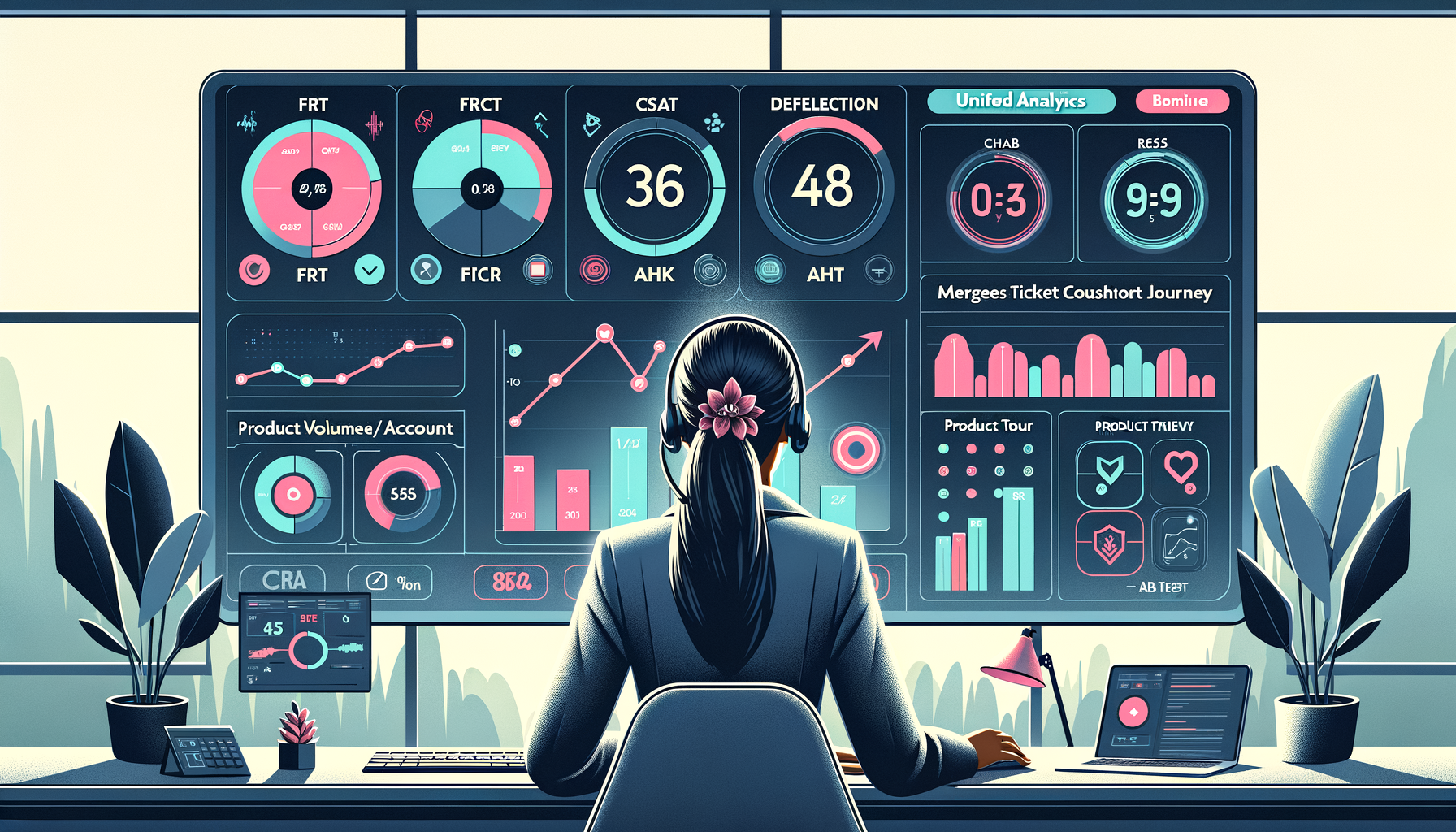
Crucially, we close the loop. When we release a fix or improvement, we notify affected customers and the agents who flagged the issue. We track downstream effects—ticket deflection, CSAT, feature adoption, and time-to-resolution—so everyone sees how customer support ai strategy accelerates product-led growth.
This approach also builds culture. Empowered product teams treat support as a strategic partner, not a cost center. Agents become co-creators of the roadmap, and PMs gain a steady stream of product discovery opportunities grounded in real user outcomes.
If you’re getting started, a simple 30-60-90 can help: in 30 days, unify the data and agree on taxonomy; in 60, instrument dashboards and adopt a weekly insights ritual; in 90, align priorities to OKRs, launch targeted fixes, and measure business impact. That’s how tickets turn into product truth—and how CX insights drive compounding wins.
Inspired by this post on Amplitude – Perspectives.
How do you help disadvantaged students take action on opportunities they don't even know exist? That question has been top of mind for me as I’ve explored how AI can augment—not replace—human mentorship. Recently, I dug into the work behind Zero Gravity, a UK-based platform using mentoring, community, and learning pathways to unlock elite career opportunities for state school students. Their approach reframed a core problem I care deeply about: the "knowing-doing gap."
I sat down with Elliot Little (Product Manager) and Dan St. Paul (Software Engineer) from Zero Gravity to unpack how they’re tackling this gap with an AI career co‑pilot. They’ve intentionally positioned the system as an orchestrator, not an automation tool—bridging the space between knowing what to do and actually doing it. As a product leader, I see this as a powerful pattern for Generative AI: use AI to coordinate steps, personalize guidance, and empower action in moments where confidence and clarity are fragile.
What resonated most was the humility of their build journey. They started with grand visions of AI mentors and synthetic avatars, then scaled back to something simpler and more effective. The first prototype—a job suitability summary—didn’t deliver the "wow moment" they expected. And they discovered that hiding the "LLM magic" backfired—students needed to feel the personalization. That insight aligns with my own experience: users must perceive the value for trust and motivation to compound.
From a UX standpoint, the team chose text chat over voice input and leaned into guided prompts rather than empty text boxes. That decision lowered cognitive load and increased completion rates—classic product management tradeoffs that privilege momentum over novelty. In my view, this is what good AI product strategy looks like: invite action with structure, then expand autonomy as confidence grows.
The technical backbone is equally thoughtful. Multi‑month journeys require rigorous context window management to avoid exploding token counts and degrading quality. I appreciated their pragmatic toolkit: context management techniques like removing stale tool calls, summarizing history, exposing tools conditionally. They also used application logic rather than complex RAG architectures to manage tool availability and context freshness. This is the kind of disciplined engineering that keeps systems reliable at scale without overcomplicating the stack.
Model selection was fit‑for‑purpose, not one‑size‑fits‑all. They’re using different models for different tasks, including "GPT-5 Nano for structured outputs, lighter models for quick replies." That modularity enables speed and cost control while preserving high‑fidelity moments where structure matters most.
Safeguarding was treated as a first‑class concern—non‑negotiable when you’re building AI for 16‑year‑olds. Their safeguarding architecture pairs moderation endpoints with external verification via Unitary. They also invested in building a failure taxonomy through internal red team/green team exercises. This is AI risk management done right: define failure modes early, test ruthlessly, and wire safety into the product surface area—not just the model layer.
Evaluation was grounded in outcomes, not demos. The team focused on whether students progressed from insight to action: applying, interviewing, and engaging with mentors. That aligns with how I run eval‑driven development—ship narrowly, measure real behavior, and iterate toward a repeatable "wow moment" that students can actually feel.
Looking ahead, I’m excited by what’s next: long‑term memory management for multi‑year student journeys. It’s a hard problem—balancing privacy, provenance, and portability—but it’s precisely where an AI career co‑pilot can compound value over time. The vision is compelling: a resilient companion that remembers goals, adapts to context, and orchestrates the right next step.
If you want to dive deeper, you can listen to the full conversation on Spotify and Apple Podcasts:
Listen to this episode on: Spotify | Apple Podcasts
Blue Dot Impact AI Safety Course – free AI safety course Elliot recommended: https://bluedot.org/
My key takeaways: build AI that augments human relationships, not replaces them; don’t hide the personalization—let learners feel it; privilege application logic over unnecessary architectural complexity; and treat safety, context, and evaluation as product features, not afterthoughts. That’s how we bridge the "knowing-doing gap" with integrity and scale.
I’ve sat in countless AI measurement debates and noticed a recurring gap. One major voice has been noticeably underrepresented in the AI measurement conversation: the product manager (PM) that’s leading development. From experience, PMs and developers do need different measurement tools—and making those differences explicit is exactly what speeds up decisions and improves outcomes.
Developers optimize the model and system layer. Their toolkit centers on eval-driven development: offline evals, regression suites, red-teaming, latency and throughput monitoring, token cost tracking, and hallucination rate reduction. On the delivery side, engineering teams watch DORA metrics alongside CI/CD performance to keep iteration fast and safe. When building LLM-backed experiences, they also care deeply about retrieval-first pipeline quality and context window management because those mechanics determine grounding, relevance, and consistency.
PMs, by contrast, own outcomes. We instrument user journeys end to end and define a clear north-star tied to value: activation, time-to-value, task success rate, retention analysis, support deflection, and revenue contribution. We rely on A/B testing frameworks and minimum detectable effect (MDE) planning to separate real impact from noise, and we consolidate behavioral signals in a unified analytics platform like Amplitude analytics and Pendo to understand adoption, friction, and cohort differences. This is the heart of product-led growth and continuous discovery: evidence, not anecdotes.
The fact that these toolboxes differ is a strength, not a weakness. Specialized metrics keep responsibilities crisp: developers guarantee model quality and reliability; PMs guarantee that quality translates into customer and business outcomes. What we need is an explicit metrics ladder that connects layers—model-level quality floors and SLOs, feature-level KPIs, and company-level results—so trade-offs are transparent and prioritization is principled.
In practice, I create a shared measurement contract for every AI initiative. It links eval sets to user-facing success criteria, defines acceptance thresholds, and spells out observability across the stack. We include governance from day one—AI risk management, privacy-by-design, and data governance—so we can scale responsibly without slowing teams down.
Here’s the AI product toolbox I give my teams: start with a concise value hypothesis; define a success rubric the customer would recognize; instrument the happy path and the failure path; plan experiments with MDE up front; segment results by persona and job-to-be-done; and close the loop with qualitative feedback inside the product via in-app guides, product tours, and lightweight surveys. For AI features specifically, add Agent Analytics for agentic AI, capture grounding sources for explainability, and log model/context inputs to make debugging and iteration repeatable. That way, LLMs for product managers stop being magic and start being manageable.
When we roll out a new assistant—whether a retrieval-augmented copilot or a voice AI agent—we set two dashboards: one for developers (eval pass rates, latency, context integrity, error budgets) and one for PMs (activation, task completion, deflection, satisfaction). The dashboards read differently by design, yet they are joined at the hip by shared definitions and experiment IDs. This lets us move quickly with confidence: engineering can tighten quality loops while product steers toward the outcome that matters most.
If you’re feeling the tension between model metrics and product metrics, don’t collapse them—connect them. Start with a thin slice, agree on 3–5 measurable outcomes, and let your evals and A/B tests work together. With a clear metrics ladder and a unified analytics platform, PMs and developers can each excel at their craft and still ship AI that customers love.
Buy-in isn’t a single meeting; it’s a designed journey. Over the years leading product strategy at HighLevel, I’ve learned that the fastest way to earn durable support is to reduce uncertainty, align on outcomes, and create visible momentum. Explore how to get buy-in from stakeholders with practical strategies, clear communication tips, and proven methods used by the best. Here’s the 7-step playbook my teams and I rely on to move from idea to aligned action.
Step 1 — Anchor on outcomes, not outputs. I start by writing a crisp problem statement, the target customer, and the measurable outcome tied to our North Star metric. I translate this into outcomes vs output OKRs so every stakeholder can see the difference between what we’ll ship and what we intend to change. This framing keeps discussions grounded in impact, not features.
Step 2 — Map stakeholders and incentives. Effective stakeholder management begins with a living map: economic buyers, executive sponsors, influencers, and operators. I capture each person’s goals, risks, and decision cadence. When I speak to Finance, I foreground cost and runway; with Sales, I emphasize pipeline and win rate; for Customer Success, I speak to retention and NPS. Meeting stakeholders where they are builds trust quickly.
Step 3 — Co-create early with the product trio. I pull the product trios (PM, Design, Engineering) into continuous discovery with GTM partners to validate assumptions and de-risk the solution. This is where empowered product teams shine—rapid discovery sprints, early prototypes, and clear learning objectives. Co-creating exposes blind spots early and transforms critics into champions.
Step 4 — Socialize a narrative, not a deck. Before any formal review, I circulate a short narrative memo that ties our product strategy to a clear value proposition, competitive differentiation, and go-to-market strategy. I include options and trade-offs so stakeholders feel invited to shape the path, not just stamp approval. Pre-wiring conversations ensure that the “meeting” is simply the last 10% of the decision.
Step 5 — Back the story with data and a viable plan. I combine retention analysis, funnel metrics, and customer evidence to demonstrate opportunity size and risk reduction. Then I outline a phased approach with product roadmapping and sprint planning, milestones, and success metrics. I highlight the smallest viable bet that proves value fast, along with contingency paths if we learn something unexpected.
Step 6 — Design the decision. I define the decision we need, by whom, and by when. The decision doc includes the problem, options, risks, mitigations, and the explicit ask. I schedule 1:1s to address concerns, then run a focused review with clear roles and time-boxed discussion. Clarity about the decision—and the criteria—prevents drift and protects timelines.
Step 7 — Sustain momentum post-approval. After the green light, I convert the plan into execution cadences: weekly demos, transparent dashboards, and QBRs vs OKRs check-ins to reinforce outcomes. We celebrate learning milestones, not just launches, and keep stakeholders informed with concise updates that tie progress to the original outcomes and value proposition. Momentum is the best antidote to second-guessing.
Clear communication and a repeatable process turn buy-in from a hurdle into a habit. When stakeholders see a compelling narrative, credible evidence, and a path to value, they don’t just approve—they advocate. Follow these seven steps and you’ll build alignment faster, ship smarter, and strengthen trust across the organization.