Products without borders are exhilarating—and unforgiving. In my role leading product strategy, I’ve learned that “global” isn’t a launch plan; it’s a system. It’s the discipline of creating one product vision that flexes to many markets without breaking the core experience, the roadmap, or the business.
Here’s what a Global Product Manager does, key skills, tools, challenges, and how to grow into this high-impact role.
At its heart, the Global Product Manager role orchestrates product-market fit in multiple regions simultaneously. I translate a unified value proposition into localized realities—aligning product positioning, go-to-market strategy, pricing and packaging, and compliance—while keeping the platform cohesive. That means partnering closely with product trios, regional leaders, sales, customer success, and marketing to drive outcomes vs output OKRs that actually move the business.
Operationally, I start with deep product discovery across segments and geographies: what pains are universal, and where do we need regional nuance? From there, I map points of parity we must maintain globally and the differentiators we’ll localize—copy, workflows, payments, support models, and integrations. The art is delivering a consistent core with flexible edges so we can scale without fragmenting the codebase or the customer experience.
Trust is the non-negotiable. I build privacy-by-design into the product and roadmap, and I collaborate early with legal and security on data governance, data residency, and evolving regulations like GDPR. The right guardrails reduce rework later and enable faster regional launches—because compliance is a feature customers feel, even when they don’t see it.
On the commercial side, I partner on consumption SaaS pricing, product-led growth motions, and country-level market entry. Some markets need lighter onboarding and in-app guides; others demand concierge support or partner-led distribution. I use retention analysis to identify fit and inform sequencing, then adjust messaging and activation flows to shorten time-to-value and improve user activation by region.
My analytics and enablement stack is intentionally boring—and ruthlessly consistent. A unified analytics platform with Amplitude analytics gives us comparable funnels across countries. For experimentation, I run A/B testing with a clear minimum detectable effect (MDE) and disciplined rollout plans. Pendo powers product tours and in-app guides tailored by locale, while Intercom and CRM integration with HubSpot help me close the loop with GTM and support teams. The outcome is a learning system, not just a dashboard.
The hardest part isn’t translation—it’s alignment. Time zones, competing priorities, and matrixed ownership test even strong cultures. I rely on stakeholder management, crisp decision records, and product roadmapping and sprint planning rituals that respect regional input without derailing the global plan. When tension rises, I return to first principles decision making and the try do consider framework to make trade-offs transparent and repeatable.
If you’re growing into this role, start by owning a multi-region initiative end to end: lead localization for a critical workflow, run market-specific A/B testing with clear MDE, and publish a country launch plan that ties discovery insights to OKRs and resourcing. Build your credibility by shipping outcomes, not artifacts—then scale your impact by mentoring peers and creating shared templates for pricing, positioning, and experimentation. That’s how you shift from capable PM to trusted global operator.
Ultimately, a Global Product Manager is a force multiplier. We reduce complexity for the organization while increasing resonance for customers. If “products without borders” is your mandate, build the systems—analytics, governance, enablement, and decision-making—that make borderless execution reliable, repeatable, and fast.
I’ve seen what happens when talented teams drift into silos: priorities splinter, timelines slip, and what looks like progress turns out to be motion without momentum. My job is to turn those walls into bridges—aligning product, engineering, design, and go-to-market around outcomes that matter to customers and the business.
For siloed teams, walls go up, and unnecessary work gets done. Learn the signs, the damage, and the way to break free from the illusion of work.
The signs show up early if you know where to look: duplicated efforts across squads, decision-making that bounces between functions, roadmap debates grounded in opinions rather than data, and “busy” sprints that ship outputs without measurable outcomes. These are classic stakeholder management breakdowns, often masked by perfect decks and full calendars.
The damage is real. Customers feel friction and inconsistency, product-market fit signals get missed, and we over-invest in features that don’t drive user activation or retention. Morale takes a hit as teams lose the thread of purpose. That’s the “illusion of work” in action—activity that crowds out impact.
Here’s how I build bridges. First, I organize around empowered product teams and product trios (product, design, engineering) who own customer outcomes, not just velocity. We practice first principles decision making, write decisions down, and align early with adjacent functions so there are no surprises when we move from product discovery to delivery.
Second, I anchor planning in outcomes vs output OKRs. We commit to a small set of measurable outcomes, then use QBRs vs OKRs cadences to inspect progress, cut scope that doesn’t move the needle, and recalibrate with clarity. This shifts the conversation from “What did we ship?” to “What changed for customers and the business?”
Third, I make impact measurable and visible. We instrument the funnel end to end, define a minimum detectable effect (MDE) for experiments, and use A/B testing to de-risk bets before we scale them. A unified analytics platform—with Amplitude analytics, Pendo, Intercom, and HubSpot tied back to our CRM integration—keeps everyone looking at the same truth so we can diagnose what’s working and what’s noise.
Fourth, I bring collaboration into the core rituals: transparent product roadmapping and sprint planning, weekly cross-functional reviews, and fast, lightweight artifacts that clarify hypotheses, success metrics, and trade-offs. By the time we launch, stakeholders already understand the why, the how, and the expected impact.
If parts of your organization feel stuck, start small: pick one shared outcome, form a cross-functional trio, define your leading indicators, and run one experiment with clear MDE and a two-week readout. The momentum you create will turn walls into bridges—and busywork into business results.
I’m excited to share that we’re opening our next R&D hub in Berlin to support significant investment in our AI customer service platform, Intercom, and market-leading AI Agent, Fin. We intend to hire 100 people in Berlin over the year ahead across engineering, AI, data science, product, and design. This move reflects our AI Strategy, our commitment to product management leadership, and our focus on building enduring product-led growth.
We believe that in a short number of years, the vast majority of customer service will be done by AI. Fin is already the world’s best Customer Service Agent. At Pioneer, our recent summit for AI customer service leaders in NYC, we talked about how Fin will become a true end-to-end Customer Agent, extending far beyond service. We showcased how companies like WHOOP, Anthropic, and Lightspeed are already pushing Fin in ways that help them grow their business.
This market opportunity is massive and expanding at unprecedented pace. Our ambition is to earn our place as one of the most successful AI businesses during this wave of AI disruption, and we want more brilliant people on our team to pursue this as aggressively as possible. If you’re motivated by Generative AI, LLMs, and building real products that scale, you’ll find both challenge and impact here.
We are already on track to be one of the fastest growing private software companies. Fin is the primary contributor to this, and is months away from passing $100m in ARR. So far, more than 7000 businesses have transformed their customer service with Fin, including German companies like electricity provider Ostrom, smart home technology provider tado°, and grocery delivery company Flink, along with global leaders like Vanta, Clay, Lovable, and Miro.
Why Berlin? We’re drawn to the city’s rare blend of deep technical talent and rich creative culture—within a vibrant, globally connected ecosystem close to our R&D hubs in Dublin and London. It’s a place where top-tier engineers and designers thrive, and where ambitious builders from around the world want to relocate and create category-defining products.
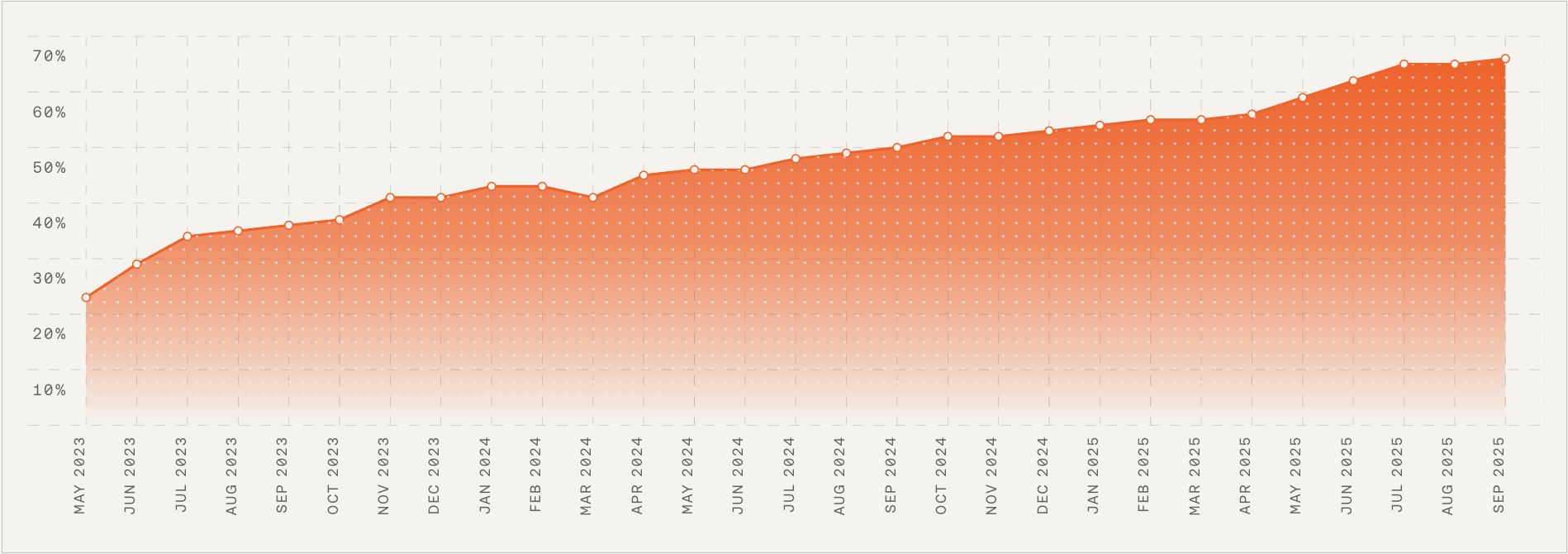
Momentum is building: this month-by-month chart shows a consistent rise from the mid-20s to nearly 70% between May 2023 and Sep 2025—signaling strong progress as we expand engineering, AI, and automation at our new Berlin R&D hub.
We needed a new location that would sustain the high ambition and standards held by our world-class AI teams in Dublin and London. Berlin has emerged as one of Europe’s hottest centers for AI talent, with a high density of AI-focused startups, applied research labs, and practitioners who bring exceptional literacy, optimism, and ambition. It’s the right accelerator for our AI hiring and a place to bring in brilliant minds to shape the future of our product and business.
While Intercom’s reach is global with our headquarters in San Francisco, our R&D leadership remains anchored in Dublin, where half of the executive team sits—making Berlin both geographically and strategically an ideal next location for our growth.
This isn’t our first time expanding our footprint; we previously bet on London and are delighted with how that’s been working. When we shared our Berlin news internally, the energy was palpable, with many teammates volunteering to help spin up the hub successfully—including colleagues who helped make London a big success, like Danny. That level of ownership and momentum is exactly what we aim to cultivate in Berlin.
We’re looking for people who thrive in a high-intensity, high-ambition, high-standards environment and want to help build one of the world’s best AI companies. For builders like that, the opportunity for impact, growth, and career progression is extraordinary. As with London and Dublin before it, the early Berlin cohort will have a disproportionate influence on team norms, culture, and long-term outcomes. We are in the middle of a huge disruptive wave with AI, and Fin is one of the leading examples of commercially successful AI applications. Joining Intercom is an opportunity to be part of this disruptive wave, and help us build out our vision for Fin becoming the world’s best Customer Agent.
On a minimalist stage, four speakers share insights on AI research, automation, and engineering as part of a panel tied to Berlin expansion and the launch of a new European R&D hub.
There are plenty of AI companies to join, but our technology and culture set us apart. Any AI product is only as good as the AI layer powering it. Ours is industry-leading, built by a highly talented, ambitious, and technical team of over 40 machine learning scientists, engineers, and designers in Europe who continuously optimize Fin’s performance through cutting-edge research, experimentation, and innovation. Fin’s average resolution rate increases 1% every month. That kind of steady, compounding improvement is exactly what great customer support AI strategy looks like in practice.
We also build in public and share our progress and learnings with the AI community at large. Recently, our Chief AI Officer Fergal Reid and SVP of Engineering Jordan Neill joined leaders from Cognition, Harvey, and Perplexity in San Francisco to share real lessons, challenges, and breakthroughs from building frontier AI products. Our AI team regularly publishes their insights on the AI research blog; from optimizing inference speed and availability, to building our own proprietary models that outperform general purpose models for CX.
Our AI group and the broader R&D org they operate within work at extraordinary scale and speed. We recognize that moving fast can’t be taken for granted—you must fight for it—and we’re doing just that, embracing the capabilities AI tooling brings us to achieve 2x the throughput. One example of this mindset in practice is us “Betting on the future of frontend at Intercom,” making a technology choice that optimizes for our teams’ ability to build high-quality product, fast.
Our design and product teams are world-class and forward-thinking; they’re embracing AI to evolve how they work, as shared in our 3-point framework for AI-driven design and recently presented by Emmet Connolly, our SVP of Design, at this year’s Hatch conference in Berlin. As a product leader, I’m grateful to work alongside brilliant product and design thinkers—it gives me confidence that we’re solving the right problems, solving them well, and driving real impact.
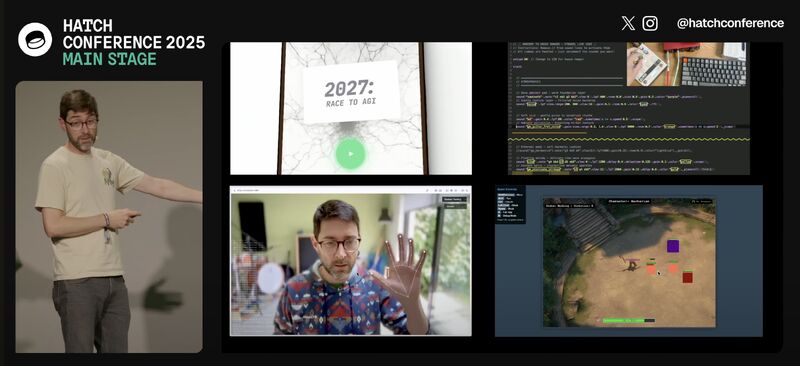
From live demos to hands-on coding, this snapshot captures the momentum we're bringing to our Berlin R&D hub – AI experiments, hand-tracking prototypes, and simulation tools powering our next wave of engineering.
We plan to open our Berlin office space in December or January. To get the office started, we’re hiring Senior Product Engineers, Machine Learning Scientists, Product Managers, Senior Product Designers, Engineering Managers, and Data Scientists immediately. If your craft sits at the intersection of LLMs for product managers, agentic AI, and empowered product teams, you’ll be right at home.
You can learn more about our open roles, company, culture, and locations on our careers site, or feel free to reach out to me, Jordan, Fergal, or Brian directly on LinkedIn if you have any questions.
Some of our engineering team will also be at LeadDev Berlin on November 3rd—come say hi if you’re attending.
I’m looking forward to continuing to build Intercom as one of our generation’s best AI companies—and I’m excited for our expansion into Berlin to be a major contribution to that success.
Context is king in AI-powered product work—and I felt that deeply while digging into “Context is King – All Things Product Podcast with Teresa Torres & Petra Wille.” The conversation affirmed a truth I see daily: AI becomes a powerful teammate only when we give it the right context, just as we do with empowered product teams. When we treat AI like a colleague joining mid-flight—without our company history, industry nuances, or strategy—we instantly unlock better outcomes.
Listen to this episode on: Spotify | Apple Podcasts
Here’s what stood out and how I’m applying it. First, most AI outputs fail without proper context. That’s not a model problem; it’s a leadership problem. Thinking of AI like onboarding a new intern is the right mental model—start with the minimum viable context, then iterate. Practical first steps matter: decision logs, clear success metrics, and structured documentation. The art is balancing enough context to guide performance without overloading the system. The parallels are striking: the way we create strategic context for product trios and teams is the same way we’ll empower agentic AI systems.
In my teams, we prepare for AI collaboration by operationalizing context. We keep decision logs to capture the why behind choices, use outcome-based success metrics (not just output), and maintain machine-readable documentation that LLMs for product managers can parse reliably. We define guardrails up front—constraints, customer segments, privacy-by-design considerations, and the non-goals that often trip up gen ai. This foundation turns AI from a novelty into a force multiplier for product discovery and product roadmapping and sprint planning.
I use a simple “context pack” to onboard AI agents and teammates alike: 1) business goals and outcomes, 2) constraints and guardrails, 3) canonical artifacts (like PRDs, journey maps, interview notes), 4) domain vocabulary and definitions, and 5) operating procedures (how we make decisions, when to escalate, what good looks like). Start small, then refine as the AI demonstrates capability. This mirrors great onboarding—and it works just as well for agentic AI as it does for humans.
Not all context is helpful. More isn’t better; the minimum effective context is. I resist the urge to dump our entire Confluence on an AI system. Instead, I progressively reveal relevant details—just like I would with a new PM on a complex problem space. This keeps signals high, noise low, and performance measurable against clear success metrics.
If your org isn’t adopting AI yet, don’t wait. You can become AI-ready now by documenting strategic intent, decision rationale, and definitions in structured, searchable, machine-readable ways. Treat this as core AI Strategy work that strengthens empowered product teams—regardless of tooling—while building your AI product toolbox for tomorrow.
For those who want to explore further, these resources and mentions are a strong complement to the episode’s themes.
Follow Teresa Torres: https://ProductTalk.org
Follow Petra Wille: https://Petra-Wille.com
Agentic AI
Teresa’s new podcast, Just Now Possible in Youtube, Apple Podcast, and Spotify
Petra’s Coaching Packages
ChatGPT
Henrik Kniberg’s talk at Product at Heart on treating AI agents like interns
Teresa’s webinars on how she built the Product Talk Interview Coach: Behind the Scenes: Building the Product Talk Interview Coach and How I Designed & Implemented Evals for Product Talk’s Interview Coach
Josh Seiden’s blog series about AI
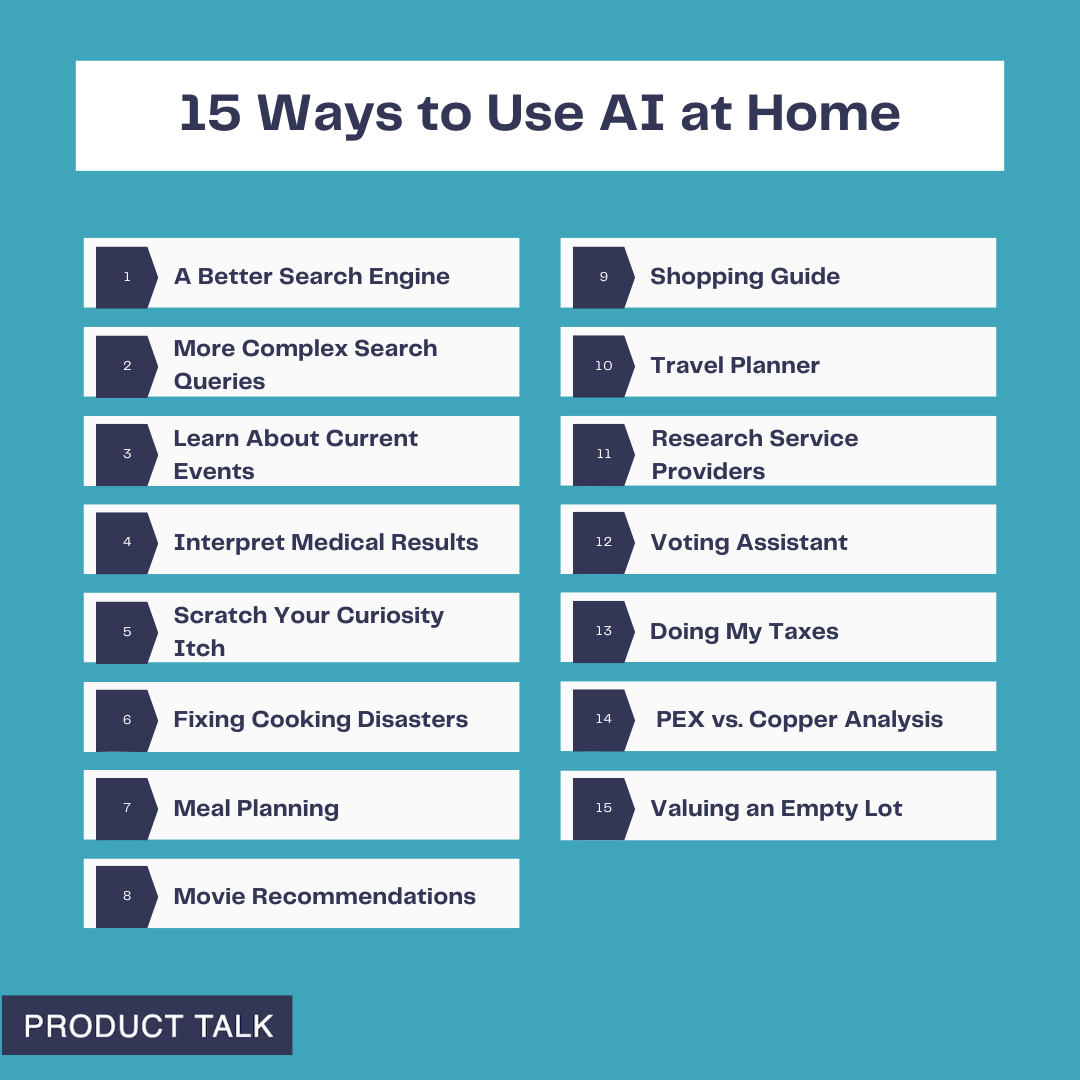
Teresa’s new blog posts: 15 Ways to Use AI at Home (and Fill Your AI Product Toolbox) and 21 Ways to Use AI at Work (And Build Your AI Product Toolbox)
Petra's new blog post: Why Context, Not Just Data, Will Define AI-Ready Product Teams
Have thoughts on this episode or how you’re preparing your teams to collaborate with AI? Leave a comment below—let’s compare playbooks and level up together.
Digital transformation rewired our systems; AI transformation rewires how we learn, decide, and compete. “AI transformation goes beyond automation to create adaptive, intelligent organizations. Discover why it’s the next imperative and how to measure success.” That statement captures what I experience daily: we’re moving from scripted workflows to living systems that improve with every interaction.
When I talk about AI transformation, I’m not describing a tool rollout. I’m describing an operating model where data, models, and product strategy converge to create compounding advantage. In practice, that means agentic AI orchestrating tasks, robust data governance and privacy-by-design from day one, and empowered product teams that ship, measure, and iterate at high tempo.
The imperative is strategic, not merely technical. Markets are compressing cycle times, and customers now expect intelligent experiences by default. Organizations that master AI Strategy and product-led growth will set the pace—using AI for competitive differentiation rather than feature parity.
This shift changes how I build teams and backlogs. I lean on product trios, forward deployed engineers, and tight product discovery loops to reduce uncertainty early. We design for resilience and learning: human-in-the-loop feedback, clear escalation paths, and telemetry that turns every interaction into a hypothesis test.
Governance is a first-class feature. AI risk management, data governance, and threat detection and response sit alongside performance metrics in the same dashboard. We codify guardrails—policy, provenance, and permissions—so innovation scales safely and sustainably.
Measurement is where transformation becomes real. I anchor on outcomes vs output OKRs tied to customer value and revenue impact. At the product layer, I track activation, time-to-value, retention, and adoption by persona. For ML quality, I monitor precision/recall, coverage, hallucination rate, and model drift. In experimentation, A/B testing with a thoughtful minimum detectable effect (MDE) prevents false wins, while Amplitude analytics, Pendo, and Intercom instrumentation expose where guidance or UX writing can unlock activation.
The fastest wins often start in service and sales. A customer support ai strategy can deflect tickets with high-resolution answers while escalating edge cases to humans with full context. CRM integration with HubSpot and a ChatGPT connector enables reps to generate next-best-actions, summarize calls, and personalize outreach—measurably lifting conversion and lowering cost-to-serve.
On the build side, LLMs for product managers and gen ai for product prototyping accelerate discovery cycles. I use CustomGPT workflows to validate value propositions quickly, then harden successful flows with engineering. Throughout, product positioning and a crisp value proposition ensure that what we ship is understandable, differentiated, and priced to match ROI—consumption SaaS pricing when usage scales value.
If you’re getting started, begin with a single, high-frequency journey, instrument it deeply, and publish transparent OKRs. Pair empowered product teams with clear governance, and iterate toward agentic AI experiences. The payoff isn’t a one-time launch; it’s a continuously learning system—and a culture—that compounds advantage release after release.
AI overwhelm is real. Whether you’re a complete novice who isn’t sure where to begin or you’re deep into building AI features, it can feel like everyone else is light years ahead. The hype is loud, adoption is exploding, and it’s easy to assume you’re already behind. Take a breath—you have more time than the headlines suggest.
Here’s how I approach it: start with simple, low-stakes use cases you can do today. Then add a little complexity at a time. With each step, you’ll pick up a new capability—prompting, structuring context, decomposing tasks, and eventually automating workflows. Before long, you’ll be designing your own use cases and systems. And if you’re being asked to deliver AI products yesterday, the same skills will make you a more confident builder when it’s time to ship.
Start small, build fast. Every time you try an AI tool at home—whether for planning meals, organizing tasks, or learning—you're adding a new skill to your product toolbox and unlocking more ways to create.
My journey from AI consumer to AI builder started with ChatGPT. I used it like a cleaner, faster search engine—and appreciated the lack of ads. Very quickly, my questions got more complex. I began using it for day-to-day problem-solving and task execution. Through experimentation, I learned how to give the right context, what worked and what didn’t, how to use persistent memory, and how to conduct deep research. That hands-on tinkering began to influence my roadmap. In my role leading product, those experiments sparked prototypes that translated directly into features and workflows we could ship.
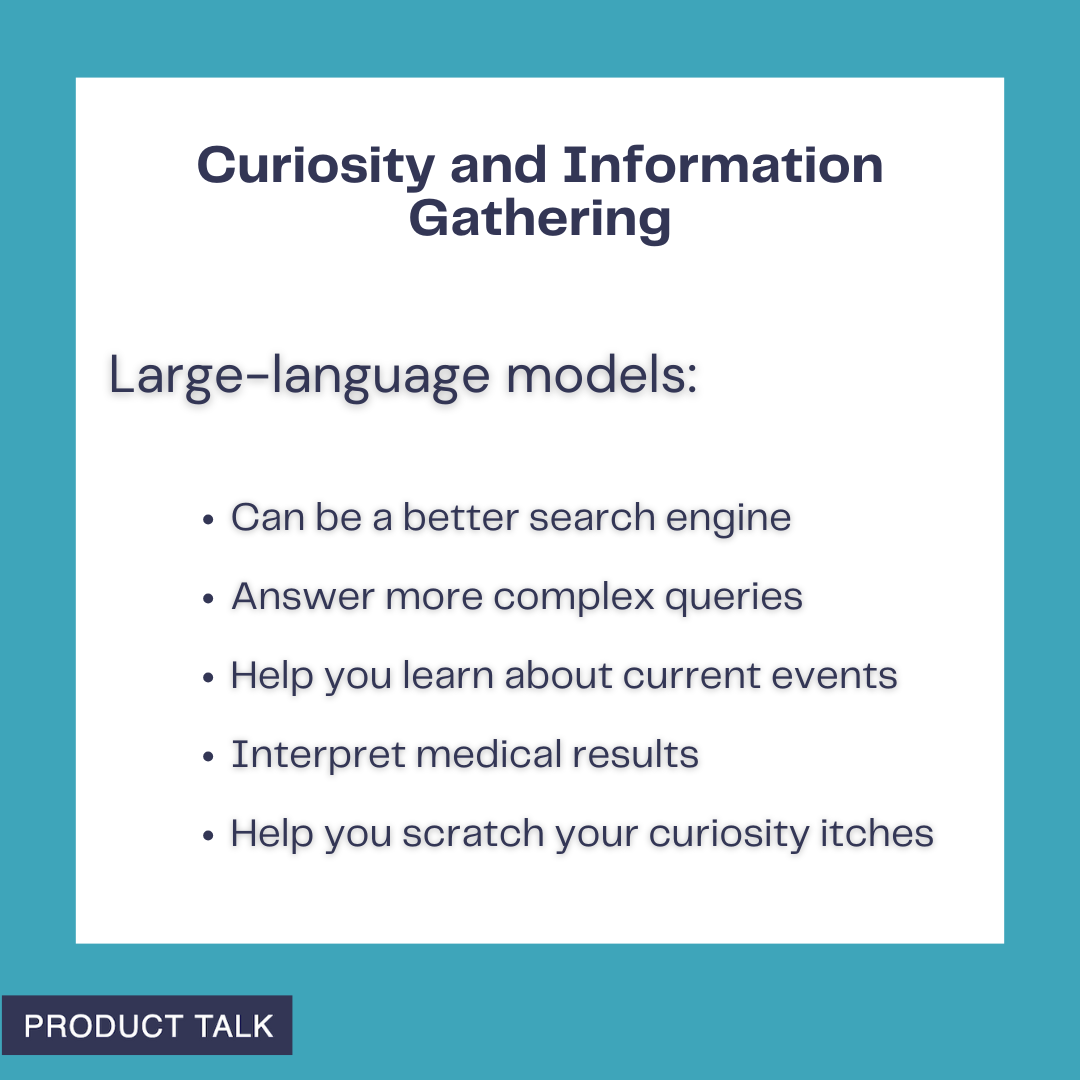
From 15 Ways to Use AI at Home: see how large-language models turbocharge information gathering—work as smarter search, tackle complex questions, explain medical results, and keep you informed about current events.
You can follow the same path. Start small. Pick something tedious or annoying. Ask ChatGPT, Claude, or Gemini for help. When you have a prompt that works, try to automate it. If automation is new to you, tools like Zapier, Make, or n8n are a great starting point—and your company might already use them. You’ll make everyday life easier while building the exact skills that underpin modern AI product work: prompt engineering (giving the right context), task decomposition, and multi-step workflows.
Turn everyday curiosity into answers. This prompt-style graphic shows how AI can quickly check civic data, like the age makeup of the US Senate, helping you build a practical, at-home AI toolbox.
To help you get started, here are the personal use cases that built my AI muscles at home, ordered from simple to more advanced. I group them into three buckets: Curiosity and Information Gathering, Everyday Life, and Deep Research. Start at the top and move down as your confidence grows.
Curiosity drives everyday learning at home. This Product Talk quote card shows someone seeking answers about the Middle East—illustrating how generative AI can support research, summaries, and safe, guided exploration.
Curiosity and Information Gathering is where large language models really shine. They’ve been trained on large portions of the internet as well as thousands of books and other resources. Here’s how I put them to work.
Use AI wisely at home: let LLMs help you prepare for appointments—organize symptoms, draft questions, and summarize records—but never treat them as a replacement for professional medical care.
1. A Better Search Engine. I rarely Google things anymore. I ask ChatGPT and get faster answers without the noise. I still use it for simple queries like: “Can my dog eat this?”, “Can I slow peaches from ripening if I put them in the fridge?”, “Does oatmeal go bad?”, “Can my dog be off-leash at Todd Lake?”, and “What’s a good coleslaw recipe that isn’t sweet or too mayonnaise-y?” If you’re brand-new to AI, this is the perfect on-ramp. You’ll get comfortable chatting with LLMs and quickly overcome the “What do I use this for?” hurdle.
A minimalist quote card captures an everyday question—how big a tractor to buy—showing how AI can turn casual curiosity into smart guidance for home projects, purchases, and product research.
2. More Complex Search Queries. The real power shows up when your question needs reasoning or synthesis. I recently wondered how many US Senators are over 75. Google returned lists of all 100 senators; I’d still have to count. ChatGPT gave me the answer immediately—there are 10 US Senators over the age of 75—listed each one, cited Axios, and offered another way to cross-check. That was more than good enough for my purpose and a great reminder of what LLMs can do better than search engines.
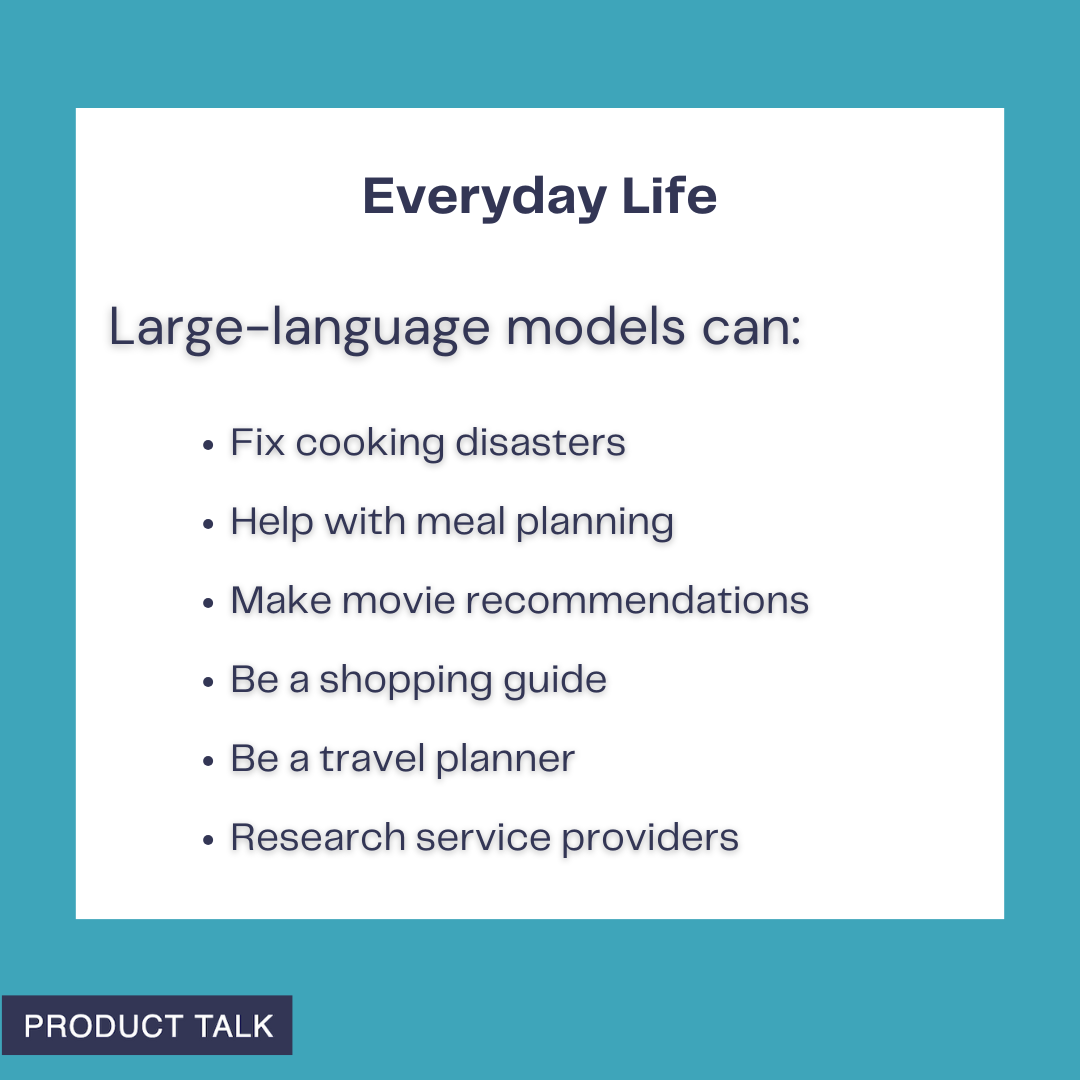
From kitchen fixes to trip planning, generative AI can streamline daily decisions. This Everyday Life graphic spotlights how large-language models support meals, movies, shopping, travel, and finding trusted service providers.
3. Learn About Current Events. When Hamas attacked Israel on October 7, 2023, I had a lot of questions—some I felt I should already know. I used ChatGPT to explore the region’s history, the etymology of “anti-Semitism,” and the context around Hamas, Hezbollah, and Jordan. It was empowering—and it also made me more vigilant about bias and hallucinations. I asked for sources, spent time on Wikipedia, and triangulated with trusted outlets. Now, I routinely use LLMs as a starting point to frame questions and then verify. You’ll learn to explore new topics while staying mindful of bias and accuracy.
From meal planning to DIY fixes, this quote shows how ChatGPT becomes your go-to helper. Explore practical, at-home ways to use generative AI and build a product toolbox you’ll actually rely on.
4. Interpret Medical Results. Medicine is full of information asymmetry. I use LLMs to prepare for appointments so I can ask better questions. After an ankle surgery, I read my operative notes and saw a ligament repair described as “secondary.” I pasted the entire report into ChatGPT and asked for an explanation. I learned that a secondary repair indicates an old tear—not the current injury. I dug into common repair types and their trade-offs, which helped me have a more productive follow-up with my surgeon. When bloodwork flags an out-of-range value, I ask ChatGPT to explain potential implications. I once tested high for bilirubin; both ChatGPT and my doctor explained that I likely have Gilbert’s Syndrome—a benign genetic variant that explains easy bruising and isn’t a concern. I never use LLMs in place of seeing a qualified medical practitioner, but they’re excellent preparation tools.
Context powers useful AI at home. This clean quote graphic underscores that adding goals, constraints, and examples leads to smarter assistants and a stronger AI product toolbox for everyday tasks.
5. Scratch Your Curiosity Itch. Once you’re comfortable, let LLMs become your curiosity engine. My husband dreams of building a trials course in our yard and wondered what size tractor could move a “4' x 2' x 2'” rock. ChatGPT asked about rock type, then reasoned: Central Oregon has basalt; basalt’s density is X; the estimated weight for a 4' x 2' x 2' basalt rock is Y; therefore, you need a tractor that can lift Z pounds; here are some models that meet your specs. We won’t be buying a tractor—but it was a fun, fast way to learn. Any time a question blends information and reasoning, an LLM can be a great copilot.
Personalization should get smarter over time—not forget you. This quote kicks off our 15 Ways to Use AI at Home series, highlighting how to diagnose drifting models and keep preferences front and center.
Everyday Life is where LLMs move from interesting to indispensable. I rely on them as all-purpose problem solvers.
Kickstart your home AI experiments by asking ChatGPT to define clear criteria for tasks and tools. With a simple prompt, you can compare options, set priorities, and grow a practical AI product toolbox.
6. Fixing Cooking Disasters. One night, I cooked rice with the wrong ratio—twice the water for half the rice—and ended up with a pot of soup. ChatGPT gave me three ways to salvage it. The first approach worked well enough to save dinner. I regularly ask for ingredient substitutions mid-recipe, fresh ideas for dinner, and tweaks to avoid dietary triggers. The more you throw at it, the faster you’ll learn what LLMs are great at (and where they stumble) and you’ll build the habit of turning to them first.
Clear prompts power better AI. This quote from our Product Talk series reminds us: add context to your requests or expect generic results. Use it as a rule of thumb for home AI tasks and experiments.
7. Meal Planning. I use ChatGPT to plan meals in a few ways: starting with what’s in the fridge, asking for a week’s worth of meals based on preferences, and, most often, requesting creative ideas when we’re bored with our rotation. The key is context. Allergies, likes and dislikes, what you’ve eaten lately, and any dietary framework all improve the suggestions. This is a perfect sandbox for practicing how to provide the right context to get high-quality output.
AI can take on the heavy lifting so you can focus on life. Discover 15 practical ways to use ChatGPT at home—from planning and chores to learning and creativity—plus tips to grow your AI product toolbox.
8. Movie Recommendations. The second hardest daily decision in my house—after dinner—is what to watch. We began with a ChatGPT thread where I listed our likes and dislikes with examples. It recommended a short list with synopses, we asked clarifying questions, picked a film, and enjoyed it. Over months, the recs got stale—ChatGPT started suggesting titles I had already rejected. That was my first brush with a context window limit. I moved to a Claude Project and added three documents: our preferences, movies we liked, and movies we didn’t. Recommendations improved dramatically. The hit rate is now much higher than the miss rate. The same setup works for TV, music, or books. Along the way, you’ll learn about context window limits, how examples improve quality (few-shot or n-shot prompting), using persistent state/memory, and iterative refinement.
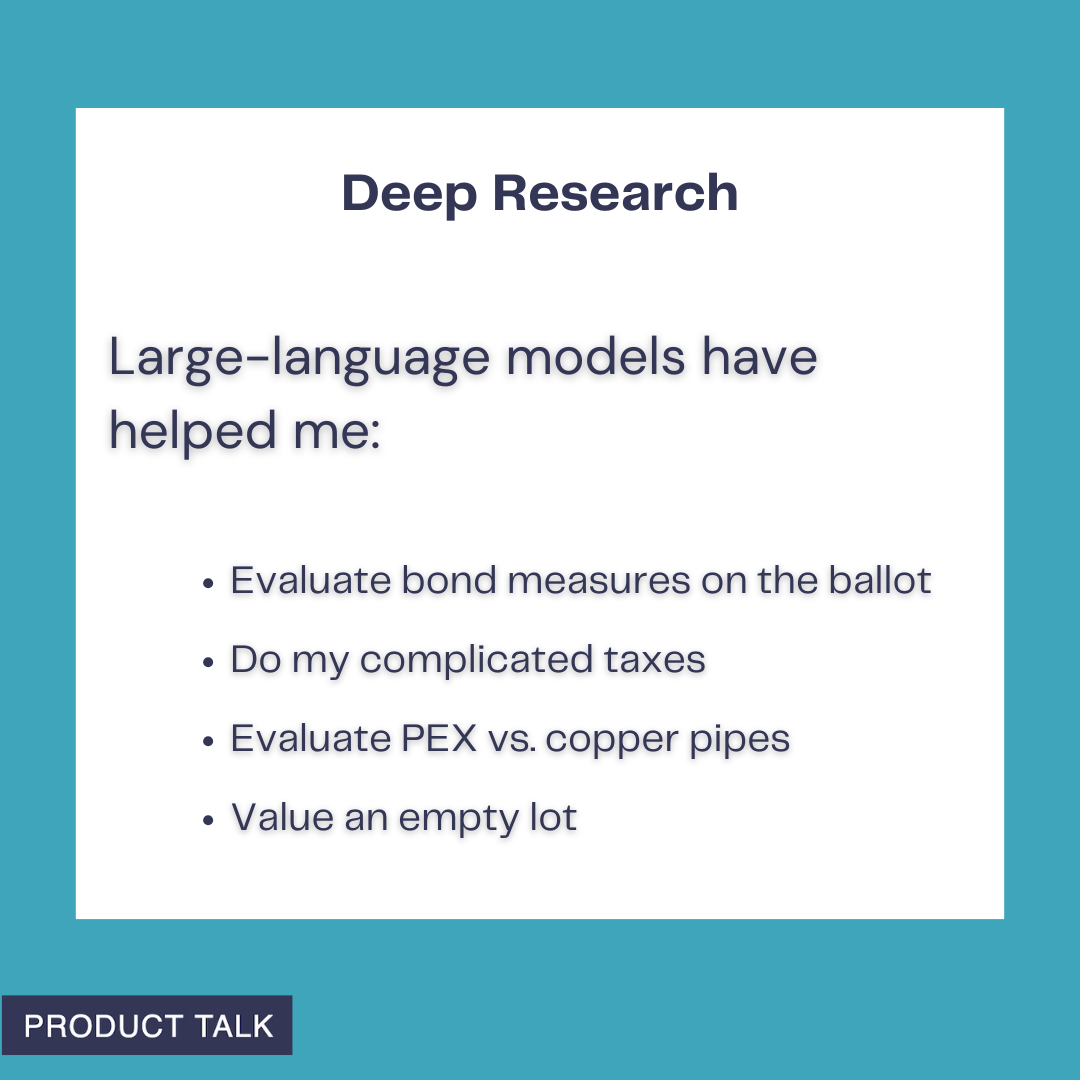
Deep Research with LLMs: from civic choices to home projects, AI helps evaluate bond measures, untangle complex taxes, compare PEX versus copper pipes, and estimate the value of an empty lot—everyday, practical wins.
9. Shopping Guide. Sometimes I outsource the whole decision; other times I use LLMs to structure criteria and compare options. I needed a new webcam without autofocus issues, explained my use cases (calls, webinars, talks, recorded video), and prioritized picture quality. ChatGPT suggested three options; I asked a few follow-ups, picked one, and was done in under ten minutes. In another case, we adopted a picky border collie/pit bull mix and wanted to level-up her food. We got overwhelmed between better kibble, fresh food, grain-free choices, and countless permutations. ChatGPT helped us define criteria, including several vet ratings that reflect nutritional balance and sustainability—both important to us. Then it generated a detailed comparison grid for top kibble and top fresh options. What felt impossible became tractable. You get to decide how much autonomy to give the LLM—pick for you, or inform your choice. Both add value.
10. Travel Planner. For the inaugural Product at Heart conference in Germany, we turned the trip into three weeks of exploring. Our shortlist included biking through wine country, visiting friends in Munich, spending time on Lake Constance, and, of course, Hamburg. I spent weeks researching and then realized I could ask ChatGPT; it compiled the core options in minutes. More recently, we needed a beachside, high-end resort near Del Mar and San Marcos for family visits, with active surf for my husband. After sifting through dated hotels, I was ready to give up. ChatGPT suggested the Alila Marea Beach Resort in Encinitas. The location was perfect, the resort delivered, the surf worked, and we booked with points. If you don’t provide context, you’ll get generic suggestions—so let the LLM interview you to surface your implicit preferences and constraints.
11. Research Service Providers. I procrastinate on chores like finding contractors. Selling our Portland townhouse forced my hand: I needed movers and someone to stretch and re-tack carpet, on a tight timeline. I asked ChatGPT for a short list of providers with strong reviews, reliable communication, and good punctuality. It then offered to draft an email—yes, please—which included questions I wouldn’t have thought of (“Do you use a power stretcher?” “Do you guarantee your work?”) and listed contact info for each. For movers, I needed a long-distance crew (three hours over a mountain pass) that could also move a hot tub. After striking out, I told ChatGPT what went wrong; it refined the search and found companies that specifically handle heavy items. I got quotes and booked the move. Having a coach that does the heavy lifting is a game-changer. If an LLM misses, tell it why and ask it to try again.
Deep Research is where LLMs become indispensable. These are the projects I wouldn’t tackle without one: being a more informed voter—including using an LLM to build a detailed model of my school district’s expenses to better evaluate a bond measure; filing both an S-corp return and a fairly complex personal tax return, and why I chose that route instead of continuing to work with my tax accountant; evaluating PEX vs. copper for a plumbing repipe when two well-respected plumbers argued opposite sides; and pricing an empty lot next door to evaluate whether it was a good purchase for us (later validated when the listing hit the market at the high end of ChatGPT’s range).
The meta-skill across all of these is partnering with LLMs: define the job to be done, supply crisp context, iterate, verify with sources when needed, and automate when a workflow stabilizes. Do that, and by the time you’re ready to build your first AI product, your toolbox will already be half full.