I recently dug into a conversation with Marco Zappacosta, co-founder and CEO of Thumbtack, who has spent the last 13 years building the company into a billion-dollar business — and it’s his first and only job after graduating college. As someone who lives at the intersection of product management leadership and company-building, I was struck by how deliberately he navigates the deluge of advice that comes with being a first-time founder.
What resonated most was the way he differentiates between moments that demand a return to first principles and those that benefit from a tested playbook. In my own practice, I’ve found that product strategy and organizational design often require first-principles thinking, while operational cadence and execution rituals tend to scale best with proven patterns. The key is recognizing which game you’re playing — invention versus optimization — and applying the right mental models to filter input without losing velocity.
Marco’s approach to parsing counsel as a first-time CEO is refreshingly pragmatic. Rather than treating advice as binary, he triangulates from multiple data points, looks for invariants, and pressure-tests assumptions against the company’s unique context. I use a similar lens: anchor on the problem, map potential solutions to risk/return, and calibrate decisions with base rates where possible. It’s a disciplined way to turn a mountain of opinion into actionable signal — especially when stakes are high.
He also connects this discipline to stakeholder management, particularly in how he runs Thumbtack’s board so quarterly meetings become a critical resource, not just a time suck — and why he shares the board deck with the entire company. I’ve found this level of transparency to be a force multiplier: it aligns teams on priorities, elevates product roadmapping and sprint planning, and empowers leaders to make trade-offs with clarity. When the narrative is shared, accountability scales.
Marco candidly reflects on Thumbtack’s COVID-related layoff last year, and what he specifically did as CEO to ensure the folks who remained still had confidence in the company and his leadership moving forward. In hard moments like these, consistent communication, explicit prioritization, and a clear framework for decision-making matter more than ever. Trust is built by showing your work — why choices were made, what changes now, and how success will be measured.
Finally, he opens up his playbook for choosing what to spend his time on as a busy CEO with only so many hours in the day — and perhaps more importantly, how he stays accountable for these priorities. I’ve learned to pair outcome-oriented OKRs with a ruthless weekly schedule audit: if the calendar doesn’t reflect the strategy, the strategy won’t happen. This discipline creates focus, accelerates learning loops, and keeps leaders from becoming the bottleneck.
For builders at any growth stage, there’s a powerful takeaway here: cultivate a repeatable way to distill advice, clarify when to use first principles versus a playbook, operationalize board relationships as strategic assets, and turn time into your sharpest instrument. The result is a more resilient company — and a leadership practice that compounds.
AI has changed the tempo of product management, but not the timeless fundamentals. I’m living that paradox daily: the technology reshapes how we plan, build, and ship—yet the way we find real customer value hasn’t budged. Here’s how I reconcile both truths in practice.
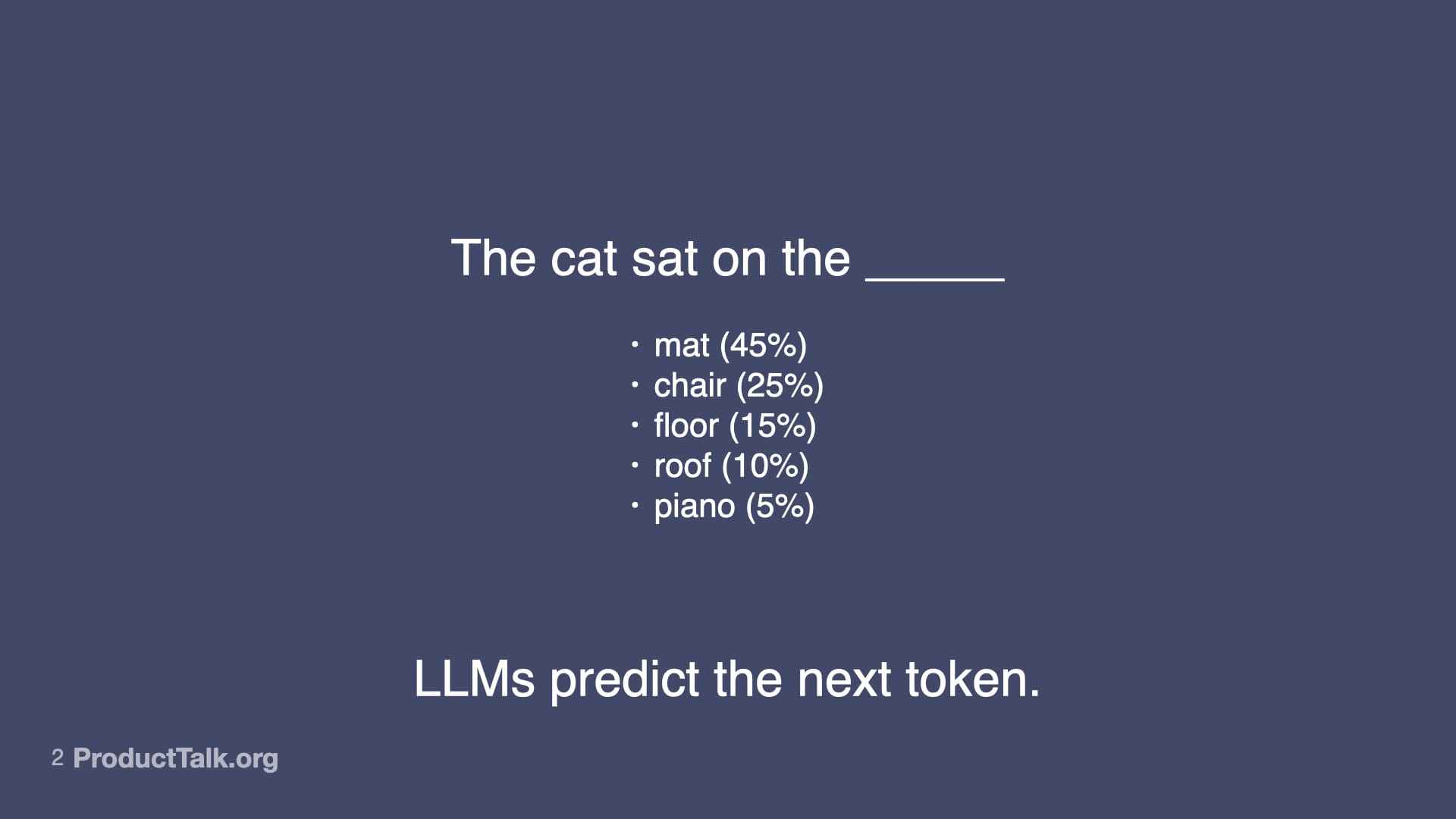
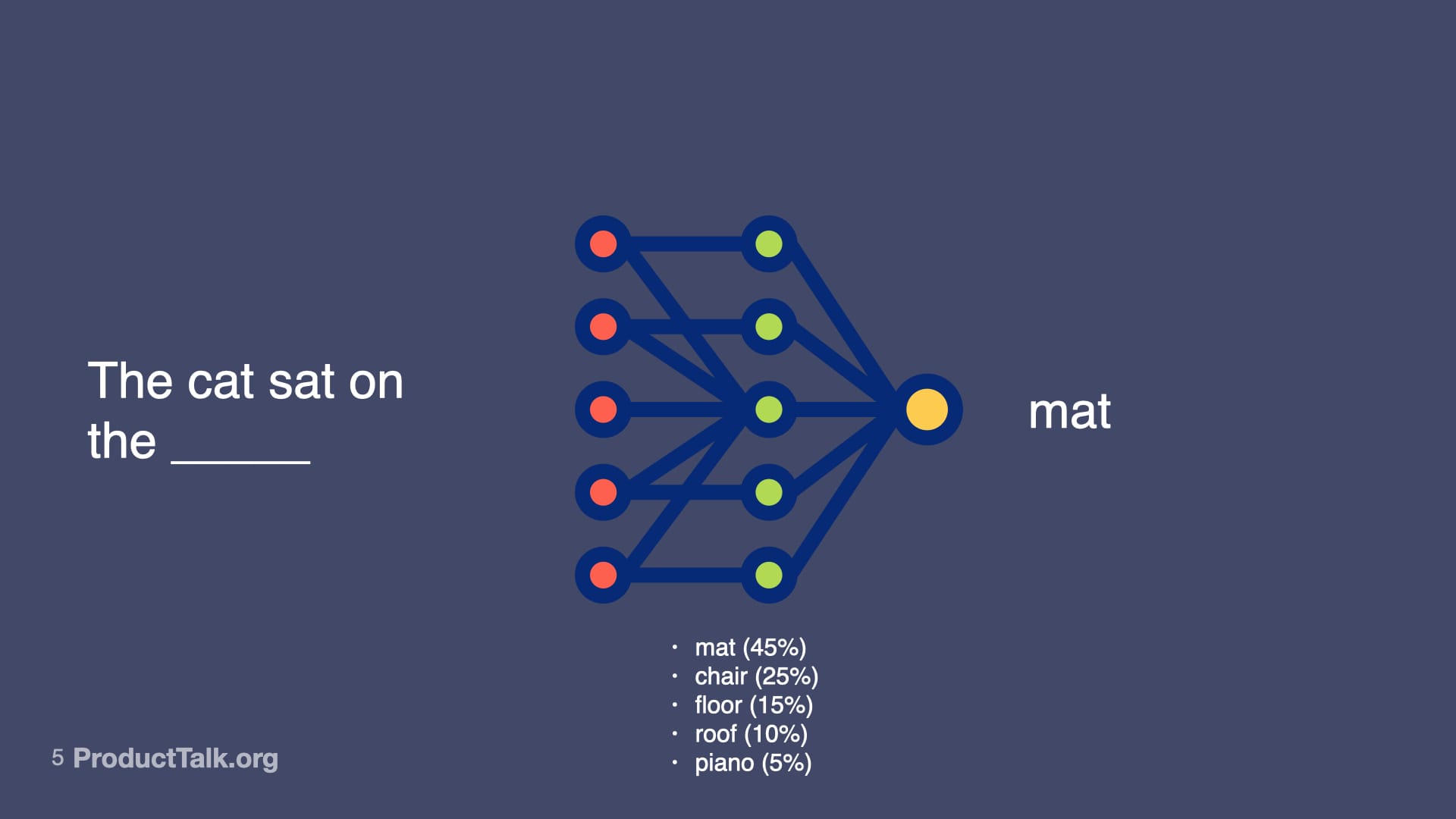
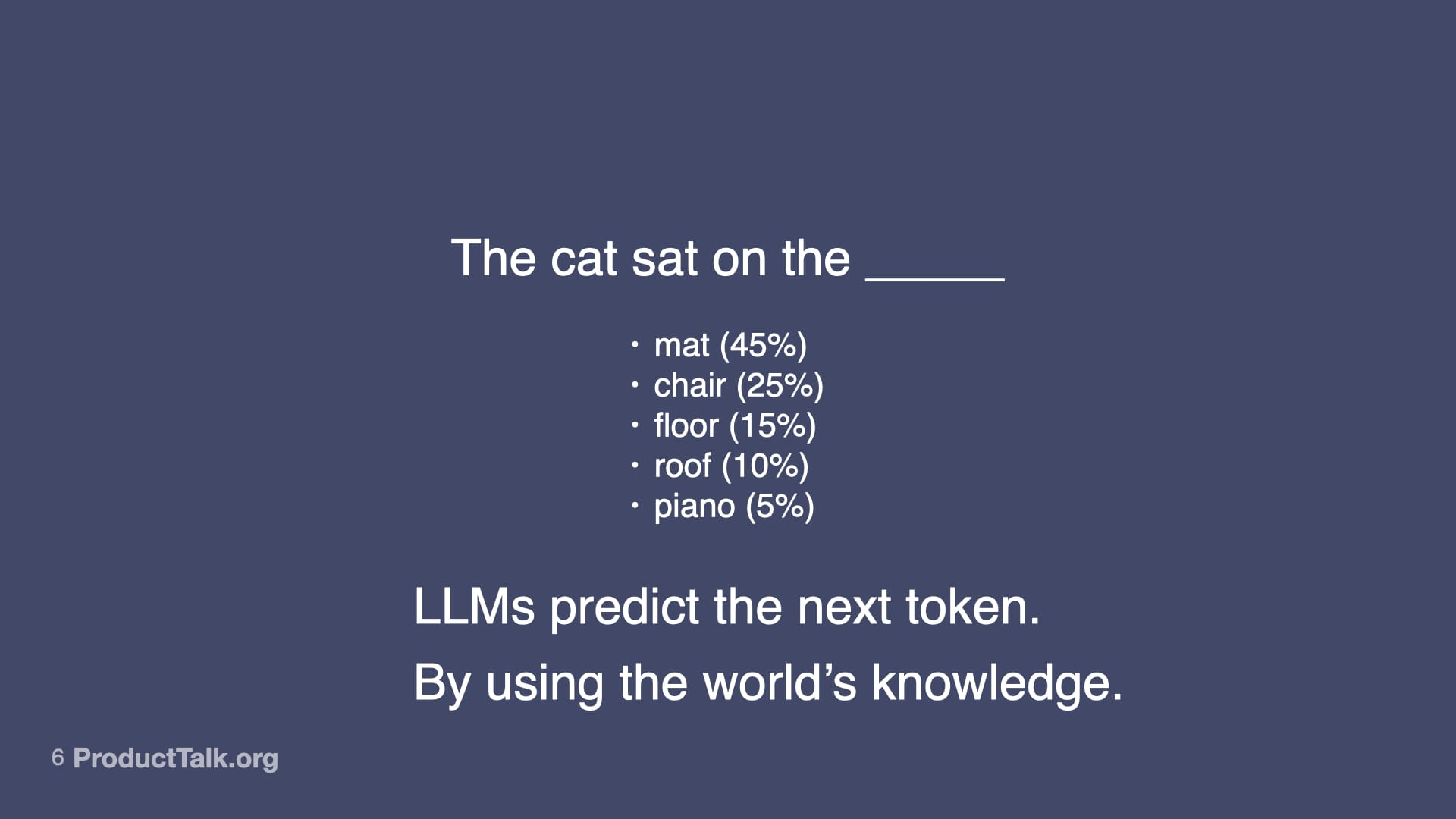
At their core, large language models predict the next token. That’s it. Consider the prompt, “The cat sat on the ____.” Mat is most likely. Chair is pretty likely. Floor, roof, piano—all possible, just less probable. When you give an LLM a prompt, it runs through a neural network—billions of parameters making calculations—to predict the most likely next word, then the next, then the next. That neural net represents not just facts, but relationships, patterns, context—and some might even argue reasoning capabilities—that all influence the probabilities of different outputs. So LLMs don’t just predict the next token. They predict the next token by drawing upon a vast amount of knowledge. LLMs are transformational.
Behind the magic, LLMs don’t “know”—they rank what likely comes next. This slide’s cat sentence with weighted options underscores how generative AI reshapes work while remaining probability-driven.
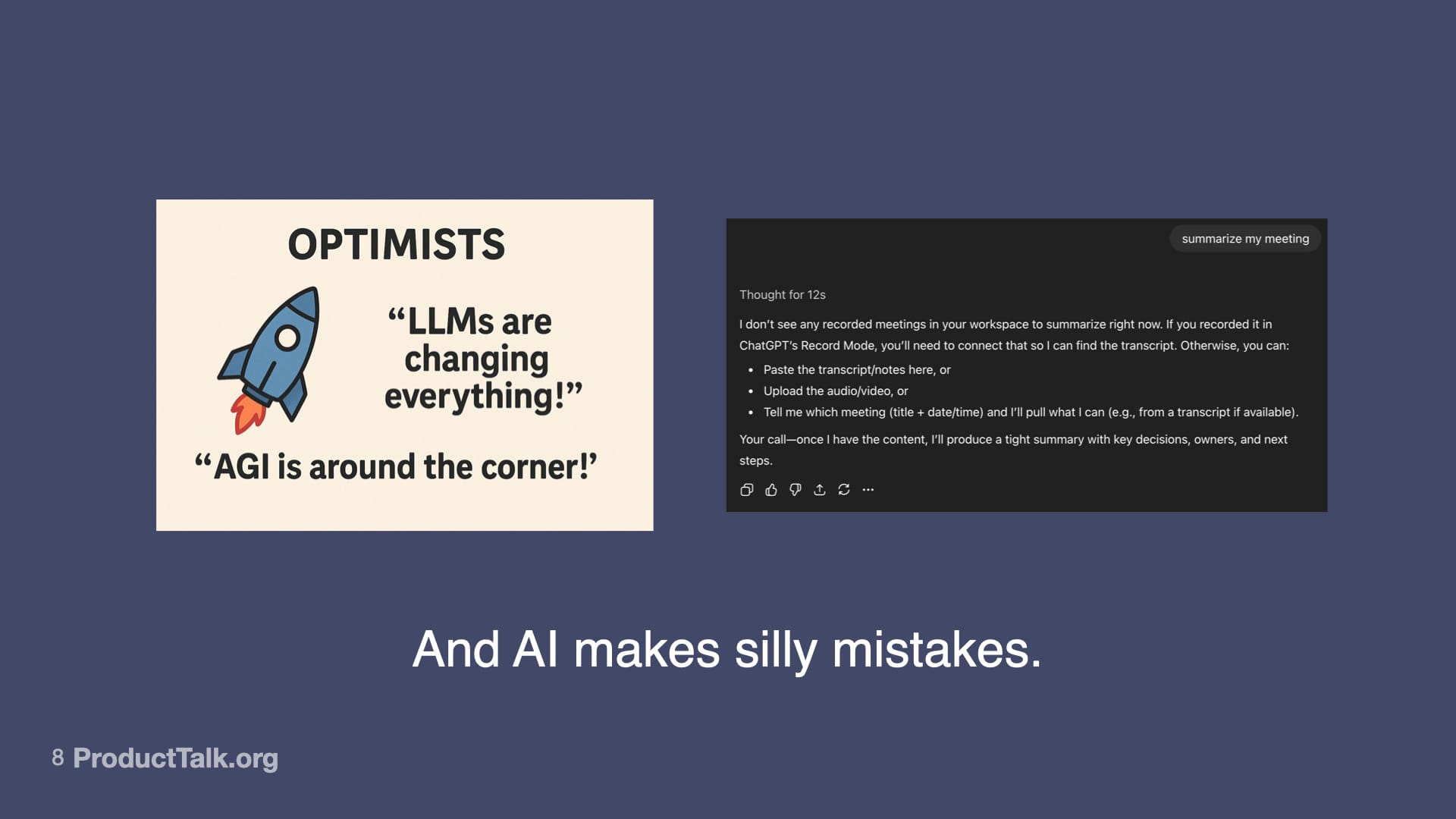
And yet, AI makes silly mistakes. The kind that make you wonder how it could be so smart and so dumb at the same time. No matter how hard I tried, I could not get ChatGPT-5 to fix the closing quote on an image. And it took 12 seconds of thinking to figure out that I asked for a meeting summary but didn’t include any meeting notes. Why do LLMs make these mistakes? Well, it’s because all the LLM is doing is predicting the next token based on patterns. And sometimes those predictions are wrong. And when it’s wrong, it can be confidently wrong. So what do we do?
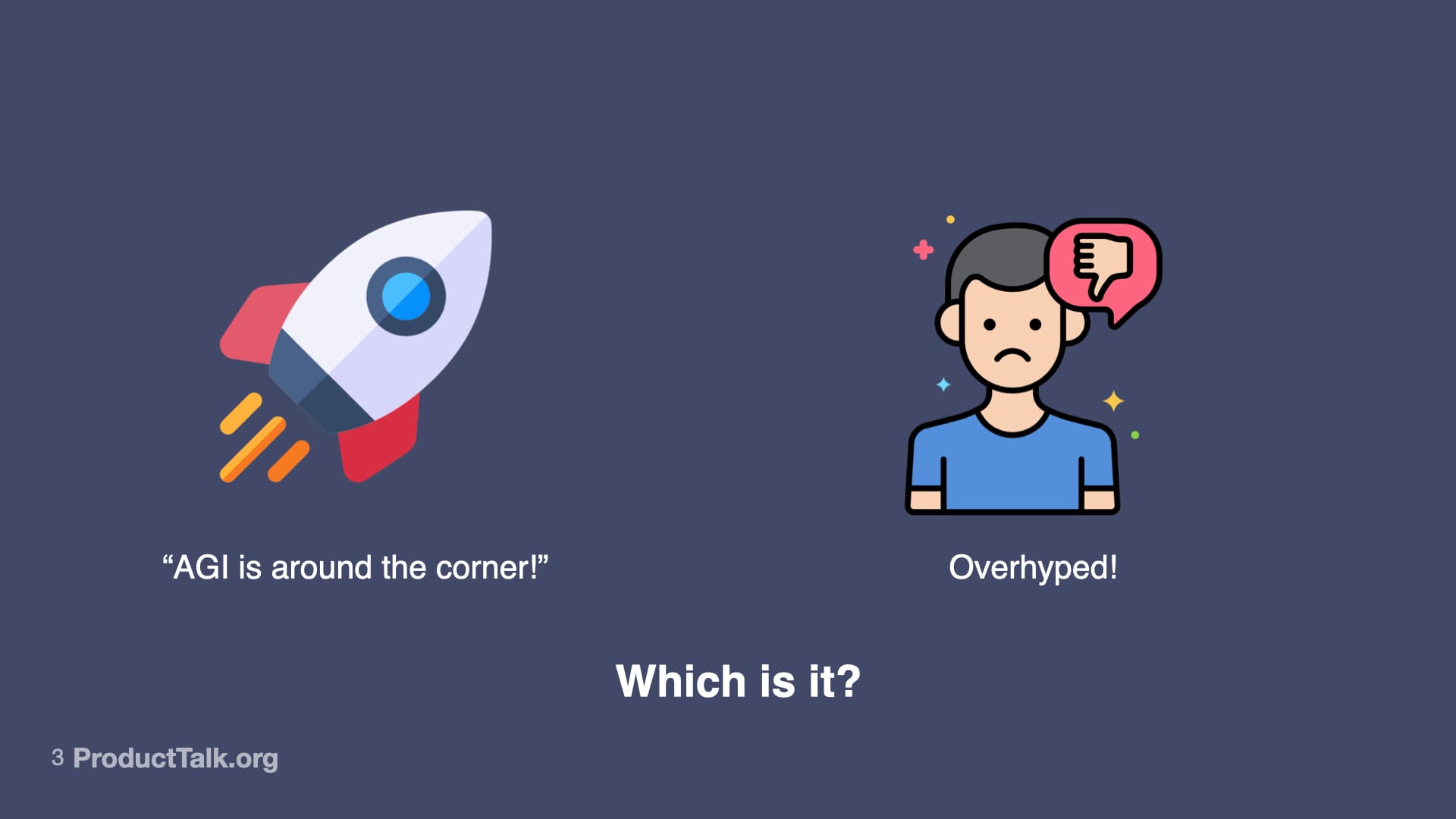
A side-by-side visual pits an optimistic AGI rocket against a frowning skeptic with a thumbs-down, ending with the prompt 'Which is it?'—capturing the debate over whether generative AI is transformative progress or overhyped.
To build reliable AI features, I focus my team on four core skills: prompt engineering, context engineering, orchestration, and evaluation (evals). Together, they let us harness what’s powerful about generative AI while reducing unforced errors.
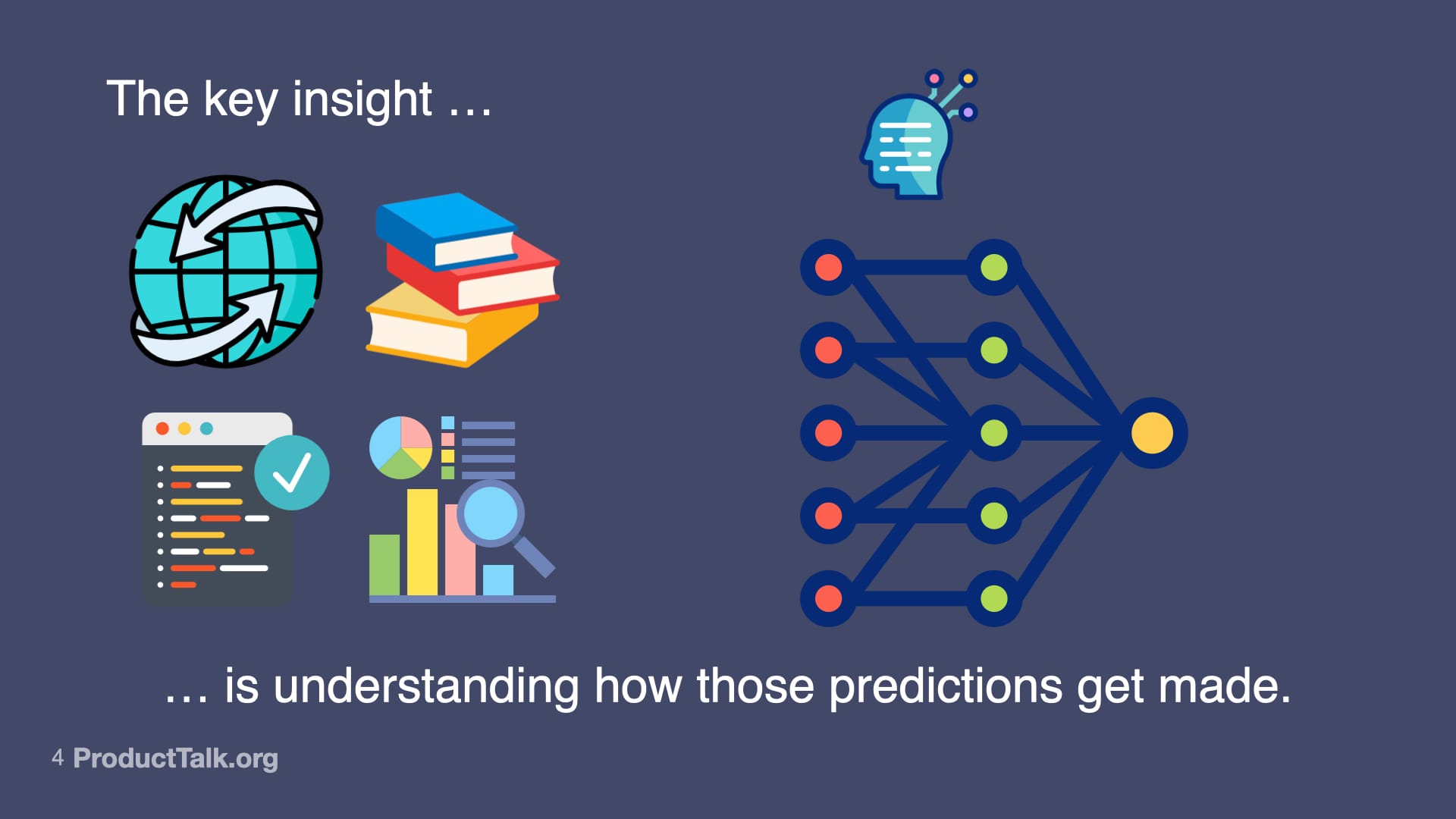
Generative AI isn’t magic—it’s inputs, training data, and models. This visual invites readers to examine how predictions are produced and why transparency, bias checks, and ethics shape responsible outcomes.
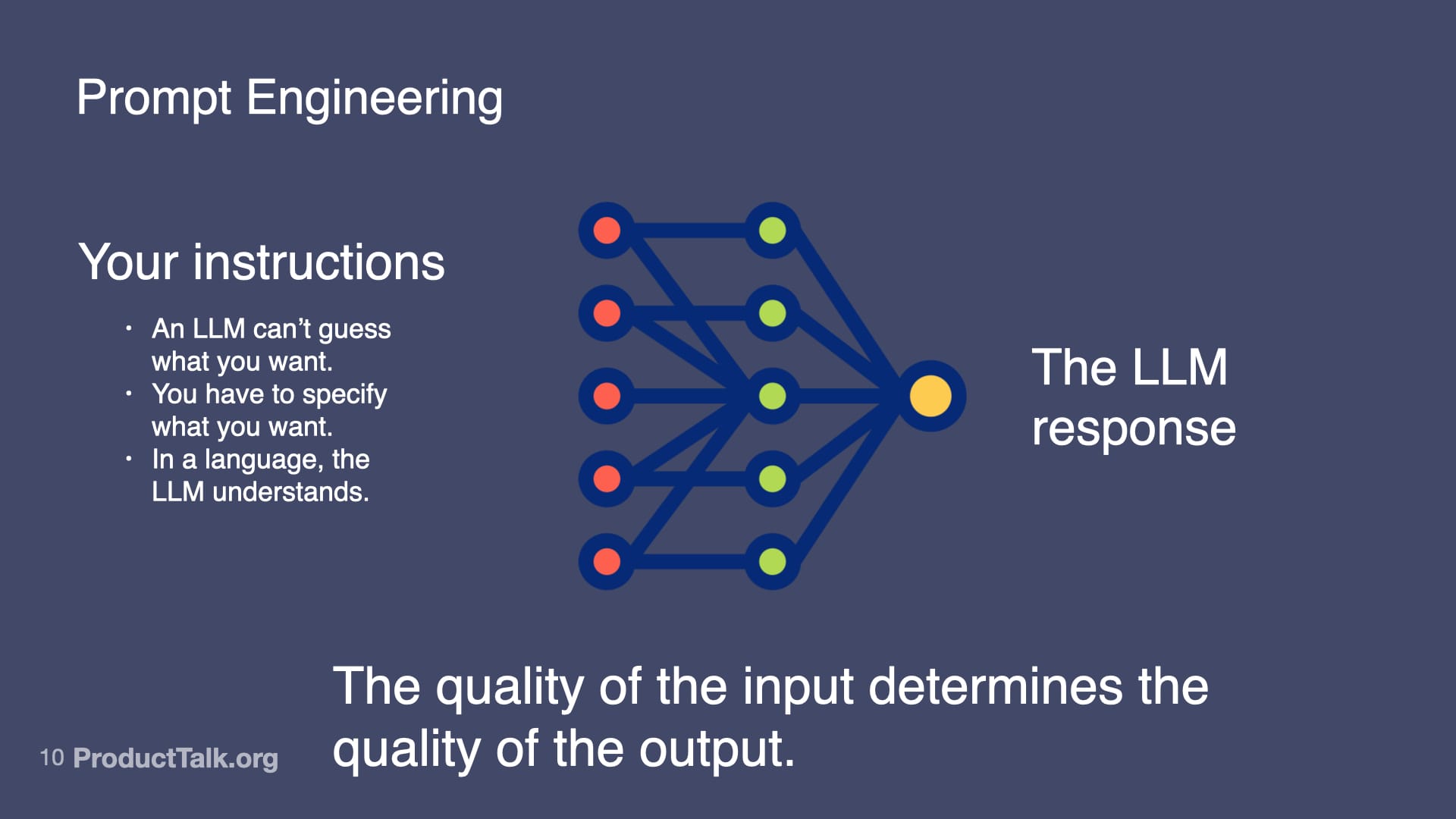
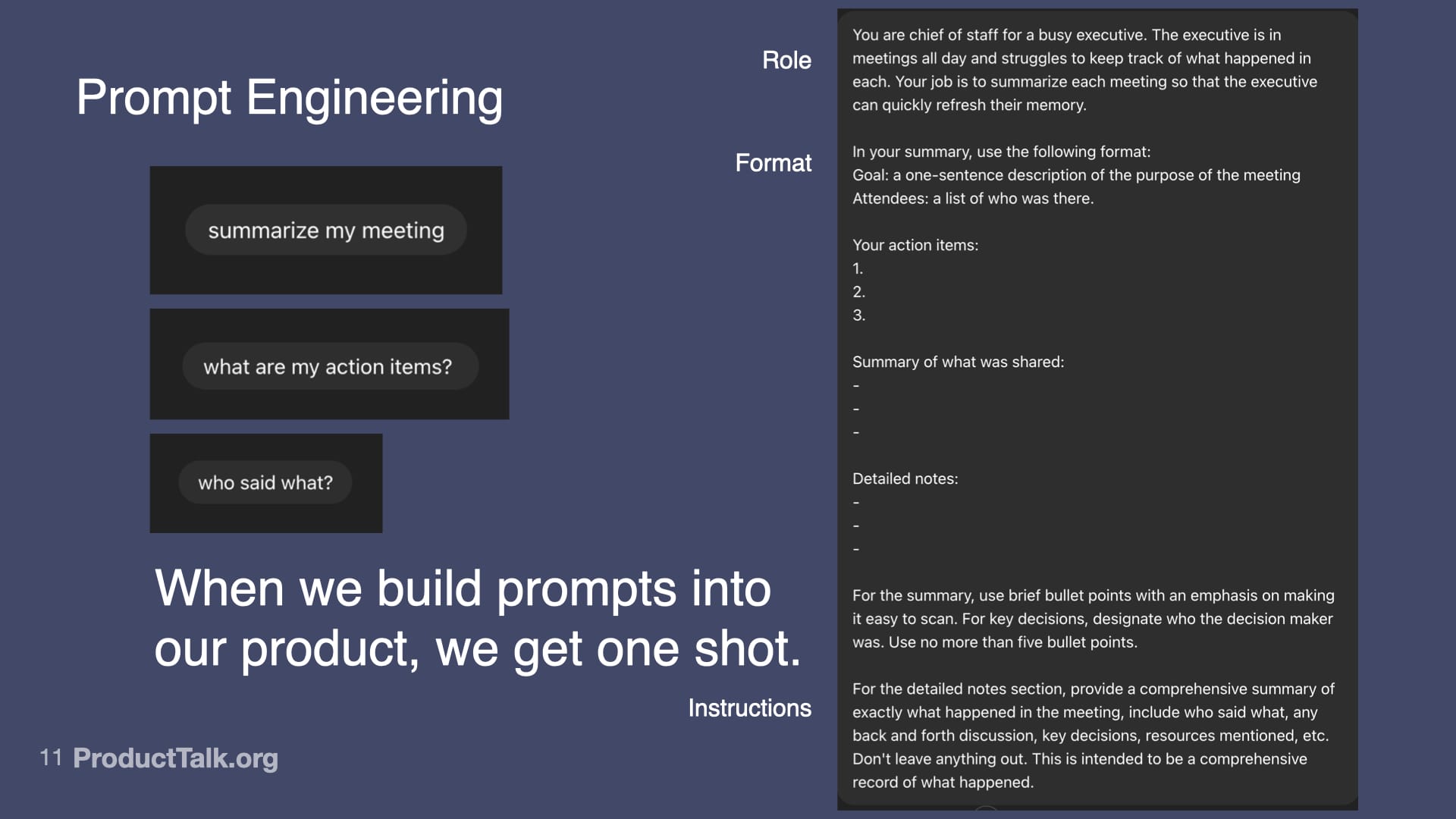
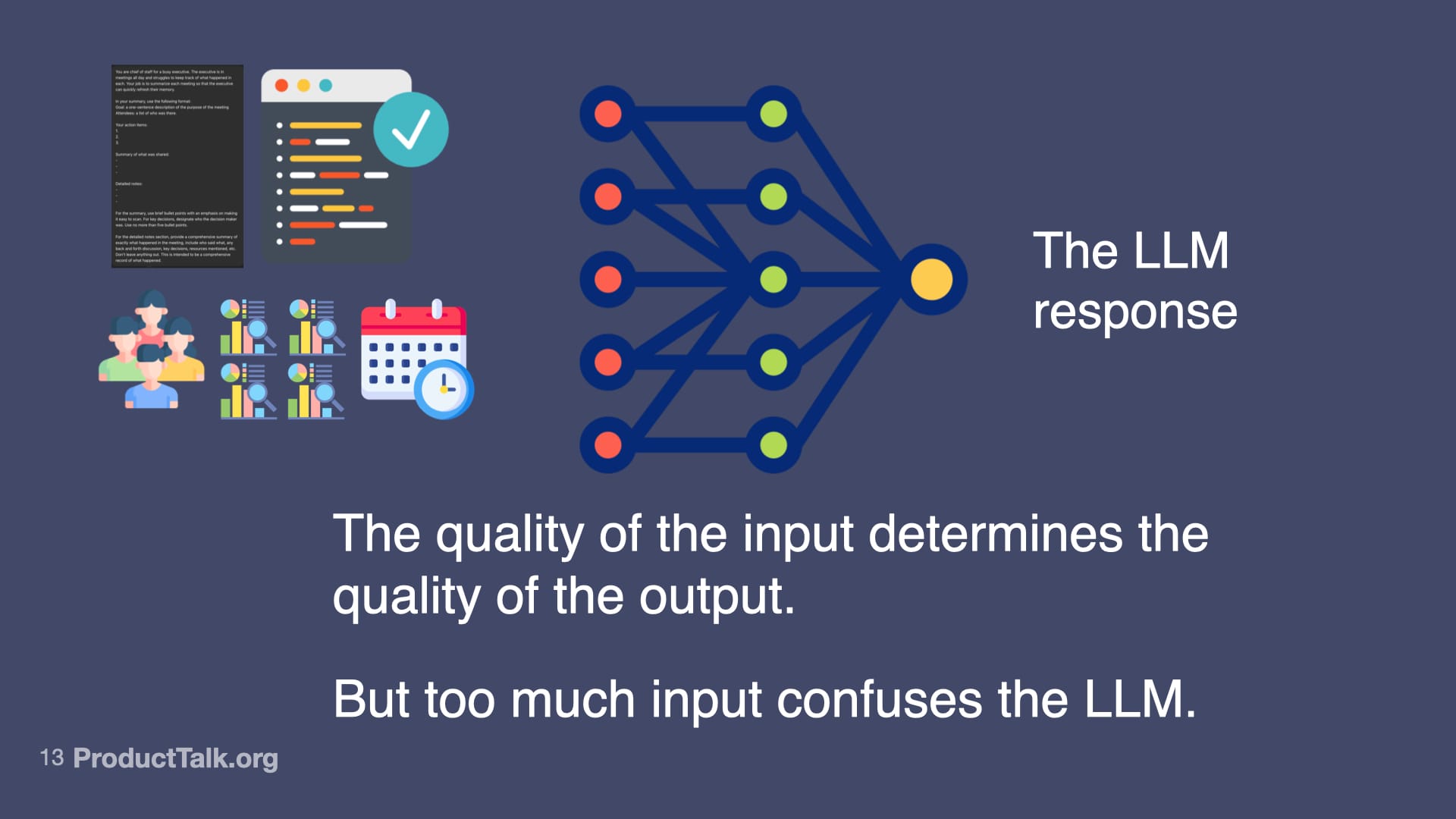
First, prompt engineering. With LLMs, the quality of the input determines the quality of the output. An LLM can’t guess what you want. You have to specify what you want in a language the LLM understands. In a chat, you can iterate with multiple turns. In a product, you get one shot. When we ship a meeting summarizer, for example, I design a production-ready prompt that assigns a role (“You are a chief of staff for a busy executive…”), specifies output format (e.g., a structured list of action items), and clarifies exactly what to include and how to structure it. This is prompt engineering. It’s like writing a really good product spec—but for an AI.
A simple sentence becomes a window into generative AI: a neural network weighs options and selects 'mat,' showing how models rank likely words to produce fluent text—and why outputs feel confident yet probabilistic.
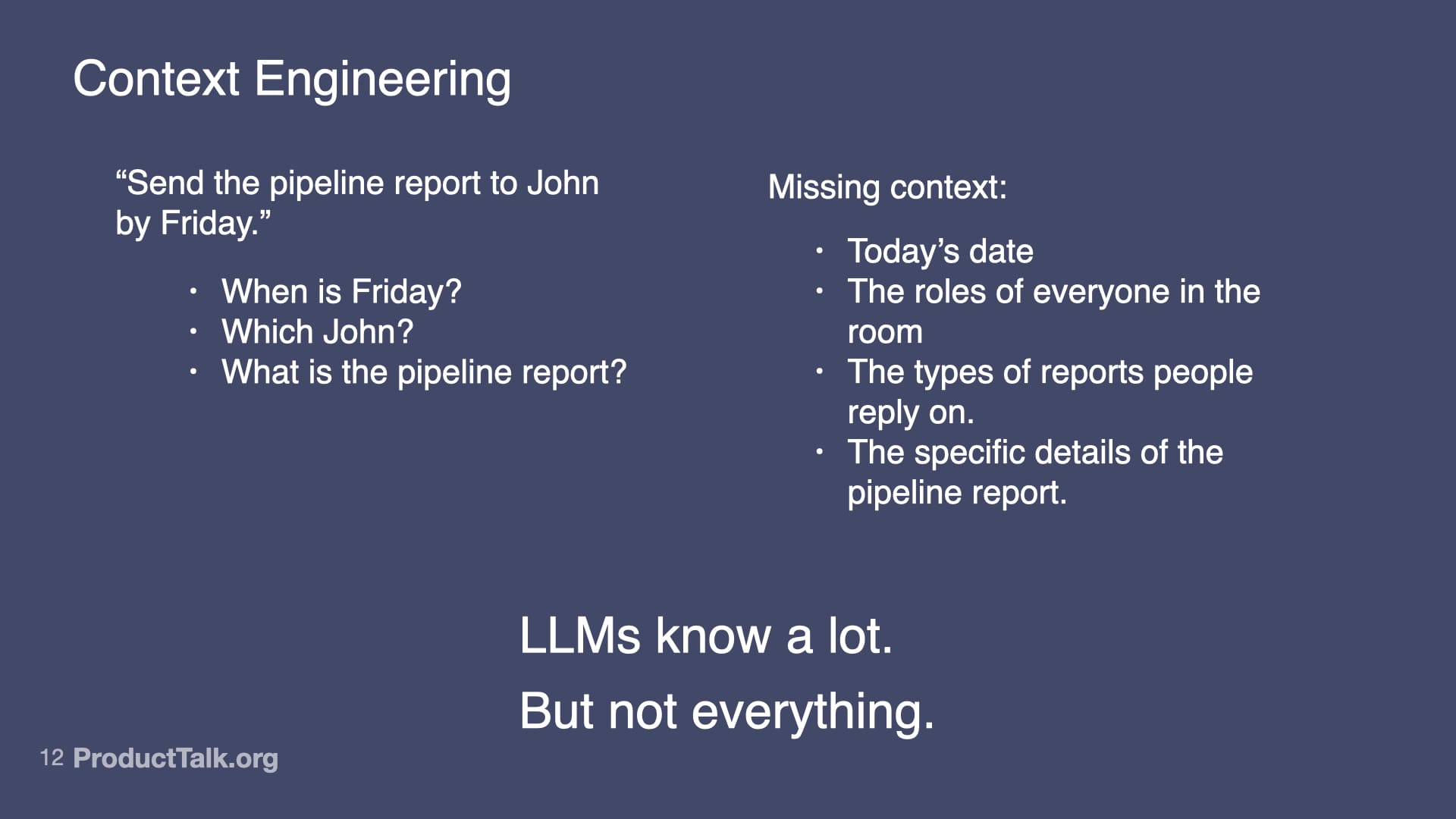
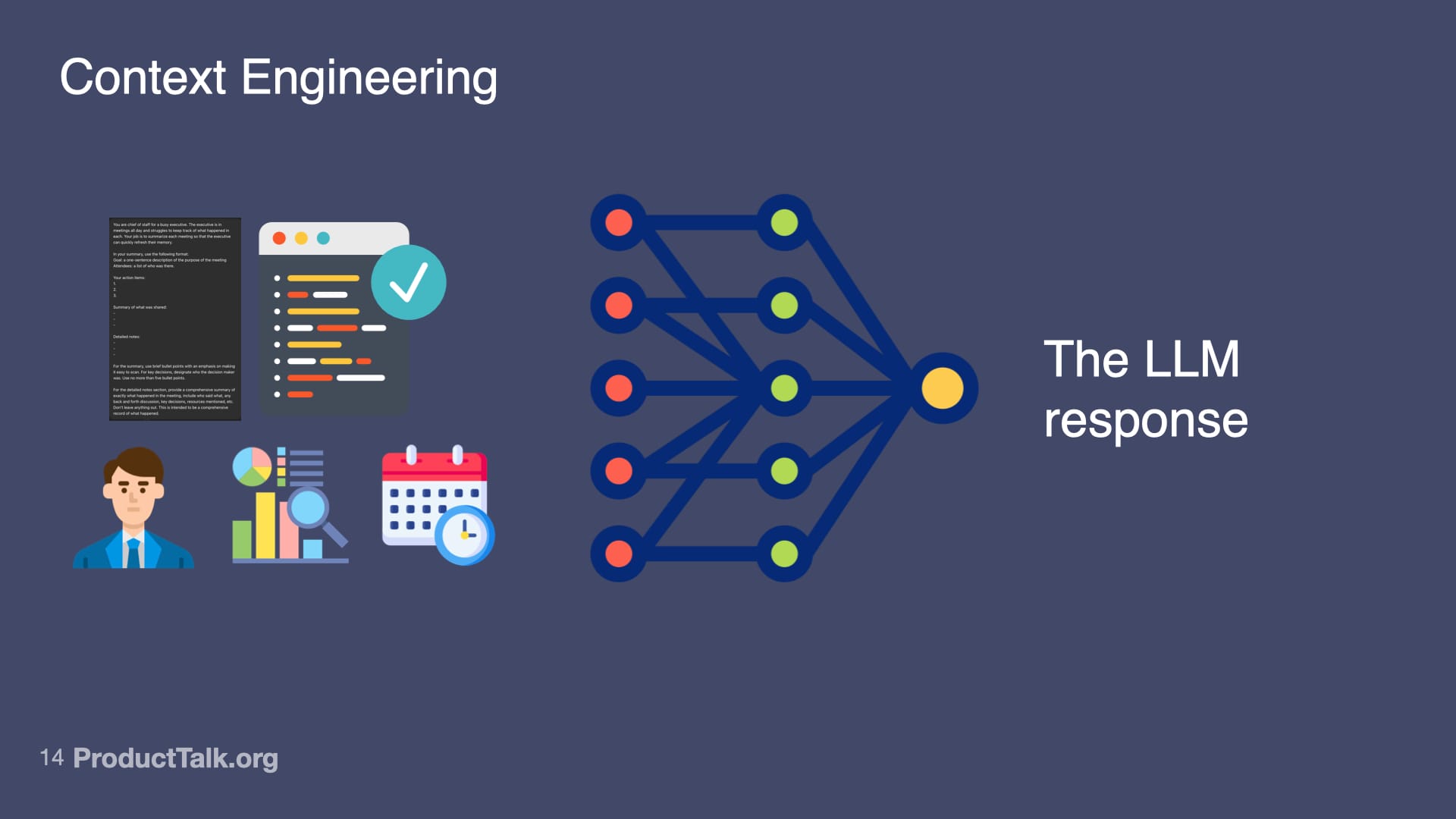
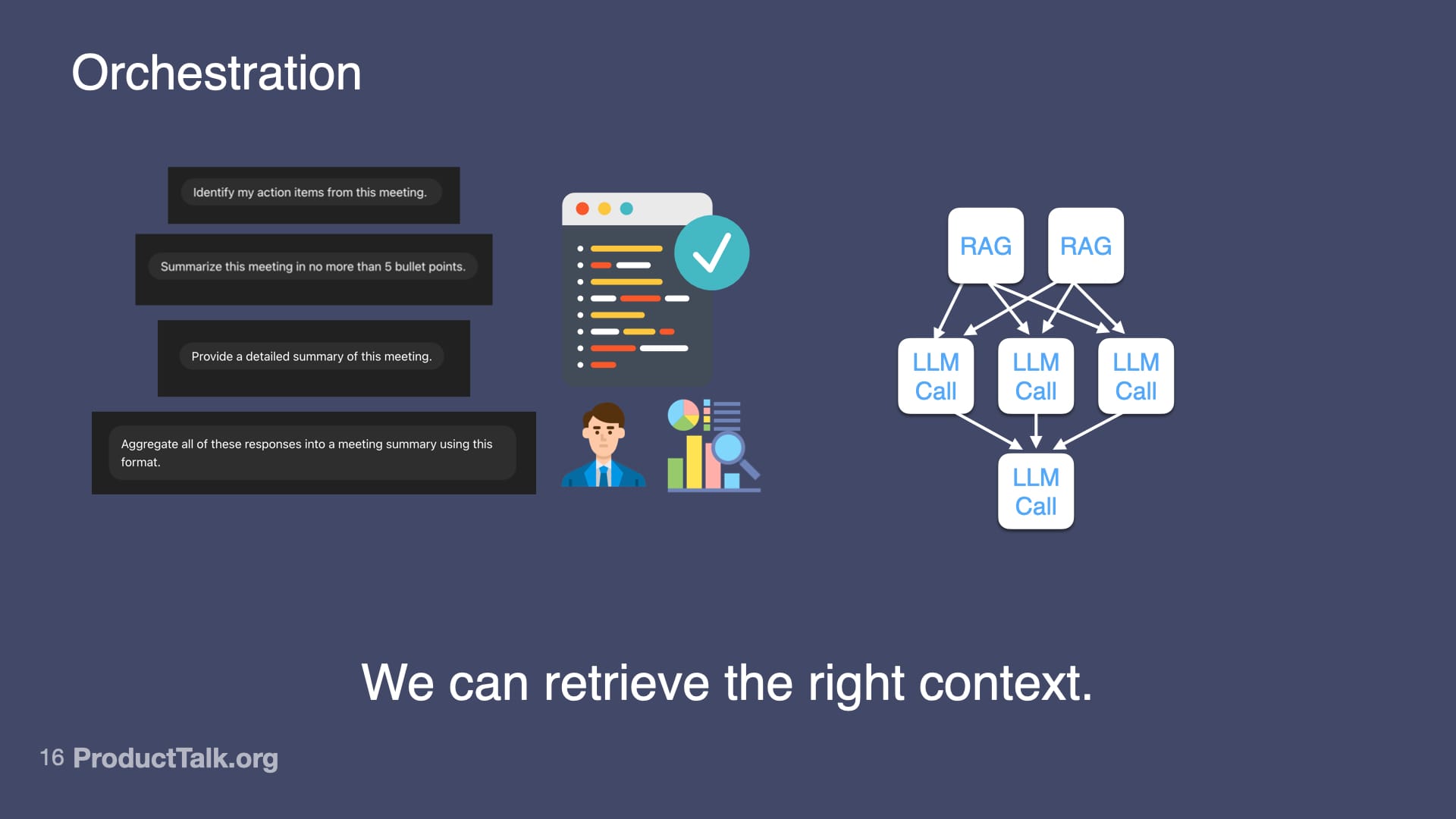
Second, context engineering. LLMs know a lot, but not everything. Imagine a takeaway reads, “Send the pipeline report to John by Friday.” When is Friday? Which John? What is the pipeline report? The model lacks today’s date, the roles of participants, and the specifics of our reporting vocabulary. If you dump every possible detail into the prompt, the model gets noisy input and the quality drops. The key is to add only the context the LLM needs to do the task at hand and nothing more. This is where techniques like RAG (Retrieval Augmented Generation) shine: retrieve just the relevant snippets—e.g., attendee roles, the precise definition of “pipeline report,” and the calendar context for “Friday”—and include only those in the prompt.
A minimalist slide demystifies how LLMs choose words: given 'The cat sat on the ____', the model ranks options by probability, showing that AI outputs are weighted predictions, not facts, which matters for ethics and product decisions.
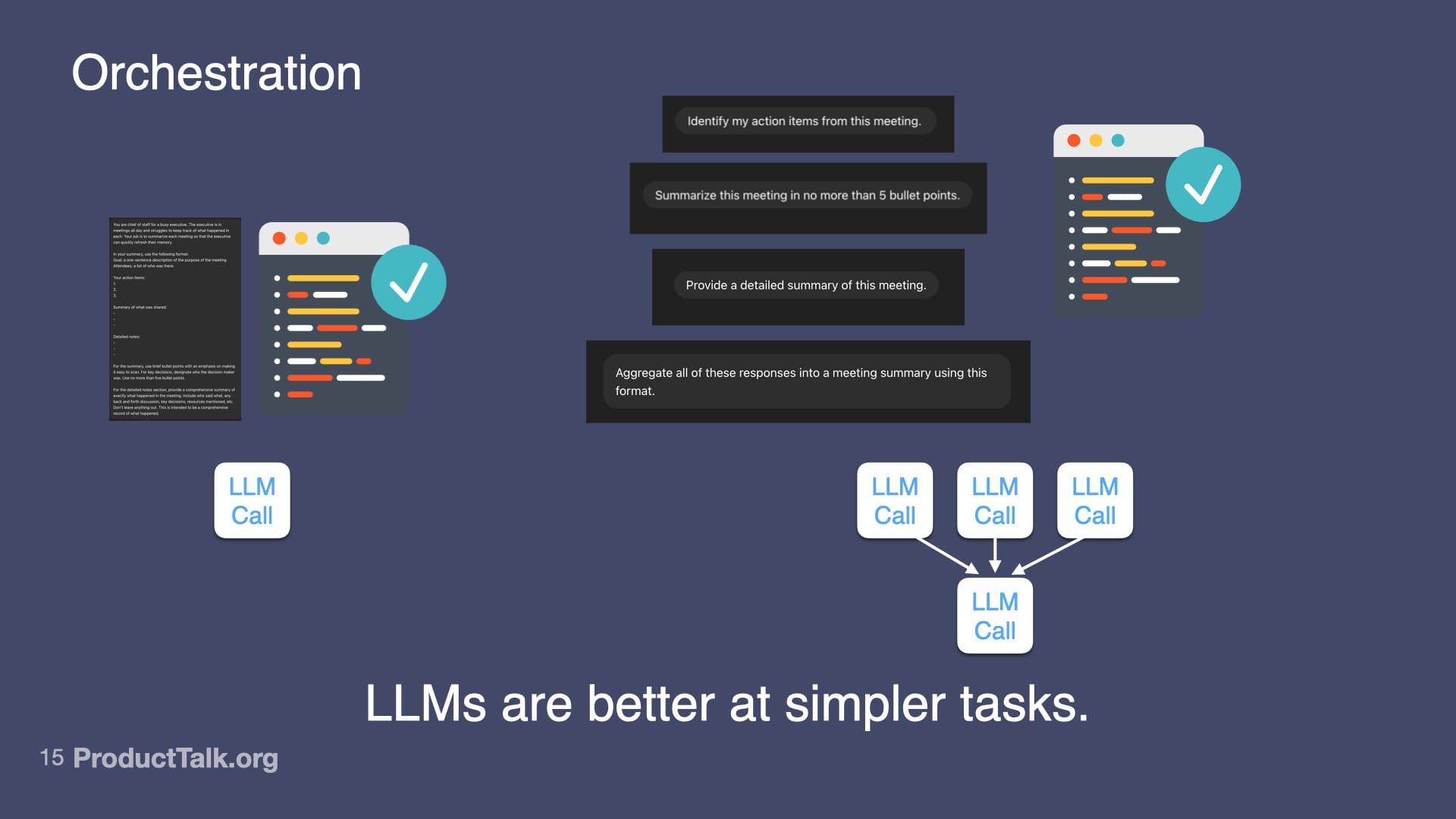
Third, orchestration. LLMs are better at simpler tasks. If you try to do everything in one prompt—identify action items, summarize the meeting, categorize by urgency, match to owners, check for clarity—the quality goes down. But if you break it into steps, each focused on one thing, the quality goes up. I design a workflow of multiple LLM calls that work together. For example: First call: identify action items from the transcript. Second call: categorize by urgency using lightweight project context. Third call: match to owners with a minimal team directory. Fourth call: generate calendar events via an API. Each step is simple. But together, they create something sophisticated.
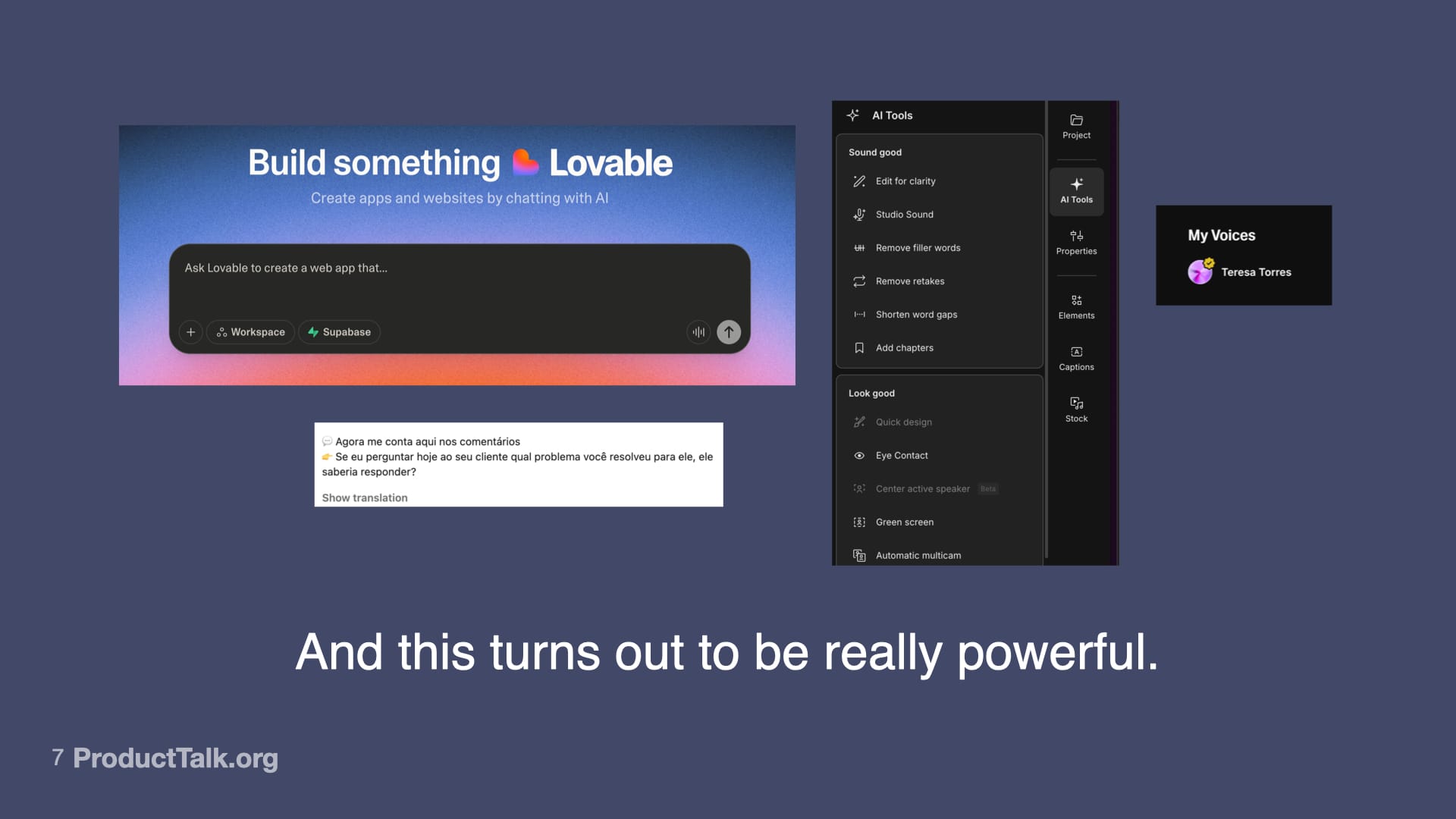
From building apps by chatting to auto-cleaning video and translating comments, AI compresses complex tasks into simple prompts. This scene shows why it feels transformative—while nudging us to weigh its limits and ethics.
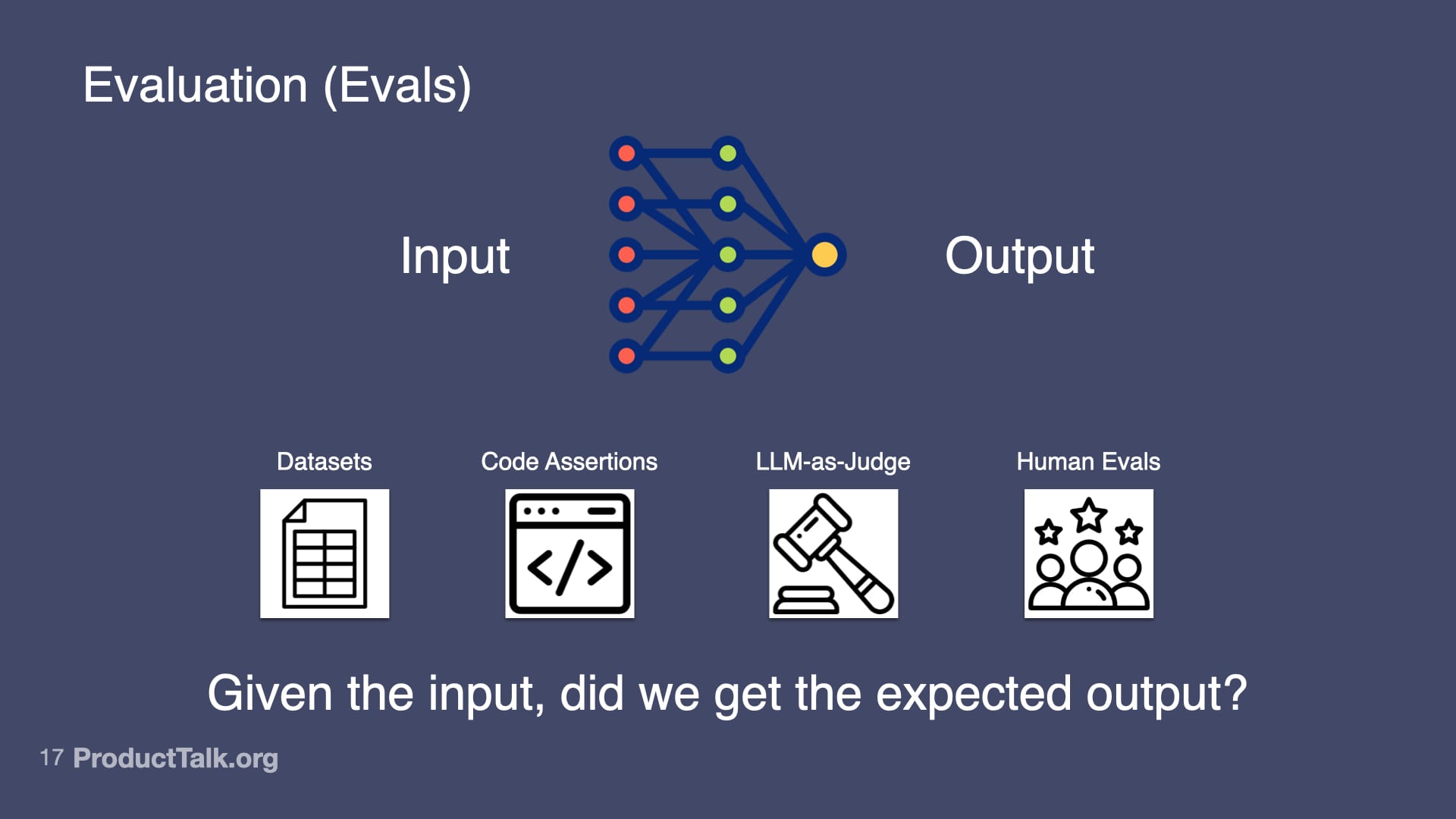
Fourth, evaluation (evals). Otherwise known as: Is my AI product any good? At the heart of evals is this question: Given the input, did we get the expected output? I use several approaches. Datasets: I collect 20–100 real examples, define expected outputs, run the prompt, and measure the success rate. Code assertions: I enforce rules the output must follow (for example, “Every action item must have a task, owner, and deadline”) and fail the test when they’re violated. LLM-as-Judge: I use a model to verify factuality (e.g., “Is each item in this summary in the meeting transcript? Yes or no.”). Human evals: I track whether users need to edit the output and by how much. Start simple; get more sophisticated as the stakes rise.
From “AI Changes Everything (And Nothing At All),” this slide contrasts bold promises with everyday glitches: optimism about LLMs and AGI on the left, and a meeting-summarizer that can’t find content on the right—reminding us AI still errs.
Here’s the hard truth: you can master all four skills and still ship the wrong thing. Why? Because you chose the wrong problem to solve. Who needs yet another meeting summarizer? The ease of building with generative AI tempts us to jump straight to solutions. Resist it.
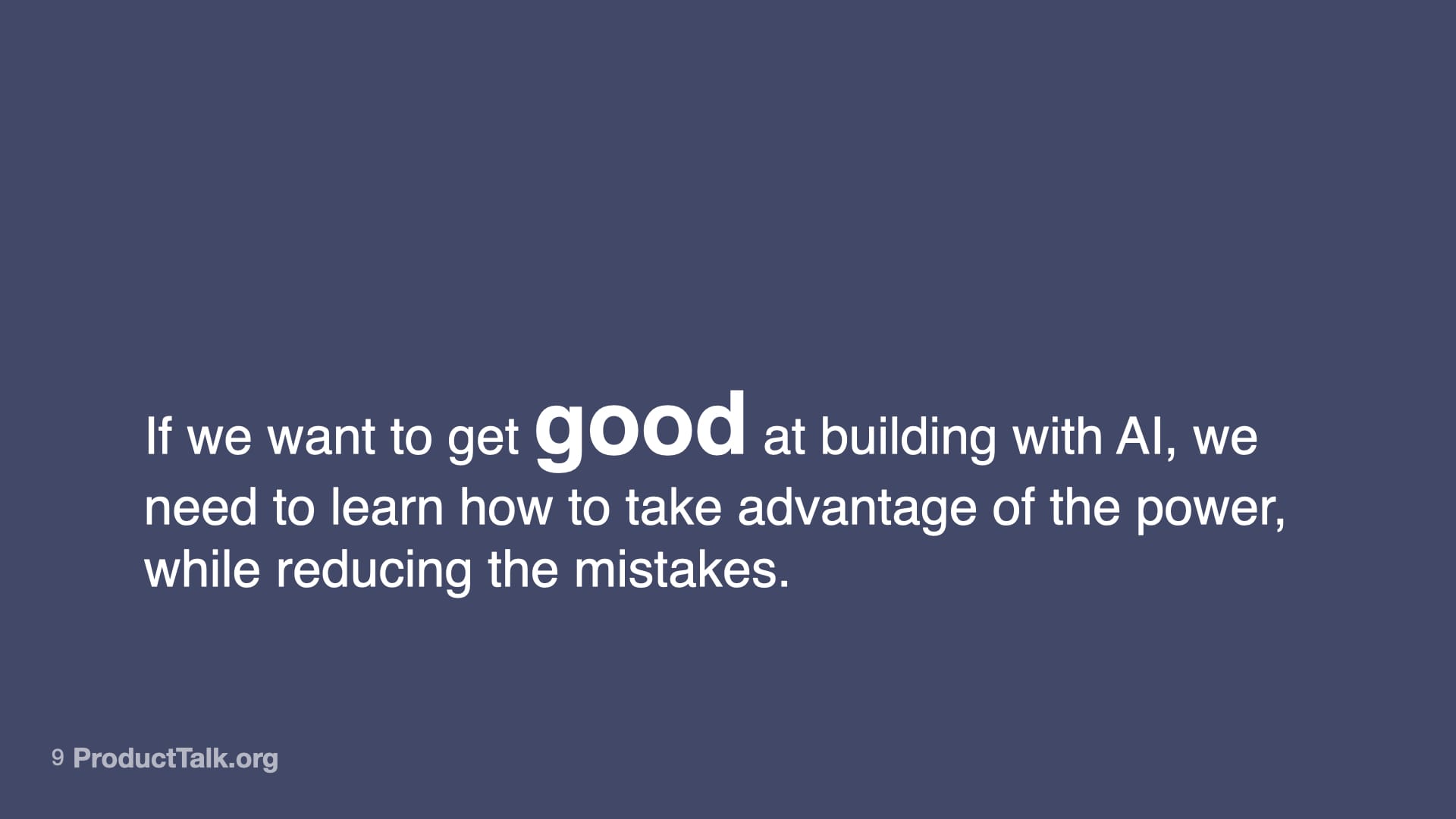
A keynote slide from AI Changes Everything (And Nothing At All) urges teams to master AI by harnessing its power while minimizing errors, framing a practical, ethical approach to building trustworthy products.
Discovery matters more than ever. Before writing your first prompt, be explicit about the impact you want and set a clear outcome. Talk to your customers and ensure you understand their needs; choose the right opportunity before you chase a cool solution. Explore multiple options and use assumption testing to converge on what will actually move the needle.
Clear prompts shape better AI. This slide shows how explicit, well-structured instructions lead to stronger LLM responses, reminding builders that inputs drive outcomes—and that responsible prompting begins with clarity.
Prototype, test, and build iteratively. With AI products, it’s easy to get to a great demo and hard to get to a production-grade experience. I validated feasibility before I wrote a line of production code by experimenting directly in a model’s UI, pasting real transcripts, and shaping the system instructions and output format. Only after I had a repeatable prompt and useful feedback did I worry about deployment.
Designing prompts is product design. This visual pairs common meeting requests with a rigorous summary framework, reminding teams that when prompts are embedded in products, accuracy matters because you get one shot.
From there, I tested deployment paths with the smallest viable investment. I tried a custom chat in Replit and embedded it. It wasn’t the right interaction model for targeted feedback. I switched to a submission flow using a homework-style pattern: students upload their transcript, the system processes it, they get detailed feedback. Done. That worked—until automation reliability lagged. I wired it up in Zapier, then rebuilt it on AWS Step Function for robust retries and better error handling when scale introduced edge cases.
A reminder that AI needs context: a simple instruction becomes ambiguous without dates, roles, recipients, and report details, highlighting the limits of LLM knowledge and the value of precise, shared prompts.
Each iteration tested a different assumption. Iteration 1 (Claude): Can AI even do this? What makes good feedback? Iteration 2 (Replit chat): How should people interact with it? Iteration 3 (Zapier): Can I integrate this into the existing workflow with minimal engineering? Iteration 4 (Step Functions): How do I make it reliable at scale when things inevitably go wrong? I didn’t know the answers up front; I learned by building, shipping, and observing.
From AI Changes Everything (And Nothing At All), this visual reminds builders that curated, high‑quality prompts yield better LLM responses, while overloaded, noisy inputs derail reasoning and reduce reliability.
Ethical data practices are non-negotiable. Improving AI products requires inspecting traces—the user input, system prompts, tool calls, and LLM responses. For a coaching flow, that includes the uploaded transcript, the system prompts that define evaluation criteria, and the AI’s feedback. To fix issues, I look at traces where things went wrong—but only with explicit user permission. Too many AI products collect everything by default and review traces without clear consent. Don’t do this.
A visual explainer showing how structured inputs—documents, verified code, roles, metrics, and timelines—flow into a network to shape a single, clear LLM response, underscoring the power of context in generative AI.
In my products, users must explicitly grant permission for me to review their data. The consent is clear and specific. If they say no, I don’t see their data. Full stop. That forces me to rely on synthetic data for many tests and to engineer privacy into the architecture from day one rather than bolt it on later. It’s the right thing to do, and increasingly, it’s required.
A visual guide to orchestration: break a complex meeting recap into smaller LLM calls, gather action items, bullet points, and a detailed summary, then aggregate the outputs to boost accuracy and reliability.
Everything changes—and nothing changes. Yes, there are new skills you should master: prompt engineering to get the right output the first time; context engineering to give the LLM exactly what it needs; orchestration to decompose complex tasks into simpler steps; and evals to systematically measure quality. And the fundamentals still rule: solve the right customer problems with strong discovery; prototype and iterate to de-risk; and uphold ethical data practices as a design constraint, not an afterthought. The teams that win with AI will master both the new technical craft and the timeless product fundamentals.
A presentation slide visualizes AI orchestration: user prompts generate meeting summaries while a graph of RAG and LLM calls routes tasks to the best sources, underscoring that retrieving the right context drives better outputs.
If this resonates, pick one active workflow, apply the four AI skills end-to-end, and run a short discovery and eval cycle against a clear outcome. Then ship. You’ll learn faster than any slide deck could ever teach you.
This presentation slide maps how to assess AI: link inputs to outputs with datasets, code assertions, LLM-as-judge checks, and human reviews—centering the question, "Given the input, did we get the expected output?"
I’ve led and observed AI initiatives across fast-moving product organizations, and one pattern is unmistakable: “The AI revolution needs a departmental leader.” When that leader is unclear, pilots stall, risk mounts, and value gets trapped in proof-of-concept purgatory. When it’s clear, AI moves from demos to durable outcomes.
In my experience, IT is uniquely positioned to play that leadership role. IT sits at the nexus of data, identity, security, and infrastructure—exactly where scalable AI capabilities live. IT also has the vantage point to connect use cases across teams, manage risk, and operationalize change without derailing core systems.
Put simply, this is the promise: “Learn the key reasons why IT teams are uniquely positioned to be the strategic leaders of your company’s AI projects.” The reasons are pragmatic—access to systems of record, stewardship of data governance, ownership of integration patterns, and accountability for reliability and compliance—yet the impact is strategic.
Here’s how I frame the operating model. IT provides strategic leadership and platform stewardship; Product owns the outcomes; Engineering delivers services and integrations; Security and Legal codify guardrails; and Finance supports cost modeling. We establish tight collaboration through product trios (Product, Design, Engineering) that plug into an IT-led AI platform, enabling empowered product teams to ship safely and quickly.
Governance turns intent into repeatable action. I use outcomes vs output OKRs to force clarity on value, pair them with lightweight QBR cadences for course correction, and require architecture reviews that cover model/data governance, observability, privacy, and vendor risk. This ensures we can scale gen ai without surprise failures or compliance gaps.
On the delivery side, forward deployed engineers embedded with business units accelerate discovery and reduce translation loss. We leverage gen ai for product prototyping to validate desirability and feasibility early, then harden solutions on our shared AI platform. This keeps experimentation fast while maintaining an enterprise-grade backbone.
Roadmapping balances ambition with throughput. I tie product roadmapping and sprint planning to value streams, not just features, and I make stakeholder management explicit—especially with customer support, finance, and operations—so we design for adoption. For example, a customer support ai strategy isn’t a chatbot alone; it’s an outcome-driven service redesign, with training, playbooks, and measurable deflection and CSAT targets.
Success demands the right metrics. Beyond typical velocity measures, I track time-to-first-value, model quality and drift, cost-to-serve, and risk posture. These roll into OKRs that link frontline improvements (e.g., resolution time) to enterprise outcomes (e.g., gross margin, retention), giving executives confidence and teams a clear definition of done.
If you lead IT, this is your moment to step into strategic ownership and elevate AI from scattered experiments to a coherent platform. If you lead Product, partner with IT to align discovery, outcomes, and guardrails so empowered teams can move fast and responsibly. Together, we can turn AI from a buzzword into a durable advantage.