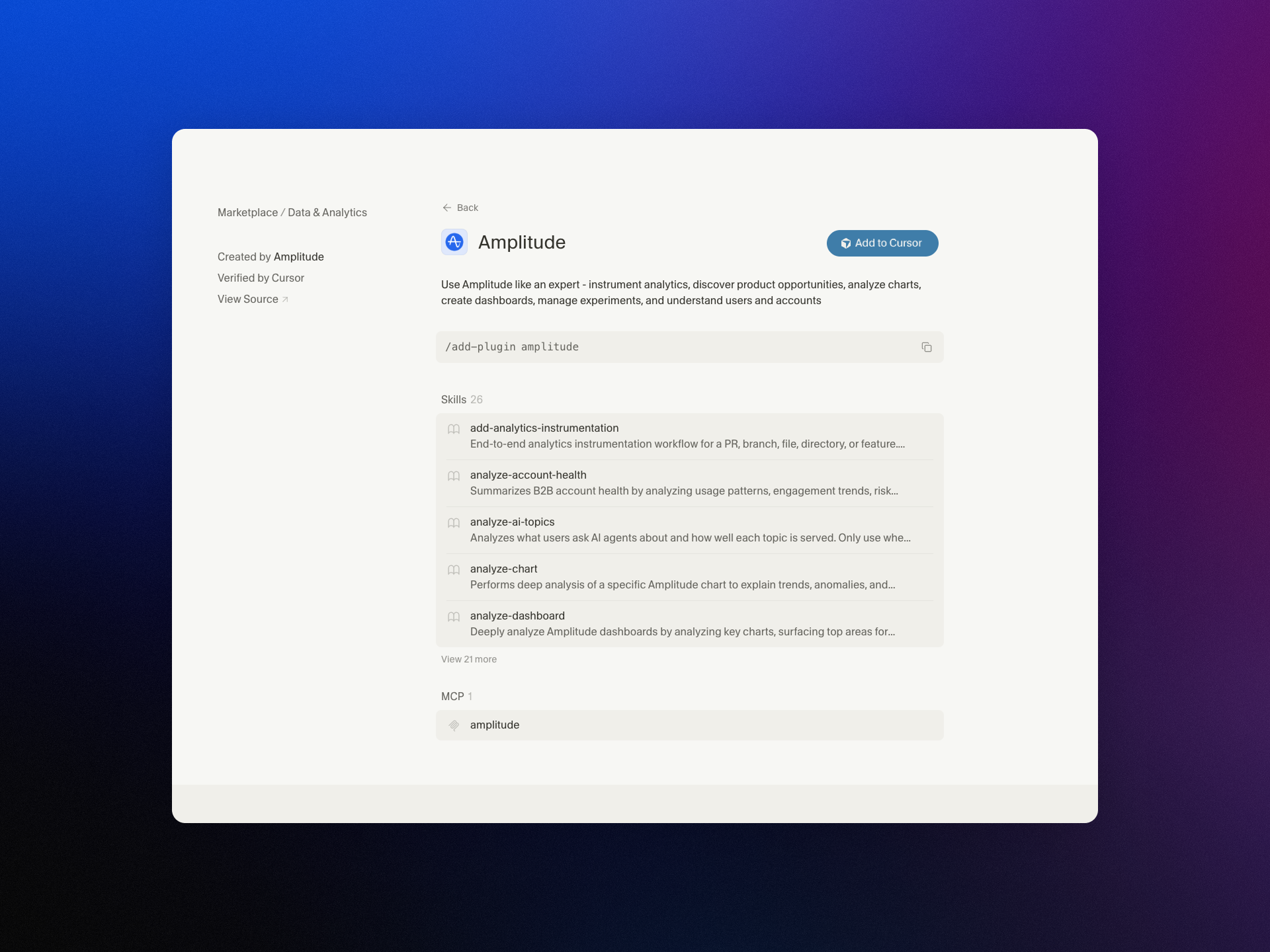
I’m excited to share that we’ve brought Amplitude Plug and Play to the Claude and Cursor marketplaces—a lightweight way to infuse your everyday prompts with serious product analytics context and speed.
"Learn more about our new AI plugin, the easiest way to turn your favorite AI client into an analytics expert with a single-install."
For years, I’ve watched teams lose momentum hopping between dashboards, docs, and spreadsheets just to answer simple questions like “What changed in activation last week?” or “Which cohort is driving retention?” With Amplitude analytics and behavioral analytics at the core, Amplitude Plug and Play collapses that friction by bringing the answers to where you already think and build—inside Claude and Cursor.
In practice, this means I can ask natural-language questions such as “Show me the funnel from signup to activation by region,” “Compare retention week over week for new users from our latest release,” or “Summarize our last A/B testing results on onboarding” and get structured, context-aware responses. The goal is to keep me in flow while still honoring the rigor of a unified analytics platform.
What I love most is how this elevates both discovery and delivery. Product managers can accelerate continuous discovery by querying cohorts, drivers, and anomalies mid-conversation. Engineers working in Cursor or with Claude Code can validate event definitions, sanity-check metrics, and spot regressions without leaving their IDE. The result is tighter feedback loops and better decision quality.
Just as importantly, the experience is designed for clarity and consistency. When I ask about activation, I expect the same canonical definition every time. When I explore a retention analysis, I want clear assumptions and transparent logic. By anchoring responses to well-defined metrics and event taxonomies, the plugin helps reinforce good data governance while keeping the interaction fast and conversational.
Getting started takes only a few minutes. Open the Claude or Cursor marketplace, search for Amplitude Plug and Play, complete the single-install flow, and connect to your Amplitude analytics workspace. From there, start prompting as you normally would—only now your AI client can reason with product context.
This launch is part of how I see gen ai reshaping AI workflows for product teams: less context switching, more signal per prompt, and a shared, accessible understanding of what’s really moving the business. If you’re ready to turn your AI assistant into a trusted partner for product insight, Amplitude Plug and Play is a powerful next step.
Inspired by this post on Amplitude – Best Practices.
You are not really deciding whether an LLM can chat about a menu. You are deciding whether it can turn a messy WhatsApp exchange into a correct, payable order without making the customer or venue staff repair its work.
That distinction changes the product. The hard parts are structured order state, deterministic commerce operations, response time, failure recovery, and venue-specific evaluation. Get those right and WhatsApp can become a genuine ordering channel. Get them wrong and you have a fluent chatbot sitting in front of an unreliable transaction.
Key takeaways
Define success as a confirmed, recoverable order in the system of record, not a conversation that sounded helpful.
Let the model interpret customer language, but keep menu data, prices, modifiers, delivery eligibility, payment state, and order commits behind deterministic tools.
Store the current order as structured state outside the transcript. A conversation is evidence of intent, not an order ledger.
Measure useful response time across the complete WhatsApp-to-POS path, then remove tool round trips and parallelize safe read operations.
Make item identification accuracy the primary trust metric, supported by guardrails for modifiers, payments, duplicate submissions, handoffs, and latency.
Evaluate every venue against its real menu and rules, then turn recurring configuration, tests, and operating procedures into reusable templates.
Define the product around a completed order
WhatsApp is the interface, not the product boundary. The product boundary should run from the customer’s first request to an order state that the venue can fulfill and the customer can verify.
Write an order contract before choosing models or orchestration frameworks. The contract is the minimum structured state required to fulfill, charge for, recover, and audit an order. It will usually include:
The venue and the applicable menu version.
Canonical item identifiers, quantities, and customer-facing item names.
Required and optional modifier selections, represented by identifiers rather than prose alone.
Fulfillment method, such as pickup or delivery.
The validated delivery result when delivery is requested.
A system-generated quote, including the values the customer must approve before payment or submission.
Payment-link and payment states, without treating a generated link as proof of payment.
Customer confirmation state, POS submission state, and the resulting order identifier.
The current owner of the interaction: agent, venue staff, or a defined recovery process.
The contract gives product, engineering, operations, and venue teams the same definition of done. It also exposes where autonomy is not yet safe. If the integration cannot validate a delivery zone, for example, the agent should collect the address and hand the order to a person. It should not infer eligibility from a conversational guess.
Order stage
The agent’s job
Condition before proceeding
Discover
Map natural language to menu candidates and explain relevant options.
One supported item is identified, or the agent asks a specific clarifying question.
Configure
Capture quantity, required modifiers, exclusions, and additions.
Every required choice is present and valid for that item.
Fulfillment
Resolve pickup or delivery and call the applicable eligibility checks.
The requested fulfillment method is supported for this order.
Quote and payment
Retrieve the authoritative quote and create the approved payment flow.
Prices and payment state come from the commerce system, not generated text.
Commit
Present the structured summary and submit the confirmed order once.
The customer has confirmed the current version and the POS returns a result.
Status and recovery
Report system-backed status or transfer the interaction with its context intact.
The response is tied to an order identifier or an explicit handoff owner.
Pay particular attention to the acceptance boundary. A friendly message such as “your order is being prepared” is an operational commitment. It must only appear after the system of record has accepted the order. If submission times out or returns an ambiguous result, the safe response is that confirmation is still pending, followed by a status check or human recovery. Guessing success can create duplicate orders, missed orders, and payment disputes.
You can still launch with partial automation, but name it accurately. Menu search, order drafting, and staff-assisted submission can deliver value while the integrations mature. The mistake is allowing the customer to believe the order was accepted when the product has only generated a plausible summary.
Keep the order deterministic even when the conversation is not
Customers do not speak in schemas. They change quantities, refer to items by incomplete names, add a second request before answering the first question, and revise earlier choices. Your architecture has to translate that non-deterministic conversation into structured, POS-compatible data without losing which version the customer actually approved.
My rule is simple: the model may interpret intent and propose an order-state change, but deterministic services must validate and commit it. The transcript should never be the only place where the current order exists.
A reliable turn can follow this sequence:
Load the current structured order, venue configuration, and relevant menu context.
Interpret the latest message as a proposed change: add, remove, replace, modify, confirm, cancel, pay, or request status.
Resolve referenced items and modifiers to canonical identifiers.
Call read-only tools for availability, configuration, fulfillment rules, or quotes as needed.
Validate the proposed change against required modifiers and venue rules.
Write a new order-state version and generate the next response from that validated state.
Use a separate, idempotent write operation when the customer confirms submission.
This design makes corrections much safer. If the customer says, “Make the second one large and remove the fries,” the agent should apply a state delta to the identified lines, validate the revised configuration, and show the updated summary. It should not regenerate the entire order from memory and hope that unrelated details remain intact.
Tool contracts should be narrow and explicit. Menu search should return canonical candidates and the information needed to distinguish them. Item detail should return valid modifier groups. A quote tool should return authoritative values. A payment tool should return a system-created link or a structured error. An order-submission tool should return an accepted identifier, a definite rejection, or an unresolved state that triggers recovery.
Do not let the model invent a price, payment URL, availability claim, delivery decision, or order status. These are business facts with financial and operational consequences. The response composer can explain them in natural language, but the underlying values must come from an approved system.
Separate reads from writes in the architecture. Independent menu and item lookups can often run in parallel. Writes should be serialized against a known order-state version. Every commit operation should accept an idempotency key so a retry cannot create a second order. If the state changed after the customer saw the summary, require confirmation of the new version rather than silently committing it.
The same discipline applies to human handoff. Transfer the structured cart, unresolved question, relevant tool results, and submission state along with the transcript. A handoff that forces staff to reread the entire conversation and reconstruct the order is not graceful degradation; it is deferred manual work.
Choose the orchestration pattern from the service objective, not from architectural fashion. Under tight response constraints, AITropos chose direct tool calls instead of MCP or a multi-stage pipeline to reduce orchestration overhead. That is not a universal argument against MCP. It is a reason to benchmark the actual path. Compare end-to-end latency, traceability, schema governance, failure isolation, and engineering cost using representative ordering turns. If an abstraction adds useful control, keep it. If it only adds another round trip, remove it.
Manage latency as part of the customer experience
The model’s inference time is only one part of latency. From the customer’s perspective, the clock starts when the message is sent and stops when a useful next action arrives. Context retrieval, menu search, validation, payment calls, POS submission, message delivery, retries, and overloaded queues all sit inside that interval.
Instrument the complete path before optimizing it. Capture timestamps for message receipt, context assembly, model execution, every tool call, state validation, response creation, and outbound delivery. Report median and tail latency by turn type. A single average can hide a checkout path that is consistently slower than menu questions.
At minimum, separate these turn classes:
Menu discovery and recommendation.
Item identification and configuration.
Cart edits and corrections.
Delivery or fulfillment validation.
Quote and payment-link creation.
Order confirmation and POS submission.
Order-status retrieval.
Human escalation and recovery.
Set a service objective for each class from observed channel behavior and the operational risk of delay. There is no useful universal number. A status lookup and a multi-item order edit do different work. What matters is that the team can see which component consumes the budget and what happens when that component times out.
Optimize in the order that removes uncertainty as well as delay:
Remove unnecessary model and tool round trips. Load the active order and venue configuration before asking the model what to do.
Parallelize independent read operations, such as resolving multiple products mentioned in one message.
Prefetch likely item context so the agent does not discover basic menu facts one call at a time.
Inject only the context needed for the current turn. An oversized prompt moves latency rather than eliminating it.
Keep deterministic validation outside the model when a rule or schema check can answer immediately.
Give every external dependency a timeout, an observable error state, and a safe recovery path.
Use concise responses that advance the order. Extra prose increases reading time and can obscure the decision you need from the customer.
Watch the failure mode on the other side of aggressive optimization. Cached menu metadata can reduce retrieval work, but stale availability or price data can create a wrong commitment. Define which fields are stable enough to cache, how they are invalidated, and which values must be retrieved at quote or submission time. Speed is valuable only when the answer remains authoritative.
When a slow operation cannot be avoided, use an honest progress message and preserve the pending state. Do not fill the wait with repeated acknowledgements that imply completion. If the customer sends another message while the tool is running, the state machine should know whether to queue the change, cancel the pending operation, or ask the customer to wait for its result.
Evaluate each venue, then template what repeats
Make item accuracy precise enough to govern decisions
Item identification accuracy deserves to be the primary trust metric. If the agent resolves the wrong item, every later component can behave perfectly and still produce the wrong order. AITropos treats order item identification accuracy as its most important KPI, giving model, prompt, retrieval, and fallback decisions a common objective.
Define the metric before building a dashboard. I would count an attempted line item as correct only when the canonical item, quantity, and required modifier interpretation match the customer’s resolved intent. A necessary clarification is not automatically an error; it should count against a separate clarification-burden metric. Otherwise, the team may improve apparent accuracy by asking the customer to confirm every obvious detail.
Do not let the primary KPI hide transaction failures. Pair it with guardrails for:
Unsupported substitutions or invented items.
Missing and invalid required modifiers.
Customer corrections after the agent presents a summary.
Quote, payment-link, and POS tool failures.
False confirmations, unresolved submissions, and duplicate commits.
Order completion and abandonment by journey stage.
Human handoff rate, reason, and time to recovery.
End-to-end latency by turn class and venue.
Link corrections back to the original decision. If the customer changes an item because the agent misunderstood it, label the item-resolution turn rather than treating the correction as an unrelated edit. That is how production behavior becomes useful evaluation data instead of a collection of support anecdotes.
Simulate failures before customers encounter them
A venue-specific evaluation suite should use that venue’s menu identifiers, modifiers, availability behavior, delivery rules, payment flow, and POS adapter. A generic restaurant benchmark can test language understanding, but it cannot tell you whether the agent knows that a particular size requires a particular modifier or that two similar menu names map to different SKUs.
Build test families for:
Incomplete names, colloquial references, and ambiguous matches.
Several products requested in one message.
Required modifiers, exclusions, additions, and invalid combinations.
Quantity changes, replacements, removals, and cancellation.
Unavailable items and acceptable alternatives.
Pickup, delivery, and addresses that cannot be validated.
Quote changes before confirmation.
Payment failure, delayed payment state, and an abandoned payment flow.
Tool timeouts, malformed tool results, retries, and uncertain POS submission.
Interrupted conversations that resume with an existing cart.
Requests that require staff judgment rather than autonomous execution.
Generate the expected structured order independently from the agent being tested. Otherwise, the same model can reproduce its own misunderstanding in both the answer and the grade. Keep a small, human-reviewed set of critical conversations alongside the larger generated suite, and add every material production failure to the permanent regression set.
Scale matters when menus contain many combinations. Before each new venue goes live, AITropos runs thousands of simulated customer conversations overnight. The number alone is not the release gate. Coverage, a trustworthy expected answer, and clear failure categories are what make simulation useful.
Simulation also cannot reproduce every production condition. Follow it with a staff sandbox and a controlled production phase. Use only redacted, properly authorized customer conversations in evaluation systems, and retain no more personal data than the test requires.
I would treat any path that invents a price or payment state, falsely confirms an order, or can duplicate a commit as release-blocking. Other thresholds should reflect the venue’s menu complexity, existing human baseline, handoff capacity, and the cost of a wrong order. Record those thresholds before the final test run so launch pressure cannot redefine success afterward.
Roll out autonomy in observable stages
Start with a venue that is operationally manageable but representative enough to expose real modifiers, fulfillment rules, and integration behavior. An unusually simple pilot may produce a clean demo while postponing the problems that determine whether the product can scale.
Configuration: ingest and normalize the menu, map canonical identifiers, mark required modifiers, connect fulfillment and payment rules, and produce a completeness report. No customer-facing ordering is enabled.
Sandbox: let venue staff run realistic conversations while write tools remain disabled or point to a test environment.
Approval mode: allow the agent to prepare a structured order, but require a person to approve the commit. Measure how often the person changes it and why.
Constrained production: enable autonomous submission for the supported venue, fulfillment modes, and order types, with a staffed handoff path and rapid rollback.
Expansion: widen scope only after production traces confirm the accuracy, latency, recovery, and operational workload expected by the release criteria.
For every stage, decide who can pause the agent, how staff take over an active conversation, how the customer learns that a person has taken over, and how an uncertain submission is reconciled before another order is created. These are product requirements, not post-launch operating notes.
Once one venue works, resist copying its prompt and integrations into a new branch. Make venue differences configuration wherever possible: normalized menu schemas, modifier patterns, fulfillment policies, tool mappings, escalation contacts, evaluation packs, and dashboard dimensions. Keep truly distinct behavior explicit rather than burying it in prompt prose.
The scalability payoff can be substantial. AITropos reduced new-venue onboarding from three months to a few weeks, while domain templates are being used to shorten it further. Track your own onboarding work by category: configuration, data cleanup, integration, prompt or policy changes, evaluation, venue training, and launch support. If every venue still requires bespoke code and a rewritten conversation flow, the product has not yet separated its platform from its implementations.
Your next step should be concrete. Choose one representative venue and create three artifacts: the canonical order contract, a failure-and-recovery matrix for every tool, and a venue-specific evaluation set built from redacted, authorized scenarios. If those artifacts cannot show what happens when item resolution, a modifier, delivery validation, payment, or POS submission fails, the agent is not ready to accept orders. Once those states are explicit, model and architecture choices become testable decisions rather than matters of confidence.
You open a portfolio review and find an AI request from nearly every direction. One team wants an assistant. Another wants an agent. A third has a promising prototype that now needs production funding. Every request sounds plausible, yet approving all of them would spread the company across disconnected experiments.
This isn’t primarily a prioritization problem. It is a leadership-system problem. Your job as CPO is to define the customer advantage worth pursuing, concentrate attention on a few coherent bets, specify the evidence that earns more investment, and make it clear what the company will stop doing. The roadmap should record those choices. It should not make them for you.
Allocate attention before you allocate roadmap space
AI expands the number of things a product team can plausibly build. It does not expand engineering capacity, customer attention, management bandwidth, or the company’s tolerance for operational risk at the same rate. That mismatch is why an orderly backlog can still represent a deeply unfocused strategy.
A prototype adds to the confusion because it compresses the distance between an idea and a convincing demonstration. A good demo shows that a capability may be technically possible under selected conditions. It does not establish that customers will adopt it, that it will perform reliably across real workflows, that its economics will work, or that competitors cannot reproduce it.
Before discussing priority, force each proposed investment through four decisions:
Customer advantage: What will a specific customer be able to do materially better, faster, or more safely?
Behavioral outcome: What observable change would show that the advantage matters, such as stronger activation, repeated use, retention, or expansion?
Business consequence: Which company outcome should move if the customer behavior changes, such as NRR, gross margin, payback, or cost-to-serve?
Opportunity cost: Which existing initiative, workflow, or commitment will receive less attention if this bet is funded?
The fourth decision is where focus becomes real. If a proposal enters the portfolio without displacing time, money, or executive attention somewhere else, the company has not prioritized it. It has merely added it.
A shared driver tree makes these trade-offs visible. Start with the company outcome. Connect it to the customer behavior that must change, the product lever expected to change that behavior, and the evidence required from the current initiative. If a team cannot draw a credible path through those layers, pause the funding discussion until it can. That is more useful than arguing about whether the item belongs near the top or middle of a feature list.
Your leadership context changes how you create this clarity. In a founder-led company, you often need to influence without becoming deferential: preserve the ambition in the founder’s vision while pressure-testing assumptions with customer evidence, data, and portfolio consequences. Under a hired CEO, the emphasis shifts toward explicit investment theses, capital allocation, and a tighter connection among product, financial, and go-to-market plans.
In either setting, ambition must be more precise than a mandate to become an AI company. Name the customer capability you want to own, the workflow in which it matters, and the durable advantage the company can build around it. Technology is an ingredient. Customer advantage is the strategic claim.
Turn AI feature requests into testable investment theses
A feature request arrives with a solution already embedded in it. An investment thesis keeps the solution open long enough to test whether the opportunity deserves capital. That distinction matters when models, interfaces, and implementation patterns are changing faster than an annual plan can absorb.
Rewrite each material AI proposal using this structure:
You have an AI capability that demos well, yet its growth story is still unclear. Some users try it once. The team debates model quality. The roadmap fills with features, while the link to activation, retention, or revenue remains an assumption.
You can fix that by managing AI growth as a measurable path from user intent to trusted value, repeated behavior, and a business outcome. That path tells you where growth is breaking, which experiment to run next, and whether a more capable model would solve the problem at all.
Build the growth thesis as a measurable chain
AI products invite feature-shaped goals: launch a copilot, add an agent, improve the prompt, or introduce recommendations. Those goals describe output. They do not tell you whose behavior should change or why the change matters to the business.
In my product strategy work at HighLevel, I use a simple test: if a roadmap item cannot name the user behavior it should change and the business lever that behavior affects, it is not yet a growth strategy. A North Star and its driver tree force that connection into the open.
Build your driver tree from right to left. Start with the business outcome, identify the customer behavior that can produce it, and then identify the AI-assisted moments that can change that behavior. This order prevents model capabilities from dictating the roadmap.
Name the segment. Choose a group with a shared job and context. New administrators setting up an account are more useful than all users because their intent, constraints, and success event can be observed.
Define the value moment. State what the user can do after the AI interaction that was difficult before it. An answer displayed is not a value moment. A configured workflow, resolved issue, completed analysis, or approved action can be.
Select the behavior change. Decide whether you need more users to reach first value, reach it sooner, repeat a valuable workflow, or adopt an additional capability.
Connect the behavior to one growth mechanism. Activation, retention, and expansion require different product decisions. Choose a primary mechanism for the bet instead of claiming that one feature will improve all three.
Add quality and trust guardrails. Relevance, correctness, abandonment, corrections, unauthorized actions, privacy exposure, and recoverability can invalidate an apparent growth win.
A practical AI growth equation is: eligible users multiplied by discovery, first successful use, repeat successful use, and downstream conversion. You do not need to treat the equation as a financial model. Use it to locate the weakest link. More traffic will not repair poor first-use success, and better answers will not create growth if eligible users never discover the capability.
Turn the thesis into a one-page decision document before adding projects to the roadmap. It should contain:
The target segment and the high-value job it is trying to complete.
The current friction, supported by behavioral evidence or customer discovery.
The proposed AI intervention and why AI is necessary for this step.
The primary behavioral outcome and its baseline.
The activation, retention, or expansion lever that outcome should affect.
The leading indicators that can move before the business outcome does.
The quality, reliability, and trust guardrails that must not deteriorate.
The assumptions that would cause you to stop, narrow, or redesign the bet.
Your outcome statement can follow this form: increase a named behavior for a named segment by improving a specific driver, without degrading named guardrails. Supply the target only after you have a baseline and know what change your measurement system can detect. A target chosen for presentation value is not a strategy.
A worked example: turn AI search into an activation path
Consider a SaaS administrator who searches for help while configuring a workflow. A search team could optimize result clicks and declare success. A growth team traces the job further: query submitted, useful guidance received, setup started, workflow activated, and the workflow used successfully.
If result clicks rise but completed setups do not, the team improved engagement with search rather than activation. If setup completion rises but repeat use does not, the next constraint may be workflow value, onboarding, or the quality of the initial configuration. The query-to-outcome path makes those distinctions visible.
This is why every AI growth bet needs an explicit endpoint. The endpoint is not the response. It is the valuable behavior the response enables.
Choose an intent wedge before choosing the AI experience
A broad assistant usually creates a broad measurement problem. It serves unrelated intents, carries different failure costs, and leaves the team unable to explain why adoption changed. Start with an intent wedge: a narrow set of related requests from one segment, encountered at a meaningful point in its journey.
A strong first wedge has several useful properties:
The job recurs. Repetition gives the product a chance to create a habit or reduce recurring friction.
The current path is observable. You can see where users search, abandon, ask for help, switch tools, or fail to complete the workflow.
Success is verifiable. The product can observe a completed action or downstream outcome instead of relying only on a positive reaction to the answer.
The job is close to value. Improving it can plausibly affect activation, retention, or expansion.
The failure is recoverable. Early versions should avoid irreversible or high-cost autonomy when a suggestion, preview, or confirmation can solve the same problem safely.
The scope is evaluable. The team can assemble representative intents and define what an acceptable response or action looks like.
Use continuous discovery and journey mapping to find that wedge. Review behavioral funnels and query logs, then speak with users who completed the job, abandoned it, and avoided the AI experience entirely. The last group matters because usage data cannot explain a discovery problem among people who never entered the funnel.
Capture each candidate in an opportunity card. Record the segment, trigger, intent in the user’s own language, current workaround, failure consequence, next valuable action, available evidence, trust constraints, and outcome metric. This keeps prioritization centered on customer work rather than the novelty of a model capability.
When comparing opportunities, do not collapse everything into one unexplained score. Look separately at the strength of the evidence, proximity to a growth outcome, frequency of the job, severity of the friction, ability to measure success, and cost of a wrong answer or action. A high-frequency request with no meaningful downstream behavior may be less valuable than a narrower request sitting directly before activation.
Match autonomy to the evidence you have
AI product teams often jump from static software to autonomous agents in one roadmap step. A safer growth path increases autonomy only when the preceding level has demonstrated reliable value.
Visibility. Capture and classify what users are trying to accomplish. This exposes unmet demand before you automate anything.
Retrieval and explanation. Return relevant, grounded information that helps the user make the decision. A retrieval-first approach is often the cleanest starting point because the evidence and failure points are easier to inspect.
Recommendation. Suggest a next action using the user’s context, while keeping the decision with the user.
Guided or agentic execution. Prepare or perform a multi-step workflow with appropriate permissions, confirmation, observability, and recovery.
Move up a level when the current experience has repeat use, its major failure classes are understood, and the next level removes a documented point of friction. Do not add agency merely because the model can call tools. An agent that takes the wrong action creates a more serious problem than a search result that fails to earn a click.
The decision rule is straightforward: use the least autonomous experience that can produce the target behavior. This makes learning cheaper, limits risk, and shows whether users want the job completed before you invest in completing it on their behalf.
Instrument the full path from interaction to revenue
You cannot manage AI growth from a usage count. Monthly users of an AI feature can rise because of novelty, forced exposure, or repeated failure. Instrument a closed loop that connects intent, system behavior, user response, task completion, and the relevant business outcome.
A useful event spine contains the following stages:
Eligibility and exposure: Was the right user able to discover the capability at the right moment?
Intent: What job was the user trying to complete, and how was that intent classified?
Response: Which result, recommendation, or planned action did the system produce?
User judgment: Did the user select, accept, edit, reject, retry, or abandon it?
Execution: Did the user or agent start and complete the intended workflow?
Value: Did the product observe the success event defined in the growth thesis?
Business outcome: Did the relevant account activate, retain, expand, or contribute to Net Recurring Revenue through the defined path?
Concrete event names make implementation reviews easier. Depending on the experience, you might use events such as ai_query_submitted, ai_answer_shown, ai_recommendation_accepted, ai_action_started, ai_action_completed, ai_answer_corrected, and ai_flow_abandoned. The exact naming convention matters less than preserving the sequence and using it consistently.
Attach the properties needed to diagnose changes: segment, intent class, entry point, answer type, retrieval or ranking version, model and prompt version, experiment assignment, content identifiers, action type, completion status, and failure class. Carry account and customer identifiers into downstream systems only under your approved privacy and data-governance rules.
Raw prompts and conversations can contain personal, confidential, or commercially sensitive information. Logging them by default can create exposure that outlives the experiment. Define redaction, retention, access control, and deletion rules before broad collection. If a diagnostic goal can be met with a classified intent or structured error code, do not retain the raw text merely because it may be useful later.
Organize the resulting metrics into five views:
Reach: eligible users, exposure, discovery, and first use.
Experience: acceptance, correction, retry, abandonment, and progression to the next step.
Task value: successful workflow completion and time to the defined value event.
Repeat value: return use for the same job and successful use across relevant workflows.
Business impact: activation, retention, expansion, and revenue outcomes for the target segment.
Sentiment can help you locate frustration, but it should not become the success metric. A polite response can still be wrong, and a frustrated user can still complete the task. Pair inferred sentiment with observable behavior such as correction, abandonment, repeated queries, completion, and downstream product use.
Revenue attribution needs similar discipline. Connect experiment exposure and product behavior to the CRM or revenue system, choose an attribution window that matches the natural decision cycle, and distinguish influenced revenue from causally demonstrated lift. Users who voluntarily adopt an AI capability may already be more engaged, so a dashboard correlation does not prove that AI caused their retention or expansion.
This distinction changes roadmap decisions. Behavioral analytics can reveal where the path is breaking. Controlled experiments are needed when you want to know whether fixing that point changes behavior or dollars.
Turn evaluation and experiments into a delivery system
AI growth execution needs two evidence gates. Offline evaluation asks whether the system performs the intended task well enough to expose safely. Online experimentation asks whether the experience changes customer behavior. Passing one gate does not imply that you will pass the other.
Gate releases with eval-driven development
Build the first evaluation set from real intents in the chosen wedge. Cover common requests, ambiguous requests, known failures, and cases where a wrong answer or action carries a higher cost. Preserve segment and intent labels so an average score cannot hide a severe failure in an important slice.
Write the rubric before tuning. Define what must be true for the response or action to pass: correct intent, relevant evidence, accurate guidance, appropriate next step, permitted action, and recoverability where needed.
Separate failure classes. Coverage, retrieval, generation, interaction design, tool execution, permissions, and policy failures need different fixes.
Version the system. Record the model, prompt, retrieval configuration, content version, tools, and policy configuration associated with each result.
Review performance by slice. Inspect high-value intents and high-consequence failures instead of relying only on the aggregate.
Keep human review where judgment is material. Automated scoring can accelerate evaluation, but uncertain or consequential cases still need an accountable review path.
Promote real failures into the eval set. Production corrections and abandoned workflows should make future regressions easier to catch.
Do not treat every low score as a prompt problem. If the required information is absent, fix content or data coverage. If the right material exists but is not retrieved, fix retrieval or ranking. If the answer is accurate but users cannot act on it, fix interaction design or the handoff into the workflow. Prompt iteration cannot compensate for every layer of the system.
Use online experiments to answer growth questions
Once the experience passes its release gate, write an experiment card that another product leader could audit without attending the planning meeting.
The target segment and eligibility rule.
The behavior you expect to change and the mechanism behind that change.
The control and variant, including model, prompt, ranking, content, or interaction differences.
One primary behavioral outcome tied to the growth thesis.
Quality, reliability, cost, privacy, and business guardrails relevant to the change.
The randomization unit, especially when users within the same account can affect one another.
The natural usage or buying cycle the test must observe.
The decision rule for shipping, iterating, narrowing, or stopping.
Good early tests isolate a decision. Compare retrieval or ranking approaches when users cannot find the right information. Compare concise and detailed answer formats when comprehension or action is the constraint. Test prompt variants when the failure is genuinely in instruction following or response construction. Test a guided workflow against a static answer when users understand the answer but fail at the next step.
A click is an acceptable primary metric only when the click itself represents value. Otherwise, measure the completed behavior downstream. A compelling answer that produces no useful action is engagement without growth.
Run the first 90 days around evidence, not launch theater
A 30-60-90 operating sequence gives the team enough structure to create momentum while preserving room to learn.
Days 1-30: establish the truth. Select the segment and intent wedge. Baseline the driver tree. Map the current journey. Audit events and data access. Build the initial evaluation set. Define privacy and permission constraints. Write the first growth thesis and identify the assumptions most likely to break it.
Days 31-60: ship the smallest complete path. Release a thin experience behind a feature flag. Instrument the full event spine. Run offline evaluations and the first controlled experiment. Review failed intents and abandoned workflows every week. Fix the largest diagnosable constraint rather than adding adjacent features.
Days 61-90: prove, prune, and scale. Aim to land two or three measurable wins, remove low-signal bets, and decide whether the wedge deserves more distribution, deeper personalization, or greater autonomy. Standardize the operating cadence only after the team has learned which reviews lead to decisions.
The product trio should co-own problem framing and solution shaping. Product owns the growth thesis and trade-offs. Design owns comprehension, control, feedback, and recovery in the interaction. Engineering owns system behavior, instrumentation, reliability, and safe delivery. Data science should help design evaluations, experiments, and attribution. Customer-facing teams should validate whether the job and value proposition match the language customers actually use.
Every two-week sprint: ship a testable improvement, review the evidence, and update the decision record.
Monthly: review the driver tree, experiment portfolio, business impact, costs, and cross-functional blockers.
Quarterly: reset outcomes, stop bets that have lost their evidence, and fund the next constraint in the growth path.
Feature flags, CI/CD, and observability are growth infrastructure because they reduce the cost and risk of learning. They let you separate code deployment from customer exposure, compare variants, detect regressions, and reverse a problematic release. Privacy-by-design, data governance, and observability should be release requirements rather than work deferred until scale.
Watch for five failure modes
The roadmap is organized by AI features. Reorganize it around segments, intents, and outcomes so multiple solution types can compete for the same problem.
One quality score hides the system. Break performance into coverage, retrieval, generation, interaction, execution, and policy slices so the owner of the next fix is clear.
The team optimizes prompts while the funnel is broken elsewhere. Locate the failing step before choosing the technical intervention.
Autonomy arrives before trust. Start with visibility, retrieval, or recommendations, then increase agency when reliable task completion and recovery have been demonstrated.
AI usage becomes a vanity metric. Keep the primary outcome downstream of the interaction and tie it to activation, retention, or expansion.
Key takeaways
An AI growth strategy must connect a defined segment and intent to a valuable behavior and one primary business lever.
Start with a narrow intent wedge whose success is observable, repeatable, and close to activation, retention, or expansion.
Use the least autonomous experience that solves the documented friction, then earn the right to add agency.
Instrument eligibility, intent, response, user judgment, execution, value, and business outcome as one path.
Use offline evaluations to manage quality and controlled experiments to establish behavioral or revenue impact.
Treat feature flags, observability, privacy, and data governance as part of the growth system.
Review failures weekly, ship testable improvements in two-week sprints, and prune bets that do not change customer behavior.
Start with one segment, one recurring intent, and one outcome. Trace the current path event by event, identify its weakest link, and write the smallest experiment that can test your explanation. That is enough to turn AI growth from a feature campaign into a learning system.
You don’t have a chatbot problem. You have an operating-model decision: which customer outcomes may an AI agent own, when must a person take over, and who is accountable when the system gets it wrong?
Get those decisions right and one frontline system can qualify buyers, resolve routine requests, and give specialists better conversations. Get them wrong and you will automate confusion: weak meetings enter the pipeline, unresolved tickets look like successful deflection, and customers repeat themselves after every handoff.
Give the agent a job with an observable finish line
The phrase ‘handle customer conversations’ is not a usable product requirement. It describes a channel, not a job. An agent needs a bounded responsibility, the information and actions required to perform it, and an event that tells you whether the work was completed correctly.
Write a job card before designing prompts or choosing a model. It should specify:
Customer job: the need the agent is expected to address, such as qualifying an inbound buyer or resolving a known setup question.
Eligible intents: the requests it may own and the requests it must immediately transfer.
Allowed actions: retrieve an approved answer, update a permitted field, schedule a meeting, initiate a workflow, or route to a named queue.
Completion event: a correctly qualified meeting, a documented disqualification, a verified resolution, or an accepted handoff.
Failure event: an unsupported answer, an incorrect action, a dropped conversation, a lost handoff, or an outcome that violates policy.
Accountable owner: one person who owns performance across the model, knowledge, workflow, integrations, and operating policy.
The finish line matters because apparent activity is easy to mistake for value. A calendar booking is not a sales success if the buyer does not meet the qualification rules. A conversation that ends without a human transfer is not a support resolution if the customer simply gives up.
Correct disqualification and justified escalation should count as valid outcomes. The objective is not to force every conversation into automation. It is to move every eligible conversation to the right outcome with the least avoidable effort.
Start by running the agent beside an existing human path. Parallel operation gives you a visible fallback, preserves service while the system is learning, and makes outcome quality easier to compare. Broaden ownership only after the agent performs reliably on the job it already has.
Route by customer intent, not your organization chart
Customers do not arrive thinking in sales and support queues. A question about a feature may come from an anonymous buyer, a trial user, an existing customer considering an upgrade, or a customer blocked from completing a task. The words can be identical while the correct response, permitted data, and next action are completely different.
This is why CRM integration and conversation context are core parts of the product rather than optional enrichment. The agent needs enough verified context to determine which job it is performing. It should not expose account-specific information, alter a record, or initiate a commercial workflow until identity and permissions are clear.
A practical conversation policy follows this sequence:
Establish the relationship. Determine whether the person is an anonymous visitor, prospect, trial user, customer, or authorized account contact.
Classify the job. Identify the outcome the customer wants, not merely the keywords in the message.
Retrieve permitted context. Load only the account, conversation, product, and lifecycle information needed for that job.
Ask for missing facts. Collect the minimum qualification or troubleshooting details required to make the next decision.
Complete or transfer. Take an approved action when confidence, policy, and permissions allow it. Otherwise, move the conversation to the correct person.
Record the disposition. Store the recognized intent, facts collected, actions attempted, outcome, and reason for any handoff.
The handoff is part of the agent experience. It should contain the person’s identity and account state, the stated goal, relevant facts, knowledge consulted, actions already attempted, results, and the recommended next step. A transcript dump is not enough. It makes the human reconstruct the problem and usually makes the customer repeat it.
Define transfer triggers before launch. Useful triggers include missing or contradictory approved knowledge, insufficient identity, an action outside the agent’s permissions, repeated failed attempts, an explicit request for a person, a commercial exception, or a conversation where relationship judgment matters more than speed.
Keep the commercial objective visible without letting it corrupt support. Resolve the customer’s blocking issue before introducing an upgrade unless the customer explicitly asks about buying. Likewise, a low-intent visitor does not need to be forced into a meeting. The agent can direct that visitor to useful self-service material and preserve context for a later conversation.
Measure sales creation and support resolution separately
A single automation rate hides the decisions you need to make. Sales and support share an interface, but they create different outcomes. Give each motion its own scorecard and connect the two through shared measures for handoff quality, trust, and customer effort.
Motion
Primary outcome
Diagnostic signals
Downstream proof
Sales
A correctly qualified meeting, documented disqualification, or appropriate nurture path
Qualified, disqualified, dropped, routed, and handoff-accepted conversations
Opportunity creation, attributable pipeline, and revenue
Support
A correct routine resolution or a context-rich transfer
Intent, topic, repeated attempt, escalation reason, time to resolution, and where customers abandon the flow
Successful resolution, repeat contact, sentiment, and CSAT
Shared experience
A trustworthy completion with no unnecessary restart
Unsupported answers, incorrect actions, lost context, policy violations, and customer-requested transfers
Outcome quality by intent, channel, customer type, and agent version
Give agent-originated sales conversations a distinct origin field in the CRM. Retain the conversation identifier, final disposition, and qualification facts, then follow each cohort through opportunity and close. If agent results disappear inside total inbound performance, you cannot tell whether the system created incremental pipeline, shifted work from another channel, or merely booked more low-quality meetings. Meetings, pipeline, and revenue need explicit attribution.
Support needs the same discipline. Do not treat a lack of escalation as proof of resolution. Examine whether the requested task was completed, whether the answer came from approved knowledge, whether the customer returned with the same issue, and whether the handoff arrived in a usable state. Topic and intent analytics should reveal where demand is rising, where customers get stuck, and which workflows actually shorten resolution.
Use a high-performing human on the same channel as the operational benchmark. That comparison is more useful than a generic automation target because it preserves the standards customers already experience. It is a target for your system, not a claim that every agent meets it. Compare like with like: the same eligible intents, customer mix, qualification policy, and access to knowledge.
Before expanding eligibility, use eval-driven development and controlled experiments. Keep the eligibility rules stable during a comparison, segment results by intent, and change one major layer at a time. If the prompt, knowledge base, routing policy, and action permissions all change together, a better aggregate score will not tell you what improved or which new failure mode you introduced.
Put one owner over knowledge, guardrails, and iteration
A customer-facing agent is a production system, not a launch asset. Product knowledge changes. Qualification rules change. Integrations fail. Customers find language the original tests did not cover. Performance will drift unless someone owns the whole loop.
That owner needs program-level responsibility. In sales, the role may be an AI SDR program lead. In support, it may sit with an AI operations or product leader. The title matters less than the decision rights: the owner must be able to change eligibility, knowledge, prompts, workflows, routing, evaluation criteria, and rollout scope.
The operating loop should be explicit:
Review outcomes by intent. Inspect successful completions as well as failures; a passing aggregate can conceal one dangerous category.
Classify the failure. Separate knowledge gaps, intent errors, policy mistakes, tool failures, permission problems, poor handoffs, and correct answers delivered in an unhelpful way.
Fix the smallest upstream cause. Update the audited knowledge when the fact is missing, the workflow when the action is wrong, the policy when the boundary is unclear, or the conversation design when the interaction creates friction.
Replay representative evaluations. Test the changed component against known successful cases, known failures, ambiguous requests, and transfer scenarios.
Release to limited eligibility. Preserve the human fallback and monitor the affected intent before increasing traffic or adding actions.
Record the change. Version the knowledge, prompt, policy, workflow, and evaluation set so a metric movement can be traced to a real product change.
Ground answers in a retrieval-first pipeline backed by audited knowledge. The generative layer should explain and adapt approved information; it should not invent product behavior, policy, eligibility, or commercial commitments. When the agent can take action, give each action its own identity checks, required fields, permission boundary, confirmation behavior, and failure path.
CRM context improves relevance, but it also increases the cost of a permission mistake. Apply privacy-by-design at the workflow level: retrieve only what the current job needs, verify identity before exposing account details, restrict actions by role, and preserve an audit trail of what the agent saw and did. A fluent response does not compensate for unauthorized access.
The rollout is incomplete until human work changes. Salespeople should gain time for higher-conversion conversations, multi-stakeholder account development, guided trials, and situations where judgment affects the buying process. Support specialists should receive the nuanced, emotionally sensitive, or genuinely novel problems with the context already assembled.
Is the job bounded? The eligible intents, required context, allowed actions, and prohibited actions are written down.
Is success observable? Sales quality reaches pipeline and revenue; support quality reaches real resolution rather than mere non-escalation.
Is the transfer designed? Triggers are explicit, the receiving queue is known, and the human receives a structured handoff instead of a raw transcript.
Is attribution separate? Agent-originated conversations, dispositions, downstream outcomes, and versions can be analyzed without disappearing into channel totals.
Is trust engineered? Approved knowledge, evaluations, identity controls, action permissions, privacy rules, and audit records exist before broad access does.
Has human capacity been reassigned? Sales and support specialists have named higher-value work to absorb the time the agent releases.
If any answer is no, do not widen the agent’s scope yet. Tighten the job, instrumentation, or boundary that is missing. More traffic will amplify an unclear operating model faster than it will improve one.
Your next move is small but concrete: choose one frequent intent with audited knowledge and an unambiguous finish line. Write its job card, run it beside the existing human path, assign one accountable owner, and track the outcome through the system that ultimately matters. Expand only when the agent is reliably completing that job and the human team is using the released capacity deliberately.
You are deciding whether Amplitude Agents deserve a place in your product operating system. A fluent answer or polished insight is easy to admire. The harder question is whether the agent helps someone make a better decision, complete a valuable task, or change user behavior.
That distinction determines how you should instrument, evaluate, and roll out the experience. Treat Amplitude as the measurement spine connecting agent activity to funnels, cohorts, experiments, retention, and product outcomes. Otherwise, you will know that the agent was used without knowing whether it was useful.
Pick a workflow with an observable finish line
Do not begin with a broad ambition such as helping everyone understand the data. It cannot be measured cleanly, and it gives the agent too much room to produce plausible output without resolving a real job.
Write a workflow contract before configuring dashboards or prompts:
User: Name the role doing the work, such as a product manager investigating onboarding friction.
Trigger: Describe the event that makes the job necessary, such as a drop in activation or an unexpected cohort difference.
Bounded job: State exactly what the agent should help accomplish.
Required evidence: Identify the events, funnels, segments, or cohorts that should support the output.
Done state: Define the observable action that marks useful completion.
Fallback: Decide what happens when the inputs are missing, the evidence conflicts, or the agent cannot complete the task reliably.
For an onboarding investigation, the contract might ask the agent to help identify where a defined cohort leaves the activation journey and produce evidence-backed hypotheses for the product manager to review. The task is not complete when text appears. It is complete when the user reviews the relevant evidence and records a decision, launches a follow-up analysis, or creates an experiment.
Use a simple outcome ladder to keep the team honest: eligible users see the experience, some start it, some reach the workflow’s done state, some act on the result, and the intended product outcome changes. Each level answers a different question. Collapsing them into an agent usage metric hides the point at which value disappears.
Instrument the agent journey, not just the final answer
Your event design should let you reconstruct the journey from opportunity to outcome. The names below are examples, not an official Amplitude schema. Adapt them to your existing naming convention and governance rules.
Journey stage
Question it answers
Suggested event
Eligible
Who could reasonably use this workflow?
agent_workflow_eligible
Exposed
Who actually saw an entry point?
agent_entry_viewed
Started
Who chose to begin?
agent_run_started
Evidence reviewed
Who engaged with the information needed to judge the output?
agent_evidence_viewed
Completed
Who reached the workflow-specific done state?
agent_task_completed
Actioned
Who used the output in a downstream decision or action?
agent_output_applied
Handed off
Where did the experience require a deterministic flow or human review?
agent_handoff_triggered
Returned
Who came back when the job occurred again?
agent_run_started, segmented by prior successful completion
Add properties that explain why behavior differs: workflow identifier, product surface, user role, account cohort, journey stage, agent version, prompt or instruction version, completion reason, handoff reason, and error class. Version properties are essential. Without them, a release can change output quality while the dashboard incorrectly treats the experience as one stable product.
If prompts may contain customer or company data, do not log the raw text by default. Prefer derived classifications, structured outcome fields, or properly redacted samples governed by your retention and access policies. Product analytics should increase observability without creating an unnecessary copy of sensitive input.
Build each metric with an explicit denominator:
Discovery rate: exposed eligible users divided by eligible users.
Start rate: users who start divided by users exposed to the entry point.
Completion rate: users reaching the workflow-specific done state divided by users who start.
Action rate: users taking the defined downstream action divided by users who complete.
Retained use: previously successful users who return when the job recurs divided by previously successful users who had another opportunity.
The eligibility and opportunity conditions matter as much as the numerator. A user cannot retain to a workflow that has not recurred, and someone who never saw the entry point should not be treated as a failed starter.
In Amplitude, separate the views rather than forcing everything into one chart. Use an exposure funnel for discoverability, a workflow funnel for completion, cohorts for segment differences, retention analysis for repeat behavior, and a guardrail view for errors, retries, and handoffs. Use Agent Analytics for the execution signals available from the agent, then connect those signals to the behavioral events that represent product value.
Keep output quality and product impact on separate scorecards
Behavioral analytics cannot tell you whether an answer was correct. An evaluation set cannot tell you whether customers changed their behavior. You need both views because they fail in different ways.
Before widening access, create an evaluation set drawn from the workflow contract. Include ordinary cases, incomplete inputs, ambiguous requests, conflicting evidence, and cases that should trigger a handoff. Grade the output against criteria that can be reviewed consistently:
Correctness: Does the conclusion match the available evidence?
Grounding: Can the user see which events, funnels, cohorts, or other inputs support it?
Task adherence: Did the agent solve the bounded job rather than produce a generic analysis?
Uncertainty handling: Does it distinguish supported conclusions from hypotheses?
Handoff behavior: Does it stop or redirect appropriately when required evidence is unavailable?
Actionability: Can the intended user make the next decision without reconstructing the analysis?
Record pass or fail for non-negotiable criteria such as unsupported conclusions and failed handoffs. Keep graded usefulness criteria separate. A high average score should not conceal a smaller set of serious failures.
Run the same evaluation set when you change instructions, tools, model configuration, retrieval behavior, or the data made available to the agent. This is the practical value of eval-driven development: a fast release becomes a controlled product change rather than an untraceable shift in behavior.
Your online scorecard should then contain distinct layers:
Primary outcome: the workflow-specific completion or downstream action that represents value.
Adoption diagnostics: eligibility, exposure, start rate, and first successful completion.
Quality diagnostics: evaluation results, user corrections, retries, and unsupported-output flags.
Operational guardrails: errors, latency appropriate to the workflow, abandonment, and handoffs.
Product impact: the activation, feature adoption, retention, or other behavioral outcome the workflow is intended to influence.
Choose one primary outcome before launch. The other measures explain why it moved or protect against a misleading win. If every metric is primary, the team can always find one that improved after the fact.
User ratings can help diagnose tone, relevance, or missing context, but they are not a substitute for observed outcomes. A response can feel impressive and still produce no action. It can also look concise while helping an expert complete the job quickly. Pair stated feedback with completion, downstream action, and return behavior.
Run an experiment that can survive executive scrutiny
Do not compare enthusiastic agent adopters with everyone who ignored it. Those groups selected themselves, so their product outcomes may have differed before the agent appeared. Establish a baseline and create a controlled comparison wherever the workflow and traffic permit it.
Write the hypothesis in behavioral terms. Name the user, workflow, expected action, and product outcome.
Measure the current workflow before introducing the agent. Capture completion, abandonment, downstream action, and relevant guardrails.
Define eligibility before assignment so the comparison includes people with the same underlying job.
Choose the assignment unit that matches how the workflow spreads. Use an account-level unit when teammates share agent output; use a user-level unit only when experiences are genuinely independent.
Expose the treatment through a feature flag or controlled rollout, while keeping the existing path available as the comparison and fallback.
Evaluate the primary outcome and guardrails together. Do not call a faster workflow successful if output quality, error handling, or downstream behavior deteriorates.
Inspect cohorts to understand a credible result, not to search endlessly for a segment that happens to look positive.
The metric pattern often tells you where to investigate next:
High exposure with low starts can indicate weak positioning, poor timing, or an irrelevant eligible population.
Healthy starts with low completion can indicate that the promise is attractive but the workflow, inputs, or output quality is failing.
High completion with low downstream action can indicate that your done state is too shallow or the output is not trusted enough to use.
Strong agent engagement without movement in the product outcome can indicate a locally pleasant experience that does not change the broader journey.
Strong first use with weak return behavior can indicate novelty, unreliable value, or a job that simply occurs infrequently. Check opportunity before interpreting it as churn.
Good aggregate results with concentrated handoffs in one cohort can indicate missing context, permissions, or data for that segment.
Guardrails should be operational, not aspirational. Validate required inputs. Make the agent’s task and evidence boundaries clear. Route the user to a deterministic flow or human review when observable conditions show that the task cannot be completed. Missing data, failed tool calls, validation failures, and unsupported claims are stronger handoff triggers than an agent merely describing itself as confident.
Scale only when value repeats under real conditions
A spike in usage after launch mainly proves that people noticed something new. Scale when the complete chain repeats: eligible users discover the workflow, finish it, act on the result, and return when the same job appears again.
Segment that chain by role, account cohort, use case, journey, and agent version. A workflow that helps an experienced product analyst may confuse a first-time manager. An onboarding investigation may need different evidence and handoffs from a retention investigation. Aggregate adoption can hide both realities.
Expand the rollout when the primary outcome improves, evaluation quality remains stable across relevant cohorts, guardrail failures stay controlled, and repeat use matches the natural frequency of the job. Redesign when successful users cannot find the entry point, retries cluster around the same step, completed outputs rarely lead to action, or results depend on one unusually capable cohort.
Pause expansion when the agent does not improve the existing workflow, important outputs cannot be audited back to evidence, or failures cannot be routed safely. More exposure only creates more ambiguous data when the workflow contract itself is weak.
Key takeaways
Define one bounded workflow and an observable done state before measuring adoption.
Connect agent execution signals to exposure, completion, downstream action, and product outcomes in Amplitude.
Use evaluation sets for output quality and behavioral analytics for real-world impact; neither replaces the other.
Compare the agent with the existing workflow among equally eligible users.
Treat retries, errors, unsupported outputs, and handoffs as product signals, not merely engineering logs.
Scale repeatable value across cohorts and versions, not a launch-driven usage spike.
Your next move should fit on one page: the workflow contract, event map, evaluation criteria, experiment metric, and fallback path. If those elements are clear, Amplitude can show where the agent creates value and where it merely creates activity. If they are not clear, narrow the workflow before you widen the rollout.
In the age of AI, I’ve come to believe we’re all builders—yet not all building is the same. There is a very meaningful difference between building to learn (known as product discovery) versus building to earn (known as product delivery). When we confuse the two, we waste precious time, budget, and team energy on output over outcomes. My goal in this FAQ-style reflection is to clarify when and how to choose each mode so we can make smarter, faster, more confident product decisions.
Why does this distinction matter so much right now? Because as the cost of product delivery continues to drop, the scarce resource shifts from shipping capacity to clarity of problem, solution, and value. Cloud infrastructure, CI/CD, feature flags, and even gen AI code assistance have made it cheaper to launch. That’s great—but if we don’t learn the right things before we scale, we’ll efficiently deliver the wrong product. Discovery is how we de-risk that.
What do I mean by build to learn? I use discovery to quickly validate problems, test value, and shape solutions before committing delivery teams to scale. In practice, that means continuous discovery with customer interviews, rapid prototyping, and lightweight experiments that put us in front of real users fast. I rely on product trios and empowered product teams to co-own outcomes, not just output, and I anchor decisions with outcomes vs output OKRs so we stay focused on measurable impact.
How do I structure discovery sprints? I start with an opportunity solution tree to map customer pain points and candidate solutions, then select the smallest test that can invalidate a risky assumption. When signals are ambiguous, I refine the questions and instrument better learning loops rather than pushing harder on delivery. For experiments, I keep a bias to speed: clickable prototypes, concierge tests, or gen ai for product prototyping often reveal more in days than a coded MVP does in weeks. When experiments go live, I use a clear minimum detectable effect (MDE) and resist reading noise as signal.
Where does AI change the calculus? LLMs for product managers are turbocharging discovery by accelerating research synthesis, persona drafts, and early concept validation. I pair that with eval-driven development to set crisp acceptance criteria for AI behaviors before any production integration. Prompt engineering and conversation design are part of the toolkit, but the same rule applies: prototype to learn, not to impress. AI can make bad ideas cheaper to build—so disciplined discovery matters more than ever.
So when do I switch to build to earn? Once I have evidence of value and feasibility, I shift into product delivery to scale with quality, security, and reliability. This is where I bring in product roadmapping and sprint planning, DORA metrics to monitor deployment frequency and lead time, and strong SRE and observability practices to safeguard the user experience. The handoff isn’t a wall; discovery continues inside delivery to refine scope, reduce risk, and maintain momentum.
What pitfalls do I watch for? The biggest is treating delivery as discovery—shipping features to “see what happens” without a clear learning thesis. Another is tech-first decisions driven by technology FOMO instead of product strategy and customer value. I also see teams set output-based commitments that crowd out learning; outcomes vs output OKRs keep us honest. And when considering build vs buy, I evaluate whether the capability differentiates us; if not, I’ll buy to preserve discovery capacity on what truly matters.
My operating conviction is simple: invest early and deliberately in build to learn so build to earn becomes high-confidence, high-velocity, and high-impact. In practical terms, that means smaller bets, faster feedback, clearer outcomes, and tighter collaboration across product, design, and engineering. If we get discovery right, delivery feels inevitable—and customers feel understood.
Your AI feature is ready to move beyond the prototype, but one question can still stop the release: exactly which customer data leaves your boundary, where is it copied, and who can retrieve it later? If the answer is scattered across architecture diagrams, vendor settings, and assumptions, you do not yet have a security decision.
You can resolve that uncertainty without turning every experiment into a committee exercise. Map the data path, assign the capability a risk lane, minimize what the model receives, and automate the controls that follow from the classification. The result is a release process that is both faster and easier to defend.
Start with the data path, not the model
The first security question is not what the model knows. It is what your product sends, retrieves, transforms, stores, logs, and displays. A provider can have a strong security posture while your implementation still exposes data through an overbroad retrieval query, a debug log, or an incorrectly scoped support tool.
Draw the complete path for one user request. Do not use a generic platform diagram. Follow the actual capability from the moment a user or system creates an input until every resulting copy has expired or been deleted.
Identify the original input, including form fields, uploaded files, messages, system-generated events, and API payloads.
List the context added by your application, such as account attributes, conversation history, analytics, retrieved documents, feature configuration, or tool results.
Mark every transformation before the model call: filtering, redaction, tokenization, summarization, chunking, or schema conversion.
Name the service that receives each payload, including gateways, model providers, observability tools, evaluation systems, queues, and caches.
Trace the response through validation, tool execution, display, analytics, support access, and downstream storage.
Record when each copy expires, how deletion propagates, and who can access it while it exists.
For every step, capture six fields: data class, system owner, access scope, external recipient, retention rule, and failure consequence. If any field is unknown, label it unknown. An explicit unknown is useful discovery work; an undocumented assumption is hidden risk.
Use a completion test that exposes weak assumptions
Your map is ready for a decision when someone outside the feature team can answer these questions from it:
What is the most sensitive field the capability can receive?
Which fields cross the company boundary, and which named service receives them?
Can one customer ever retrieve another customer’s data?
Are raw prompts, completions, retrieved passages, or tool results logged?
Which identities can inspect those logs or replay a request?
What happens to derived data when the original record is deleted or its permissions change?
Which control contains the incident if the model, retrieval layer, or tool call behaves unexpectedly?
If the team can only answer these questions by asking several vendors or searching production settings, keep the release open. The missing work is not paperwork. It is part of the product’s operating design.
Turn the risk assessment into a release lane
A risk score is useful only when it changes what the team must do. Avoid a long questionnaire that ends with an ambiguous rating. Use a small number of lanes, give each lane an observable entry condition, and attach default release controls.
Risk lane
Typical signals
Default release posture
Low
Internal capability; synthetic or public inputs; no sensitive context; no consequential external action
Approved provider, least-privilege credentials, basic access tests, and confirmation that secrets are not entering prompts or logs
Elevated
Customer-facing capability; authenticated user context; behavioral telemetry; stored prompts or outputs; retrieval from private content
Data minimization, pre-call redaction, permission-aware retrieval, explicit retention, adversarial evaluations, runtime monitoring, and a named incident owner
High
Regulated-data adjacent; payment identifiers; broad confidential retrieval; sensitive identity data; or authority to perform a consequential action
Early Security, Legal, privacy, and Data involvement; documented threat model; human approval where an action warrants it; verified containment; and release evidence reviewed before exposure
These lanes are an operating model, not a compliance determination. Applicable controls depend on the actual data, customer contracts, geography, industry, and use case. Security and legal specialists should make those determinations when the capability creates legal, regulatory, or material customer exposure.
Classify the capability, not the entire product. A writing assistant that uses text supplied for a single request may sit in a different lane from an account assistant that searches every customer conversation and updates CRM records, even when both use the same model.
Score the capability across these dimensions:
Data sensitivity: public, internal, confidential, personal, payment-related, or regulated-data adjacent.
Audience: constrained employee group, all employees, authenticated customers, or public users.
Retrieval reach: one supplied record, an authorized account subset, or a broad internal corpus.
Action authority: produces a suggestion, drafts a change, or executes an external action.
Persistence: ephemeral processing, structured event storage, or retained raw inputs and outputs.
Third-party exposure: stays inside your controlled environment or passes through one or more providers and subprocessors.
Use the highest-risk dimension to set the initial lane. Lower it only after a design change removes the exposure. A promise to be careful is not a mitigating control; scoped retrieval, enforced redaction, disabled raw logging, and restricted tool permissions are.
Reclassify when the feature changes its data, audience, retrieval reach, retention, provider, or ability to act. A seemingly small roadmap addition, such as remembering past conversations or connecting a second data source, can change the security posture more than a model upgrade does.
Design the system to disclose less data
The most reliable way to protect data is to keep unnecessary data out of the AI path. Encryption and contractual terms matter, but they do not make an irrelevant customer field necessary. Start with the user outcome and ask which minimum facts the model needs to produce it.
Minimize before you redact
Redaction is a valuable deterministic safeguard, but it should not carry the whole design. Free-form text can contain names, secrets, identifiers, and confidential business information in formats your rules do not recognize. Reduce the payload first, then redact the smaller payload that remains.
Replace a full customer object with the few fields required for the task.
Use a temporary account token when the model does not need a person’s name, email address, or payment identifier.
Convert long interaction histories into purpose-specific structured fields when the task does not require the original prose.
Exclude internal notes, disabled fields, hidden metadata, and unrelated attachments by default.
Log structured events such as policy result, model identifier, latency, and request status when raw prompt text is not required.
Separate identity from content wherever the workflow allows it. The application can retain the relationship between a temporary token and an account while the model processes only the content needed for the task. Access to the token map should remain narrower than access to routine AI telemetry.
Make retrieval permission-aware
A retrieval-first architecture can keep the raw corpus inside your controlled boundary while selecting only relevant context for a request. It is not automatically private. If an external model receives the selected passages, those passages still cross the boundary and still require minimization, redaction, approved-provider controls, and a clear retention policy.
Apply authorization when the request is made, not only when content is indexed. The retrieval layer should constrain results by tenant, user, role, and current document permissions before any text becomes model context. Do not index content that the eventual searcher could never be allowed to read unless the architecture has another enforceable isolation boundary.
Treat embeddings and vector-store metadata as sensitive derived data. A vector is not a magic anonymizer, and metadata can disclose document names, account relationships, categories, or activity patterns even when full text is elsewhere. Your deletion and permission-change process must reach the index, cached results, evaluation copies, and any stored citations, not just the primary database.
Retrieved content is also untrusted input. A malicious or compromised document can contain instructions intended to change model behavior. Keep system instructions separate, restrict available tools, validate tool arguments, and enforce authorization in application code. The model should never be the component that decides whether a user may access a record or perform an action.
Place deterministic controls on both sides of the call
Before the call: validate the request schema, remove disallowed fields, redact known sensitive patterns, apply allow and deny policies, and constrain retrieval.
After the call: validate output structure, block disallowed sensitive patterns, verify any cited record belongs to the authorized scope, and check tool arguments before execution.
During operation: monitor unusual prompt, output, retrieval, and access patterns without creating a second uncontrolled store of raw content.
An output filter cannot undo data already disclosed to an external provider. Use post-call checks to protect users and downstream systems, but use pre-call minimization and access enforcement to prevent the disclosure itself.
Make vendor approval specific to the intended use
Do not approve an AI vendor in the abstract. Approve a defined service, account configuration, data class, region, retention posture, and use case. A provider suitable for public-content summarization may not be suitable for customer conversations or payment-related identifiers.
Ask questions that produce enforceable answers rather than broad assurances:
Training and service improvement: Can prompts, files, retrieved passages, outputs, feedback, or metadata be used to train models or improve services? Is the restriction a default, a setting, or a contractual term?
Retention: How long does each data type remain in primary systems, safety systems, failure logs, backups, and support tooling? What initiates deletion, and what exceptions apply?
Human access: Under what conditions can provider personnel inspect customer content, and how is that access authorized, logged, and reviewed?
Security controls: Is data encrypted in transit and at rest? What key-management options, private networking, scoped credentials, access logs, and administrative controls are available?
Location and subprocessors: Which regions process and store the data? Where can support access occur? Which subprocessors participate in the path?
Assurance evidence: Which services and controls are covered by SOC 2, ISO 27001, or HIPAA-related commitments where relevant to the use case?
Response: How will the provider communicate a security incident, policy change, model change, or subprocessor change that affects your approved use?
An audit or certification is useful evidence about a defined scope. It is not proof that your architecture, settings, or use case is safe. Confirm that the service named in the evidence is the service your product will actually call, and that your configuration does not bypass the controls you evaluated.
Keep a short decision record with the approved purpose, permitted and prohibited data, named endpoints or services, required account settings, retention terms, region, responsible owner, and review triggers. Reopen the decision when the purpose, data class, provider terms, model path, subprocessor chain, or architecture changes.
A shared catalog of approved providers and patterns also reduces shadow AI. Make the approved route easier to use by supplying scoped credentials, reference architectures, redaction utilities, retrieval patterns, and clear examples of prohibited inputs. Governance works better when the safe path is a usable product for internal teams.
Put the controls into delivery and incident response
A policy that depends on every engineer remembering every rule will drift. Store the capability’s classification, required controls, approved provider configuration, and decision owner alongside the delivery artifacts. Version changes so the team can see when a new data source or retention behavior altered the release posture.
Translate the release lane into automated checks wherever the control can be tested:
Scan prompts, templates, configuration, and code for exposed secrets and unapproved endpoints.
Unit-test redaction and tokenization against representative allowed and disallowed inputs.
Integration-test tenant boundaries, role permissions, retrieval filters, and deletion propagation.
Run evaluations that attempt to elicit restricted data, override instructions, retrieve unauthorized records, or trigger tools outside the allowed scope.
Validate the selected provider, model path, region, logging setting, and retention configuration against the approval record.
Block release when required evidence, monitoring, rollback controls, or an incident owner is missing.
Evaluation data needs the same scrutiny as production data. Remove unnecessary identities, restrict access, define retention, and avoid copying raw customer interactions merely because an evaluation system is internal. A test corpus can become a long-lived data store if nobody owns its lifecycle.
Monitor security-relevant events rather than indiscriminately recording content. Useful signals include blocked sensitive-data patterns, denied cross-scope retrieval, calls to unapproved services, unusual access behavior, unexpected changes in model or endpoint usage, and failed retention or deletion jobs. Structured metadata often provides the operational signal you need without preserving every prompt and completion.
Prepare containment before the first customer request
Your incident runbook should name the people and mechanisms needed to contain the feature. Depending on the incident, that can include disabling the affected path with a feature flag, revoking or rotating credentials, restricting retrieval, stopping unsafe logging, locating downstream copies, and contacting the provider.
Do not improvise evidence deletion or customer notification during an incident. Security, privacy, and legal owners should determine preservation, notification, and regulatory obligations based on the specific exposure. The product runbook should make those owners reachable and give them an accurate data-flow record, timestamps, affected systems, and containment status.
After containment, update the control that failed: the architecture, automated check, provider setting, policy, runbook, or team guidance. A review that ends with a reminder to be more careful leaves the same mechanism in place.
Key takeaways
Map every copy of the data, including retrieved passages, logs, embeddings, evaluations, caches, and tool results.
Classify individual capabilities by their highest-risk dimension, then attach mandatory controls to the lane.
Minimize fields before redaction, enforce permissions outside the model, and treat derived stores as sensitive.
Approve vendors for a named use, configuration, data class, region, and retention posture rather than issuing blanket approval.
Put redaction, access, retrieval, configuration, evaluation, and release checks into CI/CD.
Design containment and ownership before launch so an incident does not begin with a search for the right people and switches.
Pick one AI capability currently approaching release and produce its request-to-deletion data map. Assign its lane, turn every unknown into an owned backlog item, and automate the first control the team is still checking by hand. That is how security becomes part of product delivery instead of a negotiation at the end.
You have an AI demo that looks impressive. It answers the happy-path prompt, the latency seems acceptable, and stakeholders can already imagine the launch. The uncomfortable question is whether any of that proves the product is worth building.
It does not. A useful validation process has to reduce several different risks: whether customers care, whether the workflow helps them, whether the AI performs reliably, whether the economics work, and whether failures remain tolerable. Test those risks in that order and you can make a defensible investment decision without turning production traffic into your debugging environment.
Define the decision before you design the AI
The first artifact for an AI initiative should not be a model shortlist or a prototype. It should be a decision contract that states what must become true for the initiative to deserve more investment.
A practical decision statement has this shape: For a defined user in a defined situation, the proposed capability will improve an observable outcome relative to the current alternative, without breaching named guardrails. If the agreed threshold is met, you will advance. If it is not, you will stop or change a specific assumption.
Write down these five elements before the experiment begins:
User and job: Name who encounters the problem, when it occurs, and what they are trying to complete. A broad label such as knowledge workers is not precise enough to design a useful test.
Current alternative: Record what the user does now, including manual work, an existing product flow, a rules engine, or simply tolerating the problem. This is the baseline the AI must beat.
Observable outcome: Choose a user or business result, not a model activity. Task completion, time-to-value, corrected routing, rework, repeat use, or downstream resolution can carry more meaning than generations or prompt volume.
Success threshold and guardrails: Decide how much improvement would justify the cost and what must not deteriorate. Safety failures, latency, privacy exposure, retention, and cost per successful outcome can all constrain an otherwise positive result.
Decision rule: State what evidence will trigger expansion, another iteration, a change in direction, or cancellation. Precommitting prevents enthusiasm for a polished demo from moving the goalposts later.
The threshold is not universal. It should reflect the value of the outcome, the implementation and operating costs, the consequences of errors, and the return available from competing roadmap work. Minimum detectable effect belongs here: define the smallest improvement that would actually change your decision, then size the test to detect that effect. A test that cannot distinguish a worthwhile gain from noise is not a faster test. It is a delayed decision.
A driver tree helps prevent a common measurement mistake. Start with the desired outcome, connect it to the user behaviors that could produce that outcome, and then connect those behaviors to system-level drivers. For an AI support-triage capability, the outcome might be faster correct routing. Accepted category and priority suggestions are leading signals; downstream corrections, reassignment, and resolution are closer to the outcome. Model classification accuracy matters, but it is only one driver in the chain.
Volume: Does the workflow happen often enough for automation to create meaningful leverage?
Instructions: Can success, constraints, and exceptions be expressed in testable terms?
Tolerance: Is the likely failure reversible, detectable, and contained?
Access: Can the system use the necessary data and tools with reliable integrations and least-privilege permissions?
Learning loop: Can you measure quality, latency, cost, and failures after launch?
A missing condition tells you what to validate next. Unclear instructions call for more discovery and rubric design. Weak access calls for an integration or data-quality spike. Low error tolerance calls for approvals and a narrower action space. Low volume may mean that a clear workflow, a rule, or better product UX is the better answer. The purpose of validation is not to prove that AI belongs in the solution; it is to discover whether it does.
Climb an evidence ladder instead of jumping to a pilot
An oversized pilot often mixes market, usability, model, integration, and operational risk into one expensive test. When the result disappoints, nobody knows which assumption failed. An evidence ladder gives each experiment one dominant question and increases fidelity only after the previous uncertainty has been reduced.
Question to answer
Lean experiment
Evidence to inspect
What it does not prove
Do users care enough to act?
Painted door, landing page, waitlist, concierge offer, preorder, or deposit where appropriate
Click-through intent, qualified sign-ups, willingness to pay, and continued requests
Usability, AI quality, or scalable delivery
Can the proposed workflow help?
Wizard-of-Oz flow or realistic interactive prototype
Task completion, time on task, errors, material friction, and repeat use
Whether an AI system can deliver the experience reliably
Can the system perform the job?
Offline evaluation on a curated golden set plus targeted technical spikes
Rubric results by case type, failure patterns, latency, and cost
Whether the complete product changes user behavior
Does the product improve the target outcome?
Feature-flagged A/B test or holdout
Primary outcome, leading indicators, cohort effects, and guardrails
Long-term stability under every operating condition
Can it operate within acceptable risk?
Capped rollout with approvals, audit logs, monitoring, and rollback controls
Harm and privacy events, reversals, escalations, reliability, and cost per successful outcome
That future changes will remain safe without continued evaluation
Use the first row when demand is the dominant risk. A painted-door click is a signal of curiosity, not proof of durable value. A qualified sign-up asks for more commitment. A preorder or deposit, when honest and operationally appropriate, tests willingness to pay. Repeated use of a manually delivered service provides stronger behavioral evidence. Do not collapse these signals into a single conversion metric; they represent different levels of commitment.
These experiments still owe users honest expectations. A painted door should reveal that the capability is unavailable after the user expresses interest, rather than pretending it already exists. A concierge or Wizard-of-Oz flow should be explicit about how data will be handled and what follow-up the participant can expect. Deception can manufacture a metric while damaging the trust the eventual product will need.
Advance when the evidence changes the dominant uncertainty. Strong demand does not authorize a production launch; it authorizes a workflow test. A usable workflow authorizes a system evaluation. An offline pass authorizes limited exposure. Each rung earns the next investment without pretending to answer questions it was not designed to answer.
Separate model quality from product value
A model can produce better answers while the product creates less value. Added latency can interrupt the workflow. A retrieval failure can ground an otherwise capable model in the wrong context. A user may spend more time checking and rewriting an answer than doing the task manually. This is why a single accuracy score cannot validate an AI product.
Build a golden set from the work users actually do
Define the evaluation unit: Score the completed job whenever possible, not merely an isolated response. An agent that drafts a correct message but sends it to the wrong destination has failed the job.
Represent meaningful variation: Include normal cases, longer and shorter inputs, ambiguous requests, important customer segments, and known edge conditions. A convenience sample of clean happy paths measures demo readiness.
Tag each slice: Label cases by intent, complexity, risk, input type, or other distinctions that could conceal a concentrated failure. Aggregate performance can improve while a critical slice gets worse.
Write a multidimensional rubric: Score correctness, completeness, groundedness, safety, tone, policy compliance, and any task-specific requirements separately. Add latency and cost as system measures rather than blending everything into an opaque average.
Choose a real baseline: Compare the candidate with the current product, manual workflow, rules-based approach, or incumbent model. The relevant question is not whether the candidate looks capable in isolation; it is whether switching produces enough value.
Preserve regression evidence: Keep a stable set for comparisons and add newly discovered failures to an evolving challenge set. This turns production learning into protection against recurrence.
Keep the measurement layers visible in every readout:
Output quality: correctness, completeness, groundedness, tone, safety, and compliance.
System performance: retrieval quality, tool execution, policy enforcement, latency, reliability, and cost.
User outcome: task completion, time-to-value, edits, rejection, rework, escalation, and repeat use.
Business consequence: the downstream result the initiative was funded to improve, along with retention or other core guardrails where relevant.
Each layer diagnoses a different problem. If output quality is weak, work on context, prompts, retrieval, tools, policies, or the model. If output quality passes but completion does not improve, inspect the interaction and workflow. If users succeed but the cost per successful outcome is unacceptable, narrow the use case or revisit the architecture. A composite score can hide these distinctions at exactly the moment you need them.
Test the behavior distribution, not a lucky response
AI output is variable, so a candidate should not pass because one run happened to look good. Use two evaluation modes. A regression configuration should be as controlled as the system allows, with model, prompt, retrieval, tool, temperature, top-p, and seed settings documented where they apply. A production-like configuration should match the variability users will experience and repeat cases often enough to reveal unstable behavior and tail failures.
Run candidate and baseline systems on the same cases under comparable settings.
Inspect results by slice and failure type, not only the overall average.
Repeat stochastic cases so the team sees consistency, variance, and severe outliers.
Automate clear rubric checks, but retain human review for ambiguous or high-consequence judgments.
Version the model, prompt, retrieval configuration, tools, policies, and evaluation set so a change can be reproduced.
This creates a release gate instead of a demo contest. Offline evaluation will not prove market value, but it can prevent known regressions, unsafe behavior, and obviously weak variants from consuming customer trust in a live experiment.
Make the production test answer a business decision
Production exposure is justified when demand, workflow, and offline performance have enough evidence behind them. The live test should then answer a narrow causal question: does access to this capability improve the intended outcome for the eligible population, compared with the current experience, without violating the operating constraints?
Instrument the complete causal chain
Your event schema should connect eligibility to exposure, interaction, system behavior, task completion, and downstream consequences. At minimum, distinguish these moments:
The user or account became eligible for the test.
The treatment was actually shown or made available.
The capability was invoked, whether explicitly or automatically.
The system succeeded, failed, timed out, or triggered a safeguard.
The output was displayed, accepted, edited, rejected, reversed, or escalated.
The target task was completed or abandoned.
The downstream outcome occurred, such as a correction, reassignment, reopening, or successful resolution for a support workflow.
Attach the cohort and the relevant model, prompt, retrieval, tool, and policy versions to the trace. Capture latency, cost, and safety results without indiscriminately logging sensitive payloads. Privacy-by-design and data governance determine which data may be retained, who may inspect it, and how long it should remain available.
Missing links create predictable misreadings. Without an exposure event, low adoption can be confused with low visibility. Without version information, a regression cannot be tied to a system change. Without the downstream event, acceptance can be mistaken for value even when users later undo the AI’s work.
Choose the design and sample around the decision
Randomization: Choose user, account, workflow, or time window based on where contamination can occur. If people in one account share outputs, user-level assignment may mix treatment and control experiences.
Population: Define eligibility before launch. Balance or stratify meaningful groups such as new accounts and power users when their behavior or exposure differs.
Primary metric: Select one outcome that can settle the main question. Treat diagnostic measures as supporting evidence, not a menu from which to pick a winner later.
Guardrails: Monitor core experience, retention where relevant, time-to-value, safety, privacy, reliability, and cost. Write rollback conditions for unacceptable movement before exposure begins.
Effect size and power: Set the minimum detectable effect from the business decision, estimate the required sample, and acknowledge when available traffic cannot support the desired conclusion.
Exposure control: Use feature flags, a capped rollout, and a holdout so you can stop quickly and preserve a valid comparison.
Standard A/B testing fits many product changes. Ranking and retrieval changes can benefit from interleaving when alternatives can be compared within the same experience. Switchback designs can help when time, seasonality, or shared operating conditions make simultaneous assignment misleading. Match the design to the interference in the workflow instead of defaulting to the experiment template you use for deterministic UI changes.
AI variability also changes the readout. Aggregate outcomes across the multiple interactions users have, compare cohorts, and track confidence intervals over time. A snapshot p-value should not overrule an underpowered test, an unstable effect, or a concentrated safety failure. A statistically inconclusive result means the test did not resolve the decision; it does not prove that the feature has no effect.
Prewrite the scale, iterate, and stop rules
I prefer four explicit decision states because they force the readout to connect evidence to action:
Scale: The primary outcome clears the meaningful threshold, guardrails hold, important cohorts do not show an unacceptable reversal, and reliability and cost remain viable.
Iterate the AI system: User intent is strong, but a defined output or system failure blocks value. The next test should target that failure rather than repeat the same broad pilot.
Change the product experience: Offline quality passes, but users cannot discover, trust, control, or efficiently use the capability. Treat this as workflow evidence, not an automatic reason to swap models.
Stop or reframe: Demand is weak, the economics cannot work, the necessary data or access is unavailable, or credible risk remains outside tolerance.
Risk must be part of the launch rule, not a review added after a positive metric appears. Include toxicity and personally identifiable information checks where relevant, enforce least-privilege access, retain appropriate audit logs, and make rollback operational before exposure. For irreversible financial actions, sensitive regulatory decisions, or any workflow where the acceptable error rate is effectively zero, keep a qualified human approval step or defer autonomy. Faster execution does not compensate for an unacceptable blast radius.
Autonomy should be earned in stages. Begin with assistance that the user can inspect. Move to required approval before actions. Allow autonomous execution only for narrow, low-stakes, reversible actions after stability is demonstrated. Expand permissions and exposure only when monitoring shows that the earlier guardrails continue to hold.
The experiment does not end at launch. Model behavior, retrieval content, user mix, prompts, tools, and operating costs can change. Continue tracking quality, latency, cost per successful outcome, safety, and cohort behavior. Feed new failures into the evaluation set and keep a holdout when the decision warrants one. A weekly readout should identify what changed, which assumption the evidence affected, and what decision follows; it should not become a tour of every available dashboard.
Key takeaways
Start with a precommitted decision contract: user, job, baseline, outcome, threshold, guardrails, and next action.
Validate demand before usability, usability before system capability, and system capability before broad production impact.
Compare the AI with the user’s current alternative, not with an abstract standard of impressive output.
Measure output quality, system performance, user outcomes, and business consequences separately so failures remain diagnosable.
Treat stochastic behavior as a distribution: document configurations, repeat runs, inspect slices, and watch severe outliers.
Use feature flags, holdouts, exposure caps, auditability, and prewritten rollback rules to contain risk while learning.
At your next AI review, ask for the experiment contract instead of another demo. If the team cannot name the dominant risk, current baseline, meaningful threshold, guardrails, and action for each possible result, the next step is not production exposure. It is a sharper test.
Start with the smallest experiment that could credibly invalidate the idea. Evidence that survives that test earns the right to spend more, increase fidelity, and expose more users.
I move fastest in Generative AI when I strip work down to its essential signals. At HighLevel, I rely on a single-page format—”Prototyping Requirements: The One-Pager for AI PMs”—to turn ideas into testable artifacts within hours, not weeks. This approach reinforces AI Strategy, minimizes coordination overhead, and keeps Product Management focused on learning over ceremony.
“Prototyping requirements go rogue: one page, zero bureaucracy, built for AI. Shape concepts fast, prompt tools directly, and get to the truth sooner.”
In practice, my one-pager captures only what’s required to run an immediate experiment: the user problem, the target behavior change, success signals, core constraints, intended AI workflows, and the smallest realistic path to an evaluable demo. I also include example prompts, guardrails, and evaluation criteria so the team can apply prompt engineering and LLMs for product managers without guessing.
This is eval-driven development in action. I document a minimal hypothesis, concrete inputs/outputs, and a quick plan for metrics, including qualitative signals from product discovery and continuous discovery. By prompting tools directly, we expose assumptions early, shorten feedback loops, and build an AI product toolbox that compounds learning sprint after sprint.
I run this with a product trio to ensure we balance feasibility, usability, and value. We align on risks, dependencies, and what “good” looks like, then we integrate the learnings into product roadmapping and sprint planning. The result: fewer meetings, tighter collaboration, and empowered product teams delivering sharper outcomes with less friction.
If you want speed and clarity without sacrificing rigor, adopt the one-pager. It centers the conversation on evidence, accelerates AI workflows from prompt to prototype, and makes it obvious what to try next—and what to stop doing. Most importantly, it keeps the team focused on truth over theater, which is how great AI products actually ship.
Inbound leads shouldn’t wait for a rep’s calendar. When we first launched The Service Agent Blueprint, support leaders finally had a clear AI path. Go-to-market and revenue teams are now facing similar uncertainty, so I’m introducing The Sales Agent Blueprint—a practical map for launching and scaling AI for sales with confidence.
For most sales teams, inbound motions require a lot of manual work. I’ve watched leads pile up in queues, waiting for availability rather than being prioritized by buyer intent. That delay costs meetings, pipeline, and momentum—and it’s exactly where a modern AI Strategy can transform your go-to-market strategy.
Agents can run sales conversations end to end – engaging buyers, qualifying leads, and routing high-intent opportunities to the right team to move prospective buyers forward quickly. Humans will still be involved, but will move their focus to the consultative conversations and higher-value work they did not have time to focus on before. In practice, this shift enables cleaner AI workflows, better conversation design, and a healthier balance between sales-led growth and product-led growth.
The questions many go-to-market and revenue leaders are facing now are where do you start? What should success look like? How do you actually test and deploy these solutions? These are the right questions—and the ones I hear most often when teams weigh build vs buy decisions, evaluation frameworks, and CRM integration nuances.
The Sales Agent Blueprint answers those questions. It’s designed to be a strategic guide for sales, revenue, and AI transformation leaders who want to deploy AI for inbound sales fast, prove value, and build momentum. If you’re aiming for eval-driven development, this will help you define success up front and operationalize it.
What’s inside is simple by design yet deep enough to take you from zero to value. The Sales Agent Blueprint is structured around two tracks that reflect how high-performing teams adopt agentic AI: first, launch for quick wins; next, scale for durable growth.
Coming soon: Sales Agent Blueprint. A sleek, blueprint-inspired teaser with the call to 'Scale it' signals tools, playbooks, and workflows to grow revenue, streamline operations, and scale teams with confidence.
Today, I’m releasing the first part of the Blueprint: “Launch it.” It’s a practical guide for getting your Agent live and seeing real results. You’ll learn how to deploy a Sales Agent that runs inbound sales conversations end to end, engaging buyers, qualifying leads, and routing high-intent opportunities to the right outcome in real time—without disrupting your current CRM integration or pipeline processes.
By the end of the “Launch it” track, you’ll be ready to execute with clarity. Here’s how I frame the essential steps, based on what consistently works in the field.
Understand what a Sales Agent is: Discover why they’re different from chatbots and how they work. Build a business case: Prove the basic economics of AI, decide whether to buy or build, and get the buy-in and budget you need to move forward.
Evaluate an Agent: Learn how to define success, choose the right evaluation criteria, and run a focused, high-impact assessment with our five-step framework.
Deploy with confidence: Build a deployment plan that gets your Agent live quickly to engage buyers at peak intent. Learn what to expect at each stage.
Introducing the Sales Agent Blueprint. This crisp, grid-based graphic spotlights step 1—Launch it—signaling day-one activation for an AI sales agent. Explore the framework and get started at fin.ai/blueprint/sales.
Continuously improve performance: After launch, your Agent becomes a system to manage. We’ll show you how to implement a repeatable process to train, test, deploy, and optimize.
The second track, “Scale it” (coming soon), focuses on the organizational and systems design work that unlocks compounding gains. Launching AI is only the beginning. To unlock its full potential, you need to rewire your inbound sales motion—redesigning the buyer journey, building AI-first systems and ownership models, and rethinking how pipeline is generated and scaled. This is where governance, measurement, and team roles evolve to support sustainable growth.
I’ll be building this Blueprint in public as I navigate the same challenges—sharing what works, what to avoid, and how to accelerate time-to-value without sacrificing quality or trust. If you’re ready to turn intent into revenue with agentic AI, this is your head start.
The Sales Agent Blueprint is live now. Explore the full guide at fin.ai/blueprint/sales and start your “Launch it” sprint today.
You have an interview transcript waiting to be synthesized, a roadmap debate with more opinions than evidence, and a stakeholder update due before the decisions are settled. A general-purpose chatbot can help with each task. It can also produce a polished version of the wrong answer.
If you begin with a tool, its demo will define your use case. You will end up generating summaries, specifications, and slide copy because those outputs are easy to show, not because they remove the most important constraint in your product process.
Begin with a decision that is slow, inconsistent, or poorly supported. Write the workflow in one sentence:
When [trigger occurs], [owner] uses [approved evidence] to produce [decision artifact], which [reviewer] checks before [downstream action]. Success is measured by [workflow metric] and [product metric].
For customer discovery, that might become: when an interview round closes, the product manager uses transcripts, participant metadata, and the research question to produce a theme map and a list of unresolved questions. A research or design partner checks the evidence before the findings enter an opportunity solution tree. Synthesis time, evidence corrections, and the quality of the next research questions show whether the workflow is helping.
A strong first use case has four properties:
It recurs. A workflow used repeatedly gives you enough opportunities to find failure modes and improve the prompt.
Its evidence is bounded. You can identify the transcripts, event definitions, strategy documents, or decision logs the model is allowed to use.
A qualified person can review it. The reviewer knows what a plausible but unsupported answer looks like.
The improvement is observable. You can compare cycle time, rework, evidence quality, or another meaningful measure before and after introducing AI.
My rule is to start with frequent, evidence-rich work where a mistake is reversible. Interview synthesis, experiment readouts, roadmap option framing, and release communication are usually better learning environments than an autonomous decision that immediately changes customer data or launches an experience.
Capture a baseline before changing the workflow. Record how long the work takes, where review cycles occur, which errors appear repeatedly, and what downstream decision the artifact supports. Without that baseline, faster drafting can look like progress even when reviewers spend the saved time correcting unsupported claims.
Drop-off patterns, affected segments, anomalies, and testable hypotheses
Turning correlation into causation or analyzing an incorrectly defined event
Knowledge and retrieval layer
Grounding answers in current product context
Strategy, decision logs, research, taxonomy, policies, and product documentation
Traceable answers with evidence and visible conflicts
Retrieving stale, unauthorized, or contradictory material without warning
Workflow and experience automation
Moving an approved decision into repeatable execution
Approved copy, segments, triggers, stop conditions, owners, and measurement events
In-app guides, product tours, handoffs, checklists, and status updates
Publishing or acting before human approval, measurement, or rollback is ready
Use the table to expose missing layers. If research synthesis is strong but event definitions are unreliable, another writing assistant will not improve opportunity sizing. If analytics is mature but the model cannot access the current strategy or decision history, its prioritization advice will remain generic. If automation is available but ownership and rollback are unclear, speed will amplify operational risk.
Evaluate each candidate against the workflow, not against a feature checklist. Ask:
Can it work where the approved evidence already lives, or will people create uncontrolled copies?
Can a reviewer trace a conclusion back to a transcript, event definition, document, or decision record?
Can access, retention, sharing, and deletion follow your data governance rules?
Can you test a stable workflow with representative examples instead of judging a polished demo?
Can you observe failures, corrections, latency, and cost after rollout?
Does the total cost include integration, governance, evaluation, review time, and maintenance rather than only the license?
A vendor can be impressive and still be wrong for your operating environment. The decisive question is whether it strengthens a specific product decision without weakening evidence quality, privacy, or accountability.
Turn the tools into repeatable PM workflows
The prompt is not the workflow. A production workflow includes prepared inputs, an output contract, a review step, a decision owner, and a place to record what happened. The following patterns cover the PM work where AI can create leverage without pretending to replace product judgment.
Synthesize interviews without manufacturing certainty
Qualitative synthesis becomes unreliable when the model merges observation, interpretation, and recommendation into one smooth narrative. Preserve those boundaries. Give each participant a stable identifier, retain relevant segment context, and tell the model to cite the evidence behind every theme.
Copy-paste prompt: Act as a product research analyst. Use only the supplied interviews and research brief. For each theme, return the claim, supporting participant identifiers, contradictory evidence, affected segment, confidence with a reason, and the next unanswered question. Separate direct observations from interpretation and recommendation. Do not infer market prevalence from this interview sample. If a conclusion lacks evidence, label it unsupported.
Review the output by opening the cited passages, not by judging whether the summary sounds plausible. Look for participants who do not fit the dominant theme. Check whether two different needs have been combined because they use similar words. Confirm that the model has not converted the loudest quotation into the most important opportunity.
Only then move the findings into your discovery structure. The useful handoff is not a list of themes. It is a set of evidence-backed needs, open questions, affected segments, and assumptions that the product trio can investigate.
Combine behavioral data with customer evidence
Behavioral analytics can tell you where users drop out, which segments behave differently, and whether a pattern is large enough to deserve attention. It does not tell you why the behavior occurred. Interviews can reveal possible motivations, but a qualitative sample does not establish how common each motivation is. Use the two evidence types together without asking either to answer the other’s question.
Before involving an LLM, verify the event name, event meaning, user or account grain, relevant cohort, and analysis window. If instrumentation changed, include that context. Prefer aggregated or appropriately governed data; do not paste raw personal or confidential customer data into an unapproved model.
Copy-paste prompt: Use the supplied event definitions, cohort table, funnel, and interview themes. Identify the largest observed behavior changes by segment. For each change, distinguish the observed fact from possible explanations. List data quality questions, supporting customer evidence, conflicting customer evidence, and the cheapest analysis or experiment that could reduce uncertainty. Do not claim causation from a correlation.
Return to the analytics system to validate every material claim. The model is useful for connecting evidence and generating hypotheses; the governed analytics layer remains the place to confirm event behavior, segment definitions, retention patterns, and experiment results.
Frame roadmap choices as options, not generated certainty
A roadmap debate rarely fails because nobody can generate feature ideas. It fails when alternatives, assumptions, constraints, and expected outcomes are implicit. AI is most useful here as an argument compiler: it can turn scattered evidence into comparable options and expose what each option requires you to believe.
Copy-paste prompt: Use the supplied product objective, customer evidence, behavioral evidence, strategic constraints, technical constraints, and decision history. Create a set of distinct options rather than a ranked feature backlog. For each option, state the target outcome, supporting evidence, contradictory evidence, critical assumptions, excluded alternatives, leading indicator, delivery risk, and cheapest test. Flag any recommendation that lacks a traceable source. Do not make the final priority decision.
This format makes outcome-versus-output confusion visible. An option such as build a new onboarding checklist is an output. Improve successful first-time setup for a defined customer segment is an outcome. The first can support the second, but the relationship is still a hypothesis. Keep that hypothesis visible in the roadmap and in the experiment plan.
The human decision owner should record the selected option, why it won, what evidence mattered, which assumption remains unresolved, and when the decision should be revisited. That decision log becomes grounding material for later planning instead of forcing the next model session to reconstruct context from scattered documents.
Move an approved launch into an observable experience
Once the decision is approved, AI can reduce the mechanical work of adapting positioning into release notes, support context, product tours, and in-app guides. The risky part is not drafting the words. It is allowing generated content to reach the wrong segment, appear at the wrong moment, or launch without a measurement and stop condition.
Copy-paste prompt: Using only the approved positioning, UX terminology, target segment, trigger event, and product constraints, draft an in-app sequence. For each message, state its purpose, trigger, target user, action requested, dismissal behavior, stop condition, and measurement event. Preserve the approved claim boundaries. Flag any copy that introduces a benefit, capability, or promise not present in the supplied material.
Review the experience in context. Confirm that the audience definition matches the analytics definition, the trigger can actually be observed, the requested action exists in the current interface, and users can dismiss or complete the sequence. Keep experiment design and success analysis outside the copy generator. Fluent wording cannot declare the launch successful.
Make every output inspectable before it becomes operational
The difference between a useful personal assistant and a dependable organizational workflow is inspectability. A reviewer must be able to see which evidence was available, which instructions shaped the answer, what the model produced, what a person changed, and which decision followed.
Use a retrieval-first pipeline grounded in product documents and decision logs. Do not rely on model memory for current strategy, naming, policy, or product behavior. Define an authority order for conflicting material. A current approved decision record should not silently lose to an older planning document simply because the older document contains more text.
Your grounding layer should preserve permissions. Retrieval is not an excuse to expose every document to every workflow. Record the owner and freshness of important material, remove obsolete versions from the approved collection, and instruct the model to show conflicts instead of resolving them invisibly.
Treat each repeated prompt as a small product surface with a contract:
Goal: the decision or artifact the workflow must support.
Allowed evidence: the documents, data, and tools the model may use.
Definitions: the product terms, entities, events, segments, and metrics that must remain consistent.
Method constraints: what the model must separate, preserve, cite, or avoid inferring.
Output contract: the required fields, order, labels, and evidence links.
Uncertainty behavior: when to flag missing context, conflicting inputs, or unsupported conclusions.
Review and stop conditions: who approves the output and what prevents it from moving downstream.
Then create an evaluation set from representative work. Include ordinary inputs, ambiguous cases, conflicting documents, incomplete evidence, sensitive-data traps, and previously observed failures. A good evaluation checks groundedness, traceability, coverage, decision usefulness, confidentiality, and consistency. Writing quality matters, but polish is not evidence.
Re-run the evaluation whenever the model, prompt, connector, knowledge collection, event taxonomy, or output schema changes. A workflow that passed yesterday’s cases can regress when one dependency changes. This is why eval-driven development, observability, privacy-by-design, and AI risk management belong in the product manager’s toolbox rather than in a separate governance document.
For each operational run, retain enough information to diagnose failure: workflow name, input sources, prompt or configuration version, output, reviewer corrections, final decision, latency, and cost where available. The record should support improvement without retaining sensitive data longer than your policy permits.
A screenshot checklist can make the workflow easier to teach and audit. Capture the approved input location, relevant access setting, prompt configuration, evidence-linked output, human edits, final decision record, and measurement view. Screenshots do not replace logs or documentation, but they give PMs and stakeholders the same operating picture during onboarding and review.
Scale adoption through gates and measurable outcomes
Do not roll an AI tool out to every product manager and hope good practices emerge. Move one workflow through explicit gates:
Baseline the current workflow. Record cycle time, review effort, recurring errors, and the downstream outcome it supports.
Run in shadow mode. Produce the AI-assisted artifact without allowing it to drive the real decision. Compare it with the normal process and save failure cases.
Introduce assisted use. Let a named human owner use and edit the output. Require evidence checks before it reaches stakeholders or customers.
Standardize the operating pattern. Publish the input rules, prompt contract, evaluation set, owner, storage location, escalation path, and fallback process.
Expand only after the workflow holds up. Add users, data sources, or automation after quality, privacy, and review behavior remain dependable.
Measure the workflow at more than one level. Cycle time tells you whether work moves faster. Correction rate and review effort show whether speed is hiding rework. Evidence coverage shows whether claims can be defended. The linked product metric shows whether the artifact supports a meaningful outcome. Total cost tells you whether licenses, integration, evaluations, governance, and human review are worth the saved effort.
Do not count prompts submitted, words generated, summaries created, or seats assigned as product impact. Those are activity measures. A workflow is valuable when it shortens a real decision cycle, improves the evidence behind a decision, reduces preventable rework, or helps the team learn about an outcome sooner.
Pause or roll back the workflow when material claims cannot be traced, confidential data crosses an unapproved boundary, reviewers begin rubber-stamping output, small configuration changes cause unpredictable recommendations, or the review and governance burden cancels the useful gain. A graceful fallback to the previous process is part of the design, not an admission that AI failed.
Key takeaways
Choose a recurring product decision before choosing an AI product.
Combine LLMs, research synthesis, behavioral analytics, grounded knowledge, and automation only where the workflow needs them.
Require bounded evidence, visible uncertainty, traceable claims, and a named human decision owner.
Turn repeated prompts into governed contracts with evaluations, observability, and clear stop conditions.
Judge the toolbox by cycle time, evidence quality, rework, product learning, and total cost rather than by generated output.
This week, select one recurring PM decision and write its workflow sentence. Baseline the current process, run the AI-assisted version in shadow mode, and save every failure as an evaluation case. Your toolbox becomes valuable when it improves a decision you can defend, not when it produces more material to review.