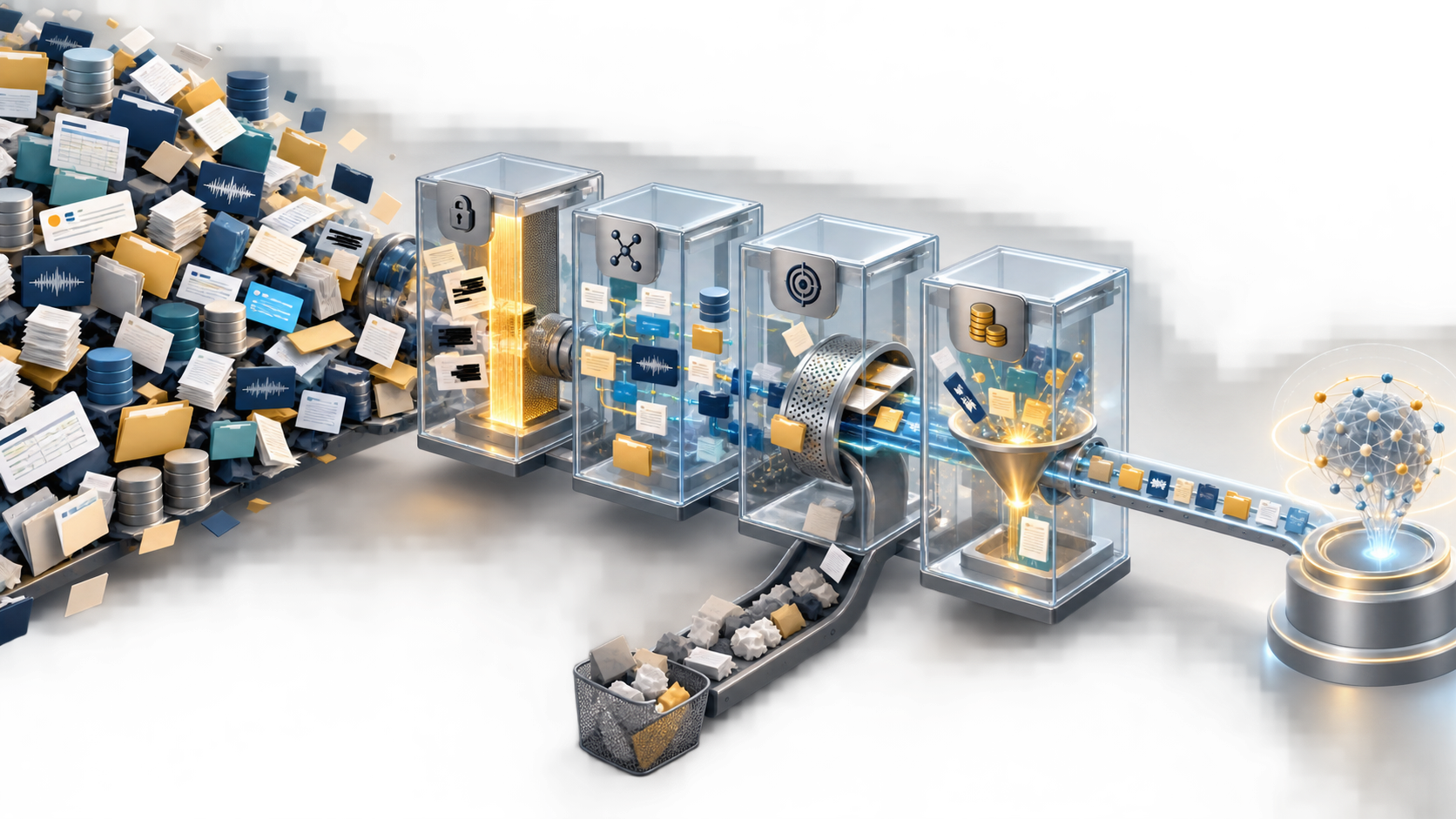
Your support team probably does not need another chatbot that summarizes a ticket on command. It needs help with the operational work surrounding every ticket: finding why escalations changed, keeping knowledge accurate, correcting broken automations, coordinating incident communication, and showing human reps what deserves attention next.
An operator AI agent can take on that work, but only if you design it as an operating system for customer operations rather than a conversational layer over support APIs. The useful version closes the loop from signal to diagnosis to tested change. The dangerous version produces plausible commentary and receives permission to act before it has earned trust.
Define the job as a closed loop, not a chat box
A customer-facing AI agent handles an individual customer’s request. An operator agent works on the system around those requests: conversations, help content, automation configuration, performance data, incident workflows, and the human queue.
That distinction changes the product requirement. The agent is not complete when it answers a question such as why escalations increased. It is complete when it can investigate the increase, identify a supported cause, determine which operational object needs attention, prepare a change, test that change where possible, and route it to the right person for approval.
- Observe: Detect a question, anomaly, scheduled task, failed conversation, release brief, or incident.
- Diagnose: Select the relevant metrics and attributes, inspect representative conversations, and separate recurring patterns from isolated cases.
- Locate the control point: Determine whether the problem sits in knowledge, guidance, a procedure, a data connector, an automation rule, or a human workflow.
- Propose: Produce a concrete artifact such as an article diff, configuration change, procedure, incident audience, or prioritized queue.
- Verify: Run a simulation or another appropriate check and expose failures, edge cases, and remaining uncertainty.
- Act and learn: Apply an approved change, record what happened, and monitor the affected outcome for regression.
Consider the prompt, Why did escalations rise last week? A reporting copilot returns a chart. A useful operator identifies which escalation definition applies, segments the change, reads relevant conversations, finds the repeated cause, checks whether the corresponding help content or automation is deficient, and prepares the smallest defensible correction. That progression from an operational question to an actionable proposal is already possible across analysis, knowledge maintenance, automation building, and human support workflows.
Write the acceptance criteria around that complete handoff. Require the evidence used, the proposed artifact, the scope of impact, the verification result, the named reviewer, and any action the agent is forbidden to take. If the output still leaves an operations manager rebuilding the context manually, you have a chat assistant, not an operator.
Build reliability below the model and price that work honestly
A foundation model with API access can make a persuasive prototype. It can query ticket data, summarize conversations, and write a report that appears coherent. The hard part begins when different workspaces use different fields, configurations, workflows, permissions, and definitions of success.
The model should not have to rediscover your operating rules on every run. Encode those rules in purpose-built tools and reusable skills. A tool performs one bounded operation, such as retrieving a conversation, searching knowledge, or running a defined report. A skill coordinates several tools to complete a business job, such as debugging a failed resolution or rolling a policy change through the help center.
Operator’s production architecture is described as having more than 50 tools and 10 multi-step skills. Those counts are not targets to copy. They illustrate how quickly the hidden surface area grows once an agent must do dependable operational work instead of demonstrating a few API calls.
| System layer | Job it must perform | Failure you should test for | Control to add |
|---|---|---|---|
| Semantic retrieval | Find content by meaning, not only exact words | Irrelevant or incomplete evidence produces a confident diagnosis | Evaluate retrieval against real support questions and known content gaps |
| Attribute awareness | Know which metrics, fields, and custom attributes are populated and meaningful | The agent invents a pattern from sparse or unused fields | Expose field definitions, coverage, allowed joins, and missing-data signals |
| Atomic tools | Perform narrow reads or writes predictably | A broad API wrapper allows an unintended query or change | Use typed inputs, constrained scopes, explicit permissions, and structured results |
| Domain skills | Chain tools according to a repeatable customer-operations method | The same request follows a different process on each run | Define required steps, exit conditions, evidence, and escalation paths |
| Review interface | Turn reasoning into charts, diffs, tests, and proposals | A reviewer approves a wall of prose without understanding the change | Render the decision in the format appropriate to the object being changed |
Semantic retrieval and attribute awareness deserve particular attention. Retrieval grounds the agent in the content that can actually answer the question. Attribute awareness stops it from treating every available field as equally meaningful. A custom field that exists but is almost never populated should not become the foundation of an operational recommendation.
Give every tool a contract before the model can call it:
- The business purpose and the questions it is allowed to answer.
- The read and write permissions it requires.
- The preconditions that must be true before it runs.
- The evidence and identifiers it must return.
- Its behavior when data is missing, ambiguous, stale, or inconsistent.
- The audit event, approval requirement, and rollback path for a write.
Evaluate build versus buy beyond the demonstration
A proof of concept establishes that a model can produce a plausible answer with your data. It does not establish that the answer is grounded, that the proposed action is safe, or that the system will behave consistently as configurations change.
For a build decision, include retrieval tuning, permission design, tenant isolation, tool maintenance, skill development, evaluation data, observability, proposal interfaces, audit history, rollback behavior, and on-call ownership. Also ask who will update the agent when a support object, metric definition, product policy, or API changes. If these responsibilities do not have durable owners, the internal agent will age like any other unsupported operations system.
For a buy decision, ask the vendor to demonstrate your difficult cases rather than its preferred prompts. Use a conversation with conflicting evidence, an unused custom attribute, an outdated localized article, a misconfigured rule, and a proposed write with a wide blast radius. Inspect the evidence, tool trace, permissions, diff, test result, and audit record. The quality of the generated prose is one of the least informative parts of that evaluation.
Put a proposal boundary around every material action
Moving from analysis to live changes is a different class of production problem. A wrong summary wastes time. A wrong configuration can degrade customer outcomes across every conversation that matches it. An incorrect outbound message cannot be recalled after customers have read it.
I would give the agent autonomy according to consequence, not according to how confident its language sounds:
- Read: Search content, inspect conversations, calculate approved metrics, and assemble evidence. Run these tasks autonomously within access controls and log every operation.
- Recommend: Explain a root cause or rank an opportunity. Attach the underlying conversations, segments, fields, and assumptions so a person can challenge the conclusion.
- Prepare: Draft an article, procedure, rule, connector configuration, customer response, or queue. Save it as a proposal with no production effect.
- Change: Publish, configure, send, or otherwise alter the live operation only after the required reviewer sees the exact scope and explicitly approves it.
A proposal is a structured change object, not a paragraph asking for trust. Production-grade operator systems can present reviewable diffs before applying changes, allowing the reviewer to accept, reject, or refine the work. The same principle should govern any operator implementation.
Your review screen should answer six questions without forcing the approver into another tool:
- What object will change?
- What exact fields, passages, rules, or recipients are affected?
- What evidence connects the observed problem to this change?
- What test ran, and which cases failed or remained untested?
- Who must approve, and which permission will execute the action?
- How can the change be reversed, and what cannot be reversed?
Customer outreach needs the strictest treatment because sending is effectively irreversible. Do not approve a batch from a conversational summary that hides the audience. The safe alternative is a preview containing the resolved customer list, inclusion logic, exclusions, exact message variants, delivery channel, and approver. Start by allowing the agent to prepare that package while a person performs the send.
Simulation also needs a visible place in the proposal. If the agent modifies an automation procedure, show which representative conversations were tested, the expected outcome for each, the observed outcome, and why any mismatch occurred. An overall pass label is not enough to reveal an important edge case.
Human approval is not a permanent substitute for system quality. If reviewers routinely accept proposals without inspecting them, the control has become ceremonial. Track corrections, rejections, rollbacks, and the evidence reviewers open. Use those signals to improve the relevant retrieval rule, tool, skill, or interface.
Roll out workflows in increasing order of consequence
Choose the first workflow by its operating characteristics. A strong starting candidate recurs frequently, consumes expert attention, has accessible evidence, produces a clear artifact, and has a named reviewer. It should also allow the agent to be useful before it receives broad write permission.
A practical rollout sequence looks like this:
- Recurring operations analyst. Give the agent one standing question, such as what changed in escalations or automation performance. Define the metric, comparison period, relevant segments, evidence requirements, and report destination. Require links to representative conversations and allow the conclusion that no action is warranted. Compare its reasoning with an experienced operator’s review until the failure modes are understood.
- Knowledge steward. Feed it a release brief or policy change. Ask it to find affected help content, identify missing coverage, and prepare article diffs in the required voice and format. Include localized variants where they exist. The reviewer should validate product behavior, instructions, links, policy language, and whether the proposed set of pages is complete before publishing.
- Automation maintainer. Start with known failed conversations. Ask the agent to distinguish a content gap from a rule, procedure, guidance, or connector problem; prepare the smallest correction; define triggers and edge cases; and simulate the result. Do not grant live configuration access until the tool trace and tests make the diagnosis reproducible.
- Human-operations coordinator. Use the agent to assemble an incident audience, draft targeted responses, prepare coaching evidence, or prioritize a rep’s queue. These workflows can save substantial coordination time, but they touch customer communication and employee decisions. Begin in preparation mode, expose the selection logic, and expand autonomy only after identity, permission, review, and audit controls have been exercised.
This sequence is a risk ordering, not a universal maturity model. A read-only weekly analysis is easier to inspect and reverse than an outbound incident campaign. A knowledge proposal has a reviewable artifact. A live automation change affects future conversations, while customer communication may create an immediate and irreversible consequence. Move forward when the evidence and controls for the next class of action are ready, not merely because the previous feature launched.
Measure the completed loop, not chat activity
Prompt counts and conversation volume tell you that people opened the product. They do not tell you that customer operations improved. Build the scorecard around the operational loop:
- Diagnostic quality: Whether the proposed root cause survives expert review, whether its evidence supports the conclusion, and how often factual correction is required.
- Operational throughput: Time from a detected signal to a reviewed proposal and from an approved proposal to a verified change.
- Artifact quality: Acceptance, revision, rejection, and rollback patterns for knowledge, automation, configuration, and communication proposals.
- Customer outcome: Resolution, escalation, repeat contact, and sentiment for the affected topic after the change, interpreted alongside volume and case mix.
- Safety: Permission denials, attempted out-of-scope actions, failed simulations, unauthorized writes, rollbacks, and missing audit events.
- Human leverage: Expert time spent collecting evidence, recreating context, drafting the artifact, and reviewing the final proposal.
Do not make automation rate the only goal. A higher rate can coexist with poor resolutions or avoidable escalations. Treat it as one diagnostic measure and pair it with customer outcomes, correction rates, and topic-level regressions.
Create an evaluation set from real operating conditions: known content gaps, misconfigured rules, legitimate escalations, sparse attributes, conflicting evidence, localized content, and incidents with precise audience criteria. Give each case an expected outcome, required evidence, allowed tools, and forbidden action. Re-run the set when the model, retrieval system, tool, skill, permissions, or support configuration changes.
Scheduled work is where the leverage begins to compound. An operator can run recurring analysis and deliver the resulting report without waiting for a manager to remember the question. Keep an owner on every scheduled job, however. That owner should know where failures appear, when the task last completed, which data it used, and how to pause it.
Key takeaways
- An operator agent improves the system around customer conversations; it is not simply another customer-facing bot.
- The product boundary should cover observation, diagnosis, proposal, verification, approval, action, and monitoring.
- Reliable behavior comes from grounded retrieval, attribute awareness, bounded tools, encoded domain skills, and structured review surfaces.
- Grant autonomy by consequence: broad freedom to inspect approved data, tighter controls to prepare changes, and explicit approval for production writes.
- Roll out recurring analysis before knowledge changes, automation configuration, and customer communication unless your own risk profile clearly supports another order.
- Measure supported diagnoses, accepted artifacts, customer outcomes, human time, and safety events rather than prompt volume alone.
Your next step is to choose one recurring operational question and write down the evidence it requires, the artifact a good answer should produce, the person who will review it, and the actions the agent must not take. Once that loop works reliably, add one downstream proposal. That is a much stronger foundation for an operator agent than beginning with an open-ended prompt and a broad API key.