
You have an agent handling research, documents, or app workflows, and the next roadmap conversation is already jumping to robots. The useful question is not whether the two categories are the same. It is which parts of your agent stack transfer, which parts become dangerous in the physical world, and what evidence you need before raising autonomy.
The core product logic transfers surprisingly well: give the system a goal, let it observe state, permit a bounded set of actions, verify the result, and recover or escalate when reality differs from the plan. The operating environment does not transfer. If you separate those layers now, your digital-agent work can become preparation for robotics instead of a collection of disconnected automation experiments.
One agent loop can serve two very different environments
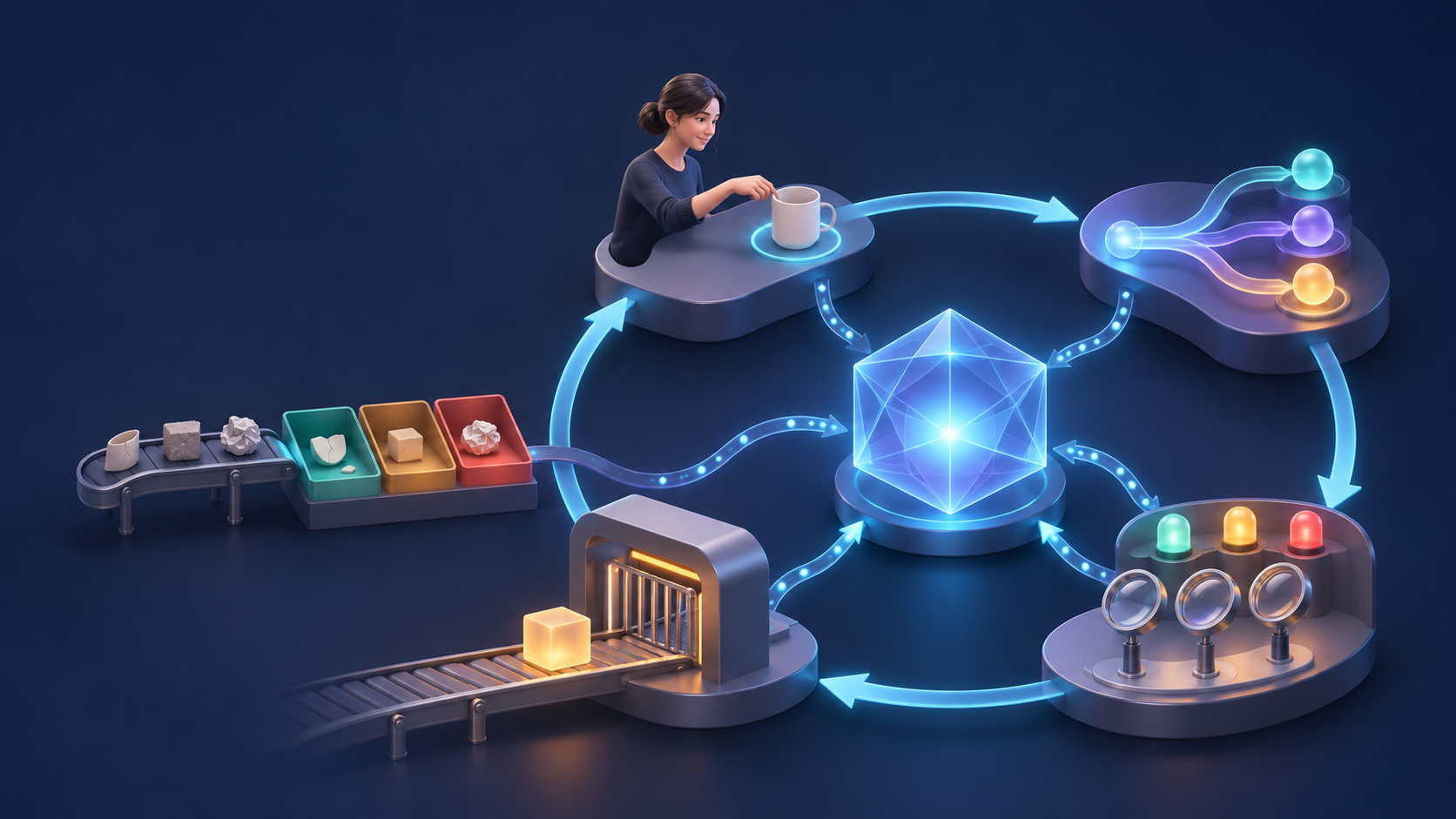
An agent is best understood as a control loop, not a chat interface. It receives a goal, gathers the relevant state, chooses an action, uses a tool, observes what changed, and decides whether to continue. A useful implementation makes each part visible:
- Translate the request into a specific outcome.
- Inspect the current state before acting.
- Select an allowed tool or action.
- Execute one step and capture what happened.
- Compare the new state with the expected state.
- Continue, try a recovery path, or hand control to a person.
That loop describes an agent updating a CRM record as easily as a robot pressing a control. The difference lies in what the system can observe, what its actions cost, and how safely it can undo a mistake.
The possibility of transfer is no longer merely conceptual. A coding agent with no additional robot-specific training reportedly completed 24 of 25 bounded real-world trials. In a separate kitchen-arm experiment, a general model missed a small rice-cooker tab and then narrowed the likely press location through a binary-search-like recovery process until the cook light provided confirmation.
Those results are promising demonstrations, not evidence that a general model is ready to run an unconstrained workplace or kitchen. They do show why digital-agent capability matters to robotics. Planning, tool selection, feedback interpretation, and recovery can be reusable model capabilities even when the tools happen to be motors rather than APIs.
| Product dimension | Digital agent | Robotic agent |
|---|---|---|
| State | Documents, application screens, records, messages, and API responses | Camera or sensor observations, object positions, joint state, and controller feedback |
| Action | Read, draft, calculate, search, update, send, or trigger a workflow | Move, grasp, press, place, navigate, or operate equipment |
| Success signal | A validated record, accepted transaction, delivered message, or completed workflow state | A sensor change, object pose, control indicator, or verified physical state |
| Recovery | Retry a tool, refresh context, choose another integration, reverse a write, or escalate | Reobserve, reposition, adjust force or trajectory within limits, return to a safe pose, or stop |
| Primary constraint | Permissions, data integrity, privacy, and downstream business consequences | Those same constraints plus physical safety, calibration, and environmental variability |
| Rollback | Sometimes available through drafts, version history, or compensating transactions | Often incomplete because the physical world has already changed |
Use that separation when you design the platform. Goal decomposition, context management, policy checks, action traces, evaluation harnesses, and escalation logic belong in a reusable agent layer. Perception, calibration, low-level control, physical constraints, and hardware-specific recovery belong in the environment layer. Mixing them makes every new task a custom project and makes failures difficult to diagnose.
The real boundary of autonomy is recoverability
First-attempt accuracy is not enough to decide whether an agent deserves more authority. You also need to know whether it can detect a miss, distinguish a recoverable error from a dangerous one, and stop before a local mistake becomes a downstream incident.
A digital failure can look harmless while changing customer data, sending an incorrect message, or triggering another automation. A physical failure is often more visible, but it can be harder or impossible to reverse. In both environments, the product boundary should be drawn around consequence and recovery, not around how human-like the interface feels.
Write an action contract before you choose the model
For each agent task, create a short action contract. It should answer the questions that a prompt normally leaves implicit:
- Outcome: What exact state must exist when the task is complete?
- Evidence: What observation proves that state exists? A generated answer is not proof unless generating text is itself the job.
- Allowed actions: Which tools, records, applications, movements, or physical zones may the agent use?
- Prohibited actions: What must never happen, even if it appears to help achieve the goal?
- Operating budget: How many retries, how much elapsed time, what level of spend, or what range of motion may be used before the system stops?
- Recovery: Which failures may trigger another attempt, and which require a rollback, safe stop, or human decision?
- Escalation package: What context, action trace, current state, and recommended next step must be handed to the operator?
For an email agent, the contract might allow reading a thread and drafting a response while prohibiting sending until a person confirms it. For a kitchen robot, it might allow another observation and a bounded repositioning attempt while requiring a safe stop when the expected indicator does not change. These are not implementation details to add after the pilot. They are part of the product definition.
Raise permissions one consequential action at a time
A practical autonomy ladder looks like this:
- Observe: The agent reads state and produces an audit trace but takes no action.
- Recommend: It proposes an action and explains the evidence behind it.
- Execute reversible work: It creates drafts, simulations, temporary records, or other outputs that can be discarded safely.
- Request approval at the consequential step: It prepares the work but pauses before sending, committing, purchasing, deleting, or moving into a higher-risk physical state.
- Operate unattended inside a narrow envelope: It acts only on task variants and permissions that have passed the relevant evaluation and escalation tests.
Promotion should depend on evidence at the current permission level. Do not jump from recommendation to unattended execution because a polished demonstration succeeded. Averages can hide the one failure mode that determines whether the task is safe to automate.
For robotics, the safety envelope must be enforced outside the language or planning model. Workspace boundaries, controller limits, collision handling, and an independent stop should not depend on the model remembering an instruction. The applicable limits must be set and validated by people qualified to assess the specific hardware and environment. A model can plan within that envelope; it should not be the sole mechanism protecting people or equipment.
Evaluate the failure lifecycle, not the demonstration
A useful agent evaluation does more than record whether the final task passed. It reveals what happened between the request and the result. Otherwise, an agent that succeeded immediately and one that wandered through risky actions before getting lucky receive the same score.
Track these measures separately for each important task type:
- Verified completion: Did an independent signal confirm the required end state?
- First-attempt success: Did the initial plan work without retrying or changing strategy?
- Self-recovery: After a detectable failure, did the agent reach the correct outcome without human intervention?
- Time and action count: How long did verified completion take, and how much unnecessary activity occurred?
- Intervention rate: How often did a person need to take over, and at which step?
- Forbidden-action attempts: Did the policy layer block actions that should never have been attempted?
- Failure severity: Was the result a harmless no-op, a reversible error, an incorrect external action, or a safety event?
- Transfer performance: What happened when wording, layout, object position, tool availability, or another irrelevant surface detail changed?
- Cost per verified outcome: What did model usage, tools, supervision, correction, and operational delay cost for completed work?
Do not compress all of this into one score. Product leaders need the distribution. A higher completion rate may be unacceptable if it comes with more consequential errors, longer recovery loops, or greater operator burden.
Test the situations that expose brittle behavior
Your evaluation set should contain ordinary cases and deliberate disturbances:
- An unambiguous task with all expected tools available.
- An incomplete or contradictory request that should trigger clarification.
- A tool, sensor, or application response that is delayed or unavailable.
- A partially completed task that should resume rather than restart.
- A changed interface, object position, field name, or document layout that preserves the underlying goal.
- A misleading intermediate signal that must not be mistaken for final success.
- A request that conflicts with the action contract and should be refused or escalated.
- A failed first attempt that is safe to retry.
- A failed first attempt that must not be retried automatically.
For every run, retain the initial state, model and tool versions, chosen actions, tool responses, policy decisions, recovery attempts, final evidence, and human interventions. That trace tells engineering whether the failure came from planning, missing context, integration behavior, perception, control, or an incorrect success check.
Ask who supplied the apparent intelligence
When you review an agent or robotics demonstration, separate the capability supplied by the environment from the capability supplied by the model. Ask:
- Was the task sequence hard-coded, demonstrated by a person, retrieved from a library, or generated during the run?
- Which actions were available, and were they already tailored to this exact task?
- How much of the environment was arranged in advance?
- Were failed runs, resets, or manual corrections excluded from what you saw?
- Did the model recognize success independently, or did an external script declare completion?
- Would the behavior survive a new object position, interface state, or wording of the same request?
- What happens after the first miss, and when does a person have to intervene?
This matters because model releases can change robotic performance even when the hardware stays fixed. A newer Claude version reportedly more than doubled its predecessor’s score on the same simulated robot. That is a meaningful result in a bounded evaluation, but it is not permission to assume every model upgrade improves every task. Pin model versions, replay the same evaluation suite, inspect regressions by failure type, and promote the new version only after it passes the action contract.
Build a capability portfolio instead of a robot moonshot
The digital-agent market already spans email, scheduling, research, reports, office documents, spreadsheets, and cross-application automation. That breadth makes vendor-first planning tempting: select an agent, connect accounts, and look for uses afterward. It usually leaves the hard product questions unanswered.
Start with a task portfolio. Rank candidate tasks by outcome clarity, frequency, consequence of error, reversibility, availability of a success signal, and current human effort. The best first task is not necessarily the largest cost center. It is the one where you can permit useful action while still verifying the outcome and containing failure.
Then use this sequence:
- Select one bounded digital workflow. Choose a task with a clear trigger, a named owner, accessible tools, and an observable end state.
- Capture the human baseline. Record the steps, exceptions, completion evidence, handoffs, and correction work. Without that baseline, an agent can appear faster simply by omitting controls.
- Write the action contract and evaluation set. Do this before comparing models or vendors so that every option faces the same job.
- Keep the architecture modular. Separate the model, tools, business context, permission policy, success verifier, trace store, and escalation path. You should be able to replace one without rebuilding the rest.
- Maintain a failure ledger. Group failures by planning, context, tool use, policy, verification, and recovery. Prioritize recurring mechanisms rather than patching individual prompts.
- Test transfer in a sandbox. Change irrelevant surface details while holding the objective constant. If the system only works on the original screen, document, arrangement, or phrasing, you have a scripted demo rather than a reusable capability.
- Introduce physical action only inside an independently enforced safety envelope. Begin with constrained objects, locations, permissions, and supervised recovery. Keep the same traces and success-verification discipline used for digital work.
- Re-run the portfolio after model or controller changes. Treat upgrades as new releases with possible improvements and regressions, not as automatic replacements.
Own the task definition even when you buy the technology
My default build-versus-buy rule is simple: rent interchangeable capability and own the control points that encode your business.
- Often sensible to buy: foundation-model access, commodity productivity integrations, standard automation connectors, established robot hardware, and specialist controllers.
- Important to own: the task definition, domain context, permission policy, evaluation cases, success verifier, audit trail, escalation design, and business measurement.
A vendor can provide a capable model or robot. It cannot decide which customer action is too consequential to automate, which exceptions define acceptable service, or what evidence your organization requires before calling work complete.
Give every pilot a task card and an accountable operator
Put one task card in the roadmap for every agent capability. Include the trigger, verified outcome, allowed actions, prohibited actions, retry policy, escalation owner, current human baseline, evaluation results, and business measure. The card should be readable by product, engineering, operations, and risk owners without translating model terminology.
Assign ownership by decision. Product owns the outcome and autonomy boundary. Engineering owns integration behavior, reliability, observability, and version control. The domain operator validates exceptions and escalation quality. For physical systems, a qualified safety owner approves the external safety envelope. If nobody is accountable for diagnosing a failed run and deciding whether it can resume, the task is not ready for unattended operation.
Key takeaways
- Digital agents and robots share a goal-action-feedback-recovery loop, but they require different tools, constraints, and safety mechanisms.
- Design around verified outcomes and recoverability. A plausible response or completed motion is not proof that the job succeeded.
- Increase autonomy by permission level, not by enthusiasm for a model demonstration.
- Evaluate first attempts, self-recovery, intervention, forbidden actions, failure severity, transfer, and cost separately.
- Keep physical safety outside the model and independently enforced.
- Own your task definitions, permission policies, evaluations, traces, and escalation paths even when models, software agents, controllers, or hardware are purchased.
Your next decision does not need to be digital agents or robotics. Choose one bounded workflow and write its action contract, success verifier, and failure tests before selecting the technology. When you can explain how the agent detects a miss, recovers safely, escalates with context, and proves the result, you have built a capability that can travel from software into the physical world. Until then, additional autonomy mainly creates a larger consequence for an error you cannot yet see.
References
- Nate Jones’s Substack — A Coding Agent With No Extra Robot Training Finished 24 of 25 Real-World Trials
- Substack AI Topic — 15 AI Agents That Could Give You Back Hours Every Week in 2026