Month: March 2026

  • Bad Advice from Your AI Clone? Ethics, IP, and How Product Leaders Protect Quality

    Bad Advice from Your AI Clone? Ethics, IP, and How Product Leaders Protect Quality

    What happens when an AI starts giving advice in your voice—advice you’d never actually give? I’ve been thinking a lot about that question, and this conversation hit home for me as a product leader navigating the fast-evolving reality of AI “clones.”

    Listen to this episode on: https://open.spotify.com/episode/7DNDIlIimwbbMOytArewRp?ref=producttalk.org | https://podcasts.apple.com/kh/podcast/bad-advice/id1794203808?i=1000756914818&ref=producttalk.org. Prefer video? Watch on YouTube: https://www.youtube.com/embed/RF4BwaeMMlg?feature=oembed

    The episode examines AI “clones” built from podcast transcripts and public content—where the experimentation feels exciting, where it crosses ethical lines, and what happens when mediocre AI outputs get attributed to real people. The tension is real: when a bot confidently answers in your style but misses the nuance, “it’s not me” becomes more than a disclaimer—it’s a reputational defense.

    We dig into the messy parts: IP ownership of open-sourced transcripts, the role of pirated books in LLM training sets, rising inference costs, and the uncomfortable economic question: if anyone can prompt “act like Teresa,” how do creators make a living? In my own decision-making, I look for clear consent, guardrails that prevent impersonation, and transparent UX that never confuses a synthetic perspective with a human expert.

    This isn’t anti-AI. It’s a nuanced conversation about quality, consent, and remembering there are real humans behind the ideas.

    Here’s how I translate the key takeaways into practice. Using AI for perspective is fine—equating it to the real person isn’t. Free-feeling AI outputs still rely on someone’s work. Expertise is more than past content—it’s context, judgment, and evolution. If someone’s work influences you, find a way to support them. These principles help teams benefit from gen ai without eroding trust or the creator ecosystem.

    “Technically possible” doesn’t mean “ethically okay.” My AI Strategy playbook includes privacy-by-design, clear data governance on training materials, and a bright line between inspiration and impersonation. When we ship AI features, we label synthetic outputs, avoid mimicking living experts without permission, and create paths to compensate or promote the humans whose thinking underpins the experience.

    I’ve also tested the “act like X” pattern to stress-test product quality. Even when outputs sound plausible, they rarely capture the expert’s mental models, trade-offs, or the evolution of their thinking—especially in complex product discovery work. That gap is the difference between average AI text and expert product management leadership.

    If you listen, consider a few reflection prompts: Have you ever used AI to “act like” someone you admire? Could you tell whether the output matched that person’s actual thinking? How do you decide what’s ethically okay when using public content in LLMs? And how can we support creators while still embracing new tools?

    Resources & Links you may find helpful: Follow Teresa Torres: https://ProductTalk.org; Follow Petra Wille: https://Petra-Wille.com; Delphi.ai (AI bot platform discussed): https://www.delphi.ai/?ref=producttalk.org; Lenny’s Podcast: https://www.lennysnewsletter.com/podcast?ref=producttalk.org; ChatGPT: https://chatgpt.com/?ref=producttalk.org; Petra’s Coaching Packages: https://www.petra-wille.com/coaching-packages?ref=producttalk.org; Teresa’s Product Talk: https://www.producttalk.org/; Teresa’s book Continuous Discovery Habits: https://www.producttalk.org/continuous-discovery-habits/; Lenny’s open-sourced podcast transcripts: https://www.dropbox.com/scl/fo/yxi4s2w998p1gvtpu4193/AMdNPR8AOw0lMklwtnC0TrQ?rlkey=j06x0nipoti519e0xgm23zsn9&e=1&st=ahz0fj11&dl=0&ref=producttalk.org

    Have thoughts on this episode or practices that have worked in your org? Share them below—I’m keen to learn how other teams are balancing innovation with integrity.


    Inspired by this post on Product Talk.


    Book a consult png image
  • Meet Amplitude’s Always‑On AI Analysts: Instant Answers Without Dashboards or Reports

    Meet Amplitude’s Always‑On AI Analysts: Instant Answers Without Dashboards or Reports

    For years, I’ve watched product, growth, and data teams burn cycles stitching together manual dashboards and reports, then slogging through replay review just to validate a hunch. That overhead slows discovery and delays decisions. The promise here is different: "Discover how Amplitude AI Agents help product, growth, and data teams turn questions into action without manual dashboards, reports, or replay review." As someone obsessed with decision velocity and evidence-based product strategy, that shift is exactly what I’ve been waiting for.

    In practice, I think about "Amplitude AI Agents" as always-on data analysts embedded in our workflow. Instead of queuing requests or context-switching into tooling, I can ask targeted questions, get synthesized insights, and move directly to action. This is a powerful example of agentic AI meeting behavioral analytics in a unified analytics platform—removing friction between inquiry and impact while keeping teams focused on outcomes, not artifacts.

    What changes for my day-to-day? I can interrogate customer behavior in real time, pressure-test hypotheses from discovery interviews, and quickly understand whether activation, retention, or monetization is the current constraint. If I’m probing a driver tree for activation or a retention analysis for a specific cohort, I can get to a decision faster—without waiting on someone to build a bespoke dashboard. That means more cycles spent shaping product strategy and fewer sunk into report wrangling.

    This matters beyond speed. When product, growth, and data leaders anchor discussions in the same source of truth, we shorten the distance from signal to decision. That alignment is the backbone of product-led growth and continuous discovery: shared context, faster feedback loops, and clearer trade-offs. It also reduces the long tail of analytics debt—those one-off reports and stale views that quietly accumulate across teams.

    Of course, adopting any AI workflow in analytics demands governance. I hold these systems to the same bar I set for my teams: clarity of assumptions, consistent metric definitions, and auditable reasoning. Pairing "Amplitude analytics" with strong data governance, CI/CD for analytics definitions, and lightweight evals helps ensure the recommendations we act on are reliable, reproducible, and explainable. AI should accelerate our judgment, not replace it.

    The strategic shift is simple and profound: move from building dashboards to making decisions. With always-on analysis, we can spend less time instrumenting analytics theater and more time delivering customer value. That is how we translate insights into impact—and why I’m excited to operationalize this capability across our product trios and go-to-market partners.


    Inspired by this post on Amplitude – Best Practices.


    Book a consult png image
  • How I Structure Documentation for AI and Humans: Battle‑Tested, SEO‑Smart Tactics That Scale

    How I Structure Documentation for AI and Humans: Battle‑Tested, SEO‑Smart Tactics That Scale

    Every week, I coach product and documentation teams on a simple truth I keep pinned above my desk: "AI is reading your documentation! Learn tips from the Amplitude docs team about how to structure your documentation for both human and AI audiences." That line captures the shift we’re all living through—our docs must now serve customers, support engineers, and increasingly, LLMs powering chat, search, and in‑product help.

    My AI strategy for documentation starts with intent. I map the core questions users ask at activation, onboarding, escalation, and renewal, then shape information architecture to reduce ambiguity. This helps humans find answers faster and helps LLMs retrieve the right chunks with higher precision—a win for UX writing, product-led growth, and support deflection.

    Structure beats style when AI is in the loop. I rely on semantic headings (H1–H3), consistent slugs, stable anchors, and one‑topic pages that can stand alone. Short paragraphs, scannable summaries, and canonical references reduce duplication and improve retrieval quality. Treat docs-as-code with CI/CD so changes are reviewed, versioned, and shipped reliably—documentation deserves the same rigor as product releases.

    Chunking matters for LLMs. I design content for context window management: one concept per section, tight procedures with numbered steps, and FAQs that mirror real queries. Glossaries define canonical terms and accepted synonyms so retrieval-first pipelines match user language without fragmenting meaning. Error messages and parameter names appear verbatim to strengthen search and grounding.

    Metadata is a multiplier. I add clear titles, descriptions, last‑updated dates, product area tags, and audience labels (admin, developer, analyst) to boost SEO and machine readability. Stable IDs for components, examples, and API objects improve deep linking and evaluation. Where appropriate, I include structured examples that align with prompt engineering best practices so AI assistants can extract inputs, outputs, and constraints cleanly.

    Quality is measured, not hoped for. I pair content audit checklists with analytics to see what’s searched, where users pogo‑stick, and which articles drive successful task completion. Tools like Amplitude analytics reveal gaps and dead‑ends, while lightweight evals (answer accuracy, grounding rate, latency) ensure LLMs retrieve the right doc chunks at the right time.

    Consistency is a feature. I standardize terminology across UI, API, and docs, and I avoid synonym sprawl that confuses both readers and LLMs. Page intros state the job-to-be-done; conclusions link to adjacent tasks; and deprecation notes are explicit with forward paths. This coherence lowers cognitive load and improves both RAG performance and human trust.

    Governance keeps it scalable. I assign owners per section, define SLAs for updates, and automate checks for broken links, orphaned pages, and outdated screenshots. Redirect rules avoid 404s, and version banners prevent LLMs from mixing deprecated guidance into current answers—small details that cumulatively protect customer experience.

    If you’re just getting started, begin with three moves: clarify intents, restructure pages into atomic, linkable units, and add metadata that reflects how customers actually search. From there, tighten your retrieval-first pipeline and run regular evals. The payoff is durable: faster time to value for users, lower support load, and AI assistants that answer accurately, confidently, and consistently.


    Inspired by this post on Amplitude – Perspectives.


    Book a consult png image
  • Docs-as-Code Leadership at Scale: How Jeff Scattini Elevates End-to-End Product Documentation

    Docs-as-Code Leadership at Scale: How Jeff Scattini Elevates End-to-End Product Documentation

    Great products aren’t just shipped; they’re understood. In my product management practice, the difference between a good release and a great one often comes down to disciplined documentation that moves at the speed of delivery. That’s why the docs-as-code approach has become a cornerstone of how I build, lead, and measure product experiences across teams.

    As I reflect on leaders who set a high bar in this craft, one description stands out: "With years of experience as Senior Documentation Manager, Jeff leads teams and oversees the end-to-end creation of documentation using docs-as-code methodology." That concise statement captures a model I deeply respect—one that treats documentation as a first-class citizen in the product lifecycle.

    In practice, docs-as-code integrates documentation into CI/CD pipelines, version control, and peer review workflows—exactly how we ship software. This elevates quality, enforces consistency, and accelerates responsiveness to change, all while enabling rigorous content audit and UX writing standards. When documentation evolves with code, it becomes discoverable, testable, and measurable—key traits for scalable product management leadership.

    The downstream impact is tangible. Users ramp faster through onboarding, in-app guides, and product tours because the narrative aligns with the product’s true state at any given commit. Support tickets drop, developers work with greater clarity, and PMs gain the feedback loops needed for continuous discovery. In a product-led growth motion, this clarity compounds—reducing time-to-value and enabling teams to ship confidently.

    Equally important is the leadership pattern behind the methodology: aligning product, engineering, and customer-facing teams around shared truths. I’ve seen empowered product teams operate at their best when documentation is embedded in planning, sprint reviews, and release gates. This creates a single source of truth that scales knowledge, preserves intent, and shortens the path from decision to delivery.

    For me, the standard expressed above isn’t just a role description—it’s a blueprint for operational excellence. When we manage documentation with the same rigor as code, we build trust at every touchpoint and create the conditions for sustained product velocity. That’s the level of clarity and execution I strive to foster across every product line.


    Inspired by this post on Amplitude – Perspectives.


    Book a consult png image
  • Kaizen for the AI Era: Tiny Daily Wins That Build Smarter, Scalable Customer Support

    Kaizen for the AI Era: Tiny Daily Wins That Build Smarter, Scalable Customer Support

    Every day, I challenge my teams to make one small, meaningful improvement—something so lightweight it’s impossible to ignore and easy to repeat. That tiny daily motion compounds, and over time it reshapes customer experience, operational quality, and team culture.

    That’s the essence of Kaizen, the Japanese philosophy of continuous improvement. Developed in post-war Japan and popularized by companies like Toyota, Kaizen proves that small, steady changes lead to significant long-term results. In product management and customer support, this approach transforms big ambitions into daily behaviors that actually stick.

    Crucially, Kaizen isn’t passive or unstructured. It thrives on three principles I reinforce across my org. First, small changes reduce resistance—when you lower the activation energy, teams move faster. Second, improvement is continuous, not occasional; instead of waiting for quarterly reviews or major releases, you ask: “What can we improve right now?” Third, everyone participates—the people closest to the work are best positioned to improve it. That’s how momentum spreads.

    In practice, the cycle is simple: identify a small problem, test the change, measure the result, refine, and repeat. The point isn’t radical transformation in a single swing; it’s steady progress guided by data and observation—a rhythm that aligns beautifully with eval-driven development and continuous discovery.

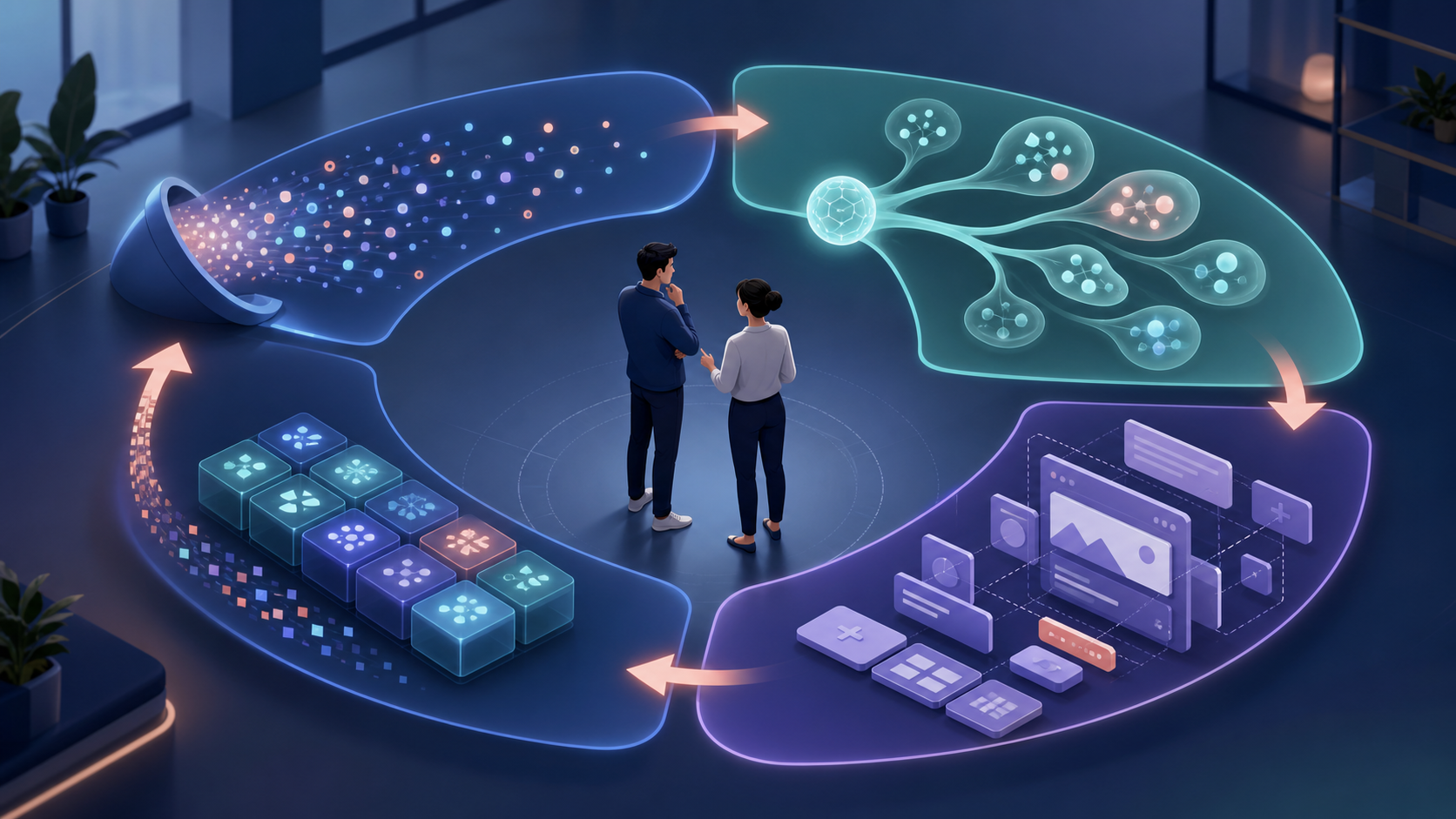
    At Intercom, we apply this same philosophy to how we manage our Agent Fin through a process we call the “Fin Flywheel”. Here’s how this works.

    Train: Teach Fin how to handle and resolve the most complex customer queries.

    Test: Run fully simulated customer conversations from start to finish to see exactly how Fin will behave before going live.

    Deploy: Launch Fin across all channels so customers get consistent support wherever they reach out.

    Analyze: Use AI-powered insights to review and improve Fin’s performance so it can deliver better customer experiences.

    This isn’t a one-time setup; it’s a continuous loop where every interaction feeds ongoing improvement. Rather than deploying AI and assuming it will perform as expected, improvement is built into the system itself. The more Fin is used, the better it gets. That’s the hallmark of agentic AI done right—tight feedback loops, purposeful conversation design, and clear Agent Analytics that illuminate what to tune next.

    But continuous improvement doesn’t stop with AI. Within our Human Support operations, I emphasize the same mindset that drives great LLMs for product managers: you instrument the experience, learn from real usage, and close gaps fast. We operate with a simple mindset: the first time that you solve a customer issue should be the last time it happens.

    When a conversation reaches a human, we pause to diagnose and prevent recurrence. Why did this reach me? Why couldn’t Fin resolve it? How can we prevent this from happening again? Those questions anchor a culture of root-cause thinking and accelerate product-led growth by removing friction at the source.

    To make this effortless, we’ve built a lightweight, AI-powered way to log suggestions in the moment—no long explanations or heavy admin required. Ideas are reviewed quickly and implemented by subject matter experts or by the team themselves. This keeps the flywheel spinning: insights flow in, fixes go out, and measurable outcomes improve.

    The result is a frontline that evolves from reactive problem-solvers into a proactive improvement engine. The people closest to customers spot friction, suggest fixes, and see their insights shaped into meaningful change. It’s continuous discovery embedded in everyday work, not a side project.

    Kaizen demonstrates that lasting progress doesn’t come from occasional transformation; it comes from intentional, everyday refinement. The “Fin Flywheel” applies that philosophy to AI. Our Human Support continuous improvement process applies it to human insights. Together, they create a shared system where both people and AI learn continuously from customer interactions.

    When improvement is built into the mechanics of how you work, it stops being a one-off project and becomes an ingrained capability. Over time, those small daily improvements don’t just add up—they compound into a sustainable, data-driven advantage that elevates customer experience and differentiates your customer support ai strategy.


    Inspired by this post on The Intercom Blog.


    Book a consult png image
  • We Built Agent Analytics After Observability Broke—Why Your AI Team Needs It Now

    We Built Agent Analytics After Observability Broke—Why Your AI Team Needs It Now

    I remember the exact moment our product crossed the threshold from scripted automation to truly agentic AI. The excitement was real—so was the pit in my stomach when our dashboards went dark. Our trusted analytics and observability stack, which had served us flawlessly for traditional software, suddenly couldn’t explain what the agent was doing, why it made certain choices, or how to reproduce outcomes across runs.

    "The moment our product became a AI agent, our entire observability stack became irrelevant—not something you want as an analytics company. Here's what we did."

    Why does this happen? Agentic AI doesn’t behave like conventional apps. Instead of deterministic flows and neatly tagged events, we face non-deterministic trajectories, tool-use chains, evolving prompts, context window dynamics, and policy guardrails that influence outcomes in real time. Clicks and pageviews give way to tokens, tool calls, and conversation turns. Without purpose-built observability, you can’t do credible product discovery, measure behavioral analytics, or run eval-driven development with confidence.

    That’s why we built Agent Analytics. We needed a unified lens to trace every step of an AI workflow—from user intent to model prompts, function calls, retrievals, tool outputs, and final responses—while capturing latency, cost, guardrail hits, fallbacks, and outcome tags. We instrumented runs end-to-end, added experiment support for prompt engineering and policy variants, and wired in evaluations so we could turn subjective quality into objective signals the team could act on.

    The impact on product management was immediate. We shortened iteration cycles by making failure states obvious and reproducible, turned ambiguous feedback into structured data, and gave engineers and designers a shared source of truth for conversation design and AI workflows. With visibility into containment, escalation, autonomy ratio, and step-level success, we could ship confidently, rollback safely, and align roadmap bets to measurable outcomes—not anecdotes.

    Building this capability demanded more than logging. We invested in data governance and privacy-by-design to mask sensitive content while preserving semantic context, and we separated human-identifiable data from model telemetry. We treated prompts and policies like code—versioned, diffable, and safely rolled out behind feature flags and CI/CD—so we could experiment without risking regressions in production.

    What should every team measure? Start with outcome quality (task success, resolution, containment), reliability (tool success rate, guardrail triggers, fallbacks), performance (time-to-first-token, total latency, step-level latency), and efficiency (tokens and cost per successful task). Add groundedness checks for retrieval steps, regression evals for core journeys, and post-release anomaly detection to catch drift before users do. These metrics become your operating system for agent performance and your compass for product strategy.

    If you’re building or scaling AI agents, you need Agent Analytics before you hit your first incident. It’s the difference between guessing and knowing—between reactive firefighting and proactive iteration. With the right observability, your team can move faster, manage risk intelligently, and translate agent behavior into business outcomes that compound over time.


    Inspired by this post on Amplitude – Best Practices.


    Book a consult png image
  • Building Foundational AI Platforms That Ignite Innovation and Redefine Analytics Strategy

    Building Foundational AI Platforms That Ignite Innovation and Redefine Analytics Strategy

    I’ve spent my career building and scaling product platforms, and I’ve seen firsthand how the right AI Strategy can unlock disproportionate impact. Foundational AI platforms are the engine room of modern analytics—when they’re done well, they compress time-to-insight, improve quality, and empower empowered product teams to deliver outcomes that matter.

    Across leading analytics ecosystems, including Amplitude analytics, the winning pattern is consistent: invest in a unified analytics platform that abstracts complexity while enabling rapid iteration. By standardizing data governance and privacy-by-design, teams gain the freedom to experiment confidently without sacrificing compliance or security.

    For me, “foundational AI platforms” means pragmatic building blocks that product and engineering can trust: evaluation harnesses for models, retrieval pipelines that surface the right context, feature stores that ensure consistency, and CI/CD with robust observability. When these AI workflows are in place, behavioral analytics, anomaly detection, and A/B testing stop being one-off projects and become repeatable capabilities.

    The payoff isn’t just efficiency—it’s strategic differentiation. Internal innovation accelerates when teams can go from idea to live experiment in days, not quarters. That speed shapes the future of AI analytics: richer insights woven directly into product experiences, LLMs for product managers to prototype faster, and analytics that feel conversational, contextual, and deeply actionable.

    Execution still makes or breaks the vision. I align product strategy around outcomes vs output OKRs, pair product trios with forward-deployed engineers, and use a clear build vs buy rubric for platform components. The goal is platform scalability without reinventing the wheel—own the parts that differentiate, integrate the rest, and keep your interfaces painfully simple.

    If you’re leading this journey, start by mapping your critical use cases to platform capabilities, close gaps in data governance, and stand up an eval-driven development loop. Within one or two quarters, you should see a measurable lift in deployment frequency, a sharper signal on performance, and a culture that ships with confidence. That’s how foundational AI platforms empower internal innovation and help define the future of AI analytics.


    Inspired by this post on Amplitude – Best Practices.


    Book a consult png image
  • Inside Medable’s Agent Studio: The Agentic AI Blueprint to Accelerate Safer Clinical Trials

    Inside Medable’s Agent Studio: The Agentic AI Blueprint to Accelerate Safer Clinical Trials

    What if AI could help reduce the 10-plus years it takes to get a new drug to market? That question has shaped much of my own product strategy thinking, and it’s exactly why I was drawn to Medable’s bold move with Agent Studio. It’s a rare look inside an enterprise AI platform built for one of the most regulated industries in the world—and a team that’s still figuring it out in real time.

    In this episode of Just Now Possible, Teresa Torres talks with four members of the Medable team: Luke Bates (Product Leader, Agent Studio), Jen Brown (Product Manager), Matt Schoolfield (Product Designer), and Fiachra Matthews (Principal Architect). Listening through a product management lens, I focused on how their choices reflect a modern agentic AI strategy that balances speed, safety, and scale.

    Medable does something uniquely hard: enabling global clinical trials across 100+ languages and accelerating drug-to-market timelines. That scope demands more than clever prompts—it requires a durable platform approach. Their answer is Agent Studio, a no-code/low-code platform for configuring and deploying agents across the clinical trial lifecycle.

    What impressed me most was how clearly the platform’s primitives map to repeatable value: models, skills, knowledge bases, MCP connectors, versioning, and trigger types. In my experience, platforms win when these building blocks are composable, governed, and observable—exactly the direction Medable is taking.

    You’ll also hear about the two agents they’ve built on top of it: an ETMF agent that automates document classification across 80,000-plus documents per year, and a CRA agent that monitors patient safety and data quality across 13 different clinical systems. For a domain where errors carry real human consequences, this is the right mix of automation and oversight.

    Under the hood, their architecture choices echo what I’ve seen work in other high-stakes environments. They walk through RAG approaches at scale: embeddings vs. markdown hierarchies vs. just-in-time MCP retrieval, and explain Why they built custom MCPs with an authentication and credentialing wrapper. They also detail Context window management with sub-agents and automatic tool filtering—critical to keep agents focused and reliable as complexity grows.

    Data alignment is often the unsung hero of agent reliability. I appreciated how they described How they built a unified ontology layer to map terminology across 13 different clinical data systems. Equally important, they show their paper trail: How they document agent intent → specification → test evidence to satisfy regulatory bodies. In a GXP context, this kind of lineage isn’t “nice to have”—it’s the price of admission.

    Infographic showing how Medable Agent Studio applies agentic AI to shorten clinical trial timelines from 10 years to 1 year, using no-code agents, automated document classification, unified data monitoring, and human oversight.
    Discover how Medable's Agent Studio reimagines clinical operations, shrinking drug-to-market timelines from a decade to a year with no-code agents, automated eTMF document classification, unified data monitoring, and human-in-the-loop validation.

    Strategically, I love that Medable chose a platform approach to agents instead of one-off builds. They outline Three deployment models: Medable-built products, services-led custom builds, and self-serve platform access. This mirrors a healthy platform business model: prove value with first-party solutions, extend via services for complex needs, and unlock scale with self-serve—while keeping governance centralized.

    Reliability is a theme throughout. They describe Evaluation design in a GXP-regulated environment: golden datasets, production monitoring, and the challenge of human feedback as ground truth. We also get a concrete picture of what human-in-the-loop really looks like when clinical decisions are on the line—tight feedback cycles, auditable interventions, and clear escalation paths.

    Looking forward, they don’t shy away from ambition. The "full self-driving" vision for clinical trials and what it would take to get there is both provocative and grounded. My read: the path runs through stronger domain ontologies, standardized interfaces (MCP done right), eval-driven development, and relentless simplification of agent skills.

    If you’re a product leader building in regulated spaces, this discussion is a masterclass in balancing innovation with compliance. The takeaways map cleanly to AI Strategy: define platform primitives, invest in retrieval-first pipeline patterns, design for context window management, lean into eval-driven development, and operationalize regulatory compliance from day one.

    To dive deeper, listen to the conversation on Spotify or Apple Podcasts, and explore Medable’s broader platform work at medable.com. I left both inspired and practically equipped—an uncommon combo in today’s AI noise.


    Inspired by this post on Product Talk.


    Book a consult png image
  • The CPO Playbook I Wish I’d Had: Ditch Bad Wisdom, Ship Faster, and Lead with Clarity

    The CPO Playbook I Wish I’d Had: Ditch Bad Wisdom, Ship Faster, and Lead with Clarity

    I keep a running list of product wisdom that sounds great on a slide but quietly sabotages execution. Recently, I revisited that list after a deep conversation with a seasoned CPO from a leading security and compliance platform and reflected on how these lessons show up in my own operating rhythm. What follows is my practical playbook for scaling product organizations without losing speed, quality, or the soul of the product.

    Most big-tech veterans struggle when they leap into startups because the safety net of process disappears. At a startup, the buck truly stops with you—there’s no committee to shield a decision and no process to rescue a weak plan. The mindset shift is simple to say and hard to do: own outcomes end to end, reduce your reliance on institutional scaffolding, and make decisions with incomplete information while keeping standards high.

    “Great product leaders stay in the details.” I sample artifacts every week—PRDs, design flows, user research notes, postmortems—and I read customer threads to calibrate my intuition. To maintain shipping velocity as headcount grows, I instrument a few critical indicators (deployment frequency, change failure rate) and favor outcomes over output. Data guides my attention; it never replaces judgment.

    As teams scale, I use a blunt rule to keep speed high: small autonomous teams, small batch sizes, short feedback loops. One clear owner, one prioritized backlog, and weekly demos to customers. We ship thin slices, not big bangs. And “Great CPOs should avoid comfort metrics”—the easy dashboards that rise when nothing meaningful is moving. I push for outcome-centric OKRs tied to customer value, not vanity charts.

    Rigid hierarchies derail quality decision-making. They slow signal, encourage escalation theater, and suppress the truth from the edges. I shorten paths between PMs, engineers, designers, research, and go-to-market leads, and I strip out stage gates that don’t add learning. Above all, I refuse to “Stop making your team fetch rocks”—randomized executive requests without context. Instead, I frame clear problem statements, explicit constraints, and observable success criteria.

    Revenue and product can feel at odds, but they don’t have to be. The key to a quality CPO and CRO relationship is a shared operating model: one customer narrative, a joint pipeline of problems worth solving, and a common scorecard. We meet weekly, review the same signals, and align on sequencing: what we solve now for impact, what we stage for scale, and what we sunset to reduce complexity. When trade-offs get tough, we anchor on customer value and long-term defensibility.

    Who ultimately oversees the quality bar? I do—and I do it through clarity, exemplars, and consistent feedback loops, not micromanagement. When I leave feedback, I make it actionable and specific: name the user scenario, note the friction, propose a sharper decision frame, and suggest a smaller, testable slice. I expect narrative memos and crisp acceptance criteria; I offer rapid, detailed responses so momentum never stalls.

    Open office hours are my forcing function for transparency and speed. Anyone can bring a thorny escalation, a design in progress, or a customer insight. Pair that with weekly 1:1s—non-negotiable for developing leaders and unblocking work—and the organization learns to surface issues early, make faster decisions, and self-correct without drama.

    Here’s a glimpse into my working week: Mondays set priorities and confirm the few decisions that matter; midweek is for deep reviews across roadmap, research, and engineering readiness; Thursdays I’m with customers and partners; Fridays I write and synthesize. I leave space for unscripted time with individual contributors—because ICs are the unsung heroes of a company—and I celebrate excellent craft out loud.

    The hardest leadership skill is knowing when to push and when to give space. I push on clarity, sequencing, and quality; I give space on solutions and implementation paths. I reject comfort metrics, reinforce outcomes vs. output, and keep the organization close to customers and details. If you’re stepping from big tech into a startup or scaling your product org through rapid growth, these practices will help you ship faster, decide better, and raise the quality bar without burning out your team.


    Book a consult png image
  • Outcomes vs Outputs: How I Stopped the Feature Factory and Drove Real Product Impact

    Outcomes vs Outputs: How I Stopped the Feature Factory and Drove Real Product Impact

    “Outcomes over outputs” is the right mantra—and one I’ve championed across product teams—but turning it into daily practice is where most teams stumble.

    It’s simple in theory: focus on the impact of what we build, not just shipping features. In reality, it’s rarely black and white because most teams are asked to do both—hit outcomes and deliver specific outputs—at the same time.

    In a benchmark survey, 20% of product teams claim to be outcome-focused, nearly half describe themselves as working in a mix of outcomes and outputs, and about 30% are still primarily working with outputs. I’ve seen versions of this in my own org: we aspire to outcomes, but our rituals, roadmaps, and reporting still reward shipping.

    Here’s how I draw the line clearly, coach my teams to avoid common traps, and negotiate better, more actionable outcomes that unlock genuine product discovery and business results.

    Simple definitions we live by

    An output is something you build or produce—a feature, a project, an initiative. It’s something your team ships.

    An outcome is the impact of that output—a change in customer behavior or a business result.

    Josh Seiden puts it well in his book Outcomes Over Output: “An outcome is a change in human behavior that drives business results.”

    Infographic comparing outputs vs outcomes in product management: outputs are what you ship—feature, project, integration; outcomes are what changes—customer behavior and business results; arrow notes where value happens.
    Shift from shipping to shaping results. This graphic clarifies outputs vs outcomes, revealing that value emerges between deliverables and impact—when features change customer behavior and move business results.

    I distinguish business outcomes from product outcomes. Business outcomes are typically financial metrics that measure the health of the business (e.g. increase revenue or reduce costs) while product outcomes measure a customer behavior in the product or a sentiment about the product.

    Here’s a simple example I’ve used with platform teams. Many B2B companies support a number of integrations. Integrations are outputs. Having integrations alone doesn’t create value. Customers using and finding value in those integrations—that’s an outcome. If those customers retain their subscriptions longer because of the integrations—that’s also an outcome.

    Building something isn’t the same as creating value. That’s the core of this distinction, and it’s what separates empowered product teams from feature factories.

    Why this distinction matters for empowered product teams

    When we task teams with delivering outputs, they’re done when the software ships. When we task teams with delivering outcomes, they aren’t done until the software ships and has the expected impact.

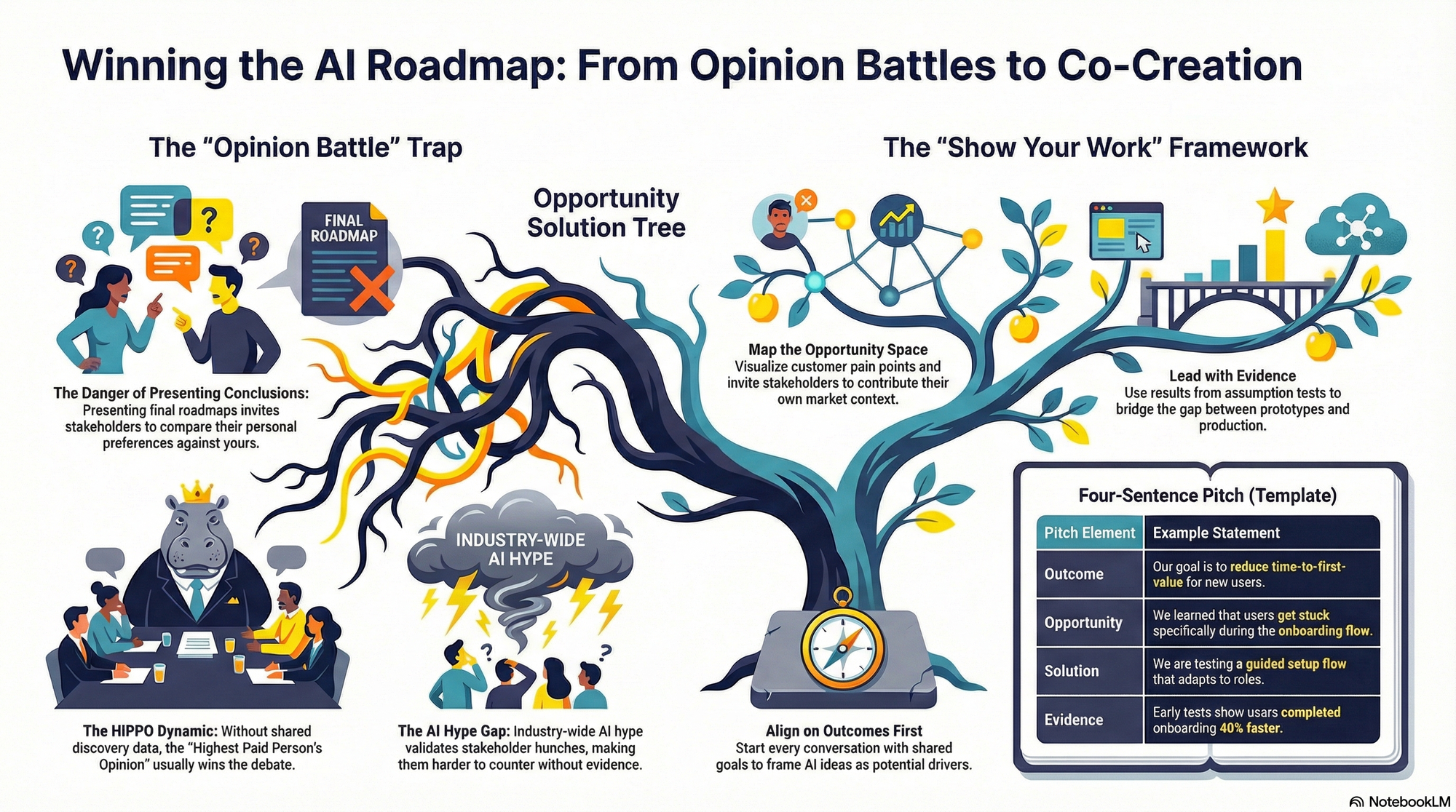
    That small shift changes almost everything about how a team works: what we measure (impact, not just delivery), how we know we’re done (measurable behavior change, not release notes), the autonomy we grant (told what to achieve, not what to build), and the planning artifacts we use (an opportunity solution tree beats a feature roadmap when we’re exploring the best path to an outcome).

    When I assign outcomes, I’m giving the team latitude—and responsibility—to figure out the best path to success. That’s what opens the door for real product discovery and continuous discovery habits.

    Infographic comparing output-driven vs outcome-driven teams, covering metrics measured, team autonomy, definition of done, and planning artifacts: feature roadmap vs opportunity solution tree.
    Shift your lens from shipping features to achieving impact. This side-by-side visual explains how outcome-driven teams measure success, grant more autonomy, define 'done' by results, and plan with an opportunity solution tree.

    Examples: spotting outputs disguised as outcomes

    Clear-cut example: “Our outcome is to deliver an Android app.” An Android app is something we build and ship. It’s clearly an output.

    To get to an outcome, I ask, “What’s the value of having an Android app?” or “How will we know the Android app is successful?”

    We might answer: “Having an Android app will allow us to engage more users. We’ll know it’s successful when people engage with the app on a regular basis.”

    This answer uncovers the hidden outcome: engage more people. Now we can set the right scope: increase the percentage of engaged users across any platform; increase the percentage of engaged mobile users; or increase the percentage of engaged Android users.

    Any of these outcomes gives us more room to explore than a fixed output. Maybe we don’t need a native app at all. We could deliver the same engagement through a mobile web experience, notifications, or email. And we’re not done when we ship—we’re done when the right people are actually engaged.

    Tricky example 1: measure the value creation moment (hires, not applicants)

    Infographic showing shift from output to outcome: build an Android app -> ask when it is successful -> increase engaged users. Highlights value, goals, and accountability in product management.
    Move beyond shipping features to the impact that matters. This visual maps the path from build an Android app to the real goal, increase engaged users, by asking why, defining value, and owning results.

    When setting outcomes, it’s tempting to choose the easiest-to-measure metric. But a good outcome measures the customer’s value creation moment.

    I worked at a company that helped new college grads find their first job. When I started working there, the primary outcome was “increase job applications.” This technically is an outcome—it measures a specific behavior in the product.

    But it doesn’t measure the value creation moment. A job seeker doesn’t get value when they apply for a job. They only get value when they get the job. Similarly, employers don’t get value from any job applicant, they get value when the right job applicant applies.

    Many job boards try to measure qualified applicants—instead of counting any applicant, they compare the credentials of the applicant to the job description and only count qualified applicants. This is better. But it still doesn’t measure the value creation moment. Both the job seeker and the employer get value when an open job is successfully filled. The right metric is hires.

    Yes, “hires” can be hard to instrument because it happens off-platform and incentives misalign. Measure it anyway, even with proxies. The easy metric isn’t always the right outcome.

    Tricky example 2: measure impact, not user-generated output (the course reviews trap)

    I worked with a team that helped students choose university courses. They set their outcome as: “Increase the number of course reviews on our platform.”

    Infographic titled '4 Outcome Traps to Avoid' for product teams, highlighting wrong moment, output in disguise, traction trap, and sentiment alone with concise guidance.
    Confusing activity with impact? This visual breaks down four common outcome traps—measuring at the wrong moment, mistaking outputs, chasing adoption, and relying on sentiment—so teams focus on real value.

    Sounds like an outcome, right? It’s a metric. You can measure it. It’s an action users take on the site—writing a review. But it’s actually an output in disguise.

    Reviews are valuable when they help a student evaluate a course. They don’t create any value if a student never sees them. More reviews aren’t always better, especially if they’re clustered where nobody looks.

    A better outcome is “Increase the number of course views that include reviews.” Now we’re measuring impact on the decision moment, not just the production of content.

    If you can hit your metric without helping customers, you’re tracking an output, not an outcome.

    Tricky example 3: measure success, not just adoption (the traction metric trap)

    “Increase the percentage of users who viewed the performance report.”

    This looks like a good outcome. It measures a specific behavior in the product. It’s within the team’s control. But it’s what I call a traction metric—it measures adoption of a single feature, not value to the customer.

    Infographic 'Why Teams Stay Stuck on Outputs' with a trust cycle—manager micromanages, team reports features, manager stays in details—and an accountability trap about safe targets and disguised outputs.
    Why teams get trapped in shipping features: a vicious trust cycle fuels micromanagement, while performance-linked outcomes push safe targets. Break the loop and refocus on customer outcomes that truly move the needle.

    Two problems arise. First, people can view the report and still not find what they need. Second, we might have perfectly happy customers who don’t need the report at all. Driving usage of an unneeded feature wastes time and erodes trust.

    Measure the value creation moment, not just feature adoption.

    Tricky example 4: pair sentiment with behavior

    I define a product outcome as a metric that measures either 1. a specific behavior in the product or 2. a sentiment about the product. But sentiment metrics—like CSAT or NPS—can be tricky on their own.

    Sentiment metrics are outcomes, but they aren’t directional. They don’t tell us where to explore or set guardrails for what to avoid. So I pair a behavior with a sentiment, for example: “Increase engagement without negatively impacting satisfaction.” I use sentiment as a counterweight.

    Facebook and Instagram illustrate why this matters. Meta is exceptional at driving engagement—but to a fault. Many of us don’t like these addictive products. Pairing engagement with a satisfaction guardrail prevents “engagement at all costs.”

    Why getting this right is hard (and how I counter it)

    Infographic, 'How to Make the Shift,' shows five steps to move teams from outputs to outcomes: translate metrics, negotiate with teams, expect iteration, watch for traps, and go deeper.
    Ready to move from shipping features to creating impact? This visual playbook shares five practical moves—translate metrics, partner with teams, iterate, avoid traps, and dig deeper—to turn outputs into measurable outcomes.

    The trust cycle. Managers don’t trust that teams can reach outcomes on their own. So managers micromanage the outputs. Teams, in turn, don’t communicate their progress toward outcomes—they communicate their progress on features. This reinforces the manager’s belief that they need to stay involved in the details. It’s a vicious cycle.

    I break it by asking teams to show their work—share assumptions, research, opportunity solution trees, and evidence behind choices—and by giving feedback on the thinking, not just the solutions.

    The accountability trap. When performance reviews are tied to hitting outcomes, teams play it safe. They sandbag their targets. They disguise outputs as outcomes to guarantee “success.”

    I treat outcomes as learning opportunities first. When we start on a new outcome, I set a learning goal—“learn what moves the needle on this metric”—before a performance goal—“increase X by Y%.” This creates space to explore without fear.

    How I get teams started with better outcomes

    Translate business outcomes to product outcomes. Business outcomes like revenue, retention, and market share are lagging indicators—by the time you see them, it’s too late to act. Product outcomes measure behavior changes within the product that lead to those business results. They’re leading indicators within the team’s control.

    Negotiate outcomes with your team. Outcome-setting should be a two-way conversation. Leadership brings the cross-company context. The team brings customer insight and technical realities. Neither side dictates; we co-own the target and the constraints.

    Infographic on outcomes vs outputs in product management: side-by-side panels show Feature Factory (measure what you ship) versus Product Team (measure what it changes), highlighting the shift to impact.
    Stop celebrating shipped features and start celebrating change. This visual contrasts a feature factory mindset with a true product team, urging teams to track impact, not output, and define success by outcomes.

    Expect to iterate on your metrics. Your first outcome metric probably won’t be right. That’s normal. Sonja at tails.com went through four iterations—from 90-day retention to 30-day to 5-day to behavior-based metrics—before landing on something actionable. Thomas at Bluestone Analytics iterated three or four times before finding the right metric. Iteration is the work.

    Watch for common mistakes. Outputs disguised as outcomes. Traction metrics masquerading as product outcomes. Sentiment metrics without direction. Business outcomes assigned directly to product teams without translating to behavior change.

    Use the right artifacts. Replace feature roadmaps with an opportunity solution tree to explore multiple paths, test assumptions, and sequence bets explicitly against a clear outcome.

    Align OKRs with outcomes. If your company uses OKRs, make sure the “KR”s are true product outcomes (behavior change and value creation), not a list of features to ship.

    The bottom line

    When we shift from an output-first mindset to an outcome-first mindset, it doesn’t mean that outputs stop mattering. Product teams will always ship features, and the ability to do so quickly and with quality still matters. This shift simply ensures those features achieve the intended impact. We aren’t done when we ship—we’re done when what we shipped has the intended impact.

    Measure success by the impact of what you ship and you’ll build a product team that learns, adapts, and creates real value. Measure success by what you ship and you’ll get a feature factory.

    Quick self-check: is your “outcome” really an outcome?

    Ask yourself: 1) Does it measure a behavior change or a sentiment tied to value creation? 2) Could we hit it without helping customers? 3) Is it adoption of a single feature (a traction metric) or a result that customers and the business care about? 4) Do we have a counter-metric to prevent unintended harm? If you stumble on any of these, refine it before you commit.


    Inspired by this post on Product Talk.


    Book a consult png image
  • Staying Sane as a Product Leader: Practical Strategies I’m Using from Teresa Torres & Petra Wille

    Staying Sane as a Product Leader: Practical Strategies I’m Using from Teresa Torres & Petra Wille

    The world can feel like it’s spinning, and as a product leader, I feel that pressure acutely—juggling customer needs, stakeholder expectations, and the relentless news cycle. I recently listened to a powerful conversation with Teresa Torres and Petra Wille about staying grounded when everything feels “bonkers,” and it offered a practical, human way to keep showing up without losing yourself.

    What resonated most was the invitation to live my values through small, consistent actions. Rather than waiting for grand gestures or perfect solutions, I’m leaning into the mindset of “Something is better than nothing.” It’s the same spirit we bring to continuous improvement in product: make a change, evaluate impact, iterate.

    “Create the world you want to live in” has become a daily prompt for me. I’m applying it to how I spend my attention, time, and platform—three scarce resources for any product management leader. I’m not going to do everything perfectly, but I can make better trade-offs this week than I did last week, and I can keep improving.

    Practically, that looks like reconsidering which speaking invites I accept, especially when representation is skewed. If a stage is heavily male, I now ask organizers about their plan for balance before committing. I also question travel expectations for short talks when a high-quality virtual experience is possible—good for sustainability, budgets, and energy. These choices compound, just like product roadmapping and sprint planning decisions.

    Petra’s “under-complexity” lens was a wake-up call. In product, oversimplified narratives—whether a single KPI, a vanity metric, or a forced binary—usually increase fear and bad decisions. The same is true in civic discourse. To counter that, I’m seeking more nuance on purpose: reading multiple sources on the same story, listening for who’s not in the room, and noticing how the same facts can carry different meanings depending on who’s telling it.

    One simple habit helps: I’ll read The New York Times and The Wall Street Journal on a headline, then follow up with Tangle by Isaac Saul, which lays out “what the left says / what the right says / editor’s take,” sometimes including perspectives from affected communities. It’s a lightweight form of personal knowledge management that improves my product judgment and my citizenship.

    Another idea that stuck with me is swapping media proxies for human connection. In product, we don’t ship based on secondhand opinions—we run customer interviews, co-create with users, and build empowered product teams. The same principle applies in community: talk to someone directly affected, ask real questions, and stay curious. When conversations get heated, I try to build bridges, reduce proxies, and look people in the eye.

    I’m also reflecting on platform responsibility. Even a “small” platform can snowball through weak ties inside a company or community. I’m asking: When should I speak up? Where should I draw lines? And when is “staying in your lane” actually a way to avoid necessary leadership? These are the same stakeholder management questions we navigate in product strategy—assess impact, clarify intent, and act with integrity.

    Local grounding matters, too. I’ve found energy and clarity in community-level action: voting, attending public protests when it feels right, mentoring, and supporting nonprofits like World Pulse. I love the framing of “don’t mess with my neighbors”—it keeps me focused on tangible care when the internet starts to feel like reality. I’ve also seen leaders use angel investing in agriculture-related efforts as a counterbalance to “internet reality,” channeling resources into durable, real-world outcomes.

    If you want to experiment this week, pick one small lever you control: where you spend money, time, attention, or your platform. Add nuance by reading at least two different perspectives before reacting. Replace proxies with people by talking to someone with lived experience. Reduce polarization by asking, “what shaped that view?” before judging it. And go local—connect with neighbors or a community group and let small actions compound.

    If you’d like to hear the full conversation that inspired these reflections, you can listen on Spotify or Apple Podcasts. Here are the direct links: Spotify: https://open.spotify.com/episode/1sxEFquu73ZB9fL9gGk6Om and Apple Podcasts: https://podcasts.apple.com/kh/podcast/staying-sane/id1794203808?i=1000755696295

    Resources I’m exploring and recommend: World Pulse (https://www.worldpulse.org/), The New York Times (https://www.nytimes.com/), The Wall Street Journal (https://www.wsj.com/), and Tangle by Isaac Saul (https://www.readtangle.com/ and https://www.readtangle.com/author/isaac-saul/). For builders and writers, I also appreciate Ghost (https://ghost.org/) as an open-source publishing platform. If you work in or with the MENA ecosystem, take a look at MENA Product Summit ’26 (https://www.prdkt.plus/summit26). Colleagues like Jeff Merrell (https://jeffdmerrell.com/) and grassroots efforts such as No Kings Protest (https://www.nokings.org/) offer additional perspectives and ways to get involved.

    If this resonates, share it with a teammate who’s been feeling the weight of the world. I’d love to hear one small, values-aligned action you’re taking this month—what “something” will you try next?


    Inspired by this post on Product Talk.


    Book a consult png image
  • Agentic Architecture Demystified: How Modern AI Systems Plan, Learn, and Execute at Scale

    Agentic Architecture Demystified: How Modern AI Systems Plan, Learn, and Execute at Scale

    In my role leading product teams at HighLevel, I’m often asked to explain what’s really happening behind the scenes of today’s AI products. The short answer is that modern systems are built on "Agentic Architecture: How Modern AI Systems Actually Work"—not just a single model, but a coordinated loop of planning, tool use, memory, and evaluation. Once you see that pattern, the design decisions snap into focus and the roadmap becomes far easier to prioritize.

    At its core, agentic AI treats the model as a reasoning engine embedded within an AI workflow. The agent interprets intent, plans steps, calls the right tools and APIs, grounds itself in trusted data, and then evaluates outcomes before deciding to continue or stop. This loop creates reliability, reduces hallucinations, and enables the system to operate in real-world, multi-step scenarios.

    Here’s the practical lifecycle I rely on. A user provides intent (a goal or request). We run a retrieval-first pipeline to ground the model in accurate, current data. Prompt engineering structures the task and primes the agent with constraints and success criteria while managing context window management. The agent generates a plan, executes steps by calling tools or services, evaluates intermediate results, reflects or revises as needed, and only then returns a final answer with clear citations or evidence.

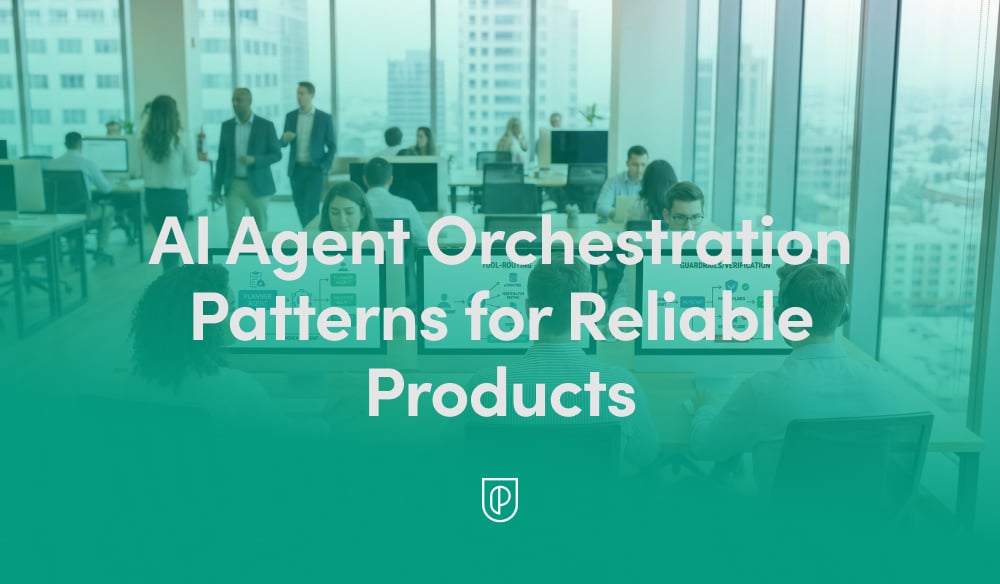
    For more complex work, I orchestrate multiple specialized agents—commonly a planner, a solver, and a critic—coordinated by a lightweight controller. This multi-agent pattern reduces single-agent blind spots, encourages self-checking, and mirrors how empowered product teams collaborate. Whether it’s conversation design for support flows or a voice AI agent driving hands-free tasks, orchestration is the difference between a clever demo and a dependable product.

    Memory is the second pillar. Short-term working context sits in the prompt, while long-term memory lives in vector stores or databases to track past interactions, preferences, and outcomes. Retrieval augments the model with the right facts at the right time, and tight context window management ensures the agent stays focused on signal, not noise. The result is faster responses, lower costs, and far better accuracy.

    Reliability is earned through eval-driven development and robust AI risk management. I define offline and online evaluations, guardrails, and human-in-the-loop checkpoints before scaling traffic. These evaluations become living, automated tests that protect against regressions as prompts, models, and tools evolve. The payoff is real: fewer escalations, higher trust, and measurable improvements to quality over time.

    From a product strategy perspective, I resist over-engineering. Start with a simple retrieval-first pipeline and a single agent; prove value; then layer in multi-agent orchestration only where it moves key metrics. Instrument everything—latency, cost, grounding coverage, and outcome quality—and build Agent Analytics dashboards so teams can diagnose issues and iterate with confidence.

    If you’re looking for a practical playbook, here’s mine: clarify the user intent and success criteria; design the tools the agent can call; ground with authoritative data; write prompts that constrain scope and define termination conditions; add reflection and automated evaluations; and ship behind feature flags for safe, staged rollout. Each step compounds reliability without killing velocity.

    The diagram and the video above bring these patterns to life. If you watch closely, you’ll see the same loop—plan, retrieve, act, evaluate—show up in every effective implementation, regardless of domain. That repetition isn’t accidental; it’s the backbone of agentic architecture and a blueprint you can adapt to your own stack.

    Ultimately, what matters is outcomes. When we build around agentic AI, we create systems that are explainable to stakeholders, maintainable by engineers, and genuinely helpful to customers. That’s how we move past hype to durable impact—shipping AI products that plan, learn, and execute at scale.


    Inspired by this post on Product School.


    Book a consult png image