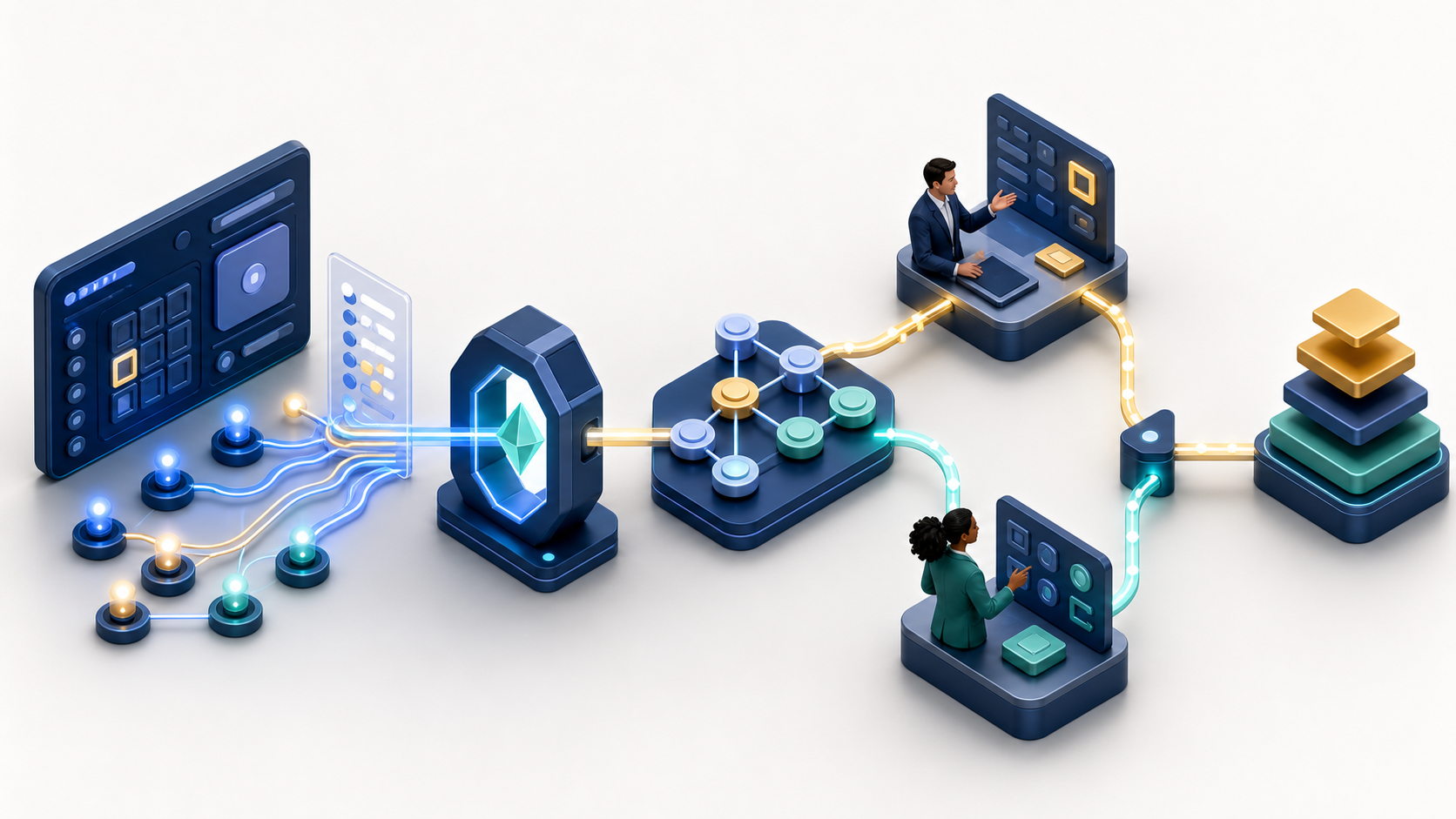
When I map the customer lifecycle, I look for the precise moments where guidance, context, and timing can transform a casual click into a committed relationship. That’s exactly why I rely on Pendo Orchestrate—to turn intent into a systematic, repeatable product strategy that scales across every stage of the journey.
From first click to lifelong retention, you’ll deliver the right message at the exact right time, every step of the way. With Pendo Orchestrate, you can design those kinds of moments with intention. And in this blog, we’ll show you how.
In practice, I translate that promise into four lifecycle journeys every product team should be running with Pendo Orchestrate: new user onboarding, activation to the aha moment, expansion and upsell, and renewal and retention. These journeys power product-led growth and keep the roadmap aligned to measurable business outcomes.
Onboarding: I use in-app guides and product tours to welcome new users, set expectations, and reduce time-to-value. Contextual tooltips and gentle checklists keep users moving, while clear, concise UX writing removes friction. The goal is simple: accelerate early wins so onboarding naturally flows into user activation.
Activation: To help users reach the aha moment, I pair behavioral insights with targeted in-app guides. When a user approaches a key milestone, Pendo Orchestrate triggers just-in-time prompts that reinforce the value proposition. I keep these nudges focused, specific, and measurable so activation improves without overwhelming the experience.
Expansion: Once users adopt core workflows, I introduce advanced capabilities through tailored tours and contextual education. These cues appear where they’re most relevant—in the flow of work—so cross-sell and upsell moments feel helpful, not salesy. The intent is to deepen adoption by connecting features to outcomes users already care about.
Renewal and retention: I watch for patterns that suggest risk (stalled usage, incomplete workflows) and offer supportive interventions. Lightweight guides, quick tips, and feedback loops help resolve issues before they become churn. Combined with retention analysis, these orchestrations keep customers engaged and set the stage for long-term value.
When these four journeys run in concert, your product becomes the primary engine of growth. Pendo Orchestrate ensures the right in-app guidance shows up at the right moment—so your product strategy, product discovery, and day-to-day execution stay tightly aligned. That’s how you move beyond one-off campaigns and build a durable, product-led growth system.
INDUSTRY 2025: The Product Conference is circled on my calendar for good reason. In my role leading product management at HighLevel, I look for events that sharpen strategy, accelerate learning, and connect me with operators who ship. This one consistently delivers on all three, and 2025 promises to raise the bar for product management leadership.
Join Pendo at INDUSTRY in Cleveland, Ohio.
First, I expect deeply actionable product strategy insights—beyond platitudes. I’m prioritizing conversations on outcomes vs output OKRs, product roadmapping and sprint planning, and how great teams articulate a crisp value proposition while maintaining points of parity that matter. I’m going in with specific questions on product-market fit lessons and how to systematize strategic bets without stifling discovery.
Second, the surge of AI in product work is too important to observe from the sidelines. I’m comparing approaches across AI Strategy, LLMs for product managers, prompt engineering, and eval-driven development—especially in retrieval-first pipeline patterns. My focus: where AI genuinely improves product discovery, in-app guides, and customer support ai strategy, and where it risks adding complexity without outcomes.
Third, the community is unmatched for conference networking and pragmatic learning. I’m intentional about meeting product trios who run continuous discovery at scale, as well as leaders who’ve cracked stakeholder management under pressure. These are the moments where competitive differentiation is born—through candid stories of what didn’t work and why.
Fourth, I’m eager to stress-test data practices that power product-led growth. I’ll be exchanging notes on retention analysis, unified analytics platform decisions, user activation, and how teams integrate qualitative feedback with event data to inform roadmaps. I’m also interested in how practitioners leverage platforms like Pendo, Amplitude analytics, Intercom, and HubSpot to reduce time-to-insight and craft effective product tours and in-app guides.
Fifth, I treat INDUSTRY as a checkpoint for leadership growth. I’m looking for fresh takes on empowering product teams, first principles decision making, organizational development, and the IC to manager transition. The best sessions don’t just inspire; they give me two moves I can apply with my team on Monday.
To make the most of the week, I’m applying a continuous discovery mindset: arrive with clear learning goals, capture portable frameworks, and translate at least two insights into experiments before wheels-up. If you’re focused on product strategy, product discovery, and product-led growth, we’ll have plenty to compare and build on together.
I’ll be in Cleveland ready to learn, share, and connect with peers who care about craft and outcomes. If you’re attending, let’s compare notes on what’s working, what’s stalled, and how we can raise the bar for product management leadership in 2025 and beyond.
Your dashboard can show growing AI agent usage while the product itself gets worse. Users may invoke the agent, wait for an answer, rewrite it, repeat the task manually, or discover too late that an action needs to be undone. An invocation count records activity. It does not tell you whether the agent was useful, safe, or worthy of more authority.
If you own an agent roadmap, the practical question is not whether the model can complete an impressive demo. It is whether you can see what the agent did, limit what it was allowed to do, connect its behavior to a user or business outcome, and stop or reverse a bad release. Product analytics should be the control system that helps you answer those questions.
Key takeaways
Define the agent’s job, eligible users, data boundary, action boundary, target outcome, and failure conditions before choosing dashboard metrics.
Join product behavior, agent decisions, tool activity, and business outcomes with shared run and workflow identifiers. A model trace or product funnel on its own is incomplete.
Treat permissions as product logic. Read access, recommendations, reversible actions, and high-consequence actions need different controls and evidence.
Version prompts, retrieval sources, models, tools, policies, and event schemas together so that a change in performance can be traced to a release.
Use quality, safety, experience, business, and operational gates to decide whether an agent should expand, remain constrained, be revised, or be retired.
Define the outcome and authority before the events
Teams often start by instrumenting what is easiest to count: conversations, messages, tool calls, and thumbs-up feedback. That produces a busy dashboard without a decision model. Start one level earlier. What job is the agent responsible for, and what evidence would justify giving it more reach or authority?
Write a one-page agent contract
An agent contract is a product artifact, not a legal document. It creates a stable reference for instrumentation, evaluation, access control, and rollout decisions. Write down:
Job: the decision or task the agent helps complete. Avoid broad mandates such as improve support or assist product managers.
Eligible workflow: the exact point at which the agent may appear or run. Eligibility must be measurable even when the user never invokes the agent.
Eligible users and accounts: the roles, segments, or environments included in the release, plus explicit exclusions.
Inputs: the approved resources, fields, retrieval collections, and user-provided context the agent may inspect.
Outputs: whether the agent answers, recommends, drafts, updates a system, contacts someone, or triggers another workflow.
Human checkpoints: the actions that require review, the person authorized to review them, and what that person must be shown.
Target outcome: the user or business result, its denominator, its measurement window, and the system that records it.
Known failure states: unsupported answers, irrelevant retrieval, repeated retries, blocked tools, abandoned approvals, incorrect actions, and failed handoffs.
Stop condition: the quality, risk, reliability, or outcome signal that pauses the rollout and identifies who owns the decision.
The eligibility definition matters more than it appears. If you count only people who chose to use the agent, your dashboard excludes people who ignored it, did not notice it, distrusted it, or could not access it. Record the eligible population first. That gives adoption, completion, and outcome metrics a defensible denominator.
Keep the first contract narrow. A practical starting footprint is one valuable question, a small team, and one assistant. Narrow scope is not merely easier to ship. It makes failures interpretable and limits the consequences of a bad policy, prompt, connector, or event definition.
Translate authority into enforceable policy
I use a strict definition of governance: the agent has a bounded objective, a known identity, limited data access, limited tools, recorded policy decisions, an escalation route, and a named owner. A policy page that the runtime cannot enforce is guidance, not governance.
Authority level
What the agent may do
Evidence to retain
Default release control
Retrieve
Read approved analytics, records, or knowledge without changing a system
Resource identifiers, applied scope, retrieval status, policy version, and references used
Pre-approved resources with least-privilege access and data minimization
Recommend
Explain, summarize, rank, draft, or propose an action
Agent version, supporting references, presentation status, and user response
The user decides whether to accept, edit, reject, or escalate
Act reversibly
Create a note or make another bounded change that can be reliably undone
Tool, target, before-and-after state, approval, execution result, and reversal path
Explicit approval during the bounded rollout, followed by evidence-based expansion
Act with high consequence
Send an external communication, alter access or entitlements, disclose sensitive data, or perform a hard-to-reverse operation
Everything above, plus approver identity, policy result, purpose, and incident linkage
A human makes the consequential decision; eligibility and tool scope remain narrow
Technical reversibility is not the same as consequence reversibility. A database field may be restored while a customer message, exposed record, or lost trust cannot be recalled. Classify authority by the real-world consequence, not by whether an API offers an undo method.
Model Context Protocol can make the policy surface clearer because it separates read-only resources from bounded tools and gives agents a standard way to discover them. That interface is useful, but the protocol does not decide who should access a resource, which fields are permitted, or whether an action needs approval. Authentication, authorization, redaction, policy enforcement, retention, and audit logging still belong in your architecture.
Apply controls before the model call and again before every tool execution. Prompts, retrieved context, logs, and third-party services can all become paths for sensitive-data leakage. Redact data the task does not require, keep secrets outside prompts, use scoped credentials, validate structured tool inputs, and record blocked requests as carefully as successful ones. A denied request is evidence that your policy worked, but repeated denials may also reveal a broken workflow, an overly broad prompt, or an attempted attack.
Build telemetry that joins agent decisions to user outcomes
Product analytics and AI observability answer different halves of the same question. A trace can show which context was retrieved, which policy ran, and which tool was called. Product analytics can show what the user did before and after the interaction, which cohort they belonged to, and whether the workflow reached its intended result. Neither view alone proves that the agent created value.
Join them with two identifiers. An agent run identifier follows one execution from trigger to final status. A workflow identifier connects that execution to the broader task, including manual steps, retries, handoffs, and the eventual business outcome. A user may start several runs inside one workflow, so treating every run as an independent success will inflate apparent demand and hide rework.
Use a minimum viable event contract
The following event model is deliberately small. Adapt the names to your analytics conventions, but preserve the states and identifiers.
Suggested event
Required properties
Decision it supports
agent_eligible
Workflow identifier, use case, surface, cohort, eligibility reason, and policy version
Who could have used the agent, including people who did not invoke it?
agent_run_started
Run identifier, workflow identifier, agent version, entry point, and initiating actor type
Where is the agent being invoked, and how often do workflows require retries?
agent_answer_presented
Run identifier, answer status, retrieval status, reference status, latency band, and fallback status
Did the user receive a grounded answer, a fallback, or no usable response?
agent_action_requested
Run identifier, tool, target type, authority level, required scope, approval requirement, and policy result
What is the agent attempting, and where are requests blocked or escalated?
agent_action_finished
Run identifier, tool, execution status, error class, approver state, reversibility state, and duration band
Did an approved action actually complete, fail, time out, or require recovery?
agent_handoff_started
Run identifier, workflow identifier, handoff reason, destination, context-transfer status, and user choice
Why did automation stop, and could the receiving person continue without reconstructing the task?
agent_run_outcome
Run identifier, workflow identifier, completion state, user response, correction state, and failure taxonomy
Was the output accepted, edited, rejected, abandoned, retried, or escalated?
workflow_outcome
Workflow identifier, outcome name, outcome state, measurement window, and source system
Did the underlying product or business result occur?
Put the agent, model, prompt, retrieval, tool, policy, and event-schema versions on the relevant records. Without version lineage, a quality shift produces debate instead of diagnosis. You will know that performance changed but not whether the cause was a prompt edit, a new model, a retrieval update, a permission change, a tool release, or broken instrumentation.
Do not make raw prompts and complete responses the default payload in a general-purpose analytics tool. They can contain personal data, secrets, customer content, or retrieved text that the analytics audience should not see. Send structured classifications and reference identifiers to product analytics. Keep any detailed trace required for investigation in an access-controlled store with explicit retention rules.
Use enumerated properties for states such as accepted, edited, rejected, blocked, failed, and handed off. Free-text status fields fragment quickly and make reliable cohorts impossible. Preserve a limited diagnostic field only where someone owns its review and classification.
Measure a stack, not a vanity metric
A useful scorecard separates five layers. Each layer answers a different management question:
Reach and adoption: Of eligible workflows, where was the agent offered and invoked? This shows discoverability and voluntary use, not value.
Task experience: Of started workflows, how many completed, retried, fell back, transferred to a person, or were abandoned? Segment edits and overrides instead of treating every acceptance as equally successful.
Agent quality: Was the answer supported by approved context, relevant to the request, structurally valid, and consistent with the task-specific evaluation criteria?
Governance and safety: Which tool requests were allowed, denied, escalated, or attempted outside the approved scope? Which redaction, moderation, or policy checks failed?
Business outcome: Did the downstream result move for the eligible workflow and intended cohort? Examples include completed onboarding, resolved cases, qualified leads, retained users, or a shorter cycle, depending on the contract.
Always display the numerator and denominator behind a rate. A falling handoff rate may look positive until you discover that completions also fell. A high acceptance rate may hide repeated runs if the dashboard counts only the final answer. A rising task outcome may reflect a changing user mix rather than the agent. Cohort, version, eligibility, and workflow-level views prevent those misreadings.
Behavioral analytics can establish association and expose where to investigate. It does not automatically establish causality. When the decision requires a causal claim, use a controlled experiment only after both variants meet the same safety and access requirements. Prompts, decision rules, and handoff designs can be tested across appropriate user cohorts; known unsafe behavior, privacy controls, and access boundaries are not experiment variants.
Turn analytics into release gates, not retrospective reporting
A governed agent release includes more than a prompt. It includes the model configuration, instructions, retrieval sources, tool definitions, permission scopes, policy rules, user disclosures, approval flow, handoff design, and telemetry. Change any of those and you have changed the product behavior.
That is why evaluation belongs in delivery, not in a quarterly review. Task-specific test sets, reference answers, error classifications, and pass-or-block thresholds can gate model and prompt changes in CI/CD. Production analytics then checks whether the behavior generalizes to real workflows without weakening the controls established before launch.
Use a staged promotion path
Validate the interface. Enumerate the resources, tools, schemas, scopes, and denial behavior. Run harmless requests and confirm that unavailable capabilities remain unavailable.
Run task evaluations. Test representative requests, known failure cases, adversarial inputs, missing context, malformed tool arguments, and handoff conditions. Classify failures by consequence rather than relying on one blended quality score.
Exercise the workflow without autonomous consequence. Use dry runs or recommendation-only behavior. Confirm telemetry, references, approvals, fallback, escalation, and rollback before enabling writes.
Release to a bounded eligible cohort. Keep tool scopes narrow and consequential actions under human control. Compare observed behavior with the contract, not with the enthusiasm generated by the demo.
Experiment inside the approved boundary. Test prompt, retrieval, interaction, and handoff variants only after they independently satisfy the safety gate. Analyze results by workflow and version.
Promote or constrain deliberately. Expand access or authority only when the relevant gates pass. A failed safety gate can restrict a release even when adoption or the business metric improves.
Pre-commit the gates
Choose thresholds and blocking conditions before reading the launch results. If the team sets them afterward, a promising outcome can quietly lower the quality bar, while a favored feature can turn every failure into an exception.
Gate
Evidence
Blocking condition
Typical response
Quality
Task evaluations, grounded-answer checks, correction categories, and unsupported-output reviews
A consequential failure class exceeds the pre-agreed tolerance or lacks a reliable detector
Revise instructions, retrieval, output constraints, or task scope
The workflow cannot meet its reliability requirement or cannot fail safely
Reduce dependency surface, improve fallback, or pause promotion
Do not average these gates into a single agent score. A composite score can let strong adoption cancel a serious security failure or let low latency hide poor answer quality. Keep each gate visible, assign its owner, and specify which failures block promotion without negotiation.
Release decisions should also be reversible. Keep prior prompt, policy, retrieval, and tool configurations identifiable. Define how the runtime disables a tool, narrows a cohort, returns to recommendation-only behavior, or routes directly to a person. A rollback plan that depends on diagnosing the root cause first is too slow for a live incident.
Make the dashboard an operating system for the product team
The best agent dashboard does not attempt to show every event. It puts the release decision in view. Organize it in the order the team should reason:
Outcome: eligible workflows, target business result, comparison group where appropriate, and results by cohort and release version.
Quality and trust: grounded status, acceptance, substantive edits, rejection, retries, corrections, fallback, and qualitative feedback categories.
Governance and operations: allowed and denied tools, approval states, out-of-scope attempts, redaction failures, incidents, errors, latency, and dependency health.
Every panel should filter by agent version, policy version, tool, entry point, cohort, and workflow outcome. A top-line average is useful for orientation, but releases fail in slices: a user role with missing permissions, a workflow with poor retrieval, a new policy that blocks a required tool, or a handoff destination that cannot use the transferred context.
Which intended outcome moved, for which eligible cohort, and under which release version?
Where did users retry, edit, reject, abandon, or request a person, and what does the failure taxonomy show?
Which permissions were never needed, and which denied requests reveal either a valid attack defense or a mismatch between the job and the available tools?
Did the agent reduce user work, or did it move that work into reviewing, correcting, approving, and recovering?
Are outcomes consistent across important roles and workflow entry points, or is the top-line result hiding a weak segment?
What changed since the prior release across the model, prompt, retrieval corpus, tools, policies, user experience, and instrumentation?
Should the team expand, hold, revise, restrict, roll back, or retire the current behavior?
Record the decision beside the release lineage: the hypothesis, eligible scope, versions, expected outcome, gates, observed evidence, known risks, owner, and next review condition. This turns governance into an operating history. It also prevents the same debate from restarting when a metric moves or a stakeholder changes.
Ownership must be explicit. Product owns the job, intended outcome, and promotion decision. Engineering owns runtime reliability, tool boundaries, traceability, and rollback mechanics. Design owns disclosure, user control, approval clarity, correction, and handoff. Data or analytics owns event integrity and metric definitions. Security and legal own the policies and incident requirements within their mandates. Shared input is valuable; shared accountability without a decision owner is not.
Start with one consequential workflow. Write its contract, add the eligibility event and shared identifiers, classify every available tool by authority, pre-commit the release gates, and review the first bounded cohort against the business outcome. Do not broaden the agent until you can explain why it ran, what it was permitted to see and do, what the user did next, whether the workflow improved, and how you would stop it safely.
Your Pendo dashboard can be green while revenue stays flat. Guide clicks, tour completions, and first-time feature use show that something happened inside the product. They do not tell you whether a customer reached value, formed a durable habit, renewed, or became ready to expand.
A Pendo-led growth motion works only when you connect product behavior to a commercial decision. You need a traceable path from an eligible user, to a valuable behavior, to an account-level change, to an owned go-to-market action, and finally to a revenue outcome. This is how to build that path without mistaking activity for impact.
Build the revenue path before you build the guide
Do not begin with a broad goal such as increase adoption. Begin with a decision someone needs to make. Which trial accounts deserve sales attention? Which new customers need onboarding help? Which established accounts show credible retention risk? Which accounts are approaching an expansion conversation?
For one target segment, write the path in this order:
Commercial outcome: the CRM result you ultimately care about, such as trial conversion, renewal, or expansion.
Eligible cohort: the users or accounts that could reasonably produce that outcome. Exclude employees, test accounts, ineligible plans, and anyone who has already completed the journey.
Value event: the action that represents meaningful progress in the customer’s job, not merely a page view or button click.
Activation milestone: the point at which the user has completed enough of the workflow to experience initial value.
Durable behavior: the repeat usage, adoption depth, collaboration, or seat activity that separates discovery from an established habit.
Commercial trigger: the combination of behaviors that should create a sales, marketing, or customer-success action.
Owner and response: the person responsible, the next action, and the condition that closes or suppresses the signal.
A generic trial journey might move from connecting data, to completing a core workflow, to returning and repeating it, to inviting colleagues, and then to meeting a defined sales-ready condition. The exact events will differ by product. The discipline is to explain why each event is evidence of customer value and why the final signal should change a commercial decision.
Time-to-value, feature adoption depth, active usage, and completed trial milestones can help identify purchase readiness. But each metric needs product-specific qualification. Weekly activity is useful only when the workflow naturally recurs weekly. Seat growth is meaningful only when additional users participate in the valuable workflow. A feature click is rarely sufficient evidence on its own.
Start with one or two high-impact lifecycle plays. Trying to instrument onboarding, conversion, retention, and expansion at once usually leaves every definition open to debate. A narrow pilot forces the team to settle the difficult questions before multiplying them.
Turn those decisions into a data contract shared by product, growth, RevOps, sales, and customer success. Record the event name, qualifying properties, user and account identifiers, time rule, exclusions, CRM destination, accountable owner, and consent requirements. Define whether an event can occur more than once, how merged identities behave, and what happens when the same person belongs to multiple accounts. Privacy-by-design matters here because behavioral data becomes more sensitive when combined with contact and account context.
Freeze the definitions for the duration of the pilot. If the activation milestone or eligible population changes after results appear, you no longer have a stable comparison. Log the change as a new version and evaluate it separately.
Use in-app guidance as a targeted intervention
Pendo guides are the intervention layer, not the strategy. Their job is to remove a specific obstacle between the eligible user and the next value event. If you cannot name the obstacle and the desired behavior, the guide is likely to become an announcement that generates attention without changing adoption.
Create a short intervention brief before building anything:
Audience: the role, lifecycle stage, account state, and relevant prior behavior.
Entry condition: the event or state that makes the message useful now.
Friction: the missing knowledge, unclear choice, or incomplete prerequisite preventing progress.
Next action: one observable behavior the user can complete.
Success event: the downstream product event that counts as progress.
Exit condition: the event that permanently stops the guide for that journey.
Fallback: help content, support, or human outreach for users who cannot complete the action.
Match the format to the problem. Use a tooltip when a specific control needs context. Use a short product tour when the user must understand a sequence. Use a banner for broad awareness when an immediate workflow is not required. A modal demands attention, so reserve it for information that justifies interrupting the user.
Behavioral targeting and progressive disclosure help keep guidance relevant. Show the smallest useful instruction at the decision point, then offer deeper help only when the user requests it or reaches the next step. Suppress the experience as soon as the success event occurs. Repeatedly explaining a completed task trains users to dismiss future messages.
Test outcome-first copy, placement, calls to action, and guide format, but choose the experiment’s primary outcome outside the guide. A click-through rate can diagnose whether the message earned attention. It cannot establish that the user completed the valuable workflow.
Define the eligible population before exposure, assign treatment consistently, and select a follow-up window that matches the workflow’s natural cadence. Randomize at the user level when the intervention affects an individual task. Randomize at the account level when colleagues share the experience or one user’s behavior can influence another’s. Otherwise, treatment can leak into the control group.
Pendo Predict can be used to rank segments by likelihood to convert, expand, or churn. Treat that score as a targeting and prioritization input, not as causal proof. Comparing a high-likelihood group with a low-likelihood group will mostly reveal that the groups were different before the intervention. To learn whether the intervention worked, compare similar eligible users or accounts with and without it.
Turn product signals into owned revenue actions
A behavioral signal creates no commercial value while it sits in an analytics dashboard. Connecting Pendo behavior with HubSpot contact and account context makes the signal available inside the workflow where sales, marketing, and customer-success decisions already happen.
The routing design should answer four questions: What happened? Why does it matter? Who owns the response? When should the signal be ignored or closed?
Commercial decision
Qualifying product evidence
Owned action
Suppression rule
Trial conversion
Activation milestone completed, meaningful feature depth, or a short product-specific time-to-value
Route the recent behaviors and account context to the sales owner for tailored discovery
Exclude internal, test, expired, or already-converted accounts; do not qualify on a guide click alone
Onboarding recovery
A prerequisite remains incomplete or progress stalls before the value event
Coordinate the next lifecycle message, contextual guide, or customer-success task
Stop the journey immediately after milestone completion or confirmed ineligibility
Retention protection
Use of a core workflow declines relative to the account’s relevant baseline
Ask customer success to verify the context before choosing outreach, training, or an in-app intervention
Do not label the account as churn risk until role changes, expected inactivity, and other context have been checked
Expansion qualification
Seat usage grows, more users complete the valuable workflow, or premium capabilities receive meaningful use
Ask the account owner to validate the need, entitlement, and buying context before opening an expansion motion
Suppress duplicate alerts and activity caused by testing, administration, or temporary access
Send the evidence behind a signal, not just a label such as hot account or churn risk. The receiving record should include the user and account, triggering behaviors, event timestamps, comparison baseline where relevant, cohort or model version, recommended next action, owner, and current status. If a predictive score is involved, include the behaviors that make the score actionable.
My rule is simple: if a signal does not change a named person’s next decision, it should not be synchronized yet. Sending every event to the CRM creates noise, duplicate outreach, and mistrust. Send the smallest set of behavioral fields that supports a real decision, then add fields only when an owner can explain how they will use them.
The same discipline applies to coordinated journeys. An email, chat message, sales task, and in-app guide should not all fire independently from the same behavior. Give the journey one state model so that completing the action in any channel suppresses the remaining prompts. The customer should experience one coherent response, not the internal boundaries between tools.
Measure incremental lift, not dashboard activity
Measurement should follow the same chain as the strategy. Keep each stage visible so you can find where performance broke rather than collapsing the journey into a single adoption score.
Reach: exposed eligible users divided by all eligible users. This reveals targeting or delivery problems.
Guide response: users taking the guide’s intended action divided by exposed users. This evaluates the prompt, not the business result.
Activation: eligible users completing the defined milestone divided by the eligible population.
Sustained adoption: initial adopters who repeat the valuable workflow during the predeclared follow-up window divided by all initial adopters.
Account progression: eligible accounts reaching the defined health, collaboration, usage-depth, or sales-ready condition.
GTM response: routed signals that receive the intended owned action, including a documented disposition.
Commercial outcome: the relevant CRM result, such as conversion, renewal, or completed expansion, measured at the same entity level as the purchase decision.
The entity level matters. Guides are often experienced by users, while renewals and expansions happen at the account level. Aggregate user behavior before joining it to an account outcome, and avoid treating multiple exposures inside one account as multiple commercial opportunities.
Separate influence from incrementality. An influenced account encountered a guide or met a Pendo cohort definition before a commercial outcome. That sequence can support diagnosis and attribution, but it does not establish that the intervention caused the outcome. Incremental impact is the additional result produced compared with what similar eligible accounts would have done without the intervention.
Use a randomized holdout when the product experience and sample allow it. Declare the primary outcome, minimum effect worth detecting, assignment unit, follow-up window, and stopping rule before launch. Do not stop when an early fluctuation looks favorable. If randomization is impractical, use a staged rollout or a carefully matched comparison cohort, control for concurrent campaigns, and describe the result as directional rather than causal.
Keep campaign identifiers, guide versions, cohort versions, and event timestamps in the joined dataset. Without them, a launch email, sales outreach, pricing change, and in-app guide can all receive credit for the same outcome. Joining usage cohorts, feedback, lifecycle activity, and pipeline context is useful precisely because it lets you inspect the whole path rather than award credit to the most visible touchpoint.
At each review, ask where the chain changed. Did the intervention increase activation? Did activation become repeated use? Did account behavior cross the commercial threshold? Did the routed owner respond? Did the CRM outcome move against a credible comparison? Scale only when the evidence survives that sequence. If guide engagement rises but the next product event does not, fix the intervention. If product behavior changes but the commercial result does not, revisit the signal definition or GTM response.
Key takeaways
Choose a revenue decision before choosing a Pendo guide, segment, or dashboard.
Define activation as a meaningful value event and distinguish it from discovery, clicks, and first use.
Use Predict scores to prioritize attention, then use a valid comparison to measure whether the intervention caused lift.
Route only signals that include evidence, an owner, a next action, and a suppression condition.
Optimize for sustained behavior and account progression; use guide engagement as a diagnostic metric.
Pilot one or two lifecycle plays, stabilize the data contract, and expand only after the full path works.
For your next rollout, select one commercial question and write its behavioral path before opening the guide builder. Confirm the eligible cohort, success event, control, CRM owner, and exit condition. When every owner can explain the chain in the same terms, Pendo becomes more than an adoption tool: it becomes part of a measurable revenue operating system.