Month: October 2025

  • From Support to Sales: The Unified Customer Agent That Supercharges Your Entire CX

    From Support to Sales: The Unified Customer Agent That Supercharges Your Entire CX

    At Pioneer 2025, we shared our most ambitious goal since we first set out to build Fin. I’ve spent my career building products that remove friction, and this is the boldest, most consequential shift I’ve seen for customer experience in years.

    Fin will not be just the world’s best Customer Service Agent. It will be the world’s best Customer Agent, capable of handling the entire customer experience.

    We’ll continue to obsess about Fin’s ability to support your customers, but now we’re broadening our focus. Fin will be able to contact your customers for the very first time; hold their hands through consideration and purchase; be there with them at every step; and know everything about their life with your business. That’s the level of continuity, empathy, and performance I expect from a truly unified AI Agent.

    It’s a big shift, and it reflects the changing future of customer service and experience. As someone who lives at the intersection of product strategy and operations, I see an incredible opportunity for teams to elevate their impact.

    Customer service leaders have been at the forefront of the AI transformation for the past two plus years. As this next evolution plays out, you’ll be uniquely positioned to lead how AI powers the entire customer experience. Your playbooks, data discipline, and operational rigor are the blueprint for what comes next.

    You can watch the full Customer Agent keynote from Pioneer 2025 here.

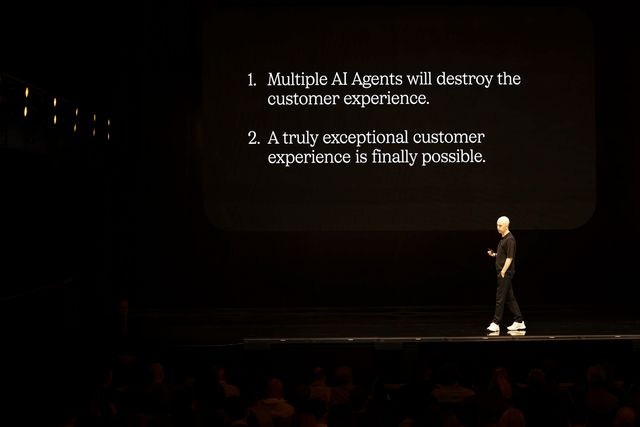
    Why we believe in the Customer Agent future comes down to two clear ideas that I’ve witnessed in practice across multiple organizations.

    1. Multiple AI Agents will destroy the customer experience

    We know that AI isn’t just changing customer service. Other teams like sales, success, and marketing are seeing the potential and starting to adopt it too. But if every function deploys its own Agent, you’ll end up with competing priorities, fragmented context, and inconsistent brand voice—exactly the kind of friction customers notice instantly.

    But if all of these teams use their own AI Agent, you’ll end up with a mess of competing Agents that will destroy the customer experience. Each one will have its own priorities and configuration parameters; they won’t talk to each other or share customer information by default, and will likely engage with customers in different ways. This is a trap we need to avoid.

    2. A truly exceptional customer experience is finally possible

    If we can avoid that trap, we’ll finally be able to provide the type of seamless experience that customers have long expected, and long deserved. The AI Agents of today, like Fin, are capable of handling many different use cases across the entire customer journey: lead qualification, onboarding, support, success, and upsell. That opens the door for the first time to previously unimaginable customer experience; one that’s truly seamless, personal, and concierge-level.

    We’ve reached another turning point in AI’s trajectory, and for customer service leaders, the opportunity around the corner is huge. In my own teams, the leaders who lean in now will shape standards for governance, measurement, and ROI across the business.

    Customer service has been the proving ground for AI transformation. The systems, strategies, and learnings leaders in this space have accumulated over the last two years can define how AI is adopted by other functions. The keynote made this clear: you have the opportunity to lead how AI is rolled out across your organization, not just in customer service.

    You already manage the most complex, high-volume customer interactions; you have rich data on customer needs and behavior; and you know how AI Agents perform in the real world. Those insights will be invaluable as AI scales across your business. The Customer Agent future will elevate the role of the customer service leader and give you the opportunity to lead AI implementation across the entire customer journey.

    To achieve this vision of Fin becoming a unified Customer Agent, it will need to evolve from being a task-based system into a true agentic system that uses AI to make decisions and pursue high-level objectives. That shift—from task execution to outcome ownership—is the inflection point I’ve been anticipating.

    Roles: Fin will have a range of roles (customer service being one) that it can fluidly move between and blend together. Each role will be deeply trained to be a world-class expert at what it does.

    Goals: Fin will also have goals to pursue. You’ll be able to tell it your objectives and priorities (for your customers, company, and revenue) and Fin will pursue them, making appropriate trade-offs between goals as needed.

    Memory: Fin will develop memory that persists and grows over the customer lifecycle, building deep context of who the customer is and what they’re trying to achieve. The customer priorities it learns on day one will be considered in year 10.

    Knowledge: Fin will accumulate deep knowledge of your business – every product detail, policy, process, your history, and plans – to act on a complete view of your customer.

    Interoperability: Fin will interoperate with different tools, systems, and channels.

    This system will be able to do much more than answer questions or complete tasks. It will adapt on the fly, learn to get better, and use all the context it has to efficiently guide each customer to great outcomes. That’s how we turn AI from a helpful assistant into a dependable operator.

    The Customer Agent vision isn’t a far-off idea. Many of our most pioneering customers have started to put Fin to work beyond customer service. They’re using it across the customer journey and want to push it further by applying it to other use cases to create a single, seamless customer experience. I’ve seen this expansion accelerate once leaders prove value in one high-stakes workflow.

    Here’s an example: fitness wearables company WHOOP, facing one of their biggest product launches ever, needed a way to handle a very large influx of sales conversations. They used Fin to help manage this surge, and it’s now resolving 84% of their sales conversations.

    These early examples show how Fin is already capable of handling multiple use cases across the customer journey. The signal is clear: a unified Customer Agent can drive measurable outcomes in both revenue and retention.

    The Customer Agent future will be built from the inside out, starting with the customer service leaders who have been pioneering AI transformation since the very beginning. Your frameworks for quality, escalation, and measurement will set the bar for every other team that follows.

    You know how to balance powerful AI with human empathy, and how to translate that into great customer experiences. Other teams will look to you, and you have the ability to lead them through this transformation. In my experience, this is the moment to define standards, instrument the journey, and scale wins deliberately.

    The very best brands compete on customer experience. The Customer Agent opens that playing field for the brands that jump first. Those who move now will own the new benchmarks for responsiveness, personalization, and ROI.

    We’ll be starting to roll out this new functionality to Fin – roles, goals, memory, knowledge, interoperability, and more – over the coming months. Stay tuned.


    Inspired by this post on The Intercom Blog.

  • From Backlog Admin to Product Creator: How I Build Impactful Products with GenAI and Discovery

    From Backlog Admin to Product Creator: How I Build Impactful Products with GenAI and Discovery

    I have been emphasizing that the heart of the product manager job is product creation.

    The job is not about being a facilitator or cheerleader, it’s not about being a project manager, and it’s definitely not about being a backlog administrator.

    Rather, the necessary role of a product manager is a product creator, working alongside…

    In practice, that means I pair closely with engineering, design, data, and go-to-market partners to explore, prototype, and validate solutions during product discovery. I set a clear problem statement, define success metrics, and align on the smallest coherent release so we can learn quickly and de-risk the path to value.

    When the problem demands deep context, I embed forward deployed engineers with customers so we can observe workflows, capture constraints, and iterate on generative AI prototypes in days, not months. Those in-the-field insights shorten feedback loops and expose edge cases that never surface in a conference room or a ticketing system.

    GenAI lets me reduce the cost of learning: with lightweight agents, synthetic data, and prompt-driven scaffolding, I can run multiple experiments in parallel and converge on what truly delivers value. This approach turns ambiguity into testable hypotheses and transforms discovery from a meeting cadence into a hands-on, evidence-driven practice.

    This is product management leadership in action—setting outcomes, defining success metrics, and aligning a cross-functional team on the smallest coherent release—instead of shuffling tickets in a backlog. The difference is night and day: we move from output to outcomes, from activity to impact.

    My weekly cadence is simple: articulate the customer problem, frame hypotheses, build the thinnest possible prototype, put it in front of real users, and measure behavior against leading indicators. That loop creates momentum, builds credibility with engineering, and keeps us honest about whether we’re creating something customers will adopt and pay for.

    If you’re feeling stuck in coordination mode, reclaim your time for discovery and creation: carve out maker hours, ship prototypes, invite engineers to customer calls, and let evidence—not opinions—steer the roadmap. The more you build, the more you learn; the more you learn, the better you lead.

    The fastest teams I’ve led are the ones that treat product management as a hands-on craft, embrace generative AI for product prototyping, and maintain a relentless focus on learning, not merely launching. That is how we earn trust, create enduring products, and make product creator more than a title—it becomes our daily practice.


    Inspired by this post on SVPG.

  • Mastering Product in the Generative AI Era: Proven Strategies to Transform Teams and Delivery

    Mastering Product in the Generative AI Era: Proven Strategies to Transform Teams and Delivery

    As generative AI continues to evolve, I’m focused on understanding its real impact on product teams and practices—and translating that into practical guidance you can apply today.

    This page is my curated hub of insights on AI in product development, where I share frameworks, case studies, and field notes from leading teams through this shift. I’ll update it regularly with new perspectives on AI-related topics that matter for product leaders and builders.

    From what I’ve seen across enterprise and startup environments, AI reshapes collaboration, decision-making, and the operating model of product teams. Product managers, designers, and engineers must now work alongside models, data pipelines, and evaluation systems. In particular, forward deployed engineers are becoming essential—bridging real customer problems with model capabilities, and validating value in the wild.

    On the product discovery front, generative AI accelerates how we identify opportunities and reduce uncertainty. I use it to synthesize qualitative research at scale, pressure-test problem statements, and generate alternative solution concepts. The key is to maintain rigor: clear research questions, transparent prompts, and measurable outcomes that tie discovery work directly to product strategy.

    Prototyping has changed as well. With gen ai for product prototyping, my teams can move from concept to interactive demo in hours, not weeks. We rely on lightweight LLM sandboxes, prompt versioning, and red-teaming to assess feasibility and risks early. This makes usability testing and stakeholder alignment faster, while giving us tighter feedback loops before we commit real engineering capacity.

    Delivery now requires new practices for reliability and governance. We integrate AI evaluation harnesses into CI/CD, monitor model drift alongside product metrics, and establish guardrails for safety, privacy, and fairness. It’s not just shipping features; it’s managing living systems where prompts, fine-tunes, and data quality are part of the release surface area.

    For product management leadership, the mandate is clear: set a strategy that balances innovation with responsibility, upskill the organization, and define standards for AI product management. That includes establishing decision rights, clarifying model ownership, and measuring value end-to-end—from discovery signal to production impact—all while building trust with customers and regulators.

    Expect ongoing updates here: proven playbooks for AI product discovery, templates for evaluation and prompt governance, and actionable guidance on team structure, roles, and KPIs. My goal is to help you navigate the AI era with confidence, reduce ambiguity, and deliver customer outcomes that stand the test of time.


    Inspired by this post on SVPG.

  • Mastering Intelligent Products: Proven Strategies to Transform Product Development with Gen AI

    Mastering Intelligent Products: Proven Strategies to Transform Product Development with Gen AI

    I’m focused on the future of the products we’ll build—and how we’ll build them. To see where we’re headed, I find it essential to reflect on the past four decades of product development, from on-prem software to cloud-native platforms, from waterfall delivery to agile and DevOps, and now to Generative AI reshaping how we imagine, design, and ship value.

    Those cycles taught us a consistent lesson: when technology shifts, our product practices must evolve with it. We learned to ship smaller, measure better, and iterate faster. Today, we’re at another inflection point where the very process of product discovery, prototyping, and delivery is being augmented by intelligence.

    Consider this quote: “Applying AI to the software development process is a major research topic.  There is tremendous…”

    That unfinished thought captures exactly where we are right now—on the cusp of tremendous potential. I see AI accelerating the full lifecycle: transforming ambiguous problems into testable hypotheses, turning research signals into prototypes within hours, and translating product intent into working code and test suites. Gen AI is becoming a collaborator in product discovery, a catalyst for engineering velocity, and a force multiplier for product management leadership.

    When I talk about creating intelligent products, I don’t mean bolting on a chatbot. I mean systems that learn from real usage, adapt to context, and continuously improve outcomes. Intelligent products are instrumented end-to-end: they observe, predict, and personalize—while giving users clear control and transparency. They reduce cognitive load, anticipate needs, and create compounding value over time.

    How we create these products must change too. In discovery, I pair structured customer interviews with gen AI summaries to surface patterns quickly. I use gen AI for product prototyping to explore solution spaces before we commit code. Forward deployed engineers work alongside PMs and designers to ship high-signal experiments into real environments, shortening the feedback loop from weeks to days.

    Operationally, the playbook includes four foundations. First, a robust data strategy: clean pipelines, privacy by design, and event models that map to user value. Second, a model lifecycle: from prompt engineering and fine-tuning to continuous evaluation and rollback plans. Third, a product discovery cadence that treats experiments as first-class artifacts. Fourth, a design system that includes AI interaction patterns—confidence indicators, explainability, and safe defaults—so experiences feel trustworthy and consistent.

    Intelligent products demand responsible guardrails. I define clear acceptance criteria for safety, bias, privacy, and reliability, and I use evaluation harnesses with real-world scenarios to test them. Human-in-the-loop checkpoints remain essential for sensitive decisions. Governance is not a blocker; it’s a quality system that protects users and the business while allowing teams to move fast with confidence.

    If you’re getting started, focus your next 90 days on three moves. Identify one high-friction workflow where intelligence can remove toil or accelerate time-to-value. Stand up a lightweight experimentation pipeline that logs outcomes and quality signals by default. And empower a small cross-functional squad—PM, designer, forward deployed engineer—to ship a measurable improvement, not a demo.

    The destination is clear: product creators who master intelligent capabilities will deliver outsized impact. The path is practical: blend rigorous product discovery with gen AI acceleration, build trust through transparency and safety, and keep users at the center of every decision. That’s how we’ll create intelligent products that compound value—and why I’m optimistic about what we’ll build next.


    Inspired by this post on SVPG.

  • Master the Next Disruption: Proven Product Strategies from the Internet to Gen AI

    When the Internet emerged in the mid-1990’s, it seemed clear to me and many others that we were entering a new era of technology, one where our devices and our servers would all be connected, and where data would largely be stored in the cloud. The Internet was essentially a new platform, and a large…

    I remember feeling that same sense of inevitability—and urgency—when I first internalized what that shift meant for product development. Platform changes don’t just add features; they rewrite the rules for product strategy, architecture, and go-to-market. The leaders who moved quickly to reimagine their products for a connected, cloud-first world won. Those who clung to comfortable assumptions faced disruption and denial in equal measure.

    Today, I see a parallel inflection point with Generative AI (gen ai). Once again, we’re not just adopting a tool; we’re building on a new platform layer that alters how we discover problems, design solutions, and deliver value. In my role leading product teams, I’ve learned that the most effective response is to pair disciplined product discovery with fast, low-risk experimentation—especially using gen ai for product prototyping—to shorten the path from insight to impact.

    Practically, this means forming forward deployed engineers and product creators into tight, outcome-driven squads that run continuous experiments, validate assumptions with real users, and iterate rapidly. It also means establishing product management leadership guardrails: clear problem statements, measurable outcomes, data baselines, and rigorous ethics reviews for AI usage. When we treat gen ai as a platform—not a feature—we unlock new product capabilities while managing risk with intention.

    The pattern is consistent across eras: replatforming demands curiosity over certainty, learning over legacy, and speed over perfection. We evaluate where connectivity, cloud, and gen ai can remove friction for customers; we instrument our products to learn faster; and we align cross-functional teams around outcomes rather than output. The organizations that embrace this mindset transform disruption into advantage—while those in denial find themselves reacting from behind.

    If you’re leading product in this moment, your edge is how quickly you can learn, prototype, and adapt. Start small, ship frequently, and let evidence—not ego—guide your roadmap. The next breakthrough will come from teams that marry strategic clarity with hands-on discovery, using gen ai to accelerate insight without sacrificing trust, safety, or product quality.


    Inspired by this post on SVPG.

  • Mastering the Balance: Proven Ways to Elevate Agency and Ambition in Product Teams

    Mastering the Balance: Proven Ways to Elevate Agency and Ambition in Product Teams

    I want to believe that all product people are both ambitious and have high agency. But recently I’ve come to realize that this is not always the case. It pains me to admit that, and my first instinct was that these are not people that I can help. But I’m not quite ready to give up.

    Over the years in product management leadership, I’ve learned that ambition and agency are related but distinct. Ambition is the drive for impact, scope, and growth. Agency is the willingness and ability to take ownership, make decisions, and move without waiting for permission. High-performing product cultures cultivate both; when one is missing, impact stalls.

    I often see four patterns. High ambition and high agency PMs compound value—they run robust product discovery, shape strategy, and ship meaningful outcomes. High ambition but low agency PMs talk big but stall on execution. High agency but low ambition PMs deliver steadily but rarely move the needle. Low on both signals a deeper mismatch with the product creator mindset.

    When I coach for agency, I remove ambiguity and increase ownership. I align the team on clear, outcome-based goals, define decision rights, and increase proximity to customers. I expect PMs to run weekly product discovery—interviews, prototypes, and experiments—so they can act decisively from evidence rather than wait for direction.

    When I coach for ambition, I connect work to a compelling mission and measurable business impact. I set expectations for strategic thinking, encourage bigger bets alongside incremental wins, and recognize impact—not just activity. I find that ambition grows when PMs see a direct line from their choices to customer and business outcomes.

    A practical routine that works: every week, PMs identify one “agency rep” (a decision they will make without escalation, within agreed guardrails) and one “ambition rep” (a scope-expanding action, like validating a bolder hypothesis or challenging a constraint). These reps build confidence and consistency.

    For hiring and development, I look for evidence of both. In interviews, I probe for moments where candidates created momentum from ambiguity (agency) and where they set or raised the bar for impact (ambition). Inside the team, I measure both with simple narratives: how did you reduce uncertainty this week, and how did you expand potential impact? The answers reveal whether we are trending toward a healthier product culture.

    If you recognize a gap in yourself or your team, don’t label it as fixed. Treat it as a capability to build. Start small, ship learning weekly, and let those compounding “reps” shift the default from hesitation to action. Ambition focuses our aim; agency pulls the trigger.

    I haven’t given up—far from it. With deliberate practice and the right environment, we can nurture product people who dream big and act boldly. That’s the standard I hold for myself, my team, and every product creator committed to meaningful outcomes.


    Inspired by this post on SVPG.

  • Mastering Pilot Teams: Proven Strategies to Navigate Product Model Politics and Win

    Mastering Pilot Teams: Proven Strategies to Navigate Product Model Politics and Win

    I’m seeing more companies than ever commit to the product model, and the shift is unmistakable. Boards are leaning in, CEOs are being pushed, and the subtext is clear: valuation. That pressure can be a powerful accelerant, but it also introduces a very real dynamic—when pilot teams become the vehicle for transformation, the politics around them can either unlock momentum or quietly poison the well.

    In my experience, the politics of pilot teams surface fast: who gets on the team, which domain gets picked, how success is framed, and whether the rest of the organization views the pilots as an elitist “special ops” unit or a path for everyone to follow. If I don’t address these dynamics head-on, I watch pilot teams deliver isolated wins that never translate into a durable product operating model.

    Here’s how I approach it. I start by being explicit about purpose: pilot teams exist to de-risk the transformation by proving that empowered product teams, operating on clear outcomes, can deliver business impact in weeks—not quarters. I select problems that are meaningful enough to matter (activation, retention, expansion, cost-to-serve) and bounded enough to win. I staff a cross-functional triad—product manager, product designer, and a senior engineering lead—augmented with forward deployed engineers so the team can learn with customers in real contexts and rapidly ship. The language is deliberate: these are product teams, not projects, and discovery is not optional.

    To neutralize the politics, I make the rules visible and fair. Team selection is transparent, criteria-based, and time-boxed. Success measures are defined up front and mapped to valuation drivers—retention, net revenue retention, conversion, and CAC payback—so the board and CEO see line of sight from product outcomes to enterprise value. I secure executive air cover for autonomy and decision rights, and I hold the same governance bar every two weeks: discovery evidence, shipped increments, customer signals, and outcome movement.

    Execution-wise, I emphasize product discovery as the engine of speed and learning. The team commits to a tight loop: frame the problem, explore multiple solutions, test with real users, instrument everything, and ship small but frequent increments. We visualize the bets, we narrate the learnings, and we make trade-offs explicit. This cadence builds credibility quickly and reduces the urge to micromanage—because the evidence is always on the table.

    The most consequential decision comes after the first 6–12 weeks: what do we scale? I codify the ways of working that made the pilot succeed—team topology, discovery practices, decision rights, metrics, and tooling—and then distribute them through enablement, not edict. I avoid the trap of permanent “hero teams.” Instead, we use the pilots to seed a repeatable product operating model that any team can adopt.

    When I present progress, I speak in outcomes and learning, not activity. I show how the pilot teams shortened time-to-insight, increased the pace of value delivery, and built the muscles we’ll rely on at scale. I’m candid about what didn’t work and why; that honesty reduces organizational resistance and builds trust with leadership.

    If you’re standing up pilot teams now, start by aligning the board and CEO on the outcomes that matter, pick one or two high-impact domains, staff a truly cross-functional team without hoarding all-star talent, and time-box the effort to about 90 days. Publish a one-page charter, instrument the metrics, and pre-commit to decisions based on thresholds: scale, iterate, or stop. Do this well, and the politics fade into the background while the product model—and your product management leadership—speaks for itself.


    Inspired by this post on SVPG.

  • Build vs. Buy in the AI Era: Proven Strategies to Master Product Decisions and Speed

    Build vs. Buy in the AI Era: Proven Strategies to Master Product Decisions and Speed

    As a VP of Product Management at HighLevel, Inc., I wrestle with the build-versus-buy question nearly every week. It’s a timeless dilemma, now intensified by generative AI. As one summary puts it, “One topic that has been around since the beginning of the tech industry, is whether we should build or buy in order to solve some problem? This question applies to traditional IT, as well as to every product team. There are often one or more buy alternatives, but each comes with an associated cost, and…”

    My take: build vs buy is not a procurement question—it’s a product strategy decision. The right answer depends on whether the capability creates durable differentiation, how quickly we need to learn, total cost of ownership, and the risks around data, compliance, and vendor lock-in. In practice, I anchor the debate in product discovery: what problem are we solving, for whom, and how will we know we’ve succeeded?

    When I choose to build, it’s because the capability is core to our product’s competitive advantage, relies on proprietary data or unique workflows, or demands tight integration across the end-to-end customer journey. In these cases, my team and I accept the higher upfront investment because it compounds into long-term strategic control and faster iteration.

    When I choose to buy, it’s because the capability is commoditized, speed-to-market matters more than novelty, or the vendor brings specialized compliance, uptime, or scale that would be expensive to replicate. Buying can be the fastest path to validated learning—especially when we need to unblock a roadmap dependency or de-risk a complex integration.

    The AI era changes the calculus but not the fundamentals. With gen ai, we can prototype quickly using off-the-shelf models, then decide if we should converge on a managed service, an open-source stack, or a hybrid. The hidden work is real: evaluation harnesses, prompt governance, data pipelines, monitoring for model drift, and cost controls for inference. These become part of the true total cost of ownership—not just license fees versus engineering hours.

    In my teams, I often deploy forward deployed engineers alongside product discovery to co-create solutions with customers. We use gen ai for product prototyping to validate value early, test prompts and retrieval patterns, and stress-test edge cases. If the prototype proves the value, we assess whether to keep the vendor in place or transition to a build for differentiation, control, and margin.

    Here’s the practical playbook I use. First, define the outcome and non-negotiables: data privacy, latency, SLAs, and compliance. Second, run rapid experiments to quantify value—speed beats speculation. Third, model TCO across 12–24 months, including staffing, MLOps, eval frameworks, and expected usage growth. Fourth, pressure-test vendor lock-in: portability of prompts, embeddings, and fine-tunes; data ownership; exit paths. Fifth, stage-gate the decision: buy to learn fast, then build (or stay bought) based on evidence.

    One recent example: we launched a gen ai capability using a vendor to achieve immediate time-to-value and validate demand. In parallel, we scoped a build option gated by adoption and unit economics. The vendor path gave us customer outcomes within weeks; the build path unlocked deeper integration and margin once the signal was strong. That dual-path strategy reduced risk without slowing us down.

    Ultimately, the smartest build-versus-buy choices align with product management leadership principles: focus on customer outcomes, quantify opportunity cost, design for learning, and avoid irreversible commitments when uncertainty is high. In the age of AI, those principles still apply—only faster.


    Inspired by this post on SVPG.

  • Discover and Master Product Leadership Archetypes: Proven Lessons I Apply Every Day

    Discover and Master Product Leadership Archetypes: Proven Lessons I Apply Every Day

    As a VP of Product Management at HighLevel, Inc., I’m constantly refining how I lead product teams to deliver better outcomes and build healthier product cultures. Just recently SVPG Partner Christian Idiodi hosted Shreyas Doshi on his Product Therapy podcast, where they discussed the role of product leadership. That conversation landed squarely on themes I live every day—how we show up as product leaders influences everything from product discovery quality to execution speed.

    If you haven’t yet listened to this interview, I would strongly encourage it, as I loved hearing Shreyas’ thoughts on this critically important topic. You can find the full episode here. Shreyas described… Rather than recap, I want to share how I translate leadership archetypes into day-to-day practices that help teams ship meaningful value faster.

    In my experience, effective product leadership is situational. I flex between discovery facilitation, outcome-driven decision making, and talent development depending on the problem space, team maturity, and risk profile. This balance is at the heart of product leadership and product management leadership—holding a high bar for product outcomes while creating the conditions for PMs, design, and engineering to do their best work.

    Practically, I anchor on a few habits. First, I make outcomes explicit—clear customer value, success metrics, and non-negotiable constraints—so product discovery has guardrails without being micromanaged. Second, I coach PMs to be true product creators: own the problem, test assumptions early, and communicate trade-offs crisply. Third, I ensure cross-functional alignment by pairing product discovery with lightweight decision cadences that keep momentum without sacrificing learning.

    There are predictable traps I try to avoid. Over-indexing on process can stall product discovery; over-indexing on vision can create ambiguity that erodes execution. Another common trap is conflating management with leadership—staffing and status updates are necessary, but modeling product judgment and customer obsession is what actually shifts outcomes.

    A quick illustration: when we’re pursuing a high-ambiguity 0→1 opportunity, I lean heavily into discovery-led facilitation—focus the team on hypotheses, fast signals, and qualitative insight. When the problem is well-characterized and the risk is primarily execution, I switch to crisp decision-making, scope control, and sequencing. The art of product leadership is knowing when to change posture and communicating that shift so the team stays confident and aligned.

    If product leadership is on your mind, this conversation is worth your time and reflection. It reaffirmed practices I rely on and challenged me to sharpen a few edges of my own approach. I encourage you to listen, take notes, and then translate one nugget into a concrete ritual with your team this week.


    Inspired by this post on SVPG.

  • Forward Deployed Engineers: My Proven Playbook to Transform Product Discovery and Outcomes

    Forward Deployed Engineers: My Proven Playbook to Transform Product Discovery and Outcomes

    As VP of Product Management at HighLevel, Inc., I’ve seen firsthand how forward deployed engineers can transform product discovery, speed up learning, and deliver outcomes that matter. When engineers sit with customers, observe real workflows, and prototype in the moment, we turn assumptions into evidence and reduce the time from insight to impact.

    “Note: This is part of the product creator series of articles, based on the overview article, The Era of the Product Creator.  This series is intended for anyone that wants to create a successful product, whether or not the person has had professional training or experience in product management, product design, or engineering. In the…”

    When I talk about Forward Deployed Engineers, I’m describing highly capable product engineers embedded directly with customers and the product discovery team. They partner closely with product management and design to run focused, time-boxed experiments, build rapid prototypes, and validate riskiest assumptions early. This approach is especially powerful in product discovery and gen ai initiatives where fast iteration and tight feedback loops are essential.

    In practice, I’ve found that a forward deployed engineer becomes the bridge between what customers say and what the team can test today. For example, while exploring a gen ai workflow concept with a key customer, we co-created an interactive prototype in a single working session. That prototype turned abstract requirements into something concrete the customer could react to, which gave us high-quality signal and accelerated our decision-making without overcommitting to a full build.

    My playbook is simple and disciplined: pair the forward deployed engineer with a product manager and designer, define the learning objective for each discovery sprint, and instrument prototypes to collect actionable data. We keep the scope small, the cycles short, and the bar high for code hygiene so that successful experiments can graduate into production safely. Most importantly, we measure learning velocity—how quickly we answer the critical questions that de-risk value, usability, feasibility, and viability.

    There are guardrails. Forward deployed engineers are not on-call firefighters or ad hoc professional services. They are discovery accelerators. To avoid thrash, I time-box engagements, maintain a clear discovery backlog, and capture decisions and learnings so the broader team benefits. Rotating engineers through these assignments also builds stronger product instincts across engineering, which pays dividends well beyond a single initiative.

    Ultimately, this is the product creator mindset in action: empowering cross-functional teams to discover what works before scaling what doesn’t. Forward deployed engineers help us validate real customer value quickly, particularly in fast-moving spaces like gen ai, and they elevate the entire product discovery practice.

    The post Forward Deployed Engineers appeared first on Silicon Valley Product Group.


    Inspired by this post on SVPG.

  • Hello world!

    Welcome to WordPress. This is your first post. Edit or delete it, then start writing!