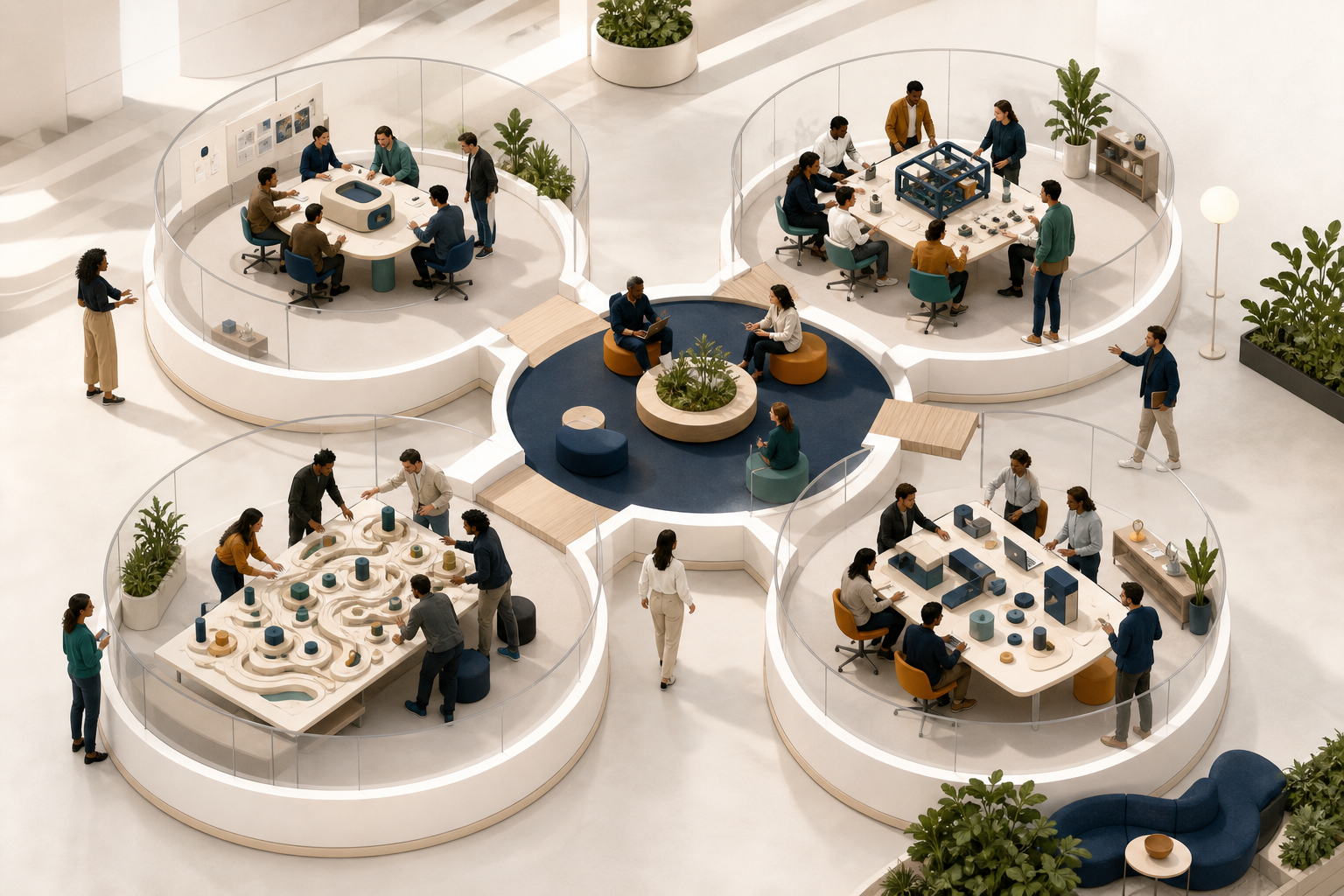
Your product teams are staffed, the roadmaps are full, and capable leaders are working hard. Yet every important decision still crosses three organizations, priorities are renegotiated in multiple forums, and shared dependencies turn routine work into escalation. That is usually not a capacity problem. It is an ownership and operating-model problem.
A scalable product-led organization gives durable, cross-functional teams responsibility for customer problems and business outcomes, then makes the boundaries around that responsibility explicit. It does not mean product managers outrank engineering, design, sales, or operations. It is also not synonymous with product-led growth. The goal is a system in which the right decisions happen close to the work without fragmenting the customer experience or the company strategy.
Key takeaways
- Use a customer problem or business outcome as the basic unit of organization design. Reporting lines should support that ownership, not define it.
- Give each important outcome one accountable owner. Other teams can have input, approval, or delivery responsibilities, but two equal owners usually means no final owner.
- Draw team boundaries along contiguous parts of the customer journey. Every recurring handoff creates delay, information loss, and another place where priorities can diverge.
- Pair autonomy with a written operating contract covering decision rights, guardrails, interfaces, funding, metrics, and escalation.
- Keep shared platforms and enterprise-wide policies centralized when fragmentation would damage reliability, pricing coherence, data quality, or brand trust.
- Introduce the model through a small set of pilot teams, then inspect decision flow and outcome movement at 30, 60, and 90 days before expanding it.
Start with outcomes before drawing reporting lines
An org chart shows who reports to whom. It does not show who can make a pricing decision, who resolves a conflict between two roadmaps, how a product team gets platform capacity, or what happens when a local optimization harms the wider customer journey. Those are the questions that determine whether the organization can move.
The foundational shift is from temporary delivery ownership to durable outcome ownership. A product operating model funds teams and outcomes rather than treating every initiative as a project with a fixed beginning and end. Teams remain responsible after launch because adoption, retention, reliability, and commercial performance continue to change.
Before moving a single box, write a one-page design brief. It should answer five questions:
<!– wp:list {