AI headlines are everywhere—and many claim they know exactly what’s coming next. In product management, I’m often asked to make single-point predictions about gen ai and LLMs for product managers. I resist that temptation because confident forecasts are seductive—and usually wrong.
Listening to Teresa Torres and Petra Wille unpack why certainty fails reinforced what I practice with my product trios: scenario planning. Instead of betting on one future, I explore several plausible ones, define the signals that would confirm or disconfirm each, and translate those insights into product strategy and product roadmapping and sprint planning we can adapt as evidence evolves.
Their argument mirrors what I see with customers and stakeholders: people are bad at predicting the future, and overconfidence creates fragility. Early adopters don’t represent everyone, so when we extrapolate from enthusiasts to the mainstream, we waste time and erode trust by building the wrong things.
Here’s how I apply this to avoid technology FOMO and make sharper AI Strategy decisions. I treat every bold claim as one possible future, then ask, “what else could happen?” I push extremes—AI everywhere vs. AI as invisible utility; GUIs vanish vs. GUIs evolve; centralized vs. edge compute—and hunt for the needs that stay true across scenarios. Those invariants anchor empowered product teams to outcomes, not outputs, and they help us stage bets responsibly.
Listen to this episode on: Spotify | Apple Podcasts
My key takeaways: Confident predictions are often wrong. Early adopters don’t represent everyone. Treat predictions as one possible future. Scenario planning > trying to be right. Focus on patterns, not hype.
In short: We’re in a period of change—but no one can predict exactly how it plays out. Strong predictions often ignore uncertainty.
A better approach in practice: Treat every prediction as a scenario. Ask: what else could happen? Use multiple futures to guide decisions.
As you evaluate roadmaps, watch for traps like “My experience = everyone’s future” thinking, over-indexing on early adopters, and ignoring real-world constraints like budgets, compliance, and change management.
Tactically, we run quick scenario exercises, push ideas to extremes to explore implications, and extract the underlying insight (not the exact prediction). This complements continuous discovery and helps us write outcomes vs output OKRs that are resilient to uncertainty.
00:00 – The problem with future predictions
04:00 – Why experts get it wrong
06:00 – Scenario planning explained
12:00 – Early adopters vs. reality
20:00 – AI, GUIs, and extreme takes
27:00 – Using scenarios in product work
34:00 – Final thoughts
Resources & Links:
Follow Teresa Torres: https://ProductTalk.org
Follow Petra Wille: https://Petra-Wille.com
Mentioned in this episode:
Claude Code
What did I miss—or what scenarios are you considering for your team? Leave a comment below and let’s compare notes.
Scaling a real-world marketplace from scrappy to dominant takes a different kind of product leadership. Reflecting on Christopher Payne’s decade leading DoorDash as President and COO — growing from roughly 70 employees to the dominant food delivery platform in the US — I’m struck by how much of that success hinged on mastering an atoms-based business while still operating with software-level rigor. As a VP of Product Management, I see the same patterns in my own work: relentless clarity on inputs, a bias for builder-executives, and a cadence that keeps leaders close to product details without becoming bottlenecks.
Running an atoms-based business versus a pure software company forces you to obsess over operational physics: unit economics, quality control, on-time reliability, and dense local liquidity. It’s precisely where traditional “bits” executives can stumble. What’s worked for me is a simple “plate spinning” framework for executive attention: identify the five or six plates that must never stop — customer experience, marketplace health, quality and safety, product velocity, platform reliability, and P&L — then schedule recurring deep dives to keep those plates spinning. If a plate wobbles, I drop in, fix the root cause, re-instrument the inputs, and zoom back out.
Hiring at hypergrowth speed only works when you bias toward a “builder mentality.” I look for executives who run toward fuzzy problems, write clearly, and can prove they’ve shipped value with incomplete information. Prior industry experience can be a liability when you’re reinventing the market; first-principles thinkers outlearn domain experts who try to port yesterday’s playbooks. In executive hiring, I’ve found structured work samples and narrative memos far more predictive than marathon interview loops — companies routinely spend too much time on job interviews and too little time evaluating how candidates think and execute.
Great executives never outgrow the details. Staying close doesn’t mean micromanaging — it means sampling the customer journey and instrumenting the system so you can feel where it hurts. In my own practice, I rotate through frontline touchpoints weekly: support transcripts, NPS verbatims, failed checkout sessions, and reliability dashboards. Small signals often reveal systemic issues. A single ciabatta bread moment — the kind of edge-case substitution that seems trivial — can expose broken handoffs, unclear policies, and misaligned incentives across the marketplace.
Top-down goal setting beats bottom-up when you’re aiming for category leadership. Bottom-up targets tend to regress to comfort; they calibrate to today’s constraints, not tomorrow’s possibilities. I set ambitious, top-down outcomes (not output), frame the non-negotiables, and map driver trees to clarify the input metrics that matter. Then I ask empowered product teams to pressure-test the plan, propose approaches, and own the how. This preserves ambition while unlocking creativity — a practical balance of clarity and autonomy that outcomes vs output OKRs were designed to achieve.
One-size-fits-all management is a myth. Early-stage teams need hands-on coaching and fast decisions; later-stage teams need mechanisms that scale: crisp PRDs, pre-mortems, and operating cadences that separate strategy, planning, and execution. The mark of a high-functioning executive team is not uniform style — it’s high candor, fast escalation paths, and visible commitment after debate. In tough moments, a little charisma goes a long way; in practice, that’s not theatrics, it’s steady optimism, simple language, and consistent follow-through that keeps people moving forward.
The hypergrowth skill stack for executives is surprisingly learnable: ruthless prioritization under uncertainty, narrative writing that aligns cross-functionally, structured delegation with clear “inspection points,” and a weekly rhythm that protects maker time. I leverage a cadence of business reviews (inputs > outputs), customer-scent checks, and decision logs so we can move fast without losing the thread. CEO and executive time management is the ultimate forcing function — if we can’t show where our attention maps to goals, the team won’t either.
Some of my enduring lessons echo the best of Amazon and eBay: customer obsession beats competitor obsession, input metrics beat lagging vanity metrics, and simple mechanisms beat heroics. From Jeff Bezos’s playbook I borrow the insistence on written narratives, single-threaded ownership, and clarity on what will not change. Those principles remain the backbone of platform scalability and resilient product strategy, especially when markets get noisy.
AI is about to flatten organizations. With agentic AI, retrieval-first pipelines, and AI workflows embedded into product development, managers can widen their span without losing fidelity. I see LLMs for product managers accelerating discovery, PRD drafting, and experiment analysis — while raising the bar on decision quality. The implication for leadership: fewer layers, more transparency, and even greater pressure to define sharp, top-down outcomes that teams can autonomously pursue.
If I had to compress this into a playbook, it’s this: set audacious, top-down goals; keep your “plate spinning” calendar sacred; write more than you talk; hire builders, not resume archetypes; sample the customer journey every week; and build mechanisms that make the right thing easier than the heroic thing. That’s how you scale product management leadership from dozens to thousands — in atoms, in bits, and in the messy, exhilarating space where they meet.
Product teams rarely fail because they don’t ship enough features; they fail because they don’t learn fast enough. That’s the core tension I manage every day: when to build to learn and when to build to earn. Navigating that balance is how we protect focus, accelerate time-to-value, and ultimately deliver durable business impact.
Over the years, I’ve seen at least two major ways to develop product: build to learn and build to earn. The first is discovery-led and evidence-seeking; the second is delivery-led and value-capturing. Both are essential. The real craft is knowing which mode to be in, when to switch, and how to keep stakeholders aligned around outcomes instead of output.
The project model remains the default in many organizations—even in the age of AI—and it’s all about output. Stakeholders or executives assemble a prioritized roadmap of features and projects, and teams ship against it. This can create momentum, but without clear outcome metrics and customer validation, it’s easy to drift into a feature factory that looks productive while missing the mark on user value and business results.
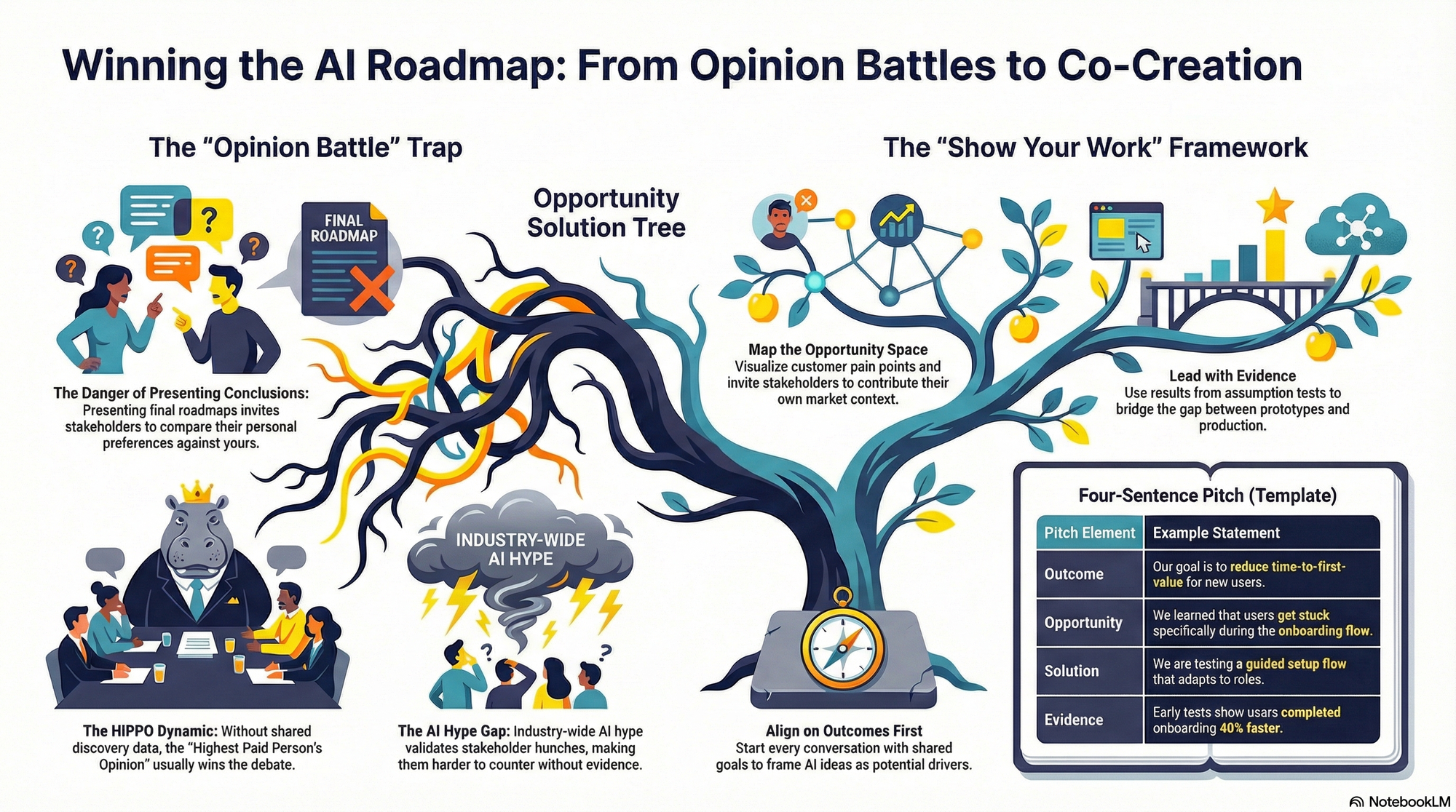
When I build to learn, I emphasize continuous discovery. That means using customer interviews to surface unmet needs, running lightweight prototypes to test desirability and usability, and deploying A/B testing to quantify impact. I map assumptions, risks, and opportunities with an opportunity solution tree, and I timebox experiments so we learn fast and cheap. The standard is evidence, not opinions—especially my own. The goal is simple: reduce uncertainty before we scale.
When I build to earn, the objective shifts to capturing value with confidence. Here I align teams to outcomes vs output OKRs, commit to clear acceptance criteria, and ensure product roadmapping and sprint planning reflect the highest-leverage bets we validated in discovery. Delivery excellence matters: crisp definition, reliable release trains, observability, and a strong feedback loop to confirm we’re moving activation, conversion, or retention in the intended direction.
Deciding when to transition from learning to earning is all about thresholds of evidence. I look for leading indicators that our solution reliably solves the target problem, shows a measurable lift in key behaviors, and can be delivered with acceptable risk. If we can’t articulate the expected outcome and how we’ll measure it, we’re not ready to scale. If we can, we invest, monitor impact, and keep guardrails in place to avoid scope drift.
The operating model that makes this sustainable is simple and disciplined. I rely on empowered product teams organized as product trios (product, design, engineering) to run dual tracks of discovery and delivery. We socialize learning with stakeholders early and often to strengthen trust and stakeholder management. We elevate strategy by linking every roadmap item to a problem statement, a testable hypothesis, and a quantified outcome—no orphan features, no vanity launches.
In the AI era, speed can tempt us back into shipping-by-idea. I use gen AI for product prototyping and insight synthesis, and I lean on LLMs for product managers to accelerate discovery work—without treating AI as a shortcut to validation. Our AI Strategy clarifies where AI augments discovery, where it powers the product, and how we evaluate risk, so we move faster without compromising rigor or ethics.
My rule of thumb: spend just enough time building to learn to achieve conviction, then shift decisively to building to earn—while preserving a small discovery cadence to keep learning alive. This rhythm protects focus, compounds insight, and makes growth more predictable. It’s how we avoid the output trap, deliver meaningful outcomes, and create products that customers love and the business celebrates.
MCP is the acronym I keep hearing in every product conversation—and for good reason. When teams like Miro and Atlassian lean in, it signals a real shift in how we design, ship, and scale value. From my vantage point leading product at HighLevel, I see MCP less as a feature and more as an operating advantage: a way to align strategy, execution, and governance so product teams move faster with higher confidence.
When I evaluate a platform like MCP, I start with three questions. First, does it advance our product strategy and sharpen competitive differentiation? Second, does it strengthen product-led growth by improving activation, onboarding, and retention? Third, does it help us drive outcomes vs output OKRs so we consistently measure what matters, not just what ships?
Execution discipline makes or breaks any MCP investment. I design measurement upfront: instrument A/B testing, define activation milestones, and monitor retention cohorts. In parallel, I use Pendo for in-app guides and product tours to accelerate adoption and reduce time-to-value, then connect this data back to roadmap decisions so each release compounds learning instead of creating noise.
On the operating model, I apply a rigorous build vs buy lens and stress-test platform scalability, reliability, and integration surfaces. Stakeholder management is critical—security, SRE, and solutions engineering must be partners from day one. I anchor teams in product trios and continuous discovery so we learn with customers in the loop, not after the fact.
At Pendomonium 2026, Pendo CPO Rahul Jain brought together four product leaders who are building with MCP. Read or watch their conversation to learn more.
My practical playbook for MCP: choose one high-signal use case, define clear success metrics, and run a tightly scoped pilot with visible executive sponsorship. Treat governance and data hygiene as first-class requirements. Close the loop weekly with qualitative insights from customer interviews and quantitative telemetry from experiments. Only then scale to adjacent workflows, keeping a steady focus on measurable customer value and repeatable delivery.
Whether you’re an emerging startup or an established enterprise, the opportunity is the same: turn MCP curiosity into durable capability. With disciplined measurement, thoughtful stakeholder alignment, and a relentless outcomes mindset, MCP can become a lever for product management leadership—not just another acronym in the stack.
Lately, I keep hearing a familiar question: with AI making it so easy to generate ideas and build products, do we still need product managers? My answer is unequivocal—yes. Tools accelerate delivery, but they don’t build trust, reconcile competing incentives, or create the shared understanding teams need to ship outcomes. Product work is relationship work.
I recently listened to “Product Work Is Relationship Work – All Things Product with Teresa & Petra,” and it echoed what I see every day in high-performing product organizations. If you prefer to watch, here’s the episode on YouTube: https://www.youtube.com/embed/d-0f8uAfc8w?feature=oembed
Listen to this episode on: Spotify | Apple Podcasts
While AI can help build things faster, it can’t replace the relationship work required to align stakeholders, navigate competing priorities, and create shared understanding across teams. That’s the hard, human part of product management—and it’s not going away.
In my experience, product teams stall when collaboration becomes transactional. We jump to negotiation (“What can you commit by Friday?”) before establishing context (“What problem are we solving and why now?”). When I slow down to get curious—about constraints, incentives, and assumptions—momentum actually increases because we’re rowing in the same direction.
Stakeholder alignment often breaks down when we conflate advocacy with exploration. We argue our viewpoint as if it were the only lens that matters, rather than making space to surface how others see the system. I’ve found the distinction between “dialogue vs. discussion,” rooted in work by Chris Argyris and elaborated in The Fifth Discipline by Peter Senge, to be a powerful reset. Dialogue builds shared understanding; discussion decides. You need both, in the right order.
Language matters in the room. The improv principle “Yes, and” is deceptively simple but transformative. When a designer, engineer, or executive feels heard (“Yes”) and we build on their idea (“and”), we create psychological safety without sacrificing critical thinking. I use “Yes, and” to explore perspectives before we converge on decisions—especially with product trios and senior stakeholders.
Here are the moves I rely on to keep collaboration relational and outcomes-focused. First, we align on outcomes before solutions. I explicitly separate outcomes vs output OKRs so we’re clear on what success looks like, independent of the features we ship. That clarity reduces rework and speeds up decision-making later.
Second, we operationalize curiosity with continuous discovery. I schedule recurring, lightweight touchpoints with customers and internal stakeholders so insights compound. When learning is continuous, debates quiet down—evidence does the heavy lifting.
Third, we invest in relationship rituals. Regular 1:1s with key partners, stakeholder maps that capture motivations, and pre-reads that frame trade-offs all prevent misalignment from surfacing in the last mile. These small habits pay huge dividends in trust and speed.
Fourth, I’m explicit about mode-switching in meetings: are we advocating a position or exploring perspectives? Calling the mode out loud prevents people from mistaking questions for opposition and keeps the conversation productive.
Fifth, we use “Yes, and” to move from possibility to practicality. We explore generously, then converge rigorously—ranking options by impact, effort, and risk so decisions are transparent and fair.
If stakeholder alignment, team dynamics, or product “politics” slow your team down, this conversation offers a practical reframe. You’ll move faster when you build the relational tissue first—because alignment is an accelerant, not a tax.
Resources & Links:
Follow Teresa Torres: https://ProductTalk.org
Follow Petra Wille: https://Petra-Wille.com
Mentioned in this episode:
Petra’s Coaching Packages
Work by Chris Argyris on organizational learning and dialogue vs. discussion
The Fifth Discipline: The Art and Practice of the Learning Organization by Peter Senge
Improv principle “Yes, and”: Saying “Yes, and” — A principle for improv, business & life and Yes, and …
Have thoughts on this episode or examples from your team? Leave a comment below—I’d love to learn what’s working (and what’s not) in your stakeholder landscape.
Every week I meet marketers who are working harder than ever—more campaigns, more content, more dashboards—yet seeing less movement on metrics that matter. The surge of AI tooling has amplified activity, not necessarily impact. That’s the focus problem: we confuse motion with momentum, and our backlogs look great while our outcomes stall.
Learn how AI agents for marketing can help you prioritize impact so you can do important work, instead of just more work.
In my role leading product and growth teams, I’ve learned that AI only compounds value when it is pointed squarely at outcomes. If we don’t define what “good” looks like, agentic AI will simply scale busywork. The antidote is a disciplined operating model that connects strategy to execution and instruments agents with clear success criteria.
First, anchor your program with outcomes vs output OKRs. Choose one or two measurable business outcomes—such as qualified pipeline, conversion rate, or activation—and make everything else subordinate. This provides the compass agents need to make effective trade-offs when speed and volume tempt you to do “one more thing.”
Second, map a driver tree from the target outcome down to the controllable levers: audience segments, offers, channels, messaging, and experience friction. This traceability shows where agents can move the needle fastest—whether that’s accelerating research, sharpening positioning, or eliminating handoffs that slow experimentation.
Third, design a small, agentic AI workforce aligned to those levers. For example: a Research Agent that synthesizes market insights and past performance; a Copy Agent that generates on-brief, on-brand variants; a Distribution Agent that adapts content to each channel and schedules posts; and an Analytics Agent that runs A/B tests, summarizes results, and flags anomalies. Keep human oversight where judgment matters most—strategy, brand voice, and high-stakes decisions.
Fourth, instrument rigor from day one with Agent Analytics and eval-driven development. Define offline evals for brand consistency, factuality, safety, and response time; pair them with online experiments that quantify lift on your target outcomes. Set a minimum detectable effect (MDE) so you stop shipping changes that cannot plausibly move the metric.
Fifth, operationalize your AI workflows. Standardize prompts, inputs, and handoffs; templatize briefs and acceptance criteria; and keep a change log so improvements compound rather than reset. Use short, frequent feedback loops to prune low-impact work and double down on what demonstrably advances your objectives.
I’ve seen teams reclaim focus and momentum when they treat agents as teammates, not toys. The magic isn’t in producing more assets—it’s in consistently choosing the next best action in service of a clear outcome. When you combine outcome clarity, a driver tree, targeted agents, and tight evals, AI becomes a force multiplier for marketing impact.
If you’re feeling overwhelmed by AI’s possibilities, start small: commit to one outcome, one driver you believe is material, and one agent designed for that job. Prove lift, codify the workflow, then scale. Velocity is only valuable when it’s pointed in the right direction.
Inspired by this post on Amplitude – Best Practices.
Internal Products Are Hard; Commercial Products Are Harder. That line captures years of hard-won lessons from leading both internal platforms and market-facing SaaS at HighLevel. I’ve seen how the two demand different muscles—even when the tech stack, talent, and timelines look the same on paper.
When I talk about internal products, I mean services and solutions that our own employees use to take care of customers—customer-enabling tools and services, agent consoles, fulfillment and billing workflows, operations dashboards, and the underlying platforms that keep them fast, compliant, and resilient. These tools don’t generate revenue directly, but they quietly determine customer experience, gross margin, and how quickly we can ship, resolve issues, and scale.
Commercial products, by contrast, add a second challenge layer. Beyond discovery, usability, and reliability, we must conquer positioning, pricing and packaging, competitive differentiation, sales enablement, procurement hurdles, and ongoing customer success motion. The surface area for failure is bigger, and the time-to-signal on product-market fit is slower and noisier.
Here’s how I decide where to invest. First, I anchor on outcomes, not output. If the business priority is net revenue retention, faster onboarding, or reduced cost-to-serve, internal products often provide the highest-leverage path. If the priority is new revenue, new market entry, or a must-have differentiator, we lean commercial. I make the trade explicit in outcomes vs output OKRs so we can defend the decision when pressure mounts.
Second, I run a clear build vs buy calculus. For internal needs, the default is buy if a mature, configurable solution exists that meets our security, data governance, and integration requirements. I only build when the workflow is core to our differentiation, the TCO of customization is lower than vendor sprawl, or we can capture unique proprietary advantage. For commercial products, I avoid embedding third-party IP in a way that caps differentiation or compresses margins as we scale.
Third, I insist on continuous discovery. Internal audiences are not a captive market—they’re discerning experts with real jobs to do. I treat them like customers, with structured customer interviews, journey mapping, and opportunity solution trees. I rely on empowered product teams and product trios to validate problems and reduce solution risk before we commit engineering time.
Fourth, I frame commercial vs internal work with capacity guardrails. In most planning cycles, I reserve explicit allocation for platform scalability and internal tooling, separate from feature bets. Without this, internal products become backlog filler, which guarantees we’ll pay the interest later in churn, SLA breaches, and slower delivery.
Execution differs too. For internal products, change management is the make-or-break. I plan enablement as a first-class deliverable: clear rollouts, in-app guides, training, and feedback loops with frontline champions. I track adoption, time-to-resolution, error rate, and satisfaction for internal users with the same rigor we apply to external users.
For commercial products, I design the discovery-to-GTM handshake early. Pricing and packaging must reflect value drivers discovered in research, not what’s easiest to meter. Sales and solutions engineering need crisp narratives, objection handling, and proof points. Customer success needs activation plans and health signals tied directly to leading indicators of retention.
Across both, I instrument the product and process. I lean on feature flags and progressive delivery to manage risk, and I protect SLOs with error budgets so teams balance reliability with iteration speed. CI/CD isn’t a badge—it’s how we earn the right to ship continuously without eroding trust.
Common pitfalls recur. Teams skip UX for employee tools because “they have to use it”—which backfires as shadow workflows and rework. Leaders underfund internal platforms, then wonder why velocity stalls. On the commercial side, teams over-index on features and under-invest in positioning and onboarding, leading to poor activation and elongated sales cycles.
What’s the payoff? When we treat internal products as products, we unlock scale: shorter handling times, fewer escalations, clearer accountability, and higher customer satisfaction. When we approach commercial products with the same discovery rigor plus smart GTM, we compress time-to-value and amplify differentiation. The craft is knowing which lever to pull when—and having the discipline to measure what matters.
My rule of thumb is simple. If the goal is operational excellence that compounds across the entire customer journey, invest in internal products with the same intensity you reserve for revenue-generating features. If the goal is market expansion or category leadership, invest in commercial products with a tight discovery-to-GTM loop. In either case, clarity of outcomes, disciplined discovery, and empowered teams win the day.
Every planning cycle, I feel the drumbeat: “Show me the AI ROI—this quarter.” The pressure is real, especially when boards and CFOs expect immediate payback. Yet when I review stalled initiatives across teams and peers, the pattern is consistent: most companies treat AI like a feature to ship, not a system to manage. That mindset almost guarantees we measure the wrong things, declare victory (or failure) too early, and miss the durable value AI can create.
Here’s the core problem I see: we leap to solution and skip the counterfactual. Without a baseline, a clear control, or a defined “what would have happened otherwise,” we’re guessing. We also fixate on lagging, financial KPIs that move slowly (revenue, cost, risk), then use outputs—not outcomes—as OKRs. If we don’t align on outcomes vs output OKRs upfront, the best team in the world can still optimize for activity over impact.
My AI Strategy starts from a simple truth: value shows up along three vectors—revenue, cost, and risk—on different timelines. In the near term, we must validate leading indicators (adoption, engagement, activation) that ladder to those vectors through a transparent driver tree. Over time, those drivers compound into the lagging KPIs finance cares about. When we make the driver tree explicit, everyone can see how model precision, response time, and workflow integration roll up to conversion lift, case deflection, time-to-resolution, or reduced exposure.
To make this rigorous, I run a five-step playbook. First, define the decision and business outcome in plain terms. Second, instrument the baseline with behavioral analytics on a unified analytics platform—tools like Amplitude analytics or Pendo help expose friction points we’ll later target. Third, create a counterfactual using A/B testing and specify a minimum detectable effect (MDE) so we know how long to run and how much traffic we need. Fourth, quantify costs (training, inference, integration, change management) and include AI risk management, privacy-by-design, and data governance up front. Fifth, lock a measurement plan that connects leading indicators to lagging ROI through the driver tree.
Most AI initiatives don’t fail on model quality—they fail on adoption. If the workflow isn’t smoother, trust isn’t earned, or value isn’t obvious, users revert. That’s why I invest early in onboarding, in-app guides, product tours, and thoughtful tooltip design to reduce the time-to-first-value. Then I watch user activation, retention analysis, and task completion to ensure the assistive experience is not just novel—it’s habit-forming.
For generative use cases, eval-driven development is non-negotiable. I maintain offline evaluations for accuracy and safety, and online evaluations for business impact. Retrieval-first pipeline health, context window management, and prompt engineering affect reliability; so do latency and grounding quality. We ship behind feature flags, measure guardrail effectiveness, and tighten feedback loops from human-in-the-loop reviews into model updates—continuously.
On the business side, I avoid “AI theater” by structuring benefits like a CFO. Revenue: increased conversion or expansion driven by better recommendations, faster sales cycles, or higher trial activation. Cost: case deflection, agent time saved, fewer escalations, and lower rework. Risk: reduced exposure via automated checks, anomaly detection, and consistent policy application. If any claim can’t be tied to measured deltas—via A/B testing or strong quasi-experiments—it doesn’t go in the deck.
Build vs buy deserves the same discipline. I map platform scalability, governance requirements, and total cost of ownership against time-to-impact. Teams often underestimate integration and maintenance drag; a pragmatic mix of bought components with thin custom layers can accelerate outcomes while keeping options open. The goal isn’t to own every layer—it’s to own the learning loop and the differentiated experience.
I also remind teams that tooling should serve the strategy, not replace it. I’ve seen concise, effective messaging that captures the point: “Increase revenue, cut costs, and reduce risk with Pendo’s Software Experience Management platform. Optimize the entire software experience to drive adoption and improve engagement.” The words are compelling because they reflect the three-vector value model and the adoption imperative. The same standard should apply to any AI initiative we propose.
If you’re under pressure to prove ROI, shift the conversation: lead with the driver tree, specify your counterfactual, and anchor on leading indicators you can move in weeks—not quarters. Then connect those to the lagging KPIs finance expects over time. When we manage AI like a product—grounded in evidence, experimentation, and user-centered adoption—we don’t have to force ROI. We compound it.
Product roadmaps should not be promises etched in stone; they are portfolios of bets made under uncertainty. When I build a roadmap, I’m not predicting the future—I’m designing a system that helps the team learn faster than the market changes, allocate capital wisely, and create alignment across engineering, design, go-to-market, and leadership.
The best roadmaps I’ve seen and shipped anchor on outcomes rather than features. “Outcomes vs output OKRs” is more than a slogan; it’s how we translate strategy into measurable impact. I start by defining a small set of outcome metrics that matter—such as activation rate, time-to-first-value, or expansion revenue—and attach clear key results and guardrails to each theme. This reframes prioritization from “what can we build?” to “what must change in customer behavior?” and gives empowered product teams real autonomy.
I organize the roadmap into time horizons—Now, Next, Later—with explicit confidence levels. Near-term items have higher confidence and more specificity; mid- and long-term bets are thematic with wider time windows. This approach reduces false precision and builds trust because stakeholders can see both the intent and the uncertainty. When dates matter, I use windows and service level expectations rather than single deadlines, and I pair each initiative with a lightweight risk scoring so we can discuss uncertainty explicitly rather than implicitly.
Continuous discovery keeps the roadmap honest. I partner in tight “product trios” across product, design, and engineering to run rapid customer interviews, opportunity sizing, and assumption tests before we commit significant delivery capacity. The opportunity solution tree is my favorite artifact here; it visualizes the path from outcomes to opportunities to experiments and solutions, making trade-offs and sequencing transparent. By the time something moves into sprint planning, we’ve already reduced key uncertainties and clarified the narrowest viable slice we can ship.
Uncertainty demands options. I plan initiatives as options with stage gates and explicit kill criteria rather than as single monolithic projects. For every significant theme, I outline base, best, and worst-case scenarios with pre-decided triggers for when we escalate, pivot, or stop. This practice prevents sunk-cost fallacy and keeps the team focused on evidence. We treat scope as a knob, not a switch, and we bias toward small, sequential bets that compound learning.
Capacity is strategy. I routinely reserve a discovery buffer—typically 10–20%—and a contingency buffer for integration, security, and performance risks that always show up late. I ruthlessly control work-in-progress to limit thrash and protect the team’s ability to respond when new information arrives. When we must navigate dependencies, I use thin vertical slices and decouple via contracts or feature flags so discovery momentum doesn’t stall while platforms evolve underneath.
Prioritization under uncertainty benefits from explicit models. I combine value, effort, and confidence with risk scoring to surface where the unknowns are hiding. Driver trees help us connect top-level outcomes to leading indicators, so we can place bets where they have the highest causal leverage. I also lean on the Kano Model and qualitative signals to avoid over-investing in performance attributes while neglecting excitement features that unlock differentiation and word-of-mouth.
The most effective stakeholder management is narrative-first. For executives, I present a one-page outcomes roadmap that shows themes, expected shifts in key results, and the learning plan. For teams, I provide a more detailed plan that links discovery insights, assumptions-to-test, and decision points. I make room for a “what we’re not doing” section to reduce noise and prevent shadow backlogs from reappearing in every meeting. Most importantly, I socialize change before it happens, explaining the evidence and the trade-offs so adjustments feel like progress, not whiplash.
Measurement closes the loop. We instrument experiments and releases with leading indicators tied to the driver tree and review them on a predictable cadence. If movement stalls, we diagnose whether we have a targeting problem (wrong audience), a value problem (weak proposition), or a friction problem (broken journey). That discipline lets us iterate with purpose instead of chasing vanity metrics or isolated anecdotes.
Here’s a concrete example of roadmapping through uncertainty. Suppose our Q3 objective is to “Increase user activation” with key results to raise the Week-1 activation rate from 32% to 45% and cut time-to-first-value by 30%. In discovery, customer interviews reveal confusion in the first-run setup and a missing integration that advanced users expect. We map an opportunity solution tree and identify two high-leverage opportunities: simplifying the first 10 minutes and offering a guided setup for the integration. We then shape two minimal bets: an in-app guide to streamline the first three tasks and an integration wizard behind a feature flag. Each bet has an explicit decision rule and a two-sprint runway. We ship the guide first, confirm a statistically significant lift via A/B testing, then expand scope. The integration wizard underperforms initial expectations, so we pause, revisit the assumptions, and re-allocate buffer to the stronger path. The roadmap updates in real time, and everyone understands why.
When uncertainty spikes—new competitor, pricing shock, platform deprecation—I shift the roadmap cadence to rolling-wave planning. We shorten planning horizons, increase the frequency of readouts, and elevate discovery allocations temporarily. We also create thematic “containment zones” where we explore multiple options in parallel with small budgets until one path justifies scale. This allows us to stay responsive without abandoning strategy.
Good governance accelerates, it doesn’t slow. A lightweight product council that reviews outcomes, risks, and cross-functional dependencies prevents surprise escalations and ensures we keep shipping what matters. We avoid death-by-approval by agreeing in advance on decision rights and thresholds—for example, a product trio can pivot a bet within a theme up to a certain budget or timeline impact without additional approval, as long as it improves the outcome likelihood.
If you’re evolving your roadmap practice, start with three moves. First, reframe your plan in outcomes and publish a driver tree that connects those outcomes to the few leading indicators you believe move them. Second, stand up a continuous discovery cadence with a visible opportunity solution tree and an assumptions-to-test backlog. Third, implement time windows and confidence levels for all mid- and long-term items, and pair each major initiative with explicit kill criteria. You’ll feel the difference in a single quarter: clearer trade-offs, faster learning, and more predictable delivery—despite uncertainty.
In the end, a roadmap that thrives in uncertainty is an agreement about how we learn and decide together. It aligns the organization on outcomes, it funds options—not fantasies—and it gives empowered product teams room to maneuver. That’s how top product teams plan for uncertainty and still deliver with confidence.
I keep a running list of product wisdom that sounds great on a slide but quietly sabotages execution. Recently, I revisited that list after a deep conversation with a seasoned CPO from a leading security and compliance platform and reflected on how these lessons show up in my own operating rhythm. What follows is my practical playbook for scaling product organizations without losing speed, quality, or the soul of the product.
Most big-tech veterans struggle when they leap into startups because the safety net of process disappears. At a startup, the buck truly stops with you—there’s no committee to shield a decision and no process to rescue a weak plan. The mindset shift is simple to say and hard to do: own outcomes end to end, reduce your reliance on institutional scaffolding, and make decisions with incomplete information while keeping standards high.
“Great product leaders stay in the details.” I sample artifacts every week—PRDs, design flows, user research notes, postmortems—and I read customer threads to calibrate my intuition. To maintain shipping velocity as headcount grows, I instrument a few critical indicators (deployment frequency, change failure rate) and favor outcomes over output. Data guides my attention; it never replaces judgment.
As teams scale, I use a blunt rule to keep speed high: small autonomous teams, small batch sizes, short feedback loops. One clear owner, one prioritized backlog, and weekly demos to customers. We ship thin slices, not big bangs. And “Great CPOs should avoid comfort metrics”—the easy dashboards that rise when nothing meaningful is moving. I push for outcome-centric OKRs tied to customer value, not vanity charts.
Rigid hierarchies derail quality decision-making. They slow signal, encourage escalation theater, and suppress the truth from the edges. I shorten paths between PMs, engineers, designers, research, and go-to-market leads, and I strip out stage gates that don’t add learning. Above all, I refuse to “Stop making your team fetch rocks”—randomized executive requests without context. Instead, I frame clear problem statements, explicit constraints, and observable success criteria.
Revenue and product can feel at odds, but they don’t have to be. The key to a quality CPO and CRO relationship is a shared operating model: one customer narrative, a joint pipeline of problems worth solving, and a common scorecard. We meet weekly, review the same signals, and align on sequencing: what we solve now for impact, what we stage for scale, and what we sunset to reduce complexity. When trade-offs get tough, we anchor on customer value and long-term defensibility.
Who ultimately oversees the quality bar? I do—and I do it through clarity, exemplars, and consistent feedback loops, not micromanagement. When I leave feedback, I make it actionable and specific: name the user scenario, note the friction, propose a sharper decision frame, and suggest a smaller, testable slice. I expect narrative memos and crisp acceptance criteria; I offer rapid, detailed responses so momentum never stalls.
Open office hours are my forcing function for transparency and speed. Anyone can bring a thorny escalation, a design in progress, or a customer insight. Pair that with weekly 1:1s—non-negotiable for developing leaders and unblocking work—and the organization learns to surface issues early, make faster decisions, and self-correct without drama.
Here’s a glimpse into my working week: Mondays set priorities and confirm the few decisions that matter; midweek is for deep reviews across roadmap, research, and engineering readiness; Thursdays I’m with customers and partners; Fridays I write and synthesize. I leave space for unscripted time with individual contributors—because ICs are the unsung heroes of a company—and I celebrate excellent craft out loud.
The hardest leadership skill is knowing when to push and when to give space. I push on clarity, sequencing, and quality; I give space on solutions and implementation paths. I reject comfort metrics, reinforce outcomes vs. output, and keep the organization close to customers and details. If you’re stepping from big tech into a startup or scaling your product org through rapid growth, these practices will help you ship faster, decide better, and raise the quality bar without burning out your team.
“Outcomes over outputs” is the right mantra—and one I’ve championed across product teams—but turning it into daily practice is where most teams stumble.
It’s simple in theory: focus on the impact of what we build, not just shipping features. In reality, it’s rarely black and white because most teams are asked to do both—hit outcomes and deliver specific outputs—at the same time.
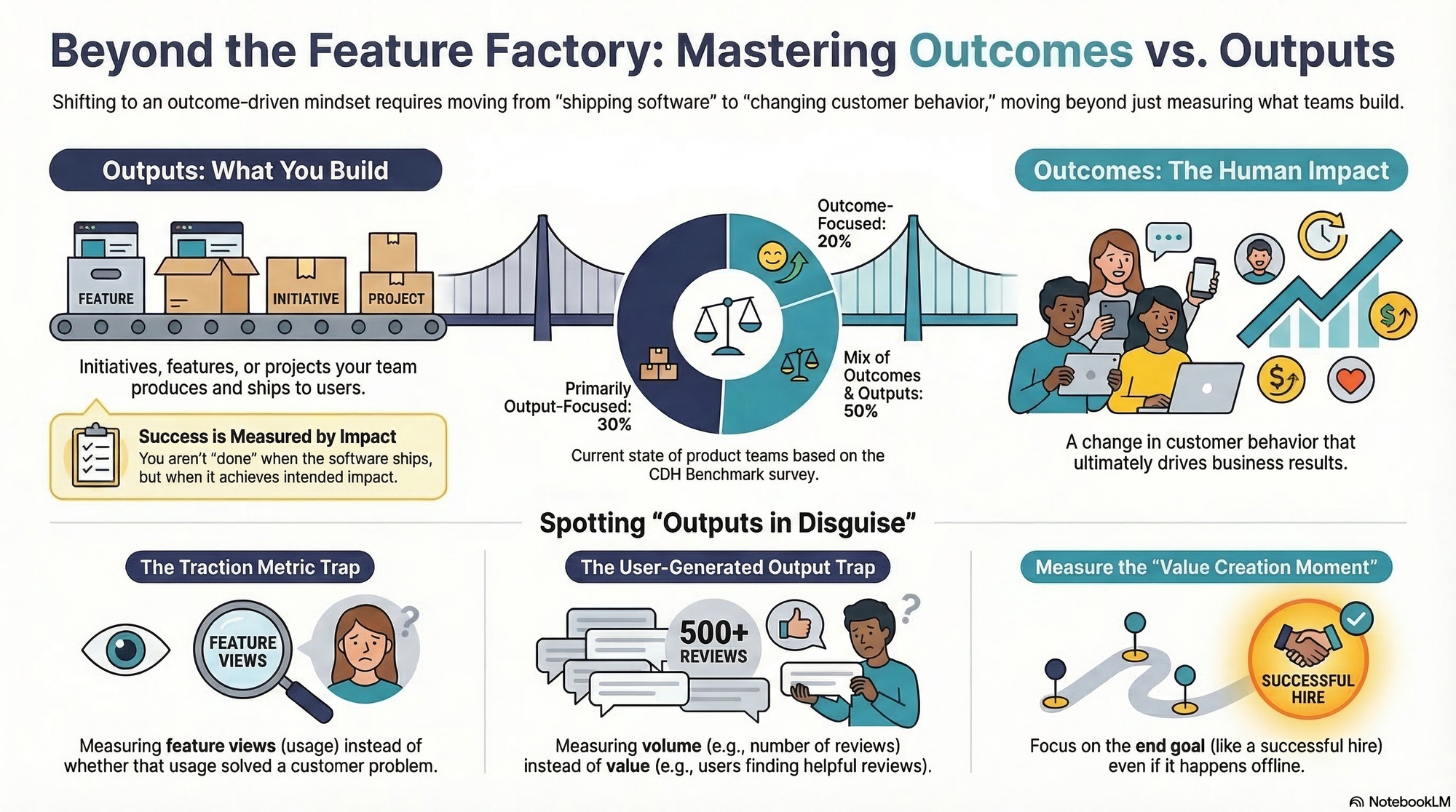
In a benchmark survey, 20% of product teams claim to be outcome-focused, nearly half describe themselves as working in a mix of outcomes and outputs, and about 30% are still primarily working with outputs. I’ve seen versions of this in my own org: we aspire to outcomes, but our rituals, roadmaps, and reporting still reward shipping.
Here’s how I draw the line clearly, coach my teams to avoid common traps, and negotiate better, more actionable outcomes that unlock genuine product discovery and business results.
Simple definitions we live by
An output is something you build or produce—a feature, a project, an initiative. It’s something your team ships.
An outcome is the impact of that output—a change in customer behavior or a business result.
Josh Seiden puts it well in his book Outcomes Over Output: “An outcome is a change in human behavior that drives business results.”
Shift from shipping to shaping results. This graphic clarifies outputs vs outcomes, revealing that value emerges between deliverables and impact—when features change customer behavior and move business results.
I distinguish business outcomes from product outcomes. Business outcomes are typically financial metrics that measure the health of the business (e.g. increase revenue or reduce costs) while product outcomes measure a customer behavior in the product or a sentiment about the product.
Here’s a simple example I’ve used with platform teams. Many B2B companies support a number of integrations. Integrations are outputs. Having integrations alone doesn’t create value. Customers using and finding value in those integrations—that’s an outcome. If those customers retain their subscriptions longer because of the integrations—that’s also an outcome.
Building something isn’t the same as creating value. That’s the core of this distinction, and it’s what separates empowered product teams from feature factories.
Why this distinction matters for empowered product teams
When we task teams with delivering outputs, they’re done when the software ships. When we task teams with delivering outcomes, they aren’t done until the software ships and has the expected impact.
That small shift changes almost everything about how a team works: what we measure (impact, not just delivery), how we know we’re done (measurable behavior change, not release notes), the autonomy we grant (told what to achieve, not what to build), and the planning artifacts we use (an opportunity solution tree beats a feature roadmap when we’re exploring the best path to an outcome).
When I assign outcomes, I’m giving the team latitude—and responsibility—to figure out the best path to success. That’s what opens the door for real product discovery and continuous discovery habits.
Shift your lens from shipping features to achieving impact. This side-by-side visual explains how outcome-driven teams measure success, grant more autonomy, define 'done' by results, and plan with an opportunity solution tree.
Examples: spotting outputs disguised as outcomes
Clear-cut example: “Our outcome is to deliver an Android app.” An Android app is something we build and ship. It’s clearly an output.
To get to an outcome, I ask, “What’s the value of having an Android app?” or “How will we know the Android app is successful?”
We might answer: “Having an Android app will allow us to engage more users. We’ll know it’s successful when people engage with the app on a regular basis.”
This answer uncovers the hidden outcome: engage more people. Now we can set the right scope: increase the percentage of engaged users across any platform; increase the percentage of engaged mobile users; or increase the percentage of engaged Android users.
Any of these outcomes gives us more room to explore than a fixed output. Maybe we don’t need a native app at all. We could deliver the same engagement through a mobile web experience, notifications, or email. And we’re not done when we ship—we’re done when the right people are actually engaged.
Tricky example 1: measure the value creation moment (hires, not applicants)
Move beyond shipping features to the impact that matters. This visual maps the path from build an Android app to the real goal, increase engaged users, by asking why, defining value, and owning results.
When setting outcomes, it’s tempting to choose the easiest-to-measure metric. But a good outcome measures the customer’s value creation moment.
I worked at a company that helped new college grads find their first job. When I started working there, the primary outcome was “increase job applications.” This technically is an outcome—it measures a specific behavior in the product.
But it doesn’t measure the value creation moment. A job seeker doesn’t get value when they apply for a job. They only get value when they get the job. Similarly, employers don’t get value from any job applicant, they get value when the right job applicant applies.
Many job boards try to measure qualified applicants—instead of counting any applicant, they compare the credentials of the applicant to the job description and only count qualified applicants. This is better. But it still doesn’t measure the value creation moment. Both the job seeker and the employer get value when an open job is successfully filled. The right metric is hires.
Yes, “hires” can be hard to instrument because it happens off-platform and incentives misalign. Measure it anyway, even with proxies. The easy metric isn’t always the right outcome.
Tricky example 2: measure impact, not user-generated output (the course reviews trap)
I worked with a team that helped students choose university courses. They set their outcome as: “Increase the number of course reviews on our platform.”
Confusing activity with impact? This visual breaks down four common outcome traps—measuring at the wrong moment, mistaking outputs, chasing adoption, and relying on sentiment—so teams focus on real value.
Sounds like an outcome, right? It’s a metric. You can measure it. It’s an action users take on the site—writing a review. But it’s actually an output in disguise.
Reviews are valuable when they help a student evaluate a course. They don’t create any value if a student never sees them. More reviews aren’t always better, especially if they’re clustered where nobody looks.
A better outcome is “Increase the number of course views that include reviews.” Now we’re measuring impact on the decision moment, not just the production of content.
If you can hit your metric without helping customers, you’re tracking an output, not an outcome.
Tricky example 3: measure success, not just adoption (the traction metric trap)
“Increase the percentage of users who viewed the performance report.”
This looks like a good outcome. It measures a specific behavior in the product. It’s within the team’s control. But it’s what I call a traction metric—it measures adoption of a single feature, not value to the customer.
Why teams get trapped in shipping features: a vicious trust cycle fuels micromanagement, while performance-linked outcomes push safe targets. Break the loop and refocus on customer outcomes that truly move the needle.
Two problems arise. First, people can view the report and still not find what they need. Second, we might have perfectly happy customers who don’t need the report at all. Driving usage of an unneeded feature wastes time and erodes trust.
Measure the value creation moment, not just feature adoption.
Tricky example 4: pair sentiment with behavior
I define a product outcome as a metric that measures either 1. a specific behavior in the product or 2. a sentiment about the product. But sentiment metrics—like CSAT or NPS—can be tricky on their own.
Sentiment metrics are outcomes, but they aren’t directional. They don’t tell us where to explore or set guardrails for what to avoid. So I pair a behavior with a sentiment, for example: “Increase engagement without negatively impacting satisfaction.” I use sentiment as a counterweight.
Facebook and Instagram illustrate why this matters. Meta is exceptional at driving engagement—but to a fault. Many of us don’t like these addictive products. Pairing engagement with a satisfaction guardrail prevents “engagement at all costs.”
Why getting this right is hard (and how I counter it)
Ready to move from shipping features to creating impact? This visual playbook shares five practical moves—translate metrics, partner with teams, iterate, avoid traps, and dig deeper—to turn outputs into measurable outcomes.
The trust cycle. Managers don’t trust that teams can reach outcomes on their own. So managers micromanage the outputs. Teams, in turn, don’t communicate their progress toward outcomes—they communicate their progress on features. This reinforces the manager’s belief that they need to stay involved in the details. It’s a vicious cycle.
I break it by asking teams to show their work—share assumptions, research, opportunity solution trees, and evidence behind choices—and by giving feedback on the thinking, not just the solutions.
The accountability trap. When performance reviews are tied to hitting outcomes, teams play it safe. They sandbag their targets. They disguise outputs as outcomes to guarantee “success.”
I treat outcomes as learning opportunities first. When we start on a new outcome, I set a learning goal—“learn what moves the needle on this metric”—before a performance goal—“increase X by Y%.” This creates space to explore without fear.
How I get teams started with better outcomes
Translate business outcomes to product outcomes. Business outcomes like revenue, retention, and market share are lagging indicators—by the time you see them, it’s too late to act. Product outcomes measure behavior changes within the product that lead to those business results. They’re leading indicators within the team’s control.
Negotiate outcomes with your team. Outcome-setting should be a two-way conversation. Leadership brings the cross-company context. The team brings customer insight and technical realities. Neither side dictates; we co-own the target and the constraints.
Stop celebrating shipped features and start celebrating change. This visual contrasts a feature factory mindset with a true product team, urging teams to track impact, not output, and define success by outcomes.
Expect to iterate on your metrics. Your first outcome metric probably won’t be right. That’s normal. Sonja at tails.com went through four iterations—from 90-day retention to 30-day to 5-day to behavior-based metrics—before landing on something actionable. Thomas at Bluestone Analytics iterated three or four times before finding the right metric. Iteration is the work.
Watch for common mistakes. Outputs disguised as outcomes. Traction metrics masquerading as product outcomes. Sentiment metrics without direction. Business outcomes assigned directly to product teams without translating to behavior change.
Use the right artifacts. Replace feature roadmaps with an opportunity solution tree to explore multiple paths, test assumptions, and sequence bets explicitly against a clear outcome.
Align OKRs with outcomes. If your company uses OKRs, make sure the “KR”s are true product outcomes (behavior change and value creation), not a list of features to ship.
The bottom line
When we shift from an output-first mindset to an outcome-first mindset, it doesn’t mean that outputs stop mattering. Product teams will always ship features, and the ability to do so quickly and with quality still matters. This shift simply ensures those features achieve the intended impact. We aren’t done when we ship—we’re done when what we shipped has the intended impact.
Measure success by the impact of what you ship and you’ll build a product team that learns, adapts, and creates real value. Measure success by what you ship and you’ll get a feature factory.
Quick self-check: is your “outcome” really an outcome?
Ask yourself: 1) Does it measure a behavior change or a sentiment tied to value creation? 2) Could we hit it without helping customers? 3) Is it adoption of a single feature (a traction metric) or a result that customers and the business care about? 4) Do we have a counter-metric to prevent unintended harm? If you stumble on any of these, refine it before you commit.
I’ve long believed a simple truth about AI in customer support: if AI is going to earn trust, pricing has to be aligned with value. That principle has guided my product decisions and the way I hold our teams accountable for measurable outcomes, not activity.
When we shared our perspective on pricing AI Agents in 2023, we made a simple argument: if AI is going to earn trust, pricing has to be aligned with value. At the time for Fin, that value was clear. You pay when the AI resolves a customer’s problem. If it doesn’t, you don’t. That’s fair, easy to understand, and grounded in results, not activity. We were the first to introduce this pricing model because we believed that pricing and value should be inherently linked.
That belief hasn’t changed, it’s grown stronger over time. What’s changed is what Fin can do. As we expanded capabilities and pushed deeper into complex workflows, it became clear that measuring value solely by end-to-end resolutions no longer captured the full picture of impact.
Resolutions were the right place to start. Historically, we measured value based on whether Fin fully resolved a conversation on its own. These are known as resolutions and they gave support teams a clear way to measure ROI, easily comparing the cost of AI versus human support. They also aligned our incentives with our customers, as our revenue was directly tied to Fin’s performance.
That clarity worked. Today, more than 7,000 teams use Fin. Our average resolution rate across customers has increased every month and now stands at 67%, even as Fin increasingly handles more complex queries. That progress came from building an Agent that could take on harder problems and still deliver.
But as Fin got more powerful, “success” stopped being binary. I saw this first-hand in customer design sessions where policy, risk, and compliance needs rightly demanded human-in-the-loop confirmation. We weren’t failing to deliver value; we were delivering it differently.
Over the last couple of years, we invested heavily to ensure Fin could handle the most complex parts of support. As Fin’s capabilities expanded, customers began pushing what Fin can do for them by deploying Fin deeper into their workflows to handle the toughest queries.
In some cases, this required Fin to work in tandem with a human agent because that’s what customer policies and oversight needs dictated. Subscription changes, transaction disputes, billing issues, and other multi-step support scenarios can often require Fin to gather context, read and write to external systems, and execute actions before handing off to a human agent for confirmation.
Fin is still doing what it was configured for – intentionally handing off after doing more of the heavy lifting, saving valuable time for support teams and overall time to serve for their customers. But our pricing metric only recognized value when the conversation ended in a full “AI resolution” (i.e. a human was never involved).
That’s why we’re evolving Fin’s pricing metric from resolutions to outcomes. This shift reflects how customers now define value: not just in full automation, but in safe, efficient progress toward the right result across complex, multi-step, and policy-constrained workflows.
An outcome represents when Fin successfully completes the action it was configured to perform, as part of a conversation. Resolutions are still one type of outcome Fin can deliver, where it handles the issue end-to-end. Another type of outcome can be a Procedure where Fin gathers context, takes action, and hands the conversation off when that’s what customers configured it to do.
Kick off your journey with the #1 Agent—an AI partner designed to turn resolutions into real outcomes. Tap “Start a free trial” to explore faster, smarter customer service and see how Fin delivers value from day one.
Increasing end-to-end AI resolutions is still a core component of scaling Agents, but they are no longer the only measure of Fin's success and utility. Especially as Fin takes on more complex work. Moving to outcomes recognizes that solving a customer problem with full automation isn’t always appropriate. It’s about getting to the right result, safely, and efficiently.
As Fin’s capabilities expand, teams should feel empowered to use it in more nuanced, collaborative work. Outcomes support that by allowing customers to design workflows that meet compliance requirements and include a human agent when necessary. From a product management standpoint, this is how we align incentives, keep risk controls intact, and still accelerate time-to-value.
Fin is becoming even more powerful at handling complex, multi-step support queries. With outcomes, we can support that growth without constantly reinventing how value is measured. And this change gives us a strong pricing foundation that can scale as Fin continues to grow and take on more roles beyond service. This aligns with our vision of Fin becoming a “Customer Agent,” capable of handling the entire customer experience.
What this means for pricing is intentionally straightforward. An outcome will be counted when Fin successfully completes an action it was configured to perform, as part of a conversation. That keeps the model predictable for finance leaders while staying transparent for operators and product teams managing AI workflows.
The pricing model stays simple and the definition of value becomes more accurate. In other words, we’re doubling down on fairness, predictability, and competitiveness—core tenets for any consumption SaaS pricing strategy tied to real business impact.
When we first wrote about outcome-based pricing, we said that trust is the currency of AI. That’s still true. Trust is earned when customers see pricing move in lockstep with utility and risk posture, especially as gen AI and agentic AI take on higher-stakes tasks.
Pricing has to feel fair, it has to be predictable, and it has to stay competitive. Evolving from resolutions to outcomes isn’t a departure from that belief. It’s the natural maturation of how we measure value as AI moves from simple Q&A into complex procedures and human-in-the-loop collaboration.
Fin has grown more powerful because customers asked more of it. Outcomes are how we reflect that progress honestly, while staying true to the same principles that guided us from the start. This is product strategy in action: align incentives, measure what matters, and scale what works.
And as Fin continues to get stronger, we’ll keep holding ourselves to the same standard: price based on the value delivered. That’s how we build durable trust, sustainable ROI, and a better customer experience at scale.