
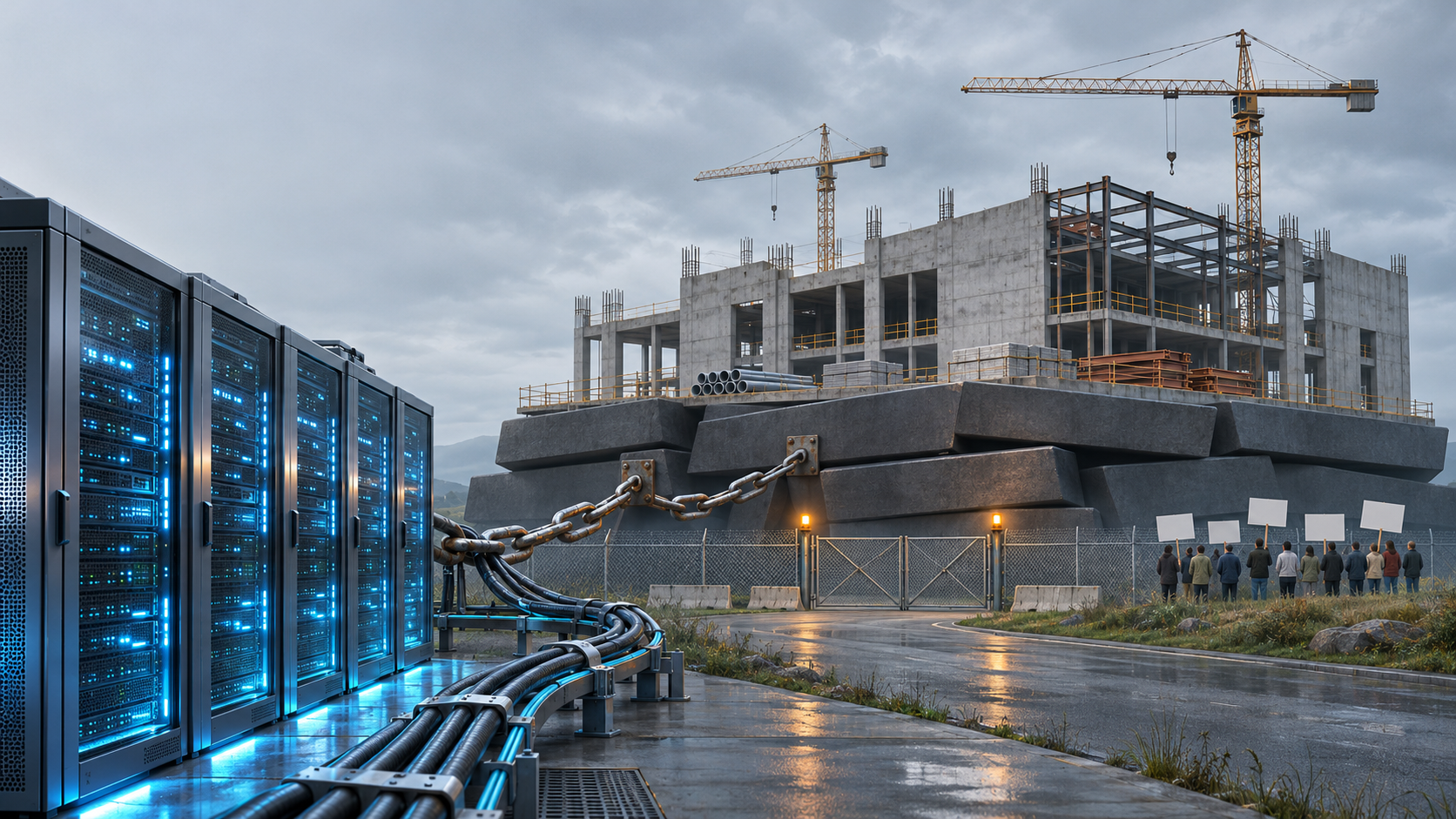
Your AI roadmap can look fully funded and still depend on a building that your provider cannot open on time. If promised throughput rests on a proposed data center carrying expensive debt, local opposition is no longer just the provider’s public-affairs problem. It can become your launch delay, pricing shock, capacity shortage, or forced migration.
You do not need to predict every ballot result or perform full credit underwriting. You do need to expose which product commitments depend on capacity that is not operating, model what a one-year delay would do, demand evidence that matches the promise, and test an alternative before you need it.
Key takeaways
- AI adoption and permission to build AI infrastructure are separate variables. Strong demand does not make a proposed facility deliverable.
- Project debt, data-center developer debt, and AI provider debt may sit in different legal entities, but delivery risk can travel through the entire contract chain.
- A one-year delay on a hypothetical project with $500 million of debt at 10% produces $50 million of simple interest before other holding costs. The cited scenario reaches $74 million in total delay costs.
- Your first diligence question is not whether a provider will fail. It is whether your contracted capacity and product commitments survive a prolonged facility delay.
- Within 90 days, every critical AI commitment should map either to operating, contractually available capacity or to an alternative you have tested on a representative workload.
AI demand and permission to build are separate markets
The apparent contradiction is easy to misread. A May Edison Research at SSRS survey found that 65% of American adults had used an AI platform in the previous week, up from 52% in February. An October ABC News/Washington Post/Ipsos poll found that 72% opposed a new data center in their community.
Those figures come from different surveys at different times, so they cannot establish how the same individuals think or why they answered as they did. They do establish a planning problem: widespread use of an AI service does not guarantee local acceptance of the infrastructure behind it.
That distinction became concrete across dozens of November 3 local ballot measures. In Edgewater, Florida, unofficial results showed more than three-quarters of voters supporting a prohibition on new data centers. A provider can therefore be right about customer demand and wrong about when, where, or whether the capacity serving that demand will become available.
Do not label this as hypocrisy and move on. People can value an application while rejecting a particular development near them. Product demand and infrastructure permission answer different questions, involve different consequences, and operate on different timelines.
Your planning model should reflect that separation. Maintain two forecasts:
- Demand forecast: expected users, workloads, tokens, inference volume, storage, latency requirements, and regional needs.
- Deliverability forecast: capacity operating today, capacity contractually allocated to you, capacity dependent on a future facility, required local approvals, financing exposure, and credible alternatives if the facility slips.
A rising demand forecast should never automatically raise confidence in the deliverability forecast. It can do the opposite: more demand increases the cost of discovering that your allocation was only an expectation, not an enforceable entitlement.
This also changes how you read a vendor’s capacity claim. “Global capacity” is not a sufficient answer when your product requires a particular region, data-residency posture, latency profile, model, or throughput level. Ask whether the capacity satisfying your actual constraints is operating and available to your account.
The debt math changes who can survive a delay
Keep the legal entities straight. A project company may own the facility and carry its construction debt. A data-center operator may lease or manage it. An AI provider may reserve capacity from that operator. Your company may then buy an API, platform, or managed service from the AI provider. The debt does not have to appear on your provider’s balance sheet for the delay to reach your roadmap.
The basic stress-test is simple:
Delay carrying burden = outstanding project debt x annual interest rate x delay duration, plus other holding costs.
Consider the worked hypothetical of $500 million in debt at 10% with a one-year delay and $74 million in total delay costs:
| Input or result | Illustrative amount | What it tells you |
|---|---|---|
| Outstanding debt | $500 million | The capital exposed to another year of carrying cost. |
| Annual interest rate | 10% | The simple cost of carrying each dollar of debt for a full year. |
| Delay | One year | The stress period, not a prediction for every project. |
| Simple interest during the delay | $50 million | $500 million multiplied by 10% for one year. |
| Total delay cost in the hypothetical | $74 million | Interest plus the scenario’s other holding costs. |
| Amount above simple interest | $24 million | The difference between the $74 million total and $50 million of simple interest. |
This is an illustrative scenario, not a generic estimate for every data center or a conclusion about any named provider. Actual exposure depends on financing structure, when funds were drawn, whether interest is fixed or variable, contractual allocation of carrying costs, and which operating expenses continue during a delay. The value of the example is the scale of the stress, not the assumption that every project has identical economics.
The mechanism matters more than the headline number. Revenue tied to the new capacity is postponed while financing and holding costs continue. An owner with sufficient liquidity may wait, refinance, substitute another site, or acquire capacity elsewhere. A constrained owner may have to sell, reduce scope, or let the project stall. A provider depending on that facility then has to reroute the workload, renegotiate its own commitments, or tell customers that the expected capacity will not arrive on schedule.
The market-level effect can look healthier than the company-level effect. Slower construction can give demand more time to catch up with supply and make overbuilding less likely. At the same time, a leveraged developer can run out of financial room before demand materializes. A failed or sold project is therefore not, by itself, proof that customers disappeared. The owner may have run out of cash or time first.
That pressure can also consolidate the market. Developers that cannot finance the wait may be forced to sell, while larger operators with cash can acquire projects and face less competition from new facilities. If your AI provider rents capacity from a company it also competes with, concentration creates another dependency: your provider may rely on a rival for an input it needs to serve you.
Do not reduce this to a binary question such as “Will the vendor go bankrupt?” That is difficult to answer with public information and too narrow for product planning. Test three separate conditions:
- Capacity dependence: Does your commitment rely on a facility or allocation that is not operating today?
- Delay resilience: Can the relevant project owner, operator, and provider continue carrying the commitment through a one-year delay?
- Substitutability: Can your workload move to another region, facility, provider, or model without breaking its economics, compliance posture, or customer promise?
A provider can be financially viable but still miss your date. A facility can open while your account still lacks an enforceable allocation. An alternative can have abundant capacity but be unusable because your application depends on provider-specific behavior. Treat those as different failure modes.
Trace every important roadmap promise to capacity that exists
Most roadmaps stop the dependency chain too early. They name the model or platform but not the region, allocation, facility status, or evidence supporting the promised delivery date. That makes a physical infrastructure dependency look like an ordinary software-vendor dependency.
Create a capacity dependency register for AI commitments whose failure would delay a launch, breach a customer obligation, force a material price change, or require an executive communication. It does not need to cover every experiment. It needs to expose every promise that would be expensive or embarrassing to unwind.
| Field | What to record | Why it matters |
|---|---|---|
| Customer or business commitment | The launch, contract, internal transformation milestone, or service level depending on AI capacity. | Connects infrastructure uncertainty to a consequence leaders already understand. |
| Workload | Model, modality, expected usage pattern, throughput, latency, storage, and regional constraints. | Prevents a generic fallback from being mistaken for a usable one. |
| Provider chain | AI provider, infrastructure operator where known, region, and any intermediary involved in delivery. | Shows where debt, construction, allocation, or competitive dependence can enter. |
| Capacity state | Operating and tested; operating but allocation unverified; reserved at an operating site; dependent on a future site; or unknown. | Separates present capacity from a plan to create capacity. |
| Evidence and date | Contract entitlement, acceptance result, capacity report, construction milestone, approval status, or provider assertion, plus when it was checked. | Makes stale or weak evidence visible. |
| Delay consequence | The roadmap, revenue, cost, compliance, or customer effect of a one-year slip. | Determines how much diligence and redundancy the dependency deserves. |
| Fallback | Alternative provider, model, region, facility, architecture, or reduced product promise, with test status. | Distinguishes a real option from a name on a slide. |
| Owner and review date | The person responsible for refreshing evidence and the next decision point. | Stops the register from becoming a one-time procurement artifact. |
Use disciplined capacity labels. “Operating and tested” should mean the relevant workload has run and the provider has confirmed your entitlement. “Reserved at an operating site” means the site exists and the contract addresses your allocation, but your application may not yet have passed acceptance. “Dependent on a future site” covers a commitment tied to capacity that still has construction, approval, financing, or commissioning work ahead. “Unknown” means the provider has not supplied enough evidence.
For planning purposes, treat unknown capacity like future capacity, not like operating capacity. That classification is not an accusation of financial distress. It is an honest statement about what you can currently verify.
Then trace the dependency from the customer promise backward:
<!– wp:list {