Month: December 2025

  • Master Burger Prompting: Build a High-Impact AI Resume Coach with Proven LLM Structures

    Master Burger Prompting: Build a High-Impact AI Resume Coach with Proven LLM Structures

    I turned the playful idea of “burger prompting” into a rigorous framework for building an AI resume coach that delivers consistent, high‑quality guidance. In product management, repeatability matters: I want dependable LLM behavior, tight control of outputs, and measurable outcomes. This approach gives me exactly that—clear roles, crisp constraints, and an evaluation loop that raises the quality bar with each iteration.

    Here’s the metaphor in practice. The top bun sets the role and goal; the middle layers stack context, examples, constraints, and tools; the patty is the core algorithm and output schema; and the bottom bun locks in the quality bar and follow-up behavior. When I apply this structure to an AI resume coach, I get results that feel expert, empathetic, and actionable—without rewriting the prompt every time.

    Top bun: I define the system role and success criteria. I’ll say, “Act as an experienced hiring manager and resume coach for SaaS product roles” and specify the north star: improve clarity, impact, and ATS alignment without fabricating experience. I also name the audience (mid-career PMs, early-career candidates, or executives) so tone and calibration stay consistent across sessions.

    First layer: I load precise context. That includes the candidate’s resume, the target job description, and any constraints (for example: keep bullets under 22 words, lead with impact, quantify outcomes). I also clarify non-goals (no inflated titles, no unverifiable claims). This is where I set the voice: confident, concise, and supportive, not generic or robotic.

    Second layer: I attach the tools and references that anchor outputs. A skill taxonomy for product roles, a style guide for resume bullets, and a scoring rubric (impact, clarity, relevance, keyword coverage) help the model prioritize. To protect quality, I call out context window management rules—what to include or trim—and how to summarize long inputs without losing signal.

    Third layer: I add exemplars. Few-shot examples of excellent resume bullets (“before” and “after”) teach the model what “great” looks like. I also include a counterexample or two to prevent bad habits (for instance, over-indexing on buzzwords). Exemplars act like taste buds; they steer nuance without overfitting.

    Patty: I define the core algorithm and the output schema. The algorithm moves in stages: diagnose the resume against the job, identify 3–5 high-leverage improvements, rewrite bullets with quantified outcomes, and propose a summary that highlights relevant wins. I then specify the output sections: a brief diagnosis, rewritten bullets mapped to the job’s requirements, an ATS keyword coverage table, and a confidence score with rationale. A tight schema produces consistent, scannable outputs that are easy to evaluate—and easy to ship.

    Bottom bun: I lock in the quality bar and the follow-up behavior. If inputs are incomplete, the coach must ask clarifying questions before rewriting. If claims lack evidence, it should suggest proof points (metrics, scope, stakeholders) rather than embellish. Finally, I require a self-check pass where the coach verifies that each bullet demonstrates impact, relevance, and clarity before presenting the final result.

    Implementation blueprint: I create a reusable prompt template with clear system and user sections, then parameterize it for different roles (PM, design, data). If I have a library of style guides or skill matrices, I wire it into a retrieval layer so the model references the right material for each job. This setup makes the coach portable across tools and easy to maintain as the taxonomy evolves.

    Evaluation and iteration: I practice eval-driven development. I assemble a small, representative test set of resumes and job descriptions, define acceptance criteria (readability score, keyword coverage, human rater alignment), and A/B test prompt variants. I track drift and tighten the schema whenever outputs start to meander. The goal isn’t just impressive demos—it’s reliable performance at scale.

    Governance guardrails: A trustworthy resume coach respects privacy-by-design. I strip PII where possible, avoid storing raw resumes beyond what’s necessary, and document bias checks so advice doesn’t disadvantage non-traditional candidates. Clear data governance and risk management keep the product shippable and compliant as it grows.

    When I apply burger prompting end to end, the AI resume coach becomes a repeatable system: fast, accurate, and measurably helpful. The structure teaches the model how to behave; the evals keep it honest; and the schema makes the result easy to review, refine, and ship. If you want dependable LLM outcomes, start with a great bun—and don’t skimp on the patty.


    Inspired by this post on Pendo – Best Practices.


    Book a consult png image
  • Inside Google’s Product Model: Hard-Won Lessons to Build Empowered, Outcome-Driven Teams

    Inside Google’s Product Model: Hard-Won Lessons to Build Empowered, Outcome-Driven Teams

    I’ve been systematically exploring how the product model shows up inside iconic companies. After studying “The Product Model at Spotify” and “The Product Model at Amazon,” I’m turning my lens to Google—specifically, how the product operating model, product culture, and product strategy manifest in practice and what we can pragmatically take back to our own organizations.

    When I talk about the product model, I’m looking at the machinery that connects strategy to outcomes: empowered product teams, clear decision rights, tight product trios, continuous discovery, data-informed bets, and an operating cadence that enables learning at speed. My goal here is to unpack how those elements come together at Google and translate them into repeatable patterns you can adopt.

    At a high level, I focus on how teams are empowered to solve problems rather than ship outputs, how outcomes vs output OKRs clarify what matters, and how experimentation (from rapid prototyping to A/B testing) de-risks decisions before they scale. I also examine how engineering and product partner to balance platform scalability with customer value, and how stakeholder management reinforces alignment without slowing teams down.

    Why does this matter? Because the product model is a lever for resilience and speed. When product strategy is explicit and the operating model is built for learning, organizations multiply the impact of talented people. That’s how small, focused teams repeatedly deliver outsized results—even in complex, regulated, or high-scale environments like Google.

    In the sections that follow, I’ll synthesize what I see as the core patterns behind Google’s approach and distill them into actionable guidance: how to structure product trios, how to run continuous discovery alongside delivery, how to set and calibrate OKRs for outcomes, and how to evolve your product culture so empowered product teams can do their best work. My aim is not to idolize a model, but to extract what’s portable and help you adapt it to your context.


    Inspired by this post on SVPG.


    Book a consult png image
  • Inside Amplitude’s Browser SDK: Developer Experience that Accelerates Product-Led Growth

    Inside Amplitude’s Browser SDK: Developer Experience that Accelerates Product-Led Growth

    From a product leadership vantage point, I’ve learned that the fastest path to trustworthy insights and product-led growth runs through the SDKs we put in developers’ hands. When the instrumentation layer is frictionless, data quality improves, teams move faster, and customer value compounds—especially when you’re building on Amplitude analytics.

    I collaborate closely with a Senior Software Engineer on the Developer Experience team, specializing in development of Amplitude's Browser SDK. That partnership has reinforced a simple truth: an exceptional developer experience is a growth lever. Streamlined APIs, clear conventions, and resilient client-side telemetry reduce setup time, eliminate common integration errors, and unlock cleaner event streams for retention analysis and user activation.

    On the technical front, our shared priorities center on performance, reliability, and privacy-by-design. We optimize for minimal bundle size and zero-regret API ergonomics, while ensuring robust offline queuing, retry logic, and graceful degradation to protect Web Vitals in real-world conditions. CI/CD guardrails, automated schema checks, and backward-compatible versioning keep event contracts stable and predictable as products evolve.

    Data governance is a first-class requirement. Consent-aware collection, PII redaction at the edge, and clear controls for regional data routing align implementation with organizational risk tolerances. When teams trust the pipeline, they are more willing to broaden coverage, accelerate experimentation, and make faster, higher-confidence decisions.

    The business impact is immediate. Cleaner event taxonomies drive sharper funnel views, enabling tighter A/B testing loops and faster identification of activation drop-offs. With dependable data, product trios can iterate toward the right experience, boosting activation rates, compressing time-to-value, and supporting durable retention analysis without chasing analytics debt.

    Great SDKs also multiply the reach of developer evangelism. Strong documentation, copy-pasteable patterns, and pragmatic examples reduce onboarding friction and promote consistent instrumentation across squads. That consistency scales platform scalability, cuts incident noise, and supports reliable DORA metrics—so teams ship frequently without sacrificing quality.

    My takeaway is simple: treat Amplitude's Browser SDK as a product surface, not just a technical dependency. Invest in the Developer Experience team, and you’ll find that every improvement pays dividends across experimentation velocity, data trust, and ultimately, product-led growth. When the foundation is solid, everything built on top gets better—faster.


    Inspired by this post on Amplitude – Best Practices.


    Book a consult png image
  • Master Web Vitals in Amplitude to Elevate UX, SEO, and Product Growth with Confidence

    Master Web Vitals in Amplitude to Elevate UX, SEO, and Product Growth with Confidence

    I obsess over the moments that make or break user trust: how fast a page paints, how responsive it feels, and how stable it stays as content loads. Web Vitals are the clearest lens I have to connect those micro-moments to macro outcomes—activation, conversion, retention, and, yes, SEO ranking. Bringing those signals into Amplitude lets me translate web performance into product decisions that move the business.

    Now in Amplitude, improve your website user experience and SEO ranking by measuring and taking action on your Web Vitals.

    In practice, I focus on the Core Web Vitals—Largest Contentful Paint (LCP), Interaction to Next Paint (INP), and Cumulative Layout Shift (CLS)—and instrument them as event properties so I can segment by page type, device, geography, traffic source, and user cohort. That gives me a single source of truth that aligns engineering performance work with product metrics like activation and revenue, all inside a unified analytics platform.

    My workflow is straightforward: I instrument Web Vitals in the client (sampling if needed), stream them into Amplitude, and build dashboards that pair performance distributions with key funnels. I look for thresholds—where a user’s LCP or INP crosses a boundary and their likelihood to convert or retain drops. When I see those cliffs, I know exactly which pages or audiences to target and which improvements unlock the most value.

    From there, I run experiments. A/B testing on navigation layout, image optimization, or lazy-loading strategies helps me validate that a performance lift also drives a statistically significant improvement in conversion or retention. Because the analysis lives in Amplitude, I can quickly cohort users by performance experience (for example, “green” vs “yellow” LCP) and quantify how much better experiences translate into business outcomes—reducing the risk of shipping changes that only move a synthetic score without helping users.

    SEO benefits are a welcome compounding effect. When I push more sessions into the “good” Web Vitals range, I typically see lower bounce rates, stronger session depth, and better engagement—signals that support search performance. I treat rankings as an outcome of great user experience rather than the goal itself; by improving real-user metrics, I earn durable gains that don’t evaporate with the next algorithm change.

    Operationalizing this is crucial. I define product-level service objectives for LCP, INP, and CLS by key page groups, review them in QBRs alongside activation and retention, and set guardrails so performance never regresses during feature velocity. This turns performance into a habit for empowered product teams rather than a one-off initiative.

    If you’re starting fresh, begin with a narrow slice: instrument Web Vitals on your top three entry pages, visualize their distributions in Amplitude, and overlay conversion and retention. Within a week, you’ll see where experience degrades for specific cohorts and have a prioritized, testable roadmap for improvement. The fastest path to better UX and growth is making performance visible where you already make product decisions—and that’s exactly what this workflow delivers.


    Inspired by this post on Amplitude – Best Practices.


    Book a consult png image
  • How I Make Diagnostic AI Trustworthy: Confidence Levels, Citations, and Evals That Win Trust

    How I Make Diagnostic AI Trustworthy: Confidence Levels, Citations, and Evals That Win Trust

    Trust is the true currency of diagnostic analytics. If customers can’t verify why a system reached a conclusion—or how confident it is—adoption stalls. That’s why this line resonated so strongly with my own playbook: Amplitude used confidence levels, citations, and evals to build a diagnostic AI tool accurate enough to earn customer trust.

    Confidence levels are my first non-negotiable. When a model flags a root cause or prescribes a next step, I want the UI to state its certainty upfront and in plain language—ideally with calibrated ranges and a brief rationale. This simple pattern sets the right expectations, reduces over-trust, and supports AI risk management by making uncertainty visible. In practice, we pair this with clear UX writing so users understand what “High,” “Medium,” or “Low” confidence really means in their workflow.

    Citations are the second pillar. Every diagnostic needs a breadcrumb trail back to source data: which metrics were analyzed, what time window was used, and how the insight was derived. Linking directly to the underlying chart, query, or dashboard reinforces data governance and shortens the path from “interesting” to “actionable.” When customers can click through to verify the evidence, they gain the confidence to make decisions—fast.

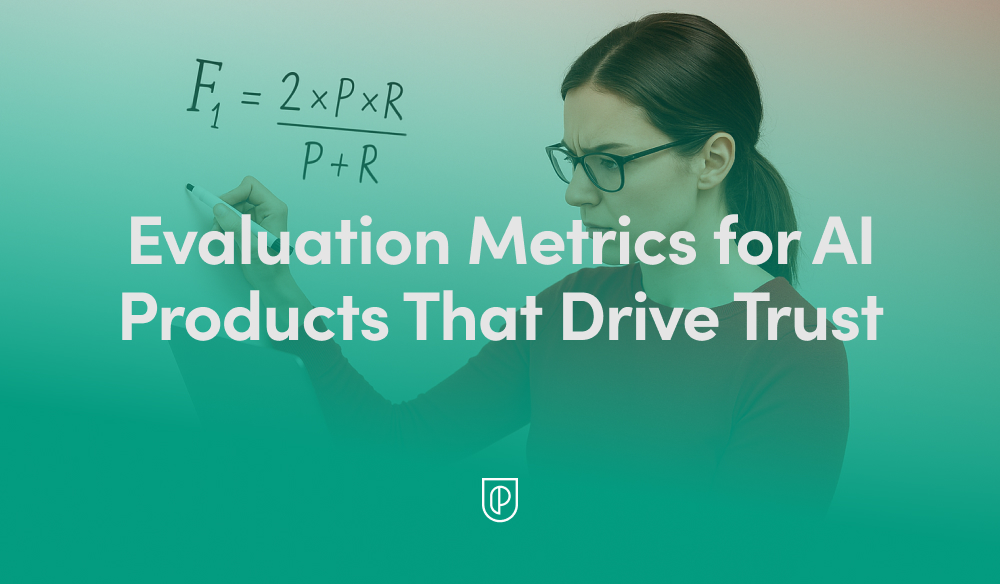
    Evals complete the trio. Before and after launch, I hold the team to eval-driven development: offline benchmarks, targeted scenario tests, and live performance monitoring that mirrors real customer use. We define success criteria for precision/recall, false-positive thresholds, and latency, then wire those checks into CI/CD so regressions are caught early. Continuous evals aren’t just QA; they’re the heartbeat of an AI workflow that keeps insights reliable at scale.

    Operationally, these practices compound. Confidence levels help prioritize follow-up analysis, citations accelerate collaboration across product and data teams, and evals keep quality high even as models, data, and usage evolve. Together, they form a pragmatic AI strategy that aligns product discovery with measurable outcomes and safeguards customer trust where it matters most—inside daily decisions.

    If you’re building a diagnostic AI tool, start with these three building blocks and resist the urge to hide uncertainty. Make it legible. Make it verifiable. And measure it continuously. That’s how we turn powerful models into trustworthy products customers depend on.


    Inspired by this post on Amplitude – Perspectives.


    Book a consult png image
  • What It Takes to Build AI-Powered Products: A Senior Engineer’s Playbook and Mindset

    What It Takes to Build AI-Powered Products: A Senior Engineer’s Playbook and Mindset

    I spend my days partnering with technical leaders who bridge invention and impact. The role of a Senior Software Engineer at Amplitude working on AI-powered products epitomizes how engineering and product fuse to ship customer value with speed, safety, and conviction. In my world, that fusion isn’t accidental—it’s designed, measured, and relentlessly improved.

    When I form product trios—engineering, product, and design—we clarify the problem, the target users, and the measurable outcomes before a single line of code ships. This is how empowered product teams operate: we trade feature wish-lists for hypotheses, align on success metrics, and commit to learning loops that turn ambiguity into progress.

    On the technical front, modern AI systems demand a retrieval-first pipeline, robust data contracts, and a thoughtful orchestration layer for LLMs. I expect eval-driven development to be first-class: offline unit-style evals for prompts and policies, and online evals that track behavior changes and quality at scale. This rigor gives us confidence to ship, learn, and iterate without burning cycles on guesswork.

    Velocity matters, and so does reliability. I look for CI/CD that makes small, safe, frequent releases the default, and for DORA metrics to shine a light on delivery health. Pair that with platform scalability, clear SLOs, and pragmatic SRE practices, and teams earn the right to move fast without breaking trust.

    Responsible AI is non-negotiable. We operationalize AI risk management with guardrails, input/output filters, red-teaming, and human-in-the-loop review where stakes are high. Data governance and privacy-by-design ensure that our creativity never outruns our compliance—because durable products are built on durable trust.

    Impact comes from evidence. I advocate for disciplined A/B testing, careful minimum detectable effect (MDE) planning, and retention analysis that ties feature work to real business outcomes. Clear analytics pipelines and transparent dashboards keep stakeholders aligned and make good decisions repeatable.

    Ultimately, the Senior Software Engineer I want to collaborate with is a builder who balances systems thinking with customer empathy: someone who can design reliable architectures, instrument the work with meaningful evals, and co-lead discovery to de-risk the roadmap. When we combine that mindset with crisp execution, AI-powered products stop being demos—and start becoming indispensable.


    Inspired by this post on Amplitude – Perspectives.


    Book a consult png image
  • Retail & Ecommerce Product Benchmarks That Win: Data-Backed Metrics to Outperform Competitors

    Retail & Ecommerce Product Benchmarks That Win: Data-Backed Metrics to Outperform Competitors

    Every week, retail and ecommerce leaders ask me the same thing: which product metrics truly separate the winners from the rest? As a VP of Product Management at HighLevel, Inc., I rely on benchmarks to translate strategy into measurable, repeatable outcomes—so I built a simple way to use them to guide roadmaps, experiments, and executive alignment.

    Discover exclusive data and strategies from our Product Benchmark Report. Compare the ecommerce industry’s performance across key product metrics.

    Benchmarks aren’t just numbers on a chart; they’re context. They help me calibrate goals, set outcomes vs output OKRs, and focus our product-led growth efforts on the handful of inputs that actually move revenue, loyalty, and lifetime value in retail and ecommerce.

    The metrics I prioritize map to the customer journey: acquisition efficiency (visit-to-signup), activation and time-to-first-value, product-to-checkout conversion, order completion rate, repeat purchase and subscription retention, average order value, and LTV/CAC. I also track friction signals like cart abandonment, returns, and refund rates to surface hidden points of failure.

    Here’s how I use the report in practice. First, baseline performance against peer benchmarks so we know whether we have a strategy or an execution gap. Second, segment by cohort (new vs. returning, mobile vs. desktop, subscription vs. one-time) to reveal where the experience is underperforming. Third, instrument clean funnels and events in our unified analytics platform—Amplitude analytics or Pendo—so every metric is observable and trustworthy.

    From there, I translate gaps into a focused experimentation plan. We run A/B testing with proper guardrails, size tests using minimum detectable effect (MDE), and predefine success metrics to avoid p-hacking. Each experiment ties directly to an outcome metric, not an output, so we can attribute impact and iterate with confidence.

    Strong execution requires strong alignment. I bring product, marketing, and CX together as a product trio to turn benchmark deltas into a crisp value proposition, targeted onboarding, and lifecycle messaging. That cross-functional focus turns insights into conversion, retention, and customer lifetime value—fast.

    Data integrity underpins all of this. We establish clear event taxonomies, privacy-by-design practices, and governance to keep analytics reliable at scale. When the data is clean, decisions get faster, and experimentation becomes a compounding advantage.

    If you’re ready to pressure-test your roadmap and accelerate growth, start with the benchmarks. Use them to prioritize opportunities, prove impact with disciplined experiments, and communicate strategy in language the business understands. That’s how retail and ecommerce teams move beyond vanity metrics and win their market.


    Inspired by this post on Amplitude – Perspectives.


    Book a consult png image
  • Beyond the Support Iceberg: Gradient Labs’ Multi‑Agent Breakthrough That Actually Gets Work Done

    Beyond the Support Iceberg: Gradient Labs’ Multi‑Agent Breakthrough That Actually Gets Work Done

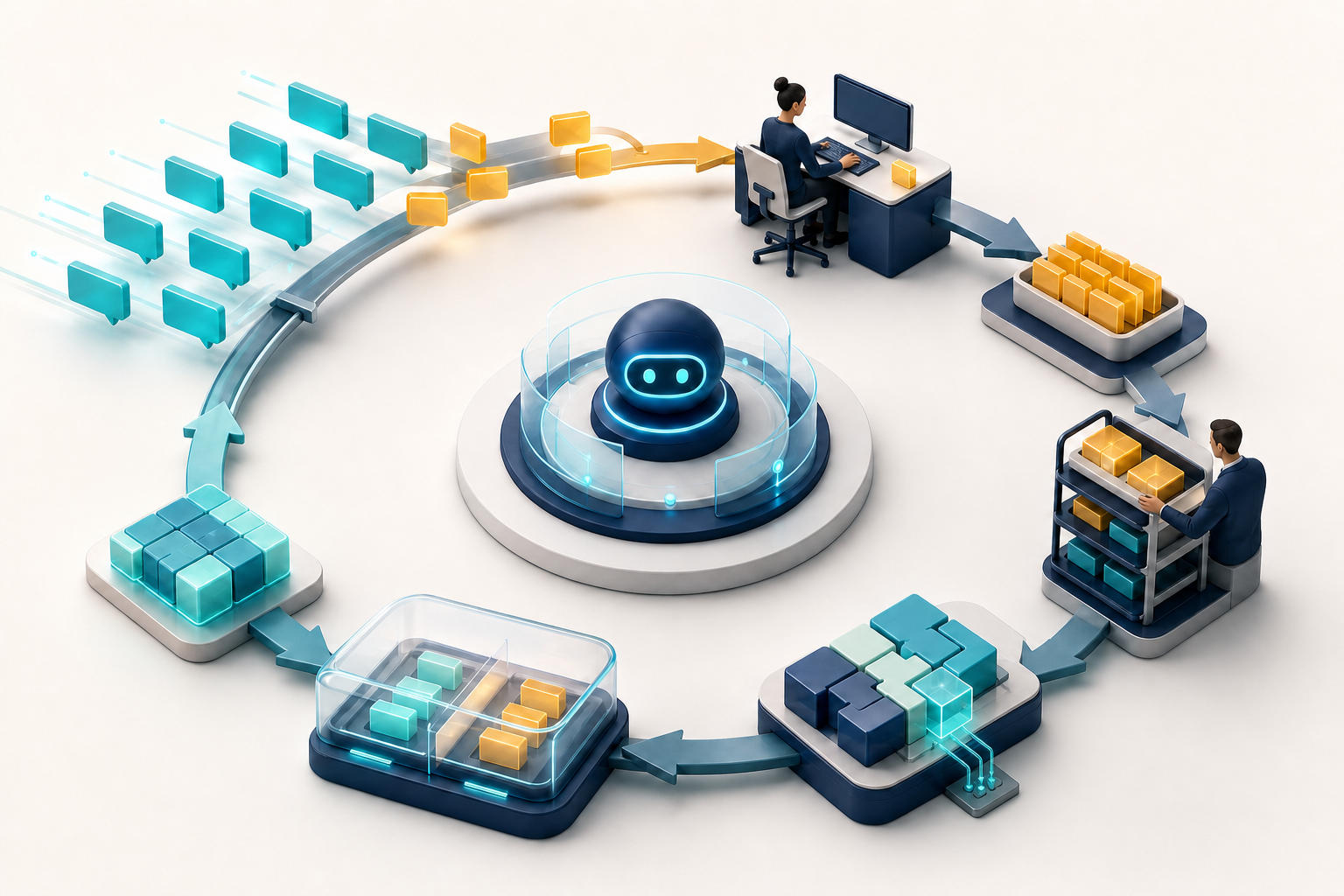
    When a customer reports a stolen credit card, the frontline play seems straightforward—freeze it. But that’s just the visible tip of a much larger customer support iceberg. Underneath sits the real work: dispute filings, fraud investigations, merchant communications, proactive outreach, and follow-ups that unfold over days across multiple systems. Most AI support tools only touch the surface; they don’t coordinate or close the loop. That gap is exactly where my product instincts kick in—and why this story matters.

    I recently listened to a conversation with Jack Taylor (Product Engineer) and Ibrahim Faruqi (AI Engineer) from Gradient Labs, an AI-native startup building agents that automate the full scope of customer support in fintech. Their approach resonated with the challenges I see every day in customer support automation: fragmented workflows, regulatory complexity, and the need for human-in-the-loop moments. Gradient Labs has architected a platform with three coordinating agents—"inbound, back office, and outbound"—all built on a shared foundation of "natural language procedures, modular skills, and configurable guardrails."

    What impressed me most was how they "Let non-technical subject matter experts define agent behavior through natural language procedures—no coding required." That’s a powerful way to remove engineering bottlenecks, accelerate iteration, and keep the domain experts—those closest to fraud, disputes, and compliance—directly in control. In my experience, this design choice alone can compress lead times from weeks to hours and aligns perfectly with continuous discovery and eval-driven development.

    At the heart of their platform is orchestration. They "Architected a state machine orchestrator that manages turns, triggers, and skill selection across long-running conversations." That "turn" architecture is built for the messy reality of async, multi-day support. They treat "Skills as modular agent capabilities—and how they're scoped deterministically per turn," ensuring the system stays predictable and auditable. They also confront a nuanced challenge most teams dodge: "Defining "done" for outbound agents when the customer isn't the one ending the conversation." That’s where deterministic criteria, timers, and clearly scoped outcomes matter as much as the model beneath.

    Compliance is not an afterthought—it’s baked into the core. Gradient Labs "Built guardrails as binary classifiers with eval pipelines, tuning for high recall on critical regulatory checks." In regulated domains, optimizing for recall on high-stakes checks is the right call; you can tolerate a few extra reviews, but you can’t miss a potential fraud signal. More broadly, they frame "Guardrails as classification problems: balancing recall and precision for regulatory compliance." That mindset is exactly how I like to merge AI risk management with product velocity.

    Crucially, they avoid the trap of fully autonomous optimism. "Ask a Human: a tool call that brings humans into the loop for approvals or missing APIs" gives the system a safety valve for novel or high-risk cases. I also appreciated the explicit "Ask A Human Tool" pattern, which cleanly integrates approvals, policy exceptions, or data gaps without derailing the workflow.

    Quality doesn’t happen by accident. They "Designed an auto-eval system that samples conversations for human review to catch edge cases and build labeled datasets" and built "Auto-eval pipelines that flag conversations for manual review and feed labeled datasets." That closed-loop evaluation flow is the backbone of sustainable performance in agentic AI. Combine this with targeted instrumentation—think CSAT, first contact resolution, deflection rate, time to resolution, and escalation rate—and you get a real Agent Analytics discipline, not just logs and dashboards.

    The "iceberg" metaphor is more than a catchy visual. It’s a blueprint for scoping multi-agent platforms that work across the entire customer journey. With "inbound, back office, and outbound" agents coordinating on complex tasks like fraud disputes, the system can transition cleanly from intake to investigation to resolution—without dropping context or asking customers to repeat themselves. This is what genuine customer support automation looks like when it’s grounded in real operations.

    Under the hood, the team leans into robust design choices that matter at scale: the "Complexities of Natural Language Input" are managed with explicit state and skill scoping, "Deterministic Skill Execution" reduces flakiness, and "Customer-Specific Guardrails" ensure compliance remains aligned to each client’s policies. Add their focus on "APIs and Customer Tools Integration" and the result is a platform that can actually take action—not just answer questions.

    If you’re building in this space, here’s how I’d apply these lessons. Start by mapping the iceberg: enumerate back-office steps, approvals, and SLAs that follow the initial customer touchpoint. Capture those steps as "natural language procedures" owned by SMEs. Implement a "state machine orchestrator" to manage "turns, triggers, and skill selection" across multi-day workflows. Treat "guardrails as classification problems" and tune for high recall on high-stakes checks. Introduce "Ask a Human" early to handle missing APIs or policy exceptions. Finally, operationalize learning with "auto-eval pipelines" and tight, eval-driven development loops. That’s how multi-agent platforms deliver measurable outcomes in fintech support.

    If you want to hear the full conversation, you can listen on Spotify or Apple Podcasts. You’ll also hear a nod to the "Incident.io episode – Referenced in the conversation," and a thoughtful take on the "Future of Multi-Agent Systems."

    In short: this is a shift from simple Q&A bots to agents that can coordinate, comply, and complete. It’s the kind of multi-agent platform work that moves the needle for customer support in fintech—and a compelling template for any product leader scaling agentic AI and AI workflows beyond the tip of the iceberg.


    Inspired by this post on Product Talk.


    Book a consult png image
  • Product Manager Cover Letter Mastery for 2026: Proven Steps, Templates, and AI Workflows

    Product Manager Cover Letter Mastery for 2026: Proven Steps, Templates, and AI Workflows

    Every week I review dozens of applications for PM roles, and in under 30 seconds I decide whether to keep reading. In 2026, the bar is higher than ever: clarity, outcomes, and customer insight beat buzzwords every time.

    Learn how to write a standout product manager cover letter with steps, examples, templates, and smart AI workflows to make your application stand out.

    I start with a crisp opening that communicates my value proposition in one sentence: the product problem I love solving, the customer I serve, and the measurable outcomes I drive. Then I connect my experience to the role’s core responsibilities—product discovery, product positioning, go-to-market strategy, and stakeholder management—without rehashing my resume.

    A strong PM cover letter follows a simple structure: a hook with context, one paragraph proving product management leadership through outcomes vs output OKRs, a paragraph on how I partner with empowered product teams and engineering to ship, and a closing line that shows I understand the company’s roadmap and where I can help now.

    To make this concrete, I include brief examples that show decisions, not duties: how I translated ambiguous customer signals into a roadmap, how I balanced platform scalability with speed, and how I measured success with activation, retention, and adoption—not vanity metrics.

    Templates help me move fast, but I always tailor. I mirror the job’s language, highlight the few experiences that map 1:1, and cut everything else. I quantify impact where possible, link outcomes to business value, and keep it to 200–300 words so hiring managers can scan.

    I also use smart AI workflows to accelerate the craft without sacrificing authenticity. My LLMs for product managers playbook: extract the role’s competencies, generate a draft outline, compare multiple versions with light A/B testing, and refine tone and clarity. Tools should augment judgment; the final voice is mine.

    If you’re applying now, assemble your core template, slot in two role-specific examples, and close with a confident ask for next steps. With the right structure, clear outcomes, and a little AI leverage, your product manager cover letter will stand out in any stack.


    Inspired by this post on Product School.


    Book a consult png image
  • Plan Your 2026 Product Conference Calendar: Top Events, Locations, and Insider Tips

    Plan Your 2026 Product Conference Calendar: Top Events, Locations, and Insider Tips

    I’m curating a living list of 2026 product conferences to help product managers, product leaders, and empowered product teams plan ahead with confidence. I use this calendar to align my team’s discovery work, roadmapping, and go-to-market strategy—and to prioritize conference networking and learning that moves the needle on product-led growth.

    This list is not exhaustive. If there’s a product conference missing that should be here, please send it to conferences@producttalk.org. I’ll keep updating this as new events are announced so you have a reliable guide throughout the year.

    I’ll be teaching a workshop and speaking at the Product at Heart conference in June in Hamburg, Germany. If you plan to attend, be sure to say hi.

    Are you looking for the 2025 Product Conferences list? Find it here.

    How I use this guide: I map events to our quarterly OKRs (outcomes vs output OKRs), focus on sessions that sharpen product discovery, stakeholder management, and product roadmapping and sprint planning, and bring a clear plan for takeaways I can apply the day I’m back. If you’re exploring AI Strategy and LLMs for product managers, you’ll find several strong options below.

    January

    Jan 28 — Product-Led Summit — Washington, DC, USA

    Jan 30–31 — Prdkt+ — Cairo, Egypt

    February

    Feb 1–4 — WebSummit — Doha, Qatar

    Feb 2–20 — DeveloperWeek Hackathon — San Jose, CA, USA & Virtual

    Feb 4 — DDX Innovation & UX Conference — Tokyo, Japan

    Feb 4–5 — UX360 Virtual Summit — Virtual

    Feb 7–8 — DDX Innovation & UX Conference — Dubai, UAE

    Feb 18–20 — DeveloperWeek — San Jose, CA, USA

    Feb 18–20 — ProductWorld — San Jose, CA, USA

    Feb 24 — ProductCon — London, UK

    Feb 24–25 — axe-con — Virtual

    Feb 24–25 — Product-Led Summit — Austin, TX, USA

    March

    Mar 9–10 — Gartner Product Leadership Conference — Grapevine, TX, USA

    Mar 12–18 — SXSW — Austin, TX, USA

    Mar 23–26 — The Annual ACM Conference on Intelligent User Interface — Paphos, Cyprus

    Mar 26 — Chief Product Officer Summit — New York, NY, USA

    Mar 26–27 — Product Operations Summit — New York, NY, USA

    Mar 26–27 — Product-Led Summit — New York, NY, USA

    April

    Apr 1–2 — Product-Led Summit — Denver, CO, USA

    Apr 11 — ProductCamp — Phoenix, AZ, USA

    Apr 13–14 — Business of Software — Cambridge, UK

    Apr 13–17 — ACM CHI — Barcelona, Spain

    Apr 14 — Chief Product Officer Summit — Palo Alto, CA, USA

    Apr 15–16 — UX Nordic — Aarhus, Denmark

    Apr 15 — AI Product Summit — San Jose, CA, USA

    Apr 20–21 — Product at Heart Leadership — Hamburg, Germany

    April 22–23 — UX360 NA — Atlanta, GA, USA

    May

    May 7–8 — ProductWorld 2026 — Opatija, Croatia

    May 9 — DDX Innovation & UX Conference — Munich, Germany

    May 11–13 — UXDX — New York, NY, USA & Virtual

    May 11–14 — Web Summit — Vancouver, Canada

    May 12–13 — Product Operations Summit — Amsterdam, The Netherlands

    May 12–15 — UXLx User Experience — Lisbon, Portugal

    May 13 — Leading the Product Leaders Forum — Melbourne, Australia

    May 13–15 — SaaStr Annual — San Mateo, CA, USA

    May 14 — Leading the Product Conference — Melbourne, Australia

    May 19 — La Product Conf — Paris, France

    May 20 — Leading the Product Leaders Forum — Sydney, Australia

    May 20 — ProductCon — New York, NY, USA

    May 21 — Leading the Product Conference — Sydney, Australia

    May 27–29 — UXDX EMEA — Berlin, Germany & Virtual

    May 22 — La Product Conf — Madrid, Spain

    May 27–28 — Dublin Tech Summit — Dublin, Ireland

    May 28–29 — Chief Product Officer Summit — Amsterdam, The Netherlands

    May 28–29 — Product-Led Summit — Amsterdam, The Netherlands

    June

    Jun 8–11 — Web Summit — Rio de Janeiro, Brazil

    Jun 15–16 — #mtpcon: A Mind the Product conference — London, UK

    Jun 16 — Growth Minded Superheroes — Frankfurt, Germany

    Jun 17–18 — Product-Led Summit — Seattle, WA, USA

    Jun 22–26 — UXPA International — Las Vegas, NV, USA

    Jun 23–24 — UX360 EU — Berlin, Germany

    Jun 24–25 — Product-Led Summit — London, UK

    Jun 26 — Product at Heart Conference — Hamburg, Germany

    July

    Jul 2–3 — Agile on the Beach — Falmouth, UK

    Jul 26–28 — Agile2026 — Washington, DC, USA

    Jul 26–31 — HCI International — Montreal, Canada

    August

    Aug 5 — ProductCon AI: Online Edition — Virtual

    September

    Sep 16–17 — uxcon — Vienna, Austria

    Sep 16–18 — Hatch Conference — Berlin, Germany & Virtual

    Sep 17 — DDX Innovation & UX Conference — San Diego, CA, USA

    Sep 17 — Chief Product Officer Summit — San Francisco, CA, USA

    Sep 22–23 — Product-Led Summit — San Francisco, CA, USA

    Sep 22–23 — Product Operations Summit — San Francisco, CA, USA

    Sep 28–30 — B2B Summit EMEA — London, UK

    Sep 30–Oct 2 — GOTO Copenhagen — Copenhagen, Denmark

    October

    Oct 14–15 — Product-Led Summit — Berlin, Germany

    Oct 16 — Just Product 2026 — Munich, Germany

    Oct 26–27 — Y Oslo — Oslo, Norway

    Oct 28 — Product-Led Summit — Sydney, Australia

    Oct 28–29 — Product-Led Summit — Boston, MA, USA

    November

    Nov 9–12 — Web Summit — Lisbon, Portugal

    Nov 11–12 — Product-Led Summit — Toronto, Canada

    Nov 11–12 — Leading Design — London, UK

    If you’re attending any of these, let me know—conference networking is always better with a plan and a friendly face. And if you’ve got a must-attend event on your radar, send it to conferences@producttalk.org so I can keep this guide comprehensive for the community.


    Inspired by this post on Product Talk.


    Book a consult png image
  • Master AI as a Product Manager in 12 Months: My 2026 Roadmap to Ship Smarter, Faster

    Master AI as a Product Manager in 12 Months: My 2026 Roadmap to Ship Smarter, Faster

    AI isn’t a side quest for product managers anymore—it’s the skill stack that will define how we discover problems, prototype solutions, and ship value in 2026. Over the last few cycles, I’ve watched teams that embrace AI Strategy outperform on speed, signal, and stakeholder confidence. This roadmap is the approach I use to build capability in a structured, outcome-driven way—so we ship smarter, faster, and more impact-driven products.

    "AI for PMs in 2026: why it matters, what to learn, and a 12-month AI roadmap to master product skills and ship smarter, faster, impact-driven products."

    Here’s how I frame what to learn and why: focus on enduring capabilities first (problem discovery, experimentation, ethics), then layer the AI product toolbox (LLMs for product managers, retrieval-first pipeline patterns, AI workflows), and finally operationalize with outcomes vs output OKRs. The goal isn’t to sprinkle gen ai on everything—it’s to make better decisions, reduce cycle time, and unlock product-led growth in measurable ways.

    Months 1–3: Foundations. I build literacy around model behavior and constraints, context window management, and prompting patterns. I pair this with data governance and privacy-by-design basics so we avoid rework later. Practically, I assemble an AI product toolbox (evaluation checklists, prompt libraries, retrieval-first pipeline templates) and apply them to product discovery—summarizing research, clustering feedback, and sharpening value propositions without losing critical nuance.

    Months 4–6: Prototyping and evaluation. This is where ideas become testable artifacts. I use gen ai for product prototyping to create UX mocks, PRDs, and in-app guides rapidly, then validate with eval-driven development. I run lean experiments (A/B testing with a clear minimum detectable effect), wire up analytics to Amplitude, and track activation and retention signals. The mantra: instrument early, measure causally, and iterate based on evidence.

    Months 7–9: Shipping AI-enabled workflows. I partner with product trios to integrate AI into real user journeys—customer support ai strategy, CRM integration, and guided onboarding are common wins. We explore agentic AI for complex multi-step tasks, add safeguards for AI risk management, and pressure-test systems with threat detection and response playbooks. As features reach production, we monitor deployment frequency and tighten feedback loops to protect quality while accelerating learning.

    Months 10–12: Scale and governance. I operationalize what works with product roadmapping and sprint planning aligned to outcomes vs output OKRs. We codify playbooks for continuous discovery, define eval gates for new AI features, and unify analytics so teams can compare lift apples-to-apples. Stakeholder management matures into clear narratives: what shipped, what moved, what’s next—so leadership sees compounding value, not just activity.

    Throughout the year, I keep the focus on real users and real metrics: fewer hops from insight to iteration, tighter loops between problem and prototype, and crisper communication around trade-offs. The result is a team that can translate AI capabilities into differentiated product experiences—reliably and responsibly. If you follow this path, you’ll enter 2026 with the confidence to lead, the systems to scale, and the evidence to prove it.


    Inspired by this post on Product School.


    Book a consult png image
  • Must‑Know Product Benchmarks for Financial Services: Actionable Insights to Accelerate Growth

    Must‑Know Product Benchmarks for Financial Services: Actionable Insights to Accelerate Growth

    I’ve learned that in financial services, intuition isn’t enough—rigorous product benchmarks are what separate signal from noise. When my team and I evaluate portfolio performance, we anchor our decisions to the metrics that correlate with customer trust, compliant growth, and durable revenue.

    Discover exclusive data and strategies from our Product Benchmark Report. Compare the financial services industry’s performance across key product metrics.

    Here’s how I use a benchmark report in practice: I calibrate our baseline against peers, identify the few levers that disproportionately drive outcomes, translate those findings into outcomes vs output OKRs, and align stakeholders across product, risk, operations, and go-to-market. Benchmarks turn debate into data and surface the opportunity cost of not fixing broken journeys.

    The product metrics I zero in on typically include user activation rate, time-to-first-value, onboarding completion, funnel conversion (for example, from signup to funded account or application to approval), cohort-based retention analysis (D7/D30/D90), depth of feature adoption, weekly-to-monthly active ratios, support contact rate, and cost-to-serve. In financial services, these signals tell a clear story about trust, reliability, and product-market fit.

    To operationalize these insights, I combine Amplitude analytics with Pendo in-app guides to instrument end-to-end journeys, segment by customer profile, and run disciplined A/B testing with clear guardrails. This lets us move from anecdotes to statistically defensible changes and iterate confidently on onboarding, product tours, and moments that drive activation and engagement.

    Because the trust and regulatory bar is higher in financial services, I also watch for friction in verification flows, error states that erode confidence, and any gaps between intent and completion. When benchmarks show we’re lagging, I pair discovery with rapid experiments to improve the experience while maintaining privacy-by-design and strong governance.

    Use this benchmark report to pinpoint where you outperform and where you lag, prioritize roadmap bets, and focus your product-led growth motion. When teams rally around a shared set of product benchmarks, execution speeds up, trade-offs become clearer, and the value proposition sharpens for both customers and the business.


    Inspired by this post on Amplitude – Perspectives.


    Book a consult png image