I look for product marketing leaders who translate market noise into clear decisions that move roadmap, revenue, and relationships. In that context, Darshil Gandhi exemplifies how competitive rigor and technical depth can sharpen product strategy and accelerate go-to-market strategy across empowered product teams.
Darshil leads competitive intelligence, partner product marketing and technical marketing at Amplitude. He is a former solutions engineering team principal.
That blend matters: a solutions engineering mindset grounds messaging in real implementation details, while competitive intelligence and partner product marketing align product positioning, points of parity, and competitive differentiation with what buyers actually evaluate. At a company centered on Amplitude analytics, that cross-functional view helps transform behavioral data into a crisp value proposition customers can feel in evaluations and expansions.
In practice, I prioritize a few patterns when partnering with leaders who span these domains: align on a single competitive narrative using driver trees that connect capabilities to outcomes; use Amplitude analytics to validate claims and win themes; co-create partner playbooks that make integrations repeatable; and ensure technical marketing closes the loop by pressure-testing demos, docs-as-code, and reference architectures with field feedback. This strengthens stakeholder management across sales, solutions engineering, and product trios, reducing ambiguity and speeding decisions.
The net effect is clarity: sharper differentiation in the field, cleaner handoffs between teams, and faster feedback cycles that de-risk launches. It’s a model I trust when stakes are high—use the truth of implementation to tell a compelling story, then let the market confirm it.
Inspired by this post on Amplitude – Perspectives.
I’m continually inspired by platform specialists who champion their analytics platforms end to end. When I study their work, I look for the connective tissue between strategy and execution—how behavioral analytics informs decisions, how a unified analytics platform reduces tool sprawl, and how great documentation and enablement convert insights into habit across product, engineering, and go-to-market teams.
What consistently stands out is the rigor behind the scenes: clear data governance, privacy-by-design, and instrumentation standards that keep events trustworthy as products evolve. Platform scalability isn’t just about throughput; it’s about guardrails—naming conventions, schema versioning, and lineage—that let teams move quickly without sacrificing integrity. These are the unsung details that make insights reliable and repeatable at scale.
I also pay close attention to how experimentation gets operationalized. Thoughtful A/B testing, well-scoped feature flags, and crisp definitions of “minimum detectable effect (MDE)” ensure that experiments produce signal instead of noise. Driver trees, opportunity solution trees, and continuous discovery keep teams anchored on outcomes, while retention analysis translates curiosity into durable growth. This is the backbone of product-led growth: small, fast bets tied to measurable behavioral shifts.
Reliability and insight quality go hand in hand. Observability for event pipelines, anomaly detection to surface data drift, and targeted session replay help teams debug both product experience and analytics instrumentation. Paired with Web Vitals and clear ownership models, these practices shorten feedback loops, reduce blind spots, and keep platform credibility high—because trust is the real KPI behind every dashboard.
In my own practice, I translate these lessons into roadmaps that balance discovery with delivery, and align solutions engineering, product, and design around the same north-star metrics. The result is a culture where platform champions don’t just advocate for tools—they enable outcomes. If you’re scaling an analytics stack or elevating your product strategy, these principles will help you move faster, with confidence, and make every insight count.
Inspired by this post on Amplitude – Best Practices.
I build experimentation programs to drive measurable outcomes, not just dashboards. In my product leadership work, I’ve seen how the right operating model turns experimentation into a reliable growth engine—especially when paired with the analytical depth of Amplitude. My goal is to help teams move from ad-hoc tests to a disciplined system that compounds learning and impact.
Rigor starts with clarity. I translate strategic goals into testable hypotheses using driver trees, then structure A/B testing with a defined minimum detectable effect (MDE), guardrail metrics, and pre-registered decision criteria. This reduces p-hacking, shortens debate cycles, and makes outcomes auditable. I’m equally deliberate about risk: we monitor sample ratio mismatch, use feature flags for safe rollouts, and align on outcomes vs output OKRs so we celebrate business impact, not vanity wins.
Amplitude analytics is my backbone for behavioral analytics at every step. I instrument clean event taxonomies, build funnels and cohorts to track user activation and retention analysis, and centralize experiment readouts in a unified analytics platform. This lets product trios quickly see how treatments shift behavior, where friction hides, and which moments matter most for product-led growth. The result is a trusted, shared source of truth that accelerates continuous discovery.
At enterprise scale, governance matters as much as math. I often point to lessons inspired by Peacock’s experimentation program: standard naming conventions, centralized QA, CI/CD integration, and an active community of practice. Those practices keep velocity high without sacrificing validity, and they make wins repeatable across teams and surfaces.
Operationally, I anchor the program in clear roles (data, engineering, design, product), templates for hypotheses and readouts, and a tight feedback loop from deploy to decision. With Amplitude, solutions engineering partnerships, and disciplined experiment hygiene, teams learn faster, ship safer, and build products customers love. That’s how experimentation becomes a strategic capability—not a side project.
Inspired by this post on Amplitude – Perspectives.
I keep asking myself a simple, high-stakes question: what does it take to build an AI customer support agent that actually knows when it can't help — and says so?
Recently, I dug into how Jamie Hall (Co-founder & CTO), Xharmagne Carandang, and Rona Wang at Lorikeet are answering that question for enterprises in regulated industries. Their target outcome is refreshingly concrete: an agent that responds like the best customer support you’ve ever had — one that knows you, gets things fixed, and hands off gracefully when it’s out of its depth.
What resonated first was the honesty about early missteps. The team explored reflection tools and information dashboards before a healthcare startup reframed the job-to-be-done with a blunt directive: just help us clear the inbox. The earliest prototype wasn’t flashy — a command-line script spitting out a CSV — yet it paved the way for a scalable, measurable foundation.
Today, the system runs on a dual-agent architecture: a Concierge that handles customer tickets end-to-end, and a Coach that helps customers configure, test, and continuously improve it. That split is more than a technical choice; it’s a product strategy that separates operational resolution from the meta-work of quality, guardrails, and evaluation.
The backbone principle is "AI humility" — defaulting to a human handoff when uncertain. In practice, this isn’t about avoiding responsibility; it’s about preserving trust. When an agent signals uncertainty, it protects brand equity and customer experience while still accelerating the path to resolution.
Lorikeet integrates with Zendesk and Intercom instead of replacing them. That decision respects the entrenched workflows and analytics ecosystems support leaders already rely on, and it reduces adoption friction while enhancing existing queues, macros, and reporting.
The UX has evolved from a workflow builder to a conversational interface — and yet the blank chat box is still hard. Guardrails, prompts, and example-led onboarding help teams get started without forcing them to be prompt engineers. When you’re aiming for low cognitive load, a hybrid of guided steps and conversational nudges works better than a pure canvas.
One of the most nuanced patterns is "resolution in the loop": how human agents unblock the AI without taking over a ticket. Instead of a full manual escalation, humans can provide a targeted nudge — a missing piece of data, a policy citation, a link to a system of record — and let the Concierge finish the job. That collaboration preserves productivity while keeping humans in the quality loop.
Guardrails turned out to be deeply domain-specific — a cannabis company’s support tickets famously broke the team’s first approach. That’s a crucial lesson for regulated industries: policy nuance often lives in the edge cases. Lorikeet responded by making customer-configurable guardrails a first-class capability through the Coach interface.
Even more interesting, they’re flipping the configuration workflow so customers define "what good looks like" before they ever write a standard operating procedure. By anchoring configuration in outcomes and test cases rather than prose SOPs, teams move faster, reduce ambiguity, and get to measurable quality earlier.
The platform leans into eval-driven development: using AI to diagnose failure modes in traces and automatically suggest fixes. A "Trace Diagnosis Agent" surfaces root causes and remediation paths, shrinking the feedback loop from discovery to improvement.
Culturally, the product engineering cadence is customer-obsessed: every engineer asks weekly what they learned from a customer. That lightweight ritual is a forcing function for continuous discovery and keeps prioritization tethered to real-world tickets, not just internal hypotheses.
Here’s how I translate these lessons for any customer support AI strategy in regulated environments. First, ship with opinionated "AI humility" and measure handoffs as a quality feature, not a failure. Second, separate resolution from configuration via a dual-agent architecture so each can evolve independently. Third, integrate where your customers already work (Zendesk, Intercom) to accelerate time-to-value. Fourth, make guardrails domain-native and customer-configurable, and start with evals that define "what good looks like". Finally, invest in trace analysis and automatic fix suggestions to shorten the learning cycle.
If you’re scaling support in healthcare, financial services, or any high-stakes domain, these patterns are practical, defensible, and ready to operationalize. Build the Concierge to resolve, empower the Coach to continuously improve, and let "resolution in the loop" bind humans and agents into one reliable system of service.
Old-school, in-person selling is having a renaissance in the AI era, and I’ve seen why up close. From leading product and go-to-market teams through hypergrowth, I keep returning to one lesson: enterprise buyers still reward the teams who show up, orchestrate change management, and own outcomes end-to-end. The tech has changed; the human dynamics haven’t.
Has the sales playbook changed in the AI era? The tools are faster and the surface area is bigger, but the core motion remains the same: “showing up” beats letting the marketplace decide. That’s why in-person enterprise rollouts still beat product-led motions, especially when the stakes include security, governance, and cross-functional adoption. You win by reducing organizational risk, not by assuming free trials will do the heavy lifting.
Great enterprise sellers collapse silos. They sell to engineers and executives in one motion, pairing deeply technical validation with crisp business narratives. In my org, that means every high-velocity pilot has a dual thread: hands-on, eval-driven proof for the builders and a value architecture for the budget owners. When those motions run in parallel, time-to-value plummets and procurement friction fades.
Selling to AI-native buyers who grew up on ChatGPT changes tempo, not fundamentals. The same seller, different tempo: 8 weeks vs. 8 business days. These buyers evaluate fast, expect clear ROI, and push for automation-first workflows. How AI-native buyers handle build vs. buy decisions comes down to build for differentiation and buy for acceleration. If you make procurement feel like product—frictionless, instrumented, and transparent—you’ll meet their bar.
Process matters, but humanity wins. Building a robust sales process that still leaves room for unscripted moments is where trust is formed. I’ll never forget the story of the rep who taught a champion’s son guitar over Zoom—an unscripted moment that cemented a partnership. The lesson: raise the floor without capping the ceiling. Equip every rep with repeatable plays, then celebrate the creative instincts that make champions out of customers.
In early GTM, why the three highest-leverage early sales hires aren’t sellers at all resonates with my experience. I prioritize a solutions engineer who can de-risk integration, a forward-deployed operator who can run the first rollout like a product manager, and a customer success lead who designs adoption paths from day zero. Together, they compress the value journey from proof to production.
Compensation design shapes your talent market. The case for outsized commission accelerators for star sellers — and the kind of person they attract is real: magnets for competitors who close complex, multi-threaded deals and thrive with ownership. But beware: why too much process narrows the kind of seller you attract. Over-script it and you filter out the very people who can navigate ambiguity with customers.
Under the hood, instrumenting the funnel from stage zero to close keeps the system honest. I track intent signals before pipeline, conversion by persona and use case, proof milestones, and time-to-value in production. The three pillars of GTM excellence for me are repeatable discovery, referenceable outcomes, and relentless enablement. And inside the leadership team, building peers who are 80% aligned, not 100% preserves healthy tension while keeping execution fast.
AI is expanding the definition of enablement—whether AI is changing what good enablement looks like isn’t a theoretical question anymore. I see world-class teams arming reps with retrieval-first knowledge bases, sandbox environments, and objection libraries that evolve weekly. Meanwhile, selling against direct and implied competitors at once is the norm: your battlecard must cover “do nothing,” internal tools, adjacent categories, and new AI entrants—while you still remember why in-person enterprise rollouts still beat product-led motions for durable adoption.
Planning horizons tighten in AI markets. How far out should a GTM leader be planning? I work a dual cadence: a rolling 6-week operating plan that’s ruthlessly tactical and a 2–3 quarter roadmap for coverage, enablement, and category storytelling. What a normal week looks like in hypergrowth blends customer time, pipeline triage, onboarding and enablement, deal engineering, and process tuning—always with one or two high-conviction bets that could bend the curve.
If you’re scaling an AI product today, pair a disciplined sales-led growth engine with the best of product-led growth: fast paths to proof, hands-on validation for builders, executive-level value mapping, and human moments that turn customers into advocates. That’s how you compress an eight-week cycle into five business days—and keep the expansion flywheel spinning.
I’ve learned that customers don’t just buy features—they buy the way we discover, decide, build, ship, and support. In other words, the operating model is the product. That realization has shaped how my team and I at HighLevel translate product strategy into tangible, repeatable outcomes that show up in quality, reliability, onboarding, and consultative support every single day.
We created Product Partners to codify that operating model and scale it with discipline. It’s a blueprint and operating rhythm that unifies product strategy with go-to-market strategy, customer success, and solutions engineering—so empowered product teams can move faster without sacrificing clarity, governance, or customer trust.
First, we anchored on continuous discovery. Product trios work shoulder-to-shoulder with customer-facing teams to run customer interviews, journey mapping, and A/B testing, then validate insights with session replay and behavioral analytics. We use driver trees and opportunity solution trees to connect problems to outcomes, ensuring prioritization is evidence-based and aligned to product-market fit—not just output.
Second, we elevated delivery excellence. Our practices emphasize CI/CD, feature flags, observability, SRE-informed incident management, and DORA metrics to shorten feedback loops while raising the bar on stability. Privacy-by-design, data governance, and regulatory compliance are built into our workflows, and we make deliberate build vs buy decisions to protect platform scalability and long-term velocity.
Third, we integrated go-to-market alignment from day one. Solutions engineering and customer success shape requirements early, so launches include in-app guides, product tours, onboarding paths, and consultative support that accelerate user activation. We tie outcomes vs output OKRs to stakeholder management rituals, ensuring sales-led and product-led growth motions reinforce each other instead of competing for focus.
Finally, we closed the loop with a unified analytics platform. Activation, retention analysis, and Net Recurring Revenue (NRR) sit alongside qualitative signals from customer interviews and support. This single source of truth helps us refine product positioning, sharpen value propositions, and improve roadmapping and sprint planning with clear, testable hypotheses.
What does this mean for our partners and customers? Faster time-to-value, fewer handoffs, clearer expectations, and a shared lens on the metrics that matter. Product Partners isn’t a side program; it’s how we operationalize trust—through transparency, consistent rituals, and a bias toward learning that compounds.
If this resonates, you’ll feel it in how we discover, build, and support together. I’ll continue to share our playbooks—covering continuous discovery, onboarding, and outcome-based planning—so we can keep raising the standard for product management leadership and product-led growth, one operating rhythm at a time.
I see the rise of Customer Forward Deployed Engineering (FDE) as a pivotal bridge between FinOps engineering, AI strategy, and measurable customer outcomes. When we align internal platforms and agentic AI with real-world use cases, we don’t just reduce cloud costs—we accelerate adoption, de-risk deployments, and create durable product value that compounds over time.
"Hac Phan leads FinOps engineering at Amplitude, where he builds internal platforms and AI agents that help teams understand and optimize cloud spend. He now heads Amplitude's Customer Forward Deployed Engineering team." That evolution—from building internal capabilities to leading a customer-facing FDE function—captures a pattern I’ve seen repeatedly: the skills that tame complexity inside the company are exactly the skills customers need most at the edge.
In my experience, Customer FDEs thrive when they embed with strategic accounts to translate product capabilities into concrete outcomes: lower unit economics, faster time-to-value, and cleaner governance. They partner closely with solutions engineering, product management, and customer success, using platform building blocks and AI workflows to illuminate the cost drivers that matter—then engineering the shortest path to savings and scale.
The operating model is straightforward but disciplined. Set a clear mission (optimize cost-to-value while expanding usage), define a small set of leading indicators (time-to-first-value, cost per active workload, deployment frequency, NRR lift on FDE-supported accounts), and establish crisp handoffs with core product teams. When FDEs surface repeatable patterns, those insights should flow back into the roadmap as native features, guardrails, and in-product guidance—so every customer benefits, not just the lighthouse few.
Tooling matters. Internal platforms that unify telemetry, usage metering, and pricing logic give FDEs the levers to diagnose and fix issues quickly. Layering AI agents on top of that foundation enables proactive recommendations—think unit-economics dashboards, anomaly detection on spend spikes, and automated playbooks that right-size workloads. With agent analytics in place, we can measure the value of each recommendation and continuously tune the system.
I’ve seen this model turn tense, cost-focused conversations into strategic planning sessions. Instead of debating line items, we co-design architectures that scale efficiently, with platform scalability and governance built in from the start. Customers appreciate the candor and the engineering rigor; teams appreciate how those field insights sharpen product strategy.
For leaders considering this path, start small and design for leverage. Stand up a single FDE pod focused on 2–3 high-potential customers. Codify playbooks for cloud cost optimization, instrument agent analytics from day one, and publish a weekly learning loop back to product. Within a quarter, you’ll know which interventions to automate, which to turn into product features, and which require deeper solutions engineering support.
The broader lesson is simple: when we merge FinOps discipline with customer-embedded engineering and AI-driven insights, we create a force multiplier. Customer FDEs don’t just help accounts spend less; they help them achieve more—sustainably, transparently, and with the confidence that comes from a platform (and a team) built to scale.
Inspired by this post on Amplitude – Perspectives.
I’ve learned that the smallest slice of your support queue often dictates the majority of your operating cost, customer memory, and automation ceiling. In product reviews and CX ops deep-dives, I see the same pattern: the “easy” tickets pad your resolution counts, but the complex, multi-step queries quietly own your handle time and your brand trust. If you care about compounding impact, your customer support AI strategy has to target that hardest percentage first.
Complex queries are a small percentage of your queue, but they consume a disproportionate share of your team’s time.
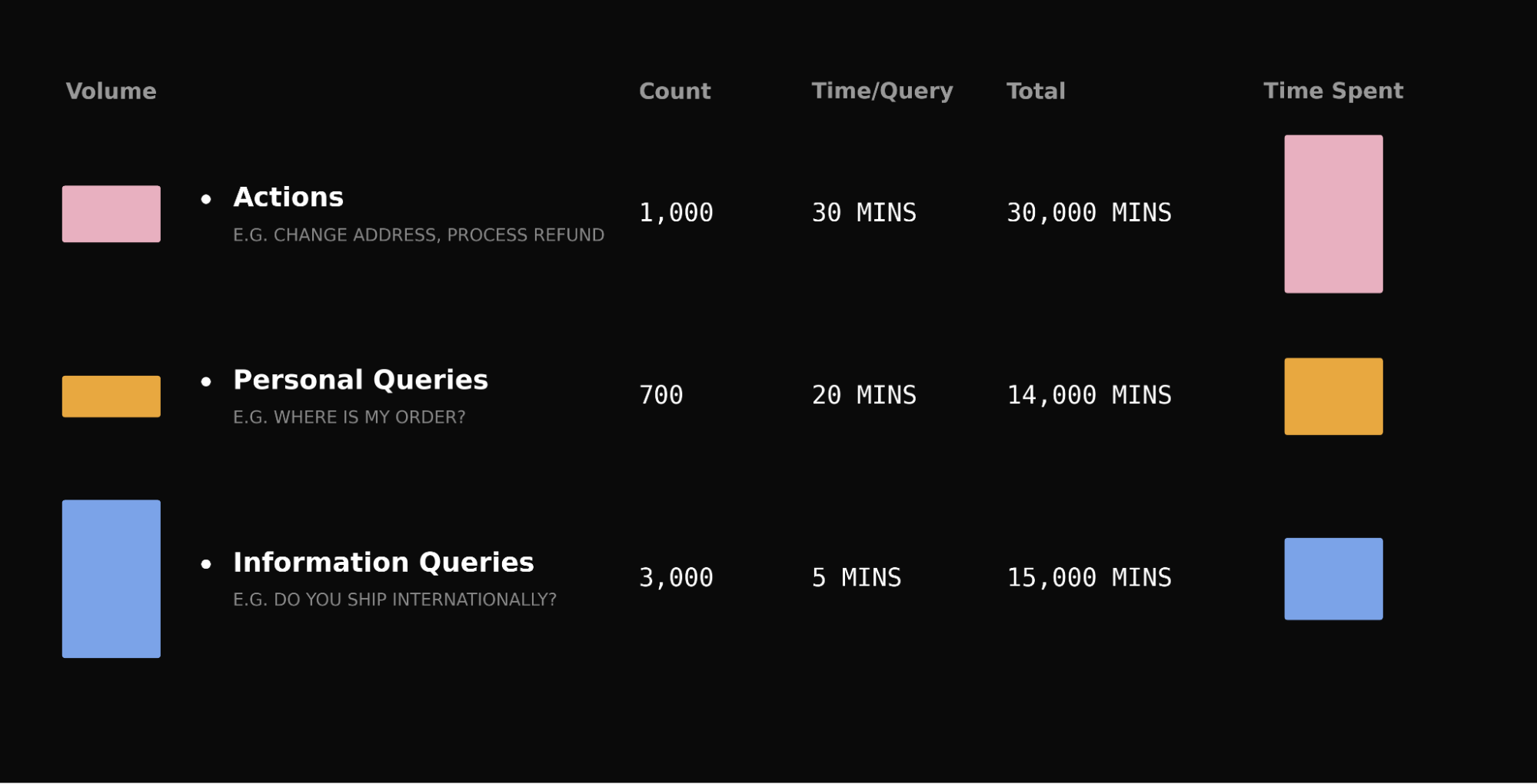
Take a typical queue: password resets outnumber refund disputes ten to one, but a reset takes five minutes and a dispute takes thirty. The “rare” query accounts for over a third of total handling time. The same pattern holds for account investigations, subscription changes, and billing disputes.
How you handle complex queries is also what customers actually remember about their support experience. When someone is dealing with a damaged order or a billing dispute, the stakes are higher, and a fast, good resolution is what separates a forgettable interaction from one that builds lasting trust.
Most AI Agents automate the easy, informational queries well. The question for your automation rate is whether they can handle the hard ones. That’s where agentic AI and robust AI workflows make or break your outcomes.
We’ve gotten really good at informational queries – the hard part is what comes next. I’ve seen teams invest deeply here, and for good reason: it lifts containment quickly and cheaply. But to break through the plateau, you have to execute actions across systems, not just answer with text.
We’ve invested deeply in informational Q&A. We built Apex, a specialized customer service model trained on billions of support interactions, as Fin’s core answering engine. Beneath that sits a custom retrieval model, a purpose-built reranker, and a unified RAG pipeline, all trained specifically for customer service. Fin resolves issues at a higher rate than general-purpose frontier models, with fewer hallucinations and at lower cost.
But informational Q&A only covers queries where text is the answer. Most Agents can handle that. Far fewer let you configure complex, multi-step actions without a forward-deployed engineer setting it up for you, which creates a gap.
Every query your team handles falls into one of three categories:
Informational: “Can you ship transatlantic by priority next day?” Answered with text from your knowledge base.
Personalized: “Where is my order?” Requires data unique to that user.
Action-led: “My order arrived damaged, I need a refund.” Requires doing something: checking a return window, cross-referencing transaction data, making a judgment call – reading from multiple systems and acting across them.
From Jan to Apr 2026, the trend moves steadily upward, pausing briefly before a sharp late surge. A clear snapshot of momentum for customer service KPIs, finance results, and the impact of new procedures.
These complex queries, the ones that require multi-step processes across systems, aren’t edge cases; they’re the reason your support team exists. This is the gap Fin Procedures was built to close.
It works in practice, and the trajectory matters for product strategy and ops planning.
Procedures is live, it’s scaling, and the results are clear. Since launching in managed availability, Procedures has handled over 1.5 million conversations, and volume is doubling month over month across hundreds of apps in fintech, e-commerce, gaming, healthcare, and SaaS.
When customers hit complex, multi-step queries, the experience is dramatically better when Fin can do the work end-to-end. We tested this with a randomized 5% holdout – conversations where Procedures would normally run, but didn’t. CSAT was 28.93% higher when Procedures ran, a statistically significant result.
A product, not a services engagement. I’ve sat through too many “automation” projects that were really solutions engineering gigs: workshops, custom scripts, then a queue of change requests when policies shift. It’s fragile and slow.
The B2B AI industry has a consultingware problem. It’s not databases being forked anymore, it’s prompts. The economics of maintaining bespoke setups per customer don’t work. Either the application falls behind new models, or the vendor changes the model and quality degrades invisibly.
In my view, an agentic AI platform should be a product your team owns end to end: a natural language editor – literally paste your existing SOPs – branching logic, data connectors, and AI-powered simulations for testing. Your CX ops team configures this, iterates on it, owns it. If you need help, a forward-deployed team can assist, but they’re optional, not a dependency. You always have control.
And because it’s a unified product, improvement compounds. When the vendor optimizes a prompt, every customer’s Procedures get better. When they upgrade the model, they can A/B test across the entire customer base and know it’s better before rolling out. You can’t do that when every customer has a bespoke prompt. The consulting model isn’t just expensive, it’s structurally unable to compound.
Today, Fin Procedures is available to every Intercom customer – no waitlist or managed rollout, ready for all 8,000+ customers.
We’re iterating fast based on real customer feedback. Here’s what’s landed since the last major update, and why it matters for reliability and governance:
AI-powered Procedure review: Flags broken logic, missing references, and unreachable conditions before you deploy.
Kick off your journey with the #1 Agent—an AI partner designed to turn resolutions into real outcomes. Tap “Start a free trial” to explore faster, smarter customer service and see how Fin delivers value from day one.
Procedure failure reporting: A new reporting dimension that lets you drill into conversations where Procedures failed, so you can diagnose and fix.
Version history with rollback: Track every change, compare versions, roll back if needed.
Data connector health monitoring: See at a glance if your integrations are healthy, degraded, or failing.
Optional data connector parameters: Fin only asks customers for information when it’s actually needed, instead of prompting for every field.
Email Simulation support: Test how your Procedures behave across chat and email before going live.
Agent in the Loop (Beta) unlocks the next tranche of automation. Even with Procedures, two things hold teams back from automating their most complex queries: missing integrations and policies that require a human sign-off on sensitive decisions.
“Agent in the Loop” is built for both. Need Fin to check your internal admin tools but haven’t built a data connector yet? Put a human checkpoint at that step. Fin handles the conversation, gathers context, and pauses, surfacing a structured summary for a human agent to verify or act, then resumes. You get automation on the 80% that doesn’t need the integration.
For compliance – identity verification, high-value refunds – Fin does the legwork, a human makes the final call and then hands it back to Fin. This works natively in the Intercom Inbox and via Slack. Some competitors don’t have an inbox-native variant at all, meaning humans need to leave their primary workspace to review AI actions.
Procedures are also built to let you collaborate with all your teammates – both human agents and AI Agents. Fin can work with them directly inside a Procedure, using APIs and webhooks to loop in another teammate mid-flow, hand off context, and pick back up once they’re done.
Making it easier, faster. Procedures is already self-serve, but the next step is making Procedure creation, testing, and maintenance significantly more streamlined and easy to do, with less manual editing and more AI-assisted building and debugging. There’s a lot coming in this space over the next few months – and it aligns perfectly with a retrieval-first pipeline and stronger governance at scale.
The hardest percentages matter the most. The biggest unlock for your automation rate won’t be answering more FAQs, it will be handling the complex, multi-step queries that consume your team’s time and define what customers remember about their experience with you.
That means working with an Agent that goes beyond answering questions and executes processes. A product your team owns and configures, not a service you buy and hope gets maintained. And a platform where every improvement compounds across every customer. That’s Procedures. Available now, for everyone.
The best signal often comes from the least scalable work.
I’ve learned this the hard way—and the rewarding way. When I’m closest to customers, rolling up my sleeves with the team, I uncover nuanced, high-signal insights that no dashboard or aggregate report can reveal. Those insights, when treated with rigor and discipline, become the backbone of a durable product strategy and true product management leadership.
At Intercom, that is at the heart of how we operate on “swarms.” Swarms are cross-functional teams of Fin experts focused on ensuring customers succeed when trialing Fin. Each team consists of engineers, data scientists, and a product manager, all focused on optimizing Fin for our customers.
Working in these teams gives us deep insights into the needs of individual customers, but they can also form the foundation of new Fin features. Let me explain.
I frame the journey from insight to impact in three levels: “Level 1: Swarms – where the signal comes from,” “Level 2: Cockpit – where the signal starts to scale,” and “Level 3: Product – where the signal reaches maximum leverage.” This model blends continuous discovery with pragmatic solutions engineering and creates a clear path from hands-on learning to product-led growth.
Level 1: Swarms – where the signal comes from. The goal is simple: help Fin resolve more conversations and help customers understand and use the product. Swarms partner with customers to define their goals and how Fin fits into their workflows. We map out an automation roadmap by analyzing their conversations, determining the APIs and Procedures they need, and the level of automation they can achieve. We then support them in implementing it and reaching that outcome. This involves ongoing analysis to identify optimizations to their configuration and the next best actions for increasing automation levels, such as improving knowledge base content or deploying new APIs.
During a swarm, the feedback loop is fast. We test something, ship something, and quickly see whether the metric moves. That speed and depth is what makes swarms so valuable. It’s also what makes them hard to scale. I’ve felt the thrill of watching a key metric bend within hours—and the constraint of knowing that kind of attention doesn’t scale to every account.
For example, we developed an automation taxonomy to predict the level of automation a customer can achieve. Initially, this analysis was manual and took more than half a day to run, with time required to prep and visualize the data. But the effort was worthwhile. For one customer, we predicted an automation rate of 70% and they achieved exactly that.
By working closely with customers, we learn what drives success, but this work is inherently hands-on and doesn’t scale on its own. So the real challenge is figuring out how to turn what we learn in those high-touch engagements into systems, tools, and product changes that benefit far more customers. That’s the inflection point where AI workflows and product strategy meet.
Level 2: Cockpit – where the signal starts to scale. Not every customer should need swarm-level attention. The way we bridge that gap is by making the swarm analyses repeatable and shareable. Once we can run the same analysis across customers, we can start turning bespoke swarm learnings into reusable signals. This is where Cockpit comes in.
Transform customer signals into action: this dashboard tracks support conversation volume, taxonomy percentages by type, and topic demand across account settings, billing, integration, and more to guide scalable feature bets.
We take patterns learned in swarms and encode them into internal tooling inside our insights web app, Cockpit. Instead of analysis being a bespoke project, it becomes a workflow. For example, we scaled the automation taxonomy and this has enabled us to quickly understand automation potential for all customers.
Now, a customer success manager (CSM) can pick a customer, see their automation potential and current performance, understand the biggest issues, and propose next actions. This is how we scale the impact of swarm learnings through CSMs and Sales. It allows far more customers to benefit from the same patterns we see in high-touch work, without requiring direct data science involvement every time.
Cockpit also functions as a valuable proving ground. It gives us a way to test ideas across a much broader set of customers and see what generalizes before we consider taking anything further. In other words, we transform sharp, local signal into broadly useful guidance—an essential step in any AI Strategy that aims to balance precision with scale.
Level 3: Product – where the signal reaches maximum leverage. The real payoff comes when the patterns we have validated internally become part of the product itself. Instead of helping one customer directly, or helping many customers through internal teams, we deliver a feature directly to customers so they can improve Fin’s performance on their own. Today, the automation taxonomy is a part of Insights and accessible to customers who have this feature.
Another example is CX Score. It started with close work alongside Intercom’s Customer Support team to understand performance with Fin, initially through predicted CSAT and resolution. Over time, this work evolved into CX Score: a scalable way to measure conversation quality across all customers.
The product stage is fundamentally different from Cockpit because of the constraints. Cockpit provides a platform for our customer analyses/tools but it doesn’t need to scale as far as product. What moves into product has to work for every customer, without configuration, at scale, so it has to generalize. That bar is what protects long-term quality while unlocking product-led growth.
That’s why the move from Cockpit to product isn’t automatic. We’re not just asking whether something is useful, but whether it’s broadly useful, robust, and scalable enough to run across the entire customer base. As a product leader, I push for this discipline because it’s where customer success, engineering excellence, and business outcomes converge.
The loop. The model is simple. Swarms generate the best signal, grounded in real customer problems. Cockpit operationalizes that signal so CSMs and Sales can use it across many customers. Product takes the patterns that truly generalize and turn them into scalable features that enhance every customer’s experience.
This loop allows a small swarm data science function to have impact beyond a small set of high-touch accounts, resulting in a stream of continuous improvements across all three levels and an ever-increasing level of automation for our customers. Practically, it’s a repeatable playbook for product management leadership: start with high-signal discovery, prove repeatability, and only then scale through product. Done well, it compounds learning, accelerates time-to-value, and aligns the entire organization around measurable outcomes.
Customer experience is where strategy, data, and execution converge—and where AI can deliver compounding value when thoughtfully designed. In my work, I’ve seen how the right CX vision becomes a growth engine when it’s operationalized through clear measures, robust analytics, and disciplined product practices.
"Amanda Sime is the Customer Experience Strategy Lead at Amplitude. She shapes CX strategy and partners across orgs to design and scale AI-powered solutions." That concise description captures a model I deeply respect: start with a strong CX strategy, then partner across the organization to make AI real in the day-to-day. It’s not just about new technology; it’s about aligning teams, systems, and incentives to deliver consistent customer value.
Translating that approach into practice requires a rigorous AI Strategy, anchored in measurable outcomes and informed by behavioral analytics. I prioritize journey mapping to expose friction, then connect those insights to AI workflows that enhance customer success and in-product guidance. When cross-functional partners—from solutions engineering to support—operate from a shared driver tree, the roadmap balances speed with sustainability.
Data is the backbone. A unified analytics platform—often centered on Amplitude analytics—helps teams move beyond vanity metrics to track user activation, feature adoption, and retention analysis with precision. With that foundation, we can test responsibly, iterate quickly, and validate impact with product-led growth motions that scale across segments without sacrificing quality.
Operational excellence matters just as much as vision. I’ve learned to treat CX programs like enduring products: build reliable feedback loops, connect customer support AI strategy to clear service-level outcomes, and empower product management leadership to make evidence-based tradeoffs. When teams have clarity on the problem space and access to trustworthy insights, they deliver solutions that feel both intelligent and human.
The real win is cultural: empowering product trios and partner teams to co-own outcomes, not just outputs. That’s how AI moves from a promising experiment to a durable capability—by aligning strategy, analytics, and execution so customers experience value at every touchpoint.
Inspired by this post on Amplitude – Perspectives.
I’ve led product organizations through multiple growth chapters, and the pattern is always the same: the tighter the alignment between product, sales, and marketing, the faster you scale. Reflecting on the journey of Chris Degnan — the first sales hire at Snowflake who spent 11 years helping scale the company from zero to $3.5 billion in revenue as its CRO while partnering with four different CEOs — I’m struck by how consistently the fundamentals win. The playbook isn’t mysterious; it’s disciplined execution, ruthless clarity, and a go-to-market strategy that matures with each revenue stage.
At $10M ARR, the CRO role is hands-on and founder-adjacent. You’re close to the product, running point on key deals, pressure-testing messaging, and building credibility with early customers. By $1B+, the job is organization design: segmentation, international expansion, forecast accuracy, enablement, recruiting, and cross-functional orchestration. The shift is from deal quarterback to system architect — standing up repeatable, auditable processes that produce reliable outcomes across regions, segments, and industries.
Sales leaders who can’t sell the product themselves don’t last. Whether you sit in product management leadership or run the field, you need to master discovery, speak the customer’s language, and translate use cases into value. That also means getting fluent in solutions engineering — understanding integrations, data paths, security, and the operational realities buyers live with. I’ve found this hands-on competence to be the fastest way to earn trust internally and externally, and to keep product strategy grounded in market truth.
The MEDDIC methodology is the foundation for every durable sales org — and, frankly, a founder’s best insurance policy. MEDDIC forces alignment on qualification criteria, from Metrics to Economic Buyer to Decision Process and Identifying Pain. When product and sales both operate to this standard, roadmap bets improve, marketing targets sharpen, and win rates climb. It’s not paperwork; it’s pattern recognition at scale.
High-output CROs obsess over the right numbers. Pipeline coverage by segment and stage; conversion rates through each gate; sales cycle length by use case; average selling price and discount discipline; consumption predictability when you have consumption SaaS pricing; and post-sale expansion velocity. The art is deciding which two or three metrics are the organization’s true north at a given stage — then designing enablement, compensation, and operating cadence around them.
On operating cadence, the week in the life at scale is predictable for a reason. Forecast reviews that surface risk early. Deal reviews that coach to MEDDIC depth, not activity theater. Enablement blocks to uplevel managers and ICs. Recruiting time — always. Customer roadshows to refine value proposition and product positioning. And standing meetings with product, marketing, and finance to keep the GTM motion, roadmap, and unit economics in sync.
Compensation is a force multiplier or a silent saboteur. Keep it simple, consistent, and aligned to the current motion. Early on, weight new logo acquisition and land quality; as you mature, balance new business with expansion, multi-product adoption, and healthy consumption. Guardrails matter — cap over-discounting, reward multi-threading, and avoid plans that create end-of-quarter cliff behavior. The best plans reinforce the behaviors you want your culture to scale.
Technical CEOs often underestimate how much narrative, segmentation, and process discipline great GTM requires. The handoff from founder-led GTM to sales-led growth is where many teams stall. My rule: prove one repeatable motion in one segment before you add complexity. Codify the buyer’s journey, instrument the funnel, and make sure product strategy and enablement move in lockstep.
Culture sets the ceiling. You have to find the fakers, manage-uppers, and passengers quickly — people who look busy but don’t move pipeline, who talk big but avoid accountability, or who ride the momentum of others. The mantra that has saved me endless time: “When there’s doubt, there’s no doubt”. Move fast, but with humanity; be clear on expectations, coach hard, and when it’s not a fit, make the change before the team does it for you.
Feedback is the operating system of a high-performing org. Leaders at every level need to be coachable — on message discipline, on forecast rigor, on how they develop people. I’ve benefited from straight talkers who hold a high bar, and I try to pay that forward. The fastest way to raise organizational IQ is to institutionalize feedback loops across sales, product, and marketing — from post-mortems to win-loss analysis to field-sourced roadmap reviews.
What separates exceptional ICs from the rest? Hunger, intellectual honesty, and a builder’s mindset. They qualify hard, align to customer metrics early, multi-thread to power and value, and partner tightly with solutions engineering. They don’t hide from gaps; they surface them, and they know exactly what they need from product, marketing, and leadership to win.
Executive teams that scale share a few traits: crisp segmentation decisions, single-threaded ownership for outcomes, and healthy conflict that resolves into commitment. Dysfunction, by contrast, looks like metrics roulette, opaque decision-making, and a tolerance for exceptions that become precedent. Make the rules explicit and the exceptions rare.
Leaders like Frank Slootman have popularized intensity, speed, and focus — and there’s real power there when paired with clarity and data. The lesson I carry forward: move fast on people decisions, keep the message simple, and measure what matters. Equally important is knowing where that approach can backfire — when speed outruns learning, or when pressure erodes cross-functional trust. The best operators balance urgency with systems thinking.
Most AI companies will face a go-to-market reckoning. Model quality won’t save a weak motion. The winners will articulate a hard-nosed ROI, solve specific workflow pain, address data governance and security head-on, and show measurable lift — not demo dazzle. In other words, the same fundamentals apply; the stakes and scrutiny are just higher.
If you’re building or rebuilding your revenue engine, start here: define your ideal customer profile and segmentation with ruthless clarity; adopt MEDDIC and teach it across product and sales; align compensation to today’s motion; instrument the funnel and inspect it weekly; and cultivate a culture where feedback is fuel. Do that, and the path from $0 to $3.5B stops feeling like mythology — and starts looking like math.
I’m sharing a focused set of insights on analytics, experimentation, and personalization designed to help teams ship smarter, reduce risk, and accelerate outcomes. Drawing on years of leading product teams, I translate complex data practices into practical playbooks you can apply immediately to improve user activation, conversion, and retention.
My approach starts with a strong measurement foundation. I lean on a unified analytics platform—often powered by tools like Amplitude analytics—to centralize product, marketing, and customer success signals. With clear event taxonomies, consistent governance, and trustworthy dashboards, teams gain a single source of truth to prioritize the right problems and sequence roadmap bets with confidence.
Experimentation turns insight into evidence. I emphasize A/B testing discipline, including minimum detectable effect (MDE), guardrail metrics, and pre-registered hypotheses. This repeatable system lifts decision quality, shortens feedback loops, and aligns cross-functional partners around what actually moves the needle, not what merely sounds promising.
Personalization compounds the value of experimentation by delivering the right value to the right segment at the right moment. Thoughtful in-app guides and product tours—rooted in behavioral signals—nudge users through friction points and increase the likelihood of early wins. The result is a more intuitive path to first value, stronger user activation, and healthier long-term engagement.
Retention is the ultimate scoreboard. I rely on retention analysis, cohorting, and leading-indicator metrics to connect feature usage to durable outcomes. When paired with product-led growth motions, teams can identify activation thresholds, build habit loops, and scale what works without overextending sales or support capacity.
If you’re getting started, begin with a crisp instrumentation plan, shared definitions, and a lightweight review ritual. Use continuous discovery practices, opportunity solution tree mapping, and driver trees to tie data signals to real user problems. From there, iterate: test small, learn fast, and scale what is proven. Over time, this system becomes a flywheel for product strategy—fewer debates, more evidence, better products.
In this series, I distill the frameworks, templates, and real-world lessons that have consistently improved outcomes for product teams: how to structure experiment backlogs, how to read funnel breakpoints, how to detect false positives quickly, and how to operationalize analytics for day-to-day decisions. Expect practical guidance you can copy, adapt, and run with immediately.
Inspired by this post on Amplitude – Perspectives.