I rely on product benchmarks to align teams, sharpen strategy, and accelerate outcomes—especially in healthcare, where stakes are high and complexity is real. Over the years, I’ve learned that the right metrics create clarity across product, engineering, compliance, and go-to-market, enabling faster, safer decisions that translate into measurable impact.
Discover exclusive data and strategies from our Product Benchmark Report. Compare the healthcare technology industry’s performance across key product metrics.
When I evaluate a healthcare product’s health, I focus on a few essentials: activation rate and time-to-value for new users, weekly active usage and feature adoption for clinicians and admins, and cohort-based retention analysis to understand whether value compounds over time. I also look at funnel friction (onboarding drop-off, failed setup steps), support load per account, and reliability signals that influence trust—because in healthcare, trust fuels growth.
Benchmarks turn those metrics into context. They help me answer, “Are we good, or just lucky?” By comparing our numbers to industry peers, I can prioritize the few bets that matter, set outcomes vs output OKRs, and guide empowered product teams to focus on the highest-leverage improvements.
Operationally, I instrument products with a unified analytics platform and tools like Amplitude analytics and Pendo to track user activation, feature adoption, and in-product journeys. Pairing that with continuous discovery keeps insights fresh, while A/B testing and clear minimum detectable effect (MDE) thresholds ensure we ship with statistical confidence.
In practice, my playbook for healthcare product-led growth is straightforward: simplify onboarding with targeted product tours and in-app guides, tighten the first-win loop to reduce time-to-value, and eliminate blockers surfaced by behavioral analytics. Then, reinforce the loop with lifecycle messaging, role-specific education, and clear value propositions for clinicians, operations teams, and executives.
Of course, none of this works without strong governance. Data governance and regulatory compliance aren’t just guardrails; they’re growth enablers. Clear audit trails, privacy-by-design, and reliable incident management build the trust that keeps adoption high and churn low.
If you’re ready to benchmark your roadmap against the market, this report gives you the clarity to spot gaps, the language to align stakeholders, and the metrics to execute with precision. Use it to calibrate your product strategy, guide your next set of experiments, and confidently scale what works across the healthcare technology ecosystem.
Inspired by this post on Amplitude – Perspectives.
When a customer reports a stolen credit card, the frontline play seems straightforward—freeze it. But that’s just the visible tip of a much larger customer support iceberg. Underneath sits the real work: dispute filings, fraud investigations, merchant communications, proactive outreach, and follow-ups that unfold over days across multiple systems. Most AI support tools only touch the surface; they don’t coordinate or close the loop. That gap is exactly where my product instincts kick in—and why this story matters.
I recently listened to a conversation with Jack Taylor (Product Engineer) and Ibrahim Faruqi (AI Engineer) from Gradient Labs, an AI-native startup building agents that automate the full scope of customer support in fintech. Their approach resonated with the challenges I see every day in customer support automation: fragmented workflows, regulatory complexity, and the need for human-in-the-loop moments. Gradient Labs has architected a platform with three coordinating agents—"inbound, back office, and outbound"—all built on a shared foundation of "natural language procedures, modular skills, and configurable guardrails."
What impressed me most was how they "Let non-technical subject matter experts define agent behavior through natural language procedures—no coding required." That’s a powerful way to remove engineering bottlenecks, accelerate iteration, and keep the domain experts—those closest to fraud, disputes, and compliance—directly in control. In my experience, this design choice alone can compress lead times from weeks to hours and aligns perfectly with continuous discovery and eval-driven development.
At the heart of their platform is orchestration. They "Architected a state machine orchestrator that manages turns, triggers, and skill selection across long-running conversations." That "turn" architecture is built for the messy reality of async, multi-day support. They treat "Skills as modular agent capabilities—and how they're scoped deterministically per turn," ensuring the system stays predictable and auditable. They also confront a nuanced challenge most teams dodge: "Defining "done" for outbound agents when the customer isn't the one ending the conversation." That’s where deterministic criteria, timers, and clearly scoped outcomes matter as much as the model beneath.
Compliance is not an afterthought—it’s baked into the core. Gradient Labs "Built guardrails as binary classifiers with eval pipelines, tuning for high recall on critical regulatory checks." In regulated domains, optimizing for recall on high-stakes checks is the right call; you can tolerate a few extra reviews, but you can’t miss a potential fraud signal. More broadly, they frame "Guardrails as classification problems: balancing recall and precision for regulatory compliance." That mindset is exactly how I like to merge AI risk management with product velocity.
Crucially, they avoid the trap of fully autonomous optimism. "Ask a Human: a tool call that brings humans into the loop for approvals or missing APIs" gives the system a safety valve for novel or high-risk cases. I also appreciated the explicit "Ask A Human Tool" pattern, which cleanly integrates approvals, policy exceptions, or data gaps without derailing the workflow.
Quality doesn’t happen by accident. They "Designed an auto-eval system that samples conversations for human review to catch edge cases and build labeled datasets" and built "Auto-eval pipelines that flag conversations for manual review and feed labeled datasets." That closed-loop evaluation flow is the backbone of sustainable performance in agentic AI. Combine this with targeted instrumentation—think CSAT, first contact resolution, deflection rate, time to resolution, and escalation rate—and you get a real Agent Analytics discipline, not just logs and dashboards.
The "iceberg" metaphor is more than a catchy visual. It’s a blueprint for scoping multi-agent platforms that work across the entire customer journey. With "inbound, back office, and outbound" agents coordinating on complex tasks like fraud disputes, the system can transition cleanly from intake to investigation to resolution—without dropping context or asking customers to repeat themselves. This is what genuine customer support automation looks like when it’s grounded in real operations.
Under the hood, the team leans into robust design choices that matter at scale: the "Complexities of Natural Language Input" are managed with explicit state and skill scoping, "Deterministic Skill Execution" reduces flakiness, and "Customer-Specific Guardrails" ensure compliance remains aligned to each client’s policies. Add their focus on "APIs and Customer Tools Integration" and the result is a platform that can actually take action—not just answer questions.
If you’re building in this space, here’s how I’d apply these lessons. Start by mapping the iceberg: enumerate back-office steps, approvals, and SLAs that follow the initial customer touchpoint. Capture those steps as "natural language procedures" owned by SMEs. Implement a "state machine orchestrator" to manage "turns, triggers, and skill selection" across multi-day workflows. Treat "guardrails as classification problems" and tune for high recall on high-stakes checks. Introduce "Ask a Human" early to handle missing APIs or policy exceptions. Finally, operationalize learning with "auto-eval pipelines" and tight, eval-driven development loops. That’s how multi-agent platforms deliver measurable outcomes in fintech support.
If you want to hear the full conversation, you can listen on Spotify or Apple Podcasts. You’ll also hear a nod to the "Incident.io episode – Referenced in the conversation," and a thoughtful take on the "Future of Multi-Agent Systems."
In short: this is a shift from simple Q&A bots to agents that can coordinate, comply, and complete. It’s the kind of multi-agent platform work that moves the needle for customer support in fintech—and a compelling template for any product leader scaling agentic AI and AI workflows beyond the tip of the iceberg.
Support teams in Spain just got the clearest signal yet that the old way of doing things won’t cut it anymore. As I look at the details, I see more than a regulatory hurdle—I see a blueprint for the modernization many of us have been pushing toward for years.
The signal arrives in the form of one of the most ambitious customer service regulations in Europe—a law designed to strengthen consumer protections and set clear expectations for fair, transparent, and personalized customer service. Among its measures: new protections against spam calls, stronger transparency requirements, safeguards around personalized interactions, and measurable standards for speed, accessibility, and complaint handling within customer support.
It’s a significant shift, especially for large enterprises and essential-service providers. While the initial reaction might be anxiety about audits and penalties, the larger opportunity is hard to ignore: this law compels us to build modern, resilient support operations that scale, perform, and earn trust.
Spain is often an early mover in consumer-protection regulation, and this shift could signal what future standards across the EU might look like. For EMEA leaders, this is a moment to reevaluate operating models, invest in automation thoughtfully, and ensure customer experience improvements directly support regulatory compliance.
Below, I break down what the law requires, what it means in practice, and how AI Agents like Fin can help teams meet regulatory expectations while delivering faster, more personal support at scale.
The law applies in full to providers of regulated services, including water, energy, passenger transport, postal services, pay-audiovisual media, and electronic communications, and also to any company (or group) that meets certain size and turnover thresholds, even if their core business falls outside those sectors.
Large companies (those with more than 250 employees and over €50 million in turnover) also hold additional obligations, particularly around multilingual support in Spain’s co-official language regions.
While the law is still moving through its final approval stages, the direction is clear: a broad set of obligations will apply to reinforce consumer rights, ensuring they can: Reach support quickly. Speak to a human when needed. Get clear information during outages or service disruptions. Have complaints handled promptly and on time.
1. 95% of support calls must be answered within three minutes
This raises the bar significantly for responsiveness, especially during spikes, outages, billing cycles, or seasonal surges. Most support systems are not built for this level of agility. In my experience, you can’t hire your way to this metric sustainably—you have to design for it.
2. Customers must be able to speak to a human on request
Automation is allowed, but it cannot be the only option. At any point during a call, a customer must be able to transfer to a human if they ask for one. Companies cannot trap customers in automated loops. The practical implication: every workflow needs a reliable, audited escape hatch to a person.
3. Support lines must be free of charge
Premium-rate numbers are prohibited. Customer service cannot generate revenue for the business, nor may it be used to upsell products. This cleanly separates service from sales and reduces consumer friction.
4. Essential services must offer 24/7 support for continuity issues
Electricity, water, gas, telecoms, and transport providers must always be reachable at all hours when customers need to report service interruptions. That means coverage, triage, and routing must be always-on.
5. Complaints must be resolved within 15 days – or within five days for undue charges
This halves the previous general complaint window of 30 days and adds a much faster path for billing-error complaints. Companies must maintain records, assign tracking numbers, and ensure timely follow-up. Your case management discipline will make or break this requirement.
6. No spam calls or unwanted commercial pressure
Companies must identify business calls with a designated prefix, and customer -service calls with a different one. Telecom operators will be required to block calls that do not use these codes. Additionally, contracts obtained via unsolicited calls will be legally null and void, protecting consumers from being pressured into commitments they never intended to make.
7. Companies must maintain a unified complaint-tracking system
All complaints, claims, and incidents must be recorded in a centralized system to ensure traceability. If your data is fragmented across tools, this is a call to centralize and standardize intake.
8. Companies must pass annual external audits
These audits assess whether customer service processes are meeting the required standards. In practice, that means consistent processes, measurable outcomes, and reliable evidence.
9. Better linguistic and accessibility rights
Large companies operating in regions with co-official languages must be able to provide support in those languages. They must also ensure their customer service is accessible for vulnerable consumers, such as those with disabilities or older adults. Multilingual and accessible by design is the new default.
10. Fairer contract renewals
Companies must provide customers with 15 days’ notice prior to automatic renewal of online subscriptions and make cancellation simple. This is both a compliance and customer trust win.
Most support systems weren’t built for this level of speed or operational rigor. But the steps required to comply are the same ones that make service better for customers—and better for the teams delivering it. That’s why I view AI as an essential capability, not a bolt-on.
With the regulatory expectations clear, the question becomes: what does a modern, compliant support operation look like? For me, it blends human empathy with intelligent automation, proving auditability without sacrificing experience.
This is where AI plays a meaningful role. Not as a replacement for humans, but as a reliable front line that can handle a wide range of queries, including the most complex ones that require real depth, while keeping queues under control.
Adopting an AI Agent like Fin helps teams build a support model that meets regulatory expectations and improves customer experience across all your channels. Here’s how.
Many organizations will struggle to meet the three-minute standard during normal times, let alone during spikes or busy seasons, without unsustainably scaling their teams. Fin can help by reducing the number of calls that reach your phone lines and Fin Voice will ensure the ones that do are handled quickly.
Reducing avoidable call volume before it reaches the queue
Many of the queries teams receive are predictable: outage updates, billing questions, account changes, and other repeatable issues. Fin can resolve these instantly across several channels, including live chat, SMS, email, and WhatsApp, using the content and processes your team already maintains. I’ve seen this alone cut peak-time pressure dramatically.
Answering the phone immediately
For customers who do call, Fin Voice can pick up straight away. It provides natural, conversational responses based on your existing knowledge and helps your team stay responsive during busy periods.
Making it easy to reach a human easier during spikes
When queues build up, Fin can capture the reason for the call, gather details, and prioritize the most urgent issues. If you offer callback options, Fin can help schedule them quickly so customers avoid long wait times, which is key for staying compliant during peak periods.
The law requires customers to reach a real person whenever they request one. Fin supports this by keeping the path to a human clear and dependable: every interaction includes an option to speak to a person, and that option is accessible until the issue is resolved; when chosen, Fin hands over full context so human teams don’t start from scratch; if you show team availability or wait times, Fin can surface that information for customers; escalations can be prioritized to ensure faster pickup; alerts can notify on-call staff when urgent issues arise. On the phone, Fin Voice follows the same principle. Callers can request a transfer at any moment, and Fin routes the call to the right team with context intact.
Essential-service providers must be reachable at any hour when customers need to report service interruptions. Fin can help you meet this requirement without building a full overnight staffing model.
Always-on answers and triage
Fin provides first-line support at any hour of the day or night. Fin Voice brings this capability to the phone, giving callers immediate help even when your human team is offline. Fin can also direct customers to the latest updates you’ve published, such as outage information or status pages.
Routing urgent issues to the right people
When an issue requires human judgment, Fin gathers the necessary details and routes it to the appropriate on-call team using your existing after-hours processes. Teams can set up notifications so urgent issues are seen quickly.
Proactively surface what matters most
With AI Insights, Fin can also monitor for emerging patterns in customer conversations through Trending Topics. This means that if there’s a sudden spike in reports about a specific outage or a recurring question about a new process, Fin can flag these trends in real time. Your team is alerted to what’s top-of-mind for customers, so you can prioritize updates, publish targeted FAQs, or escalate critical issues, ensuring your support stays relevant and responsive, even overnight.
Complaints and outages often create the biggest spikes in volume, and the new law increases pressure to respond quickly, keep customers informed, and maintain complete records. This is exactly where structured AI intake adds value.
A more structured complaint intake
Fin can recognize when a customer is lodging a complaint, gather required information, and initiate a record in your existing system with a clear ID assigned from the outset.
Clear ownership and deadline alignment
Your team can then use your case-management tools to apply the 15-day resolution timeline (or five says for undue charges). Fin’s structured intake helps ensure that ownership and next steps are visible, rather than buried in unstructured notes.
Faster, more consistent outage communications
During service interruptions, Fin can share the latest published information, provide estimated fix times when available, and direct customers to live updates. On the phone, Fin Voice can triage incident-related calls quickly so callers aren’t waiting for a human agent just to receive basic information.
While multilingual support is only mandatory for large companies operating in co-official language regions, it remains essential for meeting consumer expectations. Fin helps by supporting multilingual, natural language interactions across voice and other channels; operating within channels that support accessibility features, like channels compatible with screen readers or commonly used messaging apps; and offering “request a call” paths and collecting the necessary information up front so teams can follow up quickly for customers who prefer phone support.
The law prohibits customer service interactions from generating additional revenue or being used to offer new products. With Guidance, you can set Fin up to stay firmly within these boundaries by shaping how it responds, which topics it should avoid, and what it should prioritize when a customer is seeking help or lodging a complaint.
The law raises expectations around documentation and audit readiness. Fin helps by making customer interactions more structured and consistent: when a conversation involves a complaint, Fin can ensure the required information is captured and a clear ID assigned; that ID can follow the interaction so it remains easy to trace; consistent intake gives you better visibility into key metrics regulators care about, like response times, time to first human contact, escalation volume, and whether complaints are resolved within required timelines; transcripts, summaries, and metadata can be retained until cases are resolved, supporting audit requirements; many organizations maintain internal compliance playbooks outlining processes and owners. Fin’s structured intake helps keep these practices reliable; leverage Insights to identify trending topics, optimize processes and measure service quality.
Spain’s new customer service law raises the bar on speed, access, and accountability. It’s natural to worry about how your team will cope, especially if your support operation has grown organically across tools and regions. I’ve seen how quickly burnout and chaos can set in when expectations rise faster than capacity.
The reality is that meeting these expectations through people alone would put unsustainable pressure on already stretched support teams. The risk of burnout and operational chaos is real, which is why an AI Agent like Fin can bring welcome relief.
By handling everything from high-volume, repetitive questions to many of the deeper, more involved issues customers raise, Fin keeps queues manageable and prevents the strain from falling entirely on your human team, helping everyone stay above water as expectations rise.
For companies operating across the EU, adapting early to Spain’s stricter expectations can build resilience for whatever comes next—whether that ends up being driven by regulation or customer demand. Now is the time to align compliance, AI strategy, and customer experience into a single, measurable operating model.
I build products on the belief that trust is earned in every design decision and every deployment. Trust has always been a first principle at Intercom, from our early investments in security and privacy to the globally recognized certifications that shape our approach today.
As AI becomes more deeply embedded in customer-facing work, it’s essential that businesses can rely on systems that are safe, reliable, and governed to the highest standards. That’s why we’re proud to share that Intercom is now AIUC-1 certified, becoming one of the first companies to meet the world’s first standard designed specifically for AI Agents. For leaders navigating AI Strategy and AI risk management, this is more than a badge—it’s a measurable leap forward in governance and operational rigor.
AIUC-1 is the first certification tailored to the unique risks and challenges of AI Agents. It complements broader AI governance frameworks like ISO 42001 by focusing on enterprise-specific concerns like security, customer safety, system reliability, data and privacy, society, and accountability. In practice, this alignment helps us translate policy into deployable safeguards across cybersecurity, data governance, and regulatory compliance.
To achieve certification, organizations undergo independent third-party audits and quarterly adversarial testing across more than a thousand enterprise risk scenarios. This continuous technical evaluation ensures that AI systems remain robust against fast-evolving threats and that safeguards keep pace with rapid progress in the field. As a product leader, I welcome this level of scrutiny—it’s how we operationalize threat detection and response and make agentic AI dependable at scale.
AIUC-1 itself evolves every quarter, incorporating new research, threat patterns, and global best practices. The standard is shaped by the AIUC-1 Consortium, launched in November with more than 50 founding members who collectively handle tens of trillions of dollars in payments and serve over a billion people daily. Intercom is proud not only to be certified, but to be recognized as a founding technical contributor helping shape the development of the standard. That continuous, community-driven iteration mirrors how we build—measure, learn, and harden—so our customers benefit from real-world, enterprise-ready AI.
Intercom has decades of combined experience in security, compliance, and trust, and we’ve consistently demonstrated that robust governance and fast innovation can coexist. Achieving AIUC-1 certification reinforces that the same rigor we apply across our platform also extends to Fin, our AI Agent. I’ve seen first-hand how risk and procurement teams evaluate generative AI: they expect clarity, evidence, and controls. This certification delivers independent proof that our approach meets those expectations.
For our customers, this certification provides independent validation that Intercom’s AI systems are safe, resilient, and enterprise-ready. It confirms that our AI is tested regularly, built with strong safeguards, and aligned with the expectations of modern security and risk teams. It also signals our continued leadership in shaping responsible AI practices globally, ensuring our customers benefit from standards built for real-world use. In short, you can move faster with confidence—without compromising on governance.
Intercom has always approached trust as an ongoing commitment. AIUC-1 strengthens the foundation we’ve built across other frameworks and certifications, including SOC 2, ISO 27001, ISO 27701, ISO 27018, HIPAA, HDS, and ISO 42001. Together, these certifications create a comprehensive control fabric across privacy, security, and reliability—critical pillars for any enterprise deploying gen AI into production workflows.
As AI technology accelerates, we will continue to evolve our safeguards, deepen our governance practices, and contribute to the standards that shape responsible AI. Our promise is simple: to build AI that is not only powerful and efficient, but safe, transparent, and deserving of the trust our customers place in us. That’s how we turn innovation into durable value.
You can learn more about our certifications and access our security and compliance documentation through the Intercom Trust Center.
Get started with Fin and see how an AIUC-1 certified, enterprise-ready AI Agent can elevate your customer experience with confidence.
Balancing rigorous governance with relentless shipping velocity is the product leader’s paradox. When I say we must "Govern Like an Enterprise, Ship Like a Startup," I’m describing a culture where controls are hardwired into how we build—without slowing down how fast we learn and deliver value.
Learn how to scale data quality, automate compliance, and build AI-ready data foundations with Amplitude’s latest enterprise governance features.
In practice, governing like an enterprise starts with uncompromising data governance, privacy-by-design, and regulatory compliance. I expect standardized tracking plans, clear ownership, and role-based access to be non-negotiable. Auditability matters as much as usability, and our analytics stack must enable trustworthy insights while protecting sensitive data and reducing operational risk.
Shipping like a startup means we align governance with product velocity. My teams use CI/CD principles for analytics (think automated schema checks and data contracts), pair tracking changes with code reviews, and treat approval workflows as guardrails—not gates. We work as product trios, run continuous discovery, and keep event taxonomies lightweight and evolvable so iteration never stalls.
Compliance cannot be an afterthought; it has to be automated. Embedding least-privilege access, consent metadata, and policy-as-code into everyday workflows turns regulatory compliance and cybersecurity from projects into practices. The result is fewer surprises during audits and more confidence during releases.
Building AI-ready data foundations raises the bar further. Clean, consistent, and well-labeled event data; documented lineage; and explicit handling of PII give our models the context they need while honoring privacy commitments. This is how an AI Strategy moves beyond experimentation to measurable impact.
Amplitude analytics plays a pivotal role as part of a unified analytics platform strategy: it helps us codify standards, democratize insights safely, and maintain a single source of truth for product decisions. With the right governance features in place, teams can self-serve with confidence while leaders get the assurance that quality and compliance scale with growth.
If your organization is pushing for product-led growth while raising the bar on data governance, it’s time to operationalize both sides of the equation. The payoff is tangible: faster iteration cycles, stronger signal quality, lower risk, and a foundation that’s truly ready for AI-driven innovation.
Inspired by this post on Amplitude – Best Practices.
Every successful AI initiative I’ve led or advised has shared the same foundation: we treat data as a product. Models will improve, infrastructure will evolve, and use cases will expand—but only high-quality, well-governed, and well-structured data compounds value over time.
“Companies that prioritize data quality, governance, and structure will accelerate their AI initiatives the fastest.” That line has become a non-negotiable principle in my playbook because it consistently separates prototypes that stall from platforms that scale.
When I say data quality, I mean trustworthy signals: clear definitions, deduplication, lineage, and timely freshness. Governance adds accountability and safety: ownership, access controls, auditability, and privacy-by-design aligned with regulatory compliance. Structure makes it all usable: consistent schemas, event taxonomies, and feature stores that let product teams ship faster without reinventing pipelines.
In practice, this looks like aligning an AI Strategy with a unified analytics platform so every team works from the same truth. It means instrumenting feedback loops, labeling outcomes, and building a retrieval-first pipeline that brings the right context to LLMs at the right time. It also means thoughtful context window management so models remain grounded, relevant, and cost-efficient.
I’ve seen the difference firsthand. Early gen ai prototypes built on messy, conflicting data looked promising in demos but failed in the wild—hallucinations spiked, confidence scores dipped, and user trust eroded. Once we tightened governance, standardized schemas, and implemented human-in-the-loop evaluation, accuracy climbed, risk dropped, and feature velocity increased without sacrificing safety.
For product managers, the mandate is clear: treat data work as core product work. Define quality SLAs, make data contracts explicit, and give empowered product teams the tools to observe, debug, and improve signals continuously. Pair AI risk management with measurable product outcomes, and you’ll turn experimentation into a durable advantage.
The payoff is more than model performance; it’s organizational clarity and speed. With the right data foundation, LLMs for product managers become easier to deploy, customer experiences feel coherent, and roadmaps shift from firefighting to compounding wins. Invest in data quality, governance, and structure now, and your AI initiatives won’t just move faster—they’ll sustain momentum.
Inspired by this post on Amplitude – Best Practices.
Every time I ship a new generative AI capability with my product teams, I’m reminded that governance isn’t a compliance afterthought—it’s a strategic advantage. In today’s landscape, the way we govern data determines how quickly we can innovate, how confidently we can scale, and how credibly we can talk about risk with customers, regulators, and our own board.
New AI pressures are redefining what good governance takes. Learn how to build better frameworks, move fast with confidence, and keep your data from being a black box.
My north star for AI Strategy is simple: align business outcomes with responsible practices that are auditable, repeatable, and fast. Practically, that means codifying AI risk management, privacy-by-design, and regulatory compliance into the product lifecycle—requirements, design, build, deploy, and operate. When those guardrails live inside our workflows (not just in policy docs), we accelerate delivery without increasing exposure.
Visibility breaks the “black box.” I start by establishing a unified analytics platform and a living data catalog with lineage, classification, and stewardship. When we pair that with a retrieval-first pipeline for LLMs, we can trace exactly which sources informed a response, who had access, and whether consent and retention rules were honored. Provenance, RBAC/ABAC, encryption, and deterministic masking stop sensitive data from leaking into training sets while keeping our teams productive.
Speed with safety comes from engineering the right controls into CI/CD. Before any AI feature hits production, we run automated checks for PII exposure, policy violations, adversarial prompts, and data drift; then we add human-in-the-loop review where stakes are high. Continuous monitoring, audit logs, and playbooks for incident management and threat detection and response turn governance into an everyday habit rather than a once-a-quarter ritual.
In the first 30 days, I inventory systems, map data flows, and assign clear ownership. We define data quality SLAs, document lawful bases for processing, and publish a concise policy that product managers and engineers can actually use. This anchors stakeholder management and sets expectations for trade-offs.
By day 60, we implement fine-grained access controls, consent-aware tracking, and consistent metadata standards across sources. We wire dashboards for high-signal metrics—access attempts, data minimization, model input/output risk flags—so leaders can see governance health at a glance and course-correct quickly.
By day 90, we close the loop with outcomes vs output OKRs, tying governance to business impact: faster cycle times, fewer incidents, and higher customer trust. Training for LLMs for product managers and communities of practice ensure empowered product teams can make judgment calls confidently, not wait for gatekeepers.
If you’ve felt the friction between innovation and oversight, you’re not alone. The good news is that the right framework lets us do both: move fast with confidence, demonstrate responsible AI, and earn the trust that compounds into product-led growth. That’s the real promise of modern data governance—and it’s how we make sure our AI is powerful, reliable, and never a black box.
Inspired by this post on Amplitude – Best Practices.
Every week, I’m in conversations with product leaders, engineers, and security teams who are trying to ship AI features faster without compromising trust. The tension is real: stakeholders want velocity, customers want transparency, and regulators want accountability. That’s exactly where modern data governance earns its keep.
New AI pressures are redefining what good governance takes. Learn how to build better frameworks, move fast with confidence, and keep your data from being a black box.
In my role leading product management, I’ve learned that robust data governance isn’t a compliance checkbox—it’s a strategic capability. When we treat governance as a product, we architect for clarity, safety, and speed. That means aligning AI Strategy with day-to-day delivery so teams know what they can ship, when, and why.
Here’s the practical blueprint I rely on. First, establish ownership and a shared language. Create a living data catalog, lineage maps, and clear data classifications so teams know which assets are sensitive, regulated, or eligible for training LLMs. Second, harden privacy-by-design and least-privilege access. Bake PII detection, secrets management, and role-based policies directly into your workflows. Third, bring quality and observability to the forefront: instrument data contracts, monitor drift, and track model performance across environments. Finally, implement model governance end to end—dataset cards, model cards, bias testing, human-in-the-loop review, and a repeatable evaluation harness.
To move fast with confidence, make governance invisible and automated. Treat policies as code in CI/CD, gate deployments with pre-merge checks, and fail builds that violate data contracts. Log prompts and outputs responsibly, route unsafe patterns to red-teaming, and use a retrieval-first pipeline to anchor models on verified sources rather than fragile context stuffing. This is how we scale AI product development while keeping audit trails complete and costs in check.
Avoiding the black-box problem starts with transparency. Document assumptions, training data sources, and known limitations—then expose explanations where it matters in the product experience. Pair this with a unified analytics platform to tie telemetry, feature flags, and user feedback to model changes. When something goes sideways, your observability, incident management playbooks, and threat detection and response processes should make root-cause analysis fast and defensible.
If you’re building your program from scratch, use a 30-60-90 approach. In the first 30 days, inventory systems, classify data, and map high-risk use cases. By day 60, formalize RACI for governance, deploy access controls, and set up your evaluation pipeline with golden datasets and measurable acceptance thresholds. By day 90, operationalize incident response, conduct tabletop exercises, and wire governance outcomes into OKRs—think time-to-approval for high-risk changes, reduction in production incidents, and model evaluation pass rates.
This playbook pays off in board conversations and with customers. You can articulate your AI risk management posture, show measurable progress on regulatory compliance, and demonstrate how governance accelerates—not hinders—delivery. Most importantly, your teams gain the confidence to experiment, knowing there’s a safety net that protects users, the brand, and the business.
If your organization is wrestling with how to balance innovation and control, start small, codify what works, and scale with intent. With the right foundations in data governance, AI becomes an engine for durable advantage—not a source of sleepless nights.
Inspired by this post on Amplitude – Perspectives.
I’m thrilled to share that Intercom is now a certified Shopify Plus Partner on the Technology Track. As someone who obsesses over product quality, speed, and measurable outcomes, this milestone reflects the rigorous standards we hold ourselves to and the trust Shopify Plus merchants can place in our solution.
The Shopify Partner Program Technology Track supports the largest Shopify merchants by helping them find the apps and solutions they need to build and scale their business. The program is available specifically for Shopify Partners who provide a level of product quality, service, performance, privacy, and support that meets the advanced requirements of Shopify Plus merchants.
As a Technology Partner, Shopify has recognized Intercom as a provider trusted to help high-growth ecommerce brands scale.
“The Shopify Partner Program Technology Track is designed to meet the advanced requirements of the world’s fastest growing brands. We’re happy to welcome Intercom to the program, bringing their insight and experience in Customer Support to the Plus merchant community.”
— Jeff Kennedy, Head of Product Partnerships, Shopify
For Shopify Plus merchants, this certification means that our integration is vetted and optimized, and that our roadmap aligns with Shopify’s priorities. In practice, that translates into faster resolutions, less context switching, and more personalized conversations—without compromising privacy or performance.
Over the past year, we’ve launched a series of enhancements to our Shopify integration to give merchants more control and speed in support, including:
Data Connector templates so our AI Agent Fin can fully resolve requests from customers who want to get information about their Shopify order.
Multi-store support for merchants to manage conversations from multiple storefronts in one inbox.
Inbox order actions for merchants to take actions like editing shipping addresses, cancelling and refunding whole orders, deduplicating or creating duplicate orders based on existing ones, all without leaving the conversation.
EU workspace support to ensure merchants stay aligned with EU data residency requirements.
Launch your AI customer service faster—this hero graphic invites users to try the #1 AI agent with a bold headline and clear CTA, emphasizing practical, real‑world demos over polished Hollywood sizzle.
Updated data mapping and custom fields to keep Shopify order data and customer profiles fully in sync.
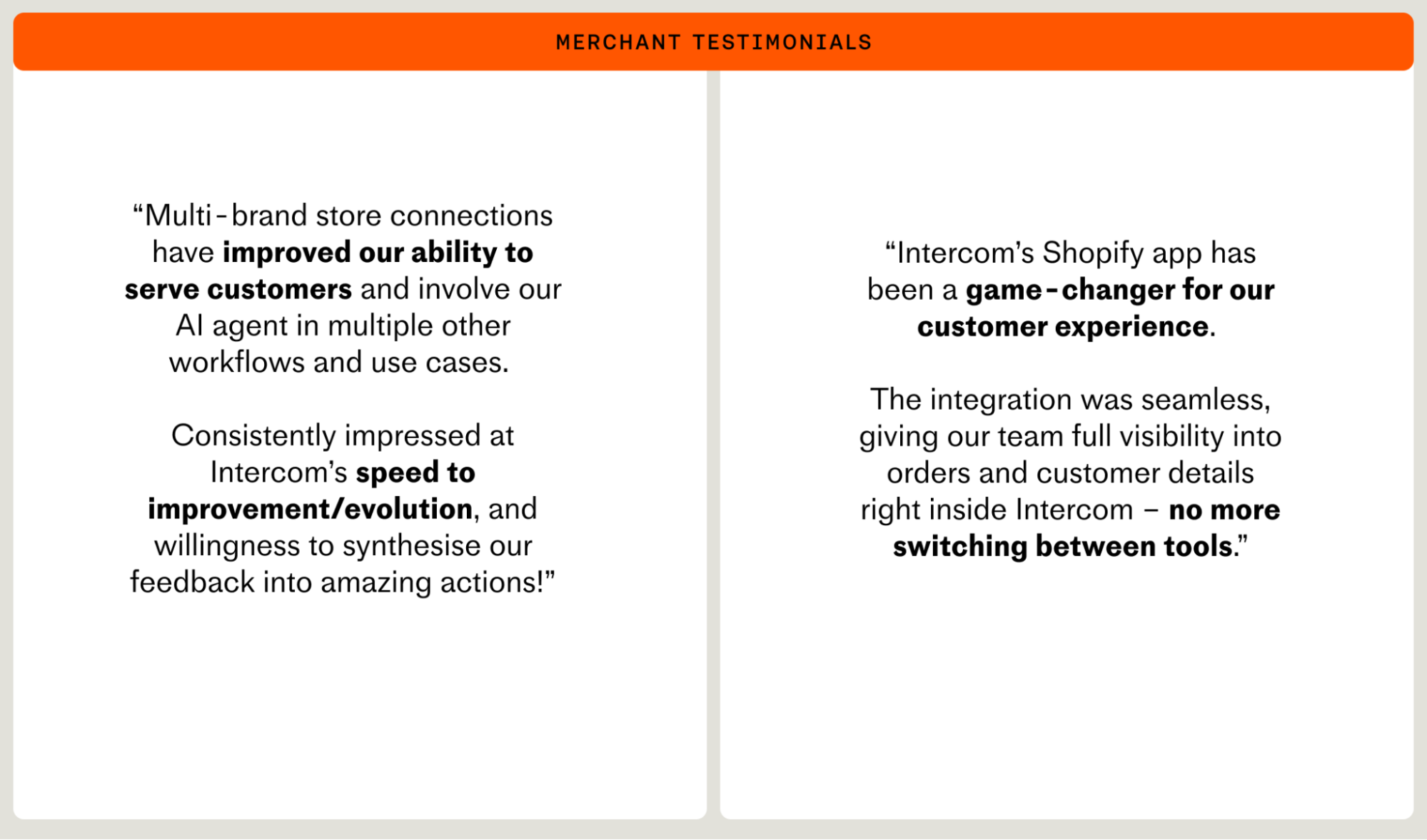
These updates make it faster and easier for merchants to resolve queries, personalize conversations, and drive loyalty, all from one platform. I’ve seen these capabilities reduce average handle time and minimize escalations—especially for complex order changes and post-purchase workflows.
We’re already seeing how our Shopify integration is helping merchants scale their support and deliver better customer experiences: teams are deflecting routine inquiries with AI while empowering agents to focus on high-value, relationship-building conversations.
Our team is continuing to invest in Shopify-specific capabilities. Here’s what we’re working on:
Expanded Fin Tasks for complex order actions with new pre-built workflows.
Enabling Model Context Protocol (MCP) support.
Smarter product search powered by Shopify data.
These additions will help merchants resolve faster, personalize at scale, and stay ahead of rising customer expectations – particularly as we approach peak season. We’ll continue to ship in tight feedback loops with Plus merchants to ensure each improvement moves the needle.
If you’re a Shopify Plus merchant, learn more about how we can help you scale your support with Fin, the best performing AI Agent for ecommerce. Ready to move fast? Get started with Fin now.
I hit play on Global Invoicing – All Things Product Podcast with Teresa Torres & Petra Wille and felt an immediate jolt of recognition. We’ve all launched a feature that looked solid—until a small, overlooked detail broke everything. Their stories about global invoicing and taxes echoed challenges I’ve faced leading product for international customers: if you don’t design for the last mile of compliance, you can accidentally block the very "moment of value creation" your product promises.
Listen to this episode on: Spotify | Apple Podcasts
The conversation starts as a candid rant about EU tax compliance and quickly becomes a precise product management lesson: when we fail to map the entire path to customer value—down to the tiniest regulatory requirement—we can ship something “done” that still doesn’t work in the real world. That gap between intention and outcome is where good product teams live or die.
In my experience, the nightmare of global invoicing for small online businesses is very real. Even big platforms (like Squarespace and Teachable) miss the mark on EU tax compliance, and when they do, customers feel it immediately. It’s the kind of edge case that doesn’t show up in a demo but absolutely shows up in revenue. Or as Teresa put it, “It’s not a little detail when your client won’t pay the invoice.” — Teresa Torres
I appreciated how the episode digs into the difference between passing a regulatory checklist and actually meeting customer needs. Put plainly: the product isn’t “done” when the ticket moves to Done; it’s done when the customer completes the job—receives an acceptable invoice, pays successfully, and can reconcile it without friction. That’s why I lean hard on story mapping for regulatory work; it exposes the invisible steps where value creation can silently fail.
Here’s how the episode resonates with my own playbook: the nightmare of global invoicing for small online businesses is a systems problem; why even big platforms (like Squarespace and Teachable) miss the mark on EU tax compliance is a prioritization and discovery problem; how Petra and Teresa navigated invoicing across borders with Ableify and LearnWorlds highlights pragmatic tool choices and trade-offs; the key difference between meeting regulations and meeting customer needs is an outcomes-over-output mindset; what product teams can learn from regulatory edge cases is how to find the seams where markets, laws, and workflows collide; how missing a single detail can block the "moment of value creation" is a reminder that value is defined by customers; and why story mapping is critical for finding gaps between "we shipped it" and "customers got value" is the method that connects all of the above.
Practically, that means I treat regulatory features like any other high-stakes product surface: do real product discovery with affected users; co-design the happy path and the ugly edge cases; write acceptance criteria that include jurisdictional and document-level specifics (e.g., VAT numbers, invoice formats, timing rules); align with finance and legal early; and instrument the journey from invoice issued to invoice paid so we can see where real customers get stuck. This is outcomes vs output OKRs in action, and it’s one of the fastest ways to earn trust with stakeholders.
Key takeaways worth bookmarking: Customers define value, not your compliance checklist. Regulatory work still requires discovery—you can’t skip understanding user needs. The path to value doesn’t end when your feature works; it ends when your customer succeeds. “Sweating the details” isn’t micromanagement—it’s good product management.
Memorable quotes to bring back to your team: “If you don’t sweat the details, people choose other platforms.” — Petra Wille. “It’s not a little detail when your client won’t pay the invoice.” — Teresa Torres.
Follow Teresa Torres: https://ProductTalk.org | Follow Petra Wille: https://Petra-Wille.com
Mentioned in the episode: Squarespace | Stripe | Product at Heart | Teachable | LearnWorlds | Ablefy | Become a Better Product Leader: A 52-Week Transformation Journey | Product Talk Academy
Have thoughts on this episode? Leave a comment below.
Full transcripts are only available for paid subscribers.