Every revenue story starts with a behavior: a tap, a scroll, a search, an “aha” moment. My job is to make sure we don’t just see those moments—we connect them directly to purchases so marketing, growth, and product can act with confidence.
"Learn how Amplitude’s persisted properties and session analytics help marketing and growth teams connect behavioral data to purchase outcomes without engineering support." That sentence captures the promise I look for in a modern analytics stack: attribution that endures across sessions and analysis that moves at the pace of experimentation.
Here’s how I frame it. Persisted properties let me carry forward the critical context behind a user’s journey—campaign touchpoints, audience attributes, and key in-product actions—so when a conversion happens, I can see the exact trail of behaviors that preceded it. Instead of losing signal between anonymous exploration and account creation, I keep the connective tissue intact and attribute outcomes to the interactions that truly mattered.
Session analytics completes the picture. By understanding how users navigate within each visit—where they hesitate, what they repeat, and which micro-conversions predict success—I can link behavioral analytics to revenue outcomes with far greater precision. In practice, this means better funnels, smarter cohorts, and faster iteration cycles inside Amplitude analytics. When appropriate, I’ll also pair findings with session replay for qualitative context, but the core decision loops are driven by quantifiable behavior patterns.
My operating rhythm is straightforward: I start by defining the purchase outcome clearly, then identify the minimal set of properties that must persist to tell the full attribution story. From there, I instrument events and validate that each persisted property is captured reliably across the journey. With clean inputs, I build conversion funnels, use cohorts to isolate high-intent behaviors, and apply driver analysis to separate correlation from causation. That’s how I isolate the behaviors that consistently generate qualified leads and high-value activations.
The impact is both strategic and immediate. Marketing can test offers and channels with a unified analytics platform and know which touchpoints lift conversion, not just clicks. Growth can optimize user activation flows based on the behaviors that truly predict upgrade. Product can prioritize the moments that drive retention analysis instead of chasing vanity metrics. Most importantly, teams move from opinion to evidence without waiting in an engineering queue.
In my experience, the real unlock comes when we use persisted properties to bridge pre-signup exploration with post-signup intent. That’s where product-led growth takes off: we can trace the first meaningful action to a downstream expansion event, tie it to a specific campaign or in-app guide, and then double down confidently. The result isn’t just better dashboards—it’s a tighter feedback loop between hypothesis, experiment, and measurable revenue impact.
If you’re aiming to connect behavior to outcomes with clarity and speed, lean into persisted properties and session analytics. You’ll empower teams to discover the “moments that matter,” attribute them accurately to conversions, and iterate toward a repeatable growth engine—without slowing down your roadmap or depending on engineering for every new question.
Inspired by this post on Amplitude – Best Practices.
A prospect lands on our site, skims pricing, watches a demo, and clicks “contact sales.” For years, that’s where momentum died. They waited, and we built entire sales motions around managing that delay.
We optimized for “speed-to-lead,” made it the hallmark of a high-performing sales development org, hired more SDRs, tuned routing rules, added shift coverage, and stared at response-time dashboards. Typical SLA targets were one hour for best-fit leads, four hours for core MQLs, forty-eight hours for everyone else. Those were considered good numbers.
No one questioned the premise because the lag felt structural—shift scheduling, routing delays, and humans working 9–5. The fastest teams could only shrink the gap; nobody could remove it.
An AI Agent closes it completely.
When a prospect arrives today, the conversation can begin immediately. That single change reshapes how I design a sales org—how we staff it, what our team prioritizes, and the metrics we hold ourselves accountable for.
Step outside our dashboards and look at the buyer experience. We spend heavily to drive traffic, then push visitors into forms and queues that add friction precisely when purchase intent peaks.
Intent is highest the moment someone seeks out our product. If an SDR follows up two or three hours later, that buyer’s in another meeting, the urgency has faded, and the moment is gone. We still call it a lead; the buyer has already moved on.
What AI changes
Agents eliminate the structural constraints that made speed-to-lead a problem—shift scheduling, routing delays, CRM batch processing, the SDR being on another call. None of it applies anymore because every single lead can be engaged immediately, at any hour and in any language.
The impact goes beyond response time. When an Agent engages at peak intent, qualification, discovery, and even an initial demo moment can unfold in a single, continuous conversation. The gated funnel collapses. There’s no reason to qualify someone today, schedule discovery for Thursday, and demo the following week when the conversation is already happening.
The constraint the industry built around simply isn’t there anymore. We’re already seeing it with Fin, a Customer Agent. As sales leaders, we need to frame this differently.
If speed-to-lead is no longer the constraint, the knock-on effects reach every part of the org.
Introduce Fin for Sales to your team with this clean hero banner: bold headline, signature blue spiral, and a clear 'Start free trial' call to action—inviting readers to explore an AI customer agent built for revenue.
SDRs focus on moving deals forward. Instead of frontline triage, they double down on phone-based selling and relationship building, complex deal navigation, and multi-threaded engagement across stakeholders—the high-leverage work that used to get crowded out by the inbox.
Pipeline gets more relevant. The old model rewarded volume: capture as many form fills as possible, respond fast, and sort quality later. When an Agent engages at the moment of intent, it qualifies during the conversation. Low-fit leads get filtered out before they reach the team, and high-fit prospects arrive with context—needs, timeline, stakeholders—instead of just a name and email.
You measure outcomes, not response time. When first response is instant, different metrics matter. I anchor on three questions:
1) Is the Agent doing the work? Completion rate, qualification rate, and contact capture rate indicate whether conversations reach clear outcomes and produce usable handoffs to the team.
2) Is the work producing pipeline? Meetings booked and pipeline created through Agent-handled conversations are the leading indicators of revenue, not how fast someone followed up.
3) Are buyers having a good experience? Conversation-level satisfaction matters more than ever because the Agent is the first interaction prospects have with your company. The experience it delivers is the first impression you make.
These three questions reveal whether the motion is working. Time-to-first-response can’t.
Sales orgs built hiring plans, workflows, and performance metrics around beating intent decay. That made sense when the lag was unavoidable. It isn’t anymore.
An Agent is always on. It engages the moment a prospect arrives on your site, qualifies them in real time, and routes them to the right outcome without waiting for someone to be free. The lag the industry built itself around doesn’t exist when the conversation starts immediately.
The companies leaning into this are investing in what happens after the conversation starts: how well the Agent qualifies, where it creates pipeline, and what SDRs should actually spend time on. What matters now is not how fast you respond, but what the conversation produces.
Speed-to-lead made sense when the delay was structural. It isn’t anymore. If you’re re-architecting go-to-market, instrument Agent Analytics, revisit SDR charters, and tighten CRM integration so every qualified handoff is instant, traceable, and revenue-linked.
Revenue leaders are starting to use AI to generate better leads, capture peak buyer intent, and scale their pipeline without a linear increase in headcount. I see it every day in my own teams: when we get the foundations right, AI doesn’t just answer questions—it accelerates qualification and turns curiosity into pipeline.
Done well, an AI-first inbound sales experience engages buyers 24/7 in any language, qualifies leads intelligently, and routes high-intent prospects to the right conversion path. But behind that experience, there’s an unsung hero: knowledge management. I’ve learned the hard way that even the smartest Agent underperforms if it’s not fed the right information.
A Sales Agent is only as good as what you give it to work with. If you’re using an Agent, like Fin, to run inbound sales motions end to end, it needs an extensive pool of knowledge to draw from. You need to feed it accurate answers on pricing, features, and plan fit, and clear rules for how to qualify and route each prospect. Without it, your Agent can’t do its job, and your sales team is back to answering the same questions manually and triaging leads that could have been handled automatically.
In this guide, I walk through everything you need to know about building and maintaining the knowledge base that powers your Sales Agent—what to include, how to launch, what to measure, and how to iterate so results compound over time.
What is knowledge management and why is it so important?
Definition: Knowledge management is the process of creating, organizing, sharing, and maintaining knowledge in your business.
Knowledge is your sales agent's edge. This Fin testimonial shows how organizing and optimizing content removes friction in the funnel, lifting conversion and unlocking millions in pipeline and revenue for growing teams.
Your public website and product pages are classic examples, but those are just the tip of the knowledge management iceberg. In an inbound sales motion, knowledge management involves a range of activities such as creating resources (FAQs, pricing overviews, competitive battlecards, case studies, internal sales materials), identifying gaps in documentation and qualification criteria, implementing systems that make information easy to access and use, and developing processes to keep everything current. In my experience, these elements are what allow an Agent to move from merely answering questions to recommending the right plan and explaining why it fits.
Why knowledge management matters even more in the age of AI
Your knowledge base is no longer just static collateral for buyers to read. It powers your Sales Agent and entire inbound motion. It’s the key to accurately answering complex prospect queries, guiding product discovery, qualifying intent in real time, and accelerating the path to pipeline. Two realities shape my approach:
1) Your Agent is only as strong as what you “feed” it. Your Agent is only as good as the knowledge and content that it has access to. A lack of information, poorly structured sales materials, or out-of-date pricing documentation all prevent it from providing clear and correct answers to your buyers, leading to poor buying experiences that degrade trust and cost you deals. No large language model (LLM) knows your business like you do. It doesn’t understand your prospects’ specific needs, pain points, pricing tiers, or use cases. That knowledge is unique to you and your organization, which means you need to map it all out and explicitly feed it to your Agent. You need to feed it facts about your product, and also give it the context behind those facts so it can guide buyers to the right solution rather than just answering their questions.
2) Every investment of knowledge has compounding results. Making the switch to AI isn’t just adopting a new tool. It means adapting to a new ecosystem. Think of it as a flywheel. Every piece of knowledge you add makes your Agent more effective. It generates better conversations and data, which tells you what to add or refine next. The more you invest in it, the faster it compounds.
Smart sales teams don’t copy what already works for service—they connect to it. This Fin quote card reminds readers to reuse trusted knowledge, cut duplication, and keep content manageable for faster, more accurate selling.
“You have to think about AI like a new sales rep. On day one, it needs coaching, guidance, and feedback. But over time, as you refine the inputs and learn from real conversations, it becomes more autonomous and the level of coaching required decreases significantly.” Pascaline Albin, Director of Sales Development at Fin
Every upfront investment you make in your sales knowledge has long-term, revenue-generating impact. Whether you hire someone to do this work full time or give your sales reps time away from the inbox each week, the ROI speaks for itself. I’ve routinely seen small content improvements unlock big conversion gains.
Think of it this way: say it takes 30 minutes to document a new competitive battlecard or update pricing information. That 30-minute investment results in hours saved for your sales team, highly engaged buyers who get instant answers, and actionable data to optimize your inbound motion.
Calculate: Average time to compose a response × frequency of question = time saved for your team. More importantly, that’s time your SDRs and AEs can reinvest in multi-threading into accounts, running complex evaluations, and closing high-value deals that actually move pipeline.
Calculate: Number of prospects who ask this query × average time to respond = total time saved for buyers.
Give your sales agents the knowledge they need from Day 0. A friendly portrait sits next to a bold statement on using Fin's AI Customer Agent to optimize content, guide reps, and turn buyer intent into pipeline and revenue.
“For sales funnels, identifying knowledge gaps or friction can result in a huge improvement in conversion. When you optimize Fin with the right content, the incremental improvements have a big impact on our bottom line and can lead to millions of dollars in pipeline and revenue. That's why knowledge management is an integral part of our training and optimization process.” Tommy Dunton, Senior Manager of Sales Development at Fin
The best way to start generating that data is simply to start. The sooner you begin, the sooner you can capture insights about what your buyers want and need from your inbound sales experience. I prioritize quick deployment, fast feedback loops, and continuous iteration.
What to include in your knowledge base
Wrangling and prioritizing all of your internal and external sales documentation can feel daunting, but with the right technology, it doesn’t have to. The ideal platform provides data-driven insights to show what buyers actually ask and a centralized place to create, manage, and optimize your knowledge content. For example, with Fin for Sales, you get access to a leads report that gives you insight into disengaged prospects. Intercom’s Knowledge Hub enables you to create a single source of truth for your public-facing collateral and internal sales materials. Using Content Targeting, you can segment this information so your Sales Agent only uses the exact content you want.
1) Pricing and product FAQs. What it is: answers to the most common discovery questions buyers have, from pricing and plan differences to implementation, integration, and security or trust topics. How to source: analyze your sales inbox and early discovery calls. Where to use: public website, Sales Agent, and proactive outbound messages.
Give every seller instant, trusted answers with an AI-powered knowledge base that unifies docs, FAQs, and playbooks into a single source of truth—accelerating ramp, boosting call confidence, and improving every customer conversation.
2) Competitor comparisons and battlecards. What it is: guidance for handling competitor mentions, addressing friction, and highlighting unique value propositions. How to source: talk to top-performing AEs or your product marketing team. Where to use: internal snippets for your Sales Agent and internal sales materials.
3) Case studies and social proof. What it is: proof points that help buyers build business cases and gain confidence, speeding deal cycles. How to source: collaborate with customer success and marketing on ROI stories. Where to use: Sales Agent, website, and sales collateral.
4) Specific use cases and buyer personas. What it is: targeted content for cohorts with similar pain points and jobs-to-be-done (e.g., engineering teams, startups). How to source: combine product marketing’s value propositions with real discovery conversations. Document the exact probing questions your best SDRs and AEs use so your Agent can uncover context in real time. Where to use: website and Sales Agent to enable contextual solution matching.
Content formats and sources
When sourcing knowledge, cast a wide net. You likely have more relevant content than you realize, and almost any information is useful once framed correctly. With Fin, you can use public articles (product FAQs, pricing overviews, feature benefits), internal articles (internal sales materials, internal FAQs), snippets (short-form text like promotions or battlecards), website pages (synced from your marketing site), and PDFs (whitepapers, technical specs, detailed sales materials).
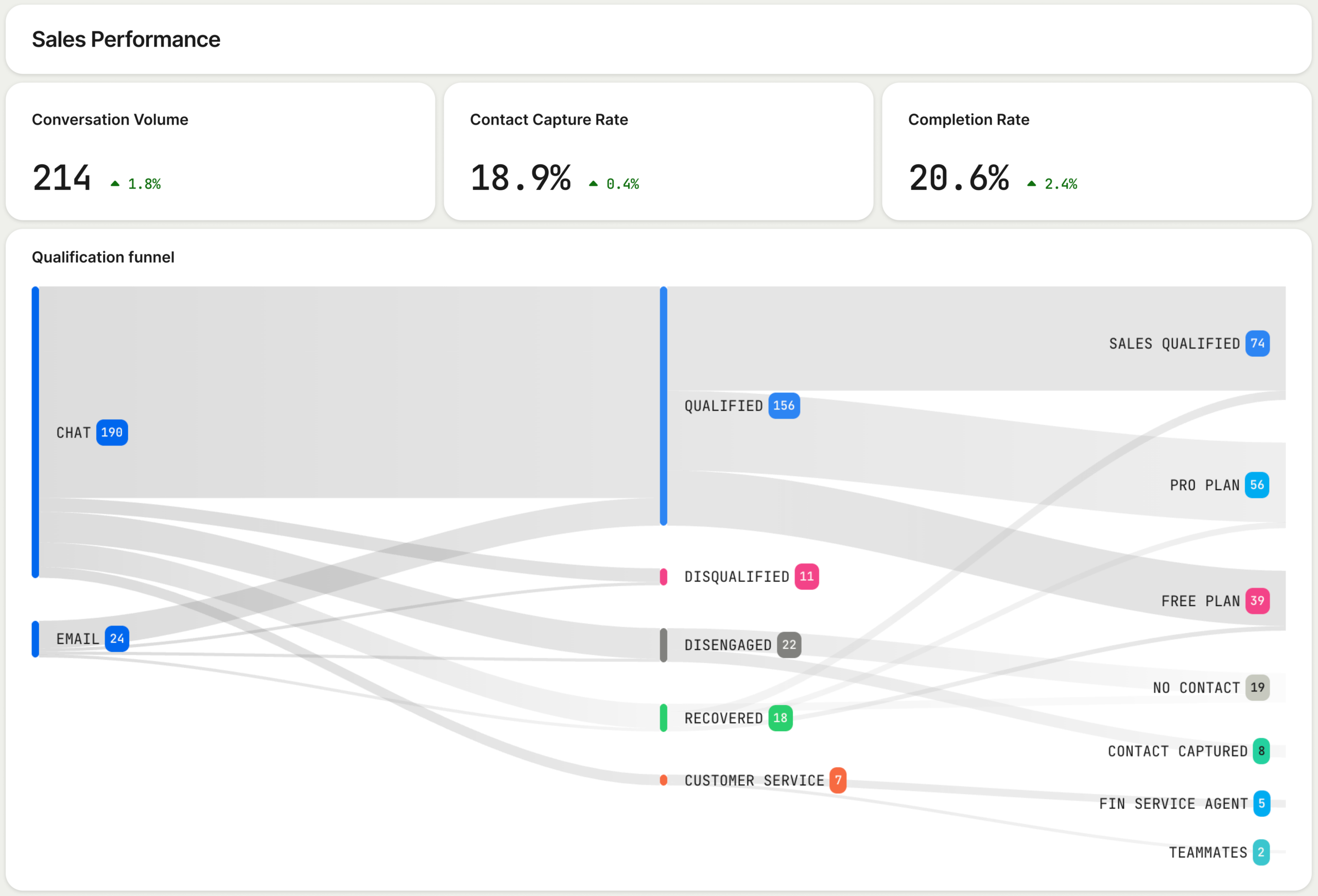
Turn conversations into revenue with a clear Sales Performance view. Track rising KPIs and follow leads from Chat and Email through Qualified, Disqualified, and Recovered to outcomes such as Sales Qualified, Pro Plan, or Free Plan.
Create a knowledge management process that fuels your Agent: 5 steps
Step 1: Audit what you have. Start by reviewing your current materials to prevent your Agent from learning outdated information and to identify gaps. If you’re already using a Customer Agent, much of that content can pull double duty for sales—no need to start from scratch. Make your existing content available for your Sales Agent and build sales-specific content on top, like pricing comparisons, competitive battlecards, customer case studies, and qualification criteria that wouldn’t apply to service conversations. If you’re starting fresh, audit pricing, product FAQs, feature details, competitor comparisons, case studies, and buyer use cases.
Put yourself in your buyer’s shoes. Walk through the same steps your prospects take, including their first interaction with your Sales Agent. Before going live, test it yourself. If you’re using Fin, you can do this using the built-in Preview panel to validate answers, routing, and missing topics or objections. Confirm that your Agent asks the right probing questions about goals, fit, and urgency before making a routing decision.
“We're moving incredibly fast at Fin with our Customer Agent, which means optimising our content, guidance and experience with Fin is a constant focus. Before we launch new products, we're testing Fin for Sales to ensure it's got all of the knowledge it needs to make sure the customer experience is perfect and we can convert that intent into pipeline and revenue from Day 0 of that launch.” Tommy Dunton, Senior Manager of Sales Development at Fin
Seek input from across your GTM organization. Don’t rely solely on sales. Involve marketing, growth, revenue ops, and sales ops to align content with campaigns and routing logic, and to integrate with systems like your CRM. Your SDRs and AEs bring real-world objections, use cases, and competitor insights that win deals—and those should feed directly into your Agent’s knowledge base. Judging fit is as much art as science, and your best SDRs can teach the Agent to interpret subtle signals.
Scalable selling starts with better knowledge. This graphic pairs a monochrome portrait with a bold Fin quote showing how training agents and curating a strong knowledge base compound AI performance over time.
Step 2: Plan and prioritize. Decide where to start by focusing on questions your team still answers manually that, if documented, would help your Agent capture more qualified intent. Identify the content your reps share most (demos, explainers, case studies) and ensure the Agent can access it. Look at leads reporting to find early-stage questions, stuck points, and high-volume disengaged outcomes, then strengthen objection-handling content. Prioritize based on pipeline value—build competitive battlecards and enterprise-tier documentation before free-plan details. Use reporting to find funnel drop-offs and content that hasn’t been updated recently—refresh pricing immediately if it has changed.
Allocate time and resources. Treat your Sales Agent like a core GTM channel, not a side project. Assemble a cross-functional project team with clear roles. The Agent owner translates sales strategy into prompts, routing logic, integrations, and rollout. The optimization owner reviews performance data, identifies drop-offs, and drives changes to content or Agent behavior. Early alignment ensures your Agent operates as a professional extension of your sales team.
Step 3: Go live and learn. Deploy broadly across your marketing site and pricing pages to accelerate learning. Within weeks, you’ll see where the Agent guides discovery and qualifies buyers versus where it stalls. Investigate drop-offs—often these point to missing answers or weak probing questions. If your Agent and knowledge base live in the same platform, you’ll get full visibility into your qualification funnel and content performance across touchpoints.
Track metrics to measure success. Monitor completion rate (conversations reaching a clear routing decision), pipeline created (opportunities generated through Agent-handled conversations), meetings booked (qualified prospects routed to a call), and customer satisfaction (quality of the experience). These metrics show what content is working and where to improve.
Step 4: Iterate and improve. Expect gaps early on. That’s good—it surfaces what buyers need to convert. When the Agent gives a poor response, the root cause is usually missing, outdated, or shallow content. Close the gaps, then monitor your metrics and conversation reviews to keep compounding improvements.
Your Sales Agent runs on great content. This Fin-themed graphic pairs a professional headshot with a bold statement highlighting how strong knowledge enables discovery answers and timely updates across the GTM motion.
Build ongoing maintenance into your workflow. Knowledge management is continuous. As your product, personas, and goals evolve, so must your content. Define owners, review cadences, and working time to refresh and create content—don’t wait for launch week chaos. Encourage a “knowledge management” mindset by logging content requests from SDRs and AEs when they hear new objections or discover probing questions that uncover true pain points.
“Training Agents to get better over time is fundamental to using AI. Fin learns from our website and help center, so the quality of those resources directly impacts its performance. The more we’ve invested in our knowledge base, the more success we’ve seen with Fin and those gains continue to compound.” Beth-Ann Sher, Senior AI Knowledge Manager at Fin
Step 5: Build knowledge management into future launch plans. Make Agent-ready sales content part of every product or pricing launch checklist. Partner with engineering, product marketing, and revenue operations to update catalogs and your Agent’s knowledge base on day zero. Then review early discovery conversations to add resources, address new objections, and fine-tune contextual solution matching.
“Content should no longer be an afterthought. It is one of your strongest GTM levers because your Sales Agent relies on it to handle discovery questions and stay up to date on your latest offerings.” Beth-Ann Sher, Senior AI Knowledge Manager at Fin
Best practices for Agent-friendly knowledge management
A pull-quote from Fin explains why one platform matters in sales: centralize conversation data, lead reporting, and agent configuration to spot funnel drop-offs, learn which content works, and elevate the buying journey.
Use the terms your buyers use. Language varies by industry, persona, and role. Analyze discovery calls and on-site searches to capture how buyers actually speak and train your Agent accordingly. Test internally across SDRs, revenue ops, and marketing to reveal variations and content gaps.
Simplify language and remove ambiguity. Machine-friendly language is buyer-friendly. Avoid jargon, spell out acronyms, and clearly explain key product terms so value propositions land.
Keep the experience consistent and on-brand. Ensure product terminology, feature names, and pricing tiers are consistent everywhere. Proof for tone, spelling, grammar, and use standardized templates to build trust.
Add context to your answers. If your internal FAQ is full of “yes/no” answers, expand on the why. Restate the question, provide business context, and equip the Agent with follow-ups that keep the conversation alive and uncover goals and constraints.
Add text to images and videos. Show and tell—always include clear explanatory text so your Agent and all users, including those with accessibility needs, can benefit.
Introduce Fin for Sales to your team with this clean hero banner: bold headline, signature blue spiral, and a clear 'Start free trial' call to action—inviting readers to explore an AI customer agent built for revenue.
Create a scannable structure. Use clear headers and lists in your source content so both Agents and humans can navigate quickly. Avoid dynamic elements that hide crucial details.
Collect bite-size information in FAQ articles. Package tactical intel—seasonal promotions, short battlecards, edge cases—into concise snippets so your Agent can retrieve and deliver them instantly.
A connected Agent turns every conversation into insight. When a Sales Agent is connected to your CRM and enrichment tools, every interaction, qualification signal, and piece of sales content flows into a connected system. “A single platform matters in sales. When your conversation data, lead reporting, and Agent configuration all live in one place, you get much better visibility into your qualification funnel. You can see where buyers are dropping off, what content is working, and can improve the buying experience.” Fred Walton, Senior AI Conversation Designer at Fin
Every conversation makes your knowledge base sharper, showing you what’s resonating, what’s missing, and where to invest next. That’s the retrieval-first pipeline mindset I push with my teams.
Make knowledge management a core sales function
Behind every high-performing Sales Agent is a comprehensive, machine-friendly knowledge management process. Without it, even the most capable Agent will struggle to deliver the pipeline gains AI can deliver. This isn’t a one-time project; it’s a continuous investment. The teams treating knowledge management as a core sales function are building systems that improve with every conversation, turning inbound demand into a compounding growth engine.
Our outcome-based pricing model hinges on one principle: you pay when Fin delivers value.
As Fin takes on new roles, that principle doesn’t change, but the definition of value does.
Fin for Sales qualifies leads, engages prospects, and routes high-intent buyers to your sales team. The value it creates isn’t a resolved query, but a pipeline of qualified opportunities. So we price accordingly: $10 per qualified lead. And you, the customer, define what “qualified” means, not Fin.
This is the first outcome-based pricing model for an AI Agent for sales. Here’s why I believe it’s the right approach and how I’ve seen it change the way teams think about SaaS pricing and ROI.
Over the years, I’ve learned that the fastest way to earn trust with sales and finance leaders is to align pricing with outcomes they actually report on. The core finding from our research was unambiguous: zero buyers preferred paying for activity. They wanted to pay for results.
That insight shaped how we priced Fin for its service role, $0.99 per resolution, where a resolution means the customer’s issue is fully solved without human intervention. More recently, we evolved that model to outcomes, reflecting the broader ways Fin delivers value across complex workflows. We believe pricing should be aligned with value delivery, and the vendor should carry risk when the product doesn’t perform. In sales, the best unit of value is pipeline.
Most sales teams today are overwhelmed by leads. Early in my career, I watched reps spend hours chasing form fills that looked promising but went nowhere. That experience cemented a lesson I still use: volume is vanity; qualification is sanity.
Ensuring the right opportunities promptly reach your sales team is what makes a difference. When a prospect visits your site, engages with Fin, answers qualifying questions, and is directed to a sales rep, Fin is identifying whether the opportunity is worth your team’s time and delivering value.
Charging per conversation would penalize businesses for every curious visitor who asks a question but isn’t a buyer. And charging per token, well, that’s always been a model that protects the vendor, not the customer.
We needed a metric that captures the actual value Fin creates in a sales context: qualified leads.
The purest version of outcome-based pricing for Fin’s sales role would be a percentage of closed revenue. Fin qualifies the lead, a rep closes the deal, and we take a cut. On paper, it looks elegant; in practice, I found it breaks down for two reasons that matter to operators.
First, attribution. Between the moment Fin qualifies a lead and the moment a deal closes, dozens of things can impact the final result. The quality of human-led demos can differ, products can have outages, prospects’ budgets can get cut. Tying Fin’s price to the final outcome holds it accountable for variables entirely outside its control.
Second, measurement. To track closed revenue, we’d need deep integration into every customer’s CRM, tracking each opportunity from qualification through to close. That’s a significant implementation burden that slows time to value, which is the opposite of what we want.
So we asked: what’s the most honest proxy for the value Fin delivers, where Fin is clearly the one creating it?
A qualified lead is that proxy. It represents the moment Fin has done its job. It has engaged the prospect, gathered the relevant information, evaluated them against your criteria, and determined they’re qualified. Everything up to that point is Fin’s work. Everything after it is the rep’s. At $10 per qualified lead, the pricing reflects this boundary.
There are two key components to how this pricing model works.
First, the customer defines success. With Fin’s sales role, the customer sets their own qualification criteria based on their business context. A company with high average contract values might set a lower bar because they can’t afford to miss anyone. A company where rep time is scarce and deal sizes are smaller might set a much higher bar, filtering aggressively to only surface the most promising prospects. The criteria flex to match the business.
Second, the economics are different by design. As a Customer Agent, Fin can switch between roles like sales and service. So if you’ve deployed Fin for Sales, it can still handle support queries like prospects asking a product question. Those queries are charged at $1 per resolution, consistent with our service pricing. Disqualifications, where Fin determines a prospect doesn’t meet the criteria, are also $1. The $10 price point for qualified leads reflects the higher value of pipeline creation compared to issue resolution.
The ROI speaks for itself. Early customers are reporting significant returns using Fin for Sales. One shared a perspective that mirrors what I hear in executive QBRs:
“I would say it’s at least 10 times the value. You’re now giving the business exactly what it needs as opposed to just activity. We say this expression in sales leadership all the time – ‘I don’t pay my sales team for activity. I pay them for results.’ I want my AI engine to be the same way.”
When you compare the cost of a qualified lead from Fin against the fully loaded cost of an SDR—salary, benefits, tooling, ramp time—the economics are compelling. For many businesses, particularly those that never had SDRs in the first place, Fin for Sales isn’t just replacing headcount, but creating an entirely new capability that wasn’t economically viable before.
This pricing model came from extensive customer research—qualitative interviews and quantitative studies—exploring how buyers want to pay for AI in a sales context. We tested multiple concepts: per-conversation, per-token, per-seat, revenue share, and per-qualified-lead. The research consistently pointed to outcome-aligned pricing as the preferred model, with the qualified lead emerging as the metric that best balances value alignment, measurability, and practical implementation.
Outcome-based pricing is still rare in AI, but we think that will change. For Sales Agents, we’re the first to do it. Transparency is part of the model. If you understand why we price the way we do, you can evaluate whether it works for your business.